• Welcome to the new Macedonian Truth Forum. All posts, members and private messages have been moved over from the old forum.

    Passwords from the old forum could not be carried over, so please use Forgot your password? to set a new one. The reset link is emailed to the address on your account.

  • Rules and Regulations at the forum of the Macedonian Truth Organisation (MTO)

    (1) The national-ethnic and cultural-linguistic identity of the Macedonian people is historically Macedonian, and derives its character from the native, indigenous and geographic homeland of the Macedonians, which is called Macedonia. To ensure that their human rights, integrity and heritage are appropriately respected, the only nouns and adjectives acceptable when reference is made to the above character and identity markers is Macedon, Macedonia, Macedonian and Macedonians.

    (2) The nation-state of the Macedonian people is the Republic of Macedonia, and is to be referred to by this official title so long as the 'republic' prefix is consistently applied to other states. Alternative references are the Macedonian Republic, or simply, Macedonia.

    (3) The 'ethnic' prefix is only acceptable for Macedonians in cases where differentiation is specifically required - so long as it is in context and consistent where it concerns its application to other ethnic groups.

    (4) Should any other differentiation be specifically required, the names of other ethnic groups that reside with Macedonians in either the Republic of Macedonia or the occupied Macedonian regions in Greece, Bulgaria, Serbia or Albania, are to be given a prefix.

    (5) Negating the identity, language and culture of the Macedonian people by deliberate avoidance of the terms Macedonia, Macedonian and Macedonians, or by any other means, is not permitted.

    (6) Systematic anti-Macedonian propaganda and rhetoric are not permitted.

    (7) Threads irrelevant to the Macedonian Cause, the community at the Macedonian Truth Organisation or the Macedonians in general may be considered as spam or not in the spirit of the forum. In such cases they are not permitted.

    (8) Continual posting of messages in threads with the sole purpose of deviating from the initial topics with the use of unrelated and unnecessary information is not permitted.

    (9) All posts, external articles, reports, etc that are cited in languages other than Macedonian or English, must be accompanied with a translation in one or both of the said languages.

    (10) Despite the possibility of some conversations and debates becoming heated, extreme abuse and/or racism, vulgar language and/or terminology, threats, revelation of personal information about others, harassment, and other such behavior will not be permitted. If deemed necessary all relevant information including member details will be reported to the appropriate authorities for investigation which may result in legal action.

    (11) Threads that are created must have a summary of a topic or excerpt of an article found in pertinent link(s) that have been included. One line threads will be considered unaccetable spam and are therefore not permitted.

    (12) Compulsive and deliberate lies, irrespective of the topic, are not permitted.

    (13) Any symbols or avatars found to be perceived as offensive to Macedonians are not permitted.

    (13) Any explicit or extreme material is not permitted.

    Failure to adhere to the above rules and regulations will result in a ban after 3 breaches. This may be reconsidered in some cases should the circumstances be of an unorthodox nature and/or require special consideration. To assure an effective deterrent against an individual or individuals with the sole purpose of causing dissent through spamming, racism or other improper means, the above rules will be strictly enforced.

    The MTO administration will monitor all discussions as reasonably practical and reserve the right to remove any post and/or member from the forum, and update the rules and regulations as required. Members are encouraged to immediately report any post and/or member to the MTO administration if they feel that these rules have not been abided by.

    The views expressed on this forum are those of the individuals. The only official representation of the MTO is made by the "Macedonian Truth Organisation (Site Owner)" username, and no other.

  • Macedonian Cause

    The Macedonian Truth Organisation calls on God in Heaven to protect, bless and guide the endeavour it is committing to undertake, and that is to work towards:

    Securing Macedonia as a free, independent and democratic republic in which sovereignty lies with the Macedonian citizens; as the nation-state of the Macedonian people in which they can preserve their culture, language and identity; as a state in which the Macedonian language and culture form the basis of public life and act as important unifying elements of Macedonian society; as the home of all its citizens to which it guarantees and obliges their inalienable natural rights and corresponding responsibilities;

    The acknowledgment as self-evident and irrefutable the existence of the:

    1) Indigenous, ethnonational name of Macedonia;
    2) Macedonian people, language and identity;
    3) Macedonian culture, symbols and folklore;
    4) Macedonian ancestry, heritage and history in its entirety; and
    5) Macedonian Orthodox Church;

    Securing recognition by the International Community of the tragedies endured by the Macedonian people, of the division of Macedonia with the signing of the Treaty of Bucharest on August 10, 1913, and the genocide committed against the Macedonian people at the hands of the Greek, Bulgarian and Serbian states and their respective churches during the 19th and 20th centuries;

    Ensuring that the Interim Accord is declared ‘null and void’ and that all constitutional provisions, acts, commitments, agreements, legislation, regulations, policies or programs emanating from, supporting or consequential to the Interim Accord are also declared ‘null and void’, including the use of any symbols and the completion of any acts imposed by, or originating from, the Interim Accord.

    Ensuring that the Framework Agreement is abolished and that all constitutional provisions, acts, commitments, agreements, legislation, regulations, policies and programs emanating from, supporting or consequential to the Framework Agreement are also abolished and replaced by a framework of constitutional and statutory law based on inalienable natural rights and corresponding responsibilities and universally codified human rights mechanisms.

    Securing the abolishment of any existing constitutional provisions, acts, agreements, legislation, regulations, policies and programs that discriminate against the Macedonian people, in any international organisation or any of the countries of the International Community where such constitutional provisions, acts, agreements, legislation, regulations, policies and programs exist, and thereby ensuring the freedom for Macedonians to exercise their inalienable natural rights and fulfil their corresponding responsibilities, and practice their culture, language and religious faiths in all the countries of the International Community without hindrance;

    The empowerment of Macedonians to undertake a moral revolution and to instil and/or reinvigorate within themselves a deep-rooted national, cultural, linguistic and historical dignity and a commitment to the exercise of freedom based on inalienable natural rights and corresponding responsibilities;

    The recognition of the Macedonian minorities in the neighbouring states of Macedonia as well as the respect for the inalienable rights and freedoms of the Macedonian minorities, as provided for by natural law and as codified by the United Nations Charter, the Universal Declaration of Human Rights and other universally codified human rights mechanisms;

    The full and unreserved respect of, and the support for, the rights of all people of non-Macedonian descent living in Macedonia and around the world, who share a reciprocal full and unreserved respect for the Macedonian people, their homeland and their state;

    The cultural unification and solidarity of the Macedonian people living in all parts of historical Macedonia and adjacent territories, as well as Macedonians throughout the world;

    The unity of all Macedonians on the principles, objectives and achievement of the Macedonian cause as defined by this declaration.

Just How 'Greek' Was The Byzantine Empire???

Even after Heraclius’ death, the Empire continued to be called “Roman”. In section IV, 66 by Fredegar, we read that Heraclius “was succeeded by Constantine’s son, during whose reign the Roman Empire was savagely looted by the Saracens”. However, neither in Fredegar’s Chronicle nor in those of his Holdovers (who kept records up until 760) do we meet (not even once) the word “Greeks” as reference to the “Byzantines”. It is obvious that up until 760, the Franks had not yet decided to falsify History by naming the free Romans of the Empire “Greeks”. On the contrary, they acknowledged that the Empire was one, and that Rome belonged to it, as can be seen in Fredegar’s Holdover (paragraph 37) where he recounts the wars between Franks and Longobards in 754, following Pope Stephen’s appeal to the Franks for aid. Throughout this Chronicle, one can still discern a respect and a friendly climate in the references to the Empire. While Fredegar’s Holdovers never used the word Graeci, twenty years later, in 780, things began to change. The Franks with Charlemagne have now subjugated the Longobards and have created a kingdom that extends over present-day France, Germany, Switzerland, Austria and Northern Italy. In “History of the Longobards” by Paul the Deacon, who resided in the court of Charlemagne, certain curious neologisms began to make their appearance. Quite inexplicably, the free Romans began to be called “Greeks”.

The narration up to the time of Heraclius presents no problems: “Heraclius, son of Heraclionus, assumed the governance of the Roman nation.” In fact, Tiberius, who acceded to the throne in 578, is clearly referred to as the “fiftieth emperor of the Romans”, in an uninterrupted succession from the Octavian Augustus. Then, all of a sudden, the “Greeks” make their appearance around 650: “When the Greeks arrived in those days to plunder the sanctuary of the Holy Archangel [Michael], which was situated on mount Garganus, Grimwald [duke of the Longobards] attacked them with his army and slaughtered them.” Further along, however, when referring to Constantine IV, he writes that “the governance of the Empire of the Romans was undertaken by Constantine, son of emperor Constantius, who reigned over the Romans for seventeen years.” [19] He repeats the same words for Constantine’s successor, Justinian II, who “undertook the government of the Romans and maintained it for ten years.”

Needless to say that in all these references to the Romans of Italy, Paul the Deacon maintains their proper name, regardless whether they are the rebelling subjects of the Longobards (for example Padua in 599 [21]) or free citizens who had preserved their property (for example Classis, which “was restored to the Romans by command of Liutprand” in 724 [22]).

http://www.oodegr.com/english/biblia/romiosyni/kef3.htm#Chapter_7

This comes from a Greek author Anastasios Philippides (& oodegr is a Greek Orthodox site).
 
Last edited:
Tacitus rescued a speech by the Roman emperor Claudius (41-54 AD) to the Senate of Rome on the acceptance of senators from the conquered Gauls. Claudius reminded the existing senators of Italy (many of whom did not want to accept the conquered "barbarian" Gaul aristocrats in the Senate) that virtually none of them was a genuine Roman in his ultimate descent, but all of them came from populations that were conquered and gradually they have acquired the Roman citizenship.


PROVINCIALS AS SENATORS

These and like arguments failed to impress the emperor. He at once addressed himself to answer them, and thus harangued the assembled Senate.

“My ancestors, the most ancient of whom was Sabine and made at once a citizen and a noble of Rome, encourage me to govern by the same policy of transferring to this city all conspicuous merit, wherever found. And indeed I know, as facts, that the Julii came from Alba, the Coruncanii from Camerium, the Porcii from Tusculum, and not to inquire too minutely into the past, that new members have been brought into the Senate from Etruria and Lucania and the whole of Italy, that Italy itself was at last extended to the Alps, to the end that not only single persons but entire countries and tribes might be united under our name. We had unshaken peace at home; we prospered in all our foreign relations, in the days when Italy beyond the Po was admitted to share our citizenship, and when, enrolling in our ranks the most vigorous of the provincials, under colour of settling our legions throughout the world, we recruited our exhausted empire. Are we sorry that the Balbi came to us from Spain, and other men not less illustrious from Narbon Gaul? Their descendants are still among us, and do not yield to us in patriotism.

“What was the ruin of Sparta and Athens, but this, that mighty as they were in war, they spurned from them as aliens those whom they had conquered? Our founder Romulus, on the other hand, was so wise that he fought as enemies and then hailed as fellow-citizens several nations on the very same day. Strangers have reigned over us. That freedmen’s sons should be intrusted with public offices is not, as many wrongly think, a sudden innovation, but was a common practice in the old commonwealth. But, it will be said, we have fought with the Senones. I suppose then that the Volsci and Æqui never stood in array against us. Our city was taken by the Gauls. Well, we also gave hostages to the Etruscans, and passed under the yoke of the Samnites. On the whole, if you review all our wars, never has one been finished in a shorter time than that with the Gauls. Thenceforth they have preserved an unbroken and loyal peace. United as they now are with us by manners, education, and intermarriage, let them bring us their gold and their wealth rather than enjoy it in isolation. Everything, Senators, which we now hold to be of the highest antiquity, was once new. Plebeian magistrates came after patrician; Latin magistrates after plebeian; magistrates of other Italian peoples after Latin. This practice too will establish itself, and what we are this day justifying by precedents, will be itself a precedent.”
 
Last edited:
1) The Emperor Manuel Comnene "showed a particular sympathy towards the Vlachs, people of the same race as him".

Translation of [1], from French into English - Page 213:

"As the basis of our discussions in this respect we can use a direct testimony which, according to Charles Hopf, we find among the information we receive in the travel journal of Benjamin of Tudela, according to which the Jewish traveler asserts that the Emperor Manuel Comnene, who ruled during his stay in Constantinople, "showed a particular sympathy towards the Vlachs, people of the same race as him" (des Kaisers Manuel Zuneigung zu den Stammesgenossen Vlachen - see footnote 1 on page 213)."

2) According to Psellos, the Comnenes were from the village of Comne, located in the Toundscha valley, near Adrianople - a region with a Vlach element.

Translation of [2], from French into English - Page 214:

"For the village of Comne, according to the very reliable geographical indication which has already been given to us, was in a region where the Vlach element, at that time, had to be sufficiently represented, because it came from the immediate vicinity of the mountains Hemus and Rhodope, which for several centuries had been flooded by masses of Vlachs from the north and constituted a land of an eminently Vlach character, a Vlachia, according to the unanimous and concordant testimonies of contemporary historical documents (Nicetas Acominatos, Ansbert, Villehardouin, Clary, Henri de Valenciennes, etc.). Acominatos assures us that in his time the Vlach pastoral population extended as far as Anchiale; a little later, in the time of Andronic Paleologus, according to Pachymere, Vlachs reached even to Vizye and the environs of Constantinople..."

3) Page 214/215 --> Year 1361, a song from Candia (Crete): "les rossignols de Vlachie pleurent, et les oiseaux, a l'Occident, pleurent Andrinople, la ville cruellement pillee" (the nightingales of Vlachia cry, and the birds, in the West, weep for Adrianople, the city cruelly plundered) - Adrianople/Andrinople appears as the chief town of balkan Vlachia.

j8SDtvg.jpg
 
In the middle decades of the 6th century, the members of the Constantinopolitan fire brigade were still summoned in the "Roman language of their ancestors" with the cry "omnes collegiati adeste".
 
In the middle decades of the 6th century, the members of the Constantinopolitan fire brigade were still summoned in the "Roman language of their ancestors" with the cry "omnes collegiati adeste".

The source of the above is from here (top of page 99):
https://books.google.ca/books?id=Yy...Q#v=onepage&q=Mauros Latin Bulgarians&f=false

lQIBL1O.jpg


The specific article is by Martha Grigoriou-Ioannidou, and analyzes the Quote where it is stated that notable Mauros speaks four languages. The paper is titled "The kath' imas glossa in the Mauros and Kouber episode."

What is rather revealing about this is the use of terminology/enumeration of languages that is being dissected by the author. I will post the most relevant screenshots.

v3vRIpT.jpg


QjvnR1O.jpg

A04hHSG.jpg


HWMnFhZ.jpg


rFfH9BN.jpg

2x20AA0.jpg

VN5JNI7.jpg

F4Z6JQs.jpg


And there you have it. The following footnote is quite telling:

"But what can he mean by saying the Romans' language? It is evident that he means the vulgar Latin language of the populations in Thrace, from which after a time proceeded the contemporary Rumanian and the 'Vlahiki' of the 'Koutsovlahoi' language."


There are many additional testimonies listed (as can be seen in the screenshots above) attesting to the FACT that the terms ROMAIOI, language of the ROMAIOI, ROMANS' language, etc. signified Latin/Romance-speaking populations of the Balkans -- and most importantly -- later than usually assumed or believed.

I also found it pretty interesting how the different scholars cited seemed to form and interpret the Quote in various ways. For example, Lemerle's mental gymanstics appear to be the most egregious and laughable; he concluded that the "Roman language" in the Quote points to the inhabitants of the Byzantine state, who naturally spoke Greek. Even Martha Grigoriou-Ioannidou is forced to reject this interpretation as unlikely and baseless.

PS:

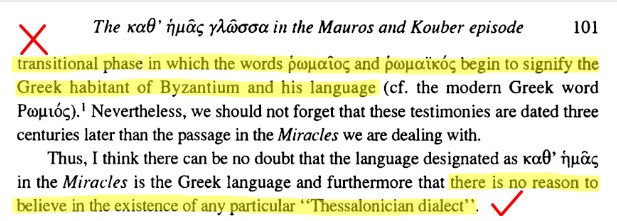
Her conclusion at the end of the article may also be partially wrong though (the one I marked with 'X').

KzFS2Ne.jpg

LzspdzP.jpg


It may not have happened as imagined by Grigoriou-Ioannidou (she uses the word "probably"). What Porphyrogennetos or Theophanes likely meant is simply that the ROMANS (by nationality) had two national languages: Latin and Greek.

If anything, if there were Greek-speaking monolinguals they called themselves only Romans - and we all know this to be a historical fact. We should also not forget the fact that by the 4th century (at least in Asia Minor) Greek was considered to be a language that "everyone spoke":
http://www.macedoniantruth.org/forum/showpost.php?p=179946&postcount=75
 
Last edited:
Galerius (Latin: Gaius Galerius Valerius Maximianus Augustus; circa 250 – April or May 311) was Roman emperor from 305 to 311.

Galerius was born near Serdica, in Dacia Ripensis, later named Dacia Mediterranea, though some modern scholars consider the strategic site where he later built his palace named after his mother – Felix Romuliana (Gamzigrad) – his birth and funeral place. His father was a Thracian and his mother Romula was a Dacian woman, who left Dacia because of the Carpians' attacks. He originally followed his father's occupation, that of a herdsman, where he got his surname of Armentarius (Latin: armentum, herd).

According to Lactantius, Galerius affirmed his Dacian identity and avowed himself the enemy of the Roman name once made emperor, even proposing that the empire should be called, not the Roman, but the Dacian Empire, much to the horror of the patricians and senators. He exhibited anti-Roman attitude as soon as he had attained the highest power, treating the Roman citizens with ruthless cruelty, like the conquerors treated the conquered, all in the name of the same treatment that the victorious Trajan had applied to the conquered Dacians, forefathers of Galerius, two centuries before.


Lactantius (c. 250 – c. 325) was an early Christian author who became an advisor to the first Christian Roman emperor, Constantine I. Lactantius, a Latin-speaking North African of Berber origin, was not born into a Christian family. He was a pupil of Arnobius who taught at Sicca Veneria, an important city in Numidia. In his early life, he taught rhetoric in his native town, which may have been Cirta in Numidia, where an inscription mentions a certain "L. Caecilius Firmianus".


URLs:
https://en.wikipedia.org/wiki/Galerius
https://en.wikipedia.org/wiki/Lactantius
 
It is often "emphasized" by many how (ancient) Byzantium was colonized by the Greeks from Megara in 657 BC, however:

- The first name of the city was Lygos according to Pliny the Elder in his historical accounts. It was founded by Thracian tribes between the 13th and 11th centuries BC, along with the neighbouring fishing village of Semistra.

- Lygos and Semistra were the only settlements on the European side of Constantinople. On the Asian side there was a Phoenician colony. On the site of Lygos, the later Byzantium was located, thus Lygos is accepted as the city which gave rise to Constantinople.

https://en.wikipedia.org/wiki/History_of_Istanbul#Lygos
 
At length, we are aware of the Alexander I episode and his claims; it is unfortunate the story of Emperor Anastasius has been "buried".

Emperor Anastasius (491-518) was a native of the city of Dyrrachion. To prove his (ethnic) Romanness, Anastasius claimed that he was biologically descended from a General of the Republic: he put it about that he was a descendant of Pompey the Great.

Unrelated to Anastasius but from the same book below:
- Some Arab writers also called the inhabitants of the western half of the former Roman empire Rum as well.
- The Tzakones were nothing more than provincial Romans.
- Arabs lived on Cyprus in the "condominium" phase (the period of division of sovereignty between the Umayyads and the Romans, when Cyprus was labeled a condominium).

Cql3lj1.jpg

OIglyMj.jpg

zP4rHgz.jpg

PlPwz5Z.jpg


7H2cQyE.jpg

6EGrd5z.jpg
 
Last edited:
"Provincial Syriac texts from the sixth century tell the same story. The Church of Zeugma, in Mesopotamia, wrote a letter to the Church of Edessa about an omen that concerned "you, us, and all the Romans" (a goose had laid an egg with the inscription "the Romans will conquer"). This letter was then copied into the so-called chronicle of Pseudo-Joshua the Stylite, a Syriac text written by an official in Edessa that is as straightforwardly pro-Roman as any Greek or Latin history written in Constantinople. It proves that members of a local church on the fringes of empire saw their fates entwined with the victories of the Roman armies and considered themselves and their fellow provincials to be Romans."

- Page 76, "Romanland", A. Kaldellis
 
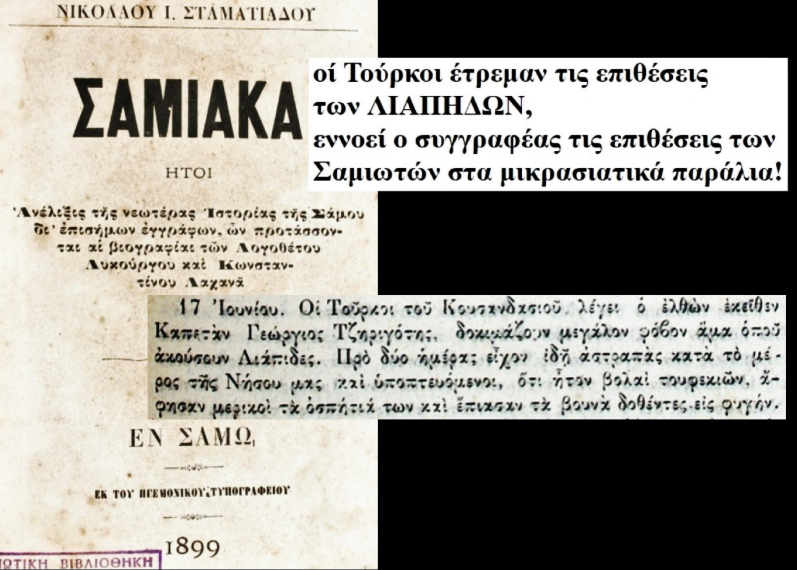
"Byzantine fleet" - This is what the people called the Ottoman fleet during the Turkish occupation.

One can see the negative memory of the Byzantine rule reflected in the collective memory of the people (the document seems to be referring to the island of Samos, and area of Izmir).

YMEFKM6.png


Also, the Turks were "shaking off attacks of the Labs (Λιάπηδες)" coming from Samos, meaning the Samian attacks of the Asia Minor beach. Historically the Labs were Albanians and followers of the Orthodox Church but many converted to Islam during Ottomon rule, with the bulk of conversion occurring in the 18th century.
jwfci0q.png
 
"Vlachogoths" (Valagothi)

Nennius was a 9th-century Welsh writer who wrote the Latin work Historia Brittonum. The interesting thing about this story is that it defines the Ostrogoths of Italy as "Vlachogoths" (Valagothi = Goths of "Vlachia" or Italy; we know of the Polish term Włochy for Italy), a term that Nennius almost certainly borrowed from the Germanic-speaking Saxons. In the minds of the Germanic-speaking peoples, Italy was the primitive "Vlachia" because it is the cradle of the Roman Empire, and Latin-speakers.

URL:
https://www.thelatinlibrary.com/histbrit.html

17 Aliud experimentum inveni de isto Bruto ex veteribus libris veterum nostrorum. tres filii Noe diviserunt orbem in tres partes post diluvium. Sem in Asia, Cham in Africa, Iafeth in Europa dilataverunt terminos suos. primus homo venit ad Europam de genere Iafeth Alanus cum tribus filiis suis, quorum nomina sunt Hessitio, Armenon, Negue. Hessitio autem habuit filios quattuor: hi sunt Francus, Romanus, Britto, Albanus. Armenon autem habuit quinque filios: Gothus, Valagothus, Gebidus, Burgundus, Longobardus. Negue autem habuit tres filios: Vandalus, Saxo, Boguarus. ab Hisitione autem ortae sunt quattuor gentes Franci, Latini, Albani et Britti. ab Armenone autem quinque: Gothi, Valagothi, Gebidi, Burgundi, Longobardi. a Neguio vero quattuor Boguarii, Vandali, Saxones et Turingi. istae autem gentes subdivisae sunt per totam Europam. Alanus autem, ut aiunt, filius fuit Fetebir, filii Ougomun, filii Thoi, filii Boib, filii Simeon, filii Mair, filii Ethach, filii Aurthach, filii Echthet, filii Oth, filii Abir, filii Ra, filii Ezra, filii Izrau, filii Baath, filii Iobaath, filii Iovan, filii Iafeth, filii Noe, filii Lamech, filii Matusalae, filii Enoch, filii Iareth, filii Malalehel, filii Cainan, filii Enos, filii Seth, filii Adam, filii dei vivi. hanc peritiam inveni ex traditione veterum.

YH9TGC1.png


Walhakurne = Roman/Gallic grain

*Walhaz is a reconstructed Proto-Germanic word meaning "Roman", "Romance-speaker", or "Celtic-speaker".

It is attested in the Roman Iron Age from an inscription on one of the Tjurkö bracteates, where walhakurne "Roman/Gallic grain" is apparently a kenning for "gold" (referring to the bracteate itself). The Tjurkö 1 bracteate is dated to the Germanic Iron Age between 400 and 650 AD.

There is a consensus that walha-kurne is a compound word referring to the bracteate itself, and that walha (cognate with Modern English Welsh) means "foreign, non-Germanic" - here perhaps more specifically "Roman" or "Gallic."

URLs:
https://en.wikipedia.org/wiki/Walhaz
https://en.wikipedia.org/wiki/Tjurkö_bracteates
 
Back
Top