• Welcome to the new Macedonian Truth Forum. All posts, members and private messages have been moved over from the old forum.

    Passwords from the old forum could not be carried over, so please use Forgot your password? to set a new one. The reset link is emailed to the address on your account.

  • Rules and Regulations at the forum of the Macedonian Truth Organisation (MTO)

    (1) The national-ethnic and cultural-linguistic identity of the Macedonian people is historically Macedonian, and derives its character from the native, indigenous and geographic homeland of the Macedonians, which is called Macedonia. To ensure that their human rights, integrity and heritage are appropriately respected, the only nouns and adjectives acceptable when reference is made to the above character and identity markers is Macedon, Macedonia, Macedonian and Macedonians.

    (2) The nation-state of the Macedonian people is the Republic of Macedonia, and is to be referred to by this official title so long as the 'republic' prefix is consistently applied to other states. Alternative references are the Macedonian Republic, or simply, Macedonia.

    (3) The 'ethnic' prefix is only acceptable for Macedonians in cases where differentiation is specifically required - so long as it is in context and consistent where it concerns its application to other ethnic groups.

    (4) Should any other differentiation be specifically required, the names of other ethnic groups that reside with Macedonians in either the Republic of Macedonia or the occupied Macedonian regions in Greece, Bulgaria, Serbia or Albania, are to be given a prefix.

    (5) Negating the identity, language and culture of the Macedonian people by deliberate avoidance of the terms Macedonia, Macedonian and Macedonians, or by any other means, is not permitted.

    (6) Systematic anti-Macedonian propaganda and rhetoric are not permitted.

    (7) Threads irrelevant to the Macedonian Cause, the community at the Macedonian Truth Organisation or the Macedonians in general may be considered as spam or not in the spirit of the forum. In such cases they are not permitted.

    (8) Continual posting of messages in threads with the sole purpose of deviating from the initial topics with the use of unrelated and unnecessary information is not permitted.

    (9) All posts, external articles, reports, etc that are cited in languages other than Macedonian or English, must be accompanied with a translation in one or both of the said languages.

    (10) Despite the possibility of some conversations and debates becoming heated, extreme abuse and/or racism, vulgar language and/or terminology, threats, revelation of personal information about others, harassment, and other such behavior will not be permitted. If deemed necessary all relevant information including member details will be reported to the appropriate authorities for investigation which may result in legal action.

    (11) Threads that are created must have a summary of a topic or excerpt of an article found in pertinent link(s) that have been included. One line threads will be considered unaccetable spam and are therefore not permitted.

    (12) Compulsive and deliberate lies, irrespective of the topic, are not permitted.

    (13) Any symbols or avatars found to be perceived as offensive to Macedonians are not permitted.

    (13) Any explicit or extreme material is not permitted.

    Failure to adhere to the above rules and regulations will result in a ban after 3 breaches. This may be reconsidered in some cases should the circumstances be of an unorthodox nature and/or require special consideration. To assure an effective deterrent against an individual or individuals with the sole purpose of causing dissent through spamming, racism or other improper means, the above rules will be strictly enforced.

    The MTO administration will monitor all discussions as reasonably practical and reserve the right to remove any post and/or member from the forum, and update the rules and regulations as required. Members are encouraged to immediately report any post and/or member to the MTO administration if they feel that these rules have not been abided by.

    The views expressed on this forum are those of the individuals. The only official representation of the MTO is made by the "Macedonian Truth Organisation (Site Owner)" username, and no other.

  • Macedonian Cause

    The Macedonian Truth Organisation calls on God in Heaven to protect, bless and guide the endeavour it is committing to undertake, and that is to work towards:

    Securing Macedonia as a free, independent and democratic republic in which sovereignty lies with the Macedonian citizens; as the nation-state of the Macedonian people in which they can preserve their culture, language and identity; as a state in which the Macedonian language and culture form the basis of public life and act as important unifying elements of Macedonian society; as the home of all its citizens to which it guarantees and obliges their inalienable natural rights and corresponding responsibilities;

    The acknowledgment as self-evident and irrefutable the existence of the:

    1) Indigenous, ethnonational name of Macedonia;
    2) Macedonian people, language and identity;
    3) Macedonian culture, symbols and folklore;
    4) Macedonian ancestry, heritage and history in its entirety; and
    5) Macedonian Orthodox Church;

    Securing recognition by the International Community of the tragedies endured by the Macedonian people, of the division of Macedonia with the signing of the Treaty of Bucharest on August 10, 1913, and the genocide committed against the Macedonian people at the hands of the Greek, Bulgarian and Serbian states and their respective churches during the 19th and 20th centuries;

    Ensuring that the Interim Accord is declared ‘null and void’ and that all constitutional provisions, acts, commitments, agreements, legislation, regulations, policies or programs emanating from, supporting or consequential to the Interim Accord are also declared ‘null and void’, including the use of any symbols and the completion of any acts imposed by, or originating from, the Interim Accord.

    Ensuring that the Framework Agreement is abolished and that all constitutional provisions, acts, commitments, agreements, legislation, regulations, policies and programs emanating from, supporting or consequential to the Framework Agreement are also abolished and replaced by a framework of constitutional and statutory law based on inalienable natural rights and corresponding responsibilities and universally codified human rights mechanisms.

    Securing the abolishment of any existing constitutional provisions, acts, agreements, legislation, regulations, policies and programs that discriminate against the Macedonian people, in any international organisation or any of the countries of the International Community where such constitutional provisions, acts, agreements, legislation, regulations, policies and programs exist, and thereby ensuring the freedom for Macedonians to exercise their inalienable natural rights and fulfil their corresponding responsibilities, and practice their culture, language and religious faiths in all the countries of the International Community without hindrance;

    The empowerment of Macedonians to undertake a moral revolution and to instil and/or reinvigorate within themselves a deep-rooted national, cultural, linguistic and historical dignity and a commitment to the exercise of freedom based on inalienable natural rights and corresponding responsibilities;

    The recognition of the Macedonian minorities in the neighbouring states of Macedonia as well as the respect for the inalienable rights and freedoms of the Macedonian minorities, as provided for by natural law and as codified by the United Nations Charter, the Universal Declaration of Human Rights and other universally codified human rights mechanisms;

    The full and unreserved respect of, and the support for, the rights of all people of non-Macedonian descent living in Macedonia and around the world, who share a reciprocal full and unreserved respect for the Macedonian people, their homeland and their state;

    The cultural unification and solidarity of the Macedonian people living in all parts of historical Macedonia and adjacent territories, as well as Macedonians throughout the world;

    The unity of all Macedonians on the principles, objectives and achievement of the Macedonian cause as defined by this declaration.

Macedonia and Bulgaria: Political Relations

He's brainwashed like all the other offspring of the egejski begalci in Bulgaria.

My father was one of the detsa begalci who was forced to flee the civil war and went to Romania. He lived in Romania for a few years and from there he moved to Bulgaria where he lived a good 15-20 years in Bulgaria and is not in the slightest pro Bulgarian.

I believe the Macedonians who were ethnically cleansed by the Greeks and escaped to Bulgaria during the Balkan wars and World war one were viciously assimilated by Bulgaria.


I'd say the majority are Bugarashi though.

Especially the younger generation. My friends first cousin is a Bugarash and he was born in Bulgaria. His father is from Gornicevo but his mother is Bulgarian. His other first cousin is a Grkoman and my friend is a Macedonian. Sad story.
 
I'd say the majority are Bugarashi though.

Especially the younger generation. My friends first cousin is a Bugarash and he was born in Bulgaria. His father is from Gornicevo but his mother is Bulgarian. His other first cousin is a Grkoman and my friend is a Macedonian. Sad story.


Story of our people.
 
Rosen Plevneliev was born in Gotse Delchev. He is descended from Bulgarian refugees from southern Macedonia who resettled from today's village of Petrousa in the municipality of Petrotsani in Drama regional unit, Greek Macedonia, in 1913.

Yea those Macedonians who went to Bulgaria are now Bulgarian, and those who stayed in Drama are now Greeks... And both countries expect us to believe that there's nothing wrong with this... :6:
 
1/3 of todays Bulgarians in Bulgaria have ancestry from Macedonia, Rosen is one of them and I think he admits he is Macedonian, Macedonian Bulgarian that is.
 
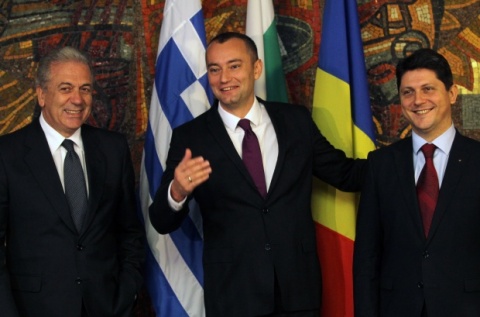
Foreign Ministers of Bulgaria & Greece leading the anti Macedonian charge.

Foreign Ministers of Bulgaria & Greece leading the anti Macedonian charge.

Code:
http://www.novinite.com/view_news.php?id=145062


photo_verybig_145062.jpg


Bulgaria does not have a problem with Macedonia and its aspirations for EU membership but with the nationalist rhetoric of some of its political leaders, Bulgarian Foreign Minister Nikolay Mladenov declared at a trilateral meeting with his Greek and Romanian counterparts.

Mladenov hosted in Sofia Monday Greek Foreign Minister Dimitris Avramopoulos and Romanian Foreign Minister Titus Corlatean for a mini-summit of Balkans' three major EU member states, Bulgaria, Greece, and Romania.

Bulgaria, Greece, and Romania have thus set out to "speak with one voice" in the European Union, their foreign ministers made it clear at their trilateral meeting.

In addition to Mladenov, the Foreign Ministers of Greece and Romania have also made it clear that Macedonia needs to prove its good-neighborliness before it can be allowed to join the European Union.

In their words, Macedonia's EU path needs to rest on a resolution of its "name dispute" with Greece – which has been blocking Macedonia's NATO and EU integration since the former Yugoslav republic is claiming a name that is also borne by an administrative district in Northern Greece – as well as on the Macedonian leaders' ability to do away with their nationalist rhetoric and verbal assaults on Bulgaria.

Bulgaria's President Rosen Plevneliev recently told EU Enlargement Commissioner Stefan Fuele that Macedonia is not ready for EU accession talks.

Plevneliev thus in effect reiterated the position of Foreign Minister Nikolay Mladenov who recently made it clear that Bulgaria does not support Macedonia's EU entry unconditionally.

Earlier, in a special statement in August 2012, Bulgarian Foreign Minister Nikolay Mladenov reacted strongly to hate speech against Bulgaria in Macedonia media.

Since the early Middle Ages, all the way to the first half of the 20th century, Macedonia and its Slavic population were considered part of the Bulgarian nation not just by Bulgaria but also by its neighbors and the international community. This is why from its National Liberation in 1878 till 1944 Bulgaria waged five wars attempting to unite all of the Bulgarian-populated lands in the Balkans, including Macedonia – after the San Stefano Treaty of March 1878 providing one state for almost all Bulgarian-populated regions was revised three months later by the European Great Powers in the Treaty of Berlin leaving the regions of Thrace and Macedonia out of Bulgaria.

After both World War I and World War II, however, Serbia/Yugoslavia kept control of 40% of the territory of the geographic and historical region of Macedonia, the so called Vardar Macedonia (which in 1991 became the Republic of Macedonia), Greece retained about 50% of the region – the so called Aegean Macedonia, while only 10% of the region – the so called Pirin Macedonia – remained in Bulgaria.

The foundations of the contemporary Macedonian nation were laid in 1943-44 by Yugoslavia's communists at a special congress that also proclaimed the creation of a Macedonian language and a Macedonian alphabet designed to differentiate the dialects spoken in the region of Macedonia from the Bulgarian language and to underline the creation of a distinct Macedonian national identity.

The so called question about the perceived Macedonian minority in Bulgaria exists since the late 1940s when the dictators of the Soviet Union and communist Yugoslavia – Joseph Stalin and Josip Broz Tito – attempted to arrange the post-World War II order on the Balkans through the creation of a Balkan federation between Bulgaria and Yugoslavia.

One of the provisions of this state engineering project of the two notorious communist dictators was the creation of a Macedonian republic within the future federation. For that to happen, the leadership of communist Bulgaria had to cede Pirin Macedonia to Yugoslavia in exchange for the territories of the so called Western Outlands (the towns of Tsaribrod (Dimitrovgrad) and Bosilegrad where the recognized Bulgarian minority in Serbia lives today).

This provision was accepted unconditionally by the Bulgarian communist leader Georgi Dimitrov who acted under direct orders from Stalin. As a result, in the late 1940s, the Bulgarian Communist Party undertook an unprecedented campaign to force its own population in the Pirin Region (today's Blagoevgrad District in Southwest Bulgaria) to change its Bulgarian nationality and identity into the newly invented Macedonian one, and the official census figures out of the blue recorded that 250 000 Macedonians living in Bulgaria.

The campaign to force the people of the Blagoevgrad District to become "Macedonians" was dropped by the Bulgarian Communist Party after the entire project for a Balkan federation between Bulgaria and Yugoslavia was killed with the falling out between Stalin and Tito in 1948-49 – a rift that had wide repercussions for Europe during the entire Cold War period. This left the population of Southwest Bulgaria – which was harassed by its own government on orders from Moscow – to shake off the imagined ethnic Macedonian identity imposed on it.

Ever since, however, the authorities in Skopje whose legitimacy relies primarily on the doctrine described by the Bulgarian historians as "macedonianism", i.e. the distinct national identity of the Slavic population of the region of Macedonia, have resurfaced claims of "hundreds of thousands of ethnic Macedonians" living in Bulgaria under some sort of "brutal oppression." Macedonian media cite as evidence for such claims statements by the so called ethnic Macedonian party "OMO Ilinden-Pirin", whose members according to publications in the Bulgarian media are paid from Skopje and Belgrade to declare themselves as "Macedonians."

The provocations in the Macedonian media on the "question" of "ethnic Macedonians" abroad seem to be in line with last year's construction of monuments in Skopje of Alexander the Great and the medieval Bulgarian Tsar Samuil, both of which are deemed to be great Macedonians by the government of Macedonian Prime Minister Nikola Gruevski and his party VMRO-DPMNE – a move that caused anger in Greece, ridicule in Bulgaria, and criticism by the European Commission.

Some 50 000 Macedonians have granted Bulgarian citizenship in the past decade, and that the figure has seen a staggering increase in the past couple of years, as many Macedonians are, in the worlds of Bulgarian historian, ex Diaspora Minister and current head of the National History Museum, Bozhidar Dimitrov, returning to their "Bulgarian roots."

As of 2010, it is much easier for Macedonians to get Bulgarian citizenship because the Bulgarian authorities no longer ask them to provide a document of Bulgarian origin – which is usually some sort of a church or municipal certificate from the time of their grandparents; instead, for the purposes of granting citizenship, the Bulgarian state has switched to assuming that all Macedonians are of Bulgarian origin.

Unlike Greece, which gets enraged by FYROM's moves toying with the cultural heritage from the Antiquity period and is tangled with Macedonia in the notorious name dispute, Bulgaria's governments traditionally react to propaganda fits by Skopje with disregard, while the general public in Bulgaria accepts them with ridicule. To the extent that Bulgaria has made any claims towards Macedonia, those have boiled down to the refusal to allow Skopje to hijack Bulgaria's historical heritage from the Middle Ages and the 19th century Revival Period.

Bulgaria was the first sovereign nation to recognize the independence of the Republic of Macedonia in 1992.
 
Borisov resigns

Borisov resigns

No one has mentioned today that the bulgarian PM resigned. I think its pretty significant news.
 
Agreed.
Nothing more than another EU inspired failure.

Interesting comment:
German die Welt goes as far as saying in its title that the Bulgarian government collapsed under its EU-serfdom and that it is a prime example of how EU-compliant policy in Eastern Europe may lead to devastation.

And Macedonia is desperate to join the EU because they are "smarter".Spare me.
 
Agreed.
Nothing more than another EU inspired failure.

Interesting comment:


And Macedonia is desperate to join the EU because they are "smarter".Spare me.

Interesting quote RTG

From day 1 I have said Macedonia does not need the EU but I'm just an idiot I guess as you say they are all way to smart for someone like me to know anything.

I am quite surprised that no one has posted an article about this but as soon as some one in greece farts their something posted.

This guy was pretty anti Macedonia and now its a toss up who will take the helm in Bulgaria but I hear whispers that it may be a socialist party.

Anyway like I said I think this is a significant event that can have an impact on Macedonia.

Apparently there were violent protests too, I had no idea.

Neka si gi istajet ocite :)
 
This is what the Bulgarians are saying. Apparently Macedonia is still so fixated on their brains that they require valium everynight just to be able to sleep.

Code:
http://www.focus-fen.net/index.php?id=n300128

Macedonia finds relief from fear of Boyko Borisov (ROUNDUP)
22 February 2013 | 13:31 | FOCUS News Agency

Sofia. The Macedonian media have extensively covered the recent protests in Bulgaria and the resignation of Boyko Borisov’s government. Some of the most frequent comments are that just four days after his visit to Skopje and meeting with Macedonian counterpart Nikola Gruevski, which Borisov described as ideal, the Bulgarian government resigned and the country braces for early elections.
“Good neighborliness will be strengthened by a new government” and “Gruevski left with no interlocutor in Bulgaria” are some of the titled in the Macedonian media.
The events are used to draw parallels, such as “Borisov and Gruevski – one for the people, the other for the post,” by the biggest opposition party in Macedonia, SDSM.

In a commentary, the Utrinski Vesnik daily makes a comparison between the clashes in Bulgaria after which Borisov resigned to avoid more blood in the streets and the political crisis in Macedonia, which arose when the opposition left the parliament and journalists and citizens clashed outside the parliament last December, which Gruevski reportedly tried to underestimate.
And now what – this is the most asked question since yesterday after the Bulgarian parliament accepted the government’s resignation, writes the Utrinski Vesnik.
“The question refers mainly to the internal events and positions in government, but we consider it important whether after Borisov’s reliable visit the talks on the controversial issues will find a trump-card or they will be left in the background. The key message is that the Macedonian prime minister does not have an interlocutor in Sofia and the swiftness of the political life there and the tension and obscurity who will govern make the negotiations with Macedonia very unclear. It will be clear who will lift the Bulgarian veto in the EU, if we reach such a stage at all, when the date for elections is set,” reads the newspaper.

Four days after arriving in Skopje for a friendly conversation with his Macedonian counterpart Nikola Gruevski, Bulgarian Prime Minister Boyko Borisov resigned due to mass protests in the country, writes the Dnevnik daily.
Destroying stereotypes and enhancing bilateral relations will most probably be left for better times and it is not clear whether the working groups will hold a new meeting by the parliamentary elections in Bulgaria, reads the newspaper.
The Macedonian Foreign Ministry refused to comment whether the political situation in Bulgaria could reduce the dynamics of the working meetings between Skopje and Sofia and put the initiatives on standby.
“Borisov’s visit was a step forward. Let’s wait and see how the situation in Bulgaria will develop,” said the Foreign Ministry.

What has happened with the attempt to draw Macedonia and Bulgaria closer after Bulgarian Prime Minister Boyko Borisov’s resignation, a few days after his visit to Skopje, writes the Utrinski Vesnik daily.
The newspaper reads further that European Enlargement Commissioner Stefan Fule welcomed the meeting between the Bulgarian prime minister and his Macedonian counterpart Nikola Gruevski, describing it as positive.
The surprising visit to the Macedonian capital was not noticed in Greece, writes the daily.
According to Greek analysts the visit could be an announcement about warming up Bulgarian-Macedonian relations.
Utrinski Vesnik notes that Borisov’s resignation after nationwide protests questions the success of the initiative to break the ice in the ties between Skopje and Sofia, although, given the current ratings of the political parties in Bulgaria, it is not impossible for the outgoing prime minister to regain his post and take part in the first intergovernmental meeting with Macedonia.

At first sight the surprising meeting between the Macedonian and Bulgarian prime ministers sends the positive message that the two countries have started to solve their bilateral problems. However, it is still unclear whether the soft tones coming from the two foreign ministers after the meeting in Skopje signal a solution to the problems in a European manner, as the Bulgarian foreign minister would say, says the Dnevnik daily
 
bulgaria's smugness really irritates me. They are always up on their high horse are they that blind that they don't see that their country is just as big a shit hole as Macedonia.At least Macedonia is aesthetically nicer than bulgaria. Tatarsko pleme smrdeno.
 
I find the peasant mentality in the Balkans is consistent throughout the entire region. Even the highly educated ones have a little peasant in them. Not much difference anywhere!

Bulgaria has no reason to be on a high horse. It is a fine example of why Macedonia has no need for the EU. Rather than capitalising on an opportunity to sit outside of the EU, Macedonia seeks to be constrained by the same limiting factors and willing to absorb the collective debt. Only peasants and criminal politicians would be up for that.
 
"Academia" in the Balkans

"Academia" in the Balkans

This reeks of communism where facts and reason are replaced by ideological consensus and the "cooperation between the peoples".

[URL]http://www.balkaninsight.com/en/article/macedonian-bulgarian-academies-boost-cooperation[/URL]
Macedonian, Bulgarian Academics Boost Working Links

October 10, 2013

Macedonian and Bulgarian academics agreed practical ways of boosting ties after decades of non-cooperation at a time when the two countries' political relations remain strained. At a meeting last weekend in the Bulgarian town of Sandanski, academics from the neighbouring countries agreed to cooperate in some 40 different fields ranging from social to natural sciences. Vlado Kambovski, the head of the Macedonian Academy of Sciences and Arts, said the establishment of academic cooperation was of “extraordinary” importance for bilateral relations. “The fields of science and culture [are] two areas of outstanding importance for opening of the ways of cooperation between the two peoples,” Kambovski said. The teamwork should begin next month and is intended to continue for at least the next three years. The touchy subject of history, where both nations have sometimes radically different views, is one of the areas of cooperation, Kambovski confirmed. “We are not going to touch those famous questions related to identity. We in science talk with one language that embraces different scientific views,” Kambovski said. In contrast to Macedonia’s strained ties to Greece, marred by the longstanding dispute over the country’s name, Bulgaria and Macedonia have had relatively friendly relations in the past, although tainted by mutual mistrust. Bulgaria was the first country to recognise Macedonia when it proclaimed independence from Yugoslavia in 1991. Moreover, Sofia, unlike Athens, recognises its neighbour under its constitutional name, Republic of Macedonia. On the other hand, Sofia is reluctant to recognise the existence of a Macedonian language, separate from Bulgarian, and many Bulgarian historians still maintain that Macedonians are ethnic Bulgarians. Bulgaria also does not recognise the existence of a Macedonian minority in south-west Bulgaria, though Macedonia reluctantly admits that there are people with a Bulgarian identity in Macedonia. The political relations between the two took turn for the worse when in December last year, Bulgaria joined Greece in preventing Macedonia from obtaining a start date for EU accession talks. While Greece justified its blockade on the grounds of the bilateral dispute over Macedonia’s name, Bulgaria said it could not support a country that had failed to nurture neighbourly relations. Bulgaria said it objected to what it saw as discriminatory attitudes towards ethnic Bulgarians in Macedonia, accusing Skopje of fomenting an anti-Bulgarian atmosphere. As a result, Brussels said it would closely monitor the effort to improve bilateral ties as a precondition for the country’s accession talks. In January, both sides set up political work groups and launched negotiations, expected to result in the signing of a friendship treaty. Both countries also pledged to boost economic ties. But with the European Commission annual report on Macedonia’s progress towards joining the EU about to be published next week, there is no sign of the announced Macedonia-Bulgaria friendship treaty. Observers fear that this will be regarded in the Commission’s report as a shortcoming after the initial progress in improving relations at the start of this year.
 
Definitely Communism & ideological concensus here.What cooperation from the people only from academics.The Bulgarians won't change they think they can hold up the friendship act.At the same time he people of pirin aren't getting their human rights.When we talk of friendliness etc of Bulgaria ,the Bulgarians don't want any talk of pirin.WE have simple denials.A wasted time because the academics are never going to have a consesnsus.TO do that the Bulgarians need to give Macedonians in pirin recognition,with,giving of basic human rights.this is a good article of the Bulgarians Tom.Beware of wolves in sheep's clothing.Also no one should fall for any bs Bulgarian crap ,One thread article at MTO the Bulgarians were asking Macedonia through our president ivanov that we ought to celebrate illinden together.They thought that illinden should unite us.THere could be nothing further from the truth.Why because we have nothing in common until our brothers in pirin are given basic rights & freedoms.One needs only to read human rights artcles & one will see the real discrimination & bullying that goes on in Prin.The Bulgarians are very good of denying & lying about pirin.
 
Last edited:
Macedonian-Bulgarian joint celebration of St.Kiril and Metodi

Macedonian-Bulgarian joint celebration of St.Kiril and Metodi

google translate

Vlado Kambovski: We accept Bulgarian invitation honoring the Saints Kiril and Methodius

It takes a joint Bulgarian - Macedonian celebration of the holy Kiril and Methodius because they are not only significant figures for these two countries but also in the Balkans and beyond. So great personalities should celebrate not only when it comes to Macedonia and Bulgaria , but those figures that connect our country and Albania , for example . These are figures from the wider meaning and it should be in the spirit of European integration , said the " Journal " academician Vlado Kambovski , President of the Macedonian Academy of Sciences and Arts .

Kambovski spoke opposite the first joint celebration of the holy Kiril and Methodius , which will be held on May 11 in Sofia , Bulgaria , where the Macedonian delegation composed of the head of the MOC - OA , Archbishop Stefan, President of the Academy to attend the festivities organized crime the holy brothers . The invitation for a joint celebration in Bulgaria sent the President of the Bulgarian Academy of Sciences , Stephen Vodenicharov . Academics and clerics attended the Divine Liturgy , the Patriarch Neophytus which will serve the church " St. Alexander Nevski " in Sofia .

Archbishop Stefan , because of unresolved canonical status of the MOC is not invited to sosluzhuva the liturgy , but only you can attend like any other citizen because BOC has canonical communion with the Orthodox Church . Then everyone will move to the Bulgarian Academy of Sciences , which also has a program for the occasion .

- These are the result of honor with a new spirit and a new stage of integration to which you should strive in the Balkans . We will one day be together in the European Union and therefore have more regional connecting - Kambovski explains .

He added that such occasions do not need anyone's personality emphasizing that the nation belongs to the people because they respected his work more broadly , many peoples and nations in the world .

Macedonia and Bulgaria , it is known that every year organize special celebration in Rome , Italy , at the tomb of St. Kiril in honor of the Slavic educators . But state and church delegations celebrations do separately . Macedonian delegation this year will be led by President Ivanov , and MOC will represent the European Metropolitan Pimen .
- MASA and MOC are institutions that are not part of the state structure . Our joint celebration should be an incentive for states to consider their way of chestvuvavnje - highlight academic Kambovski .

The idea of ​​a joint Bulgarian - Macedonian Ilinden celebration of other holidays in 2006 was first to promote Buckovski , then as prime minister, together with his Bulgarian counterpart Sergei Stanishev . Buchkovski was convinced that a joint Balkan history can mean a European future .

- Some mistakenly perceive that the Ilinden if any come together to celebrate , it would grab part of our history . No, on the contrary , it confirmed the independence of the Macedonian people - then declared Buchkovski .


Then Crvenkovski pleaded against this initiative , although Buchkovski claimed that he and Stanishev will adhere to the idea of the Presidents of the two countries for joint celebration of holidays . Several Macedonian historians then coming out against the idea on the grounds that behind this initiative hide golemobugarskite interests .

- With regard to significant historical events such as the Ilinden and others, and that in Macedonia and in Bulgaria there are different views , it is historians continue to explore and exchange views . Thus slowly and accounted barriers of ideological and political character and approach to shared honor with - says the president of the Academy , adding that details of the celebration will be announced on Monday .

izvor: http://www.maticanaiselenici.com/?p=3953
 
I wouldn't celebrate anything with Bulgarians whils't our brothers in pirin aren't afforded human rights.I don't trust the Bulgarians.Neither should anyone else.The celebrations have serious undertones.
 
As starting point, they intend to use the 1999 Declaration for friendship and cooperation, signed by (back then) PMs LjuBco Georgievski and Ivan Kostov.

Also the newly (re)elected president of RoM G. Ivanov states: " We are ready immediately to sign the declaration from 1999 with Bulgaria". izvor: http://www.novamakedonija.com.mk/DetalNewsInstant.asp?vestInstant=34447

This is an exerpt from the declaration:

google translate

" ... 11th Both sides will undertake , encourage and support each other actions that have hostile character .

Neither side would not allow its territory to be used against the other organizations and groups aimed at committing subversive and separatist activities or actions threatening the peace and security of the other country .

The two sides have not and will not exhibit territorial claims to each other .

Macedonia declares that nothing in its Constitution can not and should not be construed to constitute or ever will be the basis for the interference of the Republic of Macedonia in the internal affairs of the Republic of Bulgaria in order to protect the status and rights of persons who are not citizens of the Republic Macedonia .

Both sides shall take effective measures to prevent nedobro - deliberate propaganda by institutions and agencies will not allow private actions aimed at inciting people to violence , hate or other actions that would harm relations between Macedonia and Bulgaria.
It was signed in Sofia on 22 February 1999 constitutional languages of both countries and Macedonia , according to the Constitution of the Republic of Macedonia and Bulgaria , according to the Constitution of the Republic of Bulgaria, both texts being equally authentic . "


Complete text of the Declaration is published by the Macedonian Information Agency ( MIA ) on 02/23/1999 ;

„...11. Двете страни нема да преземаат, поттикнуваат и поддржуваат една кон друга дејства кои имаат непријателски карактер.
Ниту една од страните нема да дозволи нејзината територија да биде користена против другата од организации и групи кои имаат за цел извршување субверзивни и сепаратистички дејства или дејства насочени кон загрозување на мирот и безбедноста на другата земја.
Двете страни немаат и нема да пројавуваат територијални претензии една спрема друга.
Република Македонија изјавува дека ништо од нејзиниот Устав не може и не треба да се толкува дека претставува или некогаш ќе претставува основа за мешање на Република Македонија во внатрешните работи на Република Бугарија со цел да го заштити статусот и правата на лица кои не се државјани на Република Македонија.
Двете страни ќе преземаат ефикасни мерки за спречување на недобро-намерната пропаганда од страна на институции и агенции и нема да дозволат активности на приватни лица насочени кон поттикнување на насилство, омраза или други слични дејства кои би наштетиле на односите меѓу Република Македонија и Република Бугарија.
Декларацијата е потпишана во Софија на 22 февруари 1999 година на уставните јазици на двете земји- македонскиот, согласно Уставот на Република Македонија и бугарски, согласно уставот на Република Бугарија, при што двата текста имаат еднаква важност”.

Интегралниот текст на Декларацијата е објавен од Македонската информативна агенција (МИА), на 23.02.1999;
 
Joint Macedonian-Bulgarian Celebrations

Joint Macedonian-Bulgarian Celebrations

What joke. Joint celebrations of Macedonian historical figures, Stefan was only allowed to attend as a "guest" and all of this supposedly made it a non-political event.

**************
http://www.balkaninsight.com/en/article/bulgaria-macedonia-hold-joint-celebration-amid-strained-ties

Bulgaria, Macedonia Tackle Tensions With Religious Celebration


The Macedonian and Bulgarian academies of sciences and churches held their first joint celebration of Saints Cyril and Methodius in a bid to end decades of non-cooperation.

The joint celebrations dedicated to the saints widely regarded as the fathers of Slavic literary culture took place on Sunday in Sofia, coming at a time when the two countries' political ties remain strained.

The head of the Bulgarian academy of science, Stefan Vodenicharov, and his Macedonian counterpart, Vlado Kambovski, laid wreaths at the monument to Cyril and Methodius outside Bulgaria's National Library in Sofia.

“Science is an independent field and should not be affected by political affairs,” Vodenicharov said.

Kambovski added that the “negative energy” that exists between the two countries “should be transformed into a constructive force while Macedonia and Bulgaria jointly integrate into the European Union”.

The two academies made their first official contacts last year after decades of non-cooperation. The two sides agreed to work together on some 40 scientific projects, 30 of which have already begun.

The next joint event will come at the end of May when the Macedonian academy will organize the Days of the Bulgarian Academy of Sciences in Skopje. A similar event is planned for the Macedonian academics in Sofia in the second half of this year.

Also present at the celebration in Sofia was the head of the Macedonian Orthodox Church, Archbishop Stefan, who attended a mass celebrated by Patriarch Neofit, the head of the Bulgarian Church in Sofia's Alexander Nevski church.

Stefan was there only as spectator because the Bulgarian church does not recognize Macedonia's religious institution as independent, taking the side of the Serbian Church.

The Macedonian church proclaimed independence, or so-called ‘authocephaliy’, in 1967, but the Serbian Church declared this move uncanonical, and was supported in this by the other Orthodox Churches, which is why the Macedonian Church remains unrecognized to this day.

However, Stefan said his Bulgarian counterparts had done everything to make his attendance at the mass a pleasant one.

The celebration, which is observed as national holiday in both countries, was the first joint event of its kind. In previous years, both countries’ state and religious delegations held separate observations at St Cyril’s tomb in Rome.

The development came amid continuing strained political ties between the two neighbours.

In December 2012, in Brussels, Bulgaria joined Greece in preventing Macedonia from obtaining a start date for EU accession talks.

While Greece justified its blockade on the grounds of the bilateral dispute over Macedonia's name, Bulgaria said it could not support a country that had failed to nurture neighbourly relations.

Bulgaria said it objected to what it saw as discriminatory attitudes towards ethnic Bulgarians in Macedonia, accusing Skopje of fomenting an anti-Bulgarian atmosphere.

Since then both sides have set up political work groups and launched negotiations, expected to result in the signing of a ‘friendship treaty’. Both countries have also pledged to boost economic ties.

In contrast to Macedonia’s strained ties to Greece, marred by the longstanding dispute over Macedonia’s name, Bulgaria and Macedonia had relatively friendly relations in the past.

Bulgaria was the first country to recognize Macedonia when it proclaimed independence from Yugoslavia in 1991. Moreover, Sofia, unlike Athens, recognises its neighbour under its constitutional name, the “Republic of Macedonia”.

On the other hand, Sofia is reluctant to recognise the existence of a Macedonian language, separate from Bulgarian, and many Bulgarian historians still maintain that Macedonians are ethnic Bulgarians.

Bulgaria also does not recognize the existence of a Macedonian minority in southwest Bulgaria, though Macedonia reluctantly admits that there are people with a Bulgarian identity in Macedonia.
 
Back
Top