• Welcome to the new Macedonian Truth Forum. All posts, members and private messages have been moved over from the old forum.

    Passwords from the old forum could not be carried over, so please use Forgot your password? to set a new one. The reset link is emailed to the address on your account.

  • Rules and Regulations at the forum of the Macedonian Truth Organisation (MTO)

    (1) The national-ethnic and cultural-linguistic identity of the Macedonian people is historically Macedonian, and derives its character from the native, indigenous and geographic homeland of the Macedonians, which is called Macedonia. To ensure that their human rights, integrity and heritage are appropriately respected, the only nouns and adjectives acceptable when reference is made to the above character and identity markers is Macedon, Macedonia, Macedonian and Macedonians.

    (2) The nation-state of the Macedonian people is the Republic of Macedonia, and is to be referred to by this official title so long as the 'republic' prefix is consistently applied to other states. Alternative references are the Macedonian Republic, or simply, Macedonia.

    (3) The 'ethnic' prefix is only acceptable for Macedonians in cases where differentiation is specifically required - so long as it is in context and consistent where it concerns its application to other ethnic groups.

    (4) Should any other differentiation be specifically required, the names of other ethnic groups that reside with Macedonians in either the Republic of Macedonia or the occupied Macedonian regions in Greece, Bulgaria, Serbia or Albania, are to be given a prefix.

    (5) Negating the identity, language and culture of the Macedonian people by deliberate avoidance of the terms Macedonia, Macedonian and Macedonians, or by any other means, is not permitted.

    (6) Systematic anti-Macedonian propaganda and rhetoric are not permitted.

    (7) Threads irrelevant to the Macedonian Cause, the community at the Macedonian Truth Organisation or the Macedonians in general may be considered as spam or not in the spirit of the forum. In such cases they are not permitted.

    (8) Continual posting of messages in threads with the sole purpose of deviating from the initial topics with the use of unrelated and unnecessary information is not permitted.

    (9) All posts, external articles, reports, etc that are cited in languages other than Macedonian or English, must be accompanied with a translation in one or both of the said languages.

    (10) Despite the possibility of some conversations and debates becoming heated, extreme abuse and/or racism, vulgar language and/or terminology, threats, revelation of personal information about others, harassment, and other such behavior will not be permitted. If deemed necessary all relevant information including member details will be reported to the appropriate authorities for investigation which may result in legal action.

    (11) Threads that are created must have a summary of a topic or excerpt of an article found in pertinent link(s) that have been included. One line threads will be considered unaccetable spam and are therefore not permitted.

    (12) Compulsive and deliberate lies, irrespective of the topic, are not permitted.

    (13) Any symbols or avatars found to be perceived as offensive to Macedonians are not permitted.

    (13) Any explicit or extreme material is not permitted.

    Failure to adhere to the above rules and regulations will result in a ban after 3 breaches. This may be reconsidered in some cases should the circumstances be of an unorthodox nature and/or require special consideration. To assure an effective deterrent against an individual or individuals with the sole purpose of causing dissent through spamming, racism or other improper means, the above rules will be strictly enforced.

    The MTO administration will monitor all discussions as reasonably practical and reserve the right to remove any post and/or member from the forum, and update the rules and regulations as required. Members are encouraged to immediately report any post and/or member to the MTO administration if they feel that these rules have not been abided by.

    The views expressed on this forum are those of the individuals. The only official representation of the MTO is made by the "Macedonian Truth Organisation (Site Owner)" username, and no other.

  • Macedonian Cause

    The Macedonian Truth Organisation calls on God in Heaven to protect, bless and guide the endeavour it is committing to undertake, and that is to work towards:

    Securing Macedonia as a free, independent and democratic republic in which sovereignty lies with the Macedonian citizens; as the nation-state of the Macedonian people in which they can preserve their culture, language and identity; as a state in which the Macedonian language and culture form the basis of public life and act as important unifying elements of Macedonian society; as the home of all its citizens to which it guarantees and obliges their inalienable natural rights and corresponding responsibilities;

    The acknowledgment as self-evident and irrefutable the existence of the:

    1) Indigenous, ethnonational name of Macedonia;
    2) Macedonian people, language and identity;
    3) Macedonian culture, symbols and folklore;
    4) Macedonian ancestry, heritage and history in its entirety; and
    5) Macedonian Orthodox Church;

    Securing recognition by the International Community of the tragedies endured by the Macedonian people, of the division of Macedonia with the signing of the Treaty of Bucharest on August 10, 1913, and the genocide committed against the Macedonian people at the hands of the Greek, Bulgarian and Serbian states and their respective churches during the 19th and 20th centuries;

    Ensuring that the Interim Accord is declared ‘null and void’ and that all constitutional provisions, acts, commitments, agreements, legislation, regulations, policies or programs emanating from, supporting or consequential to the Interim Accord are also declared ‘null and void’, including the use of any symbols and the completion of any acts imposed by, or originating from, the Interim Accord.

    Ensuring that the Framework Agreement is abolished and that all constitutional provisions, acts, commitments, agreements, legislation, regulations, policies and programs emanating from, supporting or consequential to the Framework Agreement are also abolished and replaced by a framework of constitutional and statutory law based on inalienable natural rights and corresponding responsibilities and universally codified human rights mechanisms.

    Securing the abolishment of any existing constitutional provisions, acts, agreements, legislation, regulations, policies and programs that discriminate against the Macedonian people, in any international organisation or any of the countries of the International Community where such constitutional provisions, acts, agreements, legislation, regulations, policies and programs exist, and thereby ensuring the freedom for Macedonians to exercise their inalienable natural rights and fulfil their corresponding responsibilities, and practice their culture, language and religious faiths in all the countries of the International Community without hindrance;

    The empowerment of Macedonians to undertake a moral revolution and to instil and/or reinvigorate within themselves a deep-rooted national, cultural, linguistic and historical dignity and a commitment to the exercise of freedom based on inalienable natural rights and corresponding responsibilities;

    The recognition of the Macedonian minorities in the neighbouring states of Macedonia as well as the respect for the inalienable rights and freedoms of the Macedonian minorities, as provided for by natural law and as codified by the United Nations Charter, the Universal Declaration of Human Rights and other universally codified human rights mechanisms;

    The full and unreserved respect of, and the support for, the rights of all people of non-Macedonian descent living in Macedonia and around the world, who share a reciprocal full and unreserved respect for the Macedonian people, their homeland and their state;

    The cultural unification and solidarity of the Macedonian people living in all parts of historical Macedonia and adjacent territories, as well as Macedonians throughout the world;

    The unity of all Macedonians on the principles, objectives and achievement of the Macedonian cause as defined by this declaration.

Macedonia & Greece: Name Issue

Macedonia & Greece: Name Issue

  • .

    Votes: 5 62.5%
  • .

    Votes: 3 37.5%

  • Total voters
    8
1) Amendments to Constitution, clarifications refer indirectly to Macedonian ethnicity

In effect, with the pretext of protecting the rights of veterans the clarification asserts clearly the existence of a Macedonian ethnicity (Macedonian people) and indeed liberation struggles that sought to unify the entire geographic area of Macedonia.

ΤοΒΗΜΑ Team | 18.01.2019

URL:
https://www.tovima.gr/2019/01/18/in...ons-refer-indirectly-to-macedonian-ethnicity/

Amidst virulent recriminations between SYRIZA and main opposition New Democracy in Parliament during debate on the confidence vote on the evening of 16 June, Prime Minister Alexis Tsipras announced that Athens has received from Skopje the requisite Note Verbale that begins the countdown for the ratification of the Prespa Agreement by Greece.

Tsipras maintained that the clarifications of certain constitutional amendments passed by Skopje in accord with the agreement put to rest fears that the agreement recognises a “Macedonian ethnicity”, as New Democracy leader Kyriakos Mitsotakis claims.

“The [foreign] ministry of Macedonia further notes that in accordance with the letter and the spirit of the agreement, it is understood that the term “nationality” of the Second Party defined in Article 1 (3) (b), of the Agreement as “Macedonian/Citizen of the Republic of North Macedonia” refers exclusively to the citizenship and does not define or pre-determine ethnic affiliation/ethnicity”.

The text also notes that “the ‘Macedonian language’ refers to the official language of the Second Party as recognised by the Third UN Conference on the Standardisation of Geographical Names held in Athens in 1977, which is within the group of South Slavic languages.”

The six-page note verbale includes the four amendments to the Constitution (XXXIII, XXXIV, XXXV, XXXVI) that have been agreed to in the Prespa Agreement and key interpretive clarifications.

Name change

The first of the amendments (XXXIII) is crucial as it stipulates that any reference in the Constitution to the “Republic of Macedonia” will be changed to “Republic of North Macedonia”.

However, it exempts and retains the reference to plain Macedonia in Article 36 of the Constitution which refers to the social rights of veterans of the “Anti-Fascist Struggle” and all struggles of the “Macedonian Liberation Wars”, “for war handicapped and all those who were persecuted or jailed for the ideals of a distinct identity of the Macedonian people and Macedonian identity.”

In effect, with the pretext of protecting the rights of veterans the clarification asserts clearly the existence of a Macedonian ethnicity (Macedonian people) and indeed liberation struggles that sought to unify the entire geographic area of Macedonia, including the ancient and largest party which is now part of the Greek state.

Amendment XXXIV amends the Preamble of the Constitution in such a manner as not to depict “the Macedonian people” as above the country’s many ethnic communities – Albanian, Turkish, Vlach, Serbian, Roma, and Bosnian.

There is a citation of the decisions of the Anti-fascist Assembly for the National Liberation of Macedonia, the underpinning of which was the concept of Macedonian ethnicity and a yearning for the acquisition of Aegean Macedonia, the largest part which is in Greece.

It describes the legal decisions referring to the declaration of the first Assembly to the people of Macedonia.

A reference to those who expressed the will to create and independent sovereign state will be added.

Effectively, by referring to the legal decisions of the Assembly, Skopje is suggesting that the amendment refers only to the establishment of the Republic and not to the irredentist claims to what the Macedonians historically described as “Macedonia of the Aegean”.

Ohrid Agreement, Albanians’ rights

So too there is a reference to the Ohrid Agreement which recognised Albanian as an official language, laid the groundwork for recognising over a dozen basic rights of the Albanian minority, and stopped a budding civil war, with the attacks of the well-armed Albanian National Liberation Army (NLA), which was about to tear the country apart.

Another key amendment (XXXV) strengthens the denunciation of traditional irredentism with the declaration that Skopje respects the sovereignty, territorial integrity and political independence of neighbouring countries.

That replaces the current more restrictive declaration that Skopje simply has no territorial claims vis a vis neighbouring countries.

Diaspora

A change that is particularly important as regards potential claims of the existence of a “Macedonian minority” in neighbouring countries is amendment XXXVI. It clarifies that in expressing concern for the status of individuals belonging to the “Macedonian people” in neighbouring countries and the diaspora Skopje will not meddle in the internal affairs or sovereign rights of these neighbours.

It would appear, however, that the reference to the “Macedonian people” abroad constitutes recognition of a “Macedonian” ethnicity.

Amendment XXXVI reads as follows.

“The Republic shall respect, guarantee and foster the characteristics and the historical and cultural heritage of the Macedonian people. The Republic shall protect the rights and interests of its nationals living or staying abroad. The Republic shall provide for the diaspora of the Macedonian people and of part of the Albanian people, Turkish people, Vlach people, Serbian people, Roma people, Bosniak people and others and shall foster and promote the ties with the fatherland in doing so. In doing so, the Republic shall not interfere with the sovereign rights of other states and with their internal affairs.”

The fact that the six groups to be protected are referred to by their ethnicity and not as “Macedonians” makes it perfectly clear that the phrase “Macedonian people” refers directly to ethnicity.


2) Potami MP Lykoudis confirms he will back Prespa name deal

URL:
http://www.ekathimerini.com/236773/...oudis-confirms-he-will-back-prespes-name-deal

Spyros Lykoudis, a lawmaker from centrist party To Potami, confirmed, as expected, that he will back the deal signed between Athens and Skopje when it comes to Parliament for ratification.

“We have said from the beginning that the agreement has a positive main pillar because it fulfils the decades-old national effort for Macedonia to adopt a composite name erga omnes,” the political movement headed by Lykoudis, the “Reformists of the Left” said in a statement on Friday.

“We are today before an important and a chronic problem of our foreign policy whose perpetuation has always worked against us. This loose end must come to an end. Our country's position in the big European family and the leading role it can play in the region require the solution of the problem,” it added.

Ruling SYRIZA has 145 deputies, and can count on the positive votes of Deputy Citizens’ Protection Minister Katerina Papacosta, four ANEL deputies, Tourism Minister Elena Kountoura, Deputy Agriculture Minister Vassilis Kokkalis, Thanassis Papachristopoulos and Costas Zouraris and To Potami leader Stavros Theodorakis, and party MP Spyros Danellis, Spyros Lykoudis and Giorgos Mavrotas, we end up again with an even wider majority in the 300-member Parliament.

There might be one more, that of Democratic Left chief Thanasis Theocharopoulos.
 
Last edited:
I know you're being sarcastic Karposh.
Sadly we are relying on trash like him to save Macedonia right now. I hope he dresses up like Alexander the Great and parades on a horse around Greece demanding this all stops!

Lord knows Macedonians won't be doing anything.

50211488_1485433638259460_3811372270736113664_n.jpg


The Guy: Can’t stand this anymore. We must do something.

The sofa: Me and the stool, we’re thinking of going to the demonstrations.

50816661_1485421841593973_5456210394232127488_n.jpg
 
Last edited:
Because of the indignity it brings to the Macedonian people?
Thank you Amphipolis, that's very noble of you. See, that's how you build healthy, neighbourly relations - with some genuine respect...Good on you.

No the reason is the agreement makes no mention of the multi-ethnic nature of Northern Greece
 
Organizers of Sunday’s protest in Athens said they hoped to attract more than 600,000 people. Police estimated a crowd size of 60,000. But indications were that the actual number will fall well short. While organizers had said about 3,000 buses would travel from northern Greece, police said that only about 300 had arrived Sunday afternoon. -Associated Press

800x-1.jpg
 
YhtHVNN.jpg

tFODUdR.jpg

6nZpupB.jpg

teZWOgQ.jpg


Driven by emotions and slogans

URL:
http://www.ekathimerini.com/236792/opinion/ekathimerini/comment/driven-by-emotions-and-slogans

‘Macedonia is Greek’ is the most powerful slogan to have emerged in the 25 years of the name dispute, bringing down one government and now threatening another, while also dividing Greece between patriots and traitors.

For many years our main concern was to prove a given, namely the Greekness of ancient Macedonians, driven by the delusion that this would have an effect on the international stage. In other words, we thought that it would convince third countries not to recognize the Republic of Macedonia as “Macedonia” and curb accusations of chauvinism against Greece.

As a result, we flew banners featuring a quote by Greek geographer Strabo (circa 64 BC - AD 23) who said that, “Macedonia, of course, is part of Greece.” The boundaries of Macedonia in Strabo’s time did not coincide with those of ancient Macedonia nor with what comes to our mind today when we hear the word “Macedonia.” Even to this day, after all, Macedonia’s boundaries remain unclear for historical reasons.

The ultimate slogan, of course, is: “Macedonia is Greek.” It is the slogan that has echoed across public squares, churches and stadiums. It has been repeated at rallies organized by politicians, “national” historians and religious leaders. It has also been used by neo-fascists that wanted to mask their love for Hitler while styling themselves as untainted patriots.

This slogan brought about the collapse of a government – the conservative administration led by Constantine Mitsotakis – and poses a threat to another government today. It was also the glue that helped forge new political parties; parties that served no purpose other than fulfilling the ambitions of their leader. Like the Political Spring party, for example, established by Antonis Samaras who despite his career as foreign minister was slow to understand what was happening in the Balkans and avoided briefing his political superior (and benefactor) about his actions.

All of this is common knowledge only to those who want to know, to read and to remember; it is hardly known to anyone driven solely by emotion.

The slogan “Macedonia is Greek” has divided Greece between patriots (people who usually like to speak of “our Macedonia”) and traitors who are supposedly busy selling out everything that is Greek – including our language, ethnicity, nationality and history. The slogan has irredentist, expansionist undertones if by Macedonia we understand the entire region that was once ruled by the Macedonians, before and after Alexander the Great, and much later by the Byzantine emperors.

Not everyone understands Macedonia in this way. But this is how the people who set the tone at mass rallies certainly understand it.

Gvq2PPC.jpg
 
Last edited:
Well well well, it appears the plate smashers do know what a good deal looks like when they see one after all.

60,000 is quite pitiful indeed for a country of their size with organized transport and all.
 
i have heard that there 60k, some times have read there was 80k or 100k.

In the end who cares? 80K is still a big turn out especially when you consider it was organized rather quickly.

In Northern macedonia we have waited months for something to happen and the best we could muster was 2k, maybe 3k at most.

Even more embarrassing considering the northern macedonians had more at stake, they had EVERYTHING to lose. The modern greeks only had their egos to lose, yet they showed more heart and fight then the northerners.

Face it, in the fight for macedonia the greeks won, they deserve it. They wanted it more. Northern macedonians wanted a pay rise and entry to the EU (which may not even ever happen LOL)
 
dvnc61ixcamqmpq-205969.jpg


Стојанче Ангелов: Отсега ќе бидете Македонци кога ќе одите на грчките плажи, а не Скопјани

https://sitel.com.mk/stojanche-ange...koga-kje-odite-na-grchkite-plazhi-ne-skopjani

Firstly this guy looks like a joke, and secondly isnt it funny that his positive spin on this is that the north koreans i mean north macedonians can now go into Greece easier?

Isnt that embarrassing? Why would you still continue to go to Greece for a holiday after all of this? After all of the racist comments during protests and social media comments?

Its like going to Greece for holiday every year is a passage of right, or like going to Mecca or the vatican, a holy pilgrimage for these idiots to improve their social status on instagram.

Im sorry to say but if surrendering your name and identity just so you can go to greece for vacation once a year is a 'win' its no wonder macedonians are seen as a JOKE by everyone in the world and gets walked over.

Sadly there is much truth in what you say. Our directionally confused kin the FYROM (soon to be known as FFYROM or FROM I suppose) seem to have zero national pride. I believe we can call this Directile Dysfunction.
I can still pray the Greeks decided EVERYTHING Macedonian is Greek. And that they will vote this down Thursday.......How's their "Boycott" movement going? ( i know it's the parlement voting)
 
Bulgarian Orthodox Church Patriarch: 'Macedonia' church issue to await settlement on name

URL:
https://nezavisen.mk/en/news/2019/01/121482/

January 21, 2019

The Bulgarian Orthodox Church will address the question of the autocephaly of the Macedonian Orthodox Church after the process of the new name of the country has been completed, Patriarch Neofit told reporters on January 21.

"Work is still being done on the name of the state Macedonia. When the details have been clarified, the church question will certainly follow," the head of the Bulgarian Orthodox Church said.

Parliament in Skopje has voted its approval of the constitutional changes that will open the way for the country to be renamed "Republic of North Macedonia", in terms of the Prespa Agreement, and the legislature in Athens is also to debate and vote on the matter. This latter process is to get underway this week.

At the end of 2017, the Macedonian Orthodox Church made overtures to have the Bulgarian Orthodox Church recognised as its mother church. In 2018, the Bulgarian church formed a commission to examine the issue, which is a highly divisive one in the world of Orthodox Christianity.

In a symbolic gesture, in April 2018 the delegation from the Bulgarian Orthodox Church that went to Jerusalem at Easter to fetch the "Holy Fire" in turn passed the flame on to a group from the Macedonian Orthodox Church.

However, the following month the Bulgarian Holy Synod declined to accept an invitation from Archbishop Stefan of the Macedonian Orthodox Church to send a delegation to the celebrations of the 1000th anniversary of the Ohrid Archbishopric.

Patriarch Neofit, also asked on January 21 about the question of the Bulgarian church's stance on the autocephaly of the Ukrainian Orthodox Church said that this was an important matter that would be on the agenda and would be discussed.

The Bulgarian church has opposed convening a Pan-Orthodox Council to discuss the Ukrainian question, a proposal made by Russian Orthodox Patriarch Kirill. While Russia vehemently opposes the Ukrainian Orthodox Church being recognised as autocephalous, on January 5 Ecumenical Patriarch Bartolomeos I has signed the “tomos” document declaring it as such.
 
Last edited:
Religion, Greece and Macedonia

Why clerical rage over the “Macedonian question” has modern roots

In the southern Balkans, ethnic and ideological conflict has a sectarian edge

URL:
https://www.economist.com/erasmus/2...over-the-macedonian-question-has-modern-roots

Jan 22nd 2019 by ERASMUS

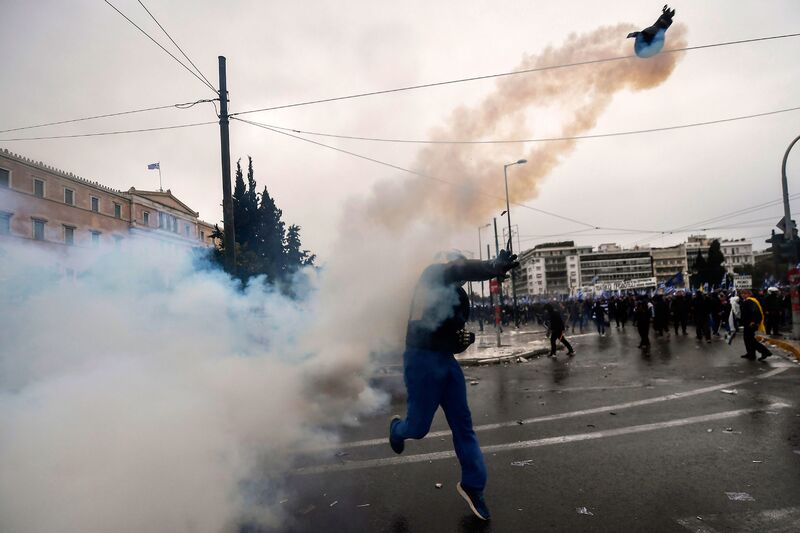
THE SPECTACLE of tear gas clouds swirling through Athens on January 20th was as bewildering to many outsiders as the passions behind the huge (and mostly peaceful) protest rally which went before. More bewildering still may have been the presence among the demonstrators of so many black-robed Greek Orthodox clergy.

What prompted the trouble was an internationally brokered compromise agreement over the name of Greece’s northern neighbour, a deal which the leftist government in Athens is now struggling to squeeze through parliament. After three decades of bitter diplomatic standoff, the neighbouring country agreed last June to change its name from the Republic of Macedonia to Northern Macedonia, while the Greek side formally promised to lift its objections to anybody except itself using any version of the M-word. The renamed country also promised to remove language from its constitution which might have implied territorial claims on Greece. The issue was pressing because Greece had said that without a resolution of the name issue, it would veto its neighbour’s admission to the European Union and NATO.

The issue touches on red-hot questions of national identity and history. In its purest form, the Hellenic version of history holds that the word “Macedonia” should only be applied to the northern extremity of the Greek world, from which Alexander the Great sprang up and fought his way from Greece to India, nearly 2,400 years ago. In the Republic of Macedonia that was proclaimed after communist Yugoslavia broke up in 1991, it was counter-asserted that a separate, non-Greek Macedonian identity had existed for many centuries. The new country, and in particular its ethnic majority which speaks a Slavic language very close to Bulgarian, saw itself as heir to that tradition. After the proclamation of the Republic of Macedonia, Greece launched a diplomatic campaign to press the freshly proclaimed country to change its name, arguing that the use of the word Macedonia was an infringement of historical copyright and a potential threat to its territory. But more than 130 countries, including the United States and Russia, still recognised the new state by the name it preferred.

The compromise deal drew sighs of relief in most Western capitals. But for the busloads of people who came down from northern Greece to Athens over the weekend to join the big demonstration, the “North Macedonia” settlement was giving away too much. Since childhood they have been told that the Greek monopoly on the word Macedonia is sacrosanct: watering it down is blasphemy. With little regard for the idea that maximalism can be counter-productive, they are faithfully repeating what they have been taught by their parents, their teachers and above all by their priests, who are particularly influential in that part of Greece.

Indeed, few segments of society have been so resistant to the possibility of making a bargain as the Greek Orthodox clergy. All 22 bishops from the Greek region of Macedonia responded to the compromise deal by saying that it would merely encourage the neighbouring state in its “irredentism” and “hostility” towards Greece, and that any Greek parliamentarians who vote for the agreement will “blacken their names forever”. Anthimos, the ruling bishop of the northern Greek capital of Thessaloniki, has been especially vocal in his view that the neighbouring state should not be allowed to use any version of the name Macedonia.

Why do emotions run so high among the gentlemen in black clothing? Some clergy in Greece would cite the fact that Macedonia is mentioned more than once in the founding text of their faith, the New Testament, whose original version is in Greek. According to the Book of Acts, chapter 16, the apostle Paul had a dream while he was in present-day Turkey in which a Macedonian man begged him: “come over to Macedonia and help us!” As a result, the Christian pioneer made stormy preaching expeditions to Thessaloniki and the nearby town of Veria. As the Greek clergy see things, all that is part of a Hellenic story.

But in fact one does not need to go back to the New Testament, or to the pre-Christian legacy of Alexander the Great, to understand why the Macedonian question has a strong religious dimension. Much more modern history can be invoked.

First, consider the “Macedonian question” that triggered an exceptionally brutal inter-communal conflict across the southern Balkans in the late 19th and early 20th centuries. This was an era when it looked increasingly obvious that Ottoman Macedonia, the lower swathe of the sultan’s remaining European lands, would soon be wrested from Turkish control. This prospect triggered a bitter competition over who would step into the void: Greece, Bulgaria or Serbia. The contest was waged by irregular fighters with little regard for civilian life.

At least on the surface, the conflict was guided not by contending proto-states but by rival bishops, who under the Ottoman order enjoyed huge personal authority. Individuals and communities caught up in the fighting had to make their choice between loyalty to the Bulgarian church and adherence to Greek bishops subordinate to the ancient Patriarchate of Constantinople, based in Istanbul. After 1904, as a guerrilla war intensified, the most visible leader of the Greek cause was a certain Bishop Germanos Karavangelis, who acted with quiet encouragement from a Greek state that hoped the disputed lands would soon be added to its territory. This whole episode is much romanticised in Greece’s literature and collective conscience, and the clergy’s role in galvanising bands of irregular fighters is generally seen as nothing but admirable.

(In the end, after two short bursts of open inter-state warfare in 1912 and 1913, the territory of Ottoman Macedonia was carved up between Greece, Bulgaria and Serbia, creating borders roughly similar to those of the present day.)

Then switch to another period of bitter fighting in the same region: the Greek civil war of 1946-49, which pitted a communist-led army against pro-government forces backed initially by Britain and then America. A significant segment of the forces fighting on the communist side identified as Slavs; some of these had already taken up arms as part of the leftist-dominated resistance to the Nazi occupation, a cause which straddled the Greek-Yugoslav border. The Greek political right, which included the leaders of the Orthodox church, demonised the communist forces in the civil war as treacherous and territorially ambitious Slavs. Indeed, for conservative anti-communist Greeks of that generation, whether lay or clerical, being anti-Slavic, and equating the Slav neighbours to the north with menacing forms of communism, became almost synonymous with being patriotic. So today, when a right-wing bishop denounces a leftist Greek government for selling out to the northern neighbours, the rhetoric has a familiar ring.

Meanwhile, even among those dreaded communist Slavs, whose official ideology was atheism, some strange manoeuvres were made involving nationalism, religion and clerical politics. The consequences are still being felt in 2019. Communist Yugoslavia, which had broken with the Soviet-led bloc in 1948, generally encouraged its most southerly constituent republic to assert a distinctive Macedonian identity and hence differentiate itself from Bulgaria, which was still loyal to Moscow. As part of that tactic, a self-ruling Macedonian Orthodox church was established in 1967, with the quiet encouragement of the Marxist authorities. Today that church, an heir to that unusual development in inter-communist politics, opposes any compromise with Greece and insists that it will never consider changing its own name.

It is, of course, quite a long time since the cold war and the Macedonian skirmishes of the early 20th century, never mind the apostle Paul or Alexander the Great. So, many might ask, isn’t it time to forgive and forget, especially for leaders of a religion whose ideals include peace, repentance and empathy for others?

On the Greek side, at least, the following might be one answer.

In the course of the 20th century, Greece saw a lot of internal conflict, for example pitting liberals against monarchists, communists against pro-Westerners, colonels against democratic politicians. And in part for that reason, today’s Hellenes tend to idealise the fighting that raged 100 years ago over the future of then-Ottoman Macedonia. It is remembered as a time when all Greeks, from gun-toting bishops to sophisticated diplomats to barely literate peasants, were on the same side, courageously advancing the interests of the nation. And in an era when purely spiritual messages can be hard to get across, the clerics of 2019 seem passionately protective of their share of that legacy.
 
Here's how we know Greeks hate Macedonia and Macedonians, regardless of what they call us.

Mitsotakis: We Will Block Macedonia's EU Prospects Even If the Agreement is Ratified!

https://english.republika.mk/news/macedonia/prespa-or-no-prespa-next-greek-pm-announces-he-will-block-macedonias-eu-accession/

The leader of the Greek conservative New Democracy party Kyriakos Mitsotakis announced that Greece will continue to veto Macedonia’s European Union accession talks, even if the so-called Prespa deal is ratified. Greek Parliament postponed its vote for Friday, and the deal contains a clause that Greece will allow Macedonia to join NATO and then EU under the name of North Macedonia.

Skopje’s EU integration process is not connected to the Prespa agreement. Greece can veto Skopje’s EU integration process at any moment and I refuse to give up this right our fatherland has, Mitsotakis said in the Parliament.

His party leads the socialist SYRIZA coalition by nearly 2:1 and he is widely expected to become the Greek Prime Minister no later than late 2019, which would likely mean that Greece will stop implementing the agreement.

The Prespa agreement should never have been signed and, of course, it should have never been brought for ratification in the Greek Parliament. It represents a national defeat, a national mistake that is an affront to truth and history. While going down, SYRIZA continues with its catastrophic mission. After wrecking both the economy as well as society it is dragging Greece to a permanent upheaval, Mitsotakis said.

His father Konstantinos Mitsotakis was famously removed from power after being perceived as too lenient on Macedonia, and his sister Dora Bakoyannis was Foreign Minister in 2008 when Greece vetoed Macedonia’s NATO membership, violating the then active agreement binding Greece to allow Macedonia’s membership as “the former Yugoslav Republic of Macedonia”.

Still, Mitsotakis said that if the deal is ratified tomorrow, it will supersede other Greek laws, and therefore members of Parliament will have to vote against it. He hinted that if the deal is ratified, Greece will still find technical reasons why it should stop Macedonia from opening EU accession chapters.

Mitsotakis’ move comes as other top New Democracy officials, such as former Prime Minister Kostas Karamanlis and EU Commissioner Dimitris Avramopoulos condemned the deal.
Share on Facebook
 
Back
Top