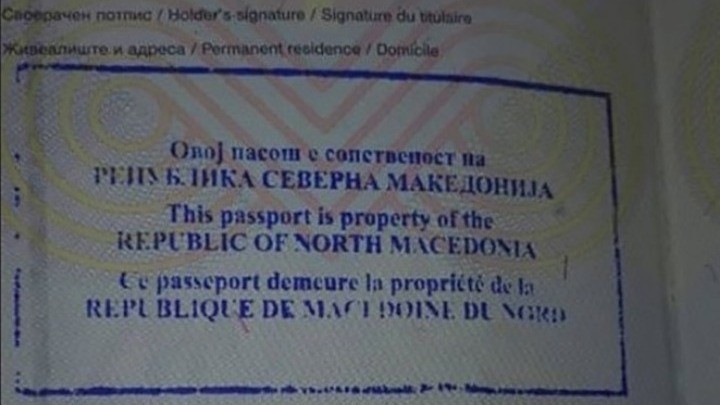
• Welcome to the new Macedonian Truth Forum. All posts, members and private messages have been moved over from the old forum.

    Passwords from the old forum could not be carried over, so please use Forgot your password? to set a new one. The reset link is emailed to the address on your account.

  • Rules and Regulations at the forum of the Macedonian Truth Organisation (MTO)

    (1) The national-ethnic and cultural-linguistic identity of the Macedonian people is historically Macedonian, and derives its character from the native, indigenous and geographic homeland of the Macedonians, which is called Macedonia. To ensure that their human rights, integrity and heritage are appropriately respected, the only nouns and adjectives acceptable when reference is made to the above character and identity markers is Macedon, Macedonia, Macedonian and Macedonians.

    (2) The nation-state of the Macedonian people is the Republic of Macedonia, and is to be referred to by this official title so long as the 'republic' prefix is consistently applied to other states. Alternative references are the Macedonian Republic, or simply, Macedonia.

    (3) The 'ethnic' prefix is only acceptable for Macedonians in cases where differentiation is specifically required - so long as it is in context and consistent where it concerns its application to other ethnic groups.

    (4) Should any other differentiation be specifically required, the names of other ethnic groups that reside with Macedonians in either the Republic of Macedonia or the occupied Macedonian regions in Greece, Bulgaria, Serbia or Albania, are to be given a prefix.

    (5) Negating the identity, language and culture of the Macedonian people by deliberate avoidance of the terms Macedonia, Macedonian and Macedonians, or by any other means, is not permitted.

    (6) Systematic anti-Macedonian propaganda and rhetoric are not permitted.

    (7) Threads irrelevant to the Macedonian Cause, the community at the Macedonian Truth Organisation or the Macedonians in general may be considered as spam or not in the spirit of the forum. In such cases they are not permitted.

    (8) Continual posting of messages in threads with the sole purpose of deviating from the initial topics with the use of unrelated and unnecessary information is not permitted.

    (9) All posts, external articles, reports, etc that are cited in languages other than Macedonian or English, must be accompanied with a translation in one or both of the said languages.

    (10) Despite the possibility of some conversations and debates becoming heated, extreme abuse and/or racism, vulgar language and/or terminology, threats, revelation of personal information about others, harassment, and other such behavior will not be permitted. If deemed necessary all relevant information including member details will be reported to the appropriate authorities for investigation which may result in legal action.

    (11) Threads that are created must have a summary of a topic or excerpt of an article found in pertinent link(s) that have been included. One line threads will be considered unaccetable spam and are therefore not permitted.

    (12) Compulsive and deliberate lies, irrespective of the topic, are not permitted.

    (13) Any symbols or avatars found to be perceived as offensive to Macedonians are not permitted.

    (13) Any explicit or extreme material is not permitted.

    Failure to adhere to the above rules and regulations will result in a ban after 3 breaches. This may be reconsidered in some cases should the circumstances be of an unorthodox nature and/or require special consideration. To assure an effective deterrent against an individual or individuals with the sole purpose of causing dissent through spamming, racism or other improper means, the above rules will be strictly enforced.

    The MTO administration will monitor all discussions as reasonably practical and reserve the right to remove any post and/or member from the forum, and update the rules and regulations as required. Members are encouraged to immediately report any post and/or member to the MTO administration if they feel that these rules have not been abided by.

    The views expressed on this forum are those of the individuals. The only official representation of the MTO is made by the "Macedonian Truth Organisation (Site Owner)" username, and no other.

  • Macedonian Cause

    The Macedonian Truth Organisation calls on God in Heaven to protect, bless and guide the endeavour it is committing to undertake, and that is to work towards:

    Securing Macedonia as a free, independent and democratic republic in which sovereignty lies with the Macedonian citizens; as the nation-state of the Macedonian people in which they can preserve their culture, language and identity; as a state in which the Macedonian language and culture form the basis of public life and act as important unifying elements of Macedonian society; as the home of all its citizens to which it guarantees and obliges their inalienable natural rights and corresponding responsibilities;

    The acknowledgment as self-evident and irrefutable the existence of the:

    1) Indigenous, ethnonational name of Macedonia;
    2) Macedonian people, language and identity;
    3) Macedonian culture, symbols and folklore;
    4) Macedonian ancestry, heritage and history in its entirety; and
    5) Macedonian Orthodox Church;

    Securing recognition by the International Community of the tragedies endured by the Macedonian people, of the division of Macedonia with the signing of the Treaty of Bucharest on August 10, 1913, and the genocide committed against the Macedonian people at the hands of the Greek, Bulgarian and Serbian states and their respective churches during the 19th and 20th centuries;

    Ensuring that the Interim Accord is declared ‘null and void’ and that all constitutional provisions, acts, commitments, agreements, legislation, regulations, policies or programs emanating from, supporting or consequential to the Interim Accord are also declared ‘null and void’, including the use of any symbols and the completion of any acts imposed by, or originating from, the Interim Accord.

    Ensuring that the Framework Agreement is abolished and that all constitutional provisions, acts, commitments, agreements, legislation, regulations, policies and programs emanating from, supporting or consequential to the Framework Agreement are also abolished and replaced by a framework of constitutional and statutory law based on inalienable natural rights and corresponding responsibilities and universally codified human rights mechanisms.

    Securing the abolishment of any existing constitutional provisions, acts, agreements, legislation, regulations, policies and programs that discriminate against the Macedonian people, in any international organisation or any of the countries of the International Community where such constitutional provisions, acts, agreements, legislation, regulations, policies and programs exist, and thereby ensuring the freedom for Macedonians to exercise their inalienable natural rights and fulfil their corresponding responsibilities, and practice their culture, language and religious faiths in all the countries of the International Community without hindrance;

    The empowerment of Macedonians to undertake a moral revolution and to instil and/or reinvigorate within themselves a deep-rooted national, cultural, linguistic and historical dignity and a commitment to the exercise of freedom based on inalienable natural rights and corresponding responsibilities;

    The recognition of the Macedonian minorities in the neighbouring states of Macedonia as well as the respect for the inalienable rights and freedoms of the Macedonian minorities, as provided for by natural law and as codified by the United Nations Charter, the Universal Declaration of Human Rights and other universally codified human rights mechanisms;

    The full and unreserved respect of, and the support for, the rights of all people of non-Macedonian descent living in Macedonia and around the world, who share a reciprocal full and unreserved respect for the Macedonian people, their homeland and their state;

    The cultural unification and solidarity of the Macedonian people living in all parts of historical Macedonia and adjacent territories, as well as Macedonians throughout the world;

    The unity of all Macedonians on the principles, objectives and achievement of the Macedonian cause as defined by this declaration.

Macedonia & Greece: Name Issue

Macedonia & Greece: Name Issue

  • .

    Votes: 5 62.5%
  • .

    Votes: 3 37.5%

  • Total voters
    8
I haven't seen anything like that yet. But then again, this is Wikipedia and it's no secret that the Macedonian pages are infested with Greek and Bulgarian idiots denigrating our history.
 
User 'Jingby' is one of those vultures that sticks out like a sore thumb. What type of loser makes 5 wikipedia edits that relate to Macedonian matters everyday day since 2006, unless he is a paid shill.
 
Last edited:
User 'Jingby' is one of those vultures that sticks out like a sore thumb. What type of loser makes 5 wikipedia edits that relate to Macedonian matters everyday day since 2006, unless he is a paid shill.
A Greek guy working from his command centre which is also his mum's basement.
 
A Greek guy working from his command centre which is also his mum's basement.

I found him...

Dyx2AdaXgAAdZom.jpg:large
 
Last edited:
The Greek Secret Intelligence Agency just posted a job ad that it is looking for people who speak the "Macedonian (South Slavic) language" lol
 
News Outlets Using "North Macedonians"

News Outlets Using "North Macedonians"

I am going to post news sites that describe Macedonians as North Macedonians -- either for people to contact to tell them we're not North Macedonians, or to use to slap Northadonians in the face with, who have said that no one will call us North Macedonians because the agreement doesn't say that.

To be fair, I don't really blame all news sites when a country changes its name. However, I know for us who aren't North Macedonians (Diaspora Macedonians and Egejsko Macedonians in Greece), we still should probably fight for our dignity and pride.


Here's one example:

As most readers will know, the contentious Greek ratification procedure for the Prespes Agreement ended with its passage in a vote January 25, with a margin of just three votes (153/300). That deal, signed in June 2018, is designed to resolve the Name Dispute once and for all between Greece and its northern neighbour, now renamed as North Macedonia. Just a few technical steps are required under the terms of the Prespes Agreement to enter into force, but for all intents and purposes, the work is complete.

New Europe will now refer to North Macedonia, the country’s newly-approved constitutional name. We have been careful to refer to the country as Macedonia/FYROM up to this point and will use that term only in a historical context or if the discussion requires this for clarity. We will use the adjective “North Macedonian” as needed, slightly shorter than the term “of North Macedonia” which the Prespes deal spells out.

And much like New Yorkers and New Zealanders are described in a two-word moniker, New Europe will describe the country’s citizens as North Macedonians, hoping to avoid the term “Macedonian/citizen of the Republic of North Macedonia” as spelt out in the Prespes Agreement. We hope our journalistic colleagues will refrain from shortening the adjective to a one-word term, as this shortcut serves to undercut most of what the Prespes Agreement is said to have attained, the use of one name for all purposes. This will take time.

The entry of North Macedonia into NATO is long overdue, but it should not be seen as the ultimate guarantee of stability in the Western Balkans, simply a new hard barrier aimed at Moscow. As for NATO’s track record, all one has to do is to look at how little success NATO has had through the years in calming Greek-Turkish competition over the Aegean.

North Macedonia’s entry into the EU will take years to negotiate and may well occur at a time when the EU itself is being deconstructed or reconstructed. Get out your crystal balls.

The deal’s supporters should refrain from praising the Prespes Agreement too loudly and simply get down to the business of solidly anchoring North Macedonia into Euro-Atlantic intuitions. It is not the best of the best by any means. There are valid concerns that democratic practices were circumvented in the battle to get the Prespes Agreement ratified in both Greece and North Macedonia. The current Greek leadership steadfastly refused to consider asking its people about the deal in a referendum or requiring a 2/3 majority to ratify it in Parliament, while in North Macedonia the failed September 30 referendum was ignored, questionable practices were used to secure key opposition party votes when needed, as well as the position of the country’s popularly-elected President somehow bypassed.

To numerous observers, it appeared at times both countries’ leaders spent more time fighting public opinion in their own countries than in negotiating a balanced mutually-beneficial deal with the UN’s help.

New Europe will be watching for key world powers to recognize North Macedonia by its new constitutional name, as many have long promised. This is important and should not be delayed. Likewise, we are on the alert for Russia’s threat to use its UN Security Council veto whenever an attempt is made to remove the old Name Dispute from the UN agenda. The last chapter may not have been completed yet.

https://www.neweurope.eu/article/welcome-north-macedonia/
 
Komiti with message at Champions League match Vardar - Veszprem

https://kurir.mk/sport/rakomet/vardar-zagubi-no-i-da-pobedeshe-natprevarot-kje-se-pomni-po-porakata/

Вардар загуби, но и да победеше, натпреварот ќе се помни по пораката…!


По феномоменалното прво полувреме, Вардар одигра катастрофално против Веспрем во второто полувреме и загуби со 27:29, но и да победеше, натпреварот сепак ќе се помни по пораката што од него ја испратија навивачите.
 
Во ООН и официјално Р. С. Македонија, јазикот македонски, опција за идентитет македонски

Обединетите нации и официјално го променија називот на земјава.

URL:
https://kanal5.com.mk/articles/3664...kot-makedonski-opcija-za-identitet-makedonski

Во графата на земјите членки, на местото ПЈРМ сега стои името Северна Македонија во списокот на признати држави, кои се подредени по азбучен ред.

Language: Macedonian language / Јазик: Македонски јазик

Inhabitants: Macedonian/citizen of the Republic of North Macedonia

Adjective: Of the Republic of North Macedonia, or North Macedonia or Macedonian

Граѓани: Македонци/Граѓани на Република Северна Македонија

Придавки: од Република Северна Македонија, од Северна Македонија или Македонци

Во делот на јазикот, на сајтот стои македонски јазик, но без ознаката дека припаѓа на словенската група на јазици. Додека пак во делот на граѓани на државата стои Македонци/Граѓани на Република Северна Македонија, со додадени придавки “од Република Северна Македонија, од Северна Македонија или Македонци. Новинарите денеска за објавеното на сајтот на ООН сакаа да го прашаат лидерот на ВМРО-ДПМНЕ Христијан Мицкоски, кој во своите тези до сега стоеше на ставот дека е изгубен јазикот и идентитетот, но тој не сакаше да даде коментар надвор од темата на партиската конвенција.

Но, сепак од партијата подоцна излегоа со став.

На сајтот на ООН исто така стои и појаснување на референците на државата и официјалните органи за новото име, каде е наведено дека официјалните орани и други јавни субјекти за активности во странство ќе го користат официјалното име или скратеното, односно, “од Република Северна Македонија” или “Северна Македонија”, додека пак сите останати придавки вклучувајќи ги и оние кои се однесуваат на приватни субјекти за активности во странство може да бидат македонски.

Од Република Северна Македонија или Северна Македонија – Официјални органи и јавни субјекти

Промената на официјалниот сајт на ООН доаѓа откако Скопје и Атина со заедничко писмо ја информираа организацијата за официјалното стапување во сила на договорот од Преспа. Од кабинетот на Генералниот секретар Антонио Гутереш, во таа прилика изјавија дека тој им честитал на двете страни за нивната определба да стават крај на 27 годишниот спор.

http://www.un.org/en/member-states/

XdXBR95.jpg


bub0tLi.jpg
 
Tsipras and Zaev were praised at the Munich Security Conference yesterday. While answering a journalist's question on what advice he would give to Greece's Balkan neighbors, Tsipras replied that the Balkan countries must "respect human rights, and respect their minorities"
 
Tsipras and Zaev were praised at the Munich Security Conference yesterday. While answering a journalist's question on what advice he would give to Greece's Balkan neighbors, Tsipras replied that the Balkan countries must "respect human rights, and respect their minorities"

Having a sense of humour without doubt helps Tsipras do his job
 
North Macedonia has a name. What’s next?

February 18, 2019
Craig Turp

URL:
https://emerging-europe.com/intelligence/north-macedonia-has-a-name-whats-next/

Now that one of the silliest international disputes of recent decades has been resolved, Greece will no longer veto Macedonia's (now officially North Macedonia) membership of international organisations. But while NATO membership could happen relatively quickly, nobody should expect EU membership anytime soon.

NATO, when it wants to, can act very quickly. Less than a week after the Greek parliament voted to sign off on the deal that will see the Republic of Macedonia officially become the Republic of North Macedonia, NATO approved the newly-renamed country’s accession protocol. Once the protocol is signed by NATO’s existing 29 members, North Macedonia will be able to take part in the organisation’s activities as an invitee. Full membership should be possible by the end of 2020.

The markets have reacted positively. North Macedonia’s 2025 sovereign bond hit a one-year high as NATO Secretary General Jens Stoltenberg welcomed the final confirmation of the so-called Prespa Agreement as “an important contribution to the stability and prosperity of the whole region.”

Ancient heritage

The name Republic of Macedonia was adopted immediately after the country declared independence from the former Yugoslavia in 1991. It had been recognised as such by more than 130 countries, but not by the United Nations, NATO or the European Union, in all three cases because of the objections of Greece, which claimed that the term ‘Macedonia’ usurped its own ancient heritage and implied territorial ambitions on its northern province of the same name, the birthplace of Alexander the Great.

The 27-year-long dispute was finally resolved in June 2018 when, after months of often delicate negotiations, Macedonian Prime Minister Zoran Zaev and his Greek counterpart Alexis Tsipras signed an agreement in the town of Prespa, which sits on the border between the two countries.

“This agreement preserves the Macedonian ethnic and cultural identity,” said Mr Zaev at the time. “Both our language and our people will continue to be known as Macedonian.”

While there was broad popular support in Macedonia for the Prespa deal, not everyone was happy. The opponents of the agreement were led by the country’s president, Gjorge Ivanov, who went so far as to call for a boycott of a referendum on the deal from the pulpit of the UN General Assembly in New York, claiming that it was “a flagrant violation of sovereignty.”

Russia was also less than pleased.

Prespa has unquestionably raised tensions between Russia and the West, exacerbated by Montenegro joining NATO in 2017 and leaving, once and for all, Russia’s circle of influence. “Moscow now sees Macedonia as crucial,” says Blerim Reka, a professor at the South East European University.

Russia invested heavily in the referendum. “The Russian propaganda machine was running at full steam,” says Mr Reka, “mostly through Serbian media, including the Belgrade offices of the Sputnik news service and the RT (formerly Russia Today) television network. Hundreds of anti-referendum websites popped up and began disseminating misinformation. Such activity did not go unnoticed: the US Congress allocated eight million US dollars for Macedonia to fight Russian disinformation campaigns.”

At what cost?

Mr Ivanov’s calls for a boycott and Russia’s interference in the referendum did not, ultimately, matter. While turnout was low – below the threshold that would have made its result binding – Mr Zaev was over the following months able to push the name change through a fractured parliament despite the opposition of nationalist parties and the president.

The biggest question now, however, is at what cost did he do so? Mr Zaev was forced to make a number of concessions to opposition MPs, some of which could place new obstacles on North Macedonia’s path towards the EU, freshly cleared of a Greek veto.

“North Macedonia’s EU accession will take far longer than NATO membership,” Maximilien Lamberston, a leading analyst at the Economist Intelligence Unit, told Emerging Europe. “While Greece will remove its veto on opening accession talks, there is still a risk that the European Commission does not recommend opening talks with North Macedonia in June this year. This could either be due to anti-enlargement sentiment deepened by eurosceptic parties performing well in the May European parliamentary elections or due to concerns that North Macedonia has made insufficient progress on improving the rule of law. Paradoxically, the political bargaining involved in passing the constitutional amendments to change Macedonia’s name (which it did to unlock EU accession), included granting amnesty to opposition MPs facing trial, which critics say undermined the rule of law and judicial independence, key requirements for EU membership. However, it would be a blow to Zoran Zaev if the EU were to demand more reforms before even opening negotiations, given the political capital Mr Zaev spent in changing his country’s name.”

A major win for the West

There are also concerns that Russia, whose opposition to Macedonia’s NATO membership remains, may make one final attempt to throw North Macedonia’s plans off course by using its UN Security Council veto to torpedo the new name.

Russian Foreign Minister Sergei Lavrov implied that it would do just that shortly after the referendum last year, when he stated that the new name would have to be reviewed by the Security Council under Resolution 845. It has yet to comment on the Greek vote, but as the American analyst Janusz Bugajski has noted, “Moscow sees its stronghold in Macedonia in [the context of] its fight against the EU and NATO” and wants to turn it into “another Republika Srpska entity” – the autonomous, pro-Russian region of Bosnia and Herzegovina, which has worked to keep that country out of Euro-Atlantic structures.

For all Russia’s anger at the deal – indeed, perhaps because of Russia’s anger – Prespa needs to be viewed as a major win for the West. Not that it will not have time to congratulate itself. North Macedonia needs more than just vague promises from its allies over the next few months.

An Open Society Foundations report, published shortly before the Greek vote, outlined the potential for disaster: “If the EU is reluctant to unblock Macedonia’s EU accession path, even after the Prespa deal, then we return to the situation before the European political re-engagement of 2017 – where the Kremlin was free to spread its influence in the Western Balkans unhindered.”

North Macedonia will hold a presidential election in April, and an early parliamentary election will almost certainly follow later in the summer. Should ordinary Macedonians see no immediate benefit from the name change – which many supported with a heavy heart – they may turn against Mr Zaev and his pro-European agenda in large numbers, ushering in a nationalist government that could halt the country’s progress towards the EU before it has even begun.
 
Last edited:
While there was broad popular support in Macedonia for the Prespa deal....
He says the above, then shortly afterwards follows with the below:
Mr Ivanov’s calls for a boycott and Russia’s interference in the referendum did not, ultimately, matter. While turnout was low – below the threshold that would have made its result binding – Mr Zaev was over the following months able to push the name change through a fractured parliament despite the opposition of nationalist parties and the president.
Another example of contradictory double-speak and double standards from a western moron.
 
No, turnout for the referendum just means they were lazy. Allowing the treachery to continue without any resistance suggests broad popular support.

A valid alternate perspective.
 
Back
Top