• Welcome to the new Macedonian Truth Forum. All posts, members and private messages have been moved over from the old forum.

    Passwords from the old forum could not be carried over, so please use Forgot your password? to set a new one. The reset link is emailed to the address on your account.

  • Rules and Regulations at the forum of the Macedonian Truth Organisation (MTO)

    (1) The national-ethnic and cultural-linguistic identity of the Macedonian people is historically Macedonian, and derives its character from the native, indigenous and geographic homeland of the Macedonians, which is called Macedonia. To ensure that their human rights, integrity and heritage are appropriately respected, the only nouns and adjectives acceptable when reference is made to the above character and identity markers is Macedon, Macedonia, Macedonian and Macedonians.

    (2) The nation-state of the Macedonian people is the Republic of Macedonia, and is to be referred to by this official title so long as the 'republic' prefix is consistently applied to other states. Alternative references are the Macedonian Republic, or simply, Macedonia.

    (3) The 'ethnic' prefix is only acceptable for Macedonians in cases where differentiation is specifically required - so long as it is in context and consistent where it concerns its application to other ethnic groups.

    (4) Should any other differentiation be specifically required, the names of other ethnic groups that reside with Macedonians in either the Republic of Macedonia or the occupied Macedonian regions in Greece, Bulgaria, Serbia or Albania, are to be given a prefix.

    (5) Negating the identity, language and culture of the Macedonian people by deliberate avoidance of the terms Macedonia, Macedonian and Macedonians, or by any other means, is not permitted.

    (6) Systematic anti-Macedonian propaganda and rhetoric are not permitted.

    (7) Threads irrelevant to the Macedonian Cause, the community at the Macedonian Truth Organisation or the Macedonians in general may be considered as spam or not in the spirit of the forum. In such cases they are not permitted.

    (8) Continual posting of messages in threads with the sole purpose of deviating from the initial topics with the use of unrelated and unnecessary information is not permitted.

    (9) All posts, external articles, reports, etc that are cited in languages other than Macedonian or English, must be accompanied with a translation in one or both of the said languages.

    (10) Despite the possibility of some conversations and debates becoming heated, extreme abuse and/or racism, vulgar language and/or terminology, threats, revelation of personal information about others, harassment, and other such behavior will not be permitted. If deemed necessary all relevant information including member details will be reported to the appropriate authorities for investigation which may result in legal action.

    (11) Threads that are created must have a summary of a topic or excerpt of an article found in pertinent link(s) that have been included. One line threads will be considered unaccetable spam and are therefore not permitted.

    (12) Compulsive and deliberate lies, irrespective of the topic, are not permitted.

    (13) Any symbols or avatars found to be perceived as offensive to Macedonians are not permitted.

    (13) Any explicit or extreme material is not permitted.

    Failure to adhere to the above rules and regulations will result in a ban after 3 breaches. This may be reconsidered in some cases should the circumstances be of an unorthodox nature and/or require special consideration. To assure an effective deterrent against an individual or individuals with the sole purpose of causing dissent through spamming, racism or other improper means, the above rules will be strictly enforced.

    The MTO administration will monitor all discussions as reasonably practical and reserve the right to remove any post and/or member from the forum, and update the rules and regulations as required. Members are encouraged to immediately report any post and/or member to the MTO administration if they feel that these rules have not been abided by.

    The views expressed on this forum are those of the individuals. The only official representation of the MTO is made by the "Macedonian Truth Organisation (Site Owner)" username, and no other.

  • Macedonian Cause

    The Macedonian Truth Organisation calls on God in Heaven to protect, bless and guide the endeavour it is committing to undertake, and that is to work towards:

    Securing Macedonia as a free, independent and democratic republic in which sovereignty lies with the Macedonian citizens; as the nation-state of the Macedonian people in which they can preserve their culture, language and identity; as a state in which the Macedonian language and culture form the basis of public life and act as important unifying elements of Macedonian society; as the home of all its citizens to which it guarantees and obliges their inalienable natural rights and corresponding responsibilities;

    The acknowledgment as self-evident and irrefutable the existence of the:

    1) Indigenous, ethnonational name of Macedonia;
    2) Macedonian people, language and identity;
    3) Macedonian culture, symbols and folklore;
    4) Macedonian ancestry, heritage and history in its entirety; and
    5) Macedonian Orthodox Church;

    Securing recognition by the International Community of the tragedies endured by the Macedonian people, of the division of Macedonia with the signing of the Treaty of Bucharest on August 10, 1913, and the genocide committed against the Macedonian people at the hands of the Greek, Bulgarian and Serbian states and their respective churches during the 19th and 20th centuries;

    Ensuring that the Interim Accord is declared ‘null and void’ and that all constitutional provisions, acts, commitments, agreements, legislation, regulations, policies or programs emanating from, supporting or consequential to the Interim Accord are also declared ‘null and void’, including the use of any symbols and the completion of any acts imposed by, or originating from, the Interim Accord.

    Ensuring that the Framework Agreement is abolished and that all constitutional provisions, acts, commitments, agreements, legislation, regulations, policies and programs emanating from, supporting or consequential to the Framework Agreement are also abolished and replaced by a framework of constitutional and statutory law based on inalienable natural rights and corresponding responsibilities and universally codified human rights mechanisms.

    Securing the abolishment of any existing constitutional provisions, acts, agreements, legislation, regulations, policies and programs that discriminate against the Macedonian people, in any international organisation or any of the countries of the International Community where such constitutional provisions, acts, agreements, legislation, regulations, policies and programs exist, and thereby ensuring the freedom for Macedonians to exercise their inalienable natural rights and fulfil their corresponding responsibilities, and practice their culture, language and religious faiths in all the countries of the International Community without hindrance;

    The empowerment of Macedonians to undertake a moral revolution and to instil and/or reinvigorate within themselves a deep-rooted national, cultural, linguistic and historical dignity and a commitment to the exercise of freedom based on inalienable natural rights and corresponding responsibilities;

    The recognition of the Macedonian minorities in the neighbouring states of Macedonia as well as the respect for the inalienable rights and freedoms of the Macedonian minorities, as provided for by natural law and as codified by the United Nations Charter, the Universal Declaration of Human Rights and other universally codified human rights mechanisms;

    The full and unreserved respect of, and the support for, the rights of all people of non-Macedonian descent living in Macedonia and around the world, who share a reciprocal full and unreserved respect for the Macedonian people, their homeland and their state;

    The cultural unification and solidarity of the Macedonian people living in all parts of historical Macedonia and adjacent territories, as well as Macedonians throughout the world;

    The unity of all Macedonians on the principles, objectives and achievement of the Macedonian cause as defined by this declaration.

Macedonian Flags and Coat of Arms


Cote Paris - Bibl. Sainte-Geneviève - ms. 3005
f. 019v
Sujet Alexandre
Auteur Sébastien Mamerot
Titre Trois Grands (Les)
Datation vers 1500
 
Peniarth 481D is a manuscript written on parchment in the late 15th century. The manuscript is in two parts, and it is likely that both parts were bound together as one volume from the outset, probably in England. This is one of the most elaborately decorated medieval manuscripts in the Library, and a rare survival in its original binding.
Contents
The first part of the manuscript was written by an English scribe and illustrated by a Flemish artist. It contains two texts:
the popular Latin textbook of proverbial advice called Disticha Catonis (‘The Distichs of Cato’), with Benedict Burgh’s Middle English paraphrase in rhyme royal interposed (ff. 1-27);
the Latin text of Historia de preliis Alexandri Magni (‘The History of Alexander’s Battles’, J1 version), based on a 10th century translation into Latin by Leo of Naples of a Greek text (ff. 30-98).

The second part of the manuscript was written and illuminated in Cologne (ff. 99-167). It contains John of Hildesheim’s 14th century Historia trium Regum (‘History of the Three Kings’), accounting for the presence in Cologne of the relics of the Magi mentioned in Matthew’s Gospel.
The first part of the manuscript is illustrated with 30 miniatures in a Flemish style. Four miniatures, mainly of author and translator, illustrate the Disticha Catonis, whilst the Historia de preliis has 26, several subdivided to give a total of 47 subjects. The popular medieval legendary account of the life of Alexander the Great was an ideal text for the illustrator, and the text is also lavishly decorated with borders and gilded initials.
This is one of a few medieval manuscripts at the National Library of Wales to retain its original binding. It is bound in wooden boards, covered with crimson velvet, and retains brass bosses, corner pieces and pins and fastenings for thongs. It was probably bound in England in the late 15th century.
The manuscript’s early history is shrouded in mystery. It was owned by Sir John Cutts of Childerly, Cambridgeshire (d. 1615) and his near-contemporary Thomas Gawdy of Snitterton, Norfolk. Subsequently, it may have been part of the library of Sir Kenelm Digby (1603-1665), whose grand-daughter married Richard Mostyn (1658-1735) of Penbedw, Flintshire. The Penbedw bookplate attests to its presence there at the beginning of the 19th century, before the manuscript passed by descent and marriage to Peniarth, Merioneth. It was excluded from the sale of Peniarth manuscripts to Sir John Williams in 1904, but was later bought by philanthropists Miss Gwendoline and Miss Margaret Davies of Gregynog, who presented the volume to the National Library of Wales in 1921.
http://www.llgc.org.uk/index.php?id=4432


Alexander, mounted on Bucephalus,


Alexander’s first victory over Darius, the Persian king (f. 51v.)


he murder of Darius by his own generals; Alexander at the side of the dying king


Alexander and his men facing amazing beasts across a river (f. 68v.)


Alexander fighting a crowned dragon; long-haired women emerging from a river (f. 90)


Alexander’s third victory over Darius; Darius escaping over the river in a cart


Alexander’s first victory over Porus (f. 64)


Alexander killing Porus in single combat before their armies


Alexander fighting the dog-headed Cynocephali (f. 92)


Nectanebus enthroned, with courtiers, receiving a sealed document bearing news of Artaxerxes’ threatened invasion; Nectanebus in his chamber bewitching Artaxerxes’ fleet in a basin of water


What I was found interesting about this picture from the same book is the coat of arms on the throne....

Nectanebus
Irish - (360-343 bc). An Egyptian pharaoh and magician. Son of Tjahepimu. Father of Scota. He was the last of the native Egyptian rulers. In some stories he was the father of Alexander the Great. He was forced to flee from Egypt and went to Macedonia where he set himself up as an astrologer. When the queen, Olympias, consulted him about a possible heir, the wily Egyptian foretold that she would bear a son to Zeus Ammon. This turned out to be true but Zeus Ammon was Nectanebus dressed as a dragon. He died when Alexander, the son of this union, pushed him into a pit. In Irish stories, Nectanebus was the father of Scota. In some accounts, called Nectanebus, Nakhthoreb, Nakhthoreb, Nectanebo II, Nectanebo II, Nakhthorheb or Nakhthorheb.
http://www.mythologydictionary.com/nectanebus-mythology.html
 
I know these have been posted before but I thought I'll add them here aswell


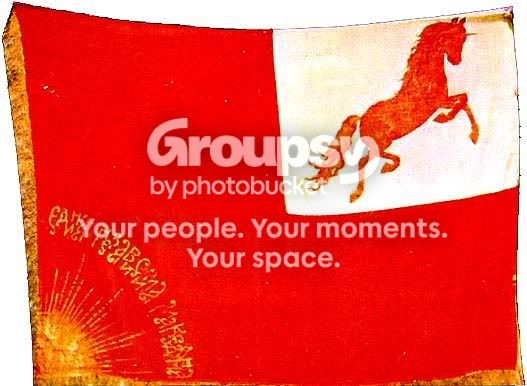
flag of the emigrant ethnic Macedonian revolutionary society in St. Petersburg, Russia, 1914 feat. Alexander’s horse, represented as an unicorn according to the old legend, and a sun symbol in the bottom left angle

SG4011.jpg


Another one...

 
you know how the greeks are saying we stole their sun symbol ell we used it long before 1988 greeks findings.They had no justification to stop us using it.Now they got it our name is next.
 
Jean de Courcy wrote his gigantic chronicle 1416-1422. Its popular title "La Bouquechardière" is taken from the name of the author's estate as seigneur de Bourg-Achard in Normandy


The Third Macedonian War (171–168 BC) was a war fought between Rome and King Perseus of Macedon.

 
Fol.286v How the inhabitants of Babylon gave the keys of the city to Alexander the Great (356-323 BC) from the manuscript by Jean Vauquelin, from the 'Histoire du Grand Alexandre', 1460 (vellum)


Das Erneuerte und vermehrte Teutsche Wappenbuch. 1. Tl. (von 5). Nbg., Fürst 1657. Qu.8°. Mit gest. Tit. u. 230 (4 teilkolor.) Taf. mit Wappenkupfern. 38 Bl. Prgt. d. Zt. (Rckn. mir Ausriss, etw. fl. u. best.).


Vgl. Lipperheide Rc 10. Von Berchem I, 573. Bernd 2296. - Der gest. Titel dat. 1657. - Erster Teil der durch Fürst besorgten vierten Ausgabe des "Teutschen Wappenbuches". Siebmacher selbst erlebte nur die erste Ausgabe von Bd. I u. II 1605-09, nach seinem Tode wurden die Platten von Fürst erworben. - Ränder leicht gebräunt, erstes Textbl. mit ergänztem Eckabschn. (ohne Textverlust).

google translate:

he Renewed and increased Teutsche crests. 1 Tl (of 5). Nbg., Prince 1657th Qu.8 °. (Teilkolor 4th) with Titus died and 230 Plate with crest engravings. 38 Bl PRGT. calf (Rckn. me avulsion, sth fl u best.).


See Lipperheide Rc 10 Berchem I, 573 Bernd 2296. - The engraved title dated 1657th - Part of worried by Prince fourth edition of the "Germans Crest Book." Siebmacher himself experienced only the first edition of Volume I & II 1605-09, after his death, the plates were acquired by Prince. - Edges slightly browned, first Textbl. supplemented with Eckabschn. (Without loss of text).

http://www.kiefer.de/auktion_artikel_details.aspx?KatNr=648&Auktion=82


Folio : 285v
Rubrique : comment alexandre fist tuer XIII des plus sedicieux les aultres se mettent en toute obeissance et il ne les veult escouter. VIIe chapitre
Légende : alexandre et soldats prisonniers
Descripteurs : alexandre, armure, dais, prisonnier, roi, trône
Inscriptions : -
Notes :
Auteur, titre : quintus curtius, historiae alexandri magni (trad. vasque de lucène)
Titre d'usage :
Nom de pays : belgique
Origine : bruges
Siècle : 15ème siècle
Date : 3e quart
Artiste : loyset liédet (atelier)


Folio : 12
Rubrique : comment alexandre passa les desers des sussiccans. chapitre. XV
Légende : alexandre traversant la sogdiane
Descripteurs : alexandre, armée, cavalier, désert, harnais, paysage, planète, reflet, roi, sogdiane, éperon
Inscriptions : -
Notes :
Auteur, titre : quintus curtius, historiae alexandri magni (trad. vasque de lucène)
Titre d'usage :
Nom de pays : belgique
Origine : bruges
Siècle : 15ème siècle
Date : vers 1470-1480
 

Embalming the body of Alexander


Bibliothèque nationale de France, Département des Manuscrits, Division occidentale
Cote : Français 711
Auteur/Titre : quintus curtius, historiae alexandri magni (trad. vasque de lucène)
Titre d'usage :
Nom de pays : france
Origine : paris
Siècle : 15ème-16ème siècle
Date :
Artiste : jean pichore
 
Auteur, titre : quintus curtius, historiae alexandri magni (trad. vasque de lucène)
Titre d'usage :
Nom de pays : belgique
Origine : bruges
Siècle : 15ème siècle
Date : vers 1470-1480
Artiste :


ConsulterElementNuFrançais 257, fol. 103v, Bataille entre macédoniens et ariens (-330)m (1)


fol. 168v, bataille de l'hydaspe (-326)
 
Back
Top