• Welcome to the new Macedonian Truth Forum. All posts, members and private messages have been moved over from the old forum.

    Passwords from the old forum could not be carried over, so please use Forgot your password? to set a new one. The reset link is emailed to the address on your account.

  • Rules and Regulations at the forum of the Macedonian Truth Organisation (MTO)

    (1) The national-ethnic and cultural-linguistic identity of the Macedonian people is historically Macedonian, and derives its character from the native, indigenous and geographic homeland of the Macedonians, which is called Macedonia. To ensure that their human rights, integrity and heritage are appropriately respected, the only nouns and adjectives acceptable when reference is made to the above character and identity markers is Macedon, Macedonia, Macedonian and Macedonians.

    (2) The nation-state of the Macedonian people is the Republic of Macedonia, and is to be referred to by this official title so long as the 'republic' prefix is consistently applied to other states. Alternative references are the Macedonian Republic, or simply, Macedonia.

    (3) The 'ethnic' prefix is only acceptable for Macedonians in cases where differentiation is specifically required - so long as it is in context and consistent where it concerns its application to other ethnic groups.

    (4) Should any other differentiation be specifically required, the names of other ethnic groups that reside with Macedonians in either the Republic of Macedonia or the occupied Macedonian regions in Greece, Bulgaria, Serbia or Albania, are to be given a prefix.

    (5) Negating the identity, language and culture of the Macedonian people by deliberate avoidance of the terms Macedonia, Macedonian and Macedonians, or by any other means, is not permitted.

    (6) Systematic anti-Macedonian propaganda and rhetoric are not permitted.

    (7) Threads irrelevant to the Macedonian Cause, the community at the Macedonian Truth Organisation or the Macedonians in general may be considered as spam or not in the spirit of the forum. In such cases they are not permitted.

    (8) Continual posting of messages in threads with the sole purpose of deviating from the initial topics with the use of unrelated and unnecessary information is not permitted.

    (9) All posts, external articles, reports, etc that are cited in languages other than Macedonian or English, must be accompanied with a translation in one or both of the said languages.

    (10) Despite the possibility of some conversations and debates becoming heated, extreme abuse and/or racism, vulgar language and/or terminology, threats, revelation of personal information about others, harassment, and other such behavior will not be permitted. If deemed necessary all relevant information including member details will be reported to the appropriate authorities for investigation which may result in legal action.

    (11) Threads that are created must have a summary of a topic or excerpt of an article found in pertinent link(s) that have been included. One line threads will be considered unaccetable spam and are therefore not permitted.

    (12) Compulsive and deliberate lies, irrespective of the topic, are not permitted.

    (13) Any symbols or avatars found to be perceived as offensive to Macedonians are not permitted.

    (13) Any explicit or extreme material is not permitted.

    Failure to adhere to the above rules and regulations will result in a ban after 3 breaches. This may be reconsidered in some cases should the circumstances be of an unorthodox nature and/or require special consideration. To assure an effective deterrent against an individual or individuals with the sole purpose of causing dissent through spamming, racism or other improper means, the above rules will be strictly enforced.

    The MTO administration will monitor all discussions as reasonably practical and reserve the right to remove any post and/or member from the forum, and update the rules and regulations as required. Members are encouraged to immediately report any post and/or member to the MTO administration if they feel that these rules have not been abided by.

    The views expressed on this forum are those of the individuals. The only official representation of the MTO is made by the "Macedonian Truth Organisation (Site Owner)" username, and no other.

  • Macedonian Cause

    The Macedonian Truth Organisation calls on God in Heaven to protect, bless and guide the endeavour it is committing to undertake, and that is to work towards:

    Securing Macedonia as a free, independent and democratic republic in which sovereignty lies with the Macedonian citizens; as the nation-state of the Macedonian people in which they can preserve their culture, language and identity; as a state in which the Macedonian language and culture form the basis of public life and act as important unifying elements of Macedonian society; as the home of all its citizens to which it guarantees and obliges their inalienable natural rights and corresponding responsibilities;

    The acknowledgment as self-evident and irrefutable the existence of the:

    1) Indigenous, ethnonational name of Macedonia;
    2) Macedonian people, language and identity;
    3) Macedonian culture, symbols and folklore;
    4) Macedonian ancestry, heritage and history in its entirety; and
    5) Macedonian Orthodox Church;

    Securing recognition by the International Community of the tragedies endured by the Macedonian people, of the division of Macedonia with the signing of the Treaty of Bucharest on August 10, 1913, and the genocide committed against the Macedonian people at the hands of the Greek, Bulgarian and Serbian states and their respective churches during the 19th and 20th centuries;

    Ensuring that the Interim Accord is declared ‘null and void’ and that all constitutional provisions, acts, commitments, agreements, legislation, regulations, policies or programs emanating from, supporting or consequential to the Interim Accord are also declared ‘null and void’, including the use of any symbols and the completion of any acts imposed by, or originating from, the Interim Accord.

    Ensuring that the Framework Agreement is abolished and that all constitutional provisions, acts, commitments, agreements, legislation, regulations, policies and programs emanating from, supporting or consequential to the Framework Agreement are also abolished and replaced by a framework of constitutional and statutory law based on inalienable natural rights and corresponding responsibilities and universally codified human rights mechanisms.

    Securing the abolishment of any existing constitutional provisions, acts, agreements, legislation, regulations, policies and programs that discriminate against the Macedonian people, in any international organisation or any of the countries of the International Community where such constitutional provisions, acts, agreements, legislation, regulations, policies and programs exist, and thereby ensuring the freedom for Macedonians to exercise their inalienable natural rights and fulfil their corresponding responsibilities, and practice their culture, language and religious faiths in all the countries of the International Community without hindrance;

    The empowerment of Macedonians to undertake a moral revolution and to instil and/or reinvigorate within themselves a deep-rooted national, cultural, linguistic and historical dignity and a commitment to the exercise of freedom based on inalienable natural rights and corresponding responsibilities;

    The recognition of the Macedonian minorities in the neighbouring states of Macedonia as well as the respect for the inalienable rights and freedoms of the Macedonian minorities, as provided for by natural law and as codified by the United Nations Charter, the Universal Declaration of Human Rights and other universally codified human rights mechanisms;

    The full and unreserved respect of, and the support for, the rights of all people of non-Macedonian descent living in Macedonia and around the world, who share a reciprocal full and unreserved respect for the Macedonian people, their homeland and their state;

    The cultural unification and solidarity of the Macedonian people living in all parts of historical Macedonia and adjacent territories, as well as Macedonians throughout the world;

    The unity of all Macedonians on the principles, objectives and achievement of the Macedonian cause as defined by this declaration.

Macedonian Folklore

I have decided to post and dedicate this thread to Macedonian Folklore,(Македонскиот фолклор).
Macedonian Folklore is a big part in Macedonian history,culture and identity that has been pasted down from generation to generation, and it must be cherished and celebrated and carried on for the generations to come. :macedonia
 
Macedonian Folk Dance (tanec)-Македонско Народно Оро (танец)

Macedonian Folk Dance (tanec)-Македонско Народно Оро (танец)

The Macedonian folk dances (Macedonian: Ора) are among the major segments that constitute the Macedonian folklore and tradition. The numerous rhythms and the vigorous steps are the culprits for the impressiveness of the traditional dances. Whether in joy or sorrow, Macedonians have always created dances in which they have brought their emotions. The dances are played on various celebrations: religious or national holidays, festivals as well as on weddings. They are always accompanied with the sound of the traditional instruments such as gaida, zurla, tapan, kaval, daire etc.


Osogovka Oro-Kopacka
YouTube - Macedonian Folklore Dance Ensemble" Tanec " - Osogovka Oro - Kopacka

Teskoto oro
YouTube - Tanec - Teskoto oro

Sedenka oro
YouTube - Folklore dances from Macedonia: Sedenka pt. 2
 
list of Macedonian folk dances:

Адана – Adana
Арамиско – Aramisko
Арнаутско – Arnautsko
Баба Ѓурѓа – Baba Gjurgja
Беранче – Beranche
Беровка – Berovka
Бувчанско – Buvchansko
Буковско свадбарско – Bukovsko svadbarsko
Велгошко – Velgoshko
Воденско – Vodensko
Водарки – Vodarki
Драчевка – Drachevka
Egejsko – Егејско
Жетварка – Zhetvarka
Зборското – Zborskoto
Иванице – Ivanice
Кавадарка – Kavadarka
Кавракировско – Kavrakirovsko
Калајџиско – Kalajdzhisko
Касапско – Kasapsko
Комитско – Komitsko
Копачка – Kopachka
Костурско – Kostursko
Крстено – Krsteno
Крстачката – Krstachkata
Малешевка – Maleshevka
Маринино – Marinino
Машко – Mashko
Невестинско – Nevestinsko
Овчеполско – Ovchepolsko
Одено Оро – Odeno Oro
Осоговка – Osogovka
Охридска деветорка – Ohridska devetorka
Пајдушко – Pajdushko
Пирин – Pirin
Повардарие – Povardarie
Поступано – Postupano
Потрчано – Potrchano
Правото – Pravoto
Право Тиквешко – Pravo Tikveshko
Преспанско – Prespansko
Пуштено – Pushteno
Ратевка – Ratevka
Русалии – Rusalii
Седенка – Sedenka
Тешкото – Teshkoto
Тиквешко – Tikveshko
Топанско – Topansko
Тоска – Toska
Тресеница – Tresenica
Тропнало – Tropnalo
Црногорка – Crnogorka
Чамче – Chamche
Чупурлика – Chupurlika
Чучук – Chuchuk
Џамалари – Dzhamalari
Шефкиево – Shefkievo


Wow there's a lot!
 
Thanks DTG, i realy enjoyed watching it.

I was lucky enough to be involved in a Macedonian Folklore dance group in my younger days. It brought me closer to my Macedonian culture and the appreciation of being a Macedonian. I recomend every Macedonian child to give it a go and join a group. Kept me fit and active, also made many friends with Macedonians.

On another note, watching the first and the third video, i can't help but compare the fast moving dance steps to the Irish. Michael Flatley's Lord of the Dance comes to mind.
 
Macedonian folk songs-Македонски народни песни

Macedonian folk songs-Македонски народни песни

Macedonian folk dances and songs are perhaps the most valuable cultural and artistic heritage of the Macedonian nation. As an expression of the artistic gifts of their creator – the nature, they have had quite a long life and have survived all challenges time posed, in all historic stages of social development, becoming thus richer and more attractive.


The Macedonian legend Aleksandar Sarievski singing "zajdi zajdi jasno sonce".

YouTube - Aleksandar Sarievski - Zajdi, Zajdi Jasno Sonce - Macedonian folk song


Bobi Andonov singing "jovano jovanke".
YouTube - Zoran Dzorlev - Bobi Andonov: Jovano Jovanke


Jordan Mitev singing "domakine dobri gosti ti dojdoa".
YouTube - Jordan Mitev-Domakine dobri gosti ti dojdoa

Beautiful Macedonian songs!
 
I must say I am partial to the folk songs more than the modern ones, especially Tose version of Zajde Zajde Jasno Sonce at Homebush Sydney with the Aboriginal didgeridoo playing.
They instil pride in me
 
Macedonian instruments-Македонски инструменти

Macedonian instruments-Македонски инструменти

Macedonian folk instruments can be broadly classified into two main groups: traditional and oriental instruments.

Gajda, kaval, supelka, duduk, zurla, dvojanka, different kinds of tambura,Gajda tapan and daire are generally considered traditional instruments. With slight variations, grneta (clarinet), kemene (violin), oud, laout, canon and tarabuka or daire are typically part of the oriental instrumental ensembles called čalgii.

Gajda:
gaida.jpg


Kaval:
kaval.jpg


Tambura:
tambura.jpg


Tapan:
tapan.jpg


Zurla:
zurla.gif


Filip Vasilevski playing the Macedonian Gajda:
YouTube - Zoran Dzorlev - Filip Vasilevski: gajda - staro makedonsko oro


Website for information on Macedonian instruments:
http://macedoniadirect.com/instruments/default.asp
 
something about the kaval and Zurla makes the hair on the back of my neck stand up and goosebumps!

Aijde Makedoncite!!!!! ohhhhhhhhhhhp!

Bravo DTG!
 
On another note, watching the first and the third video, i can't help but compare the fast moving dance steps to the Irish. Michael Flatley's Lord of the Dance comes to mind.


Interesting that you should note this. It's a little known fact that Riverdance had musical influences from Macedonia and Bulgaria, via the work of Andy Irvine.
 
I would like to get this thread going again and i just came across a link thessa posted on another thread that i found interesting.

I will not post the whole article, But it will be the majority. Bits that i find important or relevent for this discussion. (Ofcourse if thats ok with thessa). My plan is to comment and question a few things such as Dances, language, opression.... steming from this article.
Here is the link if you wish to read the whole article.

http://www.dennisboxell.com/Folklore Essays.htm#Macedonian_Dances_of_Promahi_


Macedonian Dances of Promahi

by Dennis Boxell

I first visited Promahi in the winter of 1964.
"Promahi" (BUOVO)

I had no inkling of the wonderful dances that awaited me and the adventure in learning how to do them that was ahead.
I had come from Athens, and before that, a year in the poorest rural areas of Yugoslavia and Bulgaria where the folklore was.
These poorest rural areas of Yugoslavia and Bulgaria would have been Macedonia where he first witnessed the folklore.

Finally I headed north to Macedonia, in a borrowed Volkswagen, with my trusty Uher tape recorder. The Army stopped me just south of Edessa. They cleared me for travel to the border villages but assigned a police guard to keep me from trouble.
My god......Police escorted so he does not record Macedonian songs. God forbid the truth comes out. Fascists dogs.
Recording songs in the Slavic language was strictly forbidden. It was inconceivable to them that I might want to record songs because I was a folklorist.
."Slavic" Language (Greek bullshit) .......Macedonian language was strictly forbidden. Has this changed today in this god forsaken EU member country?

I believe "Ovcharani" is the only place where people can sing in Macedonian freely. (My opinion is, in some ways, Ovcharani is potentially the modern day version of Krushevo):macedonia


I was to stay with the village arhon (AR-khohn; the lead citizen of a village, often the most wealthy; the English word “monarch” has the same Greek root). Today his home is preserved as a museum to show a typical large house of that time, with kitchen, living rooms, bedrooms on an upper floor, and stalls for animals on the ground floor, the custom in this part of Macedonia. The upper floor has a chardak, a balcony or porch. I was born in Minnesota and knew cold winters, but my idea was that bedrooms should be heated. Not here. Beds were covered by what seemed a ton of thick blankets, flokati (in Greek) or yamboliya (in Slavic), made with 5-inch strands of lamb’s wool. Only in the kitchen a wood fire burned through the night for baba (grandma), who slept next to the stove. In the morning my challenge was to get up and dress in the freezing cold and then run to the kitchen as fast as possible where baba had put more wood on the fire and breakfast was being prepared.
My mother kept all her "yamboliya" or "reseno velence" or "divtik" (which is a Turkish word). Which was made by my Baba in the Bitola region.

Speaking of "Baba" its interesting how Dennis called (Grandma) "Baba" :thumbup: Ah zlatni babichki :flowers:


On my first morning, after a few minutes of warming up next to the stove, I asked where I could wash and shave. My hosts pointed to the chardak outside, where a water basin was sitting on a table. I dashed out as snowflakes fell. The basin was under an inch of ice. What should I do? I quickly went back to explain that the water was covered with ice. I think it was one of the women who gave me that You Americans must be really dumb look and said “It’s simple. Just break the ice and shave!” “But,” I protested, “I am used to shaving with hot water!” Everyone began to laugh. Imagine, a country where men shave with hot and not cold water! But in keeping with Balkan rules of hospitality, the women of the house ran out and grabbed the basin and heated the water on the stove for me. Then one of the men piped up, “Would you like to sleep in the kitchen with baba too?” This brought another round of hearty laughter. My new friends were convinced Americans were a very soft and spoiled people with strange habits.
I had to post this its so funny. nie od strantsvo sne nogu galeni hahahaha.


I was eager to start dancing but I was told it would take a few days for the local gaida (bagpipe) player to reach us on donkey-back because of all the new snow. We also couldn’t get the local brass band together until the following Saturday.
Prior to Greece occupying Macedonia, Greeks would not have known or seen a "gajda". I am sure the first time a Greek came across a Gajda, he would have put it on a spit by mistake. :chef:

Finally the gaida player arrived, resplendent in his kalpak (lamb’s-wool hat) on a well-groomed donkey. He played solo. Oh, what incredible music. I managed to follow the steps after a few days if someone else was leading, but I could find absolutely no relation between the dances and the music. Without percussion instruments to help I couldn’t hear the beat at all. Who were these people? :macedonia Was it something in the water? Had I discovered new rhythms never before known to man?
Nothing he would have heard in Athens. These people were Macedonians thats who they were and nothing to do with the water. All to do with ethnicity. Language and culture inherited from many centuries ago.

When Saturday came and the band arrived I at last began to comprehend how the dances went to the rhythmic phrases and melodies. Melodies! What melodies? With the local combo of clarinet, trumpet, and trap-set drums the rhythm was clearer, but their harmony seemed to be from another planet. Gradually I understood. I recorded the band and practiced just about daily, during my stay and after I left the village for the next few months, alternating between the two: gajda and brass band. I was afraid I’d forget these dances for sure.
Clarinet and Trumpet is still a major instrument used today by Macedonians.

Back home I tried to teach the Promahi dances. I wondered if I myself had been transformed. There seemed to be only three or four people across the U.S. and Canada who could follow them. I gave workshops, appeared at festivals, and directed performing troupes, with good success in various folklore. If the moment felt right I would offer dances from Promahi. People couldn’t tell what I was so enthusiastic about, and they couldn’t do the dances. I heard reports of other travelers saying “No one in Greece dances like that.”
Thats because its not Greek, you would only find Gajda, Clarinet, trumpet, Baba (Grandma), kalpak (lamb’s-wool hat), In Athens but only In remote parts of Macedonia that Greece and Bulgaria occupies (only under police escort ofcourse) and every where in the ROM.

I have been going through my library re-issuing music on Compact Discs. For these CDs I have used modern electronic hardware and software, greatly improving the published sound quality. My CD FA-11 Edessa has music of Promahi and the nearby region, including my 1964 field recordings. I recommend it as the best I know. Here are the main dances.

Gaida (GUY-duh) in 2/4 rhythm is a local version of the common Sta Tria or Hassapiko found throughout Macedonia.
Hasapia (ha-sap-YA) is another local version. The Serbian dance tune Uzicko Kolo often appears.
Patrounino (pa-TROO-nee-no) is in 11/16; music 3+2+2+2+2, dance 3+4+4. “Patrouna” is a woman’s name.
Sarakina (sa-ra-KEE-na) is an eleven-measure dance originally in 3/8 i.e. 1+2; recently also in 7/8 i.e. 3+4. Also called Paidouskino (pie-DOOSH-kee-no); other dances in the family, farther north in the Former Yugoslav Republic of Macedonia and in Bulgaria, are often in 5/8 or 5/16 i.e. 2+3. Recently I dug up the words to the song, Sarakina moma (moma is “young unmarried woman” in Slavic). A popular 7/8 tune Raiko is named for a nearby mountain.
Stankino (STAN-kee-no) is in 11/8 (slow music) or 11/16 (fast music); music 2+2+3+2+2, dance 4+3+4. “Stanka” is a woman’s name. Other local tunes are Molaevo (mo-LIE-eh-vo) from mullah, a Muslim clergyman, and Suleimanovo from a Muslim man’s name. South of Aridea can be found other versions of this dance, e.g. Bukite Razviat and Marina.
Tikfeskino (tik-FESH-kee-no) is in 2/4. Tikves is a pumpkin, also a town in F.Y.R. Macedonia. Also called Krivoto (the crooked dance) or Koutsos (koo-TSOHS, limping; Greek).
Trite Pata (TREE-teh PA-ta) is in 7/4 (slow music) or 7/8 (fast music) i.e. 3+2+2. Trite Pata is “three times” or “three steps”. Also called Saflitsena (saf-LEE-tseh-na).
Gajda,- Macedonian

Uzicko Kolo- i wander if it was originally a Macedonian Dance and not serb. How can someone explain how these Macedonians in the Greek ocupied Macedonia would pick up this dance.

Patrounino- ?

Paidouskino- Macedonian dance. Which is danced to the song with words, Sarakina moma (moma is “young unmarried woman” in Macedonian). A popular 7/8 tune Raiko is named for a nearby mountain. Which "Raiko" could also be a Macedonian name for this Mountain.

Stankino (STAN-kee-no)- another i am not sure how this dance goes, but a very Macedonian sounding name for a Dance. Quote " “Stanka” is a woman’s name" and Stanko for Males. Common Macedonian name in the ROM.

Tikfeskino (tik-FESH-kee-no)- Macedonian. Tikves is a pumpkin, also a town in Macedonia. Also called Krivoto (the crooked dance)
or common practice by Greeks to steal something and Hellenise it here is another name used, Koutsos (koo-TSOHS, limping; Greek).

Trite Pata (TREE-teh PA-ta)- Macedonian. Trite Pata is “three times” in Macedonian, or “three steps”. Also called Saflitsena (Hellenised version)
 
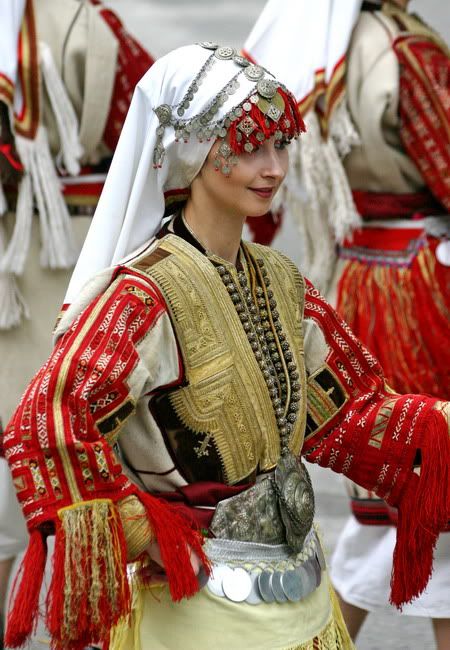
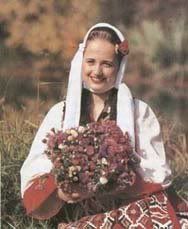
Macedonian folk costumes

Macedonian folk costumes

I find the Macedonian folk costumes very interesting, so here are some of them.

Male folk costume from Bitola region:
013.jpg


Female folk costume from Bitola region:
012.jpg


Male folk costume from Prilep region:
011.jpg


Female folk costume from Prilep region:
010.jpg


Male folk costume from Skopska Crna Gora region:
004.jpg


Female folk costume from Skopska Crna Gora region:
003.jpg


img_3633_za_net.jpg


n60639988287_7212.jpg


Very unique and colorful Macedonian folk costumes.

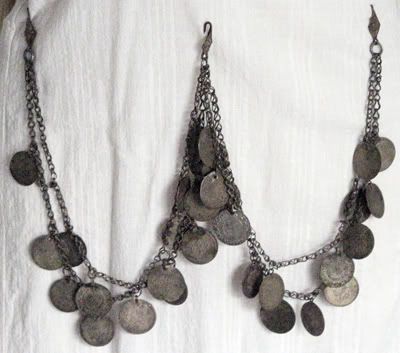
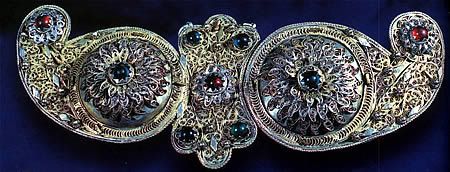
Some Macedonian folk jewelery.

Can some one tell me what this is called and what it is for?:
SA_Sep26016400.jpg


This i think this is a Ottoman coin necklace:
SA_Sep26003400.jpg


This is very nice:
CultureArt_folklor02.jpg


I am very happy with this thread, it really shows the Macedonian folk culture in a very diverse way, and this isn't even half of it.
:macedonia
 
Last edited:
It looks like a woman's brooch, a very decorative ornament DTG
keep up the good work:)

I was involved growing up with the Macedonian folkloric group for several years too, and it does instil pride in the culture and important for all of our young people to be involved in some way.

I love the Macedonian costumes, very exquisite and ornate.
 
daniel the great said:
Can some one tell me what this is called and what it is for?:
SA_Sep26016400.jpg

It is called "Tepelak" in many regions. It comes from the turkish word "Tepe" which means top, or forhead.

It is a bridal jewelery and is worn on the forehead as you can see it here:

010.jpg
 
SA_Sep26016400.jpg


In Turkey, we call this bridal jewelery as "Tepe-lik" as Makedonin said but it should always have 5 coins attached to it. I think one coin is missing on the jewelery pictured above and i can see the little attachment hook for the 5th missing coin.


I have to say that the similarity between traditional Turkish and Macedonian clothing is striking. I`ve checked wowturkey website to show you few pictures of our traditional bridal woman pictures and i saw that this jewelery is called as "Tepelik" in all other Turkic people at Caucasus too.


These are Aegean Anatolia villagers;
keremkayabasiizmirnaldo.jpg


These are central Anatolia yoruk girls;
ilhanyazganazdavay.jpg


But these are regular cloths without any jewelery. The jewelery pieces only used in weddings or panayir.


These are Pomak girls in Bulgaria with traditional cloths. They look similar to your/our clothing too;

keremkayabasipomakgenck.jpg
 
Last edited:
Onur, greeks call it "tepeliki".

Type in google 'tepeliki greece' and you will se for your self. They must think that it is from Homers time.

By the way, after 500 years of Ottoman empire, no wonder that there are many similarities. There were no borders than.
 
Back
Top