• Welcome to the new Macedonian Truth Forum. All posts, members and private messages have been moved over from the old forum.

    Passwords from the old forum could not be carried over, so please use Forgot your password? to set a new one. The reset link is emailed to the address on your account.

  • Rules and Regulations at the forum of the Macedonian Truth Organisation (MTO)

    (1) The national-ethnic and cultural-linguistic identity of the Macedonian people is historically Macedonian, and derives its character from the native, indigenous and geographic homeland of the Macedonians, which is called Macedonia. To ensure that their human rights, integrity and heritage are appropriately respected, the only nouns and adjectives acceptable when reference is made to the above character and identity markers is Macedon, Macedonia, Macedonian and Macedonians.

    (2) The nation-state of the Macedonian people is the Republic of Macedonia, and is to be referred to by this official title so long as the 'republic' prefix is consistently applied to other states. Alternative references are the Macedonian Republic, or simply, Macedonia.

    (3) The 'ethnic' prefix is only acceptable for Macedonians in cases where differentiation is specifically required - so long as it is in context and consistent where it concerns its application to other ethnic groups.

    (4) Should any other differentiation be specifically required, the names of other ethnic groups that reside with Macedonians in either the Republic of Macedonia or the occupied Macedonian regions in Greece, Bulgaria, Serbia or Albania, are to be given a prefix.

    (5) Negating the identity, language and culture of the Macedonian people by deliberate avoidance of the terms Macedonia, Macedonian and Macedonians, or by any other means, is not permitted.

    (6) Systematic anti-Macedonian propaganda and rhetoric are not permitted.

    (7) Threads irrelevant to the Macedonian Cause, the community at the Macedonian Truth Organisation or the Macedonians in general may be considered as spam or not in the spirit of the forum. In such cases they are not permitted.

    (8) Continual posting of messages in threads with the sole purpose of deviating from the initial topics with the use of unrelated and unnecessary information is not permitted.

    (9) All posts, external articles, reports, etc that are cited in languages other than Macedonian or English, must be accompanied with a translation in one or both of the said languages.

    (10) Despite the possibility of some conversations and debates becoming heated, extreme abuse and/or racism, vulgar language and/or terminology, threats, revelation of personal information about others, harassment, and other such behavior will not be permitted. If deemed necessary all relevant information including member details will be reported to the appropriate authorities for investigation which may result in legal action.

    (11) Threads that are created must have a summary of a topic or excerpt of an article found in pertinent link(s) that have been included. One line threads will be considered unaccetable spam and are therefore not permitted.

    (12) Compulsive and deliberate lies, irrespective of the topic, are not permitted.

    (13) Any symbols or avatars found to be perceived as offensive to Macedonians are not permitted.

    (13) Any explicit or extreme material is not permitted.

    Failure to adhere to the above rules and regulations will result in a ban after 3 breaches. This may be reconsidered in some cases should the circumstances be of an unorthodox nature and/or require special consideration. To assure an effective deterrent against an individual or individuals with the sole purpose of causing dissent through spamming, racism or other improper means, the above rules will be strictly enforced.

    The MTO administration will monitor all discussions as reasonably practical and reserve the right to remove any post and/or member from the forum, and update the rules and regulations as required. Members are encouraged to immediately report any post and/or member to the MTO administration if they feel that these rules have not been abided by.

    The views expressed on this forum are those of the individuals. The only official representation of the MTO is made by the "Macedonian Truth Organisation (Site Owner)" username, and no other.

  • Macedonian Cause

    The Macedonian Truth Organisation calls on God in Heaven to protect, bless and guide the endeavour it is committing to undertake, and that is to work towards:

    Securing Macedonia as a free, independent and democratic republic in which sovereignty lies with the Macedonian citizens; as the nation-state of the Macedonian people in which they can preserve their culture, language and identity; as a state in which the Macedonian language and culture form the basis of public life and act as important unifying elements of Macedonian society; as the home of all its citizens to which it guarantees and obliges their inalienable natural rights and corresponding responsibilities;

    The acknowledgment as self-evident and irrefutable the existence of the:

    1) Indigenous, ethnonational name of Macedonia;
    2) Macedonian people, language and identity;
    3) Macedonian culture, symbols and folklore;
    4) Macedonian ancestry, heritage and history in its entirety; and
    5) Macedonian Orthodox Church;

    Securing recognition by the International Community of the tragedies endured by the Macedonian people, of the division of Macedonia with the signing of the Treaty of Bucharest on August 10, 1913, and the genocide committed against the Macedonian people at the hands of the Greek, Bulgarian and Serbian states and their respective churches during the 19th and 20th centuries;

    Ensuring that the Interim Accord is declared ‘null and void’ and that all constitutional provisions, acts, commitments, agreements, legislation, regulations, policies or programs emanating from, supporting or consequential to the Interim Accord are also declared ‘null and void’, including the use of any symbols and the completion of any acts imposed by, or originating from, the Interim Accord.

    Ensuring that the Framework Agreement is abolished and that all constitutional provisions, acts, commitments, agreements, legislation, regulations, policies and programs emanating from, supporting or consequential to the Framework Agreement are also abolished and replaced by a framework of constitutional and statutory law based on inalienable natural rights and corresponding responsibilities and universally codified human rights mechanisms.

    Securing the abolishment of any existing constitutional provisions, acts, agreements, legislation, regulations, policies and programs that discriminate against the Macedonian people, in any international organisation or any of the countries of the International Community where such constitutional provisions, acts, agreements, legislation, regulations, policies and programs exist, and thereby ensuring the freedom for Macedonians to exercise their inalienable natural rights and fulfil their corresponding responsibilities, and practice their culture, language and religious faiths in all the countries of the International Community without hindrance;

    The empowerment of Macedonians to undertake a moral revolution and to instil and/or reinvigorate within themselves a deep-rooted national, cultural, linguistic and historical dignity and a commitment to the exercise of freedom based on inalienable natural rights and corresponding responsibilities;

    The recognition of the Macedonian minorities in the neighbouring states of Macedonia as well as the respect for the inalienable rights and freedoms of the Macedonian minorities, as provided for by natural law and as codified by the United Nations Charter, the Universal Declaration of Human Rights and other universally codified human rights mechanisms;

    The full and unreserved respect of, and the support for, the rights of all people of non-Macedonian descent living in Macedonia and around the world, who share a reciprocal full and unreserved respect for the Macedonian people, their homeland and their state;

    The cultural unification and solidarity of the Macedonian people living in all parts of historical Macedonia and adjacent territories, as well as Macedonians throughout the world;

    The unity of all Macedonians on the principles, objectives and achievement of the Macedonian cause as defined by this declaration.

Macedonian - Scottish historical lineage

Bratot

New member
The origin of the Gordon clan in Scotland was not Gaelic. The Gordon clan is originally from Normandy, where their ancestors are said to have had large possessions. From the great antiquity of the race, many fabulous accounts have been given of the descent of the Gordons. Some derive them from a city of Macedonia, called Gordonia (Close to modern day Gevgelija).

http://www.houseofgordon.com/HISTORY.html
http://bydand.orconhosting.net.nz/page3.htm

Perseus' one son, Alexander, was still a child when Perseus was conquered by the Romans, and after the triumph of Aemilius Paullus in 167 BC, was kept in custody at Alba, together with his father. He became a skillful toreutes, learned the Latin language, and became a public notary.

http://en.wikipedia.org/wiki/Perseus_of_Macedon
http://en.wikipedia.org/wiki/Alba


The favourite Scottish order of battle somewhat resembled the Macedonian phalanx. Their infantry formed a compact body, armed with long spears, impenetrable even to the men-at-arms of the age, though well mounted, and arrayed in complete proof.

- Sir Walter Scott
http://ebooks.adelaide.edu.au/s/scott/walter/legend/chapter15.html


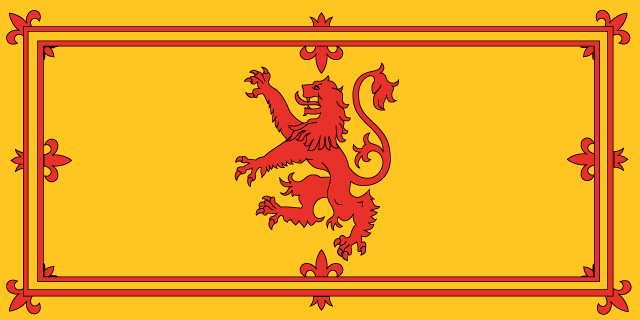
The alternative Scottish flag:

rampflag.gif


What do you think of it?

We can also mention the folklore music instrument - Gaida as common heritage.

TrueMacedonian, can you help with some matherials on this subject?
 
This clever invention, was Wallace's own creation. Wallace, it is believed, had no prior knowledge of the great Greek and Macedonian phalanxes used by armies such as those of Alexander the Great centuries before. This classical literature and the wealth of information it contained remained a secret from most Europeans until Spanish Lords captured the great palaces in the Moorish Kingdoms of Granada, and earlier in Spain itself. Much classical knowledge was reclaimed from the Spanish Reconquista, or the "reconquering" of Spain, by Christian Europeans.

Discovering a weath of books and information all written in Arabic from original Greek texts, one Spanish lord sought help to decipher them. He found that his Jewish man-servant had a knowledge of Arabic language, having lived so near the Moors and Arabs. The servant translated the texts thus unlocking vast stores of information about Greek, Macedonian, Persian, and Roman history which had been lost to Europe. Therefore, many experts feel, and I would agree, Wallace had no prior knowledge of the phalanxes used by the ancients as sometimes stated in older Scottish history texts.

http://www.scottish-history.com/falkirk.shtml


Wallas - Wallach - Woloch - Vlach? :)) kiddin'
 
Last edited:
i read on the net a theory regarding the name of scotland for example the word scotsni means to jump in macedonian.They reckon that years ago perhaps during the roman invasions,macedonians left macedonia due to the wars & landed where scotland is that's what the theory is.I wrote to a historical scottish history people & they said that it's the celtic influence from the celts.
But as far as you are concerned there is a macedonian connection,otherwise how did they get the phallanx & symbols etc.
I'm not surprised that the scots etc using macedonian symbols in theiir heraldry as its used in royal insignia all the time.Queen elizabeth has got royal symbols & it is known in heraldry that it's macedonian symbols that are used.
Regarding the gaida this historical society reckons it's the celtic influence as macedonia & other countries were invaded by the celts.
 
Last edited:
The Celts spread in wide area of Western Europe, but this musical instrument can be found only in Macedonia, Baskia and Scottland.
 
One ancient title for the Scotland, was 'Albania'.

The term derives from the Latin 'Alpine', meaning of course, 'high places'...etc, and was used commonly throughout the ancient world to describe mountainous regions.
 
Bratot I have never had any proof but always suspected a connection with the Scotts just
from observation but that line of thinking always leads to the question did they import it
from us or did we import it from them.

Long lined clan names
The bagpipe as a prominent instrument
Haggis chkemba
Red hair originating from the Balkans This I saw on channel 9 Today Show

http://en.wikipedia.org/wiki/Clan_Gordon
The first Gordon on record is Richard of Gordon, previously
of Swinton, said to have been the grandson of a famous knight
who slew some monstrous animal in the Merse during the time
of King Malcolm III of Scotland. This Richard was Lord of the Barony
of Gordon in the Merse. Between 1150 and 1160 he granted from his
estate a piece of land to the Monks of St. Mary at Kelso,


http://en.wikipedia.org/wiki/Bagpipes
Evidence of pre-medieval bagpipes is uncertain, but several textual
and visual clues may possibly indicate ancient forms of bagpipes.
In the second century AD, Suetonius described the Roman Emperor
Nero as a player of the tibia utricularis.[1]. Dio Chrysostom,
who also flourished in the first century, wrote about a contemporary
sovereign (possibly Nero) who could play a pipe ("aulein") with his
mouth as well as with his "armpit". [2] From this account, some believe
that the tibia utricularis was a bagpipe.

In the early part of the second millennium, bagpipes began to appear
with frequency in European art and iconography.
The Cantigas de Santa
Maria, compiled in Castile in the mid-13th Century, depict several
types of bagpipes. [3] Though evidence of bagpipes in the British
Isles prior to the 14th Century is contested, bagpipes are explicitly
mentioned in The Canterbury Tales (written around 1380)
http://forums.skadi.net/archive/index.php/t-22375.html
There are three different claims about the origins of red hair
in the Scottish Highlands. One claim is that it was common
among the Picts and has always been there. Another claim is
that it was brought by the Kelts. Yet another claim is that
it was brought by the Vikings.

At one time the area was settled by people with Mediterranean skulls.
Then came tall brachycephalic Beaker Folk. Hallstatt Nordics from
central Europe invaded the British Isles, but didn't penetrate
to northern Scotland, which remained Pictish. Celts often had
red hair. However, Vikings and Germanics were often described
as red-haired too. The Rus in Russia were described as redheads.
They came from Sweden, where red hair is uncommon today.


http://en.wikipedia.org/wiki/Red_hair
Several accounts by Greek writers mention redheaded people.
A fragment by the Greek poet Xenophanes describes the Thracians
as blue-eyed and red haired.
The Greek historian Herodotus described
the "Budini" (probably Udmurts and Permyak located on the Volga
in what is modern-day Russia) as being predominantly redheaded.
The Greek historian Dio Cassius described Boudica, the famous
Celtic Queen of the Iceni, to be "tall and terrifying in appearance...
a great mass of red hair... over her shoulders." Also, several
mythological characters from Homer's Iliad,
(themselves purportedly Greek) are described as being "red-haired"
including Menelaus and Achilles.

The Roman author Tacitus commented on the "red hair and large limbs
of the inhabitants of Caledonia (Scotland)",[5] which he connected
with some red haired Gaulish tribes of Germanic and Belgic relation.
The half Greek half Turkish pirate Red Beard or Hayreddin Barbarossa
is said to have had a fiery red beard.[citation needed]

Red hair has also been found in Asia, notably among the Tocharians
who occupied the northwesternmost province of what is modern-day China.
Many of 2nd millennium BC Caucasian Tarim mummies in China have been
found with red and blonde hair.[6]


A fresco of a red-haired Thracian noble woman in the Ostrusha Mound in
central Bulgaria, 4th century BC
 
image1282723701.jpg


image1282723782.jpg


image1282723811.jpg


" This he insists upon at large in this Third Book, and thinks it the
more probable, because the Story of Saxo, the Founder of the
Saxon Nation, agrees with it. He says all Authors, Crantzius ex-
cepted, agree. That the Saxons were some Remains of the Mace-
donian Army ;
and that before they came into Germany, they
were called Macedonians
; for this he quotes the German Chronicle, printed at Mentz, in 1482. the Annals of Freezland, and
others."


saxonmk.bmp


http://books.google.pl/books?id=AbU...ed=0CCsQ6AEwBA#v=onepage&q=Macedonian&f=false
 
Amazing information Bratot who would have thought. First thing that hit me was, apart from Lion emblem and the bag pipes influence, I wander if there is some influence in the Scottish Kilt coming from the Macedonian Fustanella.
 
Amazing information Bratot who would have thought. First thing that hit me was, apart from Lion emblem and the bag pipes influence, I wander if there is some influence in the Scottish Kilt coming from the Macedonian Fustanella.


I have thought of it too.. but searching for more informations I found some very symptomatic names of Gajda in Georgia:

The gudastviri (Georgian: გუდასტვირი) is a droneless, double-chantered, horn-belled bagpipe played in Georgia. The term comes from the words guda (bag) and stviri (whistling). In some regions, the instrument is called the chiboni, stviri, or tulumi.

Gude is Macedonian word for a piggy, but also for playing a violin - gudenje, the fiddlestick is called - gudalo.

Stviri is Sviri in Macedonian, in some dialect we still hear the T letter.

And Tulumi in Macedonian can be Tulum (bag for wine made of the belly skin from animals).

http://www.hangebi.ge/gudachibru.htm


If you look through the net you will find informations about Caucasian origin of Scotts, as Ossetians-Georgians.

But you will find significant Macedonian - Georgian connection from ancient times.
 
Last edited:
I don't want to go of topic to much but here is a bit of trivia for you regarding the Gajda. Apparently, Metaxas out lawed the Gajda under his regime with an excuse "it was peasantry". But most likely the reason was it was to Macedonian for Greece and its forced assimilation plans.


Back to the Scottish and Macedonian topic. I met this lovely old fellow in Ohrid playing his Gajda on top of Samuil Fortress, I am sure many travelers have met him and know who i am talking about. I asked him the difference between the Scottish Bag pipes and the Macedonian Gajda "which i have on video). With out going into the technicality of exactly how they are different, This gajdadjia told me he would not be able to play the scottish pipes and they would not be able to play ours. I am not sure why it would be different, but who am i to argue with this wanderful gajda playing old man.

Once again, sorry if i am off topic but i thought it would be interesting to know, and i will leave it at that. :)
 
Last edited:
Maybe a valuable trace...

"Scotic is related to the term Scythic and was pronounced the same in some areas of Britain. It is an interesting observation that the German word for both Scottish and Scythian is "Scutten", as the 6th century Saxon invaders of Alba spoke a form of lower German."

http://webcache.googleusercontent.c...dified+version+today&cd=1&hl=pl&ct=clnk&gl=pl


Most probably they were included in the army of Hun Empire vs the Romans. You know, as early as the first half of 5th century, Huns conquered today`s France, Germany, pretty much all of western and central Europe. When they conquered these places, there was several Germanic tribes living in that area and these Germanic pagans allied with Huns by joining their army and they attacked Romans together. European scholars usually doesn't remind that but Attila`s horde included the Saxon tribes too and thats how they reached up to the northern Europe. These tribes retreated up to the today`s Scotland and England after Hun Empire disappeared and thats how anglo-saxon unity has been born. Those were "dark ages" according to christian philosophy.


P. S: We got same musical instrument in Turkey with the name "Tulum". "Tulum" is actually the name of sheep`s belly skin and the bag of this instrument was made from this skin in the old times. It`s actually rather strange that you use same word "Gayda" along with the Scots, while i know that Greeks use "Tulum" for it. I think the word "Gayda, gajda" can be related with the "gastro", meaning belly, stomach again. Etymology dictionary says "Gastro" is a Greek word and If "Gajda" and "Gastro" are related then i wonder why Greeks use Turkish word Tulum for it instead of Gayda?


Apparently, Metaxas out lawed the Gajda under his regime with an excuse "it was peasantry". But most likely the reason was it was to Macedonian for Greece and its forced assimilation plans.


Metaxas regime also banned the taverns and the songs of Anatolian immigrants at the same time.
 
Last edited:
....... a bit of trivia for you regarding the Gajda. Apparently, Metaxas out lawed the Gajda under his regime with an excuse "it was peasantry".........
Actually it was considered an enemy of the state. The gajda was a thread to Greeces assimilation policies.
 
/offtopic on

...
I met this lovely old fellow in Ohrid playing his Gajda on top of Samuil Fortress, I am sure many travelers have met him and know who i am talking about. ...

i´ve met that cute grandpa, but unfortunately, he´s dead, someone told me last year...

/offtopic off

ontopic:

if we are somehow connected (i don´t suspect we are), there must be more than just one music instrument kept in the scotish tradition, that is related with some other Macedonian Folk Instruments.

we need scotish ethnolog / folklourist ;)
 
if we are somehow connected (i don´t suspect we are), there must be more than just one music instrument kept in the scotish tradition, that is related with some other Macedonian Folk Instruments.


You should consider that both Scots and Irish people are heavily assimilated by British centuries ago. AFAIK, there are very few left in these countries who learns their own languages as a mothertongue. Most of them speaks english anymore. I think Scots have been assimilated more than Irish people.

Also they lived through a cultural transformation when they have been converted into christianity. You know in medieval era, if certain society have been converted into christianity, they were also required to erase nearly everything related with their former culture like pagan symbols, runic writings and sometimes their language too. Especially runic writings were represented as elements related with Satanism, witchcraft or dark magic in the medieval christian literature.
 
Last edited:
I was searching online to see when the gajda came to Scottland many are saying that the gajda was introduced by the Roman arym

http://www.bagpipehistory.info/ireland.shtml

Ireland

Published winter issue 2006/7
�Bulletin�
Military Historical Society
London

Some thoughts on Irish Piping

By Frank Timoney

It is generally accepted today, that the Roman army introduced their bagpipe, the Tibia Utricularis, to the British Isles and other countries such as France, Spain, the Balkans etc. In England, it really caught on and several English variants of the Roman instrument came into being.

As far as is known, the Irish never took to the instrument, although it is felt today, that Rome invaded and conquered the country, the pipe never caught on. We know that in Britain, the Irish lived amongst the Roman army as victualers and that some lived with the Celtic tribes in England. Some actually invaded both camps. Still, the instrument seems to have been avoided, although it seems to have been worshiped by the tribes in England, who began to place depictions of the tibia on statues of Roman gods, such as the second century altar to the god Atys, unearthed in Gloucester.

The earliest Irish mention of the bagpipe is in 1206, approximately thirty years after the Anglo-Norman invasion. Obviously the instrument began to catch on in Ireland but as to whether it was the English or French variant, is anyone�s guess. It certainly was not the Scottish Great Highland pipe, the Piob Mor, because that instrument had yet to work it�s way up from England. Both England and France used the bagpipe in processions, church services, and festivities. The first pictorial representation of the native Irish mouth blown pipe is in 1578 and it shows a two-drone pipe much like both the English and French instruments.

The instrument fell out of use by the Irish after the O�Neill war ca. 1590. The Irish now became an indoor society where the use of a loud instrument was no longer needed. It is felt that the Irish piping tradition was never very strong because of the ease with which the Irish gave it up. At any rate, they were now introduced to the English Northumbrian or pastoral pipe, which they managed, by the nineteenth century, to modify into their own bellows fed Uilleann Pipe.

Around 1880, a new Gaelic awareness began to hit Ireland. A Celtic twilight instituted mainly by Anglo Irish residents. The country began to look for ties to other Celtic countries, and Scotland seemed to hold the greatest appeal. The Irish began to reason, that since they had settled the north of Scotland, the Scottish traditions were actually theirs! Onto the great stage of myth stepped the Royal Tyrone Fusiliers, a militia Bn. Of the 27th Royal Inniskilling Fusaliers, and one William O�Duane of Belfast. O�Duane invented a weird pipe he called the Dungannon. Most people today feel he hated pipes, because the instrument was utter junk! The Royal Tyrone Fusiliers felt the time had come for a pipe band in their regiment. Many �experts� in the regiment convinced the young Anglo Irish officers that it was only right for an Irish regiment to adopt the pipe, since Scotland really adopted Irish culture and traditions. So the old flute band was thrown over, and the flautists informed they would shortly become �pipers�.

There was no thought given to the art of Scottish piping, which is produced by the middle joints of the fingers. When the flautists began �playing�, they did so with the tips of the fingers, which prohibited the execution of Scottish finger movements. Every note was played with an equal duration of the proceeding note, which produced a very un-Scotish, un-crisp, round sound. But this was of little concern, going on to plague Irish piping until the 1980�s. What was of the greatest concern, was what uniform would be worn! So it was decided to adopt the Scottish kilt, which remember, the new experts felt to be rightly theirs. But what colour would it be?

Well, the conclusion was reached that tartan was out of the question. So experts of the Tyrone's searched the books only to find that the ancient Irish used �saffron�to stain their garments. But this produced a very yellow colour, exactly the same as was represented by the Fenian segment of the population. So brown was added to the dyestuff, the Royal Tyrone's called it saffron and Bob�s your uncle, the Irish had their first pipe band and the army it�s first Irish pipe band.

At this time, we must step back into the ancient world. Saffron, taken from the stigma of the autumn crocus, is not indigenous to the British Isles. It had to be imported at a very great expense, and no one in Ireland could afford it anyway. Around 1581, one Vincentio Galileo (Galilei�s father) did a report for the Venetian Doge. He was somewhat like the Doge�s man in Havana, Ireland being part of his assignment. He reported back to Venice all he noted about the Irish, including their mode of dress, the colour of which, he called saffron. At the time, the only person in Europe who could probably afford saffron was a Venetian. To Vencentio Galileo, the Irish colour looked like that obtained from saffron. English writers and soldiers soon picked up the term, so that a new piece of mis-information was added to Ireland�s supposed dress tradition.

Around 1900, a most ingenious businessman entered the stage and began to create his own Irish myth. Mr. Henry Starck, a London manufacturer of musical instruments and of Jewish persuasion, saw a brilliant business opportunity. His ancestors had come over to England with Handel to produce woodwind instruments. Henry was in partnership with one William Ross, Queen Victoria�s piper. Ross was a big figure in the Scottish piping world, supplying all her majesty�s Scottish regiments with pipes, etc. Around 1900, he passed away and his partner Stark took over the business. Starck was no fool. He saw a new market and in 1902, took out a patent with O�Duane for a new Irish chanter that allowed a full chromatic scale with four keys! Starck�s next step in 1908 was the publishing of a tutor for the new Brien Boru pipe. He took a step further, going to all the Irish infantry regiments, convincing the young Anglo Irish officers that by �tradition�, they needed a pipe band. He, by dint of good fortune, had all the �ancient � measurements of the �ancient� Irish mouth blown bagpipe, as well as the �ancient� details of �correct� Irish dress.

The young Anglo Irish officers fell for it, no questions asked. However, there was a great cry of disapproval from the older Irish officers who missed the auld flute bands and lovely Irish tunes. �Aping the Scot� was their unheard cry because the English CO was totally enamoured with the Celtic �revival� going on, and felt his regiment needed a little more gregarious panache, as much the same as the Scots regiments had. By now, one of the first things the newly formed regiment of guards did was to form a pipe band. Some said the new regiment should even be kilited! What everyone overlooked, was the fact that their was no native Irish music specifically composed for the mouth blown pipe, so that new keyed chanter fit the bill quite well. Starck�s son A.H went on to become �instructor� to the London Irish Rifles pipe band.

So there we have the �ancient� tradition of Irish mouth blown piping. All that was now needed was the printed word to make it all puncture proof. Up to the wicket stepped Dr. W.H. Gratton Flood who, in 1911 published a totally false �Story of the Bagpipe�. It had became necessary to refute Scottish Highland piping culture, in order to give the new, �ancient�, Irish �piping� effort an older and greater history. Ireland became Scotland�s teacher! This Flood successfully accomplished and his book of fantasy is eagerly sought after today in Ireland, America and Australia. Archibald Campbell, in his additions to The Notices of Pipers, reminds us that, in an attempt to give piping in Ireland some kind of pedigree which it never had, Flood invented a whole history for the instrument and presented his entire package with a marked prejudice against the Scottish Highland Pipe. The Royal Irish Fusiliers fell for it, hook, line and sinker. In 1924, their regimental newspaper, �The� Faug A Ballagh�, contained articles from the sergeant�s mess and pointed out a new fiction, that Irish piping was headed for great things, until the 1366 Statutes of Kilkenny put the Caedbosh on it, and that caused the Irish to �forget� their piping tradition. By now, the newly invented Irish �piping� had come under the scrutiny of Scottish piping circles, but sadly went on.

Today, however things are much brighter for Irish regimental piping thanks to the efforts of the Army School of Piping and the Piobaireachd Society. The old Brien Boru pipes and the keyed chanter have been chucked out (hopefully, burned at the stake). Three droned pipes have been issued or purchased for all Irish regiments and Irish regimental pipers now play with more expression, using Scottish finger movements. Thankfully, some have even begun to play Piobaireachd, the great classical music of the bagpipe.

By the way, no one in Ireland or Scotland ever referred to the mouth blown bagpipe (the Piob Mor) as a �war pipe�. It was sixteenth and seventeenth century English writers who first used the expression and with such continued persistence as to lead one to speculate that the instrument possibly was known in England, in earlier times, as a war pipe. But this is still a complicated subject, inclined to bring some to tears and some to their fists!

References:

The Piping Times
The Traditional and national Music of Scotland by Francis Collinson
The Bagpipe by Francis Collinson
Irish Archaeology Society
Journal of the Society of Antiquaries of Ireland, volume 48, 1918
Irish Music, A Fascinating Hobby by Captain Francis O�Neill ca. 1911
Irish Regiments by RG Harris
Journal of the Society for Army Historical Research, #82, 1942
History of Highland Dress by JT Dunbar
The Piobaireachd Society

Interviews by the author during late 1950�s with many ex-army Irish regimental pipers from the 1914 period and prior. Much to their credit, these old boys (contemptibles) never went back to the flute after their military service. They continued with the pipe and were much the backbone of the Irish piping scene. Their good natured humour made them a great pleasure to be with. To a man however, they continue to play with the tips of their fingers and with a minimum of graces notes some forty years after their introduction to the instrument.

 
Back
Top