• Welcome to the new Macedonian Truth Forum. All posts, members and private messages have been moved over from the old forum.

    Passwords from the old forum could not be carried over, so please use Forgot your password? to set a new one. The reset link is emailed to the address on your account.

  • Rules and Regulations at the forum of the Macedonian Truth Organisation (MTO)

    (1) The national-ethnic and cultural-linguistic identity of the Macedonian people is historically Macedonian, and derives its character from the native, indigenous and geographic homeland of the Macedonians, which is called Macedonia. To ensure that their human rights, integrity and heritage are appropriately respected, the only nouns and adjectives acceptable when reference is made to the above character and identity markers is Macedon, Macedonia, Macedonian and Macedonians.

    (2) The nation-state of the Macedonian people is the Republic of Macedonia, and is to be referred to by this official title so long as the 'republic' prefix is consistently applied to other states. Alternative references are the Macedonian Republic, or simply, Macedonia.

    (3) The 'ethnic' prefix is only acceptable for Macedonians in cases where differentiation is specifically required - so long as it is in context and consistent where it concerns its application to other ethnic groups.

    (4) Should any other differentiation be specifically required, the names of other ethnic groups that reside with Macedonians in either the Republic of Macedonia or the occupied Macedonian regions in Greece, Bulgaria, Serbia or Albania, are to be given a prefix.

    (5) Negating the identity, language and culture of the Macedonian people by deliberate avoidance of the terms Macedonia, Macedonian and Macedonians, or by any other means, is not permitted.

    (6) Systematic anti-Macedonian propaganda and rhetoric are not permitted.

    (7) Threads irrelevant to the Macedonian Cause, the community at the Macedonian Truth Organisation or the Macedonians in general may be considered as spam or not in the spirit of the forum. In such cases they are not permitted.

    (8) Continual posting of messages in threads with the sole purpose of deviating from the initial topics with the use of unrelated and unnecessary information is not permitted.

    (9) All posts, external articles, reports, etc that are cited in languages other than Macedonian or English, must be accompanied with a translation in one or both of the said languages.

    (10) Despite the possibility of some conversations and debates becoming heated, extreme abuse and/or racism, vulgar language and/or terminology, threats, revelation of personal information about others, harassment, and other such behavior will not be permitted. If deemed necessary all relevant information including member details will be reported to the appropriate authorities for investigation which may result in legal action.

    (11) Threads that are created must have a summary of a topic or excerpt of an article found in pertinent link(s) that have been included. One line threads will be considered unaccetable spam and are therefore not permitted.

    (12) Compulsive and deliberate lies, irrespective of the topic, are not permitted.

    (13) Any symbols or avatars found to be perceived as offensive to Macedonians are not permitted.

    (13) Any explicit or extreme material is not permitted.

    Failure to adhere to the above rules and regulations will result in a ban after 3 breaches. This may be reconsidered in some cases should the circumstances be of an unorthodox nature and/or require special consideration. To assure an effective deterrent against an individual or individuals with the sole purpose of causing dissent through spamming, racism or other improper means, the above rules will be strictly enforced.

    The MTO administration will monitor all discussions as reasonably practical and reserve the right to remove any post and/or member from the forum, and update the rules and regulations as required. Members are encouraged to immediately report any post and/or member to the MTO administration if they feel that these rules have not been abided by.

    The views expressed on this forum are those of the individuals. The only official representation of the MTO is made by the "Macedonian Truth Organisation (Site Owner)" username, and no other.

  • Macedonian Cause

    The Macedonian Truth Organisation calls on God in Heaven to protect, bless and guide the endeavour it is committing to undertake, and that is to work towards:

    Securing Macedonia as a free, independent and democratic republic in which sovereignty lies with the Macedonian citizens; as the nation-state of the Macedonian people in which they can preserve their culture, language and identity; as a state in which the Macedonian language and culture form the basis of public life and act as important unifying elements of Macedonian society; as the home of all its citizens to which it guarantees and obliges their inalienable natural rights and corresponding responsibilities;

    The acknowledgment as self-evident and irrefutable the existence of the:

    1) Indigenous, ethnonational name of Macedonia;
    2) Macedonian people, language and identity;
    3) Macedonian culture, symbols and folklore;
    4) Macedonian ancestry, heritage and history in its entirety; and
    5) Macedonian Orthodox Church;

    Securing recognition by the International Community of the tragedies endured by the Macedonian people, of the division of Macedonia with the signing of the Treaty of Bucharest on August 10, 1913, and the genocide committed against the Macedonian people at the hands of the Greek, Bulgarian and Serbian states and their respective churches during the 19th and 20th centuries;

    Ensuring that the Interim Accord is declared ‘null and void’ and that all constitutional provisions, acts, commitments, agreements, legislation, regulations, policies or programs emanating from, supporting or consequential to the Interim Accord are also declared ‘null and void’, including the use of any symbols and the completion of any acts imposed by, or originating from, the Interim Accord.

    Ensuring that the Framework Agreement is abolished and that all constitutional provisions, acts, commitments, agreements, legislation, regulations, policies and programs emanating from, supporting or consequential to the Framework Agreement are also abolished and replaced by a framework of constitutional and statutory law based on inalienable natural rights and corresponding responsibilities and universally codified human rights mechanisms.

    Securing the abolishment of any existing constitutional provisions, acts, agreements, legislation, regulations, policies and programs that discriminate against the Macedonian people, in any international organisation or any of the countries of the International Community where such constitutional provisions, acts, agreements, legislation, regulations, policies and programs exist, and thereby ensuring the freedom for Macedonians to exercise their inalienable natural rights and fulfil their corresponding responsibilities, and practice their culture, language and religious faiths in all the countries of the International Community without hindrance;

    The empowerment of Macedonians to undertake a moral revolution and to instil and/or reinvigorate within themselves a deep-rooted national, cultural, linguistic and historical dignity and a commitment to the exercise of freedom based on inalienable natural rights and corresponding responsibilities;

    The recognition of the Macedonian minorities in the neighbouring states of Macedonia as well as the respect for the inalienable rights and freedoms of the Macedonian minorities, as provided for by natural law and as codified by the United Nations Charter, the Universal Declaration of Human Rights and other universally codified human rights mechanisms;

    The full and unreserved respect of, and the support for, the rights of all people of non-Macedonian descent living in Macedonia and around the world, who share a reciprocal full and unreserved respect for the Macedonian people, their homeland and their state;

    The cultural unification and solidarity of the Macedonian people living in all parts of historical Macedonia and adjacent territories, as well as Macedonians throughout the world;

    The unity of all Macedonians on the principles, objectives and achievement of the Macedonian cause as defined by this declaration.

Macedonians and Cretans

The Minoans, who were the original inhabitants of the Island were absorbed into the Myceanians, who were from the southern Pelloponese.We are talking in the 1000's(or perhaps before)B.C..
What relevance this has to the connection between Macedonians and Cretans, I dont know. If there is any connection between the 2, its from well after this period.


I don't know about that.

How do explain the fact that the native langauge of Crete, was not Greek, and still in use in the 3rd century BC, at least according to Homer?
 
boys its you wannabe greeks that made such an issue about ethnicity and connections with the ancient balkan peoples, and now that we can use a scientific test that clearly demonstrates who is what in the balkans, you poor losers cant take it, and keep refferring to the biased subjective opinion of historians and politicians, and only the ones who support your views.
its not good enough to go crawling behind the skirts of isocrates and however else you discovered last week, when the truth is in our dna our genetic makeup.
if dna testing supported your position thats all you boys would be talking about.
for your information spartan macedoniasn apprently share mcuh of our dna with cretans and basques, does that explain the picture a little clearer, we didnt come down with the so called slavic invasions we have been ther since neolithic times.

I wonder if there is a dominant stubborn gene in the Greeks ?
 
I don't know about that.

How do explain the fact that the native langauge of Crete, was not Greek, and still in use in the 3rd century BC, at least according to Homer?

In the Illiad, Homer also makes many references to the Cretans and their King Idomeneus, who accompanied and joined the Greeks in their war against Troy. In the story, King Idomeneus is at all the councils of the Greek kings, and has dialogue with the other Greek kings.
The Illiad was written in 800 b.c I believe, and the events it tells us about took place 800 years before that.

I have never read that the Cretans spoke a different language and I have read many versions of the Illiad, as I find it to be a great story.
Where does Homer write about the Cretan language?
I am not asking this sarcastically, if it is true, I would like to read it as well.

The Minoans, however, are assumed to have spoken a language that was not Greek.Closer to a mix of Egyptian and Greek, as the island lies about halfway between Greece and Africa.
 
Last edited:
boys its you wannabe greeks that made such an issue about ethnicity and connections with the ancient balkan peoples, and now that we can use a scientific test that clearly demonstrates who is what in the balkans, you poor losers cant take it, and keep refferring to the biased subjective opinion of historians and politicians, and only the ones who support your views.
its not good enough to go crawling behind the skirts of isocrates and however else you discovered last week, when the truth is in our dna our genetic makeup.
if dna testing supported your position thats all you boys would be talking about.
for your information spartan macedoniasn apprently share mcuh of our dna with cretans and basques, does that explain the picture a little clearer, we didnt come down with the so called slavic invasions we have been ther since neolithic times.

Are your insults directed at me?
If so why?
Did I say something to offend you?
Is this how you respond to civilised dialogue?
I have not insulted you or Macedonians in general in any of my posts.
Just because Im Greek doesnt mean you have to attack me.
That would be considered racist, no?
Isnt that what you are against, and what you critisize Greece, EU and other organizations for?
 
Minoan Chronology
One of the hot topics in Minoan archaeology is chronology. There are two sets of Minoan chronology, one which reflects stratigraphic levels in archaeological sites, and one which attempts to plot cultural changes, with an emphasis on the Minoan palaces, since that's the defining characteristic. Traditionally, Minoan culture is divided into events. The chronology starts about 3000 BC; Knossos was founded about 1900 BC, Santorini erupted ca 1500 BC; and Knossos fell in 1375 BC.

However, recent investigations indicate that Santorini may have erupted about 1600 BC, although there is still some question about that; clearly, these absolute dates will continue to be controversial for some time to come. The following chronology is from Yannis Hamilakis' 2002 book, Labyrinth Revisited: Rethinking 'Minoan' Archaeology.

Minoan Chronology
Early Minoan I 3300-2900 BC
Early Minoan IIA 2900-2550 BC
Early Minoan IIB 2550-2300 BC
Pre-Palatial (EM III/MM IA) 2300-1900 BC (Vasilike, Myrtos, Debla, Mochlos)
Proto-Palatial (MM IIA-MM IIIA) 1900-1700 BC (Knossos, Phaistos, Malia)
Neo-Palatial (MMIIIB) 1700-1600 BC (Ayia Triadha, Tylissos, Kommos, Akrotiri)
Neo-Palatial (LM IA-LM IB) 1600-1450 BC (Vathypetro, Kommos, Palaikastro)
Late Minoan II through Late Minoan IIIA/B 1450-1200 BC (Kydonia) (Kommos, Vathypetro)
Late Minoan IIIC 1200-1150 BC

The capital was Knossos, founded about 1900 BC.

Minoans and their Writing Systems
The main written language of the Minoans was Linear A, a language which has yet to be deciphered but may represent a form of early Greek. It was used for religious and accounting purposes from about 1800-1450 BC, when it abruptly disappeared to be replaced by Linear B, a tool of the Mycenaeans.

End of the Minoans
Between about 1600 and 1627 BC, the volcano on Santorini erupted, destroying the island and the Minoan occupation there. Giant tsunamis destroyed the coastal cities such as Palaikastro, which was completely inundated. Knossos itself was destroyed by another earthquake in 1375 BC. A clear cultural shift began on Crete, with architecture, writing styles and other cultic objects similar to the Mycenaean mainland replacing much of the Minoan styles. Because of this, it was believed that what ended the Minoan culture was a combination of earthquakes and conflict wars with the Mycenaeans from mainland Greece, and/or Egypt, over the extensive trade that had developed in the Mediterranean at the time.

However, more recently, archaeologists have come to believe that at least a substantial portion of the reason for the downfall of the Minoans was internal political conflict. Evidence for the takeover by Mycenaeans includes Mycenaean-type tombs called "tholos" or "warrior graves". Recent strontium analysis shows that the people buried in "warrior graves" are not from the mainland, but were born and lived their lives on Crete, suggesting that the shift to a Mycenaean-like society may have not included a Mycenaean invasion.

Source

http://archaeology.about.com/od/mterms/qt/minoan.htm
 
Last edited:
Minoans and their Writing Systems
The main written language of the Minoans was Linear A, a language which has yet to be deciphered but may represent a form of early Greek. It was used for religious and accounting purposes from about 1800-1450 BC, when it abruptly disappeared to be replaced by Linear B, a tool of the Mycenaeans.
It might also be an early form of German.
 
not at you spartan, i dont see you denying my macedonia identity.

my refrence to you was strictly to infrom you what all dna testing has revealed, a link between modern macedonians and cretans.
 
^^ Disregard my post then
My apologies sir:)

The one possibility of a link I can think of between the Ancient Macedonians and Cretans, is the theory that the Macedonians were Dorians who didnt migrate to the Pelloponese, but stayed put where they were. The reason I say this, is that the ancient Cretans(Minoans) were believed to have been absorbed into the Mycaenians, who were a Pelloponesian people and they in turn were assimilated into the Dorian tribes that had migrated to the area from the north..
Perhaps this is the link that shows up in the DNA evidence.
These events happened 1000bc or before, so I dont know what kind of impact this would have on a DNA test, as I dont know too much about how they work .
Also this Dorian "theory" is a theory, and not accepted 100%. Many historians believe its a relatively strong possibility, but lack enough evidence to remove the "theory" label.
 
Last edited:
^^ Disregard my post then
My apologies sir:)

The one possibility of a link I can think of between the Ancient Macedonians and Cretans, is the theory that the Macedonians were Dorians who didnt migrate to the Pelloponese, but stayed put where they were. The reason I say this, is that the ancient Cretans(Minoans) were believed to have been absorbed into the Mycaenians, who were a Pelloponesian people and they in turn were assimilated into the Dorian tribes that had migrated to the area from the north..
Perhaps this is the link that shows up in the DNA evidence.
These events happened 1000bc or before, so I dont know what kind of impact this would have on a DNA test, as I dont know too much about how they work .
Also this Dorian "theory" is a theory, and not accepted 100%. Many historians believe its a relatively strong possibility, but lack enough evidence to remove the "theory" label.


There is very little evidence that Greeks migrated "from the North". Nor can historians agree exactly when the Greeks came. Some say early Bronze age, some say they came in various waves, but from where?

E.Craik has found that most "Bronze Age" sites in Mainland Greece contain many Greek words "around a non-Greek core". The Greeks, ancient and modern, are not autocthonous.

The migration of Greeks, happened rather late, and if their settlement of the coast line, provides us with any indication - the trend shows us they came from the South, and were moving North.
 
the other theory spartan is that macedonians and cretans belong to the original peoples who inhabited the islands and the balkans, wheras greeks are relative newcomers. thats what the dna testing is suggesting.
 
the other theory spartan is that macedonians and cretans belong to the original peoples who inhabited the islands and the balkans, wheras greeks are relative newcomers. thats what the dna testing is suggesting.


The bronze age, and earlier, archeological evidence is backing that claim.
 
There is very little evidence that Greeks migrated "from the North". Nor can historians agree exactly when the Greeks came. Some say early Bronze age, some say they came in various waves, but from where?

E.Craik has found that most "Bronze Age" sites in Mainland Greece contain many Greek words "around a non-Greek core". The Greeks, ancient and modern, are not autocthonous.

The migration of Greeks, happened rather late, and if their settlement of the coast line, provides us with any indication - the trend shows us they came from the South, and were moving North.

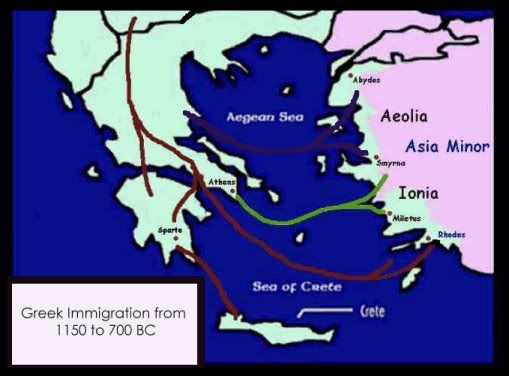
From what I know and have read, the post bronze age Greeks(classical Greeks) not to be confused with the Ancient Greeks of myth(homeric Greeks ex Mycaeneans, Minoans), came into the area, and assimilated into the remnants of the Ancients. The Dorians populated the Pelloponese( their origin is debated), and the Ionians populated Attica, the Islands and the more northen coastal areas of the Greek penninsula.
The Ionians are believed to have inhabited Anatolia(western Turkey). And as a matter of fact, the Turks refer to Greece and greeks as Ionia and Ionians to this day. Yunan and Yunanistan. Yunan being the Turkish words for Ionia.
The thing that I find intriguing though, is that if the theory that Dorians and Macedonians were one tribe at one point, then maybe your people and mine have some connection from the little bit of ancient blood that perhaps is still in some of us today!

The one thing the Ancient Spartans and Macedonians have in common is that they excelled at war, and both ruled Greece by force.
 
Last edited:
There is very little evidence that Greeks migrated "from the North". Nor can historians agree exactly when the Greeks came. Some say early Bronze age, some say they came in various waves, but from where?
E.Craik has found that most "Bronze Age" sites in Mainland Greece contain many Greek words "around a non-Greek core". The Greeks, ancient and modern, are not autocthonous.
The migration of Greeks, happened rather late, and if their settlement of the coast line, provides us with any indication - the trend shows us they came from the South, and were moving North.
the other theory spartan is that macedonians and cretans belong to the original peoples who inhabited the islands and the balkans, wheras greeks are relative newcomers. thats what the dna testing is suggesting.

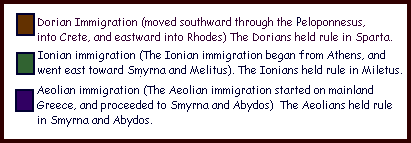
Heres some stuff I found guys.
This info is giving me a different version as to what I am reading about the Cretans on this forum.


greekimmigration.jpg

immigration.gif

References

"Dorian" Britannica Online.

http://www.eb.com:180/cgi-bin/g?DocF=micro/175/77.html
or
http://www.mnsu.edu/emuseum/prehistory/aegean/theculturesofgreece/dorians.html

Dorians
Dorians, people of ancient Greece. Their name was mythologically derived from Dorus, son of Hellen. Originating in the northwestern mountainous region of Epirus and SW Macedonia, they migrated through central Greece and into the Peloponnesus probably between 1100 and 950 B.C., defeating and displacing the Achaeans. They rapidly extended their influence to Crete and established colonies in Italy, Sicily, and Asia Minor. Sparta and Crete are generally considered as having had the most typical form of Dorian rule—the invaders maintained their separate societies and subjected and enslaved the conquered population. The arrival of the Dorians marked the disruption of the earlier Greek culture and the beginning of a period of decline. Although the cultural level of the Dorians was below that of the Achaeans, the Dorians did contribute to the culture of Greece, e.g., in drama, poetry, sculpture, and especially in the huge stone buildings that marked the beginning of the Doric style of architecture.

The Columbia Electronic Encyclopedia, 6th ed. Copyright © 2007, Columbia University Press. All rights reserved.

http://www.infoplease.com/ce6/history/A0815906.html
 
Last edited:
Actually, Homer says that the Greeks came from the Islands or the South.

Now, E. Craik in her book "The Dorian Aegean" takes the view that the Doric Greeks came from the North - and she discounts Homer's view as wrong. But, adds that their alphabet came from the East. Furthermore, she states that the linguistic evidence is contradictory, because she has found that the spread of Greek, moved Northward. So its not a clear picture.

1.That makes sense to me, seeing that the Dorians werent known for their intelligence. They have been described as uncouth, and primitive in comparison to the other 2 Greek tribes(tough as all hell though).

2.And it probably wont get any clearer than it is now.Which could be a good thing, because we can debate it till the cows come home on forums like this:p

Id just like to add, in regards to Homer, the Greeks he tells about in his stories are pre-Dorian/Ionian i believe.
 
It seems that there are similarities between Montenegrin and Cretan traditional costumes of men. What do you all think?

All 6 images below taken randomly using google.

Montenegro #1


Montenegro #2


Montenegro #3


Crete #1


Crete #2


Crete #3
 
Back
Top