• Welcome to the new Macedonian Truth Forum. All posts, members and private messages have been moved over from the old forum.

    Passwords from the old forum could not be carried over, so please use Forgot your password? to set a new one. The reset link is emailed to the address on your account.

  • Rules and Regulations at the forum of the Macedonian Truth Organisation (MTO)

    (1) The national-ethnic and cultural-linguistic identity of the Macedonian people is historically Macedonian, and derives its character from the native, indigenous and geographic homeland of the Macedonians, which is called Macedonia. To ensure that their human rights, integrity and heritage are appropriately respected, the only nouns and adjectives acceptable when reference is made to the above character and identity markers is Macedon, Macedonia, Macedonian and Macedonians.

    (2) The nation-state of the Macedonian people is the Republic of Macedonia, and is to be referred to by this official title so long as the 'republic' prefix is consistently applied to other states. Alternative references are the Macedonian Republic, or simply, Macedonia.

    (3) The 'ethnic' prefix is only acceptable for Macedonians in cases where differentiation is specifically required - so long as it is in context and consistent where it concerns its application to other ethnic groups.

    (4) Should any other differentiation be specifically required, the names of other ethnic groups that reside with Macedonians in either the Republic of Macedonia or the occupied Macedonian regions in Greece, Bulgaria, Serbia or Albania, are to be given a prefix.

    (5) Negating the identity, language and culture of the Macedonian people by deliberate avoidance of the terms Macedonia, Macedonian and Macedonians, or by any other means, is not permitted.

    (6) Systematic anti-Macedonian propaganda and rhetoric are not permitted.

    (7) Threads irrelevant to the Macedonian Cause, the community at the Macedonian Truth Organisation or the Macedonians in general may be considered as spam or not in the spirit of the forum. In such cases they are not permitted.

    (8) Continual posting of messages in threads with the sole purpose of deviating from the initial topics with the use of unrelated and unnecessary information is not permitted.

    (9) All posts, external articles, reports, etc that are cited in languages other than Macedonian or English, must be accompanied with a translation in one or both of the said languages.

    (10) Despite the possibility of some conversations and debates becoming heated, extreme abuse and/or racism, vulgar language and/or terminology, threats, revelation of personal information about others, harassment, and other such behavior will not be permitted. If deemed necessary all relevant information including member details will be reported to the appropriate authorities for investigation which may result in legal action.

    (11) Threads that are created must have a summary of a topic or excerpt of an article found in pertinent link(s) that have been included. One line threads will be considered unaccetable spam and are therefore not permitted.

    (12) Compulsive and deliberate lies, irrespective of the topic, are not permitted.

    (13) Any symbols or avatars found to be perceived as offensive to Macedonians are not permitted.

    (13) Any explicit or extreme material is not permitted.

    Failure to adhere to the above rules and regulations will result in a ban after 3 breaches. This may be reconsidered in some cases should the circumstances be of an unorthodox nature and/or require special consideration. To assure an effective deterrent against an individual or individuals with the sole purpose of causing dissent through spamming, racism or other improper means, the above rules will be strictly enforced.

    The MTO administration will monitor all discussions as reasonably practical and reserve the right to remove any post and/or member from the forum, and update the rules and regulations as required. Members are encouraged to immediately report any post and/or member to the MTO administration if they feel that these rules have not been abided by.

    The views expressed on this forum are those of the individuals. The only official representation of the MTO is made by the "Macedonian Truth Organisation (Site Owner)" username, and no other.

  • Macedonian Cause

    The Macedonian Truth Organisation calls on God in Heaven to protect, bless and guide the endeavour it is committing to undertake, and that is to work towards:

    Securing Macedonia as a free, independent and democratic republic in which sovereignty lies with the Macedonian citizens; as the nation-state of the Macedonian people in which they can preserve their culture, language and identity; as a state in which the Macedonian language and culture form the basis of public life and act as important unifying elements of Macedonian society; as the home of all its citizens to which it guarantees and obliges their inalienable natural rights and corresponding responsibilities;

    The acknowledgment as self-evident and irrefutable the existence of the:

    1) Indigenous, ethnonational name of Macedonia;
    2) Macedonian people, language and identity;
    3) Macedonian culture, symbols and folklore;
    4) Macedonian ancestry, heritage and history in its entirety; and
    5) Macedonian Orthodox Church;

    Securing recognition by the International Community of the tragedies endured by the Macedonian people, of the division of Macedonia with the signing of the Treaty of Bucharest on August 10, 1913, and the genocide committed against the Macedonian people at the hands of the Greek, Bulgarian and Serbian states and their respective churches during the 19th and 20th centuries;

    Ensuring that the Interim Accord is declared ‘null and void’ and that all constitutional provisions, acts, commitments, agreements, legislation, regulations, policies or programs emanating from, supporting or consequential to the Interim Accord are also declared ‘null and void’, including the use of any symbols and the completion of any acts imposed by, or originating from, the Interim Accord.

    Ensuring that the Framework Agreement is abolished and that all constitutional provisions, acts, commitments, agreements, legislation, regulations, policies and programs emanating from, supporting or consequential to the Framework Agreement are also abolished and replaced by a framework of constitutional and statutory law based on inalienable natural rights and corresponding responsibilities and universally codified human rights mechanisms.

    Securing the abolishment of any existing constitutional provisions, acts, agreements, legislation, regulations, policies and programs that discriminate against the Macedonian people, in any international organisation or any of the countries of the International Community where such constitutional provisions, acts, agreements, legislation, regulations, policies and programs exist, and thereby ensuring the freedom for Macedonians to exercise their inalienable natural rights and fulfil their corresponding responsibilities, and practice their culture, language and religious faiths in all the countries of the International Community without hindrance;

    The empowerment of Macedonians to undertake a moral revolution and to instil and/or reinvigorate within themselves a deep-rooted national, cultural, linguistic and historical dignity and a commitment to the exercise of freedom based on inalienable natural rights and corresponding responsibilities;

    The recognition of the Macedonian minorities in the neighbouring states of Macedonia as well as the respect for the inalienable rights and freedoms of the Macedonian minorities, as provided for by natural law and as codified by the United Nations Charter, the Universal Declaration of Human Rights and other universally codified human rights mechanisms;

    The full and unreserved respect of, and the support for, the rights of all people of non-Macedonian descent living in Macedonia and around the world, who share a reciprocal full and unreserved respect for the Macedonian people, their homeland and their state;

    The cultural unification and solidarity of the Macedonian people living in all parts of historical Macedonia and adjacent territories, as well as Macedonians throughout the world;

    The unity of all Macedonians on the principles, objectives and achievement of the Macedonian cause as defined by this declaration.

Markos Botsaris = Marko Boçari = Марко Бочар?

Carlin

New member
Markos Botsaris = Marko Boçari = Марко Бочар?

Although this may belong in an existing thread (the moderators are free to move it, if required), I would like to mention a few little known things about Markos Botsaris/Marko Boçari/Марко Бочар. : )

We all know that his "ethnic" origins are disputed, but it would now appear that there are claims that he was either: Greek, Albanian, Vlach, Bulgarian, Macedonian. : )

I have provided the links below;
Summary:

- Marko was born in Voden, Macedonia (според достапните податоци дадени од современици за семејството Бочвар, Марко бил роден во Воден и бил славјанин).
- His father's name was Krsto (Hellenized as Κίτσος Μπότσαρις/Kitsos Botsaris).
- Постојат и други примери во кои се говори за потеклото на Бочварови. Така и кнезот на албанскиот род Мирдита на гркот Фотос Цавелас ќе му каже дека лично го познавал Крсто Бочвар и дека тој е славјанин. Од друга стран, Стојчев за неговиот син Марко ќе забележи дека „Во Грција, во местото Мисулунги кај Коринт има гроб на Марко Бочварот, Македонец од Егејска Македонија, кој бил учесник во грчкото востание против Турците во 1821 година. Грците многу ја почитувале неговата храброст иако за нив тој бил „славофон“.
- Во прегледот на славјанските писатели, Бочварови и чешката историја, бугарскиот академик Емил Георгиев пушува: „Меѓу прославените борци за слобода на балканските народи видно место завзема Марко Бочар (1790 – 1823) кој загинал за време на грчкото востание. Неговата слава достигнува до Чешка и чешкото списание „Квета“ од 1846 година дава биографска скица за Марко, која чешкиот писател Прокоп Хохолоушек ја користи за сторијата „Погибијата на Сули“, во која се дадени таткому Крсте Бочвар, братучедот Георги Бочвар и 15 годишната Мара. Ова сторија е отпечатена во 1851 година во списанието „Весна“. Неговиот татко, по неуспешната борба во Видинскиот пашалак со Осман Пазвантоглу, се преселува со своето семејство во Сули каде ја продолжува својата борба против Али паша Јанински. Англискиот трговец Риплтон раскажува дека Крсто Бочвар избегал со блиските во Сули во 1795 година, по неуспешното востание и дека е славјанин.

1) Македонците и Власите трагаат по вистината
http://www.mn.mk/komentari/8631-Makedoncite-i-Vlasite-tragaat-po-vistinata

2)http://bg.wikipedia.org/wiki/Марко_Бочар

3)http://bg.wikipedia.org/wiki/Кръстьо_Бочар

4)http://www.promacedonia.org/eg/ea_4_4.htm

5) Лорд Бајрон изразил желба да биде погребан до Марко Бочвар
http://www.mn.mk/aktuelno/4167-Lord-Bajron-izrazil-zelba-da-bide-pogreban-do-Marko-Bocvar
 
Nope, I can't admit that "we all know that" as it is ridiculous and appears only in Bulgarian Wikipedia. Why don't they try to translate their "sources" in English and share it with the rest of the world (and face the scrutiny and criticism)? We all need new evidence, good sources or a good laugh.

The history of Botsaris family is long, very well known and detailed (in numerous books and Greek or foreign newspapers starting from 1803) and neither Markos nor his father Citsos was born in... Edessa (Voden) or have any relation with it.

Actually, the reason that Botsaris family was one of the leading families of Souli, since the days of Citsos Botsaris (I) in late 1600s (great-grandfather of Markos) was that a “phara” is an extended network of close or distant relatives, including 15-20 or more houses (families). So, Citsos Botsaris (II) was well connected, he had no mysterious origins and was not a mysterious outsider who arrived in the area during a foggy night and became a leader.

This is a family tree of Botsaris family (in Greek)
http://el.wikipedia.org/wiki/%CE%9C%CF%80%CE%BF%CF%84%CF%83%CE%B1%CF%81%CE%B1%CE%AF%CE%BF%CE%B9

Thanks. It is also not a great mystery that the Botsaris clan came from the village of DRAGANI (or the historically established fact that the modern Greeks of Epirus are an ethnic mélange of Albanians, Vlachs, and Slavs).
 
Marco Bocaris was the leader of Souliotes The Souliotes' native language was Albanian he was the son of Kitsos Botsaris who was murdered by Ali Pasha.
Albanian despot.Souliotes where warlike clan who fought for indipendence of Greece ,But were albanians in origin .When Greece became free from the turks the parlament spoke Albanian and their president was Albanian.Basically Greece was formed by Albanians.

Souliotes were a sub-category of Arvanites, probably more Hellenized linguistically and politically. A wild warrior clan than managed to live in a semi-autonomous “federation” and had allied or fought with both Turks and Ali-Pasha. Ali-Pasha writes to them in Greek and singles them out from Arvanites, but their original mother language was indeed Albanian. A small percentage of Vlachs also lived in Souli, but I've never heard of Slavs.

Albanian was NEVER spoken in Greek Parliament (unless I’m missing something). This is often written here, but NO, we didn't actually have an Arvanite president, because we didn’t have a President. Greece was not formed by Albanians. Arvanites were a minority, not significant enough (either in numbers or quality) to be EVEN mentioned in the formative proclamations of our country. That goes for their language too.
 
Souliotes were a sub-category of Arvanites, probably more Hellenized linguistically and politically. A wild warrior clan than managed to live in a semi-autonomous “federation” and had allied or fought with both Turks and Ali-Pasha. Ali-Pasha writes to them in Greek and singles them out from Arvanites, but their original mother language was indeed Albanian. A small percentage of Vlachs also lived in Souli, but I've never heard of Slavs.

Even Hammond (1967) states that "The Albanians themselves spread into Epirus in the fifteenth and following centuries, and they swept aside some peoples of Slav origin, who at that time occupied most of the country."
 
When King Otto of Greece came in Greece in 1830, he hardly heard anyone speak in Greek and so he asked: "Where are the Greeks in Athens?"

His court looked at each other and answered: "There are no Greeks, but do not be troubled because this Albanian population will always be faithful to your monarchy".

Zaharias Papantoniou, "King Otto"
 
AN UNKNOWN ASPECT OF GREEK AND ALBANIAN HISTORY DELIBERATELY OBSCURED IN BOTH COUNTRIES

Most Greeks and Albanians believe that our two peoples are historically enemies. This is an historical inaccuracy and oversimplification, since they mention about some events that happened only after the formation of our two countries. Th. J. Paschidis in his book “The Albanians and the future of those in the interim Hellenism”, published in 1879, wrote: “With the Albanians, the Greeks, either in empires or under despots, did not came ever into conflict either in antiquity or the Middle Ages-grip feature and infallible proof of original kinship and inextricable link of the Albanians and the Greeks, who both are Pelasgians... All agree that Albanians are Pelasgians, and therefore Greeks..

This study will refer to a relatively unknown issue, both in Greece and Albania on the repeated efforts of Greeks and Albanians to create a Greek-Albanian state, from the time of Ali Pasha until a few years before the creation of the Albanian state. But after the creation of the Albanian state, the efforts for the creation of a Greek-Albanian state did not stop. The governor of Greece, Pangalos and the governor of Albania Zogou have been in a Greek-Albanian concert that very nearly led to the creation of a Greek-Albanian state. Let's see all the efforts made between Greeks and Albanians to create a Greek-Albanian state.


1. Ali Pasha Tepeleniotis was the first who tried to make a Greek-Albanian state. In that state Christians and Muslims would have the same rights and obligations. Three years after his accession to the pashaliki of Ioannina, Ali Pasha stated the plan for the creation of the Greek-Albanian state to the Russian general Tomara. In that state there would be equity and freedom in religious beliefs of Christians and Muslims and the language in which the laws and decrees would be written determined the Greek.

2. The famous kleftarmatolos Zacharias Barmpitsiotis was the second who simply dreamed of doing the same in Peloponnese.

3. Theodoros Kolokotronis was the third who went to a plan and agreement with the Muslim Albanians in Peloponnese. He designed to create a Greek-Albanian religiously tolerant state with a flag, in which on the one side would be the cross and on the other side the crescent.


4. In 1847 in Epirus and Albania the revolution of Gjon Lekkas (Gioulekka) broke out, and Kolettis enhanced him. The revolution had great achievements and many parts were liberated. The leaders of the revolution at a meeting held on August 15, 1847 in Kourvelesi of Tepeleni decided to send a letter through their representative to the Greek Government and Otto, seeking union with Greece.

Costas Mpiris in his book "Arvanites. The Dorians of modern Hellenism "(p. 361) presents a letter of 1847 of Albanians Muslims Tosks to Otto, his government and the Greek Parliament. With this letter Albanians beg the highest state authorities of the Free Greek State to be recognized as Greeks. Tosks Muslims wanted to join the free Greek state. We present this letter:

“Most honorable presidents and elders of Athens, under the reign of Otto King of Greeks, we embrace you brotherly and we want to advice you with this letter. We the elders who sign this letter we express our sorrow because we remained under Ottomans as a people very poor illiterate in a rocky land without any education only with our guns because even this day Constantinople is still under the rule of sultans and we have to accept the rule of pashas, bezyrs and the law of Islam, we have remained in that condition for 400 years during the reign of 33 sultans we split our blood and we suffered imprisonments and inhuman treatment and unbearable taxation. That is why we decided to become rebels against our leader and Islamic father who do not pay attention to our problems treating our poor people with no compassion. Our choice is to die by sword if God can’t help us to be saved, we beg you for your compassion if you do not love us and you will not help us to our cause we do not want to live on earth any more but if you love us and you are determined to help us we assure you, we will gladly bring more people with us under your royalty. We all sign this letter to certify it. Answer to our emissary about this matter what is your will.”

47 Begs and Aghas of Albania signed with their seals this letter from regions of Delvino, Avlonas, Malakastra, Nahia Topali, Tepeleni, TopaliBerati, Timoriza, Scrampari. As a whole Albanian Aghas and Begs signed for 17,799 houses in the areas they had power. When their representative arrived in Athens, Kolettis had died. The rebels expected answer and the answer never came. Meanwhile, the Turks organized the exclusion of rebels from land and sea, and after bloody battles were able to suppress the revolution.

5. With the outbreak of the Russo-Turkish war of Crimea in 1854, the Greek government forwarded a plan for the creation of a Greek-Albanian state, which was allocated to very popular personalities in Albania at that time. Among them was the son of Karaiskakis Spyridon, the son of Kolokotronis John, the son of Plapoutas Kolinos, some Tzavellaioi and Botsaraioi, Theodoros Grivas and the overall leader Kitsos Tzavellas. This Greek-Albanian state would be Christian and would accept within the Muslims equally. The attempt failed.

6. In June and December 1877 discussions took place between representatives of the Greek government and prominent Albanians for the military-political union of Greece and Albania. Semi-formal discussions conducted at many levels and ensured the participation of many Albanians to an imminent revolution between them and the military commander of the Ottoman frontier forces Emin Bey. Spyromilios from Himara and Dimitrios Noti Botsaris from Souli, who later became president of the Arvanitic Association of Athens, showed particular interest and all these movements and individuals who are leading have a purpose to ensure the involvement of Muslim Albanians for the liberation of the areas of Epirus and Albania.


7. From 1881 to 1907 there were repeated consultations between Greeks and Albanians in order to create a Greek-Albanian state and in this period the “Arvanitic Association of Athens” was created.

8. In 1899 the “Arvanitic Association of Athens” wrote a proclamation, which was addressing to the Albanians who lived in Albania (calling them the “Arvanite sof Arvanitia”). With this proclamation the “Arvanitic Association of Athens” invited them to unite with Greece as a Greek-Albanian federation. The proclamation was signed by three people. Sechos, apparently son of the famous Despo Sechou-Tzavella, Botsaris and Tzavellas, all of origin from Souli. Let's look at an excerpt from the proclamation: “There is no other way, brothers, except to approach Greece and create the Greek-Arvanitic (Greek-Albanian) kingdom ... Look, brothers, how huge reasons we have to become one with the Greeks.”

9. THE EFFORT FOR THE CREATION OF A GREEK-ALBANIAN FEDERATION IN 1907

It is unknown in Greece and Albania that in the late 19th century was a plan between Greece and Albania for the creation of a Greek-Albanian federation and that even in 1907 a special protocol of Greek-Albanian understanding was signed by Neoklis Kazazis and Ismail Kemal, who later became prime minister of Albania. The Arvanite author Aristides Kollias writes in his book “The proclamation of the Association of Arvanites” (p. 35, ed 1996): “From 1881 to 1907 we have a sustained effort and repeated consultations between Greeks and Albanians to create a Greek-Albanian State.”
In 1893 in Athens was established by a select group of Greek citizens a patriotic organization called the Society of “Hellenism”. In December 1894 Neoklis Kazazis act as chairman of the society. Kazazis was dean of the University of Athens. The society's objective was to defend the national rights of the Greeks in Macedonia, Thrace and Eastern Rumelia and ward off the claims of Bulgaria on the Greek lands. On January 1, 1898 the official organ of society, the monthly National Review “HELLENISM.” was published. Kazazis traveled in several European countries to enlighten the European public about the national rights of the Greeks and the false claims of Bulgarian propaganda. One of the initiatives of the society was the cooperation between Greece and Albania and the establishment of a Greek-Albanian federation to face the Slavic danger.
Let's see what Thanos Paleologos-Anagnostopoulos writes in his book “Greece and Albania in the early 20th century” (pp. 32-36, ed. 1995): “Neoklis Kazazis…then immediately encouraged Ismail Kemal Vlora, who was philhellene, had graduated from the School of Ioannina Zosimaia and spoke and wrote fluent Greek, to intensify his efforts for close cooperation with Greece. These actions of N. Kazazis was very soon successful. Indeed Ismail Kemal took the initiative and in 1901, while he was in Konstantinoupolis on various issues concerning Albania, informed that he was in danger to be arrested by order of the Sultan, he left and came to Greece to talk with Kazazis.
He then went to Brussels where he settled. There he issued an Albanian newspaper, but in Greek language, which he wrote over and only the last page, on the second issue, was written in Albanian. The title of this Albanian newspaper was: “SOTIRIA-ALBANIA”. He only published five issues to tell some truths, which firmly believed. Facts that was serving the approach of the two friends people.
Characteristic of his philhellenic feelings, of his admiration and deep faith that he had toward Greece, of which he claimed close cooperation, is the article published on the first page of the second issue of “SOTIRIA-ALBANIA” entitled “THE DESTINY OF THE HELLENISM” , which literally has a monumental character and is a true anthem for Greece and its wider destination. This article could only be written by a Greek irredentist. And yet it was written by a distinguished Albanian politician, the bei of Avlona, who later, in 1914, became the first prime minister of free Albania.

Within this climate, and because the Albanians as people are very close racially and also historically to the Greeks, Kazazis tried to win over them, nurturing along with Ismail Kemal spirit of creation of a Greek-Albanian Federation. By doing this on March 22, 1907 issue reached the happy event to sign the “Declaration of the Greek-Albanian Understanding” by Kazazis and Petalas on the part of Greece and Ismail Kemal on the part of Albania. Then a “Special Protocol” was signed the same day by the same persons, which was also signed by many notables from Epirus, as Votsaris, Saroglou and others.
But before signing the “Declaration” and “Special Protocol”, namely on 18 February of the same year 1907, Ismail Kemal with the Albanian Tzaffer came in contact with Nick. Levidis, President of the Greek Parliament, as with the then Prime Minister Georgios Theotokis and informed them for their philhellenic intentions and generally for their views on the Greek-Albanian relations.

At the same time Kazazis, along with his intensive efforts to promote Greek-Albanian positions, published a small format book of about 80 pages entitled: “Greek-Albanian Understanding” and subtitled “The Albanian issue - in relation to the Greek Nation.” In this essay Kazazis expands on all his views on the broader meaning of the Greek-Albanian Understanding of 1907.
With this collaboration he seeks the integration of Albania in Greece in a Federation, which maintains the national and religious specificity of the two parties, but also stressing the superiority of Greek culture as a model for Albania, and also the need to tie Albania in the chariot of Greek politics.
By creating this Greek-Albanian Federation Kazazis seeks the cancellation of the Austrian and Italian influence, clashing with the Albanian interests and also wants to help ensure the Albanian border and rapidly the advancement and modernization of Albania within an advanced society with rising the index of economic development, which ultimately will put a barrier in both the Italian penetration in the Balkan states, and the Austrian influence in the Balkan.”
 
So basically the greeks and Albanians at first was to create a federation but greeks them got greedy and wanted to subjugate the Albanians there started the confrontation.
According to designators Greek culture and Albanian vitality together would make a strong state .But them Greeks decided they wanted a christian country not a federation with diff religions.It was the albanians who liberated greece because no country in europe would help Albania but Greece the cradle of civilization they would help.
The first parlament under king Otto the german bavarian prince spoke Albanian but at the end of the seccion wrote in Greek .Same did many like Ali Pasha in his court.
 
Funny story by definition in the first Greek constitution a greek is defined a christian in Greek territory. When the population exhange happend between Greece and Turkey most of the muslim population was actually Albanian.
There are 5 million Albanians in turkey and 12 million with Albanian origin.
120 members of parlament in turkey are with Albanian origin ,The writer of the Turkey anthem was albanian,the founder of Galatasaray was albanian.Kemal ataturk was half albanian.Basically Albanians founded Turkey and Greece.But also modern egypt.True story.
 
Not sure if this has been posted elsewhere, but here's something interesting about Botsaris. It appears that either he or a family member of his authored a Greek-Albanian dictionary. Why would this supposed "Greek hero" make the effort to do that? As indicated below, the format of the dictionary is set out in such a way that the Greek terms are on the left and the Albanian equivalents are on the right. That would suggest that the intent was to preserve the Albanian language in written form. Just a thought. Anyway, the dictionary can be downloaded here:

http://www.glossesweb.com/2011/02/marco-botsari-dictionary.html

And this from wikipedia:
Botsaris is also widely considered to be the author of a Greek–Albanian lexicon written in Corfu in 1809, at the insistence of François Pouqueville, Napoleon Bonaparte's general consul at the court of Ali Pasha in Ioannina.[12] The dictionary is of importance for the knowledge of the extinct Souliot dialect.[13] However, although the book is known as the Botsaris dictionary, scholar Xhevat Lloshi has argued in several works that Botsaris couldn't have possibly written that dictionary by himself, both because of his young age, and because of a note of Pouqueville that clearly says that the dictionary was drafted under the dictation of Marko's father, uncle, and future father-in-law.[14]

The original manuscript of the dictionary is at the National Library in Paris (Supplément Grec 251). Botsaris titled his dictionary “Lexicon of the simple Romaic and Arbanitic language” (Λεξικόν της Ρωμαϊκοις και Αρβανητηκής Απλής (sic)). The Greek terms are in columns on the left of the pages, not in alphabetical order, and the Albanian words on the right, written in Greek letters. Apart from single words, the dictionary includes complexes of words or short phrases. The Greek entries are in total 1701 and the Albanian 1494. On the first page there is a hand-written notice by Pouqueville: “Ce lexique est écrit de la main de Marc Botzari à Corfou 1809 devant moi.” This manuscript, which includes also a kind of Greek–Albanian self-teaching method with dialogues written by Ioannes Vilaras and a French-Albanian glossary by Pouqueville, was donated by the latter to the Library in 1819. The dictionary was dictated to the young M. Botsaris by his father Kitsos (1754–1813), his uncle Notis (1759–1841) and his father-in-law Christakis Kalogerou from Preveza. Titos Yochalas, a Greek historian who studied and edited the manuscript, noticing that some Greek words are translated into Albanian in more than one way, believes that M. Botsaris was writing the Greek words and the elders were translating into Albanian. As many of the entries seem unlikely to be useful either for the Suliots or the Albanians of that time and circumstances, Yochalas believes that the dictionary was composed after Pouqueville’s initiative, possibly as a source for a future French-Albanian dictionary. He also observes that the Albanian phrases are syntaxed as if were Greek, concluding that either the mother tongue of the authors was the Greek or the Greek language had a very strong influence on the Albanian, if the latter was possibly spoken in Souli (Yochalas, p. 53). The Albanian idiom of the dictionary belongs to the Tosk dialect of south Albanian and retains many archaic elements, found also in the dialect spoken by the Greco-Albanian communities of South Italy and Sicily. In the Albanian entries there are many loans from Greek (approx. 510), as well as from Turkish (approx. 190) and Italian (21).
 
Souliotes were a sub-category of Arvanites, probably more Hellenized linguistically and politically. A wild warrior clan than managed to live in a semi-autonomous “federation” and had allied or fought with both Turks and Ali-Pasha. Ali-Pasha writes to them in Greek and singles them out from Arvanites, but their original mother language was indeed Albanian. A small percentage of Vlachs also lived in Souli, but I've never heard of Slavs.

Albanian was NEVER spoken in Greek Parliament (unless I’m missing something). This is often written here, but NO, we didn't actually have an Arvanite president, because we didn’t have a President. Greece was not formed by Albanians. Arvanites were a minority, not significant enough (either in numbers or quality) to be EVEN mentioned in the formative proclamations of our country. That goes for their language too.

Interesting.
 
In Vlach, the word Sula (Soula, plural: Souli) means spike, something thin, sharp, pointy. Souli mountains seen from afar resemble spikes. In Albanian, Shul means 'post, pole' according to Vladimir Orel, while shullë/shullâ means “sunny spot” and is derived/comes from Latin solanus.

Sula/Soula/Souli is a Slavic loanword though, from the proto-Slavic *sulĭ = "pole, spear" (sulica). The Súľov mountains in Slovakia were named by the many sharp, rocky peaks that look like sharp edges.

URL:
https://en.wikipedia.org/wiki/Súľov_Mountains

PS: The fact that Ali Pasha singled out the Souliotes from Arvanites lends credence to the argument that they were originally something else.
N6ps3vI.jpg

pybpwSG.jpg
 
Last edited:
Carlin - Ali Pasha singled out Souliotes from Arvanites because they were a more hellenized group politically and culturally.
 

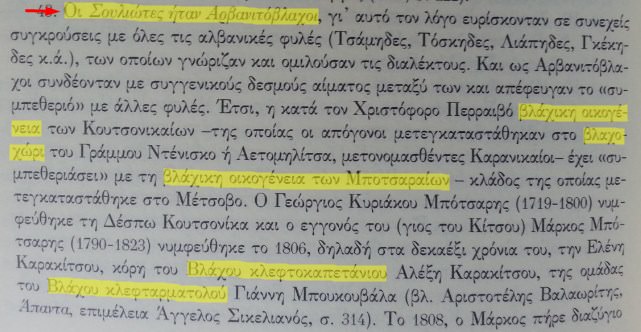
Quick summary: Souliotes (Botsaris, Koutsonikas, etc.) were Vlachs from Northern Epirus. They were at war with other Albanian tribes (Chams, Labs, Tosks). They also spoke Albanian, but they were not Albanians/Arvanites. They were Arvanitovlachs and they were married with other Vlachs.
 
Carlin - Ali Pasha singled out Souliotes from Arvanites because they were a more hellenized group politically and culturally.

Lol ok are we really serious here? You tell me what’s wrong with this post and really consider what you write next time. “Hellenized”? Lol, really now. Where in the world were these hellenes?
 
When King Otto of Greece came in Greece in 1830, he hardly heard anyone speak in Greek and so he asked: "Where are the Greeks in Athens?"

His court looked at each other and answered: "There are no Greeks, but do not be troubled because this Albanian population will always be faithful to your monarchy".

Zaharias Papantoniou, "King Otto"

By the way, this is a fake story and reference. I can't find who really first forged this, but as early as 2010 a man with the username CAKIMacedonian in Total War Center Forum writes this:


This is for you..let we laugh now......hhhh
-In the memories of prince Otto, Prince of Bavaria and first king of Greece, when he first time arrived in Athena and Peloponnesus, he said: "These are completely different people than we expected. We expected to find some ancient people, but we found only immigrants from Africa. "
"When King Otto of Greece came in Greece in 1830, he hardly heard anyone speak in Greek and so he asked: "Where are the Greeks in Athens?" His court looked at each other and answered: "There are no Greeks, but do not be troubled because this Albanian population will always be faithful to your monarchy".
King Otto, Zaharias Papantoniou
ahhhha aahhhhaaa where were your ancestors man...hhhh!!!!


By the way King Otto didn't write memoirs either.
 
Lol ok are we really serious here? You tell me what’s wrong with this post and really consider what you write next time. “Hellenized”? Lol, really now. Where in the world were these hellenes?

Hellenes were assimilated before the Dark Ages. ''Hellenized'', in modern sense, refers to becoming a modern Greek. Souliotes were Albanians who spoke bilingually Greek and considered themselves Romaioi.
They were a very war-like people, they would kill anyone who converts to Islam from their group, including kids.
 
A piece of historical fiction from Vassilis Nitsiakos’s Facebook page: https://www.facebook.com/bnitsiak/

FANTASTIC DIALOGUE WITH MARKOS BOTSARIS
- Marco Good Morning. I write to you so many years later, etc because I have questions that concern you unanswered...
- Tell me what it is you want to know
- Let me tell you first that I admire you, you are my favorite hero. And I think that in the pantheon of Greek heroes you are one of the top... Some time ago we made a documentary with an English director about the Souliotes. We disagreed about their identity and I was forced to withdraw my signature because of this event
- What was your argument?
- He supported the view that you are Albanians and that the conflict between you Souliotes and Ali Pasha was an intra-Albanian conflict...
- What, he said so? Look at this patriot. First we are Christian Orthodox and he is a Muslim. We Romioi and he is a Mohamethan. We called these Turks. I don't understand about ′′ intra-Albanian conflict ". This was a Mohamethan pass of satrapis, who didn't tolerate our own independent life, our resistance to our own conquering views. We wanted to be free and self-exous...
- Marco, I supported the opinion that you are in the majority of Arvanites, who, since you had a national conscience, was Greek. Did I do right or wrong?
- What I know and I want to tell you is that we were talking Arvanitika to each other but at least the men knew Roman too. We wanted our freedom and we fought not only for ourselves but for the whole of Romiosíni. We all, Arvanites, graics and other Christian Orthodox united by common faith and struggle against the conquerors.
- You, Marco, wrote a Roman-Arvanitiko dictionary. Why did you do that? For what purpose?
- I did this so all our people would learn Roman, because, like I told you, not everyone knew.
- And why would they learn Roman?
- Because this was the official language, the language of educated people, the language of letters. Even Ali Pasha used this and had Roman grammar and other scientists in his yard. When we made our own state, this is the language we would have... the arvanitika were not written, there was nothing written of poems, to say, literature.... it was a homemade speech and for each other, how can I explain it to you....
- Marco, if Ali managed to make his own state, Roman Albanian, what would you do?
- We would fight for our country and for Christianity, for the Roman...
- I notice that you don't say Greek and you say Roman...
- That's what we used to say back then. It was you see the Roman millet, recognized by the Sultan led by the Patriarch of Constantinople. This is how all Orthodox were one....
- Now we say Greek and we all call ourselves Greeks...
- I don't know... This may be better, because it unites us with the ancient ones and puts us all under such an umbrella, so that there are no breeds and tribes special from here and there but all Greeks...
- Marco, I guess you learned what happened after your death...
- I don't have an update down here but I would be happy if Suli and Souliotes exist second and Romiosyni is all united and strong...
 
"The case of Marko Bozzaris is another (and more recent) example. He was an important leader in the Greek struggle for freedom, is a national hero of the Greeks, claimed also by the Bulgarians and Albanians, though it is known that his parents spoke the Vlach language [See this in Walter Kolarz (1946:33). Marko Bozzaris was also the author of a Greek-Albanian dictionary and his wife, it appears, could only speak "Albanian" and "Bulgarian".]"

-- Pages 75 & 76, Memory, Identity, Typology: An Interdisciplinary Reconstruction of Vlach Ethnohistory, by Gheorghe Bogdan (BA, University of British Columbia, 1992).
 
Back
Top