• Welcome to the new Macedonian Truth Forum. All posts, members and private messages have been moved over from the old forum.

    Passwords from the old forum could not be carried over, so please use Forgot your password? to set a new one. The reset link is emailed to the address on your account.

  • Rules and Regulations at the forum of the Macedonian Truth Organisation (MTO)

    (1) The national-ethnic and cultural-linguistic identity of the Macedonian people is historically Macedonian, and derives its character from the native, indigenous and geographic homeland of the Macedonians, which is called Macedonia. To ensure that their human rights, integrity and heritage are appropriately respected, the only nouns and adjectives acceptable when reference is made to the above character and identity markers is Macedon, Macedonia, Macedonian and Macedonians.

    (2) The nation-state of the Macedonian people is the Republic of Macedonia, and is to be referred to by this official title so long as the 'republic' prefix is consistently applied to other states. Alternative references are the Macedonian Republic, or simply, Macedonia.

    (3) The 'ethnic' prefix is only acceptable for Macedonians in cases where differentiation is specifically required - so long as it is in context and consistent where it concerns its application to other ethnic groups.

    (4) Should any other differentiation be specifically required, the names of other ethnic groups that reside with Macedonians in either the Republic of Macedonia or the occupied Macedonian regions in Greece, Bulgaria, Serbia or Albania, are to be given a prefix.

    (5) Negating the identity, language and culture of the Macedonian people by deliberate avoidance of the terms Macedonia, Macedonian and Macedonians, or by any other means, is not permitted.

    (6) Systematic anti-Macedonian propaganda and rhetoric are not permitted.

    (7) Threads irrelevant to the Macedonian Cause, the community at the Macedonian Truth Organisation or the Macedonians in general may be considered as spam or not in the spirit of the forum. In such cases they are not permitted.

    (8) Continual posting of messages in threads with the sole purpose of deviating from the initial topics with the use of unrelated and unnecessary information is not permitted.

    (9) All posts, external articles, reports, etc that are cited in languages other than Macedonian or English, must be accompanied with a translation in one or both of the said languages.

    (10) Despite the possibility of some conversations and debates becoming heated, extreme abuse and/or racism, vulgar language and/or terminology, threats, revelation of personal information about others, harassment, and other such behavior will not be permitted. If deemed necessary all relevant information including member details will be reported to the appropriate authorities for investigation which may result in legal action.

    (11) Threads that are created must have a summary of a topic or excerpt of an article found in pertinent link(s) that have been included. One line threads will be considered unaccetable spam and are therefore not permitted.

    (12) Compulsive and deliberate lies, irrespective of the topic, are not permitted.

    (13) Any symbols or avatars found to be perceived as offensive to Macedonians are not permitted.

    (13) Any explicit or extreme material is not permitted.

    Failure to adhere to the above rules and regulations will result in a ban after 3 breaches. This may be reconsidered in some cases should the circumstances be of an unorthodox nature and/or require special consideration. To assure an effective deterrent against an individual or individuals with the sole purpose of causing dissent through spamming, racism or other improper means, the above rules will be strictly enforced.

    The MTO administration will monitor all discussions as reasonably practical and reserve the right to remove any post and/or member from the forum, and update the rules and regulations as required. Members are encouraged to immediately report any post and/or member to the MTO administration if they feel that these rules have not been abided by.

    The views expressed on this forum are those of the individuals. The only official representation of the MTO is made by the "Macedonian Truth Organisation (Site Owner)" username, and no other.

  • Macedonian Cause

    The Macedonian Truth Organisation calls on God in Heaven to protect, bless and guide the endeavour it is committing to undertake, and that is to work towards:

    Securing Macedonia as a free, independent and democratic republic in which sovereignty lies with the Macedonian citizens; as the nation-state of the Macedonian people in which they can preserve their culture, language and identity; as a state in which the Macedonian language and culture form the basis of public life and act as important unifying elements of Macedonian society; as the home of all its citizens to which it guarantees and obliges their inalienable natural rights and corresponding responsibilities;

    The acknowledgment as self-evident and irrefutable the existence of the:

    1) Indigenous, ethnonational name of Macedonia;
    2) Macedonian people, language and identity;
    3) Macedonian culture, symbols and folklore;
    4) Macedonian ancestry, heritage and history in its entirety; and
    5) Macedonian Orthodox Church;

    Securing recognition by the International Community of the tragedies endured by the Macedonian people, of the division of Macedonia with the signing of the Treaty of Bucharest on August 10, 1913, and the genocide committed against the Macedonian people at the hands of the Greek, Bulgarian and Serbian states and their respective churches during the 19th and 20th centuries;

    Ensuring that the Interim Accord is declared ‘null and void’ and that all constitutional provisions, acts, commitments, agreements, legislation, regulations, policies or programs emanating from, supporting or consequential to the Interim Accord are also declared ‘null and void’, including the use of any symbols and the completion of any acts imposed by, or originating from, the Interim Accord.

    Ensuring that the Framework Agreement is abolished and that all constitutional provisions, acts, commitments, agreements, legislation, regulations, policies and programs emanating from, supporting or consequential to the Framework Agreement are also abolished and replaced by a framework of constitutional and statutory law based on inalienable natural rights and corresponding responsibilities and universally codified human rights mechanisms.

    Securing the abolishment of any existing constitutional provisions, acts, agreements, legislation, regulations, policies and programs that discriminate against the Macedonian people, in any international organisation or any of the countries of the International Community where such constitutional provisions, acts, agreements, legislation, regulations, policies and programs exist, and thereby ensuring the freedom for Macedonians to exercise their inalienable natural rights and fulfil their corresponding responsibilities, and practice their culture, language and religious faiths in all the countries of the International Community without hindrance;

    The empowerment of Macedonians to undertake a moral revolution and to instil and/or reinvigorate within themselves a deep-rooted national, cultural, linguistic and historical dignity and a commitment to the exercise of freedom based on inalienable natural rights and corresponding responsibilities;

    The recognition of the Macedonian minorities in the neighbouring states of Macedonia as well as the respect for the inalienable rights and freedoms of the Macedonian minorities, as provided for by natural law and as codified by the United Nations Charter, the Universal Declaration of Human Rights and other universally codified human rights mechanisms;

    The full and unreserved respect of, and the support for, the rights of all people of non-Macedonian descent living in Macedonia and around the world, who share a reciprocal full and unreserved respect for the Macedonian people, their homeland and their state;

    The cultural unification and solidarity of the Macedonian people living in all parts of historical Macedonia and adjacent territories, as well as Macedonians throughout the world;

    The unity of all Macedonians on the principles, objectives and achievement of the Macedonian cause as defined by this declaration.

Modern Turkey: Ottomanism vs Secularism

Turkey will be the death of NATO – its recent clash with fellow member France off the coast of Libya is an early symptom

Scott Ritter is a former US Marine Corps intelligence officer. He served in the Soviet Union as an inspector implementing the INF Treaty, in General Schwarzkopf’s staff during the Gulf War, and from 1991-1998 as a UN weapons inspector.

URL:
https://www.rt.com/op-ed/495088-nato-turkey-france-libya/

When two countries who are supposed to be military allies fall out and almost get themselves into a shooting match, you know there’s going to be trouble ahead. The problem for NATO is, this time, it may prove terminal.
For a story that involves high seas skullduggery, clandestine gun-running, a punch up between people who are supposed to be friends, and an incident that could be fatal for the world’s biggest military alliance, this one started mundanely enough.

Back on June 7, 2020, a Tanzanian-flagged cargo ship, the Cirkin, quietly departed a Turkish port and set sail toward the Libyan port of Misurata.

No one is absolutely certain what its 5,800 tons of cargo was, but it’s safe to say it probably wasn’t carpets.

No, that wouldn’t require the three Turkish warships who escorted the Cirkin on its four-day, 1,000 nautical mile journey. It was almost certainly carrying military equipment for the Libyan army under the command of the Government of National Accord (GNA), in contravention of the UN-imposed arms embargo.

Things started to go wrong three days later, when a Greek helicopter, operating from a Greek frigate, the Spetsai, approached the ship and requested permission to land a boarding party for the purpose of inspecting it. The Spetsai and its helicopter were operating as part of Operation Irini, an effort in the Mediterranean undertaken by the European Council to enforce a UN arms embargo on Libya. Cirkin’s Turkish escorts rejected the request.

The Spetsai withdrew and monitored the Cirkin from a distance. Shortly afterwards, the cargo ship turned off its transponder.

A French frigate, the Courbet, operating as part of Operation Sea Guardian, a NATO maritime security operation, was then informed by NATO that the Cirkin was possibly carrying arms in violation of the UN embargo.

After the Cirkin failed to identify itself to the Courbet, and refused to divulge its final destination, the Courbet sought to board the vessel. At this point, one of the Turkish frigates illuminated the Courbet three separate times with its fire control radar, an indication it was intending to engage its weapons systems.

The Courbet withdrew, and the next day the Cirkin arrived in Misrata, where it discharged its cargo.

J’accuse
France has condemned the Turkish actions and filed an official complaint with NATO; a subsequent investigation by NATO was deemed to be “inconclusive,” although the details remain classified. For its part, Turkey has demanded an apology from France. In response, France has withdrawn its forces from Operation Sea Guardian, and demanded that NATO take seriously the task of enforcing the UN arms embargo on Libya, an act that would put it at conflict with Turkey, a NATO member.

This is where the incident becomes murky – it appears that Operation Sea Guardian lacked any NATO mandate to operate in support of Operation Irini, and that the decision to interdict the Cirkin was taken unilaterally by France, void of any NATO authority.

In the days following the June 10 incident, the European Union appealed to NATO to authorize ships assigned to Operation Sea Guardian to operate in direct support of Operation Irini’s Libyan embargo enforcement mission. However, such authorization would require the unanimous consent of all of NATO’s members, making any such authorization impossible given Turkey’s inevitable veto.

Dysfunctional and deeply divided
The circumstances that led to the confrontation between two ostensible NATO allies in the waters off Libya point to a level of dysfunction in the NATO alliance that underscores the reality that the 71-year old has outlived its utility. And that its current search for relevance outside of the post-Second World War transatlantic framework of rules-based liberal order it was created to defend, has placed the alliance on a self-destructive path where it is increasingly in conflict with itself.

More often than not, the culprit at the center of these disputes is Turkey, which raises the question as to the continued viability of Turkey as a NATO member, as well as the viability of the alliance itself.

Ever since Turkey joined NATO, in February 1952, it has been the odd man out. Its military importance to the alliance was immense – by bringing Turkey onboard, NATO not only secured its southern flank with the Soviet Union, but also insured that Turkey could never align itself with Moscow down the road.

In exchange, however, NATO had to overlook many issues that, in any other environment, proved detrimental to Turkey’s being a NATO member. The military-on-military aspect of the Turkish-NATO relationship was, at its founding, rock solid – indeed, in 1950, Ankara had dispatched a brigade of Turkish troops to fight alongside the US and the UN in defense of South Korea.

Military coups and purchases of Russian arms
But the Turkish military was a double-edged sword; in 1960, the Turkish military orchestrated a coup against the democratically elected Prime Minister Adnan Menderes, who was subsequently executed by a military tribunal in 1961. While the Turkish military restored civilian rule in 1965, it stepped in again in 1971 to oust the government of Suleiman Demirel, and again in 1980, overthrowing another Demirel-led government.

In 1998, the Turkish military undertook what has been called a “postmodern” coup, demanding the resignation of the government of Necmettin Erbakan without resorting to the actual suspension of the constitution.

The civil-military discord inherent in this string of coups is representative of the fundamental internal conflict between secular and Islamist forces inside Turkey that has been ongoing since the founding of the modern Republic.

The US and other NATO allies turned a blind eye to the Turkish military’s proclivity for overthrowing duly-elected civilian governments because the system these interventions preserved – secular, pro-West governments – were seen as a better alternative to populist Islamist movements that did not share core NATO values.

The election of Recep Tayyip Erdogan, a follower of the ousted Erbakan, as Turkey’s prime minister in 2003 set Turkey on a collision course with NATO and the West. Erdogan is an unapologetic Islamist whose pan-Ottoman vision of Turkey’s role in the world clashes with the traditional transatlantic script followed by NATO.

In July 2016, when the Turkish military undertook a failed effort to oust Erdogan, many of the perpetrators were officers with pro-NATO tendencies who objected to Erdogan’s Islamist agenda. Since the failed coup, Erdogan has reshaped the Turkish military so that its leadership is aligned ideologically with his vision of Turkey’s place in the world – a vision which often operates in opposition to NATO objectives.

Perhaps the most visible manifestation of this Turkish-NATO incompatibility is Turkey’s purchase of Russian S-400 surface-to-air missiles. The US has threatened Turkey with sanctions over this and has terminated Ankara’s participation in the production of the F-35 fighter.

Other areas of friction include Turkey’s invasion and occupation of northern Syria, and its subsequent conflict with US-backed Kurdish forces operating there; Turkey’s ongoing military operation in northern Iraq, done without the permission of the Iraqi government; and Turkey’s support of the Government of National Accord (GNA) in Libya.

It is this support to the GNA, which comes in the form of arms shipments and manpower support, which precipitated the naval incident with France and has Turkey on a collision course with NATO today.

The NATO alliance has been struggling with relevance since the dissolution of the Soviet Union in 1991. The many fractures that exist within the alliance – the new “East bloc” versus “old Europe,” rule of law proponents versus autocratic governments, transatlantic originalists versus global expansion – have been papered over by the consensus-based organization in an effort to project unity. But the inherent incompatibility of Erdogan’s pan-Ottomanism (the driving force behind Turkey’s Libyan intervention) with the rules-based “liberal order” that NATO purports to espouse, is not so easily swept under the proverbial carpet.

The incident between France and Turkey exposes the fundamental weakness of NATO, an organization desperately in search of relevance. The reality is that Turkey is the weakest link in this alliance, and its continued presence represents a poisonous pill that will ultimately prove to be the death of it. The only question is, how soon?

 
Of course it's not true that Hagia Sophia was sold to Turkey or that the Christians of Constantinople converted to Islam.

EdHoT21U8AE7Oyl
 
Last edited:
The Republic of Turkey under Erdogan's leadership is "a rising star and indispensable source of hope for Muslims and the oppressed," Shaqir Fetahu, deputy chair of the Islamic Religious Union of the Republic of Macedonia, said in his letter.

shaqir-fetahu.jpg
 
Many of the Muslims would make practing Christianity and non Islamic religions as private as having sex if they had the chance. Keep your "wrong religion" to yourself mentality.

I heard that the Eastern Roman was taxing it's critizens to death, which pushed the Islamization and the Turkification of Anatolia.
 
Of course it's not true that Hagia Sophia was sold to Turkey or that the Christians of Constantinople converted to Islam.

EdHoT21U8AE7Oyl

Perhaps not for the specific case of the Christians of Constantinople but the phenomenon of conversion to Islam is well documented.

This is the report of the Venetian ambassador Lorenzo Bernardo from 1592, which states that there are many "bastard Turks" who are mostly "descended from Christian renegades who did not understand the Muslim religion."
3RC1wp2.png


Furthermore, an interesting identity phenomenon characterizes Ottoman Muslims in the first century after the Fall. During the period 1453-1600, Ottoman Muslims often identified themselves as Rūmī ~ "Muslims of the land of the Romans" and sometimes as Rūm oğlani = "sons of the Romans" (something like "the Islamized descendants of the Romans"), when they wanted to distinguished from other Muslims such as the Persians (Acem), the Arabs (Arab) and the Mamluks of Egypt (Misirli = "Egyptian").

Oğlani = "sons, children, boys" is homonymous with the patronymic suffix -oglou = "his son" and with the term iç oğlan> tsoglani.

This custom is never found in official Ottoman documents, but was widespread enough for Muslims in other areas to observe. So in 1589, the Moroccan ambassador to Constantinople wrote about the city:

"This city was the capital of the country of the Romans (Rome), the seat of their empire and the city of the emperors. The Muslims who now live in this city identify themselves as Rūm, and prefer this origin to their normal [meaning Turkish]. Among them, they call their characteristic calligraphy khatt rūmī."
 
Another Turkish article explaining their views.


Today is the day of defeat for those who say, "Turkey’s oppression started in 1453."

Today is the day those who strove for Istanbul to meet the same fate as Andalusia lose.

Today is the day the plans made by those trying to shrink Turkey and carve it into pieces collapse.

Today is the day tens of thousands of people race to Hagia Sophia, bearing a magnificent history to the present, and announcing to the world our political legacy.

'We' are both Ottoman, Byzantine. We are the Seljuks, we are Turkey

Today is not only the day that not only the Sultan Mehmets of Turkey rejoice, but also the day the Alparslans, the Kılınçarslans, the Sultan Selims, the Sultan Süleymans, and those whose blood were shed for the sake of every inch of land in this vast region, who made this territory our homeland, who made this nation a superpower rejoice.

Today is the day the continuity of the chain of great leaders is cemented with President Recep Tayyip Erdoğan, the continuity of great states is cemented with Turkey.

Today is the day we say "we" are both Ottoman and Byzantine, we are the Seljuks and the Republic, we are Istanbul, we are Jerusalem, we are the Balkans, we are Mesapotamia, we are Anatolia and the Caucasus as well.

The Ottoman Empire became a global power with Istanbul’s conquest. Turkey will do the same with Hagia Sophia

Hagia Sophia is not only a source of joy, it is not only a sentiment. Hagia Sophia represents power. It represents a globalizing power today as it did 567 years ago.

Upon the conquest of Istanbul, Hagia Sophia’s conversion into a mosque and the collapse of the Eastern Roman Empire, the Ottoman Empire became a global power; in fact, it became the world's greatest power.

The significance and symbolism of Hagia Sophia being opened as a mosque today is no different to our presence in the Mediterranean, the Aegean, Syria, Iraq, Libya, and the Persian Gulf. Altogether, they make up our grand aim.

They prepared a destruction plan to turn Hagia Sophia into a church, Istanbul into Andalusia

A multinational intervention was launched four years ago to divide Turkey. Had the intervention been successful, Hagia Sophia would have been converted from a museum into a church today – the most critical step to detach Istanbul from Anatolia. That is when its fate resembling Andalusia’s would kick in.

We were going to be surrounded, sieged and banished from the Iran-East Mediterranean line, from all of the Mediterranean, from the Aegean. Just as they have been doing now, by getting Armenia to attack Azerbaijan, they were going to close off the Turkey’s eastern gate as well. This was not a plan to banish us back to Central Asia but rather a plan of destruction.

We are the sole nation capable of re-writing history once every four years. We broke all their sieges, and now we are building a great power in the center. It is because all this transpired, because all this was done that the Hagia Sophia decision became a possibility.

The entire region overjoyed

Today is July 24, 2020:

All of Anatolia, the Balkans, the Caucasus, Central Asia, South Asia, Africa, the Arab region, regardless of what their regimes say, are overjoyed.

Those who have been experiencing nothing but grief for the last century are now rejoicing. Those who have suffered defeat after defeat for a century are now experiencing victory.

Today is an uprising, a challenge against the Ottoman Empire’s collapse, the 20th century’s pro-tutelage period. Today is changing that history in the first quarter of the 21st century. It is the proclamation of the end of the regression and tutelage era and the start of Turkey’s new rising era.

1,000-year-old history

A country, a nation, a state raking up the history on the last thousand years, setting it on the table signals that it is re-evaluating its plans.

You no longer hear theories such as “front country,” “garrison country,” “bridge country,” Atlantic fronts’ “outpost country,” “green zone.” You will never hear them again.

This will signify nothing other than the illusions adopted by and ingrained in the minds of a very small group in Turkey.

Last defense resisted, last Crusades have stopped again in Anatolia. Third great shock over

The region’s last defense line resisted. Its last fortress remains standing. Now, a power domain is being built with this fortress at the center.

The last of the Crusades were stopped in Anatolia once again. The region’s “third great rise” after the “third great shock” has started against those who turned the “war against Islam” into a global ambition and started a new sort of “Crusader War” through the Israeli far-right and neocons following the Cold War era.

May it be blessed

Just as they turned the symbol of Istanbul’s conquest into a museum during the early Republican period, just as they imposed this and succeeded, today is the day these impositions and compulsions end.

Victory is ours and we are a nation that is accustomed with victory. The brackets of the last century, during which we were doomed to defeat, have been closed.

May it be blessed.

Notice how those who said, “Turkey’s oppression started in 1453,” disintegrated! But history is over for them.
 
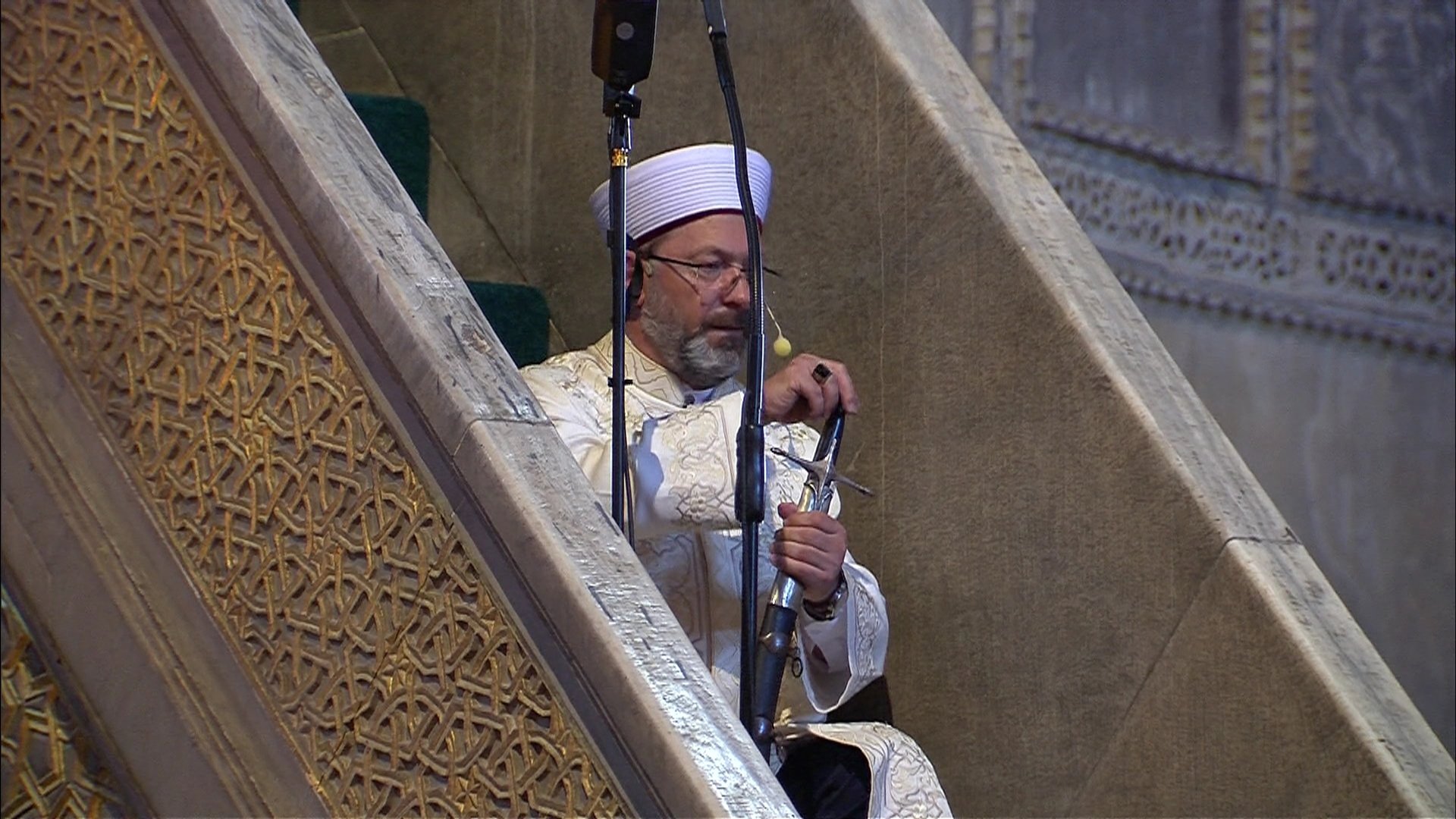
Sermons with swords part of Turkey's tradition, head of Diyanet says

Turkey's religious chief on Friday explained that swords were traditionally held during religious sermons delivered at weekly Muslim prayers as a symbol of conquest.

After leading the Friday prayer at the Hagia Sophia Mosque – the first prayer following its reversion to being a place of Muslim worship – Ali Erbaş told reporters: "Khutbahs (Friday sermons) have been delivered with a sword, without interruption, for 481 years. If Allah permits, we will resume this tradition from now on."

"This is a tradition in mosques that are the symbol of conquests," explained Erbaş, who heads Turkey's Religious Affairs Directorate (Diyanet), adding that the Hagia Sophia Mosque is one of those symbols of conquest.

48361.jpg
 
From Hurriyet


The khutbah (sermon) Ali Erbaş, the head of Turkey’s Presidency of Religious Affairs (Diyanet), delivered at the first Friday prayers performed at Hagia Sophia on July 24 after the historical structure was turned into a mosque from a church has stirred a fierce debate as critics claimed that the country’s top imam targeted Mustafa Kemal Atatürk, the founder of the republic.

“Any property that is endowed is inviolable in our belief and burns whoever touches it; the charter of the endower is indispensable and whoever infringes upon it is cursed,” Erbaş said in the sermon.

Politicians from the main opposition Republican People’s Party (CHP) and İYİ (Good) Party claimed that Erbaş’s remarks were targeting Atatürk, some calling on him to resign.

A cabinet decree back in 1934, when Atatürk was still alive, had turned Hagia Sophia into a museum. On July 10, a Turkish court annulled this decree, paving the way for its use again as a mosque after an 86-year hiatus.

Erbaş dismissed claims that he cursed Atatürk in the sermon.

“All deeds of trusts for foundations conclude with such a curse. And in my sermon, I referred to this and I referred not only to Hagia Sophia but all foundations. I also did not refer to the past but the future,” Erbaş told daily Hürriyet.

He also pointed out that it is a controversial issue among historians if Atatürk played a role in turning Hagia Sophia into a museum.

“Atatürk passed away 82 years ago. Prayers are said for those who passed away, not curses,” Erbaş said.

As the head of Diyanet he said it is his duty to remind the public of protecting foundations’ properties. “I am fulfilling this duty.”

However, politicians from the CHP and İYİ Party lashed out at Erbaş for his remarks.

“You will pay the price for bedamning Atatürk,” said Özgür Özel, the deputy group head of the CHP.

Gürsel Tekin, a lawmaker from the CHP, said no public servant can insult Atatürk, while another CHP lawmaker, Mehmet Ali Çelebi, said cursing at Atatürk is tantamount to treason.

“One day there may be political and judicial consequences for Erbaş,” said Lütfü Türkkan, the deputy group chair of the İYİ Party.

Aytun Çıray, a lawmaker from the İYİ Party, called on Erbaş to step down, saying that the head of the Diyanet in fact did not even know what was written in Sultan Mehmed the Conqueror’s foundation charter he referred to.
 
Last edited:
Another Turkish opinion article from Yenisafak

Hagia Sophia was engulfed in Sujood on Friday...

Finally.

It has been freed after 86 years...

July 24th went down in history as a day of rebirth.

July 24th has become a day of feast, of celebration, of ultimate union.

Hundreds of thousands of Muslims, whose hearts burned bright with the fire of freedom and the love of truth in spirits and minds, flocked to Hagia Sophia from all over Turkey.

Gone are the days of sorrow.

It was an altogether different experience for those who were present at Hagia Sophia Mosque on Friday.

The enthusiasm, excitement and joy were beyond explanation; it had to be experienced. Because history was being made. Milestones cannot be explained, only experienced. It all falls into place.

With about half an hour left to Friday prayers, the call to prayer was performed in different makams; spirits soared high; people were enchanted; Hagia Sophia filled with sorrow and jubilation today.

What does it mean to be a pariah? What does it mean to be free? It was then and there for the first time that I felt the meaning in my bones.

It was the first time I shuddered as I felt with every fiber of my being that while the loss of independence of these lands was not experienced on the field, it happened mentally, and that the children of these lands were not only mentally enslaved, but in fact, they fell under the spell of their tormentors.

It was on that day that I first understood in so clear a way what it meant to be free, what it meant for Hagia Sophia to be liberated.

I cried and cried and choked up on tears of sorrow and joy.

The biggest disaster that can befall a society is not being aware of its misfortune, I kept saying as I stood there.

This is exactly what I fully comprehended in Hagia Sophia.

With every fiber of my being, I saw and heard how Hagia Sophia was treated as a pariah, how the children and souls of these lands were destroyed and turned into pariahs...

This country wasn’t exactly colonized per se, but it was mentally colonized and has been under the spell of its tormentor!

I’m certain everyone experienced the same things I did both inside and outside Hagia Sophia Mosque...

Tears of sorrow and joy flowed like torrents…

The chains on Hagia Sophia have been broken. Hagia Sophia’s chains represented the shackles of our minds...

Who could ever have been made uncomfortable by the liberation of Hagia Sophia?

But this has also happened.

Hagia Sophia has been reopened as a mosque, and Greece has declared mourning.

This I can fathom.

But it’s unfathomable for me how certain types among us have lost it over Hagia Sophia’s mosque reversion.

Oh and by the way, weren’t you also the children of this country?

What kind of schizophrenia is this! What kind of a disease!

Hagia Sophia Mosque is the symbol of our civilization claims, which rendered these lands home, allowing us to wave the banner of justice and equity to the whole world.

Hagia Sophia Mosque is both the deed and the symbol of Turkey’s leadership and Muslim unity, resurrection and rebirth.

The Hagia Sophia Mosque is the most powerful, most steadfast and most unshakable gate of the only civilization that recognizes every other civilization’s right to life, the only, the last and most sophisticated representative of Islamic civilization, the Ottoman civilizational spirit and claims that has once again offered the gift of justice, peace and equity to all humanity.

In a nutshell: It’s a divine decision, it has been preordained!

O Lord!

No amount of praise will ever be enough!
 
Last edited:
Turkey tells US, EU to mind its own business as Greece ‘threatens’ military action

URL:
https://www.minareport.com/2020/07/...business-as-greece-threatens-military-action/

Days after the US State Department warned Turkey over its gas reserves exploration and drilling plans in waters between Cyprus and Greece, which Athens has declared ‘illegal’ given it cuts into Greece’s Exclusive Economic Zone (EEZ), the European Union has also put Turkey on notice, warning it could move forward with sanctions.

French President Emmanuel Macron said late this week that it’s “not acceptable for the maritime space of a European Union member state to be violated or threatened” and called for sanctions if it moves forward. On Tuesday a US State Department statement demanded that Turkey back down from its drilling plans which have put the Greek Navy on “high alert” – given Turkish exploration ships are already in or near Greek waters.

Greek media sources are now reporting that Turkey through its embassy in Washington DC has informed the Americans that it plans to proceed unimpeded with its drilling research with the Oruc Reis vessel in the disputed eastern Mediterranean waters.

“We urge Turkish authorities to halt any plans for operations and to avoid steps that raise tensions in the region,” the statement said. And Greece’s foreign ministry said it clearly violates the country’s sovereignty and that it stands ready to defend its territory.

Turkey has so far rejected all demands from the US, EU, Greece and Cyprus that it back down. Turkey’s Daily Sabah newspaper cited President Erdogan’s office as follows:

Turkey rejects Greece’s “maximalist” objectives in the Eastern Mediterranean, which lack a legal basis and disregards logic, Presidential Spokesperson Ibrahim Kalın said Thursday.

Kalın highlighted that Turkey opposes the rhetoric of threats and favors an equal distribution of resources.

The Greek side’s “maximalist” position claims that the island of Kastellorizo (Meis in Turkish)-only 2 kilometers from the Turkish shore, but about 580 km away from the Greek mainland-“should have a 40,000 square km continental shelf area, which is almost like half of Turkey’s Gulf of Antalya,” Kalın told an online policy briefing by the European Policy Centre in cooperation with the Foreign Economic Relations Board of Turkey (DEIK).

Turkey has claimed that it’s “well within its rights” amid the gas exploration and drilling.

Though Turkish media has claimed the Oruc Reis vessel has already commenced with its mission in the disputed waters, a number of analysts have cried foul, citing that it hasn’t actually left port, given Ankara may be taking Greek threats of military action seriously:

Turkey has used its claims over northern Cyprus, or the so-called “Turkish Republic of Northern Cyprus,” to say it can drill in waters encircling the entire island.

Analysts have feared the additional deployment of naval forces by both sides amid the dispute could easily lead to a break out into war.
 
“We urge Turkish authorities to halt any plans for operations and to avoid steps that raise tensions in the region,” the statement said. And Greece’s foreign ministry said it clearly violates the country’s sovereignty and that it stands ready to defend its territory.
Macedonians don't really have a dog in this fight, but I find it ironic that Greece would complain about violations after it's vicious assault on Macedonia for the last 30 years. Consequently, irrespective of whether or not the Turks are right to pursue further operations, I could care less about the sovereignty of Greece.
 
Another opinion article from Daily Sabah. As you can see they're quite clear.

The Hagia Sophia’s reclassification as a mosque and last week’s Friday prayer, which drew around 350,000 people, including Turkish statesmen, continues to make waves. No, this piece is not about reactions to that decision. I will not delve into its international reception, Greece’s response or the significance of that ancient temple serving as a mosque again for Turkey. Instead, I intend to reach certain conclusions about Turkish foreign policy on the basis of the Hagia Sophia’s reopening. I will also analyze what kind of strategic initiatives Turkey can take when it is absolutely necessary.

When Turkish troops were deployed to Cyprus in 1974, Turkey had very good reasons to launch that operation under international law. A military coup had taken place on the island and Greek Cypriot gangs had begun to massacre ethnic Turks. Citing those legitimate reasons, Turkey conducted a military operation and proceeded to gain control of predominantly Turkish parts of the island. The Cyprus conflict has been awaiting a solution since 1974. In 2004, then-United Nations Secretary-General Kofi Annan devised a peace plan, which the Turkish Cypriot community endorsed, whereas Greek Cypriots vetoed the initiative and perpetuated the dispute.

Indeed, Turkey’s interest in Cyprus predates the 1974 operation. The Turkish people have been more aware of the situation in Cyprus and have occasionally staged street protests over that matter since the 1950s. The Turkish people and government’s concerns about Cyprus primarily relate to protecting the Cypriot Turks’ right to life. There is, however, an additional strategic consideration. The Dodecanese islands were taken from Turkey and placed under Italian control shortly before World War I, only to be handed over to Greece after World War II. A quick look at the map of the Aegean Sea would suffice to appreciate how their placement under Greek control represented a massive strategic loss for Turkey. That development limited Turkish control over the Aegean Sea to several miles, despite Turkey’s huge coastline, making it hardly possible for that country to leave the Aegean. A loss of such magnitude could not have been expected not to push Turkey, a country with a sizeable population and an extensive history, to take new initiatives. My interpretation is that Turkey responded to the situation in the Aegean Sea by playing the Cyprus card and carving out space in the Mediterranean.

Here’s the lesson of that story: When Turkey encounters strategic containment, it tends to take new military, diplomatic, economic, and political steps in response, attempts to undermine that policy of containment and seeks to change the rules of the game by challenging the status quo.

In the 1970s, Turkey’s economy and national security depended heavily on outsiders. The country’s democracy was in a dismal state, and domestic political turmoil and military coups consumed its energy. Even under those circumstances, however, Turkey managed to take an important step in Cyprus. Needless to say, there is a huge gap between Turkey’s economy, population, defense industry and military experience and capabilities today and back then. The country, however, faces similar challenges to its vital interests and new containment policy. There was an attempt to establish an independent statelet for the terrorist organization YPG/PKK, with U.S. backing, in northern Syria – which Turkey thwarted by conducting several cross-border operations to neutralize the threat. The most recent escalation in the Eastern Mediterranean has similar reasons. Greece, the Greek Cypriots, Egypt, and Israel joined forces to exploit natural resources in the area and deny Turkey its fair share. According to Greek maps of the Mediterranean, the entire area was to be divided between Greece and the Greek Cypriots, unlawfully leaving Turkey, which has the longest coastline, a small maritime jurisdiction. In this regard, Turkey faces the same kind of attack against its interests in the Mediterranean that it faced in the Aegean Sea back in the day.

Turkey responded to the said attack by concluding a memorandum of understanding with Libya regarding the two nations’ respective exclusive economic zones. It supported that country’s legitimate government against the putschist Gen. Khalifa Haftar, who proceeded to suffer humiliating defeats, and challenged Haftar’s foreign sponsors in the Libyan theater. Ankara also reiterated that it would protect its interests in the Mediterranean at all costs.

If Greece and the Greek Cypriots refuse to agree on a fair allocation of Mediterranean resources, it would be reasonable to expect Turkey to take additional steps in the near future. One could indeed speculate that the Turkish government’s future steps won’t be limited to symbolic decisions, such as the reclassification of the Hagia Sophia as a mosque.
 
Turkish naval strength in Eastern Mediterranean shifts balance of power

URL:
https://www.trtworld.com/turkey/tur...n-mediterranean-shifts-balance-of-power-37730

Ankara’s long-term plans to strengthen its naval forces are paying off in the Eastern Mediterranean.

While Turkey has been part of NATO for more than six decades, under the leadership of President Recep Tayyip Erdogan, Ankara has managed to develop its military capacity indigenously.

Recent events in the Eastern Mediterranean show the improvement of Turkey’s naval fleet that have managed to deter regional powers from Greece to the Greek Cypriot Administration, Egypt and other powers.


The Turkish Navy has become one of the world’s ten sea powers, designing and building its own frigates among 20 other powers, according to prominent experts and former admirals.

“The Turkish Navy does not sail with tugboats like Russia does,” said Cem Gurdeniz, a retired Turkish rear admiral, in an interview last year.


Turkey has also been in stiff competition with powers like Russia, France, Egypt and Greece in Libya's civil war. Ankara supports the war-torn country’s internationally-recognised UN-backed Government of National Accord (GNA) based in Tripoli against the warlord Khalifa Haftar, whose militias are based in Benghazi.

Ankara has changed the course of the civil war by deploying its naval forces across the Eastern Mediterranean and providing its newly-developed drone technology to the service of the Tripoli government.


The country has managed to match other naval forces including France, Russia, Egypt and Greece, all of whom support Haftar, outplaying them in the region as the GNA forces march towards Sirte, a strategic coastal city, where the country’s former dictator Muammar Gaddafi was born.

With its navy’s support, Ankara has also protected its maritime rights across the region, continuing to explore and drill gas reserves in the Eastern Mediterranean.

Can regional powers compete with the Turkish navy?

“Turkish Navy frigate(s) continue to sail 4 months around Libya offshore non-stop. While Greek frigate's system failed and returned their base. While Russians can't sail without tugboat, Egyptians are missing, can't use their new toys effectively,” writes Kevin Sky, an expert on the defence industry, on Twitter.

The Turkish Navy continued its naval drills in the region without any interruption, Sky noted.

While Egypt’s putschist general-turned-President, Abdul Fattah al Sisi, appeared to strengthen the country’s navy more than most of his predecessors, its naval budget under the continuing economic crisis is still very limited according to experts.

Despite running an aggressive modernisation program for its navy in recent years, the Egyptian fleet does not have enough training and exercises, and might be short on logistics, experts like Gurdeniz and Sky point out.

As a result, the Egyptian navy appeared to shy away from any possible engagement with its counterparts in the Eastern Mediterranean.

Greece and the Greek Cypriot Administration (GCA) have countered with strong rhetoric against a Turkish naval presence in the region, but have done little to stop Ankara. In January, Greek Prime Minister Kyriakos Mitsotakis was in Paris to seek help from French President Emmanuel Macron against Turkey.

After the meeting, Macron dispatched war frigates to the region to show France’s strategic bond with Greece. Even the Greek defence minister claimed that the country is “examining all scenarios, even that of military engagement” against Turkey.

But Greek and French threats against Turkey have not impressed Ankara much.

“I want to underline in a mathematical certainty that Greeks would not want to stage a war with Turkey,” said Turkish Defence Minister Hulusi Akar, during a TV interview on June 10, describing his Greek counterpart’s words as “a slip of tongue.”


For more than nine centuries, the Greeks have not won any significant battle against the Turks.

In May, France appeared to send more warships to the region to counter Turkey.

On June 10, according to French authorities, an incident happened between Turkish and French navy forces in the East Mediterranean. Paris claimed that Turkish warships flashed their radar lights three times at Courbet, one of the French warships deployed into the Eastern Mediterranean waters.

But Ankara denied French claims saying that the French military ship was making fast and unnecessary manoeuvres in the region, endangering NATO principles and navy security rules. Turkey, Greece and France are members of NATO.

More ships than fish

Besides regional powers, at least ten other countries including Russia, the US, Italy and the UK also have a naval presence in the Eastern Mediterranean.

According to reports, the US operates a large fleet consisting of more than ten warships in the region, in part to keep a check on increasing Russian ambitions across the Mediterranean.

Since the beginning of the Syrian civil war, Moscow started increasing its presence there, building a dream Mediterranean naval force. In exchange for the support Moscow has given to the Assad regime in the civil war, Damascus has allowed Moscow to have more access in the Mediterranean, using the country’s ports for its naval operations.

It is a far-fetched political equation for a country that has long aimed to reach “the warm waters” of Europe. Having a grasp of the Mediterranean has been a driving political aspiration for landlocked Russia ever since its imperial days under Peter the Great in the early 18th century.

But while Russia has increased its naval forces in the region, it has not helped Libya’s Haftar claim Tripoli as Turkish-backed forces effectively routed them out from western part of the country.

Turkey’s new naval doctrine: Blue Homeland

In recent years, Turkey has developed a powerful military doctrine, aiming to protect all of its maritime rights and political interests in the country’s three seas, which is called the “Blue Homeland”.

In March, Ankara conducted the country’s biggest maritime exercises simultaneously with more than 100 military vessels in its three seas: the Mediterranean, Aegean and Black seas. The exercises are also named after “Blue Homeland”.

According to experts, the Turkish Navy’s success story lies in the recognition that Turkey could be a great power across the Mediterranean and even the globe as the country’s predecessor state, the Ottoman Empire, had once determined rules of the engagement in the region.

“...it is clear many within Turkey’s political establishment believe that the country is close to standing shoulder to shoulder with other greater powers. The Turkish navy’s reformation represents an acute example of this emerging worldview...,” says Ryan Gingeras, a professor in the Department of National Security Affairs at the Naval Postgraduate School, and an expert on Turkish, Balkan, and Middle East history.

“With more than 87 percent of the country’s trade conducted via maritime ports of entry, and a number of transnational pipelines passing through Turkish territorial waters, the country’s naval capabilities have come to figure more prominently in contemporary Turkish thinking,” Gingeras wrote.

Since 2007, Turkey’s spending on research and development has significantly increased, tripling its previous levels, according to a survey conducted by a leading defence industry group. Last year, it passed $1.2 billion, the survey showed.

Turkey has also increased its technical military capacity to a level, where it could test all of its naval capabilities without needing any external support.

Turkey also has the biggest submarine fleet in the region. Israel, Greece and Egypt are following Turkey’s lead in that area too.

The Turkish Navy has had 112 military vessels until now, but Ankara plans to add a total of 24 new ships - which include four frigates - before the Republic reaches the 100th anniversary of its founding in 2023.

“In addition to a new line of frigates and corvettes, known as the MILGEM program, local contractors have come to supply the fleet with a new array of torpedoes, missiles, and sensory equipment,” Gingeras observed.

As a result, with its enlarged fleet, the Turkish Navy has become an imposing power in the Eastern Mediterranean, defending the status quo in the Aegean Sea and enhancing the security of its strategically crucial channels in the Dardanelles and Istanbul.


Turkey to build two military bases in Libya

URL:
https://atalayar.com/en/content/turkey-build-two-military-bases-libya

The nation headed by Recep Tayyip Erdogan will build two bases in Libya, one at Misrata port and another at Al-Watiya air base, according to local media Yeni Safak. The first will be a naval base in the form of a port with permanent assault capabilities, reconnaissance and auxiliary aircraft storage, while the second will be an air base equipped primarily with unmanned aerial vehicles.

This information comes one week after Erdogan, together with the Prime Minister of the Libyan Government of National Unity (GNA), Fayez al-Sarraj, announced the military victory over the country's capital, Tripoli, after 14 months of offensive by the rival faction, the National Liberation Army (LNA), commanded by Marshal Khalifa Haftar.

In these seven days, new details of the agreements ratified between the two leaders have been discovered, which contemplate, for example, facilities for Turkish companies that want to operate in Libya and access to the nation's energy resources. At this point, it is worth remembering that Erdogan recognized his intention to conquer the oil city of Sirte. To this end, a military source consulted by Al-Arabiya, has assured that Sarraj's troops "are placing minefields in Sadada, west of Sirte".
 
Last edited:
https://www.dailysabah.com/politics...actions-to-reopening-hagia-sophia-for-worship
Turkey blasts Greece over reactions to reopening Hagia Sophia for worship

JUL 25, 2020

Turkey slammed Greek authorities for provoking the public and allowing the burning of the Turkish flag in Thessaloniki over the reversion of Hagia Sophia into a mosque. Speaking at the opening ceremony of the new Istanbul office of the country's National Intelligence Organization (MIT), President Recep Tayyip Erdoğan said Sunday: “As we witnessed during the reopening process of Hagia Sophia as a mosque, some still cannot accept the fact that Istanbul belongs to the Turkish nation and Muslims.” The Defense Ministry on Sunday condemned the incident and said that such abuses and provocations must end immediately. The Foreign Ministry also released a written statement on Saturday. "We strongly condemn hostile statements made by members of the Greek government and Parliament provoking the public opinion and allowing the burning of our glorious flag in Thessaloniki," Hami Aksoy, a Foreign Ministry spokesman, said in the statement. Reactions from Turkey came after a group of far-right Greek extremists burned Turkish flags late Friday in Thessaloniki to protest the reopening of Hagia Sophia for worship in Istanbul. The group burned a Turkish flag after gathering outside the Hagia Sophia Church before marching toward the Turkish Consulate while holding signs that read: "For homeland, nation and orthodoxy." The protesters were stopped outside the consulate by security forces but burned another Turkish flag and sang the Greek national anthem and shouted slogans. Aksoy said Greece showcased its hostility against Islam and Turkey once again under the pretext of reaction against the reopening of the Hagia Sophia Grand Mosque in Istanbul for Muslim worship. He said "the spoiled children of Europe," who cannot accept the reopening of the iconic architecture as a mosque, were "delirious" again.

"These racist mindsets, who have not drawn the required lessons from history, those who disrespect our glorious flag should remember their fate in the Aegean," Aksoy stressed. "Greece should, from now on, wake up from the Byzantine dream that it has been unable to wake up from for 567 years and get rid of its frustration emanating from it," he said. The Greek oppression against the Muslim Turkish minority in the country has been registered by the rulings of the European Court of Human Rights, he noted, adding that Greece is the only European country with no mosque in its capital and it has condoned the destruction of historical mosques in its territory. Aksoy highlighted that the Hagia Sophia Grand Mosque has reopened for worship in line with the will of the Turkish nation. He added that the mosque, like other cultural assets on the Turkish lands, belongs to Turkey, and said: "It will be in our possession and protection forever." He also stressed that the reopening of it for Muslim worship complies with the "requirements and spirit" of the 1972 UNESCO Convention on the Protection of the World Cultural and Natural Heritage.

"No country can teach Turkey about exercising its national sovereignty," he warned. "In line with Turkey's commitment and tradition of tolerance to all religious rights and freedoms, the Hagia Sophia Grand Mosque, the sanctuary of Islam, the religion of peace which embraces all religions, will continue to be open to all," Aksoy said. Ömer Çelik, a spokesman for the ruling Justice and Development Party (AK Party), also condemned the burning of the Turkish flag in Greece. "We strongly curse the burning of our glorious flag in Greece. We condemn the politicians who encouraged the Greek fascists who are trying to protest the reopening of the Hagia Sophia Grand Mosque," Çelik said on Twitter. He added that those who hung the Byzantine flag next to the Greek flag on Friday and declared mourning cannot disrespect our flag. "The Hagia Sophia Grand Mosque is open to everyone as a common value of all humanity," he stressed. Following reactions from Turkey, Greek authorities on Saturday also condemned the burning of the Turkish flag during protests in Thessaloniki a day earlier.

"We categorically condemn any action that desecrates a national symbol of any country, in this case of Turkey," Greece's Foreign Ministry said in a tweet. Hagia Sophia reopened for worship Friday for the first time in 86 years. Earlier, this month a Turkish court annulled a 1934 Turkish government decree that transformed the historic building into a museum, paving the way for its use as a mosque. Hagia Sophia served as a church for 916 years until the conquest of Istanbul and as a mosque from 1453 to 1934, for nearly 500 years and most recently as a museum for 86 years. One of the most visited historic buildings in Turkey by domestic and international tourists, Hagia Sophia was added to the UNESCO World Heritage List in 1985, during its time as a museum. Thousands of people took part in Friday prayer both inside and outside the historic mosque in Istanbul, Turkey's largest metropolis. Besides being a working mosque, Hagia Sophia is also among Turkey's top tourism destinations and will remain open for domestic and foreign visitors. On Friday, Greek Prime Minister Kyriakos Mitsotakis called Turkey a "troublemaker" and the conversion of the site an "affront to the civilization of the 21st century." Greece and Turkey disagree on a range of issues from airspace to maritime zones in the eastern Mediterranean and ethnically split Cyprus.
 
https://www.dailysabah.com/politics/16th-century-ottoman-mosque-vandalized-in-greece/news

16th-century Ottoman mosque vandalized in Greece

AUG 05, 2020

Agroup of unidentified people on Tuesday attacked a 16th-century historical Ottoman-period mosque with stones in the Greek city of Trikala. Windows on the entrance door of the Kurşunlu Mosque, also known as the Osman Shah Mosque, were broken in the assault, according to local media reports. The mosque was also attacked last month as a “retaliation” for Turkey’s decision to revert Hagia Sophia into a mosque. The Ottoman mosque was designed by the famous Ottoman imperial architect Mimar Sinan. It was the only mosque Sinan designed in Greece. The mosque opened its doors in 1570, and was the principal mosque in Trikala during Ottoman rule. The mosque was commissioned by Osman Shah, also known as Kara Osman Pasha, who was the son of one of Sultan Selim I’s daughters. Osman Shah for a long time dwelt in Trikala as the governor or sanjak of the province.

The city lost much of its Ottoman and medieval buildings in the early 20th century, particularly after it was rebuilt to fit a modern urban plan in the 1930s. It is the only mosque still standing in the city of Trikala out of the at least eight mosques that the famous Ottoman explorer Evliya Çelebi reported seeing in his writings. The mosque is no longer used for worship; it now functions as a venue for minor events and is a protected UNESCO site. Turkey last month lambasted statements and actions by Greece against the move to revert Hagia Sophia into a mosque after the first Muslim prayers were held in the Istanbul landmark. Relations between NATO allies Ankara and Athens have been uneasy in recent months but tensions increased over Hagia Sophia and the energy riches in the Eastern Mediterranean. President Recep Tayyip Erdoğan had joined thousands for the first Islamic prayer at Hagia Sophia after decades as a museum. Greek Prime Minister Kyriakos Mitsotakis said what was happening in Istanbul was "not a show of force, but proof of weakness."

The reaction to Hagia Sophia opening for Muslim worship "once again revealed Greece's hostility toward Islam and Turkey," Turkish Foreign Ministry spokesman Hami Aksoy said. Aksoy "strongly condemned" the burning of the Turkish flag in Thessaloniki and accused the Greek government and parliament of "provoking the public with hostile statements." "The spoiled children of Europe, who cannot accept renewed prostration in Hagia Sophia, are once again delusional," Aksoy added in a statement. The UNESCO World Heritage site was originally the Byzantine Empire's main cathedral before its conversion into a mosque after the Ottoman conquest of Constantinople in 1453. Turkey's highest administrative court on July 10 said Hagia Sophia, which served as a museum for 86 years, was registered in property deeds as a mosque, allowing Ankara to change its status once more.
 
Back
Top