• Welcome to the new Macedonian Truth Forum. All posts, members and private messages have been moved over from the old forum.

    Passwords from the old forum could not be carried over, so please use Forgot your password? to set a new one. The reset link is emailed to the address on your account.

  • Rules and Regulations at the forum of the Macedonian Truth Organisation (MTO)

    (1) The national-ethnic and cultural-linguistic identity of the Macedonian people is historically Macedonian, and derives its character from the native, indigenous and geographic homeland of the Macedonians, which is called Macedonia. To ensure that their human rights, integrity and heritage are appropriately respected, the only nouns and adjectives acceptable when reference is made to the above character and identity markers is Macedon, Macedonia, Macedonian and Macedonians.

    (2) The nation-state of the Macedonian people is the Republic of Macedonia, and is to be referred to by this official title so long as the 'republic' prefix is consistently applied to other states. Alternative references are the Macedonian Republic, or simply, Macedonia.

    (3) The 'ethnic' prefix is only acceptable for Macedonians in cases where differentiation is specifically required - so long as it is in context and consistent where it concerns its application to other ethnic groups.

    (4) Should any other differentiation be specifically required, the names of other ethnic groups that reside with Macedonians in either the Republic of Macedonia or the occupied Macedonian regions in Greece, Bulgaria, Serbia or Albania, are to be given a prefix.

    (5) Negating the identity, language and culture of the Macedonian people by deliberate avoidance of the terms Macedonia, Macedonian and Macedonians, or by any other means, is not permitted.

    (6) Systematic anti-Macedonian propaganda and rhetoric are not permitted.

    (7) Threads irrelevant to the Macedonian Cause, the community at the Macedonian Truth Organisation or the Macedonians in general may be considered as spam or not in the spirit of the forum. In such cases they are not permitted.

    (8) Continual posting of messages in threads with the sole purpose of deviating from the initial topics with the use of unrelated and unnecessary information is not permitted.

    (9) All posts, external articles, reports, etc that are cited in languages other than Macedonian or English, must be accompanied with a translation in one or both of the said languages.

    (10) Despite the possibility of some conversations and debates becoming heated, extreme abuse and/or racism, vulgar language and/or terminology, threats, revelation of personal information about others, harassment, and other such behavior will not be permitted. If deemed necessary all relevant information including member details will be reported to the appropriate authorities for investigation which may result in legal action.

    (11) Threads that are created must have a summary of a topic or excerpt of an article found in pertinent link(s) that have been included. One line threads will be considered unaccetable spam and are therefore not permitted.

    (12) Compulsive and deliberate lies, irrespective of the topic, are not permitted.

    (13) Any symbols or avatars found to be perceived as offensive to Macedonians are not permitted.

    (13) Any explicit or extreme material is not permitted.

    Failure to adhere to the above rules and regulations will result in a ban after 3 breaches. This may be reconsidered in some cases should the circumstances be of an unorthodox nature and/or require special consideration. To assure an effective deterrent against an individual or individuals with the sole purpose of causing dissent through spamming, racism or other improper means, the above rules will be strictly enforced.

    The MTO administration will monitor all discussions as reasonably practical and reserve the right to remove any post and/or member from the forum, and update the rules and regulations as required. Members are encouraged to immediately report any post and/or member to the MTO administration if they feel that these rules have not been abided by.

    The views expressed on this forum are those of the individuals. The only official representation of the MTO is made by the "Macedonian Truth Organisation (Site Owner)" username, and no other.

  • Macedonian Cause

    The Macedonian Truth Organisation calls on God in Heaven to protect, bless and guide the endeavour it is committing to undertake, and that is to work towards:

    Securing Macedonia as a free, independent and democratic republic in which sovereignty lies with the Macedonian citizens; as the nation-state of the Macedonian people in which they can preserve their culture, language and identity; as a state in which the Macedonian language and culture form the basis of public life and act as important unifying elements of Macedonian society; as the home of all its citizens to which it guarantees and obliges their inalienable natural rights and corresponding responsibilities;

    The acknowledgment as self-evident and irrefutable the existence of the:

    1) Indigenous, ethnonational name of Macedonia;
    2) Macedonian people, language and identity;
    3) Macedonian culture, symbols and folklore;
    4) Macedonian ancestry, heritage and history in its entirety; and
    5) Macedonian Orthodox Church;

    Securing recognition by the International Community of the tragedies endured by the Macedonian people, of the division of Macedonia with the signing of the Treaty of Bucharest on August 10, 1913, and the genocide committed against the Macedonian people at the hands of the Greek, Bulgarian and Serbian states and their respective churches during the 19th and 20th centuries;

    Ensuring that the Interim Accord is declared ‘null and void’ and that all constitutional provisions, acts, commitments, agreements, legislation, regulations, policies or programs emanating from, supporting or consequential to the Interim Accord are also declared ‘null and void’, including the use of any symbols and the completion of any acts imposed by, or originating from, the Interim Accord.

    Ensuring that the Framework Agreement is abolished and that all constitutional provisions, acts, commitments, agreements, legislation, regulations, policies and programs emanating from, supporting or consequential to the Framework Agreement are also abolished and replaced by a framework of constitutional and statutory law based on inalienable natural rights and corresponding responsibilities and universally codified human rights mechanisms.

    Securing the abolishment of any existing constitutional provisions, acts, agreements, legislation, regulations, policies and programs that discriminate against the Macedonian people, in any international organisation or any of the countries of the International Community where such constitutional provisions, acts, agreements, legislation, regulations, policies and programs exist, and thereby ensuring the freedom for Macedonians to exercise their inalienable natural rights and fulfil their corresponding responsibilities, and practice their culture, language and religious faiths in all the countries of the International Community without hindrance;

    The empowerment of Macedonians to undertake a moral revolution and to instil and/or reinvigorate within themselves a deep-rooted national, cultural, linguistic and historical dignity and a commitment to the exercise of freedom based on inalienable natural rights and corresponding responsibilities;

    The recognition of the Macedonian minorities in the neighbouring states of Macedonia as well as the respect for the inalienable rights and freedoms of the Macedonian minorities, as provided for by natural law and as codified by the United Nations Charter, the Universal Declaration of Human Rights and other universally codified human rights mechanisms;

    The full and unreserved respect of, and the support for, the rights of all people of non-Macedonian descent living in Macedonia and around the world, who share a reciprocal full and unreserved respect for the Macedonian people, their homeland and their state;

    The cultural unification and solidarity of the Macedonian people living in all parts of historical Macedonia and adjacent territories, as well as Macedonians throughout the world;

    The unity of all Macedonians on the principles, objectives and achievement of the Macedonian cause as defined by this declaration.

National Census' in Greece

Soldier of Macedon

Senior Member
https://wiki.familysearch.org/en/Greece_Census

Some early censuses were taken in different places and for different purposes. A census of Crete from 1644 and census records from some areas of Peloponnesus prior to 1820 taken during Venetian rule are located in Venice, Italy. Turkish rulers took frequent censuses, including one in the late 1600s, 1718, 1719, and others through 1798. In its early years of self-rule, Greece took a census in 1828 and 1830. A department of national statistics was established in 1834. A yearly census was taken from 1836–1845 and in 1848, 1853, and 1856. Later on, a census was taken in 1861, 1870, 1879, 1889, 1896, 1907, 1920, 1928, 1940, 1951, 1961, 1971, 1981, and 1991. With the addition of new territory, a special census of newly acquired areas was taken in 1865, 1881, 1900, 1913, and 1947. A special, voluntary census of refugees from Asia Minor was taken in 1923.

Of course, nothing regarding ethnicity or language, as had been the case in past Greek census'.

http://www.statistics.gr/StatMenu_eng.asp


If anybody does have census data on the elusive population of Greece, particularly from the 19th century, do share it, even if you are Greek, it's time to face the music so you may as well lead from the front.
 
I don't have access to this journal.

Counting Bodies, Shaping Souls: The 1903 Census and National Identity in Ottoman Macedonia
by İpek K. Yosmaoğlu
International Journal of Middle East Studies, Vol. 38, No. 1 (Feb., 2006), pp. 55-77
Published by: Cambridge University Press
 
Lets look at it from a chronological perspective, at the time of independence, Greece was reckoned to be have about 1,000,000 population, 200-250,000 of which were obviously Albanian. That amounts to a quarter of the population, and given the domination of the Greek language through the churches and schools sponsored and controlled by the Patriarchate of Constantinople, the number of Albanians would likely have been much higher, not to mention those 'Greeks' of Albanian descent. What about the number of people that were of Vlach, Slavic and Jewish origin that populated urban centres and regions in the Peloponnese and Attica, what was their amount at the time of independence?

What hapenned to the Venetians and other Latins and westerners?

How many Albanians within the population of the Ionian Islands which were ceded to Greece by Great Britain in 1864, and their numbers?

How many people from Thessaly were of Vlach, Slavic and Albanian origin when the territory was absorbed within Greek borders in the year 1881?

What was the population of Macedonia, Thrace and the rest of the islands when their were awarded to Greece as a gift by the Western Powers after the Balkan Wars in 1912-3?

What was the population and its numbers that arrived in Greece after the Christian-Muslim population exchange carried out by Greece and Turkey in the 1920's?

------------------------------------------------------


In the Greek Census of 1928, which despite its clear bias still reveals important information about the population of Greece, records the total amount of people in the country at 6,204,684, of which 5,759,523 are Greek-speakers, but only 5,716,100 Orthodox Greek-speakers. When 1,300,000 Christian Asian refugees are subtracted from that figure, it leaves 4,416,100 apparent Orthodox Greek-speakers in Greece's ever fluctuating borders between the period of her occupation of Macedonia and Thrace to the early 1920's.

Given that the Greek Census records a mere 8,773 Albanians, most of which are Muslims, one would have to ask what happened to the 250,000 Albanians of almost a century ago?
 
I wonder how Macedonians would have interacted with these Slavic tribes had they avoided the machinations of Greek nationalism in the 19th century. Do you think it would have been like Greeks and Cypriots? This is my belief.
 
I think it would have been very similar to that, given that the Macedonians would be the closest of the Slavic-speaking nations to them. Furthermore, it is more than likely that they would have also developed the definite article given their geographic position.

They seem to be strongest in the Peloponnese, although they are scattered around Attica, Thessaly and Epirus, I think they would have naturally been drawn to us had they escaped Greek propaganda, as a people called the 'Moreans'.
 
All or part of this article was on Vinozito's website but I cannot seem to locate it now. It show how the Greek Census of the 1920's recorded people who's language was identified as Macedonian, hence, in Greek, Makedonika.

http://www.florina.org/html/2000/2000_minority_language/2000_minority_language.html

WHO SAYS THERE ARE NO MINORITY LANGUAGES IN GREECE?

It is widely known that Greece refuses to acknowledge the existence of national minorities and minority languages. Similarly, in the Greek census of 1961, 1971, 1981 and 1991 any mention of one's mother tongue is absent. This is not by chance but, rather, a deliberate policy of the Greek government. In the earlier census of 1940 and 1951 one can find such declarations as "Slavic" language. Whereas, in the census of 1928 one can find a language declaration of "Slav Macedonian."

However, in the census of 1920, immediately after Greece's acquisition of the "New Territories" the government of the day offers some revealing information. In the census of 19 December, 1920, the official Greek census form had a separate area asking: "what is your mother tongue? What is the language you speak at home? If your mother tongue is not Greek do you understand Greek? This census document can be found in the book by M. Houliarakis (Geografiki, dioikitiki kai plithismiaki ekseliksi tis Ellados tom G' page 363)

The data obtained from the census of 1920 offers great detail about the population to the point of distinguishing between deaf males and deaf females. It also includes the data on language and mother tongue.
Unfortunately, the census information relating to the population of the "New Territories" was never made public. This information preceded the exchanges of Christian and Muslim populations between Turkey and Greece or the so-called "voluntary" population exchanges between Greece and Bulgaria.

At that time Greece only published the results from the geographic area of "old Greece" (Sterea, Evoia, Thessalia, Arta, Ionian Islands, Cyclades, Peloponese...). Five volumes containing census data from the "New Territories," which included information on religion and language, were prohibited from being made public.

In the archives of the Census Council or the General Archives of the Greek state we shall not find census data on the northern territories (the new territories of Macedonia and Western Thrace) for the census period of 1920.

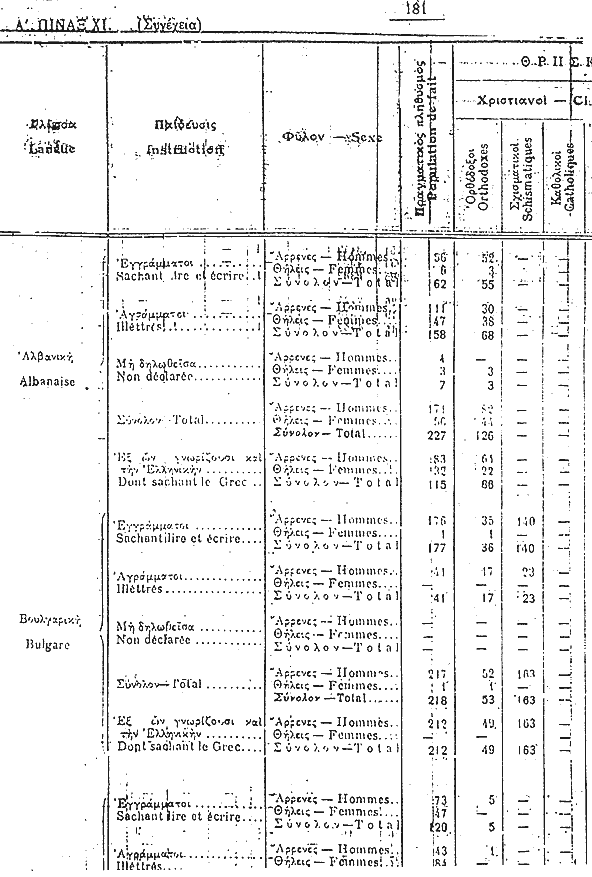
However, page 182 of the volume of census data for 1920 (published in 1929) for the area of Trikala (in Thessaly and Arta just south of the new territories) the following linguistic categories are reported for mother tongue:

Greek, Spanish, Romi, Koutsovlach, Albanian, Bulgarian, Serbian and 37 individuals from Trikala who declared their mother tongue as Macedonian.

http://www.florina.org/html/2000/2000_minority_language/2000_popis2.html

This is official census data published by the Greek government wherein, not only is the Macedonian language documented by the census authority but it is rightly distinguished from Bulgarian and Serbian.
One can now appreciate why the 1920 census results for the "New Territories" have gone missing.

We would like to thank Mr. Dimitrios Lithoksoou for uncovering this data, which we published in Volume 5 of our magazine, Nova Zora (New Dawn). Mr. Lithoksoou has his own Web site with several pages of interest to the Macedonians of Greece.
 
Hello My Macedonians brothers..
Thank you for allowing me to join onto this Forum
I have been mainly on the Macedonian Topics Forum http://www.topix.com/forum/world/macedonia
but recently discovered this forum and it has been very informative..
I may need a break from the Macedonia Topic Forum for a while as it was doing my head in..
The Greeks and Bulgarians are so Brainwashed it's unbelievable.. It's Funny how they could dismiss all Facts and evidence and yet be Experts on our Culture and Language?
 
Article by Pallis on 1928 census.

http://www.jstor.org/stable/pdfplus/1785338.pdf

Lets look at it from a chronological perspective, at the time of independence, Greece was reckoned to be have about 1,000,000 population, 200-250,000 of which were obviously Albanian. That amounts to a quarter of the population, and given the domination of the Greek language through the churches and schools sponsored and controlled by the Patriarchate of Constantinople, the number of Albanians would likely have been much higher, not to mention those 'Greeks' of Albanian descent. What about the number of people that were of Vlach, Slavic and Jewish origin that populated urban centres and regions in the Peloponnese and Attica, what was their amount at the time of independence?

What hapenned to the Venetians and other Latins and westerners?

How many Albanians within the population of the Ionian Islands which were ceded to Greece by Great Britain in 1864, and their numbers?

How many people from Thessaly were of Vlach, Slavic and Albanian origin when the territory was absorbed within Greek borders in the year 1881?

What was the population of Macedonia, Thrace and the rest of the islands when their were awarded to Greece as a gift by the Western Powers after the Balkan Wars in 1912-3?

What was the population and its numbers that arrived in Greece after the Christian-Muslim population exchange carried out by Greece and Turkey in the 1920's?

------------------------------------------------------


In the Greek Census of 1928, which despite its clear bias still reveals important information about the population of Greece, records the total amount of people in the country at 6,204,684, of which 5,759,523 are Greek-speakers, but only 5,716,100 Orthodox Greek-speakers. When 1,300,000 Christian Asian refugees are subtracted from that figure, it leaves 4,416,100 apparent Orthodox Greek-speakers in Greece's ever fluctuating borders between the period of her occupation of Macedonia and Thrace to the early 1920's.

Given that the Greek Census records a mere 8,773 Albanians, most of which are Muslims, one would have to ask what happened to the 250,000 Albanians of almost a century ago?
 
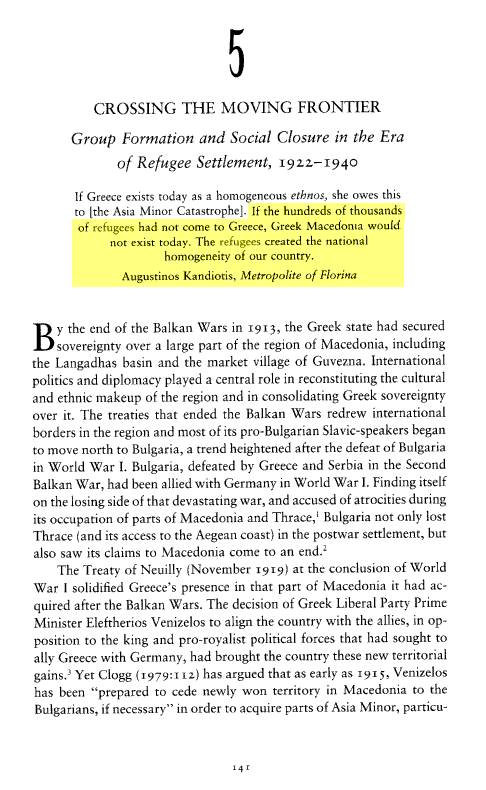
karakasidou-141.png


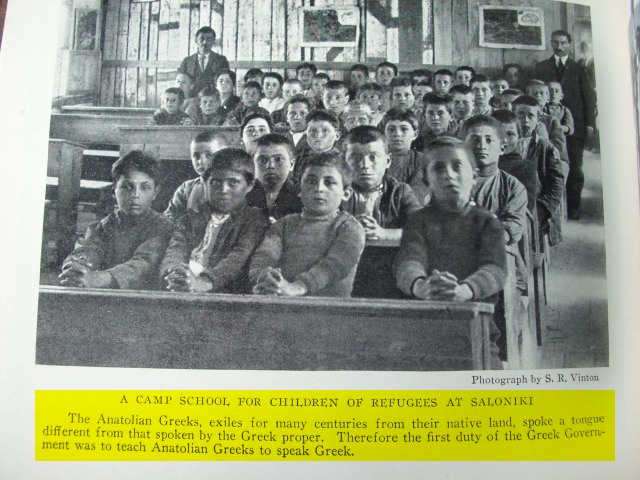
The Christian settlers made Macedonia Greek!

http://makedonika.wordpress.com/2008/10/21/the-christian-settlers-made-macedonia-greek/
 
http://makedonika.wordpress.com/2008/03/29/macedonians-acknowleged-in-a-greek-census-from-1920/

Macedonians acknowledged in a Greek census from 1920!

In the census of 1920, immediately after Greece’s occupation of the “New Territories” the government of the day offers some revealing information. In the census of 19 December, 1920, the official Greek census form had a separate area asking: “what is your mother tongue? What is the language you speak at home? If your mother tongue is not Greek do you understand Greek?” This census document can be found in the book by M. Houliarakis (Geografiki, dioikitiki kai plithismiaki ekseliksi tis Ellados tom G’ page 363)

The data obtained from the census of 1920 offers great detail about the population to the point of distinguishing between deaf males and deaf females. It also includes the data on language and mother tongue.

Unfortunately, the census information relating to the population of the “New Territories” was never made public. This information preceded the exchanges of Christian and Muslim populations between Turkey and Greece or the so-called “voluntary” population exchanges between Greece and Bulgaria.

At that time Greece only published the results from the geographic area of “old Greece” (Sterea, Evoia, Thessalia, Arta, Ionian Islands, Cyclades, Peloponese…). Five volumes containing census data from the “New Territories,” which included information on religion and language, were prohibited from being made public.

In the archives of the Census Council or the General Archives of the Greek state we shall not find census data on the northern territories (the new territories of Macedonia and Western Thrace) for the census period of 1920.

However, page 182 of the volume of census data for 1920 (published in 1929) for the area of Trikala (in Thessaly and Arta just south of the new territories) the following linguistic categories are reported for mother tongue:

Greek, Spanish, Romi, Koutsovlach, Albanian, Bulgarian, Serbian and 37 individuals from Trikala who declared their mother tongue as Macedonian.

This is official census data published by the Greek government wherein, not only is the Macedonian language documented by the census authority but it is rightly distinguished from Bulgarian and Serbian.

See for yourselves.

Page 181
popis_1.gif


popis_2.gif


GreekCensus-declaingMacedonians.jpg
 
popis_1.gif


popis_2.gif


GreekCensus-declaingMacedonians.jpg


That is a record from the 1920 Greek Census. Are you denying this, are you going against what your state has claimed in this instance, or are you being a moron again?
 
star-atlas.jpg


By Ljupcho Murgoski
http://macedoniaonline.eu/content/view/2236/4...

Dnevnik, Wednesday, July 9, 2008

Dragan Mitrevski, a resident of Prilep, is in possession of an old atlas which indicates that in 1921 in Greece there were 500,000 residents that were declared Macedonians.

In Greece in 1921, 500 thousand Macedonians were declared, who represented 8.8% of the entire population in Greece. This is recorded in a Universal atlas published in Austria which the Prilep resident Dragan Mitrevski owns. This is yet another document which proves that the Macedonians are not a tree without roots and blows away the assertions that Macedonia and the Macedonians were a Communist-International creation.

“The relevance of this document is huge considering that for years our neighbours have been insisting that there is no Macedonian minority living in their respective states. This document weighs heavily against our neighbour’s claims not only because of its existence but because it was prepared by a reputable and eminent author in an independent state,” says Dragan Mitrevski.“The universal atlas also shows that in Yugoslavia, then Serbia, there were 600 thousand Macedonians or 5% of the country’s entire population. The atlas also shows that Austria recognized Macedonians living in Bulgaria but did not show a separate count only that there was a combined population of 4 million Macedonians and Bulgarians living in Bulgaria. It is interesting to note that on the Albanian flag there is no two headed eagle, but it is red-black with a white pentagram,” says Dragan Mitrevski.

Fifteen years ago Mitrevski discovered this book by chance. He approached a person burning old books in the center of Prilep and asked if he could have some.“I have always been a collector of old books and was lucky to have found this old atlas,” says Mitrevski.

Most important about this atlas is the source it uses which comes from a census carried out in Greece on December 19, 1920. The results of that census were never officially released by Greece but there was much discussion about them because for the first time they included information on the so called “New Territories”.

In the census information included were questions like “What is your mother language?”,“What language do you speak at home?” and “If your mother tongue is not Greek, do you understand Greek?” It is sad that the Greek state only released census information on the “old territories” of Greece and not on the occupied territories (among which is 51% of Macedonia) where there is information on both language and religion.
 
The Greek census recorded (with an altered terminology) 'Makedonoslave' after the refugees in 1928.


But also called it Makedonoglosson (Macedonian speakers), FACT:
 
star-atlas.jpg


By Ljupcho Murgoski
http://macedoniaonline.eu/content/view/2236/4...

Dnevnik, Wednesday, July 9, 2008

Dragan Mitrevski, a resident of Prilep, is in possession of an old atlas which indicates that in 1921 in Greece there were 500,000 residents that were declared Macedonians.

In Greece in 1921, 500 thousand Macedonians were declared, who represented 8.8% of the entire population in Greece. This is recorded in a Universal atlas published in Austria which the Prilep resident Dragan Mitrevski owns. This is yet another document which proves that the Macedonians are not a tree without roots and blows away the assertions that Macedonia and the Macedonians were a Communist-International creation.

“The relevance of this document is huge considering that for years our neighbours have been insisting that there is no Macedonian minority living in their respective states. This document weighs heavily against our neighbour’s claims not only because of its existence but because it was prepared by a reputable and eminent author in an independent state,” says Dragan Mitrevski.“The universal atlas also shows that in Yugoslavia, then Serbia, there were 600 thousand Macedonians or 5% of the country’s entire population. The atlas also shows that Austria recognized Macedonians living in Bulgaria but did not show a separate count only that there was a combined population of 4 million Macedonians and Bulgarians living in Bulgaria. It is interesting to note that on the Albanian flag there is no two headed eagle, but it is red-black with a white pentagram,” says Dragan Mitrevski.

Fifteen years ago Mitrevski discovered this book by chance. He approached a person burning old books in the center of Prilep and asked if he could have some.“I have always been a collector of old books and was lucky to have found this old atlas,” says Mitrevski.

Most important about this atlas is the source it uses which comes from a census carried out in Greece on December 19, 1920. The results of that census were never officially released by Greece but there was much discussion about them because for the first time they included information on the so called “New Territories”.

In the census information included were questions like “What is your mother language?”,“What language do you speak at home?” and “If your mother tongue is not Greek, do you understand Greek?” It is sad that the Greek state only released census information on the “old territories” of Greece and not on the occupied territories (among which is 51% of Macedonia) where there is information on both language and religion.
I think somebody had some more information on this, DASKALOT, you're the man of many resources, can you help us out here a little more?
 
Here are some of the pages to statistics from the above atlas (not sure why some have come out in the incorrect angle as all of them are in the same angle as files, will see if I can fix it):


The Macedonians are mentioned seperately along with the rest of the south Slavic-speaking peoples, but grouped together with the Bulgarians in some instances, just like Serbs, Croats and Slovenes are grouped together.
 
Back
Top