• Welcome to the new Macedonian Truth Forum. All posts, members and private messages have been moved over from the old forum.

    Passwords from the old forum could not be carried over, so please use Forgot your password? to set a new one. The reset link is emailed to the address on your account.

  • Rules and Regulations at the forum of the Macedonian Truth Organisation (MTO)

    (1) The national-ethnic and cultural-linguistic identity of the Macedonian people is historically Macedonian, and derives its character from the native, indigenous and geographic homeland of the Macedonians, which is called Macedonia. To ensure that their human rights, integrity and heritage are appropriately respected, the only nouns and adjectives acceptable when reference is made to the above character and identity markers is Macedon, Macedonia, Macedonian and Macedonians.

    (2) The nation-state of the Macedonian people is the Republic of Macedonia, and is to be referred to by this official title so long as the 'republic' prefix is consistently applied to other states. Alternative references are the Macedonian Republic, or simply, Macedonia.

    (3) The 'ethnic' prefix is only acceptable for Macedonians in cases where differentiation is specifically required - so long as it is in context and consistent where it concerns its application to other ethnic groups.

    (4) Should any other differentiation be specifically required, the names of other ethnic groups that reside with Macedonians in either the Republic of Macedonia or the occupied Macedonian regions in Greece, Bulgaria, Serbia or Albania, are to be given a prefix.

    (5) Negating the identity, language and culture of the Macedonian people by deliberate avoidance of the terms Macedonia, Macedonian and Macedonians, or by any other means, is not permitted.

    (6) Systematic anti-Macedonian propaganda and rhetoric are not permitted.

    (7) Threads irrelevant to the Macedonian Cause, the community at the Macedonian Truth Organisation or the Macedonians in general may be considered as spam or not in the spirit of the forum. In such cases they are not permitted.

    (8) Continual posting of messages in threads with the sole purpose of deviating from the initial topics with the use of unrelated and unnecessary information is not permitted.

    (9) All posts, external articles, reports, etc that are cited in languages other than Macedonian or English, must be accompanied with a translation in one or both of the said languages.

    (10) Despite the possibility of some conversations and debates becoming heated, extreme abuse and/or racism, vulgar language and/or terminology, threats, revelation of personal information about others, harassment, and other such behavior will not be permitted. If deemed necessary all relevant information including member details will be reported to the appropriate authorities for investigation which may result in legal action.

    (11) Threads that are created must have a summary of a topic or excerpt of an article found in pertinent link(s) that have been included. One line threads will be considered unaccetable spam and are therefore not permitted.

    (12) Compulsive and deliberate lies, irrespective of the topic, are not permitted.

    (13) Any symbols or avatars found to be perceived as offensive to Macedonians are not permitted.

    (13) Any explicit or extreme material is not permitted.

    Failure to adhere to the above rules and regulations will result in a ban after 3 breaches. This may be reconsidered in some cases should the circumstances be of an unorthodox nature and/or require special consideration. To assure an effective deterrent against an individual or individuals with the sole purpose of causing dissent through spamming, racism or other improper means, the above rules will be strictly enforced.

    The MTO administration will monitor all discussions as reasonably practical and reserve the right to remove any post and/or member from the forum, and update the rules and regulations as required. Members are encouraged to immediately report any post and/or member to the MTO administration if they feel that these rules have not been abided by.

    The views expressed on this forum are those of the individuals. The only official representation of the MTO is made by the "Macedonian Truth Organisation (Site Owner)" username, and no other.

  • Macedonian Cause

    The Macedonian Truth Organisation calls on God in Heaven to protect, bless and guide the endeavour it is committing to undertake, and that is to work towards:

    Securing Macedonia as a free, independent and democratic republic in which sovereignty lies with the Macedonian citizens; as the nation-state of the Macedonian people in which they can preserve their culture, language and identity; as a state in which the Macedonian language and culture form the basis of public life and act as important unifying elements of Macedonian society; as the home of all its citizens to which it guarantees and obliges their inalienable natural rights and corresponding responsibilities;

    The acknowledgment as self-evident and irrefutable the existence of the:

    1) Indigenous, ethnonational name of Macedonia;
    2) Macedonian people, language and identity;
    3) Macedonian culture, symbols and folklore;
    4) Macedonian ancestry, heritage and history in its entirety; and
    5) Macedonian Orthodox Church;

    Securing recognition by the International Community of the tragedies endured by the Macedonian people, of the division of Macedonia with the signing of the Treaty of Bucharest on August 10, 1913, and the genocide committed against the Macedonian people at the hands of the Greek, Bulgarian and Serbian states and their respective churches during the 19th and 20th centuries;

    Ensuring that the Interim Accord is declared ‘null and void’ and that all constitutional provisions, acts, commitments, agreements, legislation, regulations, policies or programs emanating from, supporting or consequential to the Interim Accord are also declared ‘null and void’, including the use of any symbols and the completion of any acts imposed by, or originating from, the Interim Accord.

    Ensuring that the Framework Agreement is abolished and that all constitutional provisions, acts, commitments, agreements, legislation, regulations, policies and programs emanating from, supporting or consequential to the Framework Agreement are also abolished and replaced by a framework of constitutional and statutory law based on inalienable natural rights and corresponding responsibilities and universally codified human rights mechanisms.

    Securing the abolishment of any existing constitutional provisions, acts, agreements, legislation, regulations, policies and programs that discriminate against the Macedonian people, in any international organisation or any of the countries of the International Community where such constitutional provisions, acts, agreements, legislation, regulations, policies and programs exist, and thereby ensuring the freedom for Macedonians to exercise their inalienable natural rights and fulfil their corresponding responsibilities, and practice their culture, language and religious faiths in all the countries of the International Community without hindrance;

    The empowerment of Macedonians to undertake a moral revolution and to instil and/or reinvigorate within themselves a deep-rooted national, cultural, linguistic and historical dignity and a commitment to the exercise of freedom based on inalienable natural rights and corresponding responsibilities;

    The recognition of the Macedonian minorities in the neighbouring states of Macedonia as well as the respect for the inalienable rights and freedoms of the Macedonian minorities, as provided for by natural law and as codified by the United Nations Charter, the Universal Declaration of Human Rights and other universally codified human rights mechanisms;

    The full and unreserved respect of, and the support for, the rights of all people of non-Macedonian descent living in Macedonia and around the world, who share a reciprocal full and unreserved respect for the Macedonian people, their homeland and their state;

    The cultural unification and solidarity of the Macedonian people living in all parts of historical Macedonia and adjacent territories, as well as Macedonians throughout the world;

    The unity of all Macedonians on the principles, objectives and achievement of the Macedonian cause as defined by this declaration.

Origin of Romanian people and language

Ethnic Continuity in the Carpatho-Danubian Area, by Elemér Illyés

First edition: East European Monographs, no. CCXLIX, 1988
Second (revised) edition: Hunyadi Öcs. MK., Hamilton, ON., Struktura Press, 1992

- "In 271, Emperor Aurelian finally ordered the evacuation of Dacia. After the evacuation the lower Danube became once again the northern frontier of the Roman Empire. A total evacuation of Dacia, as reported by Eutropius, would hardly have been possible. It must be assumed, even in the absence of evidence, that a part of the local population remained in Dacia. However, the army, the entire administrative machinery, and with them also the business people, landholders, and aristocracy — in other words those whose interests were related to the Roman Empire, those who were the actual instruments of Romanization and who could have been the disseminators of the Latin language — left the province.

Concurrently with the evacuation of Dacia two new provinces, to the south of the Danube, were created for the evacuated population; Dacia Ripensis (part of Moesia Superior in the valley of the Timok) and Dacia Mediterranea (part of Dardania, the present-day eastern Serbia and western Bulgaria) with the principal fortresses of Naissus (Nis) and Serdica (modern Sofia)."

fAYprXs.jpg


- "Dio Cassius (150-235 A.D.) mentioned that people allied with King Decebal had sent a message written in the Latin alphabet to Trajan in 101 A.D. Some 50,000 Dacians during the reign of Augustus (63 B.C. to 14 A.D.) and 100,000 "Transdanubians" during the rule of Nero (37 to 68 A.D.) were settled south of the Danube."


felNdfo.jpg

TJqwJTX.jpg

IyRz4UG.jpg


fsCUcNI.jpg

ATRFL0j.jpg
 
Last edited:
When we look at the data on Roman legions and expenses, we come to the fact that a huge number of them were in the territory of the Balkans. In the middle of the 2nd century, there were 9 legions along the Danube; in the western part, Dalmatia and Pannonia, as many as 6:
3dFKX7K.png


This means that almost a third of the entire army of the Roman Empire lay on the Danube. Pay attention to the cost of the Danube in the 2nd century, when the calculation is made after all revenues and losses:
57vJ0Ax.png


For the Roman Empire in the 2nd century of our era, the Balkans caused a loss of about a hundred million sesterces. Or, the deficit for the Balkans was almost three times higher than Britain and Gaul combined.

The information we have about the deployment of military forces, colonies, and what we know about the later period indicates that the Balkans were probably one of the regions with an extremely high degree of romanization (speaking even before the time of Caracalla).
 
You’ve referenced authors who wrote about Roman settlements in the Balkans, yet nobody denies that Roman colonists settled in many Macedonian, Thracian and Illyrian towns after they brutally occupied the region. What you need to do is demonstrate the direct connection between those Roman colonists (in the Balkan areas south of Romania) and the modern Vlachs (who inhabit similar areas today). You can start by providing your opinion on the following:

- The Vlach and Romanian languages share many similar sound changes that evolved from Vulgar Latin. Given the distance between Macedonia (and areas further south and west) to Romania, how, when and where do you believe this occurred?

- The Vlach and Romanian languages share many similar words with Albanian. Many scholars have opined that this is a shared substratum, possibly from an indigenous Balkan language. How, when and where do you believe this occurred?

- To what extent is this supposed substratum related to any indigenous Balkan language?

I will address some of the other things you've posted in this thread in due course. But for now, these three questions will suffice.
 
- What you need to do is demonstrate the direct connection between those Roman colonists (in the Balkan areas south of Romania) and the modern Vlachs (who inhabit similar areas today).

- The Vlach and Romanian languages share many similar sound changes that evolved from Vulgar Latin. Given the distance between Macedonia (and areas further south and west) to Romania, how, when and where do you believe this occurred?

- The Vlach and Romanian languages share many similar words with Albanian. Many scholars have opined that this is a shared substratum, possibly from an indigenous Balkan language. How, when and where do you believe this occurred?

- To what extent is this supposed substratum related to any indigenous Balkan language?

1) I feel like this question is something along the following lines, if I may:

You’ve referenced authors who wrote about Roman settlements in Spain, yet nobody denies that Roman colonists settled in many Spanish towns after they brutally occupied the region. What you need to do is demonstrate the direct connection between those Roman colonists and the modern Spanish-speakers (who inhabit similar areas today).

Just like the modern Spanish-speakers were formed and developed as a result of Roman rule and civilization (as well as Catalans or Galicians), the same way "Vlachs" were formed in the Balkans as a result of long Roman rule and civilization, and Latin language.

2) The Proto-Vlach languages (if you will) were most likely formed on either side of the river Danube, including regions and areas such as modern Bulgaria and Serbia. Prior to the coming of the Slavs, 'Latin' was the official language across the entire Balkan peninsula for many centuries. The processes of how and when were likely the same/similar on either side of Danube, and took place over many centuries during Roman rule and domination. The local native populations used (vulgar) Latin as a lingua franca of sorts. Let's not forget Via Egnatia which runs across Macedonia and adjacent regions, which was constructed in order to link a chain of Roman colonies stretching from the Adriatic Sea to the Bosphorus.

I believe I have read it although I may be wrong, there is one argument which states that the proto-Romance element/language in the Balkans was formed in the Nish-Sofia-Skopje triangle region.

3) The list of similar words of Albanian is possibly a result of 'contact' with Albanian-speakers - words which were then transmitted across the entire area where Romance-speakers were present (the 'contact' could have occured south or north of Danube, anything is possible, and I don't have a strong opinion about it; I have actually read theories that this list of shared words with Albanian is actually a case against Romanians being autochthonous in Dacia. The experts do not agree and there are at least a couple / few theories in play).

4) We don't know much about this supposed substratum language. Any discussion would be pure speculation. Vlach and Romanian languages are simply eastern Romance languages.

Some of it could be coincidental independent linguistic developments. For example (an interesting example to illustrate), Sardinian and Romanian/Vlach share some sound changes that are absent, or at least non-standard, in the other Romance languages.

For example, "l" has partly shifted to "r" when next to another consonant: Romanian vreau "I want" (< volo), Sardinian abru "white" (< albu-). Also, the labiovelar sounds "qu" and "gu" have become "p"/"b": Sardinian abba "water" (< aqua), limba "language/ tongue" (< lingua), Romanian apa "water", limba "tongue"/"language".

These are probably parallel developments in Sardinian and Romanian - and not evidence of an especially close relation between the two languages or peoples.
https://forum.wordreference.com/threads/similarity-between-sardinian-and-romanian.3044669/

In general, I don't have a "decided" opinion either way about Vlachs being autochthones in Macedonia or Thessaly, or whether they came from the north. I guess anything is possible, but I currently subscribe to the Romance element also being "native" south of the Danube incl. Macedonia for reasons outlined above, as well as (I should add) that first historical references to Vlachs, Vlach language or Vlachia territories were all south of the Danube, and not in Dacia.

(Note: I'm not saying the Romanians were not present in Dacia, all I'm saying is that "Vlachs" existed south of the Danube as well.)
 
Last edited:
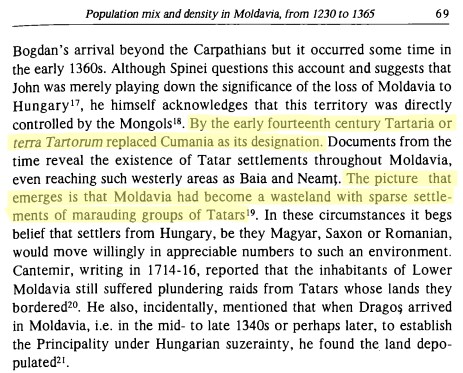
Magyars, Mongols, Romanians and Saxons: population mix and density in Moldavia, from 1230 to 1365

Robin Baker

The years immediately preceding the Mongol invasion of the territory of the later Moldavian Principality in 1241 saw an influx of Magyar and Saxon settlers to the area. The Mongol onslaught brought this to an abrupt end and ushered in a period of more than a century of which we have little firm knowledge.

In this article the author suggests answers to the central questions how absolute was the destruction wrought by the Mongols, when did resettlement begin, and when did the Hungarian Kingdom re-assert its authority in the territory.

URL:
https://ojs.lib.uom.gr/index.php/BalkanStudies/article/view/2793/2817

PYnYFRE.jpg

DcugSTl.jpg
 
Last edited:
In French only.

Photice—Colonie romaine en Thesprotie et les déstinées de la latinité épirote

M. Hatzopoulos

URL:
https://ojs.lib.uom.gr/index.php/BalkanStudies/article/view/2005/2027

After discussing some methodological problems concerning the study of the Latin speaking populations of the Greek lands, the author examines
the case of the Roman colony of Photice : its foundation, its linguistic character as revealed in the inscriptions, the persistence of bilingualism throughout the period of Late Antiquity and finally the migration of its population to the mountain fastness of the Zagori area, where Vlach speaking people are still to be found.


----------------------------------------------------------------------------------------------------------------------------------------------------------


0A07IcP.jpg

XuMAZDp.jpg

c6K1R1W.jpg

GKbhdhj.jpg

LAXo4B4.jpg

eE1SkT4.jpg

5Lv8S5O.jpg
 
Last edited:
INTRODUCTION TO THE ETYMOLOGICAL DICTIONARY OF THE ROMANIAN LANGUAGE:
https://limbaromana.org/en/introduction-to-the-etymological-dictionary-of-the-romanian-language/

The French historian Arbois de Jubainville (1889-1894), citing the Roman writer Eusebius Pamphilius, shows that Osco-Umbrians migrated from the Upper Danube River into the Italian Penninsula, around 1200-1300 BC. We may assume that at that time the Thraco-Dacian, Illyrian, Italic, and Celtic tribes were speaking similar dialects, judging by some historical and linguistic data. About the same time, the Dorians (a Thraco-Illyrian tribe) migrated into Greece. They became Greek speakers, but kept some phonological features of their original language. The Dorian dialect and other Western and Northern Greek dialects have labialized the Proto-Indo-European labiovelars (as did Thraco-Illyrian, Osco-Umbrian, and Continental Celtic), unlike the Ionian dialect which did not.

Thus, PIE *kwetwor ‘four’ > Dorian Greek péttares, Lesbian péttures, as well as Homeric Greek písures, are forms influenced by Thraco-Illyrian, but Ionian Greek téttares. Furthermore, the Roman writer Marcus Antonius, a Celt from Gaul, says that Gaulish and Osco-Umbrian have a common origin (cf. A. de Jubainville, 1894), in other words, Oscans and Umbrians were offshoots of the Celts. He lived in 1st century BC, and he was a native speaker of Gaulish, being able to see similarities between Gaulish and Osco-Umbrian which share some common features that make them different from Latin.

Regarding the Latino-Faliscans, archaeological evidence shows that they migrated from the Middle Danube Valley, as the bearers of the Villanovan culture of Italy. Velleius Paterculus (11.100), an officer in the Roman army during the Roman-Pannonian war at the beginning of 1st century AD and Roman historian, tells us that “omnibus autem Pannonis non disciplinae tantum modo, sed linguae quoqoue notitia Romanae” (“all Pannonians have not only Roman (military) discipline, but they have also knowledge of Roman language”). The explanation of this apparently bizarre statement can be simply explained by the fact that the Romans’ ancestors migrated from this region about 1,500 years before.
 
Last edited:
I found this map, while browsing a map blog and think it could be of use to this thread. I wasn’t able to find the source of it though, reverse image searching just showed a bunch of generic map compilation sites.

https://imgbb.com/
 
Romanian and the loving kindness of the Slavs

URL:
https://www.christopherculver.com/languages/the-love-and-kindness-of-the-slavs.html

Christopher Culver

In my study of the Romanian language I have been amazed at how much of the original Romance lexicon for matters of love and affection have been replaced by loans from Common Slavonic. Off the top of my head I can name:

Rom. a iubi, OCS любити ‘to love’
Rom. prieten, Bg. приятел ‘friend’
Rom. drag, OCS драгъ ‘dear’, whence comes Rom. dragoste ‘love’ and drăguț ‘nice, cute’
Rom. milos, OCS милостивъ ‘merciful, compassionate’
Rom. a gâdila, Bg. гъделичкам ‘to tickle’
Rom. nevastă, Bg. (archaic) нвеста ‘wife’

One must rethink the stereotype of the early Slavs as bloodthirsty barbarians sweeping down upon civilisation with other uncouth tribes of the Age of Migrations. They obviously knew something about teaching people to care about and appreciate each other. They should get an early-morning children’s television programme.

Concerning happy nice words in Romanian from Slavonic, one might also mention Rom. zâmbește ‘smile’, from OCS зѫмбъ ‘tooth’.


Aromanian liturgy

URL:
https://www.christopherculver.com/languages/aromanian-liturgy.html

Christopher Culver

This post might not interest readers who don’t know the Romanian translation of the Divine Liturgy of St. John Chrysostom, but a video posted on YouTube of the liturgy (specifically the Great Litany) in Aromanian makes for a convenient comparison of Romanian and Macedo-Romanian. There’s not much recorded material in Aromanian on the internet, especially of material that one would be likely to already be familiar with. So here are my superficial observations:

- Imperative in verbs borrowed from Slavonic seems to be in -ia rather than -ește: Aromanian Doamne miluia ‘Lord have mercy’ ~ Ro. Doamne miluiește. The formation of the imperative is frustratingly missing from the handful of Aromanian grammars on the internet.

- The initial blessing in Aromanian ends with tora sh-tu tutã eta a etilor, showing that the language preserves Latin aetas, -ātis ‘age’. Romanian, on the other hand, has replaced it with Common Slavonic věkŭ: și acum și pururea și în vecii vecilor.

- One notices Aromanian’s greater reliance on Greek for loanwords, e.g. basilia ‘kingdrom’ versus Ro. împărăția, piste ‘faith’ < Gr. πίστη versus Ro. credință. I would imagine that what sounds like pãlãcaldzim ‘we pray’ is from Greek παρακαλώ, compare Ro. rugăm.

- Aromanian maintains a Latin root in ascapã-nã ‘save us’ while, as I was surprised to learn just a few days ago, Romanian uses of all things a Hungarian loanword: mântuiește-ne < Hu. menteni.

The pronunciation of Aromanian here is so remarkably close to Romanian that, were I to hear anyone having a conversation in this language, I would be more inclined to think them speakers of some highly provincial form of Romanian than guess that they were Aromanians.

This recording appears to have been made by the Aromanian community in the Romanian city of Constanta. Unfortunately, that similarity between the two languages makes Aromanian’s ultimate survival among immigrants to Romania unlikely, just as Finnic-speaking refugees to Finland have not preserved their own languages but assimilated to Finnish.
 
I feel like this question is something along the following lines, if I may: You’ve referenced authors who wrote about Roman settlements in Spain, yet nobody denies that Roman colonists settled in many Spanish towns after they brutally occupied the region. What you need to do is demonstrate the direct connection between those Roman colonists and the modern Spanish-speakers (who inhabit similar areas today).
The two cases may appear analogous, but there are some important differences. For example, whilst many of the natives in conquered territories spoke Vulgar Latin out of necessity, the degree to which the peoples in the Balkans adopted it as a primary language is debatable. Clearly, it wasn't on the level of Iberia (or Gaul, for that matter), whose substantial Celtic population was linguistically assimilated with greater effect. Perhaps the language shift was facilitated by similarities within the supposed Italo-Celtic group, not unlike how Arabic extended across swathes of North Africa and replaced kindred languages that belonged to the Afro-Asiatic group. Whether or not there is any depth to that thesis, it is interesting to note that the highest concentration of people in Europe who speak Romance languages, outside of Italy, are found in France, Spain and Portugal, precisely in the contiguous area that was dominated by the Continental Celts. In contrast, areas in which Eastern Romance is spoken are linguistic exclaves, and Celtic settlements in the Balkans, most of which were around the western and central parts of the Danube, represented the fringes of their world. Another difference relates to the incursions and insurrections that both Iberia and the Balkans endured, centuries after the Roman conquest. In the former, these events didn’t sufficiently alter the landscape to displace Vulgar Latin, even though the Germanic tribes who held sway over Iberia and much of western Europe were arguably more organised, prominent and sophisticated than the somewhat ambiguous groups of people who repeatedly crossed the Danube frontier. Yet, in most of the Balkans, the presence of Vulgar Latin all but vanished. That appears to suggest that either the so-called ‘barbarians’ in the Balkans possessed more political acumen and influence than their counterparts in the west, which is unlikely, or that Vulgar Latin just wasn’t that widespread as a primary language in the east. In any case, my point with the quoted paragraph (perhaps with a bit too much intensity given the exchanges we were having back then), was to get you to challenge one theory that considers the Balkan Vlachs as mostly shepherds that came from Romania during a later period rather than mostly remnants who have always remained in the Balkans (south of the Danube) since the arrival of the Romans.
The Proto-Vlach languages (if you will) were most likely formed on either side of the river Danube, including regions and areas such as modern Bulgaria and Serbia. Prior to the coming of the Slavs, 'Latin' was the official language across the entire Balkan peninsula for many centuries. The processes of how and when were likely the same/similar on either side of Danube, and took place over many centuries during Roman rule and domination. The local native populations used (vulgar) Latin as a lingua franca of sorts. Let's not forget Via Egnatia which runs across Macedonia and adjacent regions, which was constructed in order to link a chain of Roman colonies stretching from the Adriatic Sea to the Bosphorus. I believe I have read it although I may be wrong, there is one argument which states that the proto-Romance element/language in the Balkans was formed in the Nish-Sofia-Skopje triangle region.
The relative uniformity of Eastern Romance languages and their distinction from other Romance languages suggests that early development occurred in an area that was more compact than the heterogeneous mass stretching from the Adriatic in the southwest to the Carpathians in the northeast. An outward migration upon the transition to Proto-Romanian may have then assimilated some other scattered populations that were still speaking Vulgar Latin. This seems more plausible than the existence of a language continuum across the Balkans through the mass adoption of Vulgar Latin as a primary language or the assumption that Vulgar Latin was still a widespread lingua franca spoken as a secondary language during that period, in which Proto-Romanian characteristics were disseminated, only to end up in scattered areas later on. The use of Slavic in the Balkans doesn't seem a likely catalyst for such an event, as its appearance generally coincides with the supposed period in which Proto-Romanian was becoming distinct from Vulgar Latin. Even more untenable is the notion that innovations which characterise Eastern Romance languages were concurrently developed by speakers of Vulgar Latin who were scattered across such a vast expanse and then converged afterwards.
The list of similar words of Albanian is possibly a result of 'contact' with Albanian-speakers - words which were then transmitted across the entire area where Romance-speakers were present (the 'contact' could have occured south or north of Danube, anything is possible, and I don't have a strong opinion about it; I have actually read theories that this list of shared words with Albanian is actually a case against Romanians being autochthonous in Dacia. The experts do not agree and there are at least a couple / few theories in play).
It is definitely a result of contact and given that many of those words are also present in Vlach, it further reinforces the likelihood of the abovementioned compact area for the development of Proto-Romanian. If contact occurred in Dacia, then Proto-Albanian must have passed through there before reaching the Adriatic, and given the other similarities, it may have been at a time when Proto-Romanian was already taking shape. If it occurred south of the Danube, then it suggests that there was an unattested migration to Dacia by speakers of Proto-Romanian. One conforms to the Romanian narrative on Dacian autochthony, the other conforms to the Albanian narrative on Illyrian autochthony. Those who don't want to sacrifice either look for a compromise somewhere in the geographical middle. The problem is that both Albanian and Eastern Romance languages are attested late in the historical sources, however, unlike the former, the predecessor of the latter has a proven and definitive existence in the Balkans (incl. Dacia).
We don't know much about this supposed substratum language. Any discussion would be pure speculation. Vlach and Romanian languages are simply eastern Romance languages. Some of it could be coincidental independent linguistic developments.
That may or may not apply to some of the sound changes shared by Albanian and Eastern Romance languages, but I doubt the unique words that are shared came about through independent linguistic development, as they are both too esoteric and numerous to be coincidental, especially given the different origins of the languages in question. If they don't have parallels in other Romance languages, then they most likely come from either Proto-Albanian or some other language(s) that served as a substratum.
For example (an interesting example to illustrate), Sardinian and Romanian/Vlach share some sound changes that are absent, or at least non-standard, in the other Romance languages.
A handful of similar sound changes between two distant yet related languages is not unusual, nor is it comparable to the characteristics shared by the Eastern Romance languages. Macedonian is geographically closer to Serbian than it is to Slovenian, yet Macedonian and Slovenian share the same sound change for apple (јаболко), whereas it is different in Serbian (јабука). Macedonian is geographically closer to Bulgarian than it is to Russian, yet Macedonian and Russian share the same sound change for wolf (волк), whereas it is different in Bulgarian (вълк).
In general, I don't have a "decided" opinion either way about Vlachs being autochthones in Macedonia or Thessaly, or whether they came from the north. I guess anything is possible, but I currently subscribe to the Romance element also being "native" south of the Danube incl. Macedonia for reasons outlined above, as well as (I should add) that first historical references to Vlachs, Vlach language or Vlachia territories were all south of the Danube, and not in Dacia. (Note: I'm not saying the Romanians were not present in Dacia, all I'm saying is that "Vlachs" existed south of the Danube as well.)
Vlachs were indeed attested south of the Danube before any mention of their presence further north. Historical sources record many different peoples residing in Dacia during the early Middle Ages. Not only was it a common transit area, it was often used as a staging point to conduct raids into the (eastern) Roman Empire. In that region, the exonym Vlach was referenced late, and the endonym Roman (as it pertains to Romanian-speakers) even later, yet Romanian became the language of the majority. If you had to provide an informed opinion, how do you think Romanian became dominant in Dacia? Were the speakers of that language the majority throughout the period of scant references who only asserted themselves later? Were they a minority that was augmented by speakers of kindred dialects from the Balkans in something of a reverse-migration? Or did the circumstances occur entirely differently? I understand that much of this discussion is speculative and am open to adjusting my viewpoint on any of the above if opposing perspectives are based on sound logic and evidence, but I am interested in your thoughts on this matter nonetheless, and I trust you won't take two years to respond as I did :)
 
Vlachs were indeed attested south of the Danube before any mention of their presence further north. Historical sources record many different peoples residing in Dacia during the early Middle Ages. Not only was it a common transit area, it was often used as a staging point to conduct raids into the (eastern) Roman Empire. In that region, the exonym Vlach was referenced late, and the endonym Roman (as it pertains to Romanian-speakers) even later, yet Romanian became the language of the majority. If you had to provide an informed opinion, how do you think Romanian became dominant in Dacia? Were the speakers of that language the majority throughout the period of scant references who only asserted themselves later? Were they a minority that was augmented by speakers of kindred dialects from the Balkans in something of a reverse-migration? Or did the circumstances occur entirely differently? I understand that much of this discussion is speculative and am open to adjusting my viewpoint on any of the above if opposing perspectives are based on sound logic and evidence, but I am interested in your thoughts on this matter nonetheless, and I trust you won't take two years to respond as I did :)

Hi SoM,

I'm not entirely sure, but I think the Romanian-speakers were the majority in the area that asserted themselves later. There were others to be sure, namely, the Slavs, Magyars or even Germans. Over the centuries the Romanian-speakers merged with or assimilated the Cumans and Slavs I believe.

It seems the myth of Romanian migration into Transylvania (Dacia) appeared as a response to Transylvanian Romanians demands for political and economic rights from the Austro-Hungarian Empire in the second half of the 18th century. Stories about Romanian origins south of the Danube were not mentioned for example in the fifteenth century biography of Hungarian King Matthias Corvinus, son of John Hunyadi, who was a Transylvanian Romanian. Rather, their origin was tied to Roman colonization of Dacia (modern Transylvania). It's unfortunate that a lot of "theories" in the Balkans, in this case the Romanians, are politically motivated.
 
I'm not entirely sure, but I think the Romanian-speakers were the majority in the area that asserted themselves later. There were others to be sure, namely, the Slavs, Magyars or even Germans. Over the centuries the Romanian-speakers merged with or assimilated the Cumans and Slavs I believe.
Taking the above into account, do you believe Romanians were using the Roman endonym all throughout this period, prior to being recorded as such? If so, and if they were the majority, why do you think they weren’t mentioned as a notable population in that region until much later? Also, why did Eastern Romance become more numerical in Dacia than it did in (the rest of) the Balkans?
Stories about Romanian origins south of the Danube were not mentioned for example in the fifteenth century biography of Hungarian King Matthias Corvinus, son of John Hunyadi, who was a Transylvanian Romanian. Rather, their origin was tied to Roman colonization of Dacia (modern Transylvania).
In my previous post, I explain why, on linguistics grounds, I thought it was unlikely that Proto-Romanian developed both south (e.g., Macedonia) and north (i.e., Dacia) of the Danube concurrently. What is your opinion on that explanation, given your tentative stance to the contrary?
 
Taking the above into account, do you believe Romanians were using the Roman endonym all throughout this period, prior to being recorded as such? If so, and if they were the majority, why do you think they weren’t mentioned as a notable population in that region until much later? Also, why did Eastern Romance become more numerical in Dacia than it did in (the rest of) the Balkans?

I believe so. There is nothing that would point to ... otherwise. Romanians, Macedonian Vlachs, Istro-Romanians, Arvanitovlachs, etc. all use some form of a "Roman" endonym. Nobody taught the Arvanitovlachs to call themselves "Romans" (R'm'n).

I honestly don't know. It's likely that populations south of the "Danube" reinforced the Romanian population in Dacia. There is numerous medieval references to "Vlachs" living in Bulgaria or Thrace (and in Timok/eastern Serbia). That would be pure speculation on my part.

I don't know why Eastern Romance became dominant in Dacia. That would be a million dollar question. Probably as simple as Romanian-speakers achieving some form of cultural "dominance" in Dacia - as opposed to south of the Danube.

In my previous post, I explain why, on linguistics grounds, I thought it was unlikely that Proto-Romanian developed both south (e.g., Macedonia) and north (i.e., Dacia) of the Danube concurrently. What is your opinion on that explanation, given your tentative stance to the contrary?

I believe that is correct. Proto-Romanian developed in "one area" only, whether that is in Macedonia or in Dacia. Various Vlach dialects point to a single common origin.

Again, some scholars believe that the area in question is Skopje-Nish-Sofia "triangle" and the adjacent territories.
 
Carlin, what is your opinion on the Romania-Moldova dispute? It seems like every time there is a change of government in Moldova, it is followed by a change of official state ideology with respect to the identity of the people and language, even though most commoners continue to identify as Moldovans. Do you think the two countries will unify some day or that Romania (and pro-Romanian elements in Moldova) exaggerate the pan-Romanian sentiment in Moldova?
 
Carlin, what is your opinion on the Romania-Moldova dispute? It seems like every time there is a change of government in Moldova, it is followed by a change of official state ideology with respect to the identity of the people and language, even though most commoners continue to identify as Moldovans. Do you think the two countries will unify some day or that Romania (and pro-Romanian elements in Moldova) exaggerate the pan-Romanian sentiment in Moldova?

I can't pretend that I'm expert in this area. I know nothing of socio-political situation in the country, to be honest.

From a purely "geopolitical" point of view I don't think they will unify any time soon. The Russian influence in Moldova is quite strong. They won't allow a "chunk" of Moldova to unify with a NATO member state under any circumstance.
 
So, I spent a bit of time taking a closer look at the history of the Eastern Romance peoples and what follows is a summary on the topic along with some thoughts and questions. In a typically Balkan kind of way, there are diametrically opposed interpretations, particularly between Romanians and Hungarians. The debate is not helped by the obscurities that exist in primary sources and the political biases evident in contemporary perspectives. It was also interesting to note how some of the narratives that are often taken for granted are difficult to adequately substantiate, whichever side of the argument. Anyway, to begin. Historically, the Eastern Romance peoples were known by the exonym “Vlach,” with the endonym “Roman” (along with its variants) not recorded until later. Their languages form a distinct branch derived from Latin and their traditional territory is geographically isolated from the rest of the Romance languages in Europe, most of which are found in a contiguous area in the western half of the continent. Although they are now spoken in Romania, Moldova and scattered pockets across southeast Europe, their ancestral language (Proto-Romanian) arose in a more compact area where it developed common features that distinguished it from other Romance languages. As such, there are a few schools of thought regarding the origin of the Eastern Romance peoples and their languages, with the “Dacian theory” being the most prominent among Romanians, for obvious reasons.

The Roman occupation of Dacia commenced at the beginning of the 2nd century and concluded by the second half of the 3rd century, lasting for approximately 170 years. It has been argued that the native inhabitants were so thoroughly Romanised during this short period, that even after the end of Roman rule, they continued to speak Latin, which was unrelated to their own Dacian language. Although historical Dacia covers the modern states of Romania and Moldova, it is worth noting that Roman Dacia, as a province, constituted only the western territories inhabited by the Dacians. Comparative Roman influence in the rest of Dacia often ranged from inconsistent to negligible. Thus, whilst some Dacians were certainly Romanised, many of them were not. The latter appear to have been hostile to the occupation and their kinsmen who remained free made several incursions into Roman Dacia. These events, along with raids from Gothic and Sarmatian tribes that were present in the area, led to the eventual downfall of the troublesome province. Absent the protection afforded by imperial forces, many of the Roman colonists would have undoubtedly retreated along with the military, which is evident by the gradual abandonment of Roman placenames in the region. To account for these anomalies, proponents of the “Dacian theory” point to Roman military expeditions and the establishment of forts along the northern bank of the Lower Danube in subsequent centuries, which, together with the varying use of Latin for commercial and religious purposes, is meant to imply an ongoing cultural presence in the region. Although it is possible that this may have had a positive impact on the sustainability of the Romans and Romanised Dacians who are said to have remained behind, it does not explain why the rest of the Dacians would adopt Latin as a primary spoken language, given that they were not only outside of Roman control, but, to a large extent, anti-Roman in sentiment. Surely the Dacians, who had their own language, would not need to utilise the foreign language of a nearby colonial power to communicate between themselves. Even if one were to accept that Latin was employed as a lingua franca by the Dacians, Goths, Sarmatians and others, its usefulness beyond the Roman frontier was limited and progressively curtailed as time went by. Moreover, it is unlikely to have become their primary spoken language, for without the benefit of a guiding authority or an influential number of native speakers, such conditions may have eventually produced some type of Latin-based creole, which could not have been the catalyst for the development of Proto-Romanian.

For around 900 years following the Roman withdrawal from Dacia, there is little evidence that points to the continued existence of a local Roman or Romanised community that used Latin (or Eastern Romance) as a primary spoken language north of the Lower Danube, despite the purported association with a ruling class who conquered much of Europe. Assuming their ethnogenesis occurred in antiquity, the progenitors of the Eastern Romance peoples must have been small in number for quite some time. To maintain their language and survive through various incursions and entities over several centuries, all the while going unnoticed as a unique and identifiable group by chroniclers, is nothing short of remarkable and unparalleled in other former Roman provinces with similar circumstances. Their transition from obscurity to population growth in Dacia may have relied on the assimilation of neighbouring Turkic tribes, such as the Pechenegs and Cumans, which would explain why Eastern Romance peoples, particularly those who later migrated to areas south of the Danube, were often associated with transhumant pastoralism, a practice common among steppe peoples. How this amalgamation came about and whether it had anything to do with the dissemination of Christianity is another question. Even after the Romans had evacuated their forts and ceded territories north of the Lower Danube, traces of a Christian presence, however limited, could be found in the region. This may have become more pronounced in the east of Dacia after Bulgaria became a Christian state in the 9th century, but it was sparser in the west of Dacia until the Hungarians established dioceses of the Latin rite at the beginning of the 11th century. Today, Romania and Moldova are predominantly Orthodox, however, alone among the adherents of Orthodoxy in that part of Europe, the Eastern Romance peoples derive much of their Christian terminology from Latin. It has been argued that this is an exclusive legacy carried over from earlier times, but it is worth mentioning that the aforementioned Latin churches predate the first unambiguous record of the Eastern Romance peoples. Whether they may have augmented such terminology, however, is debatable.

The earliest historical accounts about the Vlachs are problematic and a source of contention between opposing parties. Their existence north of the Danube is first mentioned at the beginning of the 12th century (Russian Primary Chronicle) and followed by another reference at the turn of 13th century (Anonymus, Gesta Hungarorum). In both cases, there are doubts about the terminology and location. Their existence south of the Danube is mentioned earlier, thus the first record of the Vlachs in general comes from the second half of the 11th century (Scylitzes, Synopsis of History) and places them in Macedonia. All three works contain anachronistic information pertaining to the Vlachs, in that they refer to events that are supposed to have occurred decades or even centuries before they were actually written. This has caused some controversy with respect to the accuracy of certain details. Subsequent historical accounts are more contemporary or closer to the period in which the events took place. One chronicler from the second half of the 11th century (Kekaumenos, Strategikon) locates the Vlachs in Thessaly during his own lifetime. However, he also relays a story or myth about their earlier dwellings near the Danube and Sava rivers before migrating south into Macedonia, Epirus and Hellas (i.e., Thessaly). One from the middle of the 12th century (Comnena, Alexiad) refers to Vlachs in both Thessaly and Thrace. Another from the second half of the 12th century (Cinnamus, History) highlights the participation of Vlachs in an expedition against Hungary. A chronicler from the early 13th century (Choniates, History) wrote of Vlachs in Galicia and near the Haemus Mountains (i.e., the Balkan Mountains). There is some dispute about the last two historical accounts and whether the Vlachs that were mentioned lived south or north of the Danube. Taking all of the above at face value, one could put forth the case that the Eastern Romance peoples originated south of the Danube. However, it could also be argued that the majority of these chroniclers were far more familiar with that region than they were with Dacia and elsewhere north of the Lower Danube, which would explain the earlier references.

Unsurprisingly, the “Balkan theory” for the origin of the Eastern Romance peoples is favoured by the Hungarians, who assert that there were no Vlachs in Dacia when they began to raid and migrate across the region in the 9th century. Proponents of the “Balkan theory” also argue that Latin, which was the administrative language of the Roman Empire until the first half of the 7th century, had a far more enduring presence south of the Danube compared to Dacia. However, even if it assumed that Latin was adopted as a primary spoken language by at least some of the people in that region, there is still a gap of more than 400 years between the reign of Heraclius (the emperor who replaced Latin with Greek) and the first mention of the Vlachs. This is an unusual absence given the position that Latin had previously held and raises doubts about the extent of its use among the local population. Another argument against the “Balkan theory” is that there is no record of a large-scale migration northward across the Danube that would explain the numerical superiority or cluster of Eastern Romance peoples in Dacia. Although the opposite is also true, the Eastern Romance peoples south of the Danube don’t occupy a territory that is both large and contiguous, and their distribution speaks to their past lifestyle as transhumant pastoralists. From a geographical and cultural standpoint, therefore, one may suggest some variant of the “Dacian theory” as a more likely candidate for their linguistic homeland. Nevertheless, the “Balkan theory” continues to feature as a part of the discussion. In addition to the Hungarians, it also has support among the Albanians, who view it as essential for their claims of indigeneity. On that point, there are some key similarities between Albanians and Eastern Romance peoples that should be highlighted.

Just like the Vlachs, the first unambiguous record of the Albanians comes from a historical account that was written in the second half of the 11th century (Attaleiates, The History). Despite their existence being attested late in history, it is a common assumption that these two groups represent the sole surviving descendants of the Romanised Paleo-Balkan peoples, which, depending on the narrative, may include the Dacians, Thracians and/or Illyrians as their forebearers. Yet, there is scant linguistic evidence to support this thesis and aside from a few possible examples that may be contested or dubious, ancient placenames of an Albanian or Eastern Romance provenance cannot be found on either side of the Danube. Instead, they only begin to make a steady appearance after the Albanians and Vlachs enter historical record. Even today, they do not abound except in countries where their languages have benefitted from statehood, such as Albania, Romania and Moldova, all of which have their fair share of Slavic placenames. One of the more routine excuses for this conspicuous absence is that Albanians and Eastern Romance peoples supposedly fled to the highlands following the “mass migration of Slavs” that began in the 6th century and only chose to reassert themselves after 500 years of self-imposed isolation. Interestingly, the earlier incursions of Goths, Sarmatians and others didn’t create enough panic to provoke such drastic measures. In any case, setting aside the discredited theory of this “mass migration,” which has been disproven by genetic and archaeological evidence (or lack thereof), the notion that they gave up their lives as soldiers, administrators, aristocrats and sedentary peasants to hide in the mountains for centuries and adopt a life of pastoralism, only to re-emerged in the Balkan lowlands around the exact same time and not too far from each other, is both creative and necessarily simplistic, resting as it does on ambiguity more than fact. A more obvious and demonstrable similarity can be observed in their languages. They share several unique features, including words that cannot be identified with any Paleo-Balkan or modern language in southeast Europe. Furthermore, over half of the Albanian lexicon (including much of its church terminology) has a Latin origin and a significant amount of its Latin-derived vocabulary shares the same development as Eastern Romance languages. That indicates a period of intense contact between the two groups before the Albanians settled in the western Balkans. Although some have proposed Moesia or Thrace as a geographical compromise between the multitude of theories, the exclusion of the Turkic cultural element from Dacia makes it difficult to explain why both Albanians and Vlachs have often (albeit not exclusively) been characterised as transhumant pastoralists and share some of the same terminology in relation to this practice.

Lastly, there is the matter concerning identity. From the early historical accounts mentioned above, some chroniclers (Kekaumenos, Strategikon; Choniates, History) had a tendency to classicise their terminology and link the Vlachs to Dacians or Mysians, one (Cinnamus, History) inferred that they are descendants of colonists from Italy and another (Anonymus, Gesta Hungarorum) referred to Romans in Pannonia (i.e., Hungary) and Vlachs in Transylvania (i.e., western Dacia) without implying a connection between the two. In some instances, the ambiguous nature of such terms and the uncertainty as to who they referred to specifically merely added to the confusion. A Roman heritage for the Vlachs started to become more pronounced in historical accounts during the 15th century, due in no small part to humanists from the Christian west. Spurred on by the historical romanticism of the Renaissance period, those from Italy seemed particularly enthusiastic when reporting on the existence of a “Roman” element in the east. One traveller from the beginning of the 15th century (Archbishop John of Sultanieh, Libellus de Notitia Orbis) noted a population living among the Serbs and Bulgars who boasted about being Romans. Other humanists from the middle of the 15th century (Poggio Bracciolini; Aeneas Sylvius Piccolomini – Pope Pius II), who may have relied on reports from travelling officials or missionaries, wrote about Roman colonists left over in Dacia, with one referring to the Vlachs as an “Italian race.” Moving forward, these stories would be repeated by others. From the 16th century, Italian humanists and travellers (Tranquillo Andronico, Francesco della Valle et al.) began to document the use of the “Roman” endonym by Eastern Romance peoples in what would later become the modern states of Romania and Moldova. It was also applied to their language. Another historical account from the second half of the 16th century (Ferrante Capeci) mentioned the “Roman” endonym in relation to the Vlachs and suggested their presence in Transylvania predated that of the Hungarians and German Saxons. However, the same chronicler also stated that the Vlachs descended from Italians and Lombards and that their language was similar to modern Italian. An Italian monk from the end of the 17th century (Ireneo della Croce) recorded a slightly different variant of the endonym (Rumeri) for the Eastern Romance peoples in Istria, but it was an isolated reference and would not be documented by Istro-Romanians themselves until the 20th century (Andrei Glavina). As for those further south, some of the earliest recorded examples come from Vlachs with links to Macedonia who were residing in Austria and Hungary at the beginning of the 19th century (Mihail Bojadzhi; George Roja). These individuals appear to have been associated with the Romanian national movement and used the name “Roman,” not “Rraman” or “Arman,” which are used as endonyms by Vlachs today. Interestingly, the so-called Megleno-Romanians continue to use “Vlach” in reference to themselves and their language.

As implied throughout, the information lends itself to a variety of interpretations and the sequence of events poses a number of questions. For example, why was there a prolonged silence on the part of chroniclers when it came to a native Latin-speaking community, be they in Dacia following the Roman withdrawal or in the Balkans after Latin was discontinued as the administrative language of the Roman Empire? Is it coincidental that Vlachs and Albanians were first recorded around the same time and within reasonable geographic proximity, given the region? And why was their existence attested so late, given their supposed pedigree? As the Vlachs were mentioned in several historical accounts beginning from the second half of the 11th century, why did it take more than 300 years (at least) before the “Roman” endonym was recorded? Why did authors of Slavonic and Greek written works, who were culturally and geographically closer to the Eastern Romance peoples, fail to record the “Roman” endonym earlier than their western counterparts? Did the churches of the Latin rite and the Italian humanists contribute to the propagation of the “Roman” endonym? What role did the civic and religious identities from the Roman and Ottoman empires play in the process? Were the developments uniform among Eastern Romance peoples on both side of the Danube, did one side influence the other, or did they occur concurrently before converging later in history? All food for thought. Anyway, if Carlin or anybody else interested in the topic finds disagreement with what has been written or wishes to fill in some blanks, feel free to provide your input.

 
Back
Top