• Welcome to the new Macedonian Truth Forum. All posts, members and private messages have been moved over from the old forum.

    Passwords from the old forum could not be carried over, so please use Forgot your password? to set a new one. The reset link is emailed to the address on your account.

  • Rules and Regulations at the forum of the Macedonian Truth Organisation (MTO)

    (1) The national-ethnic and cultural-linguistic identity of the Macedonian people is historically Macedonian, and derives its character from the native, indigenous and geographic homeland of the Macedonians, which is called Macedonia. To ensure that their human rights, integrity and heritage are appropriately respected, the only nouns and adjectives acceptable when reference is made to the above character and identity markers is Macedon, Macedonia, Macedonian and Macedonians.

    (2) The nation-state of the Macedonian people is the Republic of Macedonia, and is to be referred to by this official title so long as the 'republic' prefix is consistently applied to other states. Alternative references are the Macedonian Republic, or simply, Macedonia.

    (3) The 'ethnic' prefix is only acceptable for Macedonians in cases where differentiation is specifically required - so long as it is in context and consistent where it concerns its application to other ethnic groups.

    (4) Should any other differentiation be specifically required, the names of other ethnic groups that reside with Macedonians in either the Republic of Macedonia or the occupied Macedonian regions in Greece, Bulgaria, Serbia or Albania, are to be given a prefix.

    (5) Negating the identity, language and culture of the Macedonian people by deliberate avoidance of the terms Macedonia, Macedonian and Macedonians, or by any other means, is not permitted.

    (6) Systematic anti-Macedonian propaganda and rhetoric are not permitted.

    (7) Threads irrelevant to the Macedonian Cause, the community at the Macedonian Truth Organisation or the Macedonians in general may be considered as spam or not in the spirit of the forum. In such cases they are not permitted.

    (8) Continual posting of messages in threads with the sole purpose of deviating from the initial topics with the use of unrelated and unnecessary information is not permitted.

    (9) All posts, external articles, reports, etc that are cited in languages other than Macedonian or English, must be accompanied with a translation in one or both of the said languages.

    (10) Despite the possibility of some conversations and debates becoming heated, extreme abuse and/or racism, vulgar language and/or terminology, threats, revelation of personal information about others, harassment, and other such behavior will not be permitted. If deemed necessary all relevant information including member details will be reported to the appropriate authorities for investigation which may result in legal action.

    (11) Threads that are created must have a summary of a topic or excerpt of an article found in pertinent link(s) that have been included. One line threads will be considered unaccetable spam and are therefore not permitted.

    (12) Compulsive and deliberate lies, irrespective of the topic, are not permitted.

    (13) Any symbols or avatars found to be perceived as offensive to Macedonians are not permitted.

    (13) Any explicit or extreme material is not permitted.

    Failure to adhere to the above rules and regulations will result in a ban after 3 breaches. This may be reconsidered in some cases should the circumstances be of an unorthodox nature and/or require special consideration. To assure an effective deterrent against an individual or individuals with the sole purpose of causing dissent through spamming, racism or other improper means, the above rules will be strictly enforced.

    The MTO administration will monitor all discussions as reasonably practical and reserve the right to remove any post and/or member from the forum, and update the rules and regulations as required. Members are encouraged to immediately report any post and/or member to the MTO administration if they feel that these rules have not been abided by.

    The views expressed on this forum are those of the individuals. The only official representation of the MTO is made by the "Macedonian Truth Organisation (Site Owner)" username, and no other.

  • Macedonian Cause

    The Macedonian Truth Organisation calls on God in Heaven to protect, bless and guide the endeavour it is committing to undertake, and that is to work towards:

    Securing Macedonia as a free, independent and democratic republic in which sovereignty lies with the Macedonian citizens; as the nation-state of the Macedonian people in which they can preserve their culture, language and identity; as a state in which the Macedonian language and culture form the basis of public life and act as important unifying elements of Macedonian society; as the home of all its citizens to which it guarantees and obliges their inalienable natural rights and corresponding responsibilities;

    The acknowledgment as self-evident and irrefutable the existence of the:

    1) Indigenous, ethnonational name of Macedonia;
    2) Macedonian people, language and identity;
    3) Macedonian culture, symbols and folklore;
    4) Macedonian ancestry, heritage and history in its entirety; and
    5) Macedonian Orthodox Church;

    Securing recognition by the International Community of the tragedies endured by the Macedonian people, of the division of Macedonia with the signing of the Treaty of Bucharest on August 10, 1913, and the genocide committed against the Macedonian people at the hands of the Greek, Bulgarian and Serbian states and their respective churches during the 19th and 20th centuries;

    Ensuring that the Interim Accord is declared ‘null and void’ and that all constitutional provisions, acts, commitments, agreements, legislation, regulations, policies or programs emanating from, supporting or consequential to the Interim Accord are also declared ‘null and void’, including the use of any symbols and the completion of any acts imposed by, or originating from, the Interim Accord.

    Ensuring that the Framework Agreement is abolished and that all constitutional provisions, acts, commitments, agreements, legislation, regulations, policies and programs emanating from, supporting or consequential to the Framework Agreement are also abolished and replaced by a framework of constitutional and statutory law based on inalienable natural rights and corresponding responsibilities and universally codified human rights mechanisms.

    Securing the abolishment of any existing constitutional provisions, acts, agreements, legislation, regulations, policies and programs that discriminate against the Macedonian people, in any international organisation or any of the countries of the International Community where such constitutional provisions, acts, agreements, legislation, regulations, policies and programs exist, and thereby ensuring the freedom for Macedonians to exercise their inalienable natural rights and fulfil their corresponding responsibilities, and practice their culture, language and religious faiths in all the countries of the International Community without hindrance;

    The empowerment of Macedonians to undertake a moral revolution and to instil and/or reinvigorate within themselves a deep-rooted national, cultural, linguistic and historical dignity and a commitment to the exercise of freedom based on inalienable natural rights and corresponding responsibilities;

    The recognition of the Macedonian minorities in the neighbouring states of Macedonia as well as the respect for the inalienable rights and freedoms of the Macedonian minorities, as provided for by natural law and as codified by the United Nations Charter, the Universal Declaration of Human Rights and other universally codified human rights mechanisms;

    The full and unreserved respect of, and the support for, the rights of all people of non-Macedonian descent living in Macedonia and around the world, who share a reciprocal full and unreserved respect for the Macedonian people, their homeland and their state;

    The cultural unification and solidarity of the Macedonian people living in all parts of historical Macedonia and adjacent territories, as well as Macedonians throughout the world;

    The unity of all Macedonians on the principles, objectives and achievement of the Macedonian cause as defined by this declaration.

Origins of Ancient Greece

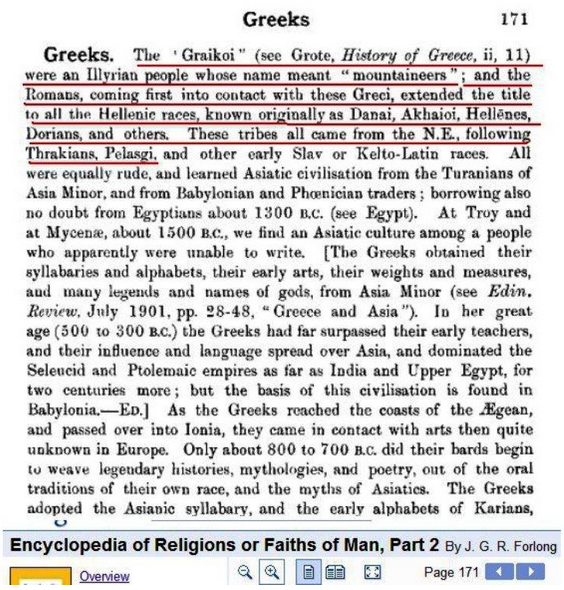
Doesn't matter because Greek substitutes Hellene, which wasn't in use until the Dorians. Regardless of linguistic relation calling the Mycenaean language Greek is fallacious. Also there's all those 'pre-Greek' words that indicate a substratum of about 1-5 different languages, one of them Pelasgian. Since it's detailed how the Dorians adopted the local language after they showed up traces of their original language were likely added to the mix as well. Mycenaean and the later Greek language are at least different enough to be classified as separate languages.
 
1024px-Homeric_Greece-en.svg.png

1200px-Mycenaean_World_en.png

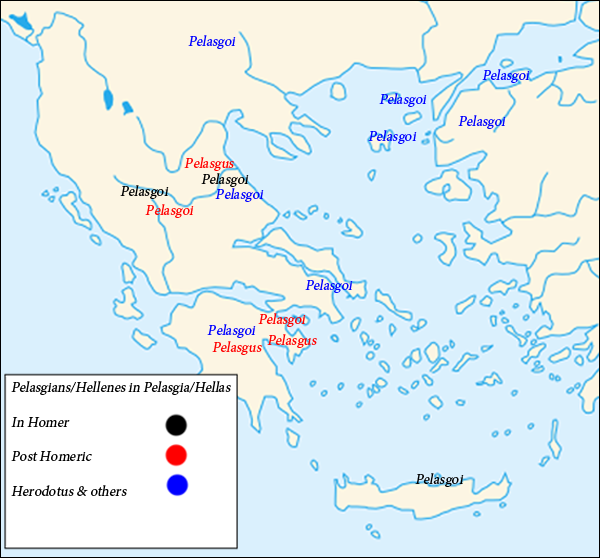
The similarities are still striking though. You see lot of influence in Classic Greece, the vases, arts etc. My guess is that the Mycenaeans would probably be the Pelasgians.
 
Last edited:
I found this one too, though I'm not sure where it's from or how reliable it is but not much else of worth turned up when I looked up Pelasgians.

PelasgiansVisuallyimpairedVersiom.png


To my understanding the Mycenaean civilization was a mix of Egyptian, Phoenician and probably what remained of the Minoan civilization as well as the Pelasgians. Perseus' wife Andromeda was Ethiopian so they may have had a presence there too.
 
It's important to remember the relativeness of colour terms. Blue was pale, rus means blond but is clearly related to roux/rousse, which refers to red. These days it seems to be a common misconception that 'fair' means 'white' skin and platinum blond hair but the term basically just means lighter in relation to the usual, regardless of how dark the usual colour is.

Around the Mediterranean, fair is more likely to be used to distinguish between black hair and brown or dark brown and lighter brown, as well as between differing shades of tan and brown skin tones. Given that blue eyes were associated with misfortune and blindness it'd have to be a less common phenotype, for example. Blond hair, while not necessarily absent, wouldn't be the common phenotype either, especially since they're both recessive traits and ill suited for sun exposure.

Some hair colour charts:

scienceLevels-840x1200.jpeg


the-shades-blonde-colors-seen-chart-may-not-appear-67844.jpg


If Xanthos refers to hair it could easily describe shades of brown in relation to darker browns or black, as well as the darker shades of blond, which would be more likely to occur than platinum blond.

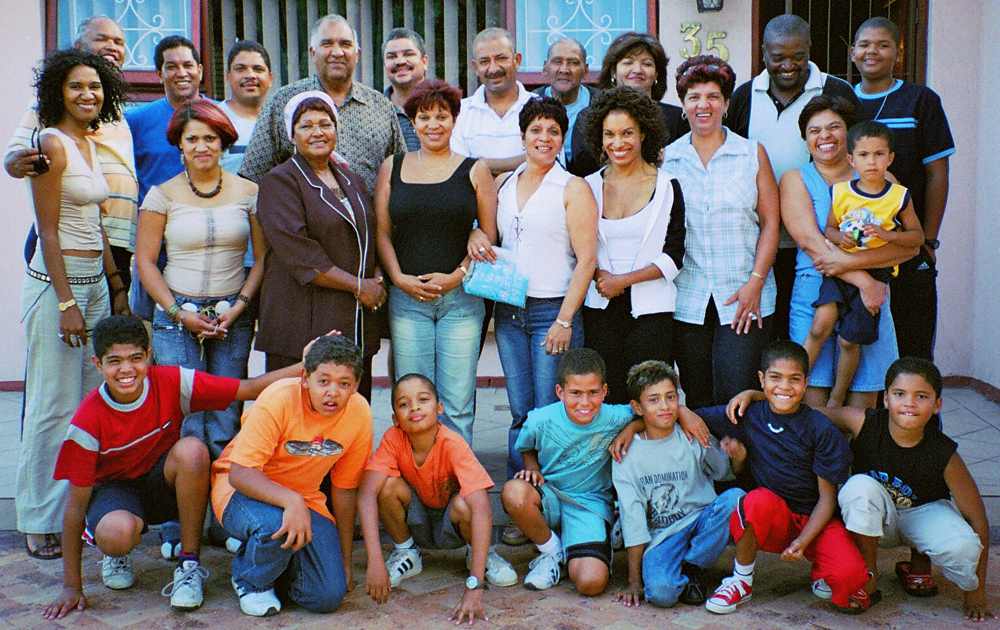
Outside of hair colour, if taken to mean 'golden' it could easily refer to golden brown or 'olive' skin tones. The wikipedia page for human skin colour shows an image of a South African family to demonstrate variation in skin colour:

Coloured-family.jpg


A lot of them could have their skin tone described as golden, mostly in the middle row.

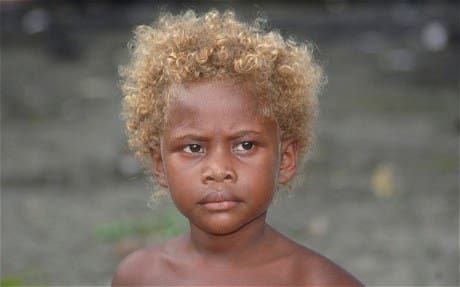
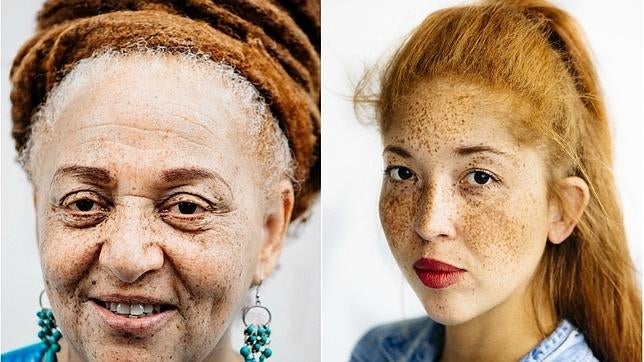
Now here are some examples of hair and skin tone combinations you wouldn't expect to see among certain ethnic groups:

solomon-islands_2210026c.jpg


CW1iS1uWIAADx8f.jpg


55dbafa41d00006e00145bed.jpeg


main-qimg-9160a1590c20d34604164d3273b368ec-c


main-qimg-e63e956c61504dce775eb4fff38af68b


m6--644x362.jpg


So basically lighter hair and eye colour can crop up pretty much anywhere and not necessarily in relation to lighter skin tones. Recessive traits are easier to maintain in small populations, which is why they're more commonly found in island populations where the gene pool is more limited and isolated from other groups. In mainland populations they tend to crop up more intermittently due to being dispersed among dominant traits, which is why natural blond hair seems to be harder to find these days.
 
Last edited:
https://www.quora.com/Did-the-Ancie...ns-as-their-ancestors/answer/Michael-Zhang-16

First, let’s clarify some terms. When modern historians speak of the Myceneans, they mean inhabitants of the powerful Late Bronze Age civilization that flourished around the Aegean sea around 1600–1100 BC. This civilization was Greek, in the sense that they spoke Greek; whether the inhabitants were ancestors of the classical Greeks, we do not know. It had several power centers, such as Pylos, Mycenae, Midea, Tiryns, and Thebes, of which Mycenae is the most prominent. This civilization had rich and highly centralized states, as revealed by its grand palaces and golden grave goods. It also had extensive trade links with each other and with the Near East, as evidenced by the uniformity of pottery found at different sites.

Beginning around 1200 BC, a series of terrible events begin to happen that would destroy this civilization and many others around the Mediterranean. Pylos and Midea are destroyed. Mycenae is reduced to a small and insignificant village. Tiryns survived, but its palace did not. Writing is completely lost throughout the Greek world. The population plummets. Pottery is not only much less advanced, but is distinct from city to city, indicating the lack of trade. Greece, after suffering this Bronze Age collapse, is now in the Dark Ages.

When Greece emerged from the Dark Ages 300 years later, around 800 BC, the new civilization is completely different. The writing system now uses a different script, adapted from that of the Phoenicians. Instead of highly centralized monarchies, Greece is now divided into thousands of city states, each with their own form of government. The Greeks living after the Dark Ages knew nothing about the Mycenean civilization that preceded them except bits and pieces preserved in legend, like the Iliad and Odyssey. The world depicted in these epics, however, is a poor and seemingly illiterate society where kings have relatively limited power. Nowhere in the Iliad or Odyssey does anyone read or write, for example, and even the queens (Helen, Penelope) weave in their spare time. While there are unquestionably some remnants of Mycenean civilization in these epics—including the Trojan War, which most historians believe actually happened—the world depicted is mostly that of the Dark Ages.

To the Classical Greeks, therefore, Mycenae was a small town that had no special significance. I’ll let 5th century BC Athenian historian Thucydides explain:

Now Mycenae may have been a small place, and many of the towns of that age may appear comparatively insignificant, but no exact observer would therefore feel justified in rejecting the estimate given by the poets and by tradition of the magnitude of the armament.

And here is Thucydides on what happened after the Trojan War:

Even after the Trojan War, Hellas was still engaged in removing and settling, and thus could not attain to the quiet which must precede growth. The late return of the Hellenes from Ilium caused many revolutions, and factions ensued almost everywhere; and it was the citizens thus driven into exile who founded the cities. Sixty years after the capture of Ilium, the modern Boeotians were driven out of Arne by the Thessalians, and settled in the present Boeotia, the former Cadmeis; though there was a division of them there before, some of whom joined the expedition to Ilium. Twenty years later, the Dorians and the Heraclids became masters of Peloponnese; so that much had to be done and many years had to elapse before Hellas could attain to a durable tranquillity undisturbed by removals, and could begin to send out colonies, as Athens did to Ionia and most of the islands, and the Peloponnesians to most of Italy and Sicily and some places in the rest of Hellas. All these places were founded subsequently to the war with Troy.

But as the power of Hellas grew, and the acquisition of wealth became more an object, the revenues of the states increasing, tyrannies were by their means established almost everywhere- the old form of government being hereditary monarchy with definite prerogatives- and Hellas began to fit out fleets and apply herself more closely to the sea. It is said that the Corinthians were the first to approach the modern style of naval architecture, and that Corinth was the first place in Hellas where galleys were built; and we have Ameinocles, a Corinthian shipwright, making four ships for the Samians. Dating from the end of this war, it is nearly three hundred years ago that Ameinocles went to Samos. Again, the earliest sea-fight in history was between the Corinthians and Corcyraeans; this was about two hundred and sixty years ago, dating from the same time.

As you can see, Thucydides didn’t know about the Mycenaean civilization, the collapse that it experienced, or the dramatic discontinuity that the Dark Ages represented. In his account, nothing dramatic happens between the Trojan War (which he probably believed to have happened circa 1200 BC) and Ameinocles going to Samos (around 700 BC).

Enough about the Mycenaeans. Who did the classical Greeks think they were descended from?

They divided themselves into 4 main tribes: Ionians, Dorians, Aeolians, and Achaeans. The Ionians inhabited Athens and cities along the western coast of modern Turkey. Both Herodotus and Strabo agree that they are of Athenian descent (which is not to say that they’re right). The Dorians inhabited mostly the Peloponnese, and were said to have migrated from the north-western parts of Greece. The Aeolians were said to originate from Thessaly; Boetians were allegedly descended from a group of Aeolians driven from Thessaly, as Thucydides tells us in the quote above. The Achaeans are the most fascinating bunch. Homer uses “Achaeans” as a generic term for all Greeks, but the classical Greeks used it to refer to people inhabiting the region of Achaea in the Peloponnese. According to Herodotus and Pausanias, these people were originally from Argolis and Laconia before moving to Achaea. One hypothesis for the Bronze Age collapse (the Dorian Invasion) is that the Dorians came down into Greece, driving out the Achaeans that originally lived there and forcing them to flee to defensible mountainous regions. The region of Achaea, under this hypothesis, is where they fled, and the classical Greeks’ Achaeans are the descendants of these refugees.
 
I might have posted this before, but here goes.

Ancient Athens was a radically multicultural and multiethnic society

Athens and Persia in the Fifth Century BC: A Study in Cultural Receptivity, By Margaret C. Miller

https://books.google.ca/books?id=oG...DAA#v=onepage&q=foreign slaves Athens&f=false

Some keypoints - pages 81 to 84:
- Pritchett concluded from his study of the Attic Stelai that at least 70 per cent of all slaves in Attica were foreign barbaroi who derived from the east and north-east rather than the west.
- There is good evidence of the use of barbaroi as nurses and paidagogoi in wealthy households, like the Thracian nurse on an Athenian loutrophoros and Alkibiades' Thracian paidagogos.
- Table 3.1 presents and lists the Ethnic distribution of foreign slaves in Attica (there are slaves from Thrace, Scythia, Kolchis, Kappadokia, Paphlagonia, Phrygia, Lydia, Karia, Syria, Persia, Arabia). From analysis of evidence, Ehrenberg concluded that Lydian and Phrygian slaves predominated, but Table 3.1 suggests rather that in addition to Phrygians, Thracians and Karians rather than Lydians were most numerous.
- By the second half of the fifth century, Athens and the Peiraieus had become a home to many metics of non-Greek origin, including a population of Egyptians.
- There existed a 'Little Phrygia' in the immediate vicinity of Athens.
- All the new cults known came from the same countries whose products and slaves were imported into Attica. Thrace, the major exporter of slaves, sent Bendis, known in Attic red-figure in the 440s and already incorporated into the Athenian cult structure by 429/8. Adonis came to Athens by the third quarter of the fifth century. Phrygia sent Sabazios (who was also Thracian).
- How can we explain the introduction and growth of foreign cults in the fifth century other than through the existence of a population of non-Greek metics?

Communities and Networks in the Ancient Greek World, edited by Claire Taylor, Kostas Vlassopoulos

https://books.google.ca/books?id=d6...DAC#v=onepage&q=foreign slaves Athens&f=false

Keypoints (pages 129, 133, 136-7, 139, 141):
- Athens of the classical period, that is the fifth and fourth centuries BCE, was a slave society. There were more slaves than adult male citizens, quite possibly several times as many. A large majority of these slaves seem to have been imported from non-Greek societies, from a wide variety of different places, with many coming from Thrace and the coast of Asia Minor.
- Rosivach argues that almost all slaves in Athens were non-Greeks.
- Non-Greek slaves made up the vast majority of slaves at Athens.
- Inscriptions reveal that Phoenicians in Athens sometimes used names representing Greek translations of Phoenician theophoric originals.
- Menander (fr. 877) depicts a Thracian, presumably a slave in Athens, boasting of his origins:

"All Thracians, and especially we Getae - for I myself proudly claim to be of that tribe - are not terribly self-controlled......"

- In Menander's Aspis (205-8) another slave makes the ironic comment that "I am a Phrygian. Many things that appear noble to you Athenians seem shocking to me - and converse is true".
 
Table 3.1 presents and lists the Ethnic distribution of foreign slaves in Attica (there are slaves from Thrace, Scythia, Kolchis, Kappadokia, Paphlagonia, Phrygia, Lydia, Karia, Syria, Persia, Arabia). From analysis of evidence, Ehrenberg concluded that Lydian and Phrygian slaves predominated, but Table 3.1 suggests rather that in addition to Phrygians, Thracians and Karians rather than Lydians were most numerous.

Table 3.1 refers to the ethnic distribution of all foreign slaves presented... in Greek comedies. Now, that is an interesting approach.
 
You are entitled to your own opinion, but you are not entitled to your own facts.

1) Communities and Networks in the Ancient Greek World edited by Claire Taylor, Kostas Vlassopoulos

"A large majority of these slaves seem to have been imported from non-Greek societies, from a wide variety of different places, with many coming from Thrace and the coast of Asia Minor. As a result of this use of imported slaves, if you count people, consider their place of birth and their native languages, Athens was a radically multicultural society."

URL:
https://books.google.ca/books?id=d6...TAD#v=onepage&q=foreign slaves Athens&f=false

2) Goddesses, Whores, Wives, and Slaves: Women in Classical Antiquity By Sarah Pomeroy

"However, since the chief requirement of the citizenship law had been Athenian parentage on both sides, and citizenship had not been predicated on actual marriage, the relaxation of this law may imply that foreign women were now permitted to be mothers of Athenian citizens. ... Some Athenian men may well have preferred foreign women to Athenians."

URL:
https://books.google.ca/books?id=v-...jAG#v=onepage&q=foreign slaves Athens&f=false

3) Hellenicity: Between Ethnicity and Culture By Jonathan M. Hall, Professor of Ancient Greek History

"Apart from the metics, however, Athens had a large slave population - estimates vary between 20,000 and 150,000 - and since the overwhelming majority of slaves were non-Greek it is easy to understand why a derogatory attitude towards 'barbarians' could have taken root in Athens."

URL:
https://books.google.ca/books?id=jJ...onepage&q=Jonathan Hall slaves Athens&f=false

====================================================================================================

Quotes from A History of Boeotia, By Robert J. Buck

Summary:

- Invasions & expulsions by fierce attackers, variously named Phlegyians, Pelasgi, or Thracians. Phlegyians were held to be of Thracian stock, while Thracians a Pelasgian people.
- Presence in Classical Greece of Thracian cults, divinities, or Thracian traces in various cults, in Boeotia and Arcadia.
- Thracian place-names, notably in Malis, Attica, Euboea and Arcadia --> simple explanation: presence of Thracians in these regions.
- Memory survived of fights with invading Thracians, fights in Phocis, Boeotia, western Attica and Megara at times close to the Trojan War.
- Thracians were believed to have maintained their grip for a time in Phocis and western Boeotia.

URL:
https://books.google.ca/books?id=5A...Q6AEwAA#v=onepage&q=Thracians Arcadia&f=false
 
Last edited:
"The Greeks of classical times were of mixed descent, spoke different dialects of a hybrid language, combined Olympian with chthonic cults and rituals ... and their traditions intermixed indigenous stocks, which were not Greek, with immigrant culture-heroes, pervasive Hellenes, migratory Dorians and Aeolians transposed and superposed on other kinds of Greeks." (1930: 531) -- John Myres, quoted in "Hellenicity".

"The Historian's History of the World", by Ulrich von Willamowitz-Moellendorff:

"[t]he umpires at the Olympian games are the first to apply the name of Hellenes to the nation - more exactly speaking, to the class. For here it has come to pass that, though politically divided into numberless cantons, though involved in perpetual feuds and irreconcilable local animosities, the members of this class recognise one another, intermarry, call a truce for the festivals, and find a common interest in maintaining their class supremacy against the encroachments of the lower orders [sic]." (1989: 67). See also Schaefer 1963: 283.

The suggestion is arresting: the Olympic Games were originally restricted to a transregional community of aristocrats.

Jonathan Hall's quote, page 227 of his book "Hellenicity" - Epilogue:

The geography and history of the Greek peninsula long conspired to militate against the emergence of an overarching, transregional Hellenic consciousness. There is not the slightest evidence that Greeks of the Late Bronze Age recognized themselves as a singular ethnic entity nor - despite claims to the contrary - is there any compelling support for the notion that confrontation with indigenous 'others' on the periphery of the Greek world triggered a sense of Hellenic 'sameness' in the 8th century BC.

The testimony suggests instead that Hellenic identity arose in the elite environment of the Olympic Games during the course of the 6th century and that it served both to cement alliances between ruling families of various regions and to promote the hegemonic claims of the Thessalians over their neighbours in central Greece.
 
Mycenaeans and Achaeans, comparison:

(1) Iron is practically unknown to tile Mycenaeans; the Achaeans are familiar with it.

(2) The dead in Homer are cremated; in Tiryns and Mycenae they are buried, implying a different conception of the afterlife.

(3) The Achaean gods are the Olympians, of whom no trace has been found in the culture of Mycenae.

(4) The Achaeans used long swords, round shields, and safety-pin brooches; no objects of such form appear in the varied Mycenaean remains.

(5) There are considerable dissimilarities in coiffure and dress.

https://home.ubalt.edu/ntygfit/ai_01_pursuing_fame/ai_01_tell/wd_tlog1_04_achaeans.htm
 
Last edited:
Back
Top