• Welcome to the new Macedonian Truth Forum. All posts, members and private messages have been moved over from the old forum.

    Passwords from the old forum could not be carried over, so please use Forgot your password? to set a new one. The reset link is emailed to the address on your account.

  • Rules and Regulations at the forum of the Macedonian Truth Organisation (MTO)

    (1) The national-ethnic and cultural-linguistic identity of the Macedonian people is historically Macedonian, and derives its character from the native, indigenous and geographic homeland of the Macedonians, which is called Macedonia. To ensure that their human rights, integrity and heritage are appropriately respected, the only nouns and adjectives acceptable when reference is made to the above character and identity markers is Macedon, Macedonia, Macedonian and Macedonians.

    (2) The nation-state of the Macedonian people is the Republic of Macedonia, and is to be referred to by this official title so long as the 'republic' prefix is consistently applied to other states. Alternative references are the Macedonian Republic, or simply, Macedonia.

    (3) The 'ethnic' prefix is only acceptable for Macedonians in cases where differentiation is specifically required - so long as it is in context and consistent where it concerns its application to other ethnic groups.

    (4) Should any other differentiation be specifically required, the names of other ethnic groups that reside with Macedonians in either the Republic of Macedonia or the occupied Macedonian regions in Greece, Bulgaria, Serbia or Albania, are to be given a prefix.

    (5) Negating the identity, language and culture of the Macedonian people by deliberate avoidance of the terms Macedonia, Macedonian and Macedonians, or by any other means, is not permitted.

    (6) Systematic anti-Macedonian propaganda and rhetoric are not permitted.

    (7) Threads irrelevant to the Macedonian Cause, the community at the Macedonian Truth Organisation or the Macedonians in general may be considered as spam or not in the spirit of the forum. In such cases they are not permitted.

    (8) Continual posting of messages in threads with the sole purpose of deviating from the initial topics with the use of unrelated and unnecessary information is not permitted.

    (9) All posts, external articles, reports, etc that are cited in languages other than Macedonian or English, must be accompanied with a translation in one or both of the said languages.

    (10) Despite the possibility of some conversations and debates becoming heated, extreme abuse and/or racism, vulgar language and/or terminology, threats, revelation of personal information about others, harassment, and other such behavior will not be permitted. If deemed necessary all relevant information including member details will be reported to the appropriate authorities for investigation which may result in legal action.

    (11) Threads that are created must have a summary of a topic or excerpt of an article found in pertinent link(s) that have been included. One line threads will be considered unaccetable spam and are therefore not permitted.

    (12) Compulsive and deliberate lies, irrespective of the topic, are not permitted.

    (13) Any symbols or avatars found to be perceived as offensive to Macedonians are not permitted.

    (13) Any explicit or extreme material is not permitted.

    Failure to adhere to the above rules and regulations will result in a ban after 3 breaches. This may be reconsidered in some cases should the circumstances be of an unorthodox nature and/or require special consideration. To assure an effective deterrent against an individual or individuals with the sole purpose of causing dissent through spamming, racism or other improper means, the above rules will be strictly enforced.

    The MTO administration will monitor all discussions as reasonably practical and reserve the right to remove any post and/or member from the forum, and update the rules and regulations as required. Members are encouraged to immediately report any post and/or member to the MTO administration if they feel that these rules have not been abided by.

    The views expressed on this forum are those of the individuals. The only official representation of the MTO is made by the "Macedonian Truth Organisation (Site Owner)" username, and no other.

  • Macedonian Cause

    The Macedonian Truth Organisation calls on God in Heaven to protect, bless and guide the endeavour it is committing to undertake, and that is to work towards:

    Securing Macedonia as a free, independent and democratic republic in which sovereignty lies with the Macedonian citizens; as the nation-state of the Macedonian people in which they can preserve their culture, language and identity; as a state in which the Macedonian language and culture form the basis of public life and act as important unifying elements of Macedonian society; as the home of all its citizens to which it guarantees and obliges their inalienable natural rights and corresponding responsibilities;

    The acknowledgment as self-evident and irrefutable the existence of the:

    1) Indigenous, ethnonational name of Macedonia;
    2) Macedonian people, language and identity;
    3) Macedonian culture, symbols and folklore;
    4) Macedonian ancestry, heritage and history in its entirety; and
    5) Macedonian Orthodox Church;

    Securing recognition by the International Community of the tragedies endured by the Macedonian people, of the division of Macedonia with the signing of the Treaty of Bucharest on August 10, 1913, and the genocide committed against the Macedonian people at the hands of the Greek, Bulgarian and Serbian states and their respective churches during the 19th and 20th centuries;

    Ensuring that the Interim Accord is declared ‘null and void’ and that all constitutional provisions, acts, commitments, agreements, legislation, regulations, policies or programs emanating from, supporting or consequential to the Interim Accord are also declared ‘null and void’, including the use of any symbols and the completion of any acts imposed by, or originating from, the Interim Accord.

    Ensuring that the Framework Agreement is abolished and that all constitutional provisions, acts, commitments, agreements, legislation, regulations, policies and programs emanating from, supporting or consequential to the Framework Agreement are also abolished and replaced by a framework of constitutional and statutory law based on inalienable natural rights and corresponding responsibilities and universally codified human rights mechanisms.

    Securing the abolishment of any existing constitutional provisions, acts, agreements, legislation, regulations, policies and programs that discriminate against the Macedonian people, in any international organisation or any of the countries of the International Community where such constitutional provisions, acts, agreements, legislation, regulations, policies and programs exist, and thereby ensuring the freedom for Macedonians to exercise their inalienable natural rights and fulfil their corresponding responsibilities, and practice their culture, language and religious faiths in all the countries of the International Community without hindrance;

    The empowerment of Macedonians to undertake a moral revolution and to instil and/or reinvigorate within themselves a deep-rooted national, cultural, linguistic and historical dignity and a commitment to the exercise of freedom based on inalienable natural rights and corresponding responsibilities;

    The recognition of the Macedonian minorities in the neighbouring states of Macedonia as well as the respect for the inalienable rights and freedoms of the Macedonian minorities, as provided for by natural law and as codified by the United Nations Charter, the Universal Declaration of Human Rights and other universally codified human rights mechanisms;

    The full and unreserved respect of, and the support for, the rights of all people of non-Macedonian descent living in Macedonia and around the world, who share a reciprocal full and unreserved respect for the Macedonian people, their homeland and their state;

    The cultural unification and solidarity of the Macedonian people living in all parts of historical Macedonia and adjacent territories, as well as Macedonians throughout the world;

    The unity of all Macedonians on the principles, objectives and achievement of the Macedonian cause as defined by this declaration.

Philiki Eteria founders most likely Vlachs & Slav

I thought the Modern Greek language was completely unintelligible with the Ancient Koine tongue? It certainly appears that way when I look at the two side-by-side anyway.

That's right. I was being sarcastic. Most can't understand shit. And the ones that do understand have gone to great lengths to affirm their antiquity connection. But they have thrown in a whole bunch of really old words to make them feel good about themselves. Add a whole bunch of ancient sounding first names and hey presto, you are related to the ancient Greeks and everyone else are just barbarians.
 
That's right. I was being sarcastic. Most can't understand shit. And the ones that do understand have gone to great lengths to affirm their antiquity connection. But they have thrown in a whole bunch of really old words to make them feel good about themselves. Add a whole bunch of ancient sounding first names and hey presto, you are related to the ancient Greeks and everyone else are just barbarians.

Other than the alphabet, few words and pronunciations like ''us'' ''os'' but that is it. Even Latin is easier to learn than ancient Greek.
 
I really don't know much about the greek language. If the ancient and modern languages are unintelligible to each other, what is it that makes them related? Is it merely location they were spoken?

Is this something that future research would show that they are different languages that use the same alphabet? Something along the lines of the Macedonian language being used with the Greek alphabet?

They are related to a certain degree, at least compared to other languages but not as much let's say Italian and Latin are.

This discussion may help, though it concludes the opposite.

https://italian.stackexchange.com/questions/1265/is-latin-to-italian-what-ancient-greek-is-to-modern-greek

I’ve never studied Latin, but it is considered a very easy language, though more complicated than English. Greek (modern or ancient) is way far more complicated.

In English nouns have two forms, in modern Greek 10, in Bible Greek 12 in Ancient Greek 18. That’s because except of singular, plural (and dual) we have 5 or 6 cases Also nouns have genres and adjectives appear in all genres.

In English verbs have two or three forms, in Greek (modern or ancient) about 36.
 
πολλὰς δ᾿ ἰφθίμους ψυχὰς Ἄϊδι προΐαψεν
ἡρώων, αὐτοὺς δὲ ἑλώρια τεῦχε κύνεσσιν
pollás d᾿ ifthímous psychás Áïdi proḯapsen
iróon, aftoús dé elória tefche kýnessin

και πλήθος αντρειωμένες έστειλε ψυχές στον Άδη κάτω
παλικαριών, στους σκύλους ρίχνοντας να φάνε τα κορμιά τους
kai plíthos antreioménes ésteile psychés ston Ádi káto
palikarión, stous skýlous ríchnontas na fáne ta kormiá tous
 
Winegrower has given a pretty much accurate picture of the use of both forms of the language. I would like to specify, though, that there is no ONE form of Ancient Greek. Ancient Greek varies widely, depending on the age when the different ancient documents were written, or on the dialect that their writers used. In this way, when you read Homer (Odyssey or Iliad) you'll most probably understand nothing but a few words. It's totally incomprehensible. But you will surely track down many words as being the origin of similar words which have developped into Modern Greek. On the other hand, if you read texts of later times, i.e. Aristotle or Thucydides, you realise that the language has evolved a lot since Homer and you understand a lot more. But even though you understand many things, you still face three main difficulties: 1. the syntax is very different and makes it difficult to understand the overall meaning of a phrase, especially if it's a long one, 2. verb/noun types can be so different that you might understand the verb (i.e. the verb "to fight") but not who is fighting or whether they will fight in the future or if they have already fought, etc., and 3. some words are identical to modern Greek words but have a slightly or totally different meaning (i.e. cosmos, which nowadays means "the world", also had the meaning of "decoration", back then. On the other hand, you can still track down the meaning of "decoration" in Modern Greek, since "cosmos" is used in words, like "cosmetic"). All in all, the Attic dialect, which was spoken at the Athens area at around 500 B.C., is the closest to Modern Greek, as far as Ancient Greek is concerned.

The evangelical language, found in Gospels, is a lot easier to understand, since the Gospels were written hundreds of years after the times when what we call "classical Greek literature" was written.

I can tell you that I studied Ancient Greek quite a lot at school, I was able to translate an ancient Greek text of average difficulty quite easily and I could conjugate/inflect any verb or noun, or just about; and, still, 15 years later, when I look at trial examination tests for University, I understand so little that it's quite embarassing.

One last thing, though: since Modern Greek lacks some types of some verbs, we still have to use various forms of archaic language, coming from Ancient Greek, in order to complete the missing types. And, of course, some proverbs or expressions do remain the same.

Wrote quite a lot, didn't I..

https://forum.wordreference.com/threads/ancient-greek-in-modern-greece.1328548/
 
It was among the Vlah merchants of Odessa that the Philike Hetairea was founded, and revolutionary literature was produced on the Vlah printing presses of the Pului brothers in Vienna.


Link:
http://www.academia.edu/302560/_The_Aromâni_Approaches_to_the_Evidence_

Brilliant. There’s enough evidence to certainly reach the conclusion that not only was the Vlach and Albanian element of what would become modern grcija the backbone of that new phenomenon “Hellenism” but the revolutionary ideas came from men foreign to the ideal ‘hellene’.
 
Athanasios Tsakalov was one of the founders of Filiki Eteria, he was born in Janina.

Who else has noticed that surname?

LoM, I actually wrote about him in this very thread. :)


Greco-Vlachs first in the foundation of the Friendly Society, a founding member of Tirnavos Tsakalov with most members of this organization was preparing the revolution of enslaved nation...

Source: Γιωργης Εξαρχος - ''Οι Ελληνοβλαχοι Αρμανοι'' ("The Hellenovlahoi Armanoi")
http://www.politeianet.gr/books/978...-oi-ellinoblachoi-armanoi-protos-tomos-204956

1) Arthur Evans (in an open letter to The Times on October 1st, 1903.):

The truth is that a large number of those described as Greeks are really Roumans. Till within recent years Hellenism found a fertile field for propaganda among the representatives of the gifted Romance speaking race of the Pindus region. Today Janina has quite forgotten its Rouman origin, and has become a center of Hellenism.

2) http://www.farsarotul.org/nl11_1.htm

Tyrnavos, a town to the north, is perhaps 60 percent Vlach, mainly those from Avdhella and Samarina. [--> 60 percent Vlach-speaking?? And this was towards the end of the 20th century.]

Tsakalov's father was originally from Tyrnavos, and as we can see from above this town which was roughly 60 percent Vlach-speaking - at the end of the 20th century! Thessaly became part of the modern Greek state only in 1881, which means that after more than a century Tyrnavos was still largely Vlach-speaking.

As I have already argued the other segment of the population of Tyrnavos who were Greek-speaking monolinguals were simply locals or natives who abandoned the use of Vlach and self-Hellenized, since 1881.

http://www.macedoniantruth.org/forum/showthread.php?t=667&page=10

And as we can see with my brief discussion with Amphipolis on this and other topics on this forum I hit a raw nerve, and A. was unable or unwilling to acknowledge basic historical facts and testimonies. The reason I always hit a raw nerve was that most of my sources/books I have used are GREEK BOOKS, BLOGS, ARTICLES - written in Greek, and largely untranslated or unknown. These GREEK BOOKS written by modern GREEK AUTHORS can hardly be considered some sort of 'propaganda'.


PS:

Unrelated to Tsakalov, but let's not forget the following. :)

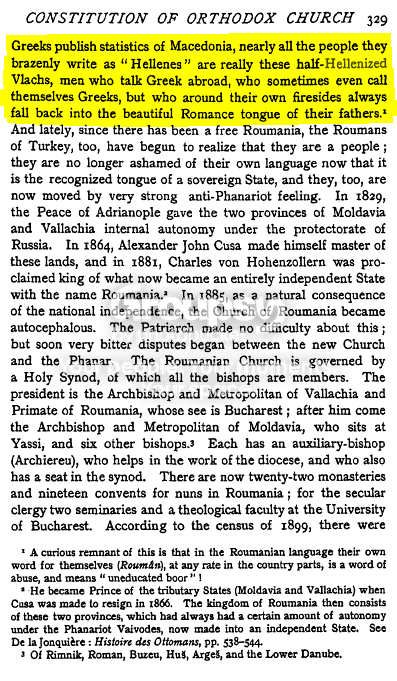
The Orthodox Eastern Church, Adrian Fortescue [Catholic Truth Society, 1908 - 451 pages]:
fortescue_zps461e9658.png
 
Last edited:
My apologies (another repost), as we are mentioning Janina/Ioannina here are my ramblings challenging some preconceived notions (assumptions) and illustrating discrepancies - which can likely be reconciled by demonstrating that (bilingual) Armani/Vlachs = Greeks.

I welcome any Responses or Challenges to my observations, and thank you in advance for taking the time to read through the below. This may appear to be unrelated to this thread but Ioannina was one of the CENTERS of Philike Hetairea activity in terms of ideology, gatherings, and dissemination of ideas. :)


I will start with a couple of quotes and then provide a quick overview/analysis. While reading this, please keep in mind the two well-known quotes which we have already seen, that is, how "Janina has quite forgotten its Rouman origin" (by Evans), and the other one "Most of the merchants and leading persons at Janina and Metsovo are Vlachs" (Great Britain. Parliament. House of Commons - 1903).

Once again, note that I am providing here merely two additional quotes.

1) On page 68 of the book "The Life of Ali Pasha, of Tepeleni, Vizier of Epirus, Surnamed Aslan, Or the ..." By Richard Alfred Davenport (year 1837), we read the following about Ioannina:

"Estimates of the population vary from thirty-five to fifty thousand persons. Forty thousand is, perhaps, about the real number. It forms a heterogeneous mass of Greeks, Turks, Albanians, Franks, Jews, Arabs, Moors, and Negroes; among whom the Greeks are the most numerous, respectable, and long established, many of the families having been settled at Ioannina for centuries."

2) The following is from A. Koukoudis, "The Vlachs of Aspropotamos: The conditions and the agents of development". It is important to note that he is a researcher (well respected in Greece), who in my opinion, has shown a tendency to minimize the number (and presence) of Vlachs in different regions of Greece. In many cases, I'd say he completely excised the Vlachs from the history of many places. The quote follows:

"A typical case is Ioannina, where Vlach traders and craftsmen mainly from Vlahodzoumerko (Kalarites and Syrrako) and Hora Metsovou settled and became very active in economic, corporate, and communal affairs. The same applies to the Lambros, Tourtouris, Sgouros, and Damiris families from Kalarites, who apparently supplanted older Ioanniot craftsmen in the Ioannina market in the time of Ali Pasha. There were a considerable number of Vlachs in the echelons of Ali’s crowded and much talked-about court, from the humble Metsovite porters who bore his litter on their shoulders to secretaries like Hristodoulos Hadzipetros from Neraïdohori in Aspropotamos (later King Otto’s aide-de-camp), the inspector of the Ioannina market Anastassios Samariniotis, privy councellors like the wealthy merchant Yeoryios Tourtouris from Kalarites, and European-trained doctors like Ioannis Kolettis from Syrrako (later Prime Minister of Greece) and Yeoryios Tsapraslis from Kalarites (who wrote one of the first grammars of the Vlach language). Vlachs from Kalarites, Syrrako, and Metsovo settled en masse in Ioannina and played an active part in revitalising that ruined town after the Greek War of Independence."

Summary (& discrepancies):

- Davenport: Greeks are the most numerous population of Ioannina in the early-mid 19th century; long established, many of the families having been settled at Ioannina for centuries. No mention of "Vlachs". Well and good.

- Koukoudis:
--> "Vlach" traders and craftsmen were very active and prominent in economic, corporate, and communal affairs.
--> There were a considerable number of Vlachs in the echelons of Ali’s crowded and much talked-about court.
--> The inspector of the Ioannina market was Anastassios Samariniotis.
--> Vlachs from Kalarites, Syrrako, and Metsovo settled en masse in Ioannina.

Analysis:

As we can see, Davenport noted a heterogeneous mass of different ethnicities in Ioannina with Greeks being the most numerous - while the "Vlachs" are invisible; no mention at all whatsoever. We have an obvious discrepancy, because from the researcher Koukoudis we see that "Vlachs" were quite numerous in Ioannina, settled en masse there, played an active and prominent role in all sorts of city affairs, and - as an example - A. Samariniotis was the inspector of the Ioannina market. A safe guess and assumption would be that the "Vlachs" were (at least) more numerous than say Franks, Jews, Arabs, Moors, or Negroes (?).

Furthermore, these "Vlachs" were not Albanians. It would be quite fair to say and conclude that the "Vlachs" knew Greek (were bilingual), and were "part" of the local Greek community. They considered themselves as Greeks - as we saw from the quote where it is explicitly stated that many distinguished Greeks are of Vlach extraction, how most of the merchants and leading persons at Janina and Metsovo are Vlachs, or that the Vlachs of Epirus would esteem it an offence to be considered of a comrade race with the Roumans.

It is very easy to see then that Davenport's Ioannina Greeks were, at the very minimum = Vlachs and Greeks. What we can also conclude is the following: Davenport did not care, bother, or knew to distinguish Vlachs from Greeks. Additionally, he was then unable to say with precision which families were long established, or which of the families having been settled at Ioannina for centuries. (The important point though is that there is a connection going back centuries.)

What completely tipped the scales here so to speak, in allowing us to easily conclude that Greeks are really Vlachophones are testimonies from Sir Arthur J. Evans and Great Britain Parliament House of Commons. In conclusion, Davenport's Ioannina Greeks were then "Vlachs"/bilingual Vlachophones who were the most numerous, respectable, and long established, many of the families having been settled at Ioannina for centuries.


Thanks for taking the time to read this.

http://www.macedoniantruth.org/forum/showthread.php?t=17&page=66
 
Last edited:
LoM, I actually wrote about him in this very thread. :)


Tsakalov's father was originally from Tyrnavos, and as we can see from above this town which was roughly 60 percent Vlach-speaking - at the end of the 20th century! Thessaly became part of the modern Greek state only in 1881, which means that after more than a century Tyrnavos was still largely Vlach-speaking.

As I have already argued the other segment of the population of Tyrnavos who were Greek-speaking monolinguals were simply locals or natives who abandoned the use of Vlach and self-Hellenized, since 1881.

http://www.macedoniantruth.org/forum/showthread.php?t=667&page=10

And as we can see with my brief discussion with Amphipolis on this and other topics on this forum I hit a raw nerve, and A. was unable or unwilling to acknowledge basic historical facts and testimonies. The reason I always hit a raw nerve was that most of my sources/books I have used are GREEK BOOKS, BLOGS, ARTICLES - written in Greek, and largely untranslated or unknown. These GREEK BOOKS written by modern GREEK AUTHORS can hardly be considered some sort of 'propaganda'.


PS:

Unrelated to Tsakalov, but let's not forget the following. :)

The Orthodox Eastern Church, Adrian Fortescue [Catholic Truth Society, 1908 - 451 pages]:
fortescue_zps461e9658.png


Great minds Carlin. His surname sounds Slavic to me, at least the -ov suffix is. Any idea how that came about?
 
Great minds Carlin. His surname sounds Slavic to me, at least the -ov suffix is. Any idea how that came about?

His surname was Russified. At a young age, he left Greece to be with his father in Russia. His 'real' surname seems to have been Tekelis or Tsakalos according to Greek wikipedia (not sure which one of the two though, as Tekeli appears to be totally different from Tsakalos).

https://en.wikipedia.org/wiki/Athanasios_Tsakalov
https://el.wikipedia.org/wiki/Αθανάσιος_Τσακάλωφ
 
Btw Greeks fought in several wars,and won many of them.When did your people fight the last 200 years ...?
(and i don't mean fighting in Bulgarian or even Greek and Serbian bands...)

Biggest lie ever spread amongst the Ken and Barbies of plastic land called greece.

I would like a greek to name me one war they won without any help from the West or from Bulgaria or Serbia or Macedonia. I mean modern and not something from antiquity that doesn’t have a relationship to the modern art masterpiss known as today’s greece.

Thanks in advance recyclables.

So we understand ourselves better;

http://www.macedoniantruth.org/forum/showthread.php?t=5473
 
Back
Top