• Welcome to the new Macedonian Truth Forum. All posts, members and private messages have been moved over from the old forum.

    Passwords from the old forum could not be carried over, so please use Forgot your password? to set a new one. The reset link is emailed to the address on your account.

  • Rules and Regulations at the forum of the Macedonian Truth Organisation (MTO)

    (1) The national-ethnic and cultural-linguistic identity of the Macedonian people is historically Macedonian, and derives its character from the native, indigenous and geographic homeland of the Macedonians, which is called Macedonia. To ensure that their human rights, integrity and heritage are appropriately respected, the only nouns and adjectives acceptable when reference is made to the above character and identity markers is Macedon, Macedonia, Macedonian and Macedonians.

    (2) The nation-state of the Macedonian people is the Republic of Macedonia, and is to be referred to by this official title so long as the 'republic' prefix is consistently applied to other states. Alternative references are the Macedonian Republic, or simply, Macedonia.

    (3) The 'ethnic' prefix is only acceptable for Macedonians in cases where differentiation is specifically required - so long as it is in context and consistent where it concerns its application to other ethnic groups.

    (4) Should any other differentiation be specifically required, the names of other ethnic groups that reside with Macedonians in either the Republic of Macedonia or the occupied Macedonian regions in Greece, Bulgaria, Serbia or Albania, are to be given a prefix.

    (5) Negating the identity, language and culture of the Macedonian people by deliberate avoidance of the terms Macedonia, Macedonian and Macedonians, or by any other means, is not permitted.

    (6) Systematic anti-Macedonian propaganda and rhetoric are not permitted.

    (7) Threads irrelevant to the Macedonian Cause, the community at the Macedonian Truth Organisation or the Macedonians in general may be considered as spam or not in the spirit of the forum. In such cases they are not permitted.

    (8) Continual posting of messages in threads with the sole purpose of deviating from the initial topics with the use of unrelated and unnecessary information is not permitted.

    (9) All posts, external articles, reports, etc that are cited in languages other than Macedonian or English, must be accompanied with a translation in one or both of the said languages.

    (10) Despite the possibility of some conversations and debates becoming heated, extreme abuse and/or racism, vulgar language and/or terminology, threats, revelation of personal information about others, harassment, and other such behavior will not be permitted. If deemed necessary all relevant information including member details will be reported to the appropriate authorities for investigation which may result in legal action.

    (11) Threads that are created must have a summary of a topic or excerpt of an article found in pertinent link(s) that have been included. One line threads will be considered unaccetable spam and are therefore not permitted.

    (12) Compulsive and deliberate lies, irrespective of the topic, are not permitted.

    (13) Any symbols or avatars found to be perceived as offensive to Macedonians are not permitted.

    (13) Any explicit or extreme material is not permitted.

    Failure to adhere to the above rules and regulations will result in a ban after 3 breaches. This may be reconsidered in some cases should the circumstances be of an unorthodox nature and/or require special consideration. To assure an effective deterrent against an individual or individuals with the sole purpose of causing dissent through spamming, racism or other improper means, the above rules will be strictly enforced.

    The MTO administration will monitor all discussions as reasonably practical and reserve the right to remove any post and/or member from the forum, and update the rules and regulations as required. Members are encouraged to immediately report any post and/or member to the MTO administration if they feel that these rules have not been abided by.

    The views expressed on this forum are those of the individuals. The only official representation of the MTO is made by the "Macedonian Truth Organisation (Site Owner)" username, and no other.

  • Macedonian Cause

    The Macedonian Truth Organisation calls on God in Heaven to protect, bless and guide the endeavour it is committing to undertake, and that is to work towards:

    Securing Macedonia as a free, independent and democratic republic in which sovereignty lies with the Macedonian citizens; as the nation-state of the Macedonian people in which they can preserve their culture, language and identity; as a state in which the Macedonian language and culture form the basis of public life and act as important unifying elements of Macedonian society; as the home of all its citizens to which it guarantees and obliges their inalienable natural rights and corresponding responsibilities;

    The acknowledgment as self-evident and irrefutable the existence of the:

    1) Indigenous, ethnonational name of Macedonia;
    2) Macedonian people, language and identity;
    3) Macedonian culture, symbols and folklore;
    4) Macedonian ancestry, heritage and history in its entirety; and
    5) Macedonian Orthodox Church;

    Securing recognition by the International Community of the tragedies endured by the Macedonian people, of the division of Macedonia with the signing of the Treaty of Bucharest on August 10, 1913, and the genocide committed against the Macedonian people at the hands of the Greek, Bulgarian and Serbian states and their respective churches during the 19th and 20th centuries;

    Ensuring that the Interim Accord is declared ‘null and void’ and that all constitutional provisions, acts, commitments, agreements, legislation, regulations, policies or programs emanating from, supporting or consequential to the Interim Accord are also declared ‘null and void’, including the use of any symbols and the completion of any acts imposed by, or originating from, the Interim Accord.

    Ensuring that the Framework Agreement is abolished and that all constitutional provisions, acts, commitments, agreements, legislation, regulations, policies and programs emanating from, supporting or consequential to the Framework Agreement are also abolished and replaced by a framework of constitutional and statutory law based on inalienable natural rights and corresponding responsibilities and universally codified human rights mechanisms.

    Securing the abolishment of any existing constitutional provisions, acts, agreements, legislation, regulations, policies and programs that discriminate against the Macedonian people, in any international organisation or any of the countries of the International Community where such constitutional provisions, acts, agreements, legislation, regulations, policies and programs exist, and thereby ensuring the freedom for Macedonians to exercise their inalienable natural rights and fulfil their corresponding responsibilities, and practice their culture, language and religious faiths in all the countries of the International Community without hindrance;

    The empowerment of Macedonians to undertake a moral revolution and to instil and/or reinvigorate within themselves a deep-rooted national, cultural, linguistic and historical dignity and a commitment to the exercise of freedom based on inalienable natural rights and corresponding responsibilities;

    The recognition of the Macedonian minorities in the neighbouring states of Macedonia as well as the respect for the inalienable rights and freedoms of the Macedonian minorities, as provided for by natural law and as codified by the United Nations Charter, the Universal Declaration of Human Rights and other universally codified human rights mechanisms;

    The full and unreserved respect of, and the support for, the rights of all people of non-Macedonian descent living in Macedonia and around the world, who share a reciprocal full and unreserved respect for the Macedonian people, their homeland and their state;

    The cultural unification and solidarity of the Macedonian people living in all parts of historical Macedonia and adjacent territories, as well as Macedonians throughout the world;

    The unity of all Macedonians on the principles, objectives and achievement of the Macedonian cause as defined by this declaration.

Population of Macedonia and Adjacent Areas

Quotes from Sir Arthur Evans (in no particular order).

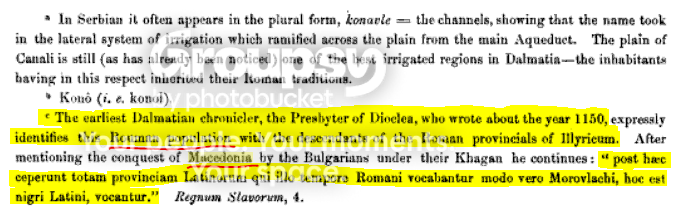
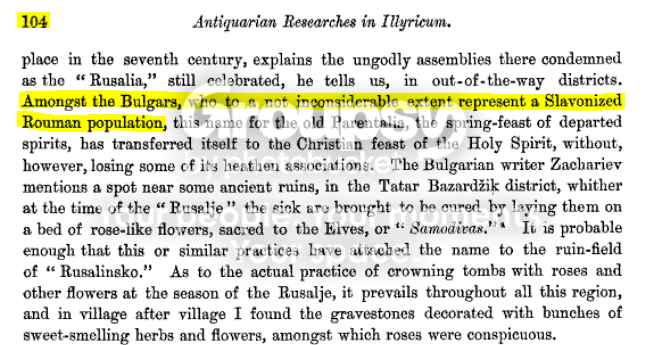
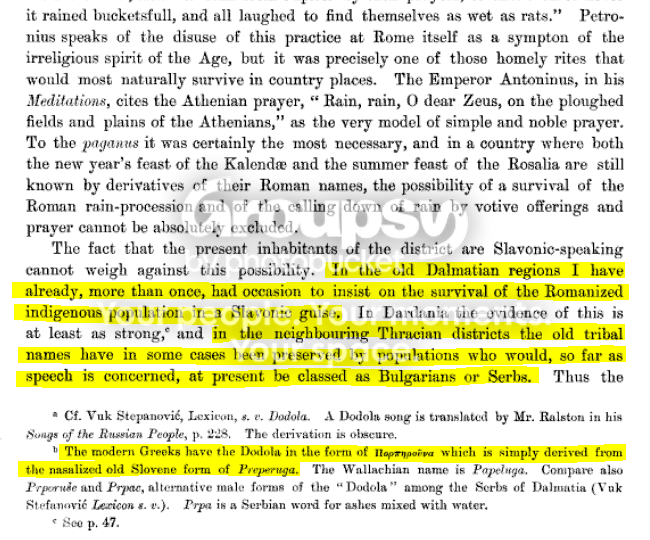
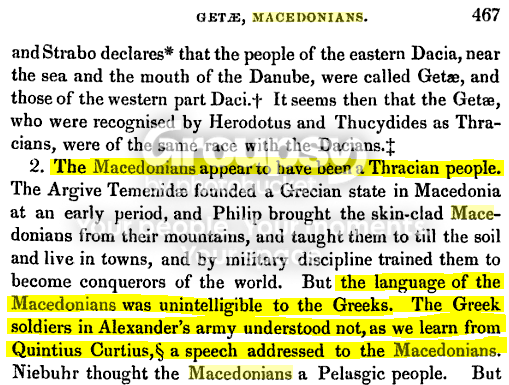
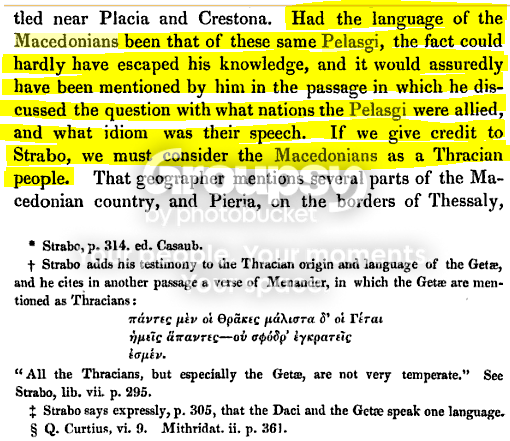
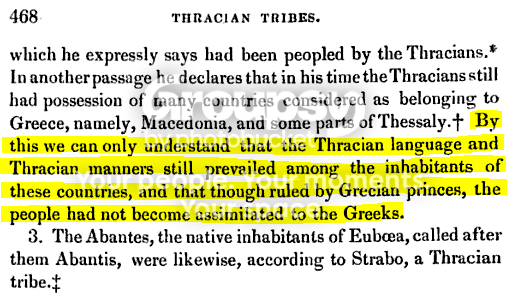
ArthurEvans_zps554c1c37.png

ArthurEvans1b_zps7b47e2b0.png

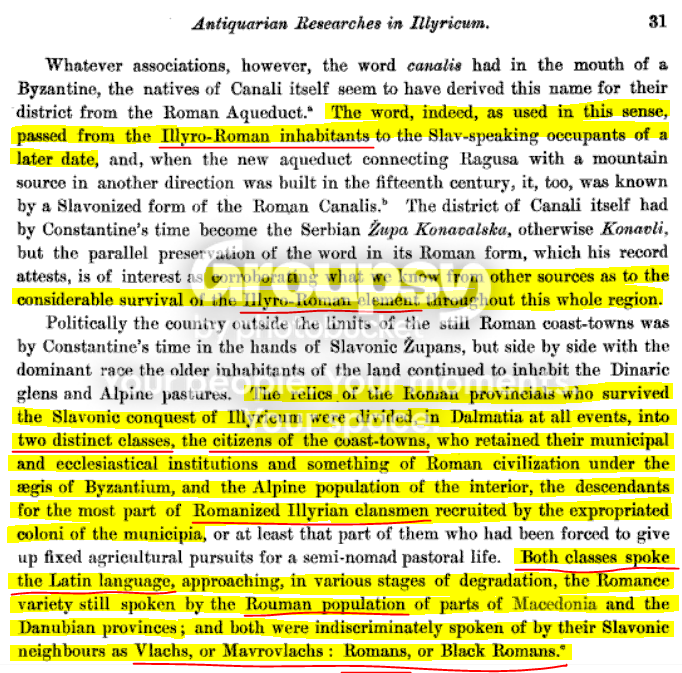
ArthurEvansBulgarsRoumans_zps1401cf17.png

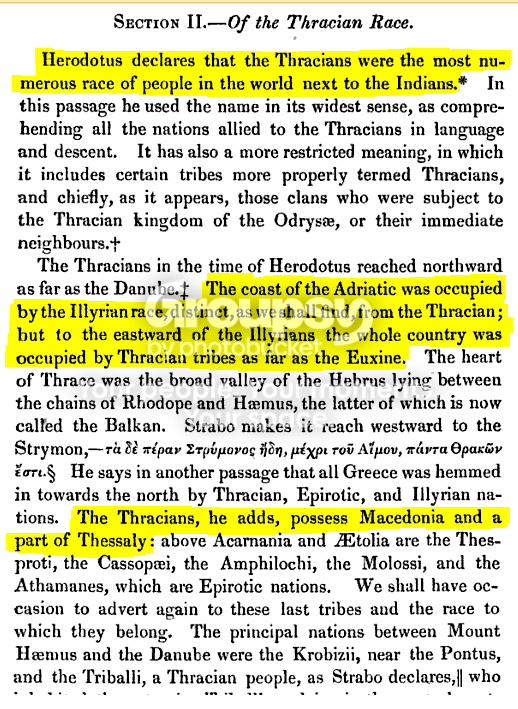
ArthurEvansBulgars_zps4edf4171.png

ArthurEvansBulgarsAlbaniansRoumans_zps43c4f289.png

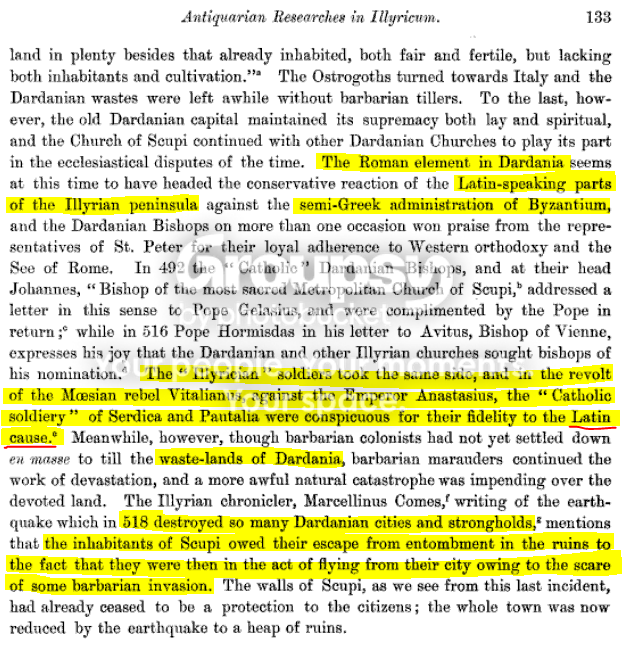
ArthurEvansDardania_zps654201b2.png

ArthurEvans1_zps6f291bf7.png
 
1) Acta S. Demetrii, c. ii.

It is there mentioned as a chief cause of the second Slavonic onslaught on Thessalonica that the city sheltered escaped "mancipia" from the interior of Illyricum. One city only ought not to be allowed to hold out when all the other cities and provinces round had been made void of Roman habitation; "hec autem" (to quote the Latin version) "sola superesset omnesque e Danubii partibus Pannoniaque et Dacia et Dardania reliquisque provinciis et urbibus transfugas reciperet atque in sinu suo foveret." The citizens of Naissus and Serdica are specially mentioned.

See page 140 in Sir Arthus Evans' book for more info and proof of this quote: Antiquarian Researches in Illyricum: Parts I-IV.

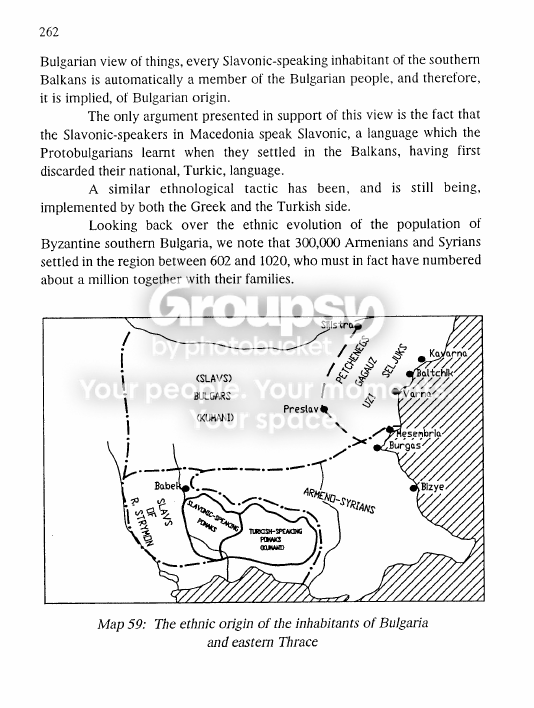
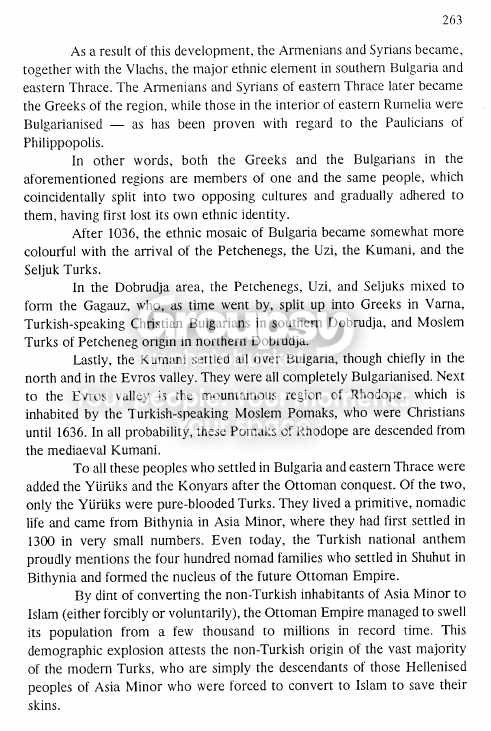
2) Nakratzas, pages 262, 263.

The ethnic origin of the inhabitants of Bulgaria and eastern Thrace.

Nakra3_zpsb7fc6204.png

Nakra4_zpsd52519e3.png
 
Last edited:
Population of Macedonia and Adjacent Areas.

What follows is a simple listing of historical facts. It will disturb a great number of nationalists all over the Balkans. :)

Migrations, settlements and colonies, wholesale removal of populations and tribes and their forceful settlement in new regions - as conducted by Roman authorities:

1) Unknown number of "barbarians" settled south of the river Danube in 62 A.D. In the sources, their number is mentioned to be around 100,000 (most likely a 'number' that was conjured up, but nonetheless..). No details about ethnic origin of this population.

2) In 268-270 A.D. a great number of Goths settled south of the river Danube. Many ended up being included in the Roman army.

3) Around 273 A.D., Carpi settled in Scythia Minor province. Scholars have linked the Carpi to a variety of ethnic groups, including Sarmatians, Thracians, Germans, and Celts.

4) In 275 A.D., a great number of Dacians settled south of the Danube.

5) A few years later, 100,000 Bastarnae settled south of Danube. They were followed by Vandals, Gepids, and others.

6) In 282 A.D., 20,000 Sarmatians settled south of Danube.

7) 290 A.D., unknown number of Arabs settled in Thrace.

8) Towards the end of the 290's A.D., additional groups of Carpi and Bastarnae settled south of Danube.

9) 303 A.D., unknown tribe settled in Thrace.

10) 334 A.D., 300,000 Sarmatians, Goths, Iazyges settled throughout Macedonia, Thrace, and Scythia Minor.

11) New transplantation of Goths in 348 A.D.

12) I will stop here, although there are a few additional facts along the same lines. Goths, Sarmatians, Celts, tribes of unknown origin continued to be settled south of Danube (..in different waves).
 
Encyclopaedia Londinensis, or, Universal dictionary of arts ..., Volume 12

http://books.google.ca/books?id=FVg...Q6AEwAA#v=onepage&q=Sclavonian Epirus&f=false

"The Sclavonian language is spoken in Epirus, the western part of Macedonia, in Bosnia, Servia, Bulgaria, in part of Thrace, in Dalmatia, Croatia, in Poland, Bohemia, Russia, and Mingerlia in Asia, whence it is frequently used in the seraglio at Constantinople. Many of the great men of Turkey understand it, and frequently use it..."
 
1.A) "Scholars paid less attention to another chapter, in which Emperor Constantine VII refers to measures taken by Emperor Justinian II in 688 or 689. Following his defeat by the Bulgars in a mountain pass near Philippopolis (present-day Plovdiv, in Bulgaria), Emperor Justinian II settled groups of "Scythians" around the gorges of the river Struma, thus laying the foundations of the Strymon kleisoura, later to become the theme (province) by the same name."

[Source: Page 98 -> "Southeastern Europe in the Middle Ages, 500-1250", F. Curta.]

1.B) "Justinian is also reported to have settled 'Scythians' in east Macedonia in the Strymon region."

[Source: Page 71, footnote 79 -> "Byzantium in the Seventh Century: The Transformation of a Culture", J.F. Haldon.]
 
Last edited:
Wilkinson, H. R., (1951), Maps and politics. A review of the ethnographic cartography of Macedonia, page 43: "He drew attention to the Vardariotes, pre-Osmanli Turks, who had become Christianized, had settled in the Vardar valley and then had been assimilated by the Slavs. (F. Meinhard distinguished a similar group in south-western Macedonia but referred to them as Bardariotes. See p. 127)."

Wilkinson, H. R., (1951), Maps and politics. A review of the ethnographic cartography of Macedonia, page 127: "The Bardariotes living in small groups south of Kastoria were also depicted on Meinhard's map. They had generally been classified as Turks."
 
Link:
https://books.google.ca/books?id=v1...ire de la Grece au Moyen Age Rynchini&f=false

Source -> "Documents inedits relatifs a l'histoire de la Grece au Moyen Age", edited by Konst. N. Sathas - Page "Preface VII", FOOTNOTE:

"On sait que dernierement un eveque russe, M. Porphyrius Uspenski, a decouvert des documents qui demontrent que les allies des Avars Rynchini, qu'on a confondus avec les Slaves, n'etaient que des Valaques (οι Βλαχοι Ρυγχίνοι). Istoria Athoni, 3me section, chap. VII, p. 320."

English summary: A Russian bishop, M. Porphyrius Uspenski, has discovered documents that demonstrate that the allies of the Avars Rynchini, that we confused with the Slavs, were only Vlachs (οι Βλαχοι Ρυγχίνοι). Istoria Athoni, 3rd section, c. VII, p. 320.
 
Source -> Wace, A., Thomson, B., (1914), The Nomads of the Balkans:

Page 30: "The Kupatshari are hellenized or semi-hellenized Vlachs. That is to say that through intermarriage and the influence of the church and Greek education they have abandoned their native language. They still however retain the Vlach national costume, and many Vlach words occur in their dialect as well as many non-Greek sounds such as sh, zh, tsh, and dzh. They inhabit the district between Ghrevena and the pure Vlach villages of Pindus. At one of their villages, Labanitsa, which is only half hellenized we obtained some insight as to the process by which denationalisation occurs. In the school and church Greek is the only language used. All the older men in the village know Vlach and so do many of the women."

Page 45: "They are called Kupatshari, "men of the oak tree" (kupatshu being Vlach for oak tree), because the district Grevena is covered in oak scrub and forest. The people of the highest of their villages, such as Kipourio and Philippaei..."

Page 46: "...and in Shatishta and Kozhani in which two latter towns the hellenized Vlachs form the strongest part of the Greek population."


Source -> The Close Racial Kinship Between the Greeks, Bulgarians, and Turks: Macedonia and Thrace By Dr. George Nakratzas; Pages 76, 77, & 85:

i) "Once they had embraced the agricultural life, the Kupatshari became Hellenised to such an extent that, by 1912, the Aromunian or Vlach language was spoken only by the old people. Today, the young Kupatshari are not even aware of their Vlach origins. Many Kupatshari moved to urban centres, where such surnames as Koupatsaras, Koupatsaris, and Koupassaris still survive."

ii) "In the Grevena area, there was one more interesting group of Vlachs, the Turko-Vlach Valahades, who lived alongside the Kupatshari. There were about 12,000 of them, and they lived in the low foothills of the Pindos near Siatista. Until 1924, when they left for Turkey under the terms of the exchange of populations, they spoke Greek. ... The fact that the Valahades lived in close proximity to the Kupatshari offers evidence of their Kupatshari origins."

iii) "On all the ethnological maps of the nineteenth century, the inhabitants of the Grevena area are described as being of Greek origin. They were Greek-speakers, certainly ... but their Greek origin is a matter of some doubt. Serious evidence of their non-Greek origin is furnished by the Athenian bishop Bardanes, who in 1210 elected to go to the see of Grevena, on the grounds that the local people did not speak Greek and were uncivilised."

iv) "There is no mention of Vlachs having migrated to the Kozani tableland. The people of this area were almost exclusively Turks from Konya, with the exception of the inhabitants of Kozani itself, who were mostly of Vlach origin."

v) "Kozani and Veria are separated by Mount Vermion, where the Vlachs of the Vermion group lived. ... The Vlach villages are: Volanda, Kato Seli, Ano Seli, Maroussa, Doliani, Xirolivadi, Kastania, and Tsarkovian. The inhabitants of the Vermion villages originally came from Moskhopoli, Samarina, Avdela and Frasheri, and settled here after 1770..."
 
Last edited:
The Armenians in the Byzantine Empire
by Peter Charanis

Extracts:

1) Basil was an Armenian, born in Macedonia where numerous Armenians had been settled. To be sure, there are references found in Arabic sources which raise the question whether Basil may not have been a Slav. In some of these references he is called simply a Slav without any further explanations; in others he is called [35] a Slav because his mother was a Slav (110). Some modern scholars have taken these references seriously and as a consequence have given to Basil a Slavic or Armeno-Slavic origin (111). But in view of the Byzantine and Armenian traditions both of which insist on the Armenian origin of Basil, their opinion is more than questionable. As for the Arabic references, they can best be explained as the result of a confusion arising from the fact that Basil's birthplace was Macedonia whose inhabitants were regarded by the Arabs as Slavs. That Basil I, the founder of the most brilliant dynasty of the Byzantine empire, was indeed Armenian and Armenian on both sides, can be regarded as an established fact (112).

2) But more important in the central administration of the empire were two other personages of Armenian or partially Armenian descent. One was Stylianos Zaoutzes, the other was Basil the paracoemomenos. Zaoutzes was an Armenian born is Macedonia whom we first find in the entourage of Basil I.

3) The diverse ethnic groups established in Thrace were reinforced by later arrivals. In the tenth century, during the reign of John Tzimiskes, a considerable number of Paulicians were removed from the frontier regions of the east and were settled in Thrace, more exactly in the country [16] around Phillippopolis (19). These Paulicians were most probably predominantly Armenians. A little later, perhaps in 988, Armenians were settled also in Macedonia. They were brought there from the eastern provinces of the empire by Basil II in order to serve as a bulwark against the Bulgarians and also to help increase the prosperity of the country (20).
 
Dr. Slavoljub Gacovic - "About ethnonym Torlak and the Romanic and Turkic basis of ethnogenesis of Torlaks and Shops".

Dr. Gacovic argues and proves that Torlaci and Shop(ov)i are slavicized Vlachs and Turkic inhabitants of the territories of eastern and southeastern Serbia, western Bulgaria and northern Macedonia.

See Conclusion below, which is in English.


Sokratis Liakos, Page 145 - "The origins of the Armonians (Vlachs)":

"... they still ignore the most asserted fact, that the Sklavinoi Rinhini of northern Chalkidiki were part of Celto-Illyrian Erkuli or Erkuni, and not Slav settlers."

For fair use.
 
Last edited:
1) LIVY, ROME AND THE MEDITERRANEAN.

Books XXXI-XLV of The History of Rome from its Foundation.

Translated by Henry Bettenson, Penguin Books. [This translation first published 1976]

Book XLIV.45 - Flight of Perseus, 168 B.C.

"First Beroea surrendered, then Thessalonica and Pella, and within two days almost all Macedonia had submitted. The people of Pydna, who were the nearest, had not yet sent envoys; a mixed and unassimilated population of many different nationalities; and the mob which had herded together as a result of the flight from the battlefield, hindered any decision or agreement among the citizens."

Book XLV.30 - Partition of Macedonia, 167 B.C.

"The third region has the notable cities of Edessa, Beroea, and Pella; it includes the warlike people of the Vettii, besides a large settlement of Gauls and Illyrians, who are energetic farmers."


2) CHAP. 17. (10.)—MACEDONIA. from the link:
http://www.perseus.tufts.edu/hopper/text?doc=Perseus:text:1999.02.0137:book=4:chapter=17


Macedonia comes next, including 150 nations, and renowned for its two kings and its former empire over the world; it was formerly known by the name of Emathia. Stretching away towards the nations of Epirus on the west it lies at the back of Magnesia and Thessaly, being itself exposed to the attacks of the Dardani. Pæonia and Pelagonia protect its northern parts from the Triballi. Its towns are Ægiæ, at which place its kings were usually buried, Beræa, and, in the country called Pieria from the grove of that name, Æginium. Upon the coast are Heraclea, the river Apilas, the towns of Pydna and Aloros, and the river Haliacmon. In the interior are the Aloritæ, the Vallæi, the Phlylacæi, the Cyrrhestæ, the Tyrissæi, the colony of Pella, and Stobi, a town with the rights of Roman citizens. Next comes Antigonea, Europus upon the river Axius, and another place of the same name by which the Rhœmdias flows, Scydra, Eordæa, Mieza, and Gordyniæ. Then, upon the coast, Ichne, and the river Axius: along this frontier the Dardani, the Treres, and the Pieres, border on Macedonia. Leaving this river, there are the nations of Pæonia, the Paroræi, the Eordenses, the Almopii, the Pelagones, and the Mygdones.
 
Vlach-speaking residents of Trnovo and Magarevo write to the Patriarch and to the Greek consulate in Bitola:

"It is true, that a corrupted language, called Vlach, which is a mix of different dialects, is still spoken by us. But this is a baby language and in time will be abandoned, as all our children, boys and girls are devoted to learning Greek. All of us here are civilized by the Greek language and use it in our commercial transactions. So our desire for it increases with the efforts of foreign forces to lead to our political and religious divide. The efforts of foreigners who were sent to us from Wallachia (Romania) will never achieve their goal"


https://bg.wikipedia.org/wiki/Магарево
https://mk.wikipedia.org/wiki/Магарево
 
Back
Top