• Welcome to the new Macedonian Truth Forum. All posts, members and private messages have been moved over from the old forum.

    Passwords from the old forum could not be carried over, so please use Forgot your password? to set a new one. The reset link is emailed to the address on your account.

  • Rules and Regulations at the forum of the Macedonian Truth Organisation (MTO)

    (1) The national-ethnic and cultural-linguistic identity of the Macedonian people is historically Macedonian, and derives its character from the native, indigenous and geographic homeland of the Macedonians, which is called Macedonia. To ensure that their human rights, integrity and heritage are appropriately respected, the only nouns and adjectives acceptable when reference is made to the above character and identity markers is Macedon, Macedonia, Macedonian and Macedonians.

    (2) The nation-state of the Macedonian people is the Republic of Macedonia, and is to be referred to by this official title so long as the 'republic' prefix is consistently applied to other states. Alternative references are the Macedonian Republic, or simply, Macedonia.

    (3) The 'ethnic' prefix is only acceptable for Macedonians in cases where differentiation is specifically required - so long as it is in context and consistent where it concerns its application to other ethnic groups.

    (4) Should any other differentiation be specifically required, the names of other ethnic groups that reside with Macedonians in either the Republic of Macedonia or the occupied Macedonian regions in Greece, Bulgaria, Serbia or Albania, are to be given a prefix.

    (5) Negating the identity, language and culture of the Macedonian people by deliberate avoidance of the terms Macedonia, Macedonian and Macedonians, or by any other means, is not permitted.

    (6) Systematic anti-Macedonian propaganda and rhetoric are not permitted.

    (7) Threads irrelevant to the Macedonian Cause, the community at the Macedonian Truth Organisation or the Macedonians in general may be considered as spam or not in the spirit of the forum. In such cases they are not permitted.

    (8) Continual posting of messages in threads with the sole purpose of deviating from the initial topics with the use of unrelated and unnecessary information is not permitted.

    (9) All posts, external articles, reports, etc that are cited in languages other than Macedonian or English, must be accompanied with a translation in one or both of the said languages.

    (10) Despite the possibility of some conversations and debates becoming heated, extreme abuse and/or racism, vulgar language and/or terminology, threats, revelation of personal information about others, harassment, and other such behavior will not be permitted. If deemed necessary all relevant information including member details will be reported to the appropriate authorities for investigation which may result in legal action.

    (11) Threads that are created must have a summary of a topic or excerpt of an article found in pertinent link(s) that have been included. One line threads will be considered unaccetable spam and are therefore not permitted.

    (12) Compulsive and deliberate lies, irrespective of the topic, are not permitted.

    (13) Any symbols or avatars found to be perceived as offensive to Macedonians are not permitted.

    (13) Any explicit or extreme material is not permitted.

    Failure to adhere to the above rules and regulations will result in a ban after 3 breaches. This may be reconsidered in some cases should the circumstances be of an unorthodox nature and/or require special consideration. To assure an effective deterrent against an individual or individuals with the sole purpose of causing dissent through spamming, racism or other improper means, the above rules will be strictly enforced.

    The MTO administration will monitor all discussions as reasonably practical and reserve the right to remove any post and/or member from the forum, and update the rules and regulations as required. Members are encouraged to immediately report any post and/or member to the MTO administration if they feel that these rules have not been abided by.

    The views expressed on this forum are those of the individuals. The only official representation of the MTO is made by the "Macedonian Truth Organisation (Site Owner)" username, and no other.

  • Macedonian Cause

    The Macedonian Truth Organisation calls on God in Heaven to protect, bless and guide the endeavour it is committing to undertake, and that is to work towards:

    Securing Macedonia as a free, independent and democratic republic in which sovereignty lies with the Macedonian citizens; as the nation-state of the Macedonian people in which they can preserve their culture, language and identity; as a state in which the Macedonian language and culture form the basis of public life and act as important unifying elements of Macedonian society; as the home of all its citizens to which it guarantees and obliges their inalienable natural rights and corresponding responsibilities;

    The acknowledgment as self-evident and irrefutable the existence of the:

    1) Indigenous, ethnonational name of Macedonia;
    2) Macedonian people, language and identity;
    3) Macedonian culture, symbols and folklore;
    4) Macedonian ancestry, heritage and history in its entirety; and
    5) Macedonian Orthodox Church;

    Securing recognition by the International Community of the tragedies endured by the Macedonian people, of the division of Macedonia with the signing of the Treaty of Bucharest on August 10, 1913, and the genocide committed against the Macedonian people at the hands of the Greek, Bulgarian and Serbian states and their respective churches during the 19th and 20th centuries;

    Ensuring that the Interim Accord is declared ‘null and void’ and that all constitutional provisions, acts, commitments, agreements, legislation, regulations, policies or programs emanating from, supporting or consequential to the Interim Accord are also declared ‘null and void’, including the use of any symbols and the completion of any acts imposed by, or originating from, the Interim Accord.

    Ensuring that the Framework Agreement is abolished and that all constitutional provisions, acts, commitments, agreements, legislation, regulations, policies and programs emanating from, supporting or consequential to the Framework Agreement are also abolished and replaced by a framework of constitutional and statutory law based on inalienable natural rights and corresponding responsibilities and universally codified human rights mechanisms.

    Securing the abolishment of any existing constitutional provisions, acts, agreements, legislation, regulations, policies and programs that discriminate against the Macedonian people, in any international organisation or any of the countries of the International Community where such constitutional provisions, acts, agreements, legislation, regulations, policies and programs exist, and thereby ensuring the freedom for Macedonians to exercise their inalienable natural rights and fulfil their corresponding responsibilities, and practice their culture, language and religious faiths in all the countries of the International Community without hindrance;

    The empowerment of Macedonians to undertake a moral revolution and to instil and/or reinvigorate within themselves a deep-rooted national, cultural, linguistic and historical dignity and a commitment to the exercise of freedom based on inalienable natural rights and corresponding responsibilities;

    The recognition of the Macedonian minorities in the neighbouring states of Macedonia as well as the respect for the inalienable rights and freedoms of the Macedonian minorities, as provided for by natural law and as codified by the United Nations Charter, the Universal Declaration of Human Rights and other universally codified human rights mechanisms;

    The full and unreserved respect of, and the support for, the rights of all people of non-Macedonian descent living in Macedonia and around the world, who share a reciprocal full and unreserved respect for the Macedonian people, their homeland and their state;

    The cultural unification and solidarity of the Macedonian people living in all parts of historical Macedonia and adjacent territories, as well as Macedonians throughout the world;

    The unity of all Macedonians on the principles, objectives and achievement of the Macedonian cause as defined by this declaration.

Population of Macedonia and Adjacent Areas

Also, let's put some flame in the forum. A week ago there was a discussion about Bouf / Akritas in Florina district where several members of the forum come from. I didn't want to mention this, but most of the short summaries and videos about the village state it was originally a Vlach village that was gradually Slavicised (linguistically). You're very interested in the Vlachs (as it seems). Do you know anything about it?

I have two points to make with regard to your comment Amphipolis. Firstly, there is no need to spare us from any embarrassment, if indeed Buf was a Vlach village at some point in the past (which it never was). Unlike in Greece, we celebrate all of Macedonia's people including Vlachs. We are not ashamed of them or try to hide them in any way. We have even reserved a special spot in our national anthem for the most famous Vlach of them all - Pitu Guli. And, we don't try and pass him off as a Macedonian either. He was a Vlach and that's how history knows him.

Secondly, were "most of the short summaries and videos" about Buf being a Vlach village in the past from Greek sources? Evidently, it is not a Greek village so, of course, they will tell their Greek audience it was a Vlach village and not a Macedonian village. It's the lesser evil in Greek eyes. Better to explain it away as a Vlach village than a filthy Bulgarian one.

Buf is a very notable, proud and famous Macedonian village. A Vlach past would be difficult and next to impossible to mask, hide or disguise. Macedonian Wikipedia has the following historical background information with regard to the ethnic make-up, early settlement and economy of this village:

The village of Buf is a very old village which, according to tradition, was founded by craftsmen who made wooden spoons. Interestingly, in the immediate vicinity of the village, there is a locality that is still known as "Lažichari" to this very day. One of the oldest written pieces of information about the village of Surovičevo is found in the Turkish census annals from the 15th century, i.e. from the extensive census record number 16 for the Lerin Nahija from 1481, where, for the village recorded as Buh, it was also noted that there were 76 Christian Macedonian families who produced up to 125 loads of wheat, 94 loads of barley, 7 loads of rye, 3 loads of millet, 2 loads beans, lentils, vegetables, honey, cultivated vineyards, etc.

Some historical observations about Buf are also given by Gjorche Petrov who observed that on the top of the mountain summit Gradiste there are ruins from an old fortress, from which only ruined walls and some drainage pipes remain. The villagers claim that the water there flowed through pipes from the opposing, southern peak of Brezovica, which is much higher than Gradishte
(Note: Gradishte means an urban settlement in Macedonian). At the foot of Gradishte, there were also dry water pipes at that time, which clearly indicates that they were bringing water from Brezovica to the fortress. The locals told Petrov that a prince (or nobleman) whose name they did not know barricaded himself in the fortress, defending it for a very long time. It was only through pure chance that an enemy's mule accidentally exposed the water pipes that led to the Gradishte fortress, as a result of extreme thirst, and caused the enemy to stop the water from reaching the fortress which lead to his eventual surrender. At the time of his visit in 1896, near the end of the XIX century, Gjorche Petrov wrote that Buff had 200 households with 2,120 inhabitants, all of them Macedonians under the clergy of the Exarchate. The villagers are distinguished for being very brave and heroic. The streets of the village were uneven, and some were paved with narrow rough cobblestones. Several streams overgrown with dense forest cut across the village. The houses were covered with straw. There is a church built 30 years ago (1860), whose construction is huge, rough and stiff. In the schools (male and female) the lessons are conducted in the Macedonian language. It is said that Buf, like Armensko, was founded by spoon-making artisans. On the northeast side of the village, the place is still called "Lazhichari". Perhaps those spoon-makers were from the Poreche area. Among the population there was no story, nor songs about the origin of the name Buff. Until 1894, the village fell under the Greek Patriarchate's spiritual jurisdiction. However, the bad behavior of the three former Buf priests forced the peasants to recognize the clergy of the Bulgarian Exarchate, while the Greek bishop, in an effort to deter Bufchani from the Exarchate, managed to close the village church for several months.

Bulgarian Wikipedia reiterates all of the above with the notable exception of replacing the term Macedonian with Bulgarian. Gjorche Petrov apparently also used the term Bulgarian when describing the village and its people...But that's not the point. The point is, Buf has never had a Vlach presence in the village.
 
And... what kind of book is this? What does it say before or after? Can you name 1 (one) Vlach village of Chalcidice? (just curious)

Also, let's put some flame in the forum. A week ago there was a discussion about Bouf / Akritas in Florina district where several members of the forum come from. I didn't want to mention this, but most of the short summaries and videos about the village state it was originally a Vlach village that was gradually Slavicised (linguistically). You're very interested in the Vlachs (as it seems). Do you know anything about it?

ΟΙ ΕΛΛΗΝΟΒΛΑΧΟΙ (ΑΡΜΑΝΟΙ) (ΠΡΩΤΟΣ ΤΟΜΟΣ), ΕΞΑΡΧΟΣ ΓΙΩΡΓΗΣ


1) In Buf, until the 19th century, the Vlach dialect was spoken, and then the inhabitants were linguistically Slavicized, as was the case in many parts of Macedonia.

URL:
http://ethnologic.blogspot.ca/2012/06/blog-post_08.html

2) Also here (Giōrgēs Exarchos, Achilleus G. Lazarou):
https://books.google.ca/books?id=al...ved=0ahUKEwig8_uMtLLaAhUM_IMKHb-YAmgQ6AEIKTAA

Carlin, do you know for a fact that Buf had a Vlach past based on hard evidence from Bufchani themselves or is the quote you provided (in bold for emphasis) from the Greek source provided?

Bill, did you want to add your five cents worth with regard to this latest revelation about Buf?
 
Carlin, do you know for a fact that Buf had a Vlach past based on hard evidence from Bufchani themselves or is the quote you provided (in bold for emphasis) from the Greek source provided?

Bill, did you want to add your five cents worth with regard to this latest revelation about Buf?

This is a translation from the Greek source.

It is possible a Vlach population lived in Buf - alongside others, and they may have been assimilated. We do not know much. Human memory and/or traditions (oral traditions, interviews) have been proven to be weak/poor proofs or evidence of anything.

As a similar example, the residents of Заграчани/Zagračani seem to have been speaking a language other than Albanian (.. recently). According to Evtim Sprostranov, the inhabitants of Zagračani were Pomaks who at the beginning of the 20th century still spoke Bulgarian, but because of the mixed marriages with the Albanians in Radolista they were subjected to Albanization. This data is also confirmed by Yakim Derebanov, who in his 1907 report also wrote that the inhabitants of the village are 397 "Bulgarian-Muslims (Pomaks)", who are supposed to have accepted Islam some 150 years earlier.

URL:
https://bg.wikipedia.org/wiki/Заграчани

There are numerous other examples throughout the Balkans.
 
This is a translation from the Greek source.

It is possible a Vlach population lived in Buf - alongside others, and they may have been assimilated. We do not know much. Human memory and/or traditions (oral traditions, interviews) have been proven to be weak/poor proofs or evidence of anything.

We should be more careful when quoting Greek sources. Greek sources claim that my dad's village in Bitola, Brusnik, once had a Greek population because the main church there, Sveti Dimitrija, was under Greek jurisdiction. It's surprising to me today but during the early 1900's Brusnichani were quite divided, as most of Macedonia was, with regards to church affiliation. Fist fights were not uncommon as my grandfather often recalled. It was a battle, along church lines, between those who attended Sveti Dimitrija and those who attended Sveti Spas, which was under Bulgarian jurisdiction.

However, the folk history of a place doesn't easily disappear and its the native people that know the true history of a place despite what foreign sources may claim. One of the things that Brusnichani pride themselves on is the fact that Brusnik has never had a single person live there that wasn't Macedonian in its entire 620 year old history of known existence under the name of Brusnik. Before it was known as Brusnik, the local village folk tradition is that a much older settlement once existed there that went by the name of "Lipa", a tree that is quite abundant in the mountain forests above Brusnik. Lipa translates to the Tilia, or more commonly, the Linden tree.

Who knows, I might find one day that Greek sources have claimed that Brusnik, like they claim of Buf, once had a Vlach population too. Does it make so? Absolutely not. Because the native population would know such a thing.

I mentioned on another thread the nearby Pelister villages of Nezhepole, Malovishte, Trnovo, Magarevo and Gopesh, once massively populated Vlach villages and today, for all intents and purposes, small Macedonian villages. If you weren't a local from the mountainside area of Bitola, you would never know that these villages were once huge Vlach villages, however, the local people know its past and who was who back then. Even though most of these villages are now Macedonian-speaking and pretty much assimilated, they are still known to everyone in Bitola as Vlach villages. There is nothing to hide and they will always be known as Vlach villages. The same is not true of Brusnik...or Buf!!!

I would not underestimate the collective folk memory and, as you say, the "oral traditions" of a people Carlin. I do not accept that they have been proven to be weak or poor in using as proof or evidence of anything. As an example, no one would have possibly known that the original name of my dad's village Brusnik, was once Lipa had it not been for the collective folk memory of Brusnichani and Brusnichani alone. No one else would have bothered to care.
 
Bill, did you want to add your five cents worth with regard to this latest revelation about Buf?
Hi Karposh.

Like you said, ill be more careful when quoting Greek sources.
Regarding the videos Amphipolis posted, i don't know why he expected we would understand what was going on since it was in the Greek language. Though i did sense (after years of experience with Greeks) that its was something disingenuous on his behalf and wasn't interested in conversing with him because i have re-evaluated my life priorities long ago, and paying attention to insincerity is long gone. Also the fact i am also aware to beware of Greeks bearing gifts:biggrin:

But regarding those videos and Amphipolis brief translation of content in those "Greek produced" videos, i find it strange how Greeks claim everything is pure Greek direct descendants of Ancient Greeks but on this occasion, they are attempting to prove impurity, i cant get my head around as to why. Mabe, just maybe since they are aware of the history of that particular village, such as the pride, heroism and having a Macedonian consciousness..... it could be that they feel its like flogging a dead horse trying to sustain the Greekness of that particular village. Like i said, i don't know, and im just speculating. I will also say, when i last visited the region, i noticed something very peculiar about Macedonian villages in Northern Greece that majority are known to be pro Macedonian. These villages are very neglected, such as poor infrastructure. It would be plausible to think its some kind of punishment, abandonment and not hard to guess why.

Finally, in-particular my ancestry side of this argument. Like LOM said, due to "Probably stuff that's been posted in these forums, couldn't quote any" at this moment...... in the 18th 19th century possibly earlier right up to the end of the Ottoman occupation, Vlachs were known as sheep or goat farmers. There are also some sources suggesting a "Vlach" wasn't meant in an ethnic sense, but a profession. Now im only going by those clues.... that i say i doubt my ancestors were Vlachs due to the history of our surname "Shapazoi" which was brought on due to an unfortunate event where their cattle contracted a disease known at the time in Macedonian as "Shapa" or "Shapka" which ive brought up previously and the fact they were cattle farmers. It probably isnt a strong argument, but unless i can get a hold of an time machine, this is all i have got to play with and i am sure there are many instances where today's known history, is based on such little but deemed plausible evidence.
 
Last edited:
oh and one last thing to my above ^^ post.

I find it hard to believe if my ancestors spoke Vlach or those of many other Boufchani i know of, today we would have no trace of an accent associated with Macedonian speaking Vlachs. I have an auntie married to a Macedonian speaking Vlach from Pelister villages of Nezhepole who has a strong unmistakable accent.
 
Nope Bill, I’m with you in this.

I have argued in dozens of cases when Carlin presents an apparently non-Vlach village as a Vlach one. When there’s nothing in google to indicate that, I tell him “go visit the place or ask the people, they’re still there, they’re in forums and websites and facebook pages”, so in the case of Bouf that was easier as you are all here.

I’ll be back (probably tomorrow) with more details about the Greek sources (Exarchos, Evangelidis, Poulianos), their nature and quality.


===
 
Last edited:
Nope Bill, I’m with you in this.

I have argued in dozens of cases when Carlin presents an apparently non-Vlach village as a Vlach one. When there’s nothing in google to indicate that, I tell him “go visit the place or ask the people, they’re still there, they’re in forums and websites and facebook pages”, so in the case of Bouf that was easier as you are all here.

I’ll be back (probably tomorrow) with more details about the Greek sources (Exarchos, Evangelidis, Poulianos), their nature and quality.


===
I doubt we are on the same page..... but carry on anyway.
 
Nope Bill, I’m with you in this.

I have argued in dozens of cases when Carlin presents an apparently non-Vlach village as a Vlach one. When there’s nothing in google to indicate that, I tell him “go visit the place or ask the people, they’re still there, they’re in forums and websites and facebook pages”, so in the case of Bouf that was easier as you are all here.

I’ll be back (probably tomorrow) with more details about the Greek sources (Exarchos, Evangelidis, Poulianos), their nature and quality.


===

Analyze this.


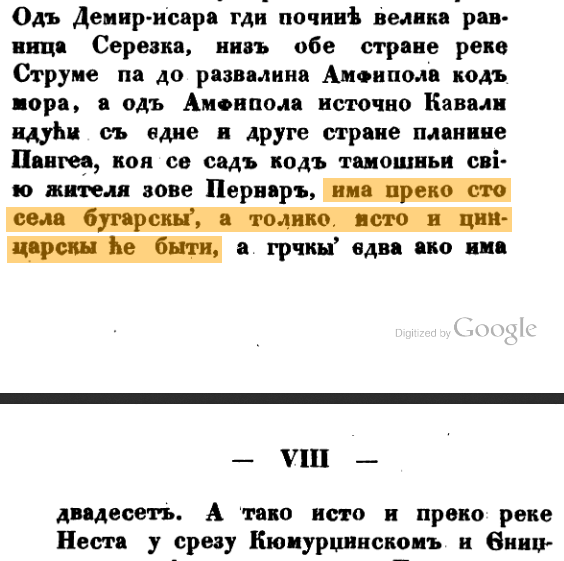
“… on both sides of the river Struma, all the way to the ruins of Amphipolis, and from Amphipolis eastward to Kavala going from either side of the Pangaion mountain range … there are over one hundred Bulgarian villages and as many Aromanian-Vlach villages, but there are barely twenty Greek ones, if at all.”

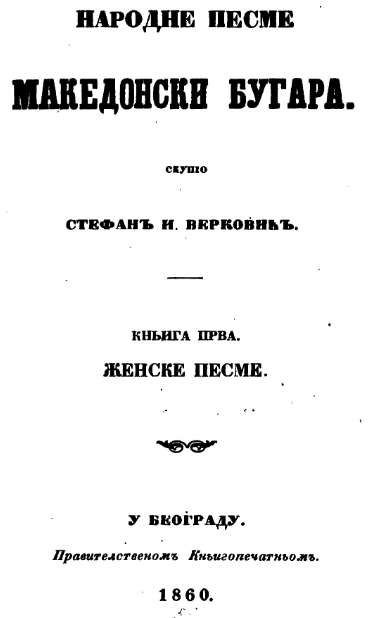
Stefan or Stjepan Ilija Verković, 1860: "Folk songs of the Macedonian Bulgarians".

The territory delineated above had roughly one hundred Aromanian-Vlach villages in 1860. Verković described the Slavophone villages as Bulgarian - but interestingly, they did not outnumber the Vlach villages by a significant factor. In fact, his wording is rather clear -- "there are over one hundred Bulgarian villages and as many Aromanian-Vlach villages".

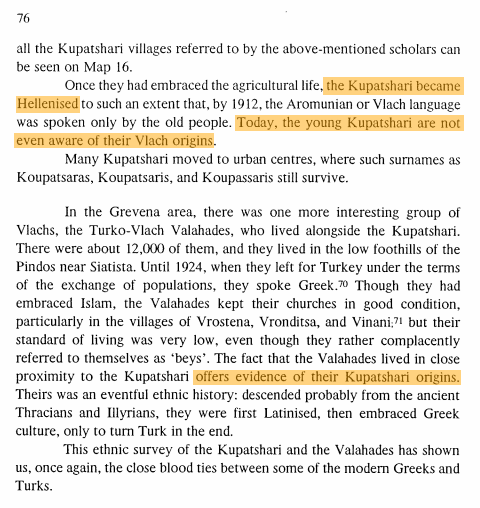
Can you name any Vlach villages today in this area? Do you know anything about it at all, and what happened to them? Did they evaporate into thin air, or did they become Modern Greeks? Is it likely that many of the residents today are not even aware of their origins - like the Kupatshari?

 
Last edited:
About the Vlachs of Serres District this is very detailed (230 pages) and available. List of Vlach villages and settlements (pure Vlach or mixed) after page 58.

http://users.uowm.gr/kdinas/wp-content/uploads/2008/01/%CE%9F%CE%B9-%CE%92%CE%BB%CE%AC%CF%87%CE%BF%CE%B9-%CF%84%CE%BF%CF%85-%CE%BD%CE%BF%CE%BC%CE%BF%CF%8D-%CE%A3%CE%B5%CF%81%CF%81%CF%8E%CE%BD.pdf

It's possible that your Bulgarian author covers also parts of Kavala district, (where my grandmother comes from), so I'm interested. Does he provide any names?
 
That research from 1860 is interesting. Unfortunately half a century later, the Christian villages around Kavala shifted completely to the Greek language, but those villages that had converted to Islam were still speaking Macedonian. What does this mean? The church was a major player in Hellenizing the Christian population and encouraging the Greek language.
 
Not sure what you're saying. Here's a map from Lithoxoou, refering to 1900 I guess. You can see details if you zoom in.

macedonia_1.jpg
 
Not sure what you're saying. Here's a map from Lithoxoou, refering to 1900 I guess. You can see details if you zoom in.

macedonia_1.jpg

That map agrees with what I'm saying. Look at the Kavala region. The Macedonian language survived only in Muslim villages because the Christian villages replaced their language with Greek.
 
Vasil Kanchov. Macedonia — ethnography and statistics Sofia, 1900, p. 90.

In Bulgarian:
Цѣлиятъ Горни Дебъръ е заплашенъ отъ поарнаутчанье. Българо-мухамеданскитѣ села, които допиратъ до арнаутски села, сѫ вече двуезични. Торбешитѣ смѣтатъ за гордость да се прѣдставятъ за арнаути. Жителитѣ на селата Острени, Търново, Кленье, Летенъ, Джепища, Ѫрбеле, Обоки, Макелари и др. прѣдпочитатъ да се казватъ арнаути и да говорятъ арнаутски. Торбешитѣ отъ с. Рàица, най-южно отъ подримскитѣ потурчени села, говорятъ повечето арнаутски и се броятъ вече като арнаути. Отъ друга страна християнското българско население се изселва много бързо отъ мѣстноститѣ Голо Бърдо, Пòле и Жупа. Отъ Голо Бърдо бѣгатъ главно въ гр. Дебъръ и въ Солунъ. Селата Вичища, Голейща и Писанки сѫ били въ началото на XIX. вѣкъ български, прѣди 30 години били наполовинъ български, а сега сѫ заселени отъ арнаути. Само въ Писанки сѫ останали още 3 български кѫщи.

In English:
All Upper Debar is threatened by Albanization. The Bulgarian-Muslim villages, which are near the Albanian villages, are already bilingual. The Torbeshi are proud to consider themselves as Albanians. The inhabitants of the villages Ostreni, Trnovo, Klenje, Leten, Dzhepishta, Erbele, Oboki, Makelari and others prefer to be called Albanians and to speak Albanian. The Torbesh village of Rajtsa, most southerly of the Islamicized villages of Lower Drim, speaks mostly Albanian and is already considered as an Albanian village. On the other hand, the Christian Bulgarian population is being expelled very quickly from the northeastern cities of Golo Brdo, Pòle and Zhupa. From Golo Brdo people mainly flee to Debar and Solun. The villages of Vichishta, Goleishta and Pisanki were at the beginning of the 19th century Bulgarian villages, 30 years ago they were half Bulgarian, and today they are settled by Albanians. There are only three Bulgarian houses left in Pisanki.
 
Amphipolis what percentage did Asia Minor Greek Christians formed after they settled in Macedonia?
 
Last edited:
Back
Top