• Welcome to the new Macedonian Truth Forum. All posts, members and private messages have been moved over from the old forum.

    Passwords from the old forum could not be carried over, so please use Forgot your password? to set a new one. The reset link is emailed to the address on your account.

  • Rules and Regulations at the forum of the Macedonian Truth Organisation (MTO)

    (1) The national-ethnic and cultural-linguistic identity of the Macedonian people is historically Macedonian, and derives its character from the native, indigenous and geographic homeland of the Macedonians, which is called Macedonia. To ensure that their human rights, integrity and heritage are appropriately respected, the only nouns and adjectives acceptable when reference is made to the above character and identity markers is Macedon, Macedonia, Macedonian and Macedonians.

    (2) The nation-state of the Macedonian people is the Republic of Macedonia, and is to be referred to by this official title so long as the 'republic' prefix is consistently applied to other states. Alternative references are the Macedonian Republic, or simply, Macedonia.

    (3) The 'ethnic' prefix is only acceptable for Macedonians in cases where differentiation is specifically required - so long as it is in context and consistent where it concerns its application to other ethnic groups.

    (4) Should any other differentiation be specifically required, the names of other ethnic groups that reside with Macedonians in either the Republic of Macedonia or the occupied Macedonian regions in Greece, Bulgaria, Serbia or Albania, are to be given a prefix.

    (5) Negating the identity, language and culture of the Macedonian people by deliberate avoidance of the terms Macedonia, Macedonian and Macedonians, or by any other means, is not permitted.

    (6) Systematic anti-Macedonian propaganda and rhetoric are not permitted.

    (7) Threads irrelevant to the Macedonian Cause, the community at the Macedonian Truth Organisation or the Macedonians in general may be considered as spam or not in the spirit of the forum. In such cases they are not permitted.

    (8) Continual posting of messages in threads with the sole purpose of deviating from the initial topics with the use of unrelated and unnecessary information is not permitted.

    (9) All posts, external articles, reports, etc that are cited in languages other than Macedonian or English, must be accompanied with a translation in one or both of the said languages.

    (10) Despite the possibility of some conversations and debates becoming heated, extreme abuse and/or racism, vulgar language and/or terminology, threats, revelation of personal information about others, harassment, and other such behavior will not be permitted. If deemed necessary all relevant information including member details will be reported to the appropriate authorities for investigation which may result in legal action.

    (11) Threads that are created must have a summary of a topic or excerpt of an article found in pertinent link(s) that have been included. One line threads will be considered unaccetable spam and are therefore not permitted.

    (12) Compulsive and deliberate lies, irrespective of the topic, are not permitted.

    (13) Any symbols or avatars found to be perceived as offensive to Macedonians are not permitted.

    (13) Any explicit or extreme material is not permitted.

    Failure to adhere to the above rules and regulations will result in a ban after 3 breaches. This may be reconsidered in some cases should the circumstances be of an unorthodox nature and/or require special consideration. To assure an effective deterrent against an individual or individuals with the sole purpose of causing dissent through spamming, racism or other improper means, the above rules will be strictly enforced.

    The MTO administration will monitor all discussions as reasonably practical and reserve the right to remove any post and/or member from the forum, and update the rules and regulations as required. Members are encouraged to immediately report any post and/or member to the MTO administration if they feel that these rules have not been abided by.

    The views expressed on this forum are those of the individuals. The only official representation of the MTO is made by the "Macedonian Truth Organisation (Site Owner)" username, and no other.

  • Macedonian Cause

    The Macedonian Truth Organisation calls on God in Heaven to protect, bless and guide the endeavour it is committing to undertake, and that is to work towards:

    Securing Macedonia as a free, independent and democratic republic in which sovereignty lies with the Macedonian citizens; as the nation-state of the Macedonian people in which they can preserve their culture, language and identity; as a state in which the Macedonian language and culture form the basis of public life and act as important unifying elements of Macedonian society; as the home of all its citizens to which it guarantees and obliges their inalienable natural rights and corresponding responsibilities;

    The acknowledgment as self-evident and irrefutable the existence of the:

    1) Indigenous, ethnonational name of Macedonia;
    2) Macedonian people, language and identity;
    3) Macedonian culture, symbols and folklore;
    4) Macedonian ancestry, heritage and history in its entirety; and
    5) Macedonian Orthodox Church;

    Securing recognition by the International Community of the tragedies endured by the Macedonian people, of the division of Macedonia with the signing of the Treaty of Bucharest on August 10, 1913, and the genocide committed against the Macedonian people at the hands of the Greek, Bulgarian and Serbian states and their respective churches during the 19th and 20th centuries;

    Ensuring that the Interim Accord is declared ‘null and void’ and that all constitutional provisions, acts, commitments, agreements, legislation, regulations, policies or programs emanating from, supporting or consequential to the Interim Accord are also declared ‘null and void’, including the use of any symbols and the completion of any acts imposed by, or originating from, the Interim Accord.

    Ensuring that the Framework Agreement is abolished and that all constitutional provisions, acts, commitments, agreements, legislation, regulations, policies and programs emanating from, supporting or consequential to the Framework Agreement are also abolished and replaced by a framework of constitutional and statutory law based on inalienable natural rights and corresponding responsibilities and universally codified human rights mechanisms.

    Securing the abolishment of any existing constitutional provisions, acts, agreements, legislation, regulations, policies and programs that discriminate against the Macedonian people, in any international organisation or any of the countries of the International Community where such constitutional provisions, acts, agreements, legislation, regulations, policies and programs exist, and thereby ensuring the freedom for Macedonians to exercise their inalienable natural rights and fulfil their corresponding responsibilities, and practice their culture, language and religious faiths in all the countries of the International Community without hindrance;

    The empowerment of Macedonians to undertake a moral revolution and to instil and/or reinvigorate within themselves a deep-rooted national, cultural, linguistic and historical dignity and a commitment to the exercise of freedom based on inalienable natural rights and corresponding responsibilities;

    The recognition of the Macedonian minorities in the neighbouring states of Macedonia as well as the respect for the inalienable rights and freedoms of the Macedonian minorities, as provided for by natural law and as codified by the United Nations Charter, the Universal Declaration of Human Rights and other universally codified human rights mechanisms;

    The full and unreserved respect of, and the support for, the rights of all people of non-Macedonian descent living in Macedonia and around the world, who share a reciprocal full and unreserved respect for the Macedonian people, their homeland and their state;

    The cultural unification and solidarity of the Macedonian people living in all parts of historical Macedonia and adjacent territories, as well as Macedonians throughout the world;

    The unity of all Macedonians on the principles, objectives and achievement of the Macedonian cause as defined by this declaration.

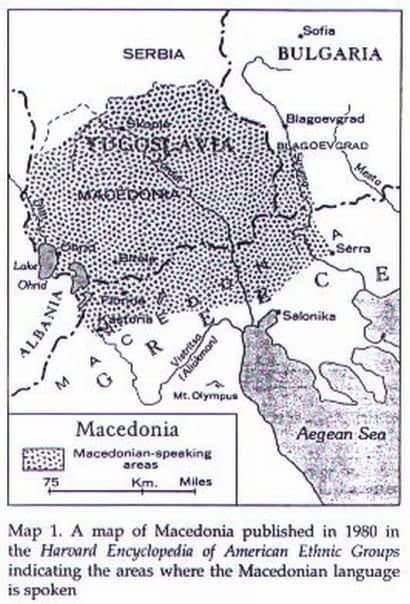
Population of Macedonia and Adjacent Areas

Any disagreement about the 300,000 Greeks of Macedonia? :tank:

I'll give you just one example. The village of Bogatsko in the Kostur region. By 1904 it was completely Greek speaking. But in the 1700s the village spoke Macedonian. How many of these 300,000 Greek speakers of 1904 spoke a different language in the 1700s?
 
Any evidence?

This book was written based on the dialects spoken in that village.

un-lexique-macedonien-du-xvi-siecle-p00.png


That was just one example, not limited to that one village. So how many of those 300,000 Greek speakers in 1904 came from families who weren't speaking Greek just a couple centuries earlier?
 
Niko, if you have read the book that you are showing, what was the proportion of the population of Greeks and Macedonians (Slavic) on Macedonia (Aegean only) based on your assumption?
 
Last edited:
Niko, if you have read the book that you are showing, what was proportion the population of Greeks and Macedonians (Slavic) on Macedonia (Aegean only) based on your assumption?

I am not assuming anything. I am only showing you facts. I am not disputing the number of 300,000 Greek speakers in Macedonia in 1904. I am only disputing the "Greekness" of those 300,000 Greek speakers. Those 300,000 Greek speakers were largely the product of Hellenization efforts from the Greek church, and later Greek sponsored schools, from roughly the year 1750. A better question to ask would be how many of those 300,000 Greek speakers had grandparents who spoke Greek? 50,000? I don't know the answer, I only know it's a lot less than 300,000.
 
Any disagreement about the 300,000 Greeks of Macedonia? :tank:

That is out of the population which are followers of the Greek Church, so it makes sense that Greek speakers were the plurality of that group, especially by the year 1904. Although, Greek speakers were far from being the plurality when considering all of Aegean Macedonia's inhabitants around that time.
 
There were Serbs in Serbia calling themselves Greek due to church persuasions. I am not buying any of this bullshit. Niko had the right idea, see what the grandparents were speaking. Same applies today. Fake country, fake news. covevf
 
I have no desire or benefit to defend Greek interests but if you want to prove a Slavic majority in Macedonia (in 17th/18th century) you should do it with backing historical data.
 
Last edited:
I stand by my earlier assertion that: Human memory and/or traditions (oral traditions, interviews) have been proven to be weak/poor proofs or evidence of anything.

Nothing, I repeat nothing, that has been presented in previous pages as 'proofs' - are actually proofs, nor do they prove anything.

I repeat.

In the late 19th century there were recorded over 100 (one hundred) Vlach villages in an extensive district within Macedonia as per Stefan or Stjepan Ilija Verković - as recorded in 1860. These villages no longer exist, and most of them (rapidly) Self-Hellenized - not just in language but in identity it seems. This affirms and proves my point that human memory/traditions are weak proofs -- because not even Amphipolis, who comes from near the area, remembers this - and this was written in 1860. More importantly, he mocked my Carlin-type sources.

Here are the two relevant quotes again. So I ask again, how are they explained away? Ad hominem attacks of the authors themselves, and not accepting certain facts/testimonies is not acceptable.

1) “… on both sides of the river Struma, all the way to the ruins of Amphipolis, and from Amphipolis eastward to Kavala going from either side of the Pangaion mountain range … there are over one hundred Bulgarian villages and as many Aromanian-Vlach villages, but there are barely twenty Greek ones, if at all.”

Stefan or Stjepan Ilija Verković, 1860: "Folk songs of the Macedonian Bulgarians".

2) “Vlach villages of Thessaloniki and Chalkidiki areas abandoned their Vlach language during the 18th century and 19th century. Similarly, Vlach villages of the mountain ranges/districts of Kavala, Drama and Serres also abandoned their Vlach language.”

ΟΙ ΕΛΛΗΝΟΒΛΑΧΟΙ (ΑΡΜΑΝΟΙ) (ΠΡΩΤΟΣ ΤΟΜΟΣ), ΕΞΑΡΧΟΣ ΓΙΩΡΓΗΣ.
 
URL:
https://books.google.ca/books?id=01...onepage&q=armenians settled macedonia&f=false

The Bogomils: A Study in Balkan Neo-Manichaeism, Dimitri Obolensky.

Page 147:

"Together with Thrace, Macedonia was likewise laid open in the late tenth century to penetration by a new wave of Eastern immigrants. In 988-9, according to the Armenian historian Asoghic, the Emperor Basil II transported a large number of Armenians into Macedonia and settled them on the borders of the Empire, to guard against Bulgarian attacks; the colonists, however, dissatisfied with the rule of their Byzantine masters, rebelled and passed over to the Bulgarians."
 
I stand by my earlier assertion that: Human memory and/or traditions (oral traditions, interviews) have been proven to be weak/poor proofs or evidence of anything.

Nothing, I repeat nothing, that has been presented in previous pages as 'proofs' - are actually proofs, nor do they prove anything.

I repeat.

In the late 19th century there were recorded over 100 (one hundred) Vlach villages in an extensive district within Macedonia as per Stefan or Stjepan Ilija Verković - as recorded in 1860. These villages no longer exist, and most of them (rapidly) Self-Hellenized - not just in language but in identity it seems. This affirms and proves my point that human memory/traditions are weak proofs -- because not even Amphipolis, who comes from near the area, remembers this - and this was written in 1860. More importantly, he mocked my Carlin-type sources.

Here are the two relevant quotes again. So I ask again, how are they explained away? Ad hominem attacks of the authors themselves, and not accepting certain facts/testimonies is not acceptable.

1) “… on both sides of the river Struma, all the way to the ruins of Amphipolis, and from Amphipolis eastward to Kavala going from either side of the Pangaion mountain range … there are over one hundred Bulgarian villages and as many Aromanian-Vlach villages, but there are barely twenty Greek ones, if at all.”

Stefan or Stjepan Ilija Verković, 1860: "Folk songs of the Macedonian Bulgarians".

2) “Vlach villages of Thessaloniki and Chalkidiki areas abandoned their Vlach language during the 18th century and 19th century. Similarly, Vlach villages of the mountain ranges/districts of Kavala, Drama and Serres also abandoned their Vlach language.”

ΟΙ ΕΛΛΗΝΟΒΛΑΧΟΙ (ΑΡΜΑΝΟΙ) (ΠΡΩΤΟΣ ΤΟΜΟΣ), ΕΞΑΡΧΟΣ ΓΙΩΡΓΗΣ.

Well, no offence but the first blue statement doesn't sound like a "recording" but at least it's a statement from 1860s. It doesn't seem close to possible since the maps I provided and the Bulgarian statistics we have are from 1900 (40 years later) and I'm sure there are more sources for Serres-Drama-Kavala region in between (e.g. from Vlach-Romanian propaganda).

On the contrary Exarchos is not a source because he doesn't even bother to provide any argument. He just says "Bouf was a Vlach village. The end". What is the value of such statements?
 
The maps and Bulgarian statistics are no more reliable or believable than the Verković's quote itself. Besides, as you have yourself admitted they come no less than 40 years after Verković made that statement.

Are the following historical testimonies also dismissed as impossible?

1) Anonymi Descriptio Europae orientalis. Imperium Constantinopolitanum, Albania, Serbia, Bulgaria, Ruthenia, Ungaria, Polonia, Bohemia. Anno MCCCVIII exarata. Cracoviae, 1916: As per the anonymous traveler of Eastern Europe from the XIV century, it is stated that Vlachs (whom the author calls "Blasi"), are a numerous people living between Macedonia, Achaia and Salonika.

2) Johann Thunmann, Untersuchungen uber die Geschichte der ostlichen europaischen Volker, I. Leipzig, 1774: The author states that Vlachs represent half the population of Thrace, and three quarters of inhabitants of Thessaly and Macedonia.

===================================================================================================

Somewhat unrelated to above.

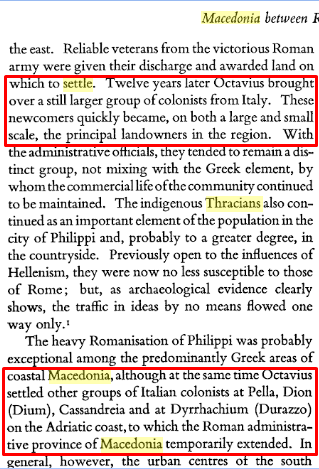
3) Romans settled large groups of Italians throughout Macedonia.


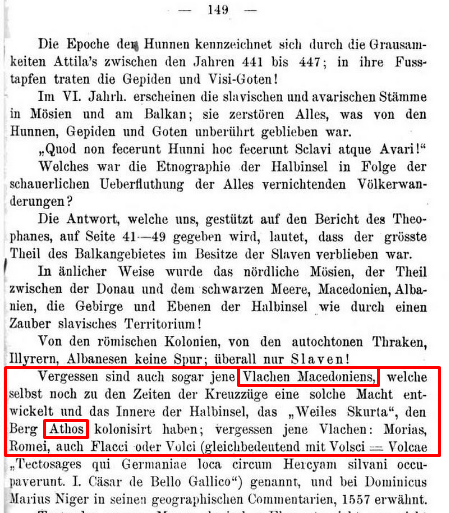
4) From 1885, Vasile Maniu.

"Forgotten are even those Vlachs of Macedonia, who even in the times of the Crusades had such a power and colonized the interior of the peninsula, the "Weiles Skurta", on Mount Athos, these Vlachs are all forgotten: Morias, Romei, also Flacci or Volci..."


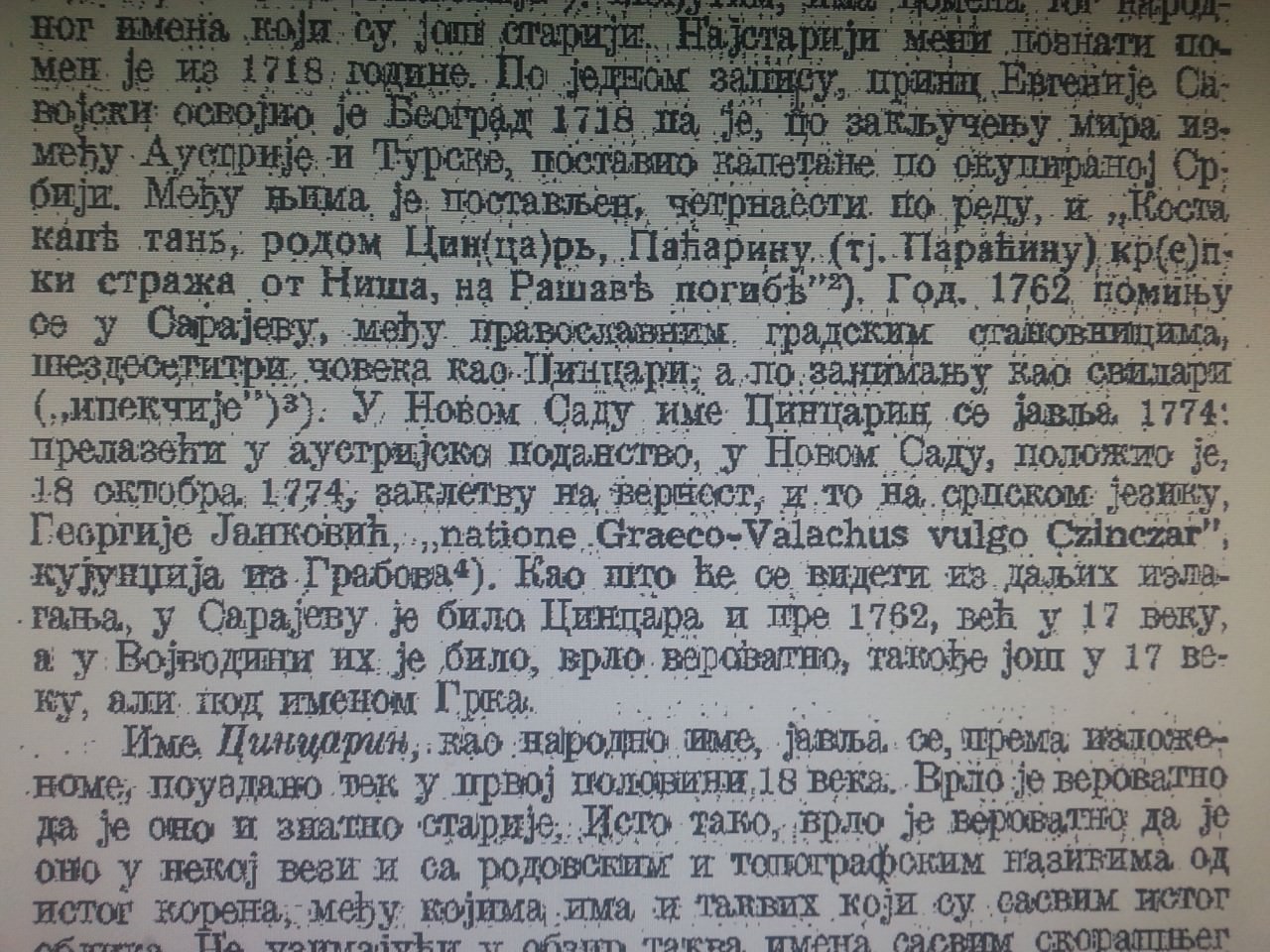
5) The following comes from Миленко Филиповић (Milenko Filipovic), from the book called Цинцари у Босни (Cincari/Aromanians in Bosnia).

- "natione Graeco-Valachus vulgo Czinczar"
- In Vojvodina "in the 17th century, (known) under the name of the Greeks"


In the same book, on page 74 M. Filipovic talks about the origin of the family Bokaris or Botsarić of Bosnia (which is very similar if not the same as Botsaris):

"Kao sto sam ranije izneo, u Banjoj Luci je moglo biti Cincara vec u pocetku druge polovine 18 veka. Po mom licnom saznanju, u Banjoj Luci su bili cincarskog porekla Zite, koji su izumrli u muskoj lozi. Bili su dosli od Korce, a tek ovde primili slavu sv. Djordja. Cincarskog porekla su i Petrušići ("Petrusi"), ciji je predak drzao han na Sitnici kod Banja Luke. Slusao sam da je nekada u Banjoj Luci ziveo i neki Cincarin koji je pravio ikone. Taj ikonopisac mogao bi biti, kako me je obavestio Đoko Mazalić, poznati slikar i istoricar umetnosti na tlu Bosne i Hercegovine, Atanasije Bokaris, docnije Bocarić, ciji je bio sin ili brat i poznati srpski slikar Špiro Bocarić. Bocarići su bili poreklom iz Makedonije ili Soluna: Atanasije je ucio slikanje u Solunu."

Translation:
"As I mentioned earlier, in Banja Luka, there could have been Aromanians already at the beginning of the second half of the 18th century. According to my personal knowledge, in Banja Luka Zita family were of Aromanian stock, which are extinct on paternal side. They came from Korcha (Albania), and only here they received or adopted the "slava" of St. George. Of Aromanian origin are the Petrusici ('Petrusi'), whose ancestor kept the inn on Sitnica near Banja Luka. I have heard that in Banja Luka, there lived some Aromanian, who made icons. This icon painter could have been, as Djoko Mazalić informed me, a famous painter and art historian in Bosnia and Herzegovina, Atanasije Bokaris, later Botsarić, whose son was (or brother) the famous Serbian painter Špiro Botsarić. The Botsarić family were originally from Macedonia or Solun: Atanasije studied painting in Solun."

(It is very likely that Atan. Bokaris was a Greek-speaker.)
 
Last edited:
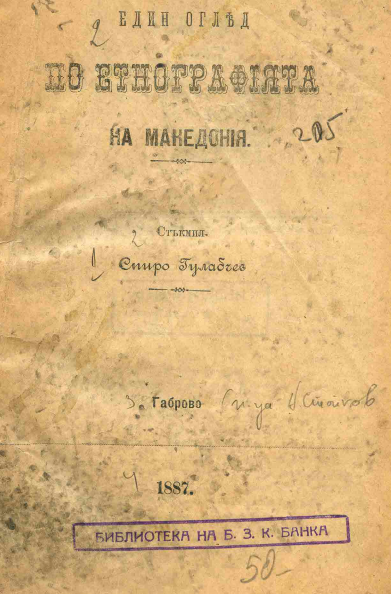
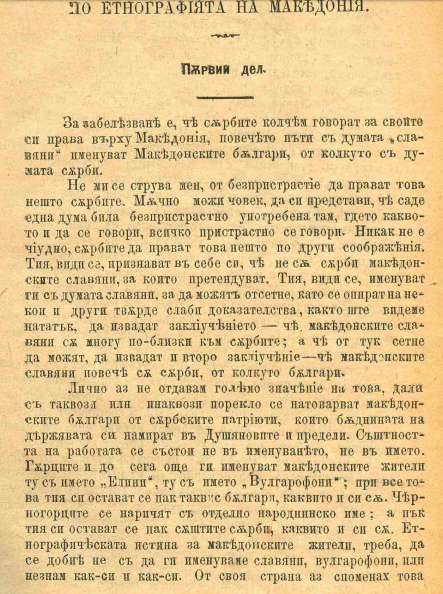
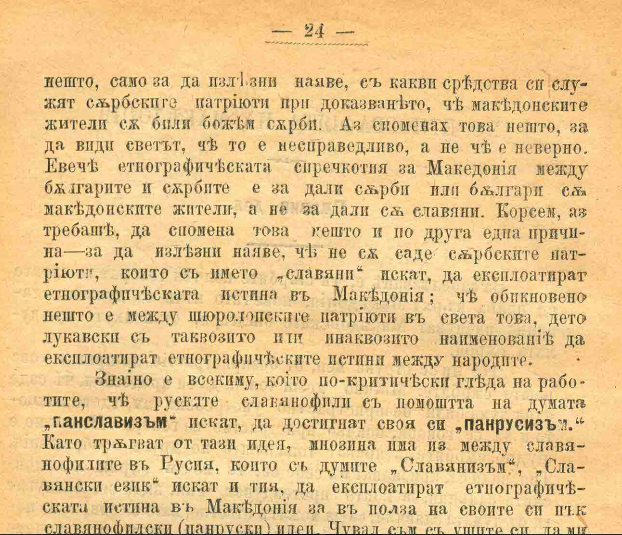
Спиро Гулабчев од Лерин -- "Един оглед по етнографията на Македония", Габрово 1887 година.


Спиро Гулабчев од Лерин -- "Един оглед по етнографията на Македония", Габрово 1887 година.


If you're trying to make a point can you please underline the relevant text that relates to your point and provide an English translation.
 
2) Johann Thunmann, Untersuchungen uber die Geschichte der ostlichen europaischen Volker, I. Leipzig, 1774: The author states that Vlachs represent half the population of Thrace, and three quarters of inhabitants of Thessaly and Macedonia.

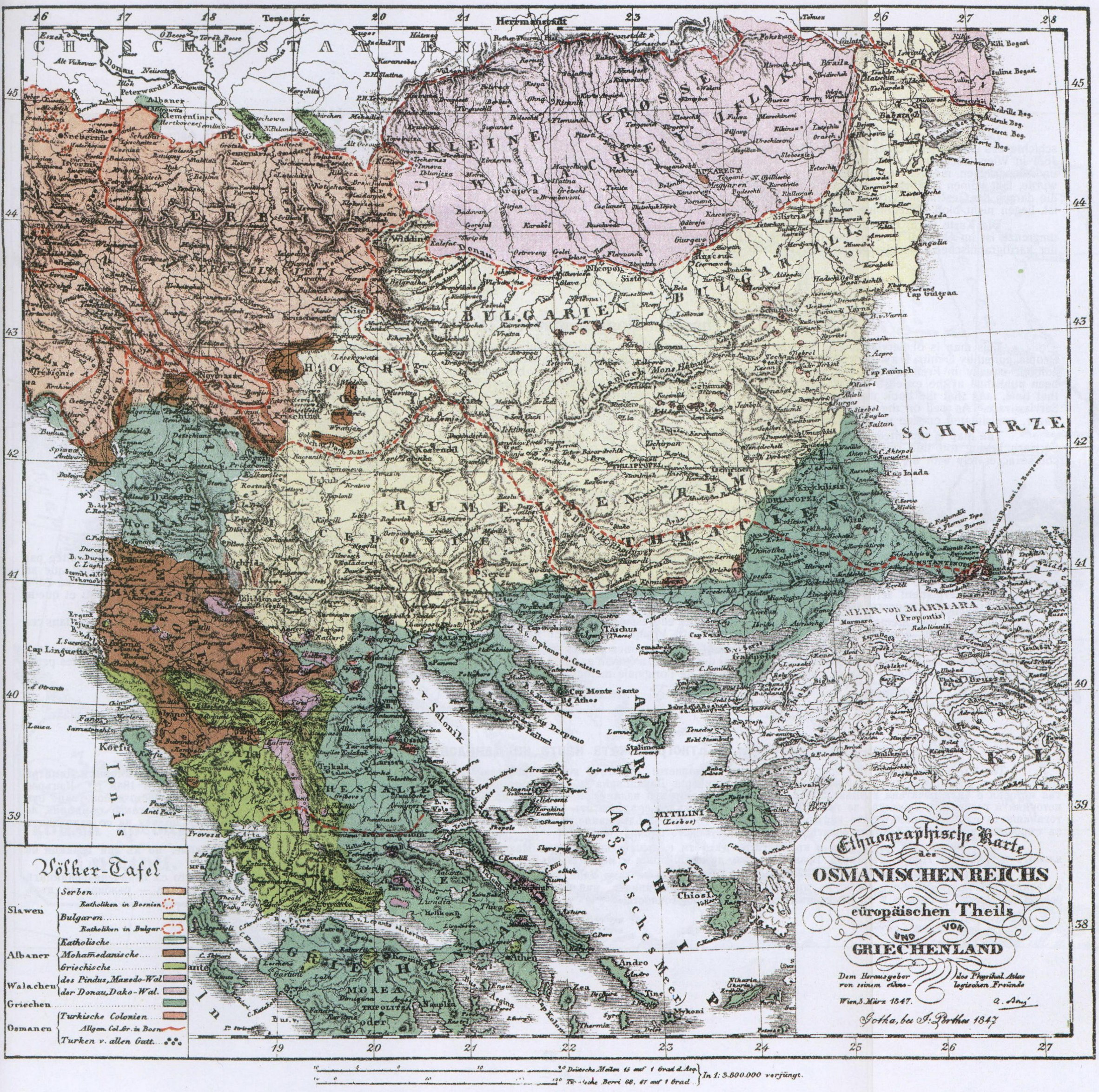
Vlachs being 75% of Macedonia/Thessaly and 50% of Thrace is also out of question (they were certainly <5% and <1% respectively). Turks claimed they were 50+0,001% themselves. Here's one of the oldest maps (a french map from 1847)

Ethnographic_map_Ami_Bou%C3%A9%2C_1847.jpg
 
''In the broadest sense, both Greek and Western sources of the later Middle Ages—like the French, Italian, and Aragonese versions of the Chronicle of the Morea, or the chroniclers Ramon Muntaner and Marino Sanudo Torsello—used "Vlachia" or similar names (Blaquie, Blaquia, Val[l]achia) to refer to all of Thessaly, from the Pindus mountains in the west to the Aegean Sea in the east, and from the area of Mount Olympus and Servia in the north to the towns of Zetouni (Lamia) and Neopatras (Ypati) in the south.''

https://en.wikipedia.org/wiki/Great_Vlachia

Olympus was inhabited by Vlachs.

mount-olympus-greece.jpg
 
Back
Top