• Welcome to the new Macedonian Truth Forum. All posts, members and private messages have been moved over from the old forum.

    Passwords from the old forum could not be carried over, so please use Forgot your password? to set a new one. The reset link is emailed to the address on your account.

  • Rules and Regulations at the forum of the Macedonian Truth Organisation (MTO)

    (1) The national-ethnic and cultural-linguistic identity of the Macedonian people is historically Macedonian, and derives its character from the native, indigenous and geographic homeland of the Macedonians, which is called Macedonia. To ensure that their human rights, integrity and heritage are appropriately respected, the only nouns and adjectives acceptable when reference is made to the above character and identity markers is Macedon, Macedonia, Macedonian and Macedonians.

    (2) The nation-state of the Macedonian people is the Republic of Macedonia, and is to be referred to by this official title so long as the 'republic' prefix is consistently applied to other states. Alternative references are the Macedonian Republic, or simply, Macedonia.

    (3) The 'ethnic' prefix is only acceptable for Macedonians in cases where differentiation is specifically required - so long as it is in context and consistent where it concerns its application to other ethnic groups.

    (4) Should any other differentiation be specifically required, the names of other ethnic groups that reside with Macedonians in either the Republic of Macedonia or the occupied Macedonian regions in Greece, Bulgaria, Serbia or Albania, are to be given a prefix.

    (5) Negating the identity, language and culture of the Macedonian people by deliberate avoidance of the terms Macedonia, Macedonian and Macedonians, or by any other means, is not permitted.

    (6) Systematic anti-Macedonian propaganda and rhetoric are not permitted.

    (7) Threads irrelevant to the Macedonian Cause, the community at the Macedonian Truth Organisation or the Macedonians in general may be considered as spam or not in the spirit of the forum. In such cases they are not permitted.

    (8) Continual posting of messages in threads with the sole purpose of deviating from the initial topics with the use of unrelated and unnecessary information is not permitted.

    (9) All posts, external articles, reports, etc that are cited in languages other than Macedonian or English, must be accompanied with a translation in one or both of the said languages.

    (10) Despite the possibility of some conversations and debates becoming heated, extreme abuse and/or racism, vulgar language and/or terminology, threats, revelation of personal information about others, harassment, and other such behavior will not be permitted. If deemed necessary all relevant information including member details will be reported to the appropriate authorities for investigation which may result in legal action.

    (11) Threads that are created must have a summary of a topic or excerpt of an article found in pertinent link(s) that have been included. One line threads will be considered unaccetable spam and are therefore not permitted.

    (12) Compulsive and deliberate lies, irrespective of the topic, are not permitted.

    (13) Any symbols or avatars found to be perceived as offensive to Macedonians are not permitted.

    (13) Any explicit or extreme material is not permitted.

    Failure to adhere to the above rules and regulations will result in a ban after 3 breaches. This may be reconsidered in some cases should the circumstances be of an unorthodox nature and/or require special consideration. To assure an effective deterrent against an individual or individuals with the sole purpose of causing dissent through spamming, racism or other improper means, the above rules will be strictly enforced.

    The MTO administration will monitor all discussions as reasonably practical and reserve the right to remove any post and/or member from the forum, and update the rules and regulations as required. Members are encouraged to immediately report any post and/or member to the MTO administration if they feel that these rules have not been abided by.

    The views expressed on this forum are those of the individuals. The only official representation of the MTO is made by the "Macedonian Truth Organisation (Site Owner)" username, and no other.

  • Macedonian Cause

    The Macedonian Truth Organisation calls on God in Heaven to protect, bless and guide the endeavour it is committing to undertake, and that is to work towards:

    Securing Macedonia as a free, independent and democratic republic in which sovereignty lies with the Macedonian citizens; as the nation-state of the Macedonian people in which they can preserve their culture, language and identity; as a state in which the Macedonian language and culture form the basis of public life and act as important unifying elements of Macedonian society; as the home of all its citizens to which it guarantees and obliges their inalienable natural rights and corresponding responsibilities;

    The acknowledgment as self-evident and irrefutable the existence of the:

    1) Indigenous, ethnonational name of Macedonia;
    2) Macedonian people, language and identity;
    3) Macedonian culture, symbols and folklore;
    4) Macedonian ancestry, heritage and history in its entirety; and
    5) Macedonian Orthodox Church;

    Securing recognition by the International Community of the tragedies endured by the Macedonian people, of the division of Macedonia with the signing of the Treaty of Bucharest on August 10, 1913, and the genocide committed against the Macedonian people at the hands of the Greek, Bulgarian and Serbian states and their respective churches during the 19th and 20th centuries;

    Ensuring that the Interim Accord is declared ‘null and void’ and that all constitutional provisions, acts, commitments, agreements, legislation, regulations, policies or programs emanating from, supporting or consequential to the Interim Accord are also declared ‘null and void’, including the use of any symbols and the completion of any acts imposed by, or originating from, the Interim Accord.

    Ensuring that the Framework Agreement is abolished and that all constitutional provisions, acts, commitments, agreements, legislation, regulations, policies and programs emanating from, supporting or consequential to the Framework Agreement are also abolished and replaced by a framework of constitutional and statutory law based on inalienable natural rights and corresponding responsibilities and universally codified human rights mechanisms.

    Securing the abolishment of any existing constitutional provisions, acts, agreements, legislation, regulations, policies and programs that discriminate against the Macedonian people, in any international organisation or any of the countries of the International Community where such constitutional provisions, acts, agreements, legislation, regulations, policies and programs exist, and thereby ensuring the freedom for Macedonians to exercise their inalienable natural rights and fulfil their corresponding responsibilities, and practice their culture, language and religious faiths in all the countries of the International Community without hindrance;

    The empowerment of Macedonians to undertake a moral revolution and to instil and/or reinvigorate within themselves a deep-rooted national, cultural, linguistic and historical dignity and a commitment to the exercise of freedom based on inalienable natural rights and corresponding responsibilities;

    The recognition of the Macedonian minorities in the neighbouring states of Macedonia as well as the respect for the inalienable rights and freedoms of the Macedonian minorities, as provided for by natural law and as codified by the United Nations Charter, the Universal Declaration of Human Rights and other universally codified human rights mechanisms;

    The full and unreserved respect of, and the support for, the rights of all people of non-Macedonian descent living in Macedonia and around the world, who share a reciprocal full and unreserved respect for the Macedonian people, their homeland and their state;

    The cultural unification and solidarity of the Macedonian people living in all parts of historical Macedonia and adjacent territories, as well as Macedonians throughout the world;

    The unity of all Macedonians on the principles, objectives and achievement of the Macedonian cause as defined by this declaration.

Population of Macedonia and Adjacent Areas

Modern nationalism is a product of the late 18th century and something that did not fully develop until the long 19th, especially in the Balkans. I seriously doubt anyone from Macedonia in that regiment had the same sort of ethnic/national identity we posses today.
Would would be the difference between someone identifying as Macedonian back then, compared to today? I ask because I`ve always heard of this concept of modern nationalities not being able to be compared to another point in history but never quite fully understood it.
 
Would would be the difference between someone identifying as Macedonian back then, compared to today? I ask because I`ve always heard of this concept of modern nationalities not being able to be compared to another point in history but never quite fully understood it.

It's near impossible to say because identity differs from person to person, I would just say that generally speaking, Macedonians back then would have been unlikely to be as patriotic and nationalistic as we are now. I highlight doubt they would vigorously defend and promote their identity and highlight its uniqueness and differences to surrounding nationalities. This is a point in time where most inhabitants of the Ottoman Empire were identified solely by their religion, so whilst there is evidence of people in Macedonia identifying themselves as Macedonian, there were also others calling themselves Romans, Bulgarians, Slavs, Christians, etc. National identity wasn't a concept understood by the majority of the inhabitants at the time and because of such, it was very fluid and one person may have given 3 different answers to being questioned on their identity.
 
The following comes from the book "The Diary of the Armatol". In fact, it is a diary of the Vlach revolutionary and national activist Kola Nicha, written by the poet Kola Karatana (who is actually the real author of this text). These records cover the period from 1902 to 1907.

We read that a Greek band fell into an ambush set by a Vlach band and actually seized the Andart leader himself - Telos Agras. The Diary of Kola Nicha writes that Agras was put to the trial by the Vlach band. This took place at the beginning of the 20th century, i.e. several years before the start of the Balkan Wars. Vlach leader Muchitani (who was in the role of the investigator in this trial) interrogated Telos Argas.

Long story short, during the dialogue the following is stated by Muchitani in response to Agras, who was explaining the Greek plans on how to Hellenize Macedonia. Found it quite interesting, as it comes to us from just before the Balkan Wars.

Muchitani states:

"When did Macedonia ever belong to Greece? On the contrary. Macedonia was the conqueror of Greece ... We (the Vlachs) consider ourselves as descendants of Thracians mixed with the Romans... Moreover, modern Greeks themselves have very little in common with the ancient Greeks. For the most part, they are Hellenized Vlachs, Slavs and Albanians..."


Interesting stuff, can you provide the direct source?
 
1) While visiting the town of Kozani in 1880, British diplomat and historian Sir Ignatius Valentine Chirol, noted that “In the 900 houses of this city there are scarcely twenty where around the family fireside any other language is spoken than the old Latin-sounding Wallach. (Still) the prosperous townsfolk would be deeply hurt if any doubt were hinted as to the genuineness of their Hellenism”.

2) Vasile Diamandi wrote: “... In the last several centuries, we lost many settlements in Macedonia, such as Siatista, Kozani… and the surroundings of Grevena. All of these places had once been Romanian according to the words of travellers who visited them… ” (Diamandi, 1906).
 
Chrysanthus of Constantinople - Хрисант Цариградски, (25 February 1768 – 10 September 1834) was Ecumenical Patriarch of Constantinople during the period 1824-1826.

Роден во февруари 1768 г. во Долно Граматиково, Воденско. На 13 јули 1811 г. станал серски митрополит и членувал во друштвото „Филики етерија“. На 9 септември 1824 г. е избран за цариградски патријарх по симнувањето на неговиот претходник Антим III. На престолот останува две години, и потоа е симнат од османлиската власт.

https://mk.wikipedia.org/wiki/Хрисант_Цариградски
https://en.wikipedia.org/wiki/Chrysanthus_of_Constantinople
https://bg.wikipedia.org/wiki/Хрисант_I_Константинополски
 
URL:
http://www.historyofmacedonia.org/Macedoniansymbols/MacedonianLion.html

- When the Venetian captain Angiolello passed through Macedonia and on August 13, 1470 recorded his stay on the Holy Mountain, he wrote that "there are many Christian monks, some of whom are Greeks, others Macedonians, Vlachs, and there are even Italians and people from other nations." Four days later, while camping by the mouth of the Mesta River, he noted that "there live Greeks and Macedonians."

- In the 15th century, Bertrando de la Brokier traveled through the Balkans and left behind an account of his travels. Among other things, he writes "...and I remembered the heavy oppression of the Turk over the emperor in Constantinople and over all Greeks, Macedonians and Bulgarians, and even over the Despot of Rascia [Rashka, as he referred to Gjuragj Brankovich] and all his subjects, which is very unfortunate for the all of Christianity.... And there are many Christians who are forced to serve the Turk, like the Greeks, Bulgarians, Macedonians, Albanians, Esklavonians, Rascians and Serbians...".

15th century you say?...Surely this must be a forgery Carlin? There is no way Macedonians could have existed in 1470. If it's actually legit, then surely these were "regional" Macedonians and not ethnic ones. I refuse to accept that Macedonians existed prior to the late 19th century. Modern nations, as we know them, didn't come into existence until 19th century...Everyone knows that.

BTW Carlin, another great find. Nice work.
 
Thanks.

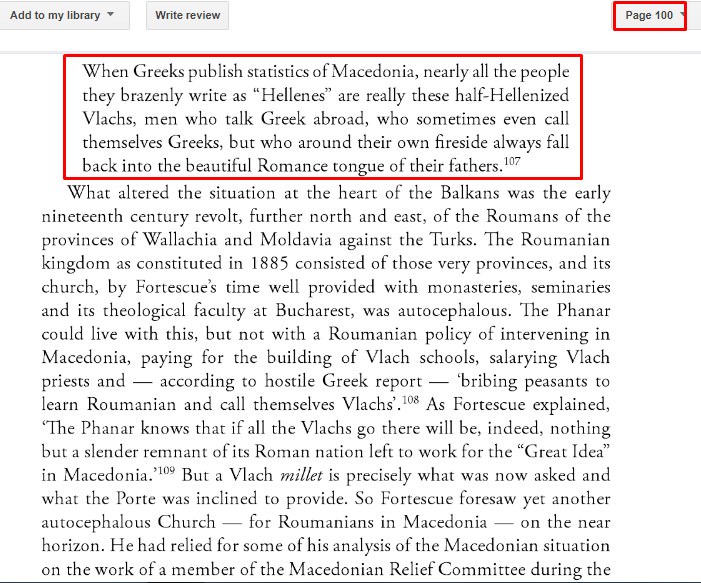
Nearly all of the native Hellenic population of Macedonia were simply Vlachs.

RqiRxoC.jpg

ZH63SFW.jpg


Quotes/testimonies such as these are NOT OPEN to interpretation. What's more... Regarding Macedonia we do know what and who the (small) remainder of the native Hellenes were -- and these were mainly Patriarchist Macedonians and Arvanites.
 
Last edited:
Thanks.

Nearly all of the native Hellenic population of Macedonia were simply Vlachs.

And Hellenized Macedonians. We know this because of 2 big reasons:

1. Villages south of Kostur that were completely Greek speaking by 1900 were documented as speaking Macedonian in the 17th century.

2. Villages around Kavala that had converted to Islam when the Ottomans arrived were documented as still speaking Macedonian by the 1900s. But those neighboring villages that kept their Christian faith were completely Greek speaking. What does this mean? At some point of time Christians in the Kavala region changed their language to Greek. Those that converted to Islam preserved their Macedonian language. Therefore the force of Hellenization had to come from the church.
 
Not sure if this was posted here before.

British map from 1916

ethnographical-map-central-and-south-eastern-europe.jpg

A great map which is often overlooked. Interesting it categorises Macedonians outside of the Slavic group, although that's not too surprising since it's a map based on ethnicity rather than linguistics.
 
And Hellenized Macedonians. We know this because of 2 big reasons:

1. Villages south of Kostur that were completely Greek speaking by 1900 were documented as speaking Macedonian in the 17th century.

2. Villages around Kavala that had converted to Islam when the Ottomans arrived were documented as still speaking Macedonian by the 1900s. But those neighboring villages that kept their Christian faith were completely Greek speaking. What does this mean? At some point of time Christians in the Kavala region changed their language to Greek. Those that converted to Islam preserved their Macedonian language. Therefore the force of Hellenization had to come from the church.
How many villages were speaking Macedonian during the 1700s that shifted to Greek and how large were those villages.
 
Last edited:
How many villages were speaking Macedonian during the 1700s that shifted to Greek and how large were those villages.

In the Kostur region, the documented example we have is the village of Bogatsko. It was documented as speaking Macedonian in the 1600s to 1700s. In 1913 it had a population of 2,693 and was completely Greek speaking. Information is not available on the other villages so we would have to count all the Greek speaking villages in the Kostur and Kozani regions and assume that most had suffered the same fate as this one (changed their language from Macedonian to Greek after the 1700s).
 
In the Kostur region, the documented example we have is the village of Bogatsko. It was documented as speaking Macedonian in the 1600s to 1700s. In 1913 it had a population of 2,693 and was completely Greek speaking. Information is not available on the other villages so we would have to count all the Greek speaking villages in the Kostur and Kozani regions and assume that most had suffered the same fate as this one (changed their language from Macedonian to Greek after the 1700s).

Can you cite quotes/information from 1700s/1600s about those villages being Macedonian? I know the source you showed but I wasn't able to find anything.

And maybe those villages were repopulated by Greek speakers during some times in history. I am not implying that you are lying it is just that I am open to all possibilities.

I don't know how those villages south of Kostur turned Greek, we don't have any sources on that. Your sources show it could have been repopulated by Vlachs.

We do have linguistic evidence that shows Macedonian was spoken there before that - You know my source is "Un lexique macédonien du XVIe siècle" by G. Giannelli and A. Vaillant.

I cannot find all the pages of this book online.

I did find a scholarly review of the book:
https://www.persee.fr/doc/rebyz_0766-5598_1959_num_17_1_1213_t1_0300_0000_1

It mentions that the author was a Greek, who with the help of a translator, collected words of the "average language" spoken "south-east" of Kostur, and that the people appeared to this Greek not as "peasants" but as "cultured Slavs".

...ces multiples notations ne sont pas l'oevre d'un specialiste, mais d'un curieux, un grec, qui, a l'aide d'un informateur, s'est complu a recueillir <<la langue moyenne>> d'une region (sud-est de Castoria) comme la parlaient, non les paysans, mais les slaves cultives....

...these multiple notations are not the work of a specialist, but of a curious, a Greek, who, with the help of an informant, has taken pleasure in collecting the "average language" of a region (south-east of Castoria) as spoken, not as peasants, but the cultured Slavs...

Bogatsko is south east of Kostur, and that village is mentioned in the book.
 
Last edited:
Back
Top