• Welcome to the new Macedonian Truth Forum. All posts, members and private messages have been moved over from the old forum.

    Passwords from the old forum could not be carried over, so please use Forgot your password? to set a new one. The reset link is emailed to the address on your account.

  • Rules and Regulations at the forum of the Macedonian Truth Organisation (MTO)

    (1) The national-ethnic and cultural-linguistic identity of the Macedonian people is historically Macedonian, and derives its character from the native, indigenous and geographic homeland of the Macedonians, which is called Macedonia. To ensure that their human rights, integrity and heritage are appropriately respected, the only nouns and adjectives acceptable when reference is made to the above character and identity markers is Macedon, Macedonia, Macedonian and Macedonians.

    (2) The nation-state of the Macedonian people is the Republic of Macedonia, and is to be referred to by this official title so long as the 'republic' prefix is consistently applied to other states. Alternative references are the Macedonian Republic, or simply, Macedonia.

    (3) The 'ethnic' prefix is only acceptable for Macedonians in cases where differentiation is specifically required - so long as it is in context and consistent where it concerns its application to other ethnic groups.

    (4) Should any other differentiation be specifically required, the names of other ethnic groups that reside with Macedonians in either the Republic of Macedonia or the occupied Macedonian regions in Greece, Bulgaria, Serbia or Albania, are to be given a prefix.

    (5) Negating the identity, language and culture of the Macedonian people by deliberate avoidance of the terms Macedonia, Macedonian and Macedonians, or by any other means, is not permitted.

    (6) Systematic anti-Macedonian propaganda and rhetoric are not permitted.

    (7) Threads irrelevant to the Macedonian Cause, the community at the Macedonian Truth Organisation or the Macedonians in general may be considered as spam or not in the spirit of the forum. In such cases they are not permitted.

    (8) Continual posting of messages in threads with the sole purpose of deviating from the initial topics with the use of unrelated and unnecessary information is not permitted.

    (9) All posts, external articles, reports, etc that are cited in languages other than Macedonian or English, must be accompanied with a translation in one or both of the said languages.

    (10) Despite the possibility of some conversations and debates becoming heated, extreme abuse and/or racism, vulgar language and/or terminology, threats, revelation of personal information about others, harassment, and other such behavior will not be permitted. If deemed necessary all relevant information including member details will be reported to the appropriate authorities for investigation which may result in legal action.

    (11) Threads that are created must have a summary of a topic or excerpt of an article found in pertinent link(s) that have been included. One line threads will be considered unaccetable spam and are therefore not permitted.

    (12) Compulsive and deliberate lies, irrespective of the topic, are not permitted.

    (13) Any symbols or avatars found to be perceived as offensive to Macedonians are not permitted.

    (13) Any explicit or extreme material is not permitted.

    Failure to adhere to the above rules and regulations will result in a ban after 3 breaches. This may be reconsidered in some cases should the circumstances be of an unorthodox nature and/or require special consideration. To assure an effective deterrent against an individual or individuals with the sole purpose of causing dissent through spamming, racism or other improper means, the above rules will be strictly enforced.

    The MTO administration will monitor all discussions as reasonably practical and reserve the right to remove any post and/or member from the forum, and update the rules and regulations as required. Members are encouraged to immediately report any post and/or member to the MTO administration if they feel that these rules have not been abided by.

    The views expressed on this forum are those of the individuals. The only official representation of the MTO is made by the "Macedonian Truth Organisation (Site Owner)" username, and no other.

  • Macedonian Cause

    The Macedonian Truth Organisation calls on God in Heaven to protect, bless and guide the endeavour it is committing to undertake, and that is to work towards:

    Securing Macedonia as a free, independent and democratic republic in which sovereignty lies with the Macedonian citizens; as the nation-state of the Macedonian people in which they can preserve their culture, language and identity; as a state in which the Macedonian language and culture form the basis of public life and act as important unifying elements of Macedonian society; as the home of all its citizens to which it guarantees and obliges their inalienable natural rights and corresponding responsibilities;

    The acknowledgment as self-evident and irrefutable the existence of the:

    1) Indigenous, ethnonational name of Macedonia;
    2) Macedonian people, language and identity;
    3) Macedonian culture, symbols and folklore;
    4) Macedonian ancestry, heritage and history in its entirety; and
    5) Macedonian Orthodox Church;

    Securing recognition by the International Community of the tragedies endured by the Macedonian people, of the division of Macedonia with the signing of the Treaty of Bucharest on August 10, 1913, and the genocide committed against the Macedonian people at the hands of the Greek, Bulgarian and Serbian states and their respective churches during the 19th and 20th centuries;

    Ensuring that the Interim Accord is declared ‘null and void’ and that all constitutional provisions, acts, commitments, agreements, legislation, regulations, policies or programs emanating from, supporting or consequential to the Interim Accord are also declared ‘null and void’, including the use of any symbols and the completion of any acts imposed by, or originating from, the Interim Accord.

    Ensuring that the Framework Agreement is abolished and that all constitutional provisions, acts, commitments, agreements, legislation, regulations, policies and programs emanating from, supporting or consequential to the Framework Agreement are also abolished and replaced by a framework of constitutional and statutory law based on inalienable natural rights and corresponding responsibilities and universally codified human rights mechanisms.

    Securing the abolishment of any existing constitutional provisions, acts, agreements, legislation, regulations, policies and programs that discriminate against the Macedonian people, in any international organisation or any of the countries of the International Community where such constitutional provisions, acts, agreements, legislation, regulations, policies and programs exist, and thereby ensuring the freedom for Macedonians to exercise their inalienable natural rights and fulfil their corresponding responsibilities, and practice their culture, language and religious faiths in all the countries of the International Community without hindrance;

    The empowerment of Macedonians to undertake a moral revolution and to instil and/or reinvigorate within themselves a deep-rooted national, cultural, linguistic and historical dignity and a commitment to the exercise of freedom based on inalienable natural rights and corresponding responsibilities;

    The recognition of the Macedonian minorities in the neighbouring states of Macedonia as well as the respect for the inalienable rights and freedoms of the Macedonian minorities, as provided for by natural law and as codified by the United Nations Charter, the Universal Declaration of Human Rights and other universally codified human rights mechanisms;

    The full and unreserved respect of, and the support for, the rights of all people of non-Macedonian descent living in Macedonia and around the world, who share a reciprocal full and unreserved respect for the Macedonian people, their homeland and their state;

    The cultural unification and solidarity of the Macedonian people living in all parts of historical Macedonia and adjacent territories, as well as Macedonians throughout the world;

    The unity of all Macedonians on the principles, objectives and achievement of the Macedonian cause as defined by this declaration.

Population of Macedonia and Adjacent Areas

An example of ancestrydna circles/dots as they appear on a map - my "common ancestors" in the year 1825 (Macedonia, Epirus and Thessaly):

TtZiDzc.jpg

I don't see how this is produced. It probably means that this is where most of your "distant cousins" (people you have common ancestors 6-8 generations ago, i.e. in 1825) live now. Does this website let you contact with these cousins?
 
The only sure thing is that the Greek clerics, John Apokaukos and George Bardanes, writing around 1220, considered Grevena in western Macedonia a barbaric Slavic-speaking place and Vonditza in Acarnania Greek-speaking.
 
I don't see how this is produced. It probably means that this is where most of your "distant cousins" (people you have common ancestors 6-8 generations ago, i.e. in 1825) live now. Does this website let you contact with these cousins?

No - the dots seem to represent ancestral birth locations. See my post #146 where I provide screenshots from the ancestry site, where they explain what the dots and lines represent on a map:
http://www.macedoniantruth.org/forum/showpost.php?p=175649&postcount=146

AncestryDNA does provide a list of 'distant cousins'.

As I already might have explained, the dots increase/decrease on a map, and they can appear/disappear in different regions as people move about/migrate.

Here is roughly the same region at 1850:
 
Where did your known ancestors come from? Also, you never told us if you are Vlach.

I'm not sure why this matters so much. My known ancestors, as far as I know, were all Orthodox Christians and came from Macedonia and Epirus regions. They spoke primarily Vlahika at home, and others Makedonika. I am of mixed ancestry.

I know that some of the men in my family also spoke Romaika, while others were not so fluent in Romaika but had some knowledge of it. Also, others (more recent/immediate ancestors) knew and spoke Arvanitika.
 
Last edited:
I'm very impressed by both these DNA companies. If you had just presented your results only a few hours earlier I might have preferred to order from the same one. I'll first wait for my results from my-heritage-DNA and see.
 
Carlin -What about Acarnina-Aetolia? I have seen some of your posts in the past but can no longer find them. What do you think/know about this region.

It was once named Little Vlachia.
 
I'm very impressed by both these DNA companies. If you had just presented your results only a few hours earlier I might have preferred to order from the same one. I'll first wait for my results from my-heritage-DNA and see.

In any event I don't think you made a mistake.

I'd be curious to compare my ancestrydna results with another service.
 
You personal summary in English?

In this debate F. Canoski and S. Ajradinoski are arguing that Torbeshi are ethnic Torbeshi and a separate people, and as such should be granted a status of a separate ethnic community in Rep. of Macedonia (they were also talking about numbers and which areas of the republic they live in; they also admitted how numerous Torbesh villages/communities declared themselves as ethnic Albanians or Turks, out of revolt). The two women in this debate are arguing that Torbeshi are ethnic Macedonians -> Macedonian Muslims.
 
Last edited:
I'm sharing the following links here that are unfortunately neither in English or Macedonian (they are in Serbo-Croatian or Croat-Serbian language). Please let me know if you'd like to read/understand some parts.

Bogomilism and Ethnogenesis of Torbeshi of Kukes Gora, Nazif Dokle
https://www.scribd.com/doc/79085856/Bogumilizam-i-Etnogeneza-Torbeša-Bošnjaka-Kukske-Gore

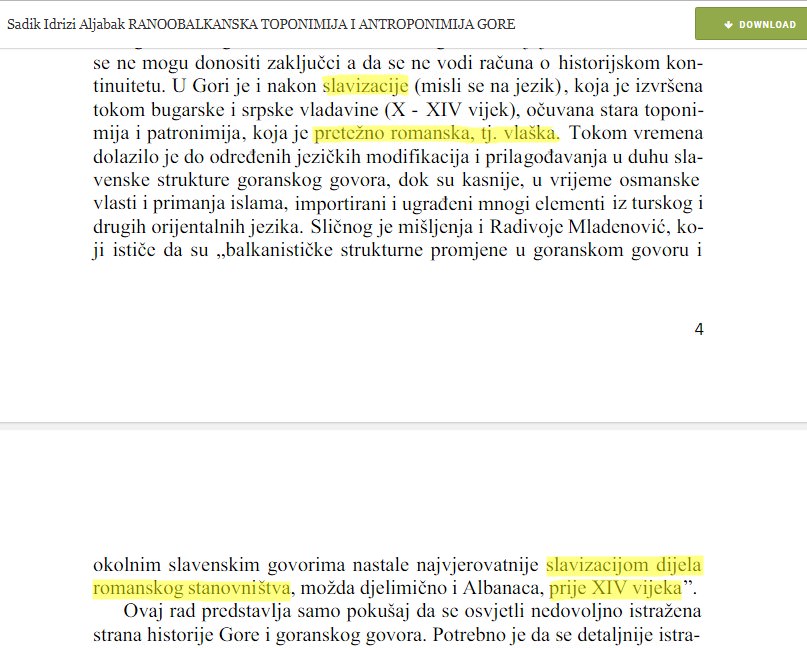
Old Balkan toponymy and anthroponymy of Gora, Sadik Idrizi Aljabak
http://www.academia.edu/26018814/Sadik_Idrizi_Aljabak_RANOOBALKANSKA_TOPONIMIJA_I_ANTROPONIMIJA_GORE

Aromanian-Vlach traces in Gora, Sadik Idrizi Aljabak
https://archive.org/details/AromunskoVlaskiTragoviUGori

"In Gora, even after linguistic Slavization (which took place during Bulgarian and Serbian rule, from the 10th until 14th c.) old Balkan toponymy and patronymy was preserved, which is mainly Romance, that is Vlach..."
Zm3KRM6.jpg
 
Last edited:
- The Aromanians were scattered everywhere in kaza Kastoria. This kaza bordered the old Aromanian settlements on Mount Gramos.

Great number of the Christian population in the town of Kastoria was of Aromanian origin. When Victor Bérard visited Kastoria toward the end of the 19th century, Aromanian was spoken or at least understood in every Christian house, which, beyond doubt, indicates the strong Aromanian presence in this town. In the mid-nineteenth century, one of the Greek propaganda leaders in Kastoria, the teacher Anastassios Piheon, reports that the town’s Greek upper class was mainly made up of Aromanian families.

- In the kaza of Katerini, the Aromanians were fairly numerous during the winter season when the Aromanians from Olympus, Mariovo, Ano Vermio, Veria, Edessa (ar. Vudena; mk. Voden), Flambourari and the Grevena area moved down toward Katerini and the coast.

According to Weigand’s statistics, 6000 Aromanians lived in kaza Katerini. According to Vasile Papa Ianuşi, Katerini was a town with 7000 inhabitants, of which half were Aromanian (PAPA IANUŞ, 1904: 41). According to Weigand, Katerini was home to 1500 Aromanians who originated from the Aromanian villages on Mount Olympus (WEIGAND, 1888: 13). Neniţescu provided a figure of about 2800 Aromanian inhabitants of Katerini (NENIŢESCU, 1895: 557).

Anastassios Piheon was born in 1836 in Ohrid, in a Vlach family. According to Bulgarian sources only his father was a Vlach, and his mother a "Bulgarian".
https://en.wikipedia.org/wiki/Anastasios_Pichion
 
Last edited:
- In northernmost areas of Macedonia, the Vlach-speakers did not settle at all until 1874, after the construction of the railroad line Skopje-Vranje. The Vlach traders from Kruševo, Bitola, Prilep, Serres, Kavala and Thessaloniki settled in Skopje after 1874 and by the Balkan Wars almost all of the economy in the town was in the hands of the 150 families from Kruševo, among which most prominent were Dicea, Papatheodosi, Crangu, Sapungi, Shcodreanu, Comati, Lazu, Catzavolu and Shcaperda. These Vlachs in Skopje inhabited Vlaško Maalo. The settlement of Vlach tailors, goldsmiths, bankers and hotel owners from Kruševo, Nymfaio, Veles and Malovište in Kumanovo occurred at the same time as the settlement of the Vlachs in Skopje (HÂCIU, 2003: 210-212; ТРПКОСКИ-ТРПКУ, 1986: 91).

- Vlasti was inhabited by Vlachs from Moscopole and Pindus, as well as by Vlachs from the former Episcopal seat Sissani (ПОПОВИЋ, 1937: 42). Hellenised Vlachs from Sissani transferred the Hellenic influence to Vlasti, which led to the hellenisation of more than half the Vlasti population in 1875 (PICOT, 1875: 37). Similar to nearby Siatista, where in 1889-1890 Weigand noted that children did not speak Vlach (WEIGAND, 1895: 129), Vlasti probably encountered the same when the Vlach population ceased using the Vlach language. In 1900, Kanchov recorded 2500 inhabitants in Vlasti, of which he considered 1300 to have been Vlach and 1200 Greek (КЪНЧОВ, 1996: 269). For more details see: ΤΣΙΡΟΣ, 1964.

- The first Vlach settlers in Bitola arrived in the second half of the 18 century, after the collapse of Moscopole. The original Vlach nucleus in the town had consisted of Moscopolitans, followed by unspecified numbers of refugees from Nikolicë, Linotopi, Grammousta, Foussia, Veternik, Niçë, Grabovë, Llëngë etc. (KOUKOUDIS, 2000: 353).

- Greek sources claim that toward the end of the 19th century half the Greek population of Salonica comprised of Vlachs (ΚΟΥΚΟΥΔΗΣ -1-, 2000: 87-90, 118-120). According to Weigand, the Greek element in Salonica was composed of hellenised Aromanians and Bulgarians. The majority of them had forgotten their mother tongue. Despite that, Vlach was spoken in the neighbourhoods of St. Nicholas, St. Athanasius and St. Theodore (WEIGAND, 1895: 222). According to Delacamara, about 10000 Vlachs lived in Salonica (DELACAMARA, 1904: 49), and the same figure was given by Cordescu as well. He concluded that the vast majority of them had already been hellenised (CORDESCU, 1906: 147). Neniţescu, on the other hand, claimed that 12500 Vlachs lived in Salonica. Their children filled the streets in the three Vlach neighbourhoods, sung and told riddles exclusively in Vlach (NENIŢESCU, 1895: 553, 571). Wace and Thompson agreed that a significant number of Salonica Greeks were, in fact, Vlachs from Mount Olympus (WACE -THOMPSON, 1914: 210). Apart from the Vlach villages on Mount Olympus, Vlachs came to Salonica from Kleisoura, Nymfaio, Kruševo, Veria, Korçë, Nižepole, Berati and the Vlach settlements in Thessaly (ZUCA, 1903: 257; NENIŢESCU, 1895: 572).

- КАТАРЏИЕВ, 1961: 16-17; According to Weigand, in 1890, 2000-3000 persons from Serres inhabitants were with Vlach origins, among which the wealthiest families: Tegochik, Duro, Kontos and Karamichu. They came from Pindus and Olympus (WEIGAND, 1895: 228). According to Picot, Vlachs were the majority in Serres (PICOT, 1875: 23). Neniţescu pinpointed a figure of over 4000 Vlachs in Serres, who were the wealthiest and most powerful in the town and pulled all the strings (NENIŢESCU, 1895: 560).
 
Last edited:
URL:
http://www.historyofmacedonia.org/Macedoniansymbols/MacedonianLion.html

- When the Venetian captain Angiolello passed through Macedonia and on August 13, 1470 recorded his stay on the Holy Mountain, he wrote that "there are many Christian monks, some of whom are Greeks, others Macedonians, Vlachs, and there are even Italians and people from other nations." Four days later, while camping by the mouth of the Mesta River, he noted that "there live Greeks and Macedonians."

- In the 15th century, Bertrando de la Brokier traveled through the Balkans and left behind an account of his travels. Among other things, he writes "...and I remembered the heavy oppression of the Turk over the emperor in Constantinople and over all Greeks, Macedonians and Bulgarians, and even over the Despot of Rascia [Rashka, as he referred to Gjuragj Brankovich] and all his subjects, which is very unfortunate for the all of Christianity.... And there are many Christians who are forced to serve the Turk, like the Greeks, Bulgarians, Macedonians, Albanians, Esklavonians, Rascians and Serbians...".

This one:
https://en.m.wikipedia.org/wiki/Mount_Athos
 
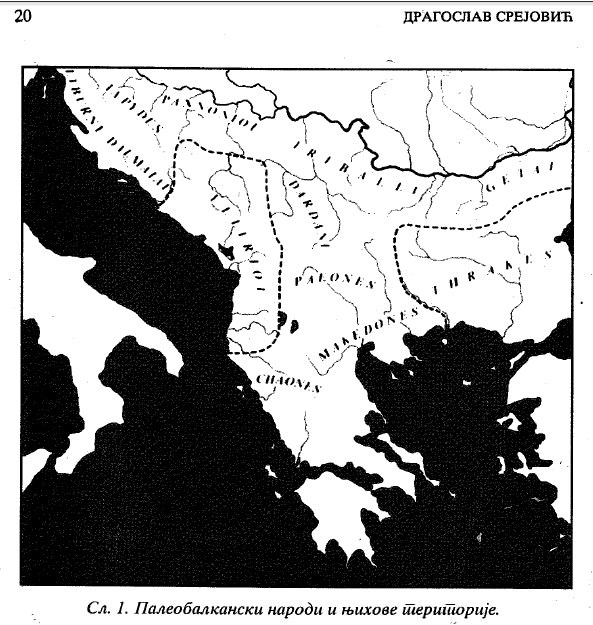
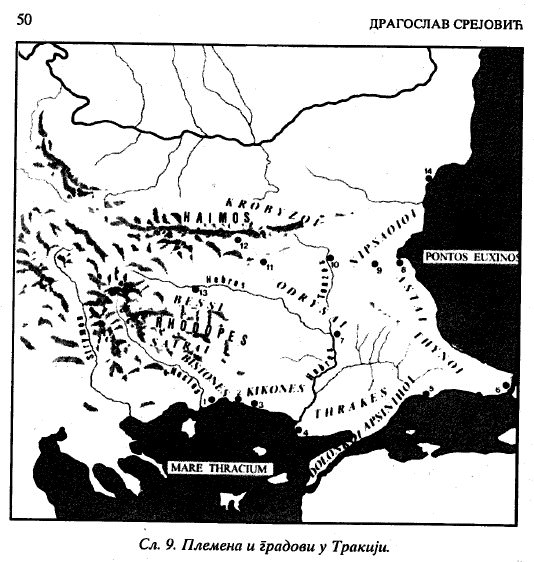
The following maps come from Dragoslav Srejovic - "Iliri i Tracani" ("Illyrians and Thracians"). The entire book, which is in Serbian, can be found here:
https://ia801202.us.archive.org/5/i...cani/Dragoslav Srejovic - Iliri i Tracani.pdf

Paleo-Balkan peoples and their territories
DMw6xYI.jpg


Tribes and towns in Thrace
yCiBNVg.jpg


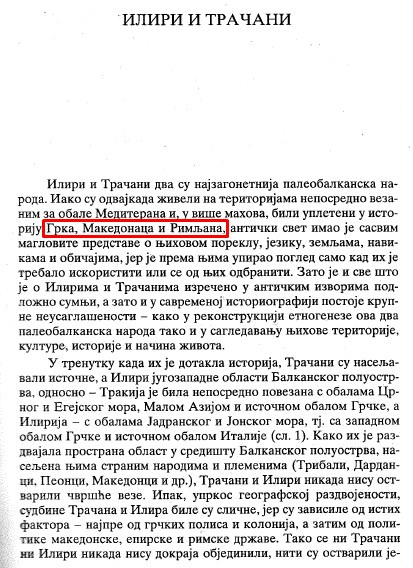
I haven't read the book but the author seems to separate the Greeks from the Macedonians. The Thracians and Illyrians are placed alongside (as separate) the other Balkan peoples such as the Dardanians, Triballians, Macedonians, etc. First page:
yUCHJOS.jpg
 
Last edited:
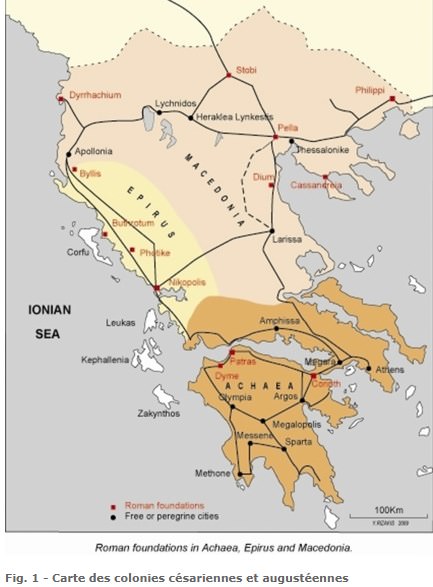
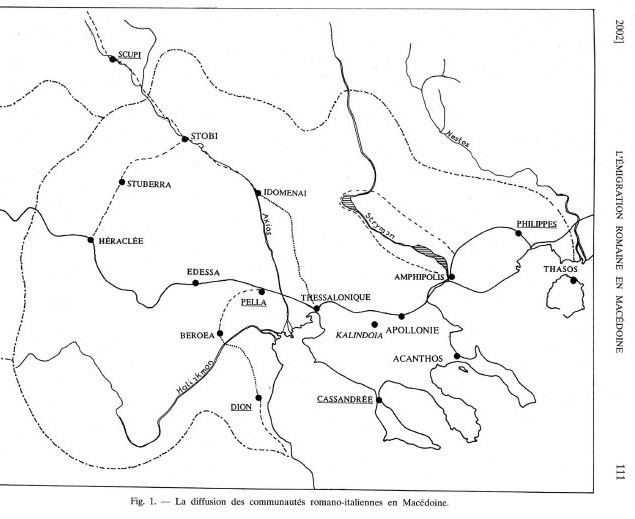
Expropriations et confiscations des terres dans le cadre de la colonisation romaine en Achaïe et en Macédoine, Athanasios D. Rizakis

URL:
https://journals.openedition.org/mefra/2879

Summary:

Rome had, in the Greek peninsula, a significant amount of land belonging to the ager publicus; this land was either old royal property (e.g. in Macedonia), confiscated by Aemilius Paullus in 167 BC and leased by the censors or else land belonging to cities (e.g. Corinth) and confiscated after the Achaean war (146 BC). When public property was not available Caesar and his successors had no qualms about confiscating the required land for their colonists (e.g. Buthrote, Dymé) by using various pretexts. Augustus, meanwhile, claimed to have bought the land given to his colonists and literary sources suggest that, in some cases, other kind of financial compensations were given to the old inhabitants of a city transformed into a colony (e.g. Patrai). At the same time the Italian grant of ius italicum was given to some colonies in Macedonia (e.g. Dyrrachion, Philippes) where the newcomers had been expelled from their Italian lands.

Ius Italicum (Latin, Italian or Italic law) was an honour conferred on particular cities of the Roman Empire by the emperors. It did not describe any status of citizenship, but granted to communities outside Italy the legal fiction that it was on Italian soil. This meant that it was governed under Roman rather than local or Hellenistic law, had a greater degree of autonomy in their relations with provincial governors, all those born in the city automatically gained Roman citizenship, and the city's land was exempt from certain taxes. As citizens of Rome, people were able to buy and sell property, were exempt from land tax and the poll tax and were entitled to protection by Roman law.

Map of Caesar's and Augustus's Colonies
j7tiYn0.jpg


The Diffusion of the Roman-Italian communities in Macedonia
ZAVXS1P.jpg
 
Last edited:
Back
Top