• Welcome to the new Macedonian Truth Forum. All posts, members and private messages have been moved over from the old forum.

    Passwords from the old forum could not be carried over, so please use Forgot your password? to set a new one. The reset link is emailed to the address on your account.

  • Rules and Regulations at the forum of the Macedonian Truth Organisation (MTO)

    (1) The national-ethnic and cultural-linguistic identity of the Macedonian people is historically Macedonian, and derives its character from the native, indigenous and geographic homeland of the Macedonians, which is called Macedonia. To ensure that their human rights, integrity and heritage are appropriately respected, the only nouns and adjectives acceptable when reference is made to the above character and identity markers is Macedon, Macedonia, Macedonian and Macedonians.

    (2) The nation-state of the Macedonian people is the Republic of Macedonia, and is to be referred to by this official title so long as the 'republic' prefix is consistently applied to other states. Alternative references are the Macedonian Republic, or simply, Macedonia.

    (3) The 'ethnic' prefix is only acceptable for Macedonians in cases where differentiation is specifically required - so long as it is in context and consistent where it concerns its application to other ethnic groups.

    (4) Should any other differentiation be specifically required, the names of other ethnic groups that reside with Macedonians in either the Republic of Macedonia or the occupied Macedonian regions in Greece, Bulgaria, Serbia or Albania, are to be given a prefix.

    (5) Negating the identity, language and culture of the Macedonian people by deliberate avoidance of the terms Macedonia, Macedonian and Macedonians, or by any other means, is not permitted.

    (6) Systematic anti-Macedonian propaganda and rhetoric are not permitted.

    (7) Threads irrelevant to the Macedonian Cause, the community at the Macedonian Truth Organisation or the Macedonians in general may be considered as spam or not in the spirit of the forum. In such cases they are not permitted.

    (8) Continual posting of messages in threads with the sole purpose of deviating from the initial topics with the use of unrelated and unnecessary information is not permitted.

    (9) All posts, external articles, reports, etc that are cited in languages other than Macedonian or English, must be accompanied with a translation in one or both of the said languages.

    (10) Despite the possibility of some conversations and debates becoming heated, extreme abuse and/or racism, vulgar language and/or terminology, threats, revelation of personal information about others, harassment, and other such behavior will not be permitted. If deemed necessary all relevant information including member details will be reported to the appropriate authorities for investigation which may result in legal action.

    (11) Threads that are created must have a summary of a topic or excerpt of an article found in pertinent link(s) that have been included. One line threads will be considered unaccetable spam and are therefore not permitted.

    (12) Compulsive and deliberate lies, irrespective of the topic, are not permitted.

    (13) Any symbols or avatars found to be perceived as offensive to Macedonians are not permitted.

    (13) Any explicit or extreme material is not permitted.

    Failure to adhere to the above rules and regulations will result in a ban after 3 breaches. This may be reconsidered in some cases should the circumstances be of an unorthodox nature and/or require special consideration. To assure an effective deterrent against an individual or individuals with the sole purpose of causing dissent through spamming, racism or other improper means, the above rules will be strictly enforced.

    The MTO administration will monitor all discussions as reasonably practical and reserve the right to remove any post and/or member from the forum, and update the rules and regulations as required. Members are encouraged to immediately report any post and/or member to the MTO administration if they feel that these rules have not been abided by.

    The views expressed on this forum are those of the individuals. The only official representation of the MTO is made by the "Macedonian Truth Organisation (Site Owner)" username, and no other.

  • Macedonian Cause

    The Macedonian Truth Organisation calls on God in Heaven to protect, bless and guide the endeavour it is committing to undertake, and that is to work towards:

    Securing Macedonia as a free, independent and democratic republic in which sovereignty lies with the Macedonian citizens; as the nation-state of the Macedonian people in which they can preserve their culture, language and identity; as a state in which the Macedonian language and culture form the basis of public life and act as important unifying elements of Macedonian society; as the home of all its citizens to which it guarantees and obliges their inalienable natural rights and corresponding responsibilities;

    The acknowledgment as self-evident and irrefutable the existence of the:

    1) Indigenous, ethnonational name of Macedonia;
    2) Macedonian people, language and identity;
    3) Macedonian culture, symbols and folklore;
    4) Macedonian ancestry, heritage and history in its entirety; and
    5) Macedonian Orthodox Church;

    Securing recognition by the International Community of the tragedies endured by the Macedonian people, of the division of Macedonia with the signing of the Treaty of Bucharest on August 10, 1913, and the genocide committed against the Macedonian people at the hands of the Greek, Bulgarian and Serbian states and their respective churches during the 19th and 20th centuries;

    Ensuring that the Interim Accord is declared ‘null and void’ and that all constitutional provisions, acts, commitments, agreements, legislation, regulations, policies or programs emanating from, supporting or consequential to the Interim Accord are also declared ‘null and void’, including the use of any symbols and the completion of any acts imposed by, or originating from, the Interim Accord.

    Ensuring that the Framework Agreement is abolished and that all constitutional provisions, acts, commitments, agreements, legislation, regulations, policies and programs emanating from, supporting or consequential to the Framework Agreement are also abolished and replaced by a framework of constitutional and statutory law based on inalienable natural rights and corresponding responsibilities and universally codified human rights mechanisms.

    Securing the abolishment of any existing constitutional provisions, acts, agreements, legislation, regulations, policies and programs that discriminate against the Macedonian people, in any international organisation or any of the countries of the International Community where such constitutional provisions, acts, agreements, legislation, regulations, policies and programs exist, and thereby ensuring the freedom for Macedonians to exercise their inalienable natural rights and fulfil their corresponding responsibilities, and practice their culture, language and religious faiths in all the countries of the International Community without hindrance;

    The empowerment of Macedonians to undertake a moral revolution and to instil and/or reinvigorate within themselves a deep-rooted national, cultural, linguistic and historical dignity and a commitment to the exercise of freedom based on inalienable natural rights and corresponding responsibilities;

    The recognition of the Macedonian minorities in the neighbouring states of Macedonia as well as the respect for the inalienable rights and freedoms of the Macedonian minorities, as provided for by natural law and as codified by the United Nations Charter, the Universal Declaration of Human Rights and other universally codified human rights mechanisms;

    The full and unreserved respect of, and the support for, the rights of all people of non-Macedonian descent living in Macedonia and around the world, who share a reciprocal full and unreserved respect for the Macedonian people, their homeland and their state;

    The cultural unification and solidarity of the Macedonian people living in all parts of historical Macedonia and adjacent territories, as well as Macedonians throughout the world;

    The unity of all Macedonians on the principles, objectives and achievement of the Macedonian cause as defined by this declaration.

Population of Macedonia and Adjacent Areas

The first major period of Armenian dispersion occurred in the 5-6th centuries as a result of Byzantine-Persian wars and the partitions of Armenia between the two empires. Occasionally, Byzantine emperors themselves deported Armenians to other parts of the Empire. In 578 for instance, around 10,000 Armenians were forcibly resettled to the island of Cyprus. The policy of resettlement of the Armenians in the Byzantine Empire continued into the later centuries, and tens of thousands of Armenians were resettled in Smyrna, Crete, Cyprus, Thrace, Macedonia, the Peloponnese, Sparta, Sicily and Italy.

URL:
http://europeofdiasporas.eu/sites/d...ction to the Armenian diasporas in Europe.pdf


Their transplantation from Armenia to Thrace.

About the middle of the eight century, Constantine, surnamed Copronymus by the worshippers of images, had made an expedition into Armenia, and found, in the cities of Melitene and Theodosiopolis, a great number of Paulicians, his kindred heretics. As a favour, or punishment, he transplanted them from the banks of the Euphrates to Constantinople and Thrace; and by this emigration their doctrine was introduced and diffused in Europe. If the sectaries of the metropolis were soon mingled with the promiscuous mass, those of the country struck a deep root in a foreign soil. The Paulicians of Thrace resisted the storms of persecution, maintained a secret correspondence with their Armenian brethren, and gave aid and comfort to their preachers, who solicited, not without success, the infant faith of the Bulgarians. In the tenth century, they were restored and multiplied by a more powerful colony, which John Zimisces transported from the Chalybian hills to the valleys of Mount Haemus.... Their exile in a distant land was softened by a free toleration: the Paulicians held the city of Philippopolis and the keys of Thrace; the Catholics were their subjects; the Jacobite emigrants their associates: they occupied a line of villages and castles in Macedonia and Epirus....

URL:
https://www.ccel.org/g/gibbon/decline/volume2/chap54.htm
 
Last edited:
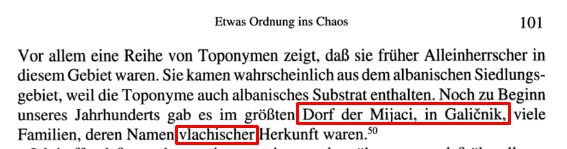
Miyak Village, Galichnik, many families whose names were of Vlach origin
p6J57Pf.jpg

A4LQCae.jpg
Carlin, are the place names and family names listed in the footnote supposed to be Vlach by origin?
 
5nnxy67.png

HUItcAM.png


arOELG3.jpg


vxikBJS.jpg


PS:

Koukoudis, Asterios (2003). The Vlachs: Metropolis and Diaspora. Thessaloniki: Zitros Publications, p. 352:

"Until the Vlachs settled there, Magarevo at least was inhabited by a small number of Slavonic-speaking Christians.... Among the Vlach immigrants there were also a few small groups of Arvanite refugees, mainly from Vithkuq, who settled in Magarevo and Trnovo. By the beginning of the twentieth century, owing to intermarriage with the Vlachs, the Arvanites had ceased to speak Albanian and had been assimilated by the more numerous Vlachs."
 
Last edited:
Yes, they are believed to be of Vlach origin (i.e. Vlach puliu = a young bird). As it states in the footnote: "Significant are names with -ul-".
If the author is referring to the -ul diminutive that is common in Romanian (e.g: Draco > Dracul), then I am not sure it applies to Pulevci, Gulovci or Tulevci, because the -ul in each of those appears to be part of the root word. Perhaps it applies to Gugulevci and Čudulovci, although the root word of the latter looks Macedonian, not to mention that all of them have Macedonian endings. As for the places, he lists names like Rusin, Kameš and Katuništa. Are these supposed to be of Vlach origin also, according to the author?
 
I think Carlin would be able to help out with this question I have. Thessaly was once known as little Vlachia in the Middle Ages. Is it possible to get an exact number of the population of Thessaly leading up to independence of the ottomans? And, if possible, get an ethnic breakdown of the people’s?
 
I think Carlin would be able to help out with this question I have. Thessaly was once known as little Vlachia in the Middle Ages. Is it possible to get an exact number of the population of Thessaly leading up to independence of the ottomans? And, if possible, get an ethnic breakdown of the people’s?
It was known as Great Vlachia. In early 1800s Thessaly had a population about 200,000 people (including Turks). Not an exactly accurate estimation but somewhere close to that number.
 
In the 1951 census, mother language is recorded. Vlach is a mother language for 0,52% of people overall Greece and 2,1% in Thessaly.
 
Thanks.

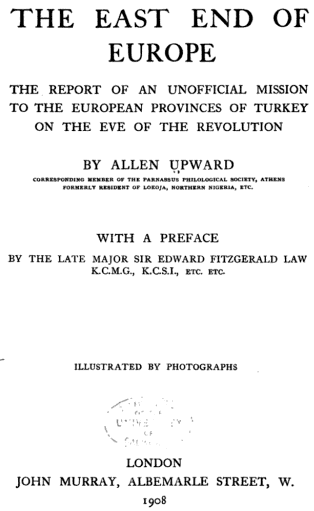
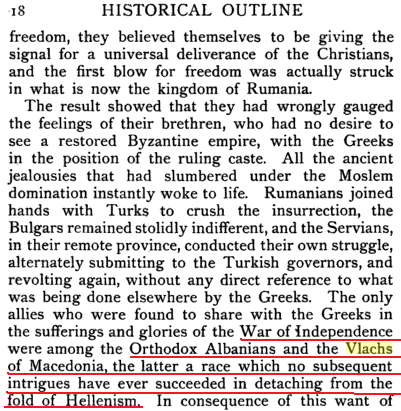
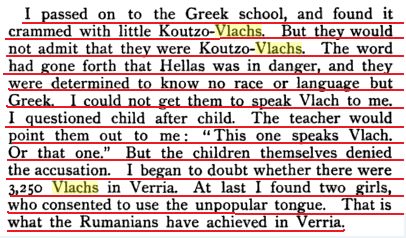
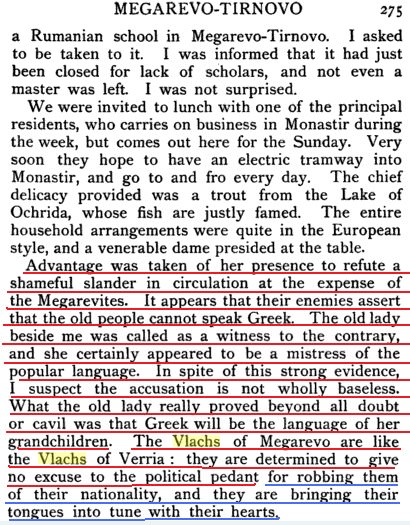
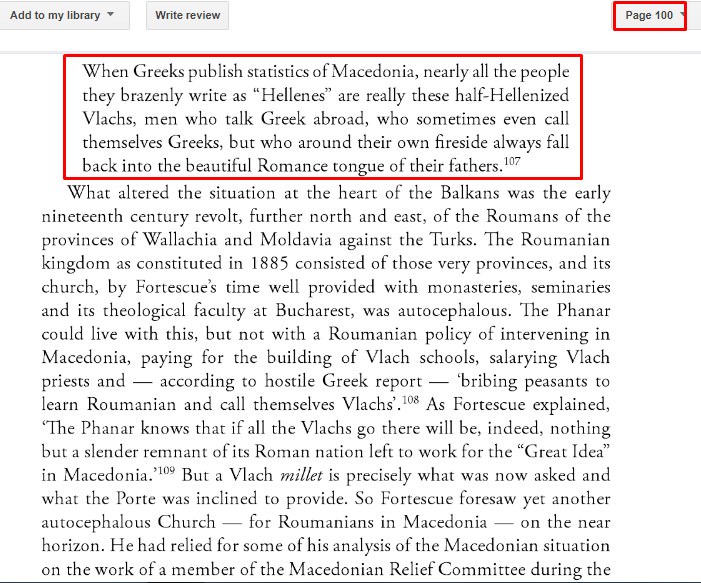
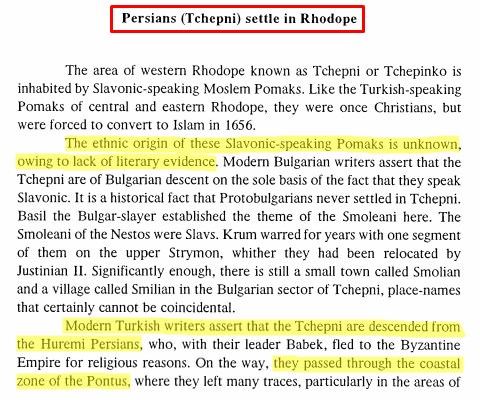
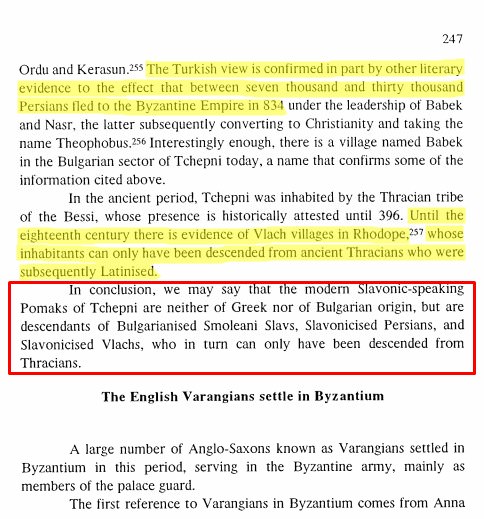
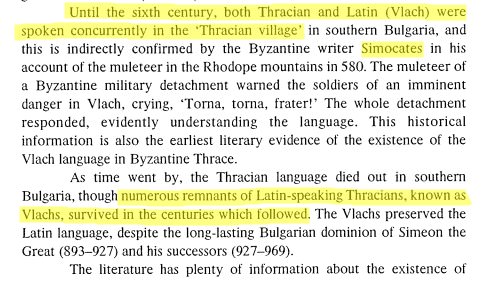
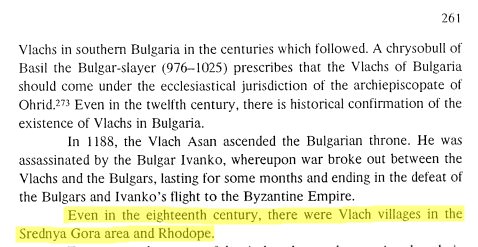
Nearly all of the native Hellenic population of Macedonia were simply Vlachs.

RqiRxoC.jpg

ZH63SFW.jpg


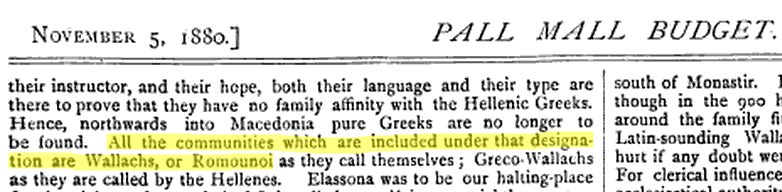
Quotes/testimonies such as these are NOT OPEN to interpretation. What's more... Regarding Macedonia we do know what and who the (small) remainder of the native Hellenes were -- and these were mainly Patriarchist Macedonians and Arvanites.

This goes in the face of the modern greek of 4000 years of “Hellenic” Macedonia.
 
In 1951 Thessaly, for mother language, Turkish 0,43%, Albanian 0,02%.

If Macedonia bordered a Vlach province how in the world did we get the inflated numbers coming out of modern “greece” during the Ottoman Empire for ethnic greeks? How much of Macedonia was actually greek?
 
- A Journey Through Albania, and Other Provinces of Turkey in Europe and Asia - By John Cam Hobhouse Broughton

Pages 491 & 492:
"The country inhabited by the southern Valachi, properly so called, is composed of the contines of Macedonia, Thessaly, and Epirus; comprehending Edessa, Castoria, as well as Larissa, Pharsalia, in the low grounds of Thessaly..."


- The Pall Mall Budget: Being a Weekly Collection of Articles ..., Volume 25
ZL1Rmb8.jpg
 
Last edited:
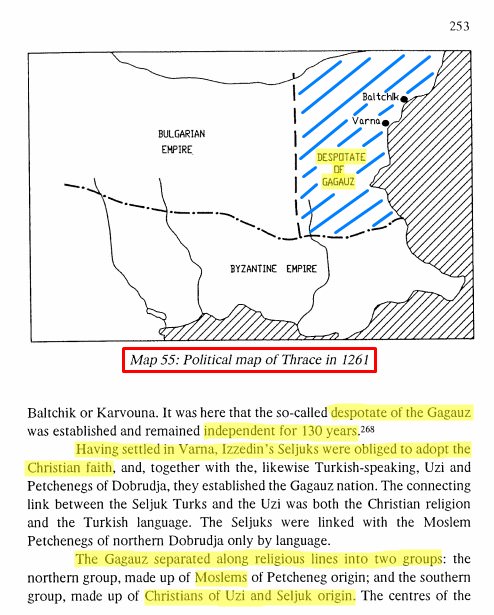
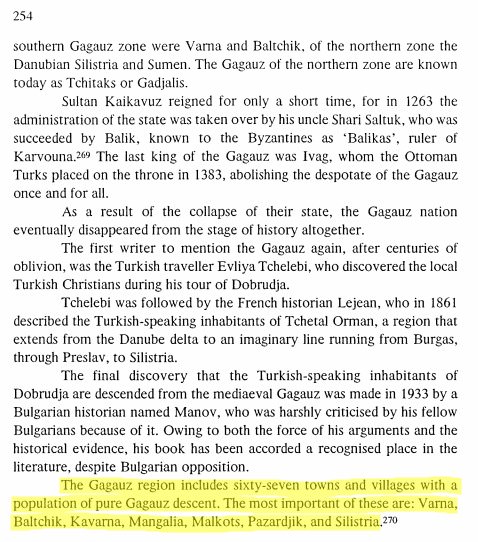
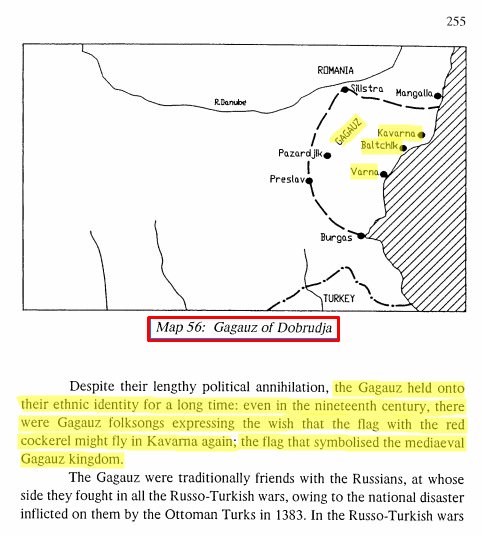
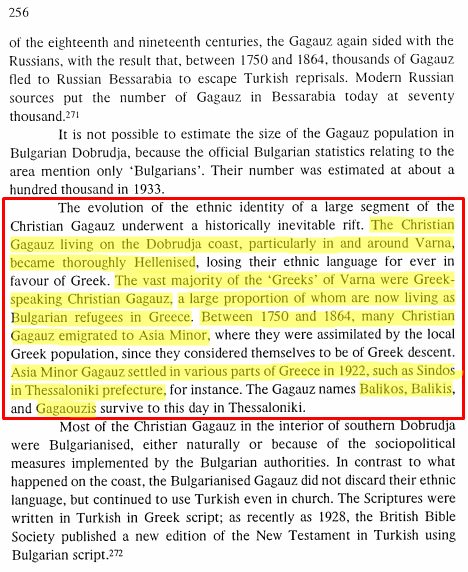
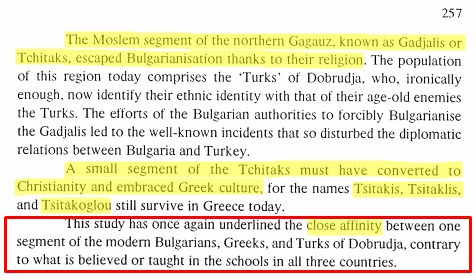
The coastal Greeks of Varna, Bulgaria were largely Gagauz Orthodox Christians who spoke Turkish at home, and studied / learned Greek in school.

5JwMaQL.jpg


The Bilinguism in Bulgarian Lands during 15 - 19 centuries, Nadka N Nikolova
 
The coastal Greeks of Varna, Bulgaria were largely Gagauz Orthodox Christians who spoke Turkish at home, and studied / learned Greek in school.

5JwMaQL.jpg


The Bilinguism in Bulgarian Lands during 15 - 19 centuries, Nadka N Nikolova

Remember reading somewhere that until the 1920s (may have been later), most of the fishermen and other merchants on the Black Sea coast of Bulgaria (including Varna) called themselves Greek/Were "Greek", can't remember the specifics. I remember it being a chapter in a book about Macedonia dedicated to exploring the development of a Bulgarian identity and essentailly how hypocritical it is for Bulgarians to dismiss a Macedonian identity when by employing their own logic, one could discredit their own identity. One of the case-in-points for this were the "Greeks" of the Black Sea who continued to dominate economic life in the region decades after the formation of the Bulgarian state.
 
Video - "That was my life!!! Christa babo Greek Gagauzka!":
https://www.youtube.com/watch?time_continue=8&v=qc-xtALDSME

"This lady was born in 1901 in Saraplar (Serbettar) of the Edirne District . She died in Orestiara Greece in 2007 (106 years old) This video have taken in 2005 ... She tell us her personal story....Her Family story....The story of all the gagauz people ,who left their places ,because of the Turkish hate for them....That because they were Christians and they were Greek!!!"


URL:
https://makedonika.files.wordpress....-greeks-bulgarians-and-turks-by-nakratzas.pdf

dhvdCmD.jpg

Qd7RSJT.jpg

0LUwIii.jpg

MIy0Bik.jpg

jzvfbV2.jpg

i1L9Kvu.jpg
 
Last edited:
What's interesting is that some Macedonians seem to have a genetic connection with the Gagauz people. From wikipedia
According to a more detailed autosomal analysis of thousands of SNPs, not just of the sex chromosome, Gagauzes are most proximal to Ethnic Macedonians, followed by Greek Macedonians apart from Thessaloniki, and others such as Bulgarians, Romanians and Montenegrins.
https://en.wikipedia.org/wiki/Gagauz_people#cite_note-17
 
Back
Top