• Welcome to the new Macedonian Truth Forum. All posts, members and private messages have been moved over from the old forum.

    Passwords from the old forum could not be carried over, so please use Forgot your password? to set a new one. The reset link is emailed to the address on your account.

  • Rules and Regulations at the forum of the Macedonian Truth Organisation (MTO)

    (1) The national-ethnic and cultural-linguistic identity of the Macedonian people is historically Macedonian, and derives its character from the native, indigenous and geographic homeland of the Macedonians, which is called Macedonia. To ensure that their human rights, integrity and heritage are appropriately respected, the only nouns and adjectives acceptable when reference is made to the above character and identity markers is Macedon, Macedonia, Macedonian and Macedonians.

    (2) The nation-state of the Macedonian people is the Republic of Macedonia, and is to be referred to by this official title so long as the 'republic' prefix is consistently applied to other states. Alternative references are the Macedonian Republic, or simply, Macedonia.

    (3) The 'ethnic' prefix is only acceptable for Macedonians in cases where differentiation is specifically required - so long as it is in context and consistent where it concerns its application to other ethnic groups.

    (4) Should any other differentiation be specifically required, the names of other ethnic groups that reside with Macedonians in either the Republic of Macedonia or the occupied Macedonian regions in Greece, Bulgaria, Serbia or Albania, are to be given a prefix.

    (5) Negating the identity, language and culture of the Macedonian people by deliberate avoidance of the terms Macedonia, Macedonian and Macedonians, or by any other means, is not permitted.

    (6) Systematic anti-Macedonian propaganda and rhetoric are not permitted.

    (7) Threads irrelevant to the Macedonian Cause, the community at the Macedonian Truth Organisation or the Macedonians in general may be considered as spam or not in the spirit of the forum. In such cases they are not permitted.

    (8) Continual posting of messages in threads with the sole purpose of deviating from the initial topics with the use of unrelated and unnecessary information is not permitted.

    (9) All posts, external articles, reports, etc that are cited in languages other than Macedonian or English, must be accompanied with a translation in one or both of the said languages.

    (10) Despite the possibility of some conversations and debates becoming heated, extreme abuse and/or racism, vulgar language and/or terminology, threats, revelation of personal information about others, harassment, and other such behavior will not be permitted. If deemed necessary all relevant information including member details will be reported to the appropriate authorities for investigation which may result in legal action.

    (11) Threads that are created must have a summary of a topic or excerpt of an article found in pertinent link(s) that have been included. One line threads will be considered unaccetable spam and are therefore not permitted.

    (12) Compulsive and deliberate lies, irrespective of the topic, are not permitted.

    (13) Any symbols or avatars found to be perceived as offensive to Macedonians are not permitted.

    (13) Any explicit or extreme material is not permitted.

    Failure to adhere to the above rules and regulations will result in a ban after 3 breaches. This may be reconsidered in some cases should the circumstances be of an unorthodox nature and/or require special consideration. To assure an effective deterrent against an individual or individuals with the sole purpose of causing dissent through spamming, racism or other improper means, the above rules will be strictly enforced.

    The MTO administration will monitor all discussions as reasonably practical and reserve the right to remove any post and/or member from the forum, and update the rules and regulations as required. Members are encouraged to immediately report any post and/or member to the MTO administration if they feel that these rules have not been abided by.

    The views expressed on this forum are those of the individuals. The only official representation of the MTO is made by the "Macedonian Truth Organisation (Site Owner)" username, and no other.

  • Macedonian Cause

    The Macedonian Truth Organisation calls on God in Heaven to protect, bless and guide the endeavour it is committing to undertake, and that is to work towards:

    Securing Macedonia as a free, independent and democratic republic in which sovereignty lies with the Macedonian citizens; as the nation-state of the Macedonian people in which they can preserve their culture, language and identity; as a state in which the Macedonian language and culture form the basis of public life and act as important unifying elements of Macedonian society; as the home of all its citizens to which it guarantees and obliges their inalienable natural rights and corresponding responsibilities;

    The acknowledgment as self-evident and irrefutable the existence of the:

    1) Indigenous, ethnonational name of Macedonia;
    2) Macedonian people, language and identity;
    3) Macedonian culture, symbols and folklore;
    4) Macedonian ancestry, heritage and history in its entirety; and
    5) Macedonian Orthodox Church;

    Securing recognition by the International Community of the tragedies endured by the Macedonian people, of the division of Macedonia with the signing of the Treaty of Bucharest on August 10, 1913, and the genocide committed against the Macedonian people at the hands of the Greek, Bulgarian and Serbian states and their respective churches during the 19th and 20th centuries;

    Ensuring that the Interim Accord is declared ‘null and void’ and that all constitutional provisions, acts, commitments, agreements, legislation, regulations, policies or programs emanating from, supporting or consequential to the Interim Accord are also declared ‘null and void’, including the use of any symbols and the completion of any acts imposed by, or originating from, the Interim Accord.

    Ensuring that the Framework Agreement is abolished and that all constitutional provisions, acts, commitments, agreements, legislation, regulations, policies and programs emanating from, supporting or consequential to the Framework Agreement are also abolished and replaced by a framework of constitutional and statutory law based on inalienable natural rights and corresponding responsibilities and universally codified human rights mechanisms.

    Securing the abolishment of any existing constitutional provisions, acts, agreements, legislation, regulations, policies and programs that discriminate against the Macedonian people, in any international organisation or any of the countries of the International Community where such constitutional provisions, acts, agreements, legislation, regulations, policies and programs exist, and thereby ensuring the freedom for Macedonians to exercise their inalienable natural rights and fulfil their corresponding responsibilities, and practice their culture, language and religious faiths in all the countries of the International Community without hindrance;

    The empowerment of Macedonians to undertake a moral revolution and to instil and/or reinvigorate within themselves a deep-rooted national, cultural, linguistic and historical dignity and a commitment to the exercise of freedom based on inalienable natural rights and corresponding responsibilities;

    The recognition of the Macedonian minorities in the neighbouring states of Macedonia as well as the respect for the inalienable rights and freedoms of the Macedonian minorities, as provided for by natural law and as codified by the United Nations Charter, the Universal Declaration of Human Rights and other universally codified human rights mechanisms;

    The full and unreserved respect of, and the support for, the rights of all people of non-Macedonian descent living in Macedonia and around the world, who share a reciprocal full and unreserved respect for the Macedonian people, their homeland and their state;

    The cultural unification and solidarity of the Macedonian people living in all parts of historical Macedonia and adjacent territories, as well as Macedonians throughout the world;

    The unity of all Macedonians on the principles, objectives and achievement of the Macedonian cause as defined by this declaration.

Population of Macedonia and Adjacent Areas

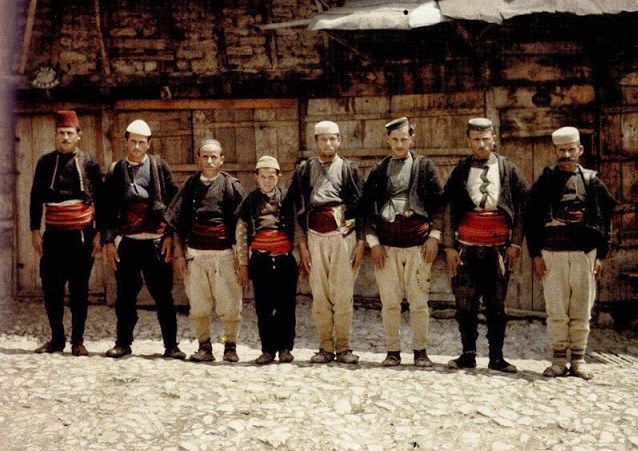
Ohrid in 1913 – Photo gallery from Albert Kahn museum

URL:
https://whereismacedonia.org/ohrid-in-1913-photo-gallery-from-albert-kahn-museum/5/

aW92wbY.jpg

Men in traditional costumes. Their caps allows differentiating between them. Turkish are with red caps, the Albanians with white caps and the Macedonians with the black caps.


Skopje in 1913 – Photo gallery from Albert Kahn museum
https://whereismacedonia.org/skopje-in-1913-photo-gallery-from-albert-kahn-museum/

Bitola in 1913 – Photo gallery from Albert Kahn museum
https://whereismacedonia.org/bitola-in-1913-photo-gallery-from-albert-kahn-museum/
 
rKOzD7n.jpg

----------------------------------------------------------------------------------------------------

gZcJmZh.jpg

----------------------------------------------------------------------------------------------------
SG4UyUK.jpg

----------------------------------------------------------------------------------------------------
MC4ZMM1.jpg

----------------------------------------------------------------------------------------------------
mSj4exa.jpg


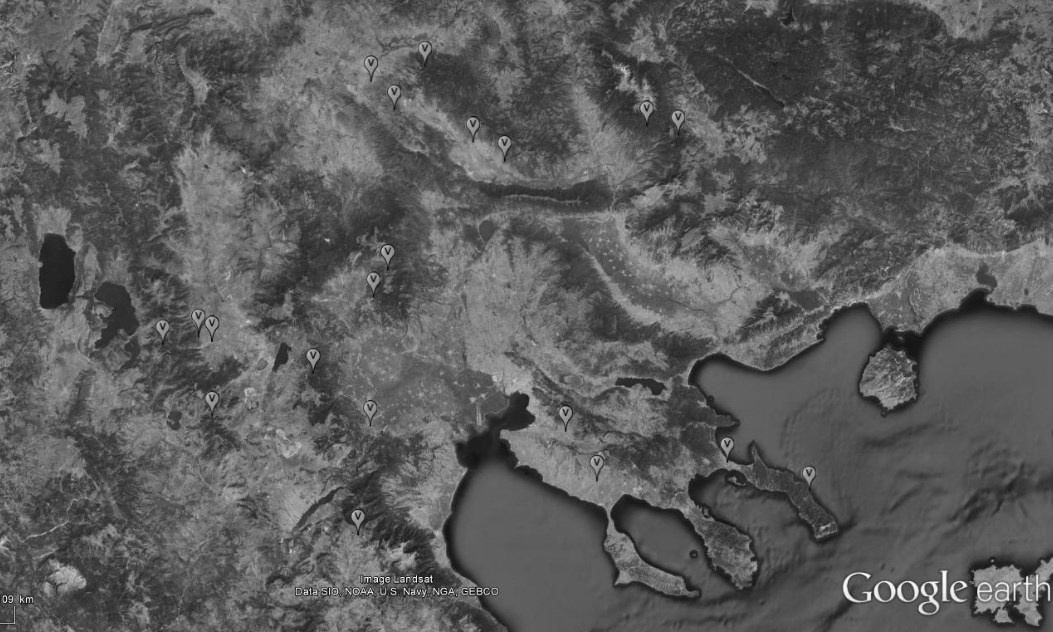
The Source-Based Presence of Vlachs in the Historical Region of Macedonia (14th Cent.) (M. Popović)
icQ0Zw7.jpg


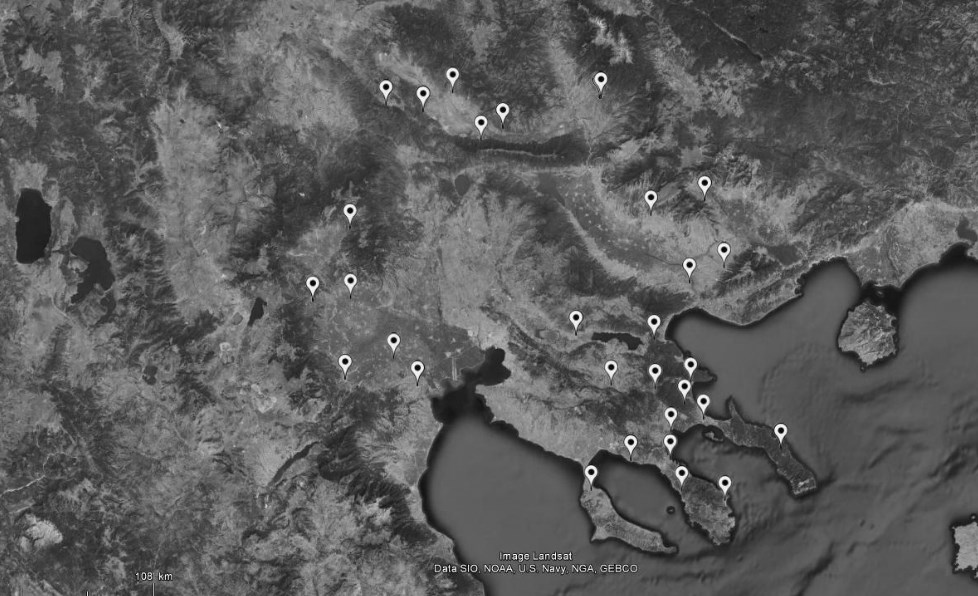
The Summer Pastures in the Historical Region of Macedonia (14th Cent.) (M. Popović)
p4WnUEE.jpg


URL:
https://dpp.oeaw.ac.at/index.php?seite=CaseStudies&submenu=skopje
 
Last edited:
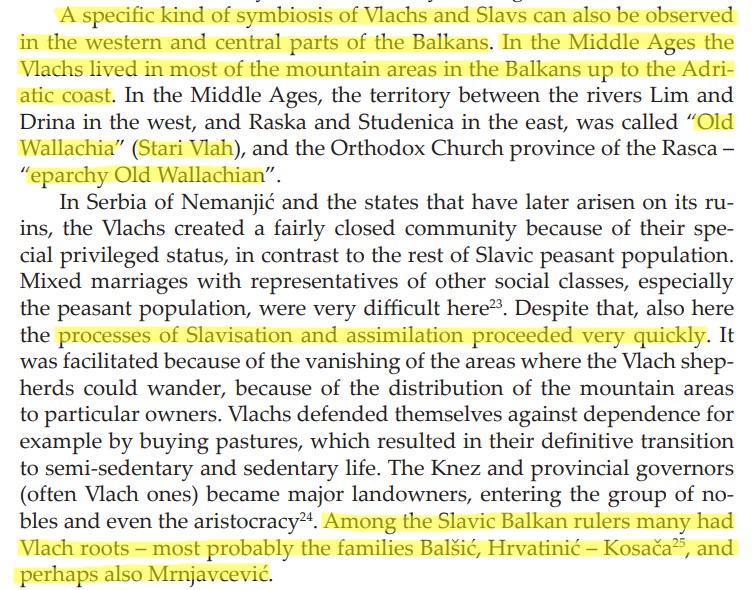
Why would a name like "Hrvatinic" suggest Vlach roots?

That's a good question. I don't know much about these families, but I do know that the Kosacha family were apparently called Vlachs.

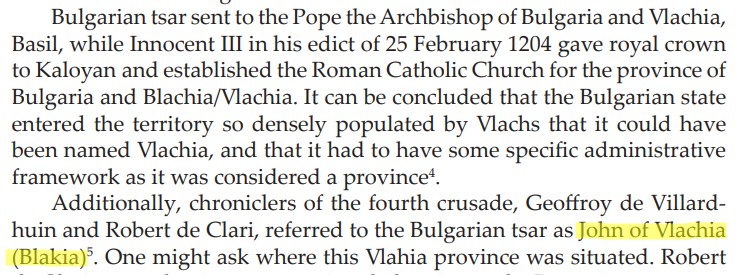
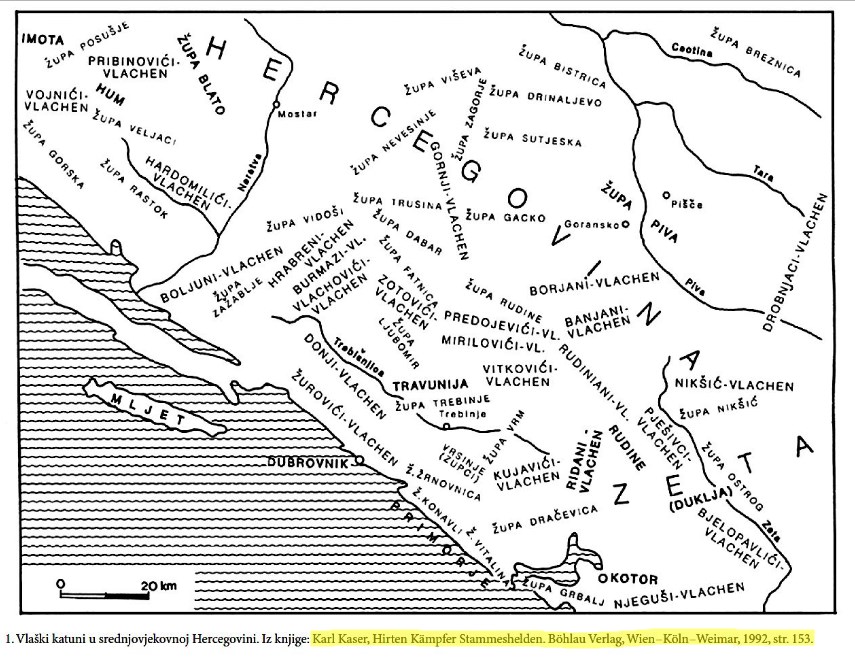
"In Southeastern Herzegovina between 1393–1437 many Vlachian katuns emerged. The primary lords of the Herzegovinian Vlachs were the Kosača, Pavlović, and Nikolić noble families. The Vlachs from Herzegovina sometime plundered lands of Republic of Ragusa in the 14th and 15th century and grew rich by trade of goods between Ragusa and the mines of Bosnia.

Vlachs were surnamed Pliščić, Gleđević, Ugarac, Boban, Mirilović, Vragović, Kresojević, Nenković, Bančić, Pilatovac, Pocrnja, Drobnjak and Riđani. Some of the Banjani and Maleševci (Stanković) were Kosača vassals."

URL:
https://en.wikipedia.org/wiki/Vlachs_in_medieval_Bosnia_and_Herzegovina

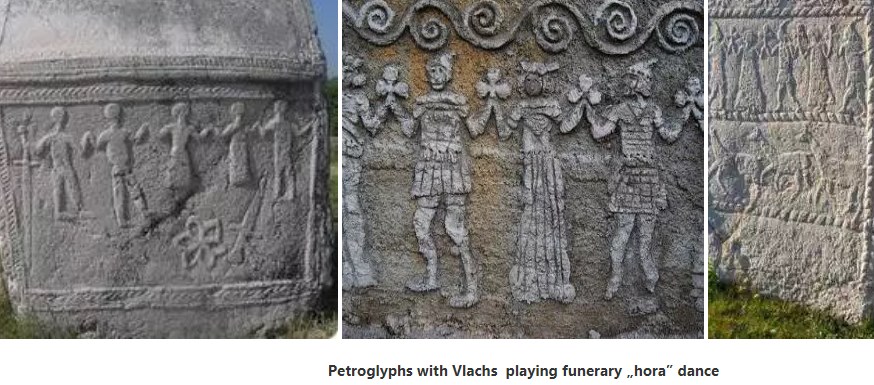
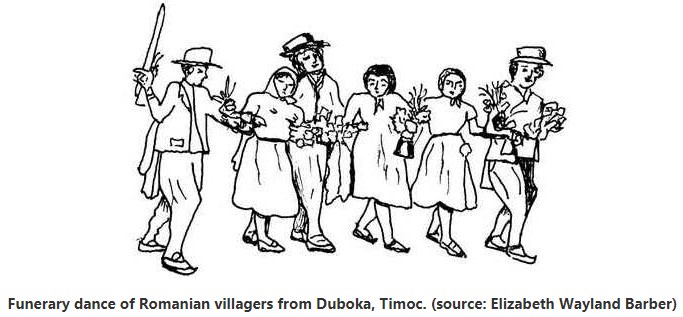
ATRRa9s.jpg

9nWPnOW.jpg


URL:
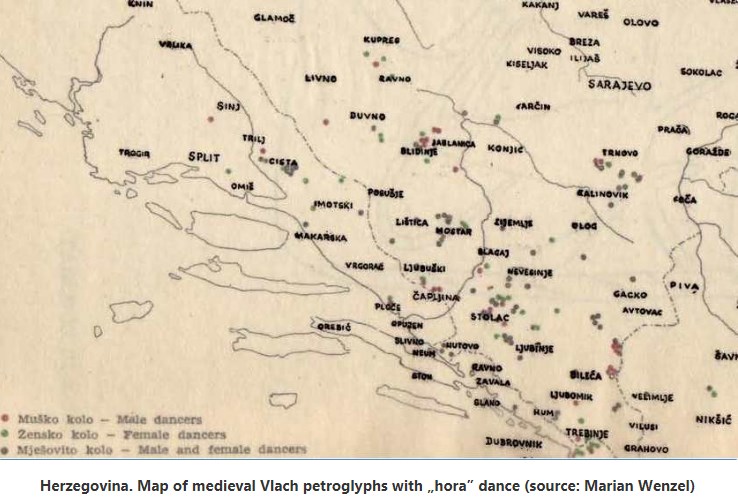
https://octavian443751826.wordpress...olises-with-petroglyphs-in-western-balkans-2/

„The paralels between (Romanian/Vlach) dancers from Duboka in Timoc and the depictions on medieval funerary stećci are far too close for accident” (Elizabeth Wayland Barber, The Dancing Goddesses: Folklore, Archaeology, and the Origins of European Dance, New York, W.W. Norton & Company, 2013, Chapter Medieval Traces).

FJw0cXL.jpg


EWqZF0y.jpg
 
Last edited:
1) "... Vlachs from ancient times have shaped Greek consciousness. They shaped it spontaneously and free .... As in the past, from the Byzantine to the Muslim period, the Vlachs of Pindus, Ohrid and Thessaly have adopted all the characteristics of Greek culture, so now they have embraced Greek national consciousness, the last product of Greek civilization ... "

- Giovani Amadori-Virgili. Archives of the Italian Ministry of Foreign Affairs. "La questione Rumeliota: (Macedonia, Vecchia Serbia, Albania, Epiros) et la politica italiana". Roma 1908.

2) While visiting the town of Kozani in 1880, British diplomat and historian Sir Ignatius Valentine Chirol, noted that “In the 900 houses of this city there are scarcely twenty where around the family fireside any other language is spoken than the old Latin-sounding Wallach. (Still) the prosperous townsfolk would be deeply hurt if any doubt were hinted as to the genuineness of their Hellenism”.

3) Nicephorus Gregoras during his visit to the town of Strumica in 1326, recorded that there he heard a large number of Macedonian folk songs. He affirms that, although he did not understand the language of the local population, the folk songs from Strumica definitely resembled - the Phrygian folk songs ("Correspondance" Paris, 1927, p. 30).

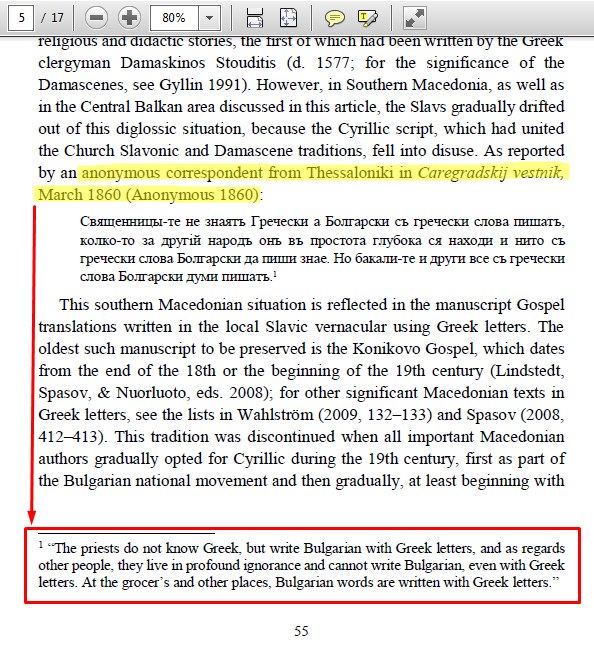
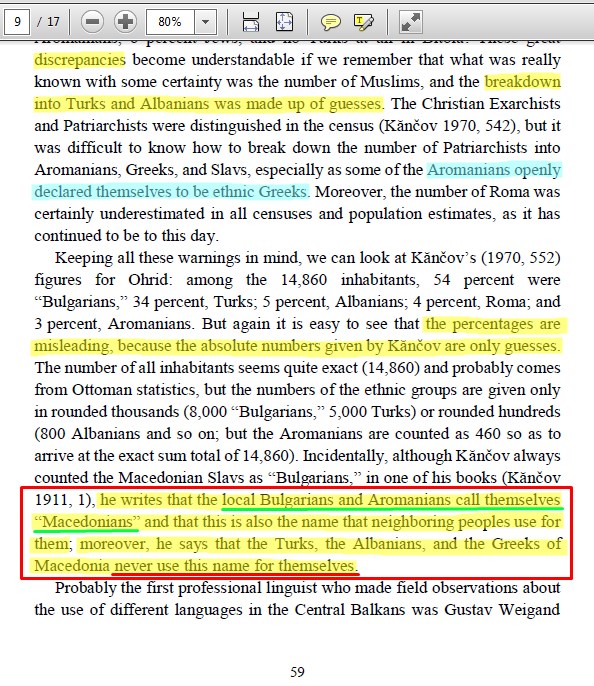
4) Vasil Kanchov. Macedonia — ethnography and statistics Sofia, 1900, p. 90:
"All Upper Debar is threatened by Albanization. The Bulgarian-Muslim villages, which are near the Albanian villages, are already bilingual. The Torbeshi are proud to consider themselves as Albanians. The inhabitants of the villages Ostreni, Trnovo, Klenje, Leten, Dzhepishta, Erbele, Oboki, Makelari and others prefer to be called Albanians and to speak Albanian. The Torbesh village of Rajtsa, most southerly of the Islamicized villages of Lower Drim, speaks mostly Albanian and is already considered as an Albanian village. On the other hand, the Christian Bulgarian population is being expelled very quickly from the northeastern cities of Golo Brdo, Pòle and Zhupa. From Golo Brdo people mainly flee to Debar and Solun. The villages of Vichishta, Goleishta and Pisanki were at the beginning of the 19th century Bulgarian villages, 30 years ago they were half Bulgarian, and today they are settled by Albanians. There are only three Bulgarian houses left in Pisanki."

 
Last edited:
"Several Roman legions were constantly quartered in these [Thracian] provinces, and numerous Roman colonies were founded in them. Roman veterans settled in the country, and young Thracians departed annually as recruits to distant legions. The Latin language appears to have amalgamated more readily with the Thracian than with the Greek. We are informed by a Greek writer, who was himself a Roman ambassador, that in the middle of the fifth century the Greek language was unknown in the countries between the Adriatic, the Aegean, the Black Sea, and the Danube, except in the commercial towns on the coasts of Thrace and Illyria; but that Latin was the ordinary medium of communication among foreign races, both for commercial and political intercourse. In the sixth century the Thracian dialect bore a strong resemblance to corrupt Latin, and to the Vallachian language spoken at the present day."

-- George Finlay, in The Byzantine and Greek Empires (London, ca. 1850)
 
Honesta missio, Viminacium, AD 196

An inscription from 196 AD from Viminacium (Kostolac, Serbia) of Moesia Superior (Legio VII Claudia) with a long list of more than 100 soldiers mentioned because they were honored with a honesta missio after a 25-year term in auxilia of the Roman army, earning a lump sum and the privilege of the Roman state.

Besides the names of the veterans, places of origin are also mentioned. Most of the troops are from the triangle of Ratiaria-Scupi-Trimontium (a lot from Scupi; i.e. "Ale]xaṇ[der(?)]" from "Sc(upis)"), while the rest are mostly from Dacia (Sarmizegetusa), Pannonia (Sirmium and Mursa) and Dalmatia (Salonae and Iadera).

There is an "Au]r(elius) Sosigenes" from "Thes(salonica)".

The inscription is here:
https://inscriptions.packhum.org/text/174440?hs=1614-1622
 
Last edited:
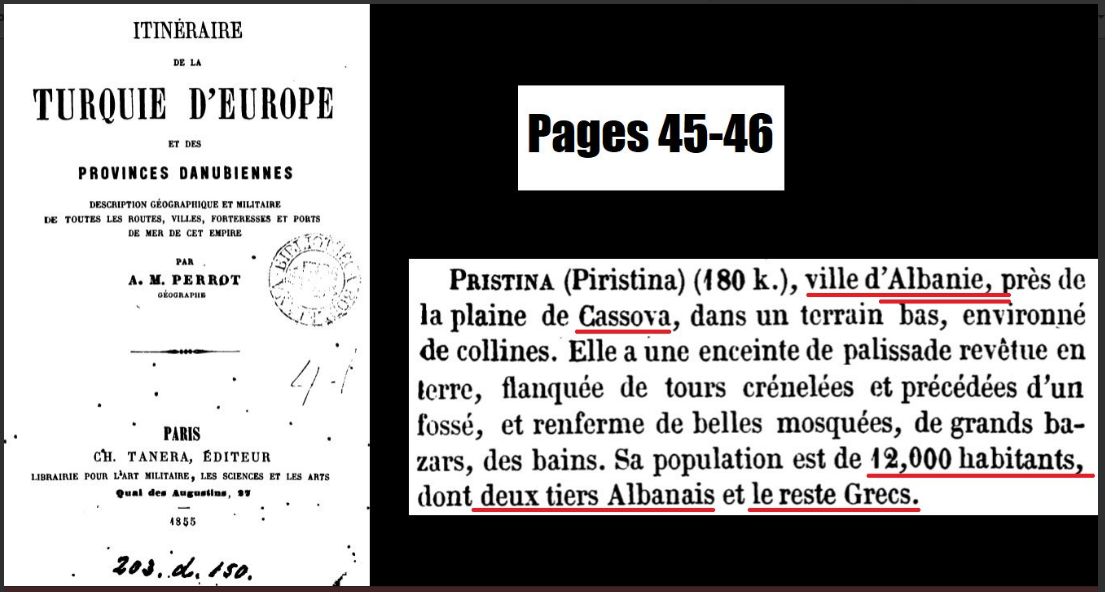
I have been harping on "terminology" (i.e. use of the term "Greeks" and what it means/encompasses) for a long time, and this is yet another blatant example of it.

The testimony comes to us from a French source (Perrot), from 1855 - far from "old". Let's see what was the "ethnic composition" of Prishtina, Kosovo according to Perrot.

pJLdr8t.png


As we can plainly see, the population of Prishtina was: "12,000, of which two-thirds are Albanians and the rest are Greeks."

Let's break it down and analyze this in more detail.

It's easy to demonstrate and show who were those "Greeks". Branislav Nushich, in 1902, talks about the diverse ethnic composition of Prishtina:

"Prishtina is a compact town; houses do not have spacious courtyards and gardens... When Prishtina was declared the headquarters of the Vilayet, it barely counted 1800 houses and now it stands at 3760 houses. Of these, 3170 houses are Turks and Albanians; 420 houses of Serbs, and there are at least 100 houses of Gypsies, about 50 Jewish houses, 10 to 15 houses of Armani (Vlachs) and a little bit of Circassians. If we were count roughly five souls per household then the population proportions would be: 15850 Turks and Albanians; 2100 Serbs; 500 Gypsies; 250 Jews and several dozen Armani (Vlachs) and some Circassians, which would total 18,800 souls. Although the official Turkish statistics show this number, however, this is exaggerated. Prishtina does not have more than 12,000 inhabitants, because many people were forced out of the Vilayet and a lot of houses were left empty. A large number of people are moving out into livlier trade places, as well as emigrating to Serbia."

Branislav Nushich link:
https://www.facebook.com/notes/priština-u-/приштинабранислав-ђ-нушић-косово/1457808190952831/

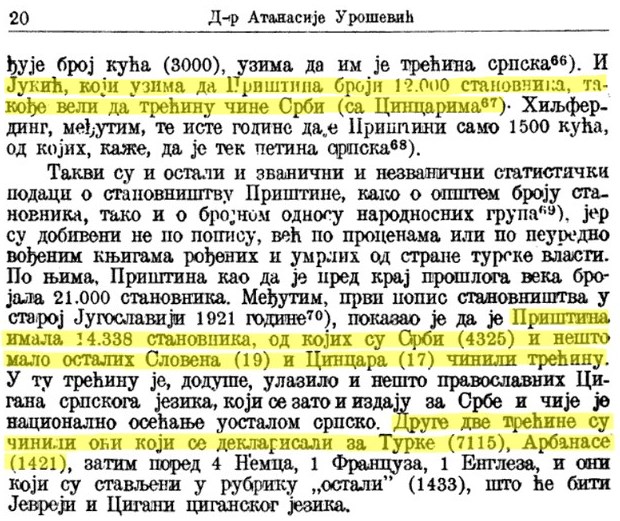
In another Serbian source/publication below we see that Jukich states that Prishtina has about 12,000 residents of which Serbs make up one-third of the population (including Vlachs in this number). According to the first official Yugoslav census in 1921, Prishtina had 14,338 inhabitants of which Serbs (4325), including 'other Slavs' (19) and Vlachs (17) formed roughly one-third (Serbian-speaking Orthodox Gypsies were apparently counted as 'Serbs' as well). Two-thirds were made up of people declaring themselves as Turks (7115!) and Albanians (1421).

3uFXbXZ.jpg

1ZTe0qM.jpg


URL for the above pages:
https://books.google.ca/books?id=NR...oECAkQAQ#v=onepage&q=Приштина Цинцари&f=false

So, Perrot - in 1855 - got the number of Prishtina residents right (!) but his "ethnic Greeks" were largely Serbs (Slavs) who were Orthodox or Greek Christians. It is possible that Greek was used at this time in the Orthodox churches in Prishtina, while some clergy and Orthodox traders utilized Greek (perhaps the language of the marketplace).

That was easy. The point/question is this:

If educated westerners were incorrectly classifying people as 'Greek' as late as 1855, what hope do we have of knowing (accepting) with certainty many other reports from Macedonia, Epirus, Thessaly, Peloponnese, Crete, etc.? Even the (widespread) use of Greek does not give us a lot of confidence to conclude anything, as these people were likely speaking a "different language at home". So, when other testimonies talk about "Albanians and Greeks in the Peloponnese", "Albanians and Greeks in Athens", etc. we simply don't know what to make of the "Greek part" until we dig deeper into the sources (if we are fortunate enough to uncover them).
 
Last edited:
abxw4Xj.jpg


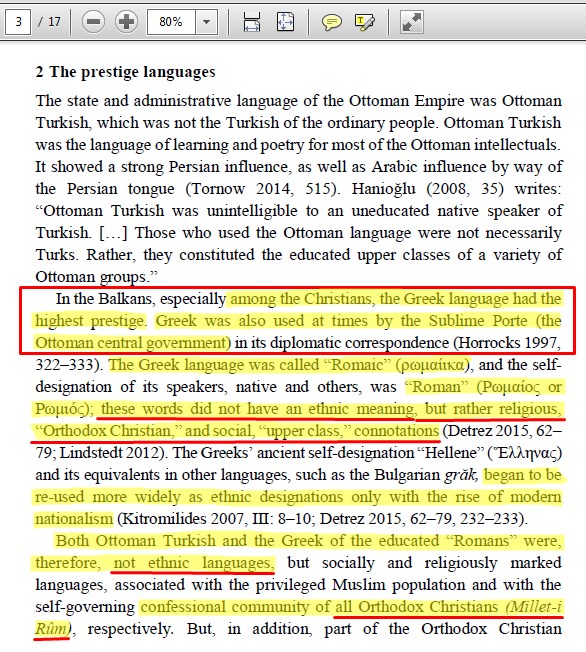
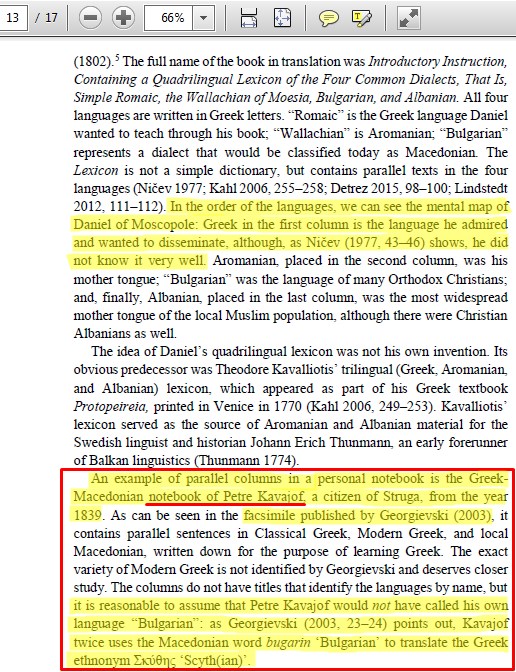
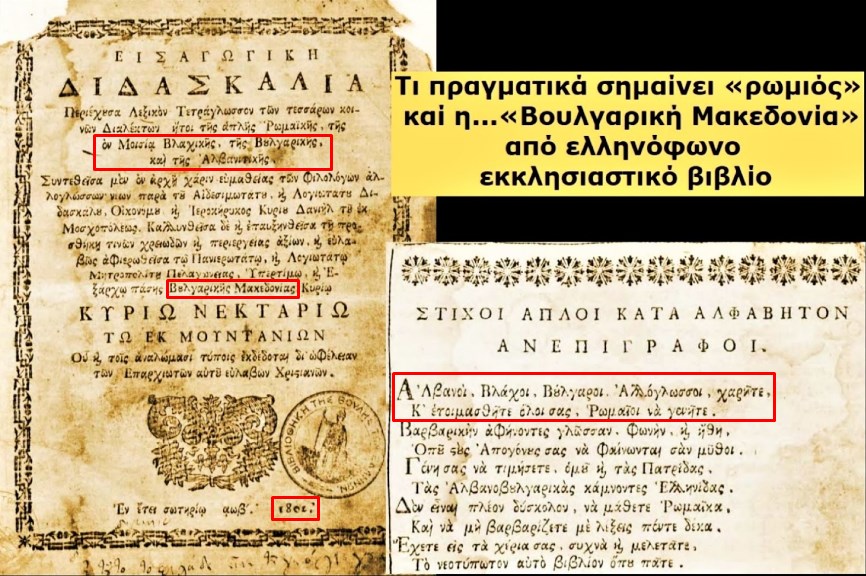
What does "Romios" really mean, and what about ... "Bulgarian Macedonia".


This book, which it says is intended for teaching, is a dictionary of the Vlach, Bulgarian and Albanian languages. It was published in 1801 by Nektarios (a priest himself) from Moudania of Asia Minor and addressed to the "pious Christians". It is a pure ecclesiastical creation for the purpose of ... guidance.

It is addressed to Albanians, Vlachs and Bulgarians and speakers of other languages (all "barbarian-speakers") to start preparing to become "Romaioi", that is, Romans.

He urges them to stop speaking their languages but also to leave their own morals and traditions, and forget about their ancestors too.

It is worthwhile to refer to the phrase "Bulgarian Macedonia", which, as we can see, comes from a Greek ecclesiastical book for guidance -- which seems to be something generally acceptable to the supreme ecclesiastical hierarchy of "Phanar".

Why else, or where would anyone dare publish such a book without their approval?
 
This is from a native of Bulgaria Evguenia Davidova:

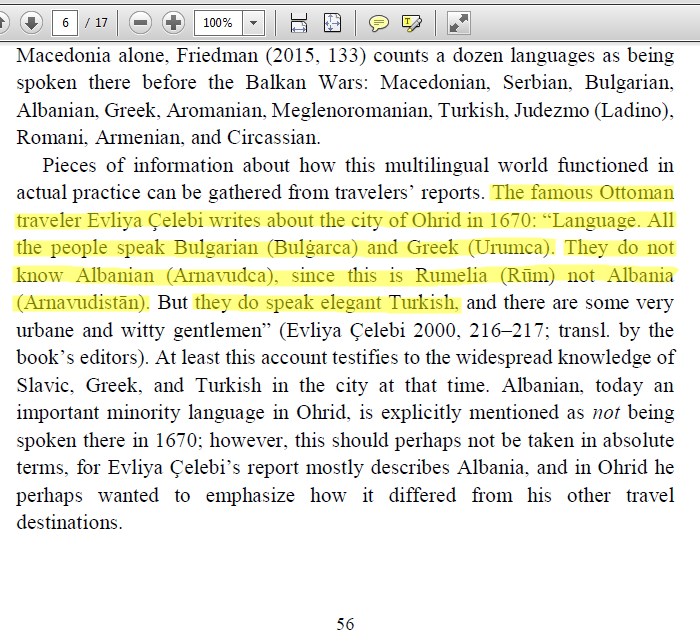
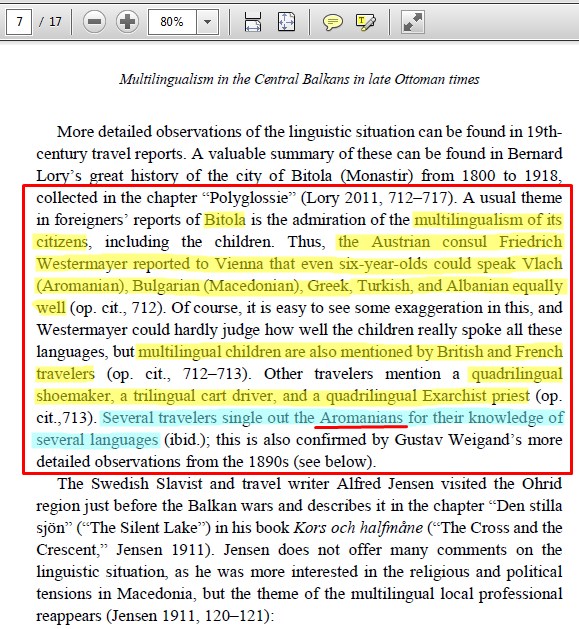
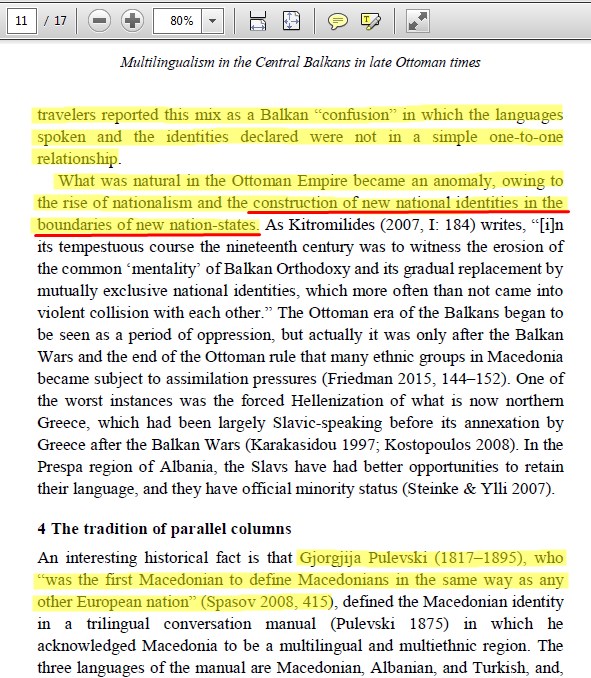
"These multilingual practices were commented upon by many contemporaries. Consider the example of the Russian female traveler Maria Karlova, who visited Macedonia in 1868. She was impressed by the "Bulgarians" in Negoš who knew both Greek and Bulgarian but preferred Greek «as a more cultured and fashionable language» in society and "Bulgarian" at home and in the surrounding villages. As well, the Bulgarian teacher Rada Kirkovich described Plovdiv around the mid-1860s as still very hellenized with regards to language:

"Bulgarian language was appreciated only in Marasha, Karshiaka [neighborhoods] and among the maids, but in the city there was rarely a family where they talk in Bulgarian. Only men were speaking in Bulgarian among themselves, and almost all their wives were speaking in Greek. There was no exception even in the families of the most prominent Bulgarian patriots."

The quote reveals not just gender but also class differences that might explain the fervent criticism against grecophone wives while sparing the reproach of their bilingual husbands. Desislava Lilova has also offered examples of Bulgarian language’s marginalization and its stigmatization as “rural” (selski).

The existence of a public language sphere vs an informal one was similarly noted by Victor Grigorovich, another Russian traveler and Slavist scholar, who also visited Macedonia in the 1840s to collect linguistic expressions. He stated that it was difficult to study Bulgarian because the population spoke either Turkish or Greek in public : «It is only in their homes, with help of the female, who is well known for being shy, that I was able to discern the [Bulgarian] lexical wealth». Grigorovich pointed out to the importance of mother’s tongue use at home, a crucial element in the subsequent national debates as Kirkovich’s quote demonstrates. He continued that especially in Macedonia, the "Bulgarians" often mix the three languages. Moreover, in schools the children of merchants and artisans studied Greek, which often was taught in a rhetorical manner, mixing everyday expressions with ancient phrases."

URL:
https://journals.openedition.org/balkanologie/2342


From George Moran:

- "The preservation of language is vital to cultural survival, and in my own travels over the Greek mountains I found it fascinating to examine why some villages preserved it better than others, and why some had lost it completely, as has happened at Namata (formerly Pipilisht), Sisanion (Shishani), and Vlasti (Blatsa) in Macedonia, until Vlachs told me why. It survives best today in villages where the Romanian schools were never established, or were forcibly closed (sometimes by Vlachs themselves), thus lessening the strife inherent in this linguistic and political coflict."

- "The Vlachs are known for their cheese-making, their flokati and spanakopita, and though the Vlahopoula of song may be romanticized, it is fact that they have always been much more than shepherds. Truth be told, this far-flung community has sent forth many leading figures in the Greek world of politics, professions, and the arts (the first prime minister of Greece Kolettis, the poets Krystallis and Zalacostas, the revolutionary Rigas Feraios, as well as names like Averoff, Tossitsa, Sturnaras, Farmakis, Zappas, Mitropanos, Kaldaras), while during the Greek War of Independence many klephts and armatoles (bandits and mercenaries) emerged from Vlach communities. The late Archbishop Athenagoras was himself a fluent Vlach speaker from Epirus. Less known, however, is the enormous business success of immensely rich Vlach merchants throughout The Balkans. The renowned Moscopolis, in Albania, once a predominantly, or perhaps entirely, Vlach town (with a Greek exterior) – the Vlach Jerusalem, as one Greek writer recently stated – resonates in Balkan history with its vibrant education and commerce, but with its final sacking in 1788, the Moscopolis Vlachs dispersed in many directions, only to enterprisingly set up shop in other towns and cities all over the Balkans. Much can be said as well of Siatista, in Greek Macedonia, where octogenarians once told me (in Greek) they "used to be Vlachs from Samarina," while praising their town for the many achievements of its native sons scattered across Europe."
 
Last edited:
URL:
https://www.ceeol.com/search/article-detail?id=12962

The Problems of the ethnic identity of Islamized Macedonians
Author: Nijazi Limanoski

Summary/Abstract:
The lslamization of part of the Macedonian population as an ethnic phenomenon on the Balkans, takes up a special place in the ethnic history of the Macedonian people. Due to the theocratic character of the Ottoman islamic empire, the islamized Macedonians and the other people with muslem religion became the object of new religious acts of this faith, through the confessional changes, they were supressed of their ethnic descent, history, and became legaly equal with the remaining people of the muslem religion. The scientific question is whether the islamization meant a total loss of national belonging or simply a change in religion. Regardless of the fact, that the islam faith evades the ethnic determination of the people, it could not prohibit the national groupation of its followers. Consequentially separate nations were formed where the islam faith spread and was the strongest (in Asia, Africa, Europe). With the reforms of Kemal Pasha Ataturk, the Turkish people finally recieved their national recognition, followed by the Albanian muslems in Albania, who were nationaly defined as Albanians. However, the problem of the islamized Slavic groups in the south Slavic countries remained (Serbians, Montenegrians, Macedonians). The islamic faith caused national isolation of the islamic population among these Slavic people, and created antagonism on religious bases. Such is the case with the islamized Macedonians. From 1945 up to 1979 the government officials neglected to make scientific use in order to ethnically determine this numerous Macedonian population, which has preserved the Macedonian language and other ethnic features, characteristic of the Macedonian people. The supressed ethnical continuity in the past was never brought to light, due to the tutorial policy over the sciences. Although the islamized Macedonians were never left unrecognized in the scientific sense, they remained politically aside. In spite the fact that the process of cultural and national renaissance was developed, the reactionary forces assisted by the obsolete belifes and delusions of the place of the religion (the islam) continue with the ethnical isolation of the Macedonian muslems from their nationality. The political interests are mixed here with the newly formed political parties of the Albanian nationality (PDP and NDP) and especially the Democratic league of the Turks and the Party of democratic action. Their aim and purpose is the assimilation of this part of the Macedonian people and subpression of their real Macedonian national identity. Obviously, the islamic legal principals both in the past centuries and today do not allow the islamized Macedonians to freely decide for the group to which they belong in a biological and ethnic sense. On the contrary they are "forced" to hide their ethnic descent and past, and on religious bases are linked to other people with which they have no ethnic ties.


URL:
https://www.ceeol.com/search/article-detail?id=253011

Ethnological Motives in the Маtеrial Culture of the Skopje Torbeshes
Author: Nijazi Limanoski

Summary/Abstract:
Тhе Markova Reka Ваѕin, which spreads in the south-west of Skopje, iѕ ап interesting ethnographic basin, including the micro region of Torbeshes. The article deals with ethnologlcal motives of the material culture of the Macedoпјап Muslims, better known under the ethnic namе "Torbeshes". The рurе Масеdonian ethnic origin of the Skopje Torbeshes сan clearly be ѕееn through them and through the entire Slavic Macedonian macro and micro-toponomy and anthropogeny of the geographical units.


VIDEO - МАКЕДОНЦИТЕ СО ИСЛАМСКА ВЕРОИСПОВЕД ЕП05:
https://www.youtube.com/watch?v=lzKwsr2o0qk
 
Last edited:
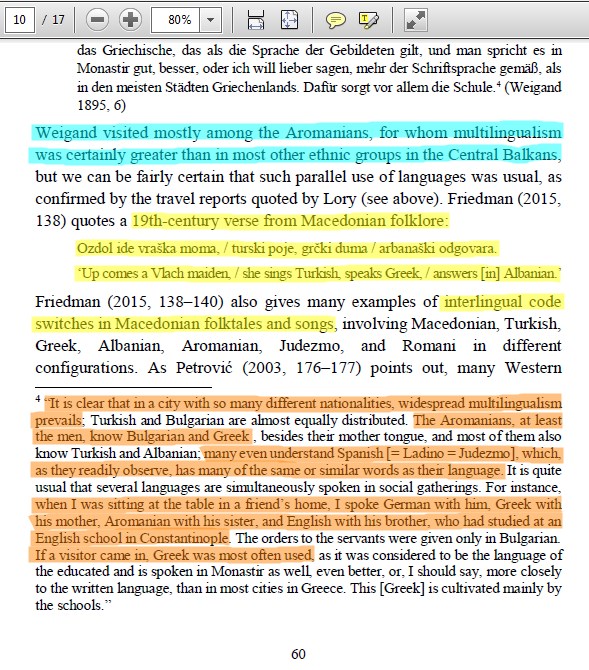
1) "Thus, there is no doubt that the Balkan languages, in our particular case Arumanian and Macedonian [a Slavic language], show a set of common structural features in their grammars, which leads...to the following question:...what was that Balkan language which has exerted the decisive structural influence upon Macedonian (and to a lesser degree upon Bulgarian and...Serbian). My contention is that this was continental Balkan Romance, or more specifically in the case of Macedonian, the primary Arumanian."

- from Zbigniew Golab, The Arumanian Dialect of Krushevo (Skopje, 1984).

2) "The Aromanians--Wallachs or Vlachs--are another people who have always lived about Ochrid. They were the great carriers of all the Balkans, and had a capital city of their own at Moschopolis, in Albania, above Korcha, where a printing press was established...They built roads and villages which show that they are among the most genuinely Roman of the nations which survived the fall of the empire. Perhaps only the Sards equal them. They have been shepherds, muleteers and traders, and became brigands too, but they were also great builders of towns like those on the hilltops of Italy (Oppida) with a feeling for stone excelled only in Dalmatia, where a large Aromanian element, the Morlachs (Sea Vlachs) settled."

- Firmin O'Sullivan, in The Egnatian Way (Pennsylvania, 1972).

3) "The Ilinden-Preobrazhenski Uprising appears to have attracted a large number of recruits to MRO's banner. According to Kral, it was most popular in Monastir Vilayet, with the majority of the people at least tacitly supporting it. In speaking about the Macedonian provinces, Brailsford corroborated this when he reported "there is hardly a village which has not joined the organization" in Monastir.

...Perhaps the most notable event of the rebellion was the Macedonian Revolutionary Organization's victory at Krushevo near Monastir. In those days Krushevo had a population of about 11,000, approximately two-thirds of which was Vlach. There for ten days a small force of MRO guerrillas, most of them Vlachs, held the mountaintop town of Krushevo and established a democratic republic. The Ottoman commander proved unable to take the town and had to be replaced. In the end the rebels were severely outnumbered and defeated but not before they put up a valiant struggle, even attempting to use hollowed-out cherry tree trunks as cannons.

Some 239 battles and skirmishes occurred in the several months of the Ilinden-Preobrazhenski Revolt. The major battles were fought in the Monastir Vilayet, especially round Monastir, Ohrid, Kostur, Lerin, Prespa, Prilep, Debar, and Krushevo as well as in the Strandzha area of Adrianople Vilayet. Provisional governments were established by MRO in Smilevo, Klissura, Krushevo, and Neveska -- the later three of which were Vlach towns and all of which were short-lived. MRO failed to consolidate its gains. In these regions inhabitants seemed to throw their support behind MRO with conviction, some even remaining in the villages despite the certainty that if discovered or caught by the Ottomans would take severe retribution. In mid to late August the soldiers of the sultan, with the strong support of the Greek bishop of Kostur, Karavangelis, mounted a sustained counterattack against the insurgents in the province. Ottoman troop strength was constantly increasing, and the outcome was inevitable."

- The Politics of Terror: The Macedonian Revolutionary Movements, 1893-1903 by Duncan M. Perry (University of Michigan, 1988)

4) "In all, the active ranks of the insurgent army in the Monastir province mustered as nearly as I can estimate some five thousand men... The Resna contingent was commanded by a capable chief named Arsof, and the northern bands around Krushevo were under a Vlach named Pitou Goule, who was killed in the second week of the rising.

The first three weeks of the insurrection were a period of almost unchecked triumph. The Turks seemed incapable of thinking out a plan of campaign, and, save in the three towns of Monastir, Ochrida, and Castoria, the insurgents were almost everywhere supreme. They took the three country towns of Krushevo, Klissoura, and Neveska -- all of them Vlach centres perched in the most inaccessible positions upon the mountain-side."

- Macedonia: Its Races and Their Future by H.N. Brailsford (London, 1906)
 
1)
3) "The Ilinden-Preobrazhenski Uprising appears to have attracted a large number of recruits to MRO's banner. According to Kral, it was most popular in Monastir Vilayet, with the majority of the people at least tacitly supporting it. In speaking about the Macedonian provinces, Brailsford corroborated this when he reported "there is hardly a village which has not joined the organization" in Monastir.

...Perhaps the most notable event of the rebellion was the Macedonian Revolutionary Organization's victory at Krushevo near Monastir. In those days Krushevo had a population of about 11,000, approximately two-thirds of which was Vlach. There for ten days a small force of MRO guerrillas, most of them Vlachs, held the mountaintop town of Krushevo and established a democratic republic. The Ottoman commander proved unable to take the town and had to be replaced. In the end the rebels were severely outnumbered and defeated but not before they put up a valiant struggle, even attempting to use hollowed-out cherry tree trunks as cannons.

Some 239 battles and skirmishes occurred in the several months of the Ilinden-Preobrazhenski Revolt. The major battles were fought in the Monastir Vilayet, especially round Monastir, Ohrid, Kostur, Lerin, Prespa, Prilep, Debar, and Krushevo as well as in the Strandzha area of Adrianople Vilayet. Provisional governments were established by MRO in Smilevo, Klissura, Krushevo, and Neveska -- the later three of which were Vlach towns and all of which were short-lived. MRO failed to consolidate its gains. In these regions inhabitants seemed to throw their support behind MRO with conviction, some even remaining in the villages despite the certainty that if discovered or caught by the Ottomans would take severe retribution. In mid to late August the soldiers of the sultan, with the strong support of the Greek bishop of Kostur, Karavangelis, mounted a sustained counterattack against the insurgents in the province. Ottoman troop strength was constantly increasing, and the outcome was inevitable."

- The Politics of Terror: The Macedonian Revolutionary Movements, 1893-1903 by Duncan M. Perry (University of Michigan, 1988)

Did you get that one from me? Can't remember if I posted the excerpt or not.
 
I don't think I got it from you.

Either way I remember reading that section of the book recently. I believe Perry stated the reason so many Vlachs took to the VMRO banner was because they were with the Exarchate. I imagine this is in reference to the Vlachs of the-then Manastır Vilayet, as the ones of the Selânik Vilayet were largely Hellenised.
 
Back
Top