• Welcome to the new Macedonian Truth Forum. All posts, members and private messages have been moved over from the old forum.

    Passwords from the old forum could not be carried over, so please use Forgot your password? to set a new one. The reset link is emailed to the address on your account.

  • Rules and Regulations at the forum of the Macedonian Truth Organisation (MTO)

    (1) The national-ethnic and cultural-linguistic identity of the Macedonian people is historically Macedonian, and derives its character from the native, indigenous and geographic homeland of the Macedonians, which is called Macedonia. To ensure that their human rights, integrity and heritage are appropriately respected, the only nouns and adjectives acceptable when reference is made to the above character and identity markers is Macedon, Macedonia, Macedonian and Macedonians.

    (2) The nation-state of the Macedonian people is the Republic of Macedonia, and is to be referred to by this official title so long as the 'republic' prefix is consistently applied to other states. Alternative references are the Macedonian Republic, or simply, Macedonia.

    (3) The 'ethnic' prefix is only acceptable for Macedonians in cases where differentiation is specifically required - so long as it is in context and consistent where it concerns its application to other ethnic groups.

    (4) Should any other differentiation be specifically required, the names of other ethnic groups that reside with Macedonians in either the Republic of Macedonia or the occupied Macedonian regions in Greece, Bulgaria, Serbia or Albania, are to be given a prefix.

    (5) Negating the identity, language and culture of the Macedonian people by deliberate avoidance of the terms Macedonia, Macedonian and Macedonians, or by any other means, is not permitted.

    (6) Systematic anti-Macedonian propaganda and rhetoric are not permitted.

    (7) Threads irrelevant to the Macedonian Cause, the community at the Macedonian Truth Organisation or the Macedonians in general may be considered as spam or not in the spirit of the forum. In such cases they are not permitted.

    (8) Continual posting of messages in threads with the sole purpose of deviating from the initial topics with the use of unrelated and unnecessary information is not permitted.

    (9) All posts, external articles, reports, etc that are cited in languages other than Macedonian or English, must be accompanied with a translation in one or both of the said languages.

    (10) Despite the possibility of some conversations and debates becoming heated, extreme abuse and/or racism, vulgar language and/or terminology, threats, revelation of personal information about others, harassment, and other such behavior will not be permitted. If deemed necessary all relevant information including member details will be reported to the appropriate authorities for investigation which may result in legal action.

    (11) Threads that are created must have a summary of a topic or excerpt of an article found in pertinent link(s) that have been included. One line threads will be considered unaccetable spam and are therefore not permitted.

    (12) Compulsive and deliberate lies, irrespective of the topic, are not permitted.

    (13) Any symbols or avatars found to be perceived as offensive to Macedonians are not permitted.

    (13) Any explicit or extreme material is not permitted.

    Failure to adhere to the above rules and regulations will result in a ban after 3 breaches. This may be reconsidered in some cases should the circumstances be of an unorthodox nature and/or require special consideration. To assure an effective deterrent against an individual or individuals with the sole purpose of causing dissent through spamming, racism or other improper means, the above rules will be strictly enforced.

    The MTO administration will monitor all discussions as reasonably practical and reserve the right to remove any post and/or member from the forum, and update the rules and regulations as required. Members are encouraged to immediately report any post and/or member to the MTO administration if they feel that these rules have not been abided by.

    The views expressed on this forum are those of the individuals. The only official representation of the MTO is made by the "Macedonian Truth Organisation (Site Owner)" username, and no other.

  • Macedonian Cause

    The Macedonian Truth Organisation calls on God in Heaven to protect, bless and guide the endeavour it is committing to undertake, and that is to work towards:

    Securing Macedonia as a free, independent and democratic republic in which sovereignty lies with the Macedonian citizens; as the nation-state of the Macedonian people in which they can preserve their culture, language and identity; as a state in which the Macedonian language and culture form the basis of public life and act as important unifying elements of Macedonian society; as the home of all its citizens to which it guarantees and obliges their inalienable natural rights and corresponding responsibilities;

    The acknowledgment as self-evident and irrefutable the existence of the:

    1) Indigenous, ethnonational name of Macedonia;
    2) Macedonian people, language and identity;
    3) Macedonian culture, symbols and folklore;
    4) Macedonian ancestry, heritage and history in its entirety; and
    5) Macedonian Orthodox Church;

    Securing recognition by the International Community of the tragedies endured by the Macedonian people, of the division of Macedonia with the signing of the Treaty of Bucharest on August 10, 1913, and the genocide committed against the Macedonian people at the hands of the Greek, Bulgarian and Serbian states and their respective churches during the 19th and 20th centuries;

    Ensuring that the Interim Accord is declared ‘null and void’ and that all constitutional provisions, acts, commitments, agreements, legislation, regulations, policies or programs emanating from, supporting or consequential to the Interim Accord are also declared ‘null and void’, including the use of any symbols and the completion of any acts imposed by, or originating from, the Interim Accord.

    Ensuring that the Framework Agreement is abolished and that all constitutional provisions, acts, commitments, agreements, legislation, regulations, policies and programs emanating from, supporting or consequential to the Framework Agreement are also abolished and replaced by a framework of constitutional and statutory law based on inalienable natural rights and corresponding responsibilities and universally codified human rights mechanisms.

    Securing the abolishment of any existing constitutional provisions, acts, agreements, legislation, regulations, policies and programs that discriminate against the Macedonian people, in any international organisation or any of the countries of the International Community where such constitutional provisions, acts, agreements, legislation, regulations, policies and programs exist, and thereby ensuring the freedom for Macedonians to exercise their inalienable natural rights and fulfil their corresponding responsibilities, and practice their culture, language and religious faiths in all the countries of the International Community without hindrance;

    The empowerment of Macedonians to undertake a moral revolution and to instil and/or reinvigorate within themselves a deep-rooted national, cultural, linguistic and historical dignity and a commitment to the exercise of freedom based on inalienable natural rights and corresponding responsibilities;

    The recognition of the Macedonian minorities in the neighbouring states of Macedonia as well as the respect for the inalienable rights and freedoms of the Macedonian minorities, as provided for by natural law and as codified by the United Nations Charter, the Universal Declaration of Human Rights and other universally codified human rights mechanisms;

    The full and unreserved respect of, and the support for, the rights of all people of non-Macedonian descent living in Macedonia and around the world, who share a reciprocal full and unreserved respect for the Macedonian people, their homeland and their state;

    The cultural unification and solidarity of the Macedonian people living in all parts of historical Macedonia and adjacent territories, as well as Macedonians throughout the world;

    The unity of all Macedonians on the principles, objectives and achievement of the Macedonian cause as defined by this declaration.

Population of Macedonia and Adjacent Areas

avgMSk.jpg
 

Is this from Duncan Perry?

The author ignored who were the Greeks of southern Macedonia as far north as Monastir and of the major trading centers in Macedonia. It seems that he ignored it, because he knew about it - as he wrote in the subsequent paragraph "Many Vlachs were quite hellenized and often were indistinguishable from Greeks or otherwise".

It is known who the Totality of native Greeks of Kozani, Siatista, Sisani, Kostur, Klissura, Salonica, etc. are.
 
Last edited:
- The city of Salonika housed a major Jewish community, mostly Eastern Sephardim, until the middle of the Second World War. It is the only known example of a city of this size in the Jewish diaspora that retained a Jewish majority for centuries.

Sephardic Jews immigrated to the city following their expulsion from Spain by Christian rulers under the Alhambra Decree in 1492. This community influenced the Sephardic world both culturally and economically, and the city was nicknamed la madre de Israel (mother of Israel).

- In 1430, the start of Ottoman domination, the Jewish population was still small. The Ottomans used population transfers within the empire following military conquests to achieve goals of border security or repopulation; they called it Sürgün. Following the fall of Constantinople in 1453, an example of sürgün was the Ottomans' forcing Jews from the Balkans and Anatolia to relocate there, which they made the new capital of the Empire. At the time, few Jews were left in Salonika; none were recorded in the Ottoman census of 1478.

- Salonika's registers indicate the presence of "Buda Jews" after the conquest of that city by the Turks in 1541. The Jewish population of the city was 20,000 in 1553. Immigration was great enough that by 1519, the Jews represented 56% of the population and by 1613, 68%.

URL:
https://en.wikipedia.org/wiki/History_of_the_Jews_in_Thessaloniki
 
Is this from Duncan Perry?

The author ignored who were the Greeks of southern Macedonia as far north as Monastir and of the major trading centers in Macedonia. It seems that he ignored it, because he knew about it - as he wrote in the subsequent paragraph "Many Vlachs were quite hellenized and often were indistinguishable from Greeks or otherwise".

It is known who the Totality of native Greeks of Kozani, Siatista, Sisani, Kostur, Klissura, Salonica, etc. are.

This is Perry yes.
 
According to Pianka Włodzimierz the origins of the name Labuništa are Greco-Latin from the toponym Albanopolis. The explanation seems pretty fanciful.

URL:
https://en.wikipedia.org/wiki/Labuništa

Labuništa is a old name dating back to the time of the arrival of Slavic peoples to the Balkans. The origins of the name Labuništa are Greco-Latin from the toponym Albanopolis. Pianka Włodzimierz connects the placename Labuništa with a south-western Balkans settlement of antiquity named Albanopolis, a city marked on an ancient map by Roman geographer Ptolemy. Through metathesis the name Albanopolis entered Slavic where the suffix polis meaning city became išta with dual meanings of either being a patronymic or indicating a place. While the form Alban, a name, underwent metathesis and became Labun in Slavic of which the syllable cluster an became un giving the final form as Labun(išta).

Włodzimierz, Pianka (1970). Toponomastikata na Ohridsko-Prespanskiot bazen. Institut za makedonski jazik "Krste Misirkov". pp. 63–64.

"Приближно на местото каде што се наоѓа Лабуништа на картата од Птоломеј (преиздадена во 1490 год.) е обележена тврдината Albanopolis; на картата од Hassius (1744 год.) е означено: Albanopoli in ruin. (в. Јаранов, Карта - текст). Словенечкиот топоним е само адаптација на грчкиот: вториот член - polis (кој всшност има функција на суфикс) е заменет со словенечкиот суфикс -иште со двојно значење: 1. nomen loci, 2. (<* iti̯o-) patronimicum. Бијкејќи членот Alban- е име, може да се претпостави дека овде си помешале двете функции на овој суфикс: тој означувал 'потомци' на Alban' и 'место каде што се наоѓала тврдината Albanopolis, впрочем тоа е веќе чисто структурална функција. Коренот Лабун- е континуација на Албан- со метатеза и македонската замена на крајно то -ан- во -ун- (спор.: лат. Salona, Albona, слов. Salona, Albona, сх. Solin, Labin, мак. Солин, Лабун- (нашиов случај), макар што се однесуваат на различни објекти (Романски С.: Именета на некои македонски градове, 1. Солунъ, МПр V, кн. 2, с. 78-84). Словенскиов топоним, значи, е многу стар, потекнува од времето на населувањето на Балканот од страна на Словените и континуација на уште постар грчко-латински топоним."
 
According to Gustav Weigand in the Struga kaza there are 12,000 Albanians (among them several hundred Turks), 16,000 Macedonians (which Weigand calls Bulgarians), and 1200 Vlachs.

In the Ohrid kaza, the Macedonians predominate: 25,000 Macedonians, 1500 Albanians, the rest are Vlachs, Turks, Gypsies.

Also in the Resen kaza according to Weigand there are 17,500 Macedonians, 4500 Turks (?), 1500 Albanians, 1000 Vlachs. (Perhaps the number of Turks includes many Albanians.)
 
May 31, 2019

Vasil Sterjovski in the Albanian parliament talking about Golo Brdo:
https://www.youtube.com/watch?v=u80cRLoP-jA

In his address to the Albanian parliament Sterjovski expressed his concern about the situation in the area of Golo Brdo, which is the poorest area in the Republic of Albania with many socio-economic problems.
 
1) RENE PICARD, “THE AUTONOMY OF MACEDONIA” (1457)

20th July 1916


URL:
https://thedocumentarynews.wordpress.com/2012/01/08/rene-picard-the-autonomy-of-macedonia/

"The idea of Macedonian autonomy is familiar to all those who are acquainted with Balkan history and politics. If we asked the Christians of Macedonia they would answer that autonomy was the most desirable solution for them.

There is and, in fact, there has always been a Macedonian spirit in Macedonia. Geographically, Macedonia has its own unity. Its borders are the following: to the south – Mt Olympus, the mountains on the north bank of the River.. Bistrica, Lake Prespa and Lake Ohrid; to the west -the Drim from Debar; to the north-west and north -the Sar Mountains, the highlands north of Skopje, the defile of Kumanovo, the mountains that mark the Serbo-Bulgarian frontier of before 1912; to the east -the Rhodope Mountains.

The borderline with Thrace on this side is not clear. The regions of Drama and Kavalla can either be adjoined to Macedonia or separated from it; the plain of Drama is populated mostly by Turks; the town of Kavalla, like all the ports, has a strong Greek colony. To the south, the Chalcidice Peninsula is geographically Macedonian, but ethnographically Greek; the line of lakes separates it by a natural border from the rest of Macedonia.

Within these borders Macedonia has the natural basins of Skopje, Bitola, Veles, Serez, Drama and Salonika with the mountains that separate them and the narrow valleys that unite them. The Christian population in the country side is Slav. It is known to be neither quite Bulgarian, although it is closer to the Bulgarians, nor quite Serbian. The Bulgarians themselves admit that the Macedonians differ from the other Bulgarians: they possess a more lively spirit, are more fond of politics and intrigue, more inclined to eloquence and the arts, also more cunning; in a word, they are a little Hellenized. The Macedonian politicians in Sofia are feared; many Bulgarians of old Bulgaria would be glad to see the Macedonian Bulgarians return to Macedonia. They accuse them of taking everything away from them, their jobs and privileges. ....."


2) RUDOLPH ARCHIBALD REISS ON THE MACEDONIANS (1467)

1918


URL:
https://thedocumentarynews.wordpress.com/2012/01/08/rudolph-archibald-reiss-on-the-macedonians/

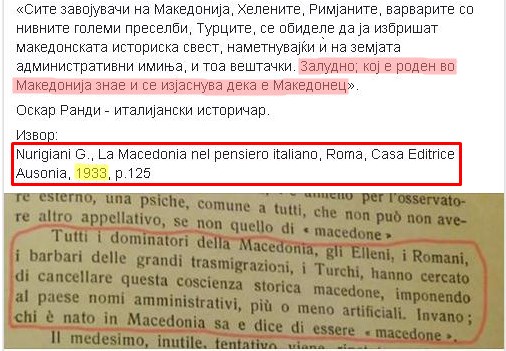
"I said that I would rather call your Bulgarophones Macedonians. You call those people
Bulgarophones, owing to their language which is similar to Bulgarian. But, is it Bulgarian,
is it the same language spoken in Sofia? No. Macedonian is just as similar to Serbian as it
is to Bulgarian. I am not a linguist and I would not allow myself a personal judgment, but
disinterested Balkanologists have asserted to me that Macedonian is more similar to
Serbian than Bulgarian. It is possible that there are linguists who assert the opposite. But it
is a fact that the Macedonian language is spoken neither in Sofia nor in Belgrade. It is an
individual Slav language, just as we have the Romansch in Switzerland, spoken in Grisons,
apart from Italian. To my mind, the Macedonian can be called neither Bulgarian nor Serb,
but simply Macedonian."
 
Last edited:
URL - ВАТИКАНСКА ЗБИРКА СО ТАЈНИ ДОКУМЕНТИ ЗА МАКЕДОНЦИТЕ: Епископ Македонски од татковината на Александар, Блаже Миневски:
https://denesen.mk/vatikanska-zbirk...eaGebG3IyUcQkkVKLM0BIq5EYIRPves7mvIUd-Uk2bRAg

Scholarships for Macedonians ... in 1619

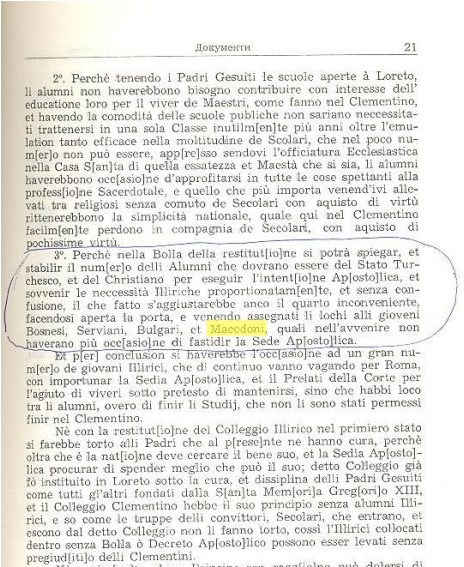
A document dating back to 1624 talks about the renewal of the Illyrian College, which means the Slavonic College of Loreto (as explained to us by B. Minevski), which was founded in 1580. At first, 40 students attended the college at its inception.

In 1593, the same college was moved to Rome, and the number of students was reduced to 12.

In 1619, the Dalmatian bishops asked that Pope Paul V decide that the College should return to Loreto and at the same time allocate places to cadets "Serbs, Bulgarians and Macedonians who in the future will have no reason to address the Holy See for scholarships".

L2eniSN.jpg
 
Last edited:
URL:
https://www.ancient.eu/article/1401/the-celtic-invasion-of-greece/

SHQUqwH.jpg


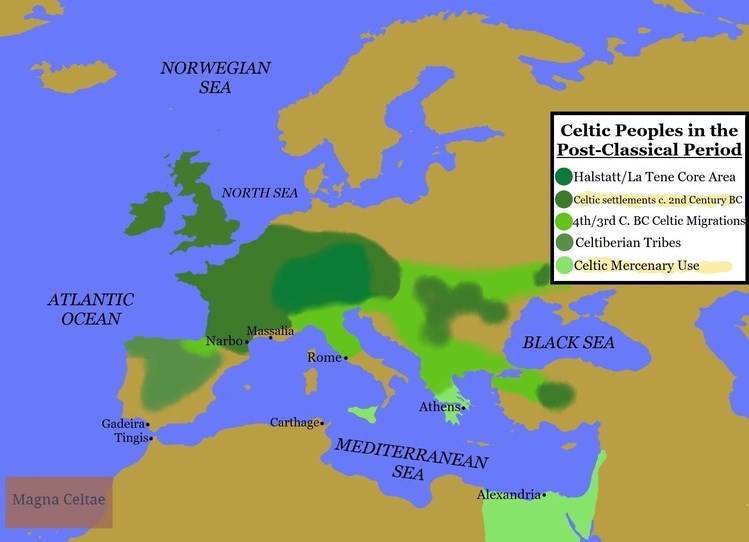
"Celtic tribes moved into Thrace and Illyria, defeating the local tribes, before advancing even further south. In 280 BCE, a large coalition of around 85,000 Celts headed for Macedon and Greece. This figure included women and children, as these were also tribal groups rather than organized armies.

A Celtic leader named Bolgios was sent with the remaining army to Macedon. In 279 BCE, Bolgios plundered the countryside of Macedon and went up against the army of Ptolemy Keraunos (r. 281-279 BCE), who had only just seized the Macedonian throne. Ptolemy Keraunos was killed in battle, and the Celts placed his head on a spear as a bloody trophy. This began roughly two years of anarchy as the Balkans were without strong central leadership, and the Celts were on the warpath."

URL:
https://www.ancient.eu/image/3687/map-of-celtic-and-germanic-tribes/

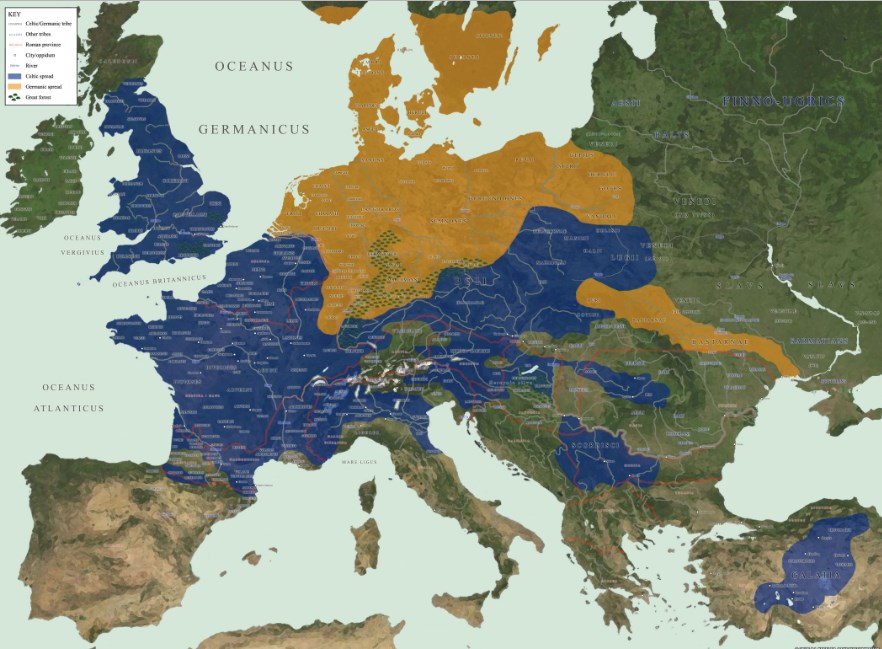
This map shows the various Celtic and Germanic tribes around circa 52 BCE (Blue=Celtic, Yellow=Germanic).
9OZaL4V.jpg
 
Last edited:
- In the year 358 AD the servile Sarmatian tribe the Limigantes came in revolt against the leading tribe, the Argaragantes in an internal Sarmatian war and they expelled their masters. These warrior nobility received a warm welcome in the Roman Empire and got settlements for them and their families in different provinces in the heartland of the Empire in Thracia, Macedonia and Northern Italy.

- Emperor Valentinian II (375-392) strengthened the borders of Pannonia by concluding new treaties foedera with the Sarmatians and Goths and offers them settlements on the Roman side of the Danube in Pannonia. It is mentioned that the majority of the Sarmatians was still living east of the Don. Sarmatians stayed in the Pannonian Plane still after the time of the Hun invasions.

- 450, in the time of the raids of the Hun Attilla groups of Sarmato-Alans were installed under their leader Candac as Foederati in the Danube valley in Little Scythia, now Bulgaria.

https://www.marres.education/sarmatic_traces.htm


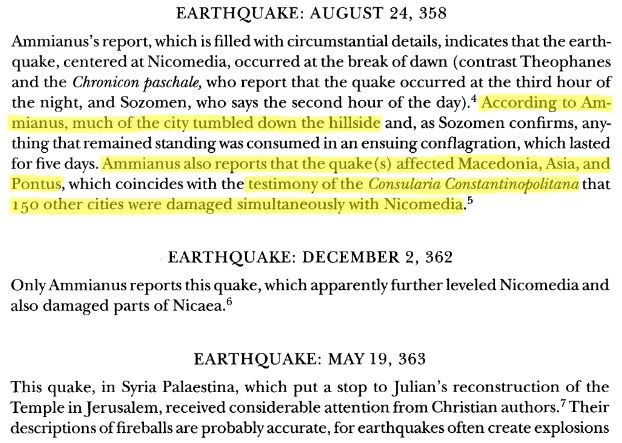
PS: In August 358 a series of earthquakes, accompanied by at least one tsunami, hit Asia, Macedonia (only the coastal areas/towns were likely affected), and Pontus and devastated numerous cities. The most notable casualty was the city of Nicomedia (in what is now Turkey) on 24 August. The earthquake caused extensive devastation to Nicomedia which was followed by a fire which completed the catastrophe. Nicomedia was rebuilt, but on a much smaller scale.
xGoLU5I.jpg
 
Last edited:
The Islamization process is held to have occurred in Golo Brdo relatively late in Ottoman times. In 1519, the region was still entirely Christian.

Some authors have held that the Islamization process in Golo Brdo to have occurred in the late 18th century, whereas others asserted that the impetus to mass Islamization in the region was the bedel tax, imposed only on Christians because they were not drafted and initiated in the region in the year 1832. According to this second theory, this tax was particularly harsh and caused many families to turn to Islam as a means of avoiding it. During the same period, a mass emigration process occurred, and many Muslim families settled elsewhere, including in Debar, and in Struga's Drimkol region.

The families that settled in Debar became Albanized, but retain memory of their origins which are denoted by their last names, including Klenja, Trebishta, Ostreni, Torbaçi, Serpetova, and others.

URL:
https://en.wikipedia.org/wiki/Gollobordë
 
Gardīzī told about the territory of Hungarians: "The Hungarians' country is situated between the territory of bulkars and eskils, who date back to the bulkars. (...) Their country reaches the Rum-sea [Black Sea]. (...) The two rivers, which flow into the Rum-sea, are called Atil [Volga] and Danube."

He wrote the following text about the Hungarian people and their culture: "These Hungarian people are pretty and handsome. Their clothes are made of brocade. Their weapons are decorated by silver and gold. In the time of proposal they have to pay for the girl, mainly they give animals. But it can be the fur of ermine, squirrel, mart or fox."

The records of Gardīzī are similar to the records of Ahmad ibn Rustah. Both of them used the notes of Ibn Harrudadbhi, called Roads and Countries as their sources, but Ahmad ibn Rustah used an older and Gardīzī used a newer one, so Gardīzī's texts contain additional information as well. For instance: "On the left [=western] side of the territory of the Hungarians near the river of Slavs there is a Christian tribe of Rum, and they are known as Wonondur."

URL:
https://ipfs.io/ipfs/QmXoypizjW3WknFiJnKLwHCnL72vedxjQkDDP1mXWo6uco/wiki/Abu_Sa'id_Gardezi.html

"Wonondur" seems to refer to Onogur-Bulgars.
 
"Immediately after his decisive victory over the Persians in 626 the emperor Heraclius turned his attention to the former Balkan provinces of the empire. Certain of the measures then taken had a lasting effect upon the history of the north-western Balkans. The Croats, a people probably of Sarmatian origin and living among Slavonic tribes in Bohemia and Silesia, were encouraged by the Byzantines to revolt against the Avars and to settle in the region south of the Save and behind the Dinaric Alps, where they speedily established themselves as the dominant power. Their rulers accepted Christianity from Byzantium, though they later lapsed, and it was from Rome, via the surviving Dalmatian cities, that the later conversion of the Croat people proceeded. Another half-Slavicised Sarmatian people, the Serbs, also revolted against the Avars, left their home somewhere in Saxony and were settled by Heraclius in the neighbourhood of Thessalonika... They were later, perhaps at their own request, moved to the area south of Singidunum and settled among the Slav tribes there as allies of Byzantium."

-- Byzantium and Bulgaria. A comparative study across the early medieval frontier, Robert Browning
 
Nope Bill, I’m with you in this.

I have argued in dozens of cases when Carlin presents an apparently non-Vlach village as a Vlach one.

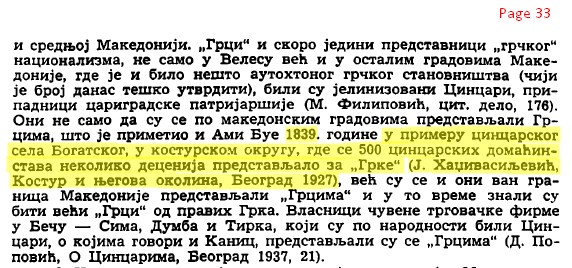
Many Greek-speaking (bilingual) Vlachs from Epirus settled in Bogatsko.

Traditions from Bogatsko indicate that, in the late 18th century, Castorians had prevented the settlement of some Epirote refugees in their city. Thus, about 70 families from different places, mainly from Moschopole, Fourka, Souli and Parga, eventually settled in Bogatsko. In 1889 according to the Serbian Spiridon Gopcevic's statistics, Bogatsko is reported to be inhabited by 3,000 Greek-speaking and Vlach-speaking Christians.

URL:
http://www.vlachs.gr/el/various-articles/h-vlahiki-parousia-stin-perioxi-tis-kastorias

I really wish we had information on the other villages, (and maybe if we dig hard enough we'll find it), but I think the information we have on Bogatsko is a good "sample" or representative for the rest of the Greek speaking villages.

In the book by Dragan Taskovski, "The birth of the Macedonian nation" (in Serbian), Bogatsko is explicitly called a Vlach village. Ultimately it appears to be a source from 1839, Ami Boue. The 500 Vlach households of Bogatsko have declared themselves as Greeks for many many decades.

kD8dSnv.jpg


PDF:
http://kok.memoryoftheworld.org/Dra...anje makedonske nacije - Dragan Taskovski.pdf
 
Last edited:
According to 19th-century Belgian testimonies that refer to the villages of Korca (Gorica) and Devol, inhabited by ethnic Macedonians, but under Albanian pressure accepted the Albanian language, that is, they Albanized or Islamized in order to receive Ottoman protection.

It is noted that massively, the Macedonian peasants from Korca and Devol, who spoke Macedonian as their mother tongue, adopted the Albanian language around 1870. The leaders of the villages in these areas pledged not to speak their mother tongue and to not speak it to their children.

- Magazine "Albania" Bruxelles, 15–30 June 1898, p. 32.

https://mk.wikipedia.org/wiki/Шкрети
 
Last edited:
Back
Top