• Welcome to the new Macedonian Truth Forum. All posts, members and private messages have been moved over from the old forum.

    Passwords from the old forum could not be carried over, so please use Forgot your password? to set a new one. The reset link is emailed to the address on your account.

  • Rules and Regulations at the forum of the Macedonian Truth Organisation (MTO)

    (1) The national-ethnic and cultural-linguistic identity of the Macedonian people is historically Macedonian, and derives its character from the native, indigenous and geographic homeland of the Macedonians, which is called Macedonia. To ensure that their human rights, integrity and heritage are appropriately respected, the only nouns and adjectives acceptable when reference is made to the above character and identity markers is Macedon, Macedonia, Macedonian and Macedonians.

    (2) The nation-state of the Macedonian people is the Republic of Macedonia, and is to be referred to by this official title so long as the 'republic' prefix is consistently applied to other states. Alternative references are the Macedonian Republic, or simply, Macedonia.

    (3) The 'ethnic' prefix is only acceptable for Macedonians in cases where differentiation is specifically required - so long as it is in context and consistent where it concerns its application to other ethnic groups.

    (4) Should any other differentiation be specifically required, the names of other ethnic groups that reside with Macedonians in either the Republic of Macedonia or the occupied Macedonian regions in Greece, Bulgaria, Serbia or Albania, are to be given a prefix.

    (5) Negating the identity, language and culture of the Macedonian people by deliberate avoidance of the terms Macedonia, Macedonian and Macedonians, or by any other means, is not permitted.

    (6) Systematic anti-Macedonian propaganda and rhetoric are not permitted.

    (7) Threads irrelevant to the Macedonian Cause, the community at the Macedonian Truth Organisation or the Macedonians in general may be considered as spam or not in the spirit of the forum. In such cases they are not permitted.

    (8) Continual posting of messages in threads with the sole purpose of deviating from the initial topics with the use of unrelated and unnecessary information is not permitted.

    (9) All posts, external articles, reports, etc that are cited in languages other than Macedonian or English, must be accompanied with a translation in one or both of the said languages.

    (10) Despite the possibility of some conversations and debates becoming heated, extreme abuse and/or racism, vulgar language and/or terminology, threats, revelation of personal information about others, harassment, and other such behavior will not be permitted. If deemed necessary all relevant information including member details will be reported to the appropriate authorities for investigation which may result in legal action.

    (11) Threads that are created must have a summary of a topic or excerpt of an article found in pertinent link(s) that have been included. One line threads will be considered unaccetable spam and are therefore not permitted.

    (12) Compulsive and deliberate lies, irrespective of the topic, are not permitted.

    (13) Any symbols or avatars found to be perceived as offensive to Macedonians are not permitted.

    (13) Any explicit or extreme material is not permitted.

    Failure to adhere to the above rules and regulations will result in a ban after 3 breaches. This may be reconsidered in some cases should the circumstances be of an unorthodox nature and/or require special consideration. To assure an effective deterrent against an individual or individuals with the sole purpose of causing dissent through spamming, racism or other improper means, the above rules will be strictly enforced.

    The MTO administration will monitor all discussions as reasonably practical and reserve the right to remove any post and/or member from the forum, and update the rules and regulations as required. Members are encouraged to immediately report any post and/or member to the MTO administration if they feel that these rules have not been abided by.

    The views expressed on this forum are those of the individuals. The only official representation of the MTO is made by the "Macedonian Truth Organisation (Site Owner)" username, and no other.

  • Macedonian Cause

    The Macedonian Truth Organisation calls on God in Heaven to protect, bless and guide the endeavour it is committing to undertake, and that is to work towards:

    Securing Macedonia as a free, independent and democratic republic in which sovereignty lies with the Macedonian citizens; as the nation-state of the Macedonian people in which they can preserve their culture, language and identity; as a state in which the Macedonian language and culture form the basis of public life and act as important unifying elements of Macedonian society; as the home of all its citizens to which it guarantees and obliges their inalienable natural rights and corresponding responsibilities;

    The acknowledgment as self-evident and irrefutable the existence of the:

    1) Indigenous, ethnonational name of Macedonia;
    2) Macedonian people, language and identity;
    3) Macedonian culture, symbols and folklore;
    4) Macedonian ancestry, heritage and history in its entirety; and
    5) Macedonian Orthodox Church;

    Securing recognition by the International Community of the tragedies endured by the Macedonian people, of the division of Macedonia with the signing of the Treaty of Bucharest on August 10, 1913, and the genocide committed against the Macedonian people at the hands of the Greek, Bulgarian and Serbian states and their respective churches during the 19th and 20th centuries;

    Ensuring that the Interim Accord is declared ‘null and void’ and that all constitutional provisions, acts, commitments, agreements, legislation, regulations, policies or programs emanating from, supporting or consequential to the Interim Accord are also declared ‘null and void’, including the use of any symbols and the completion of any acts imposed by, or originating from, the Interim Accord.

    Ensuring that the Framework Agreement is abolished and that all constitutional provisions, acts, commitments, agreements, legislation, regulations, policies and programs emanating from, supporting or consequential to the Framework Agreement are also abolished and replaced by a framework of constitutional and statutory law based on inalienable natural rights and corresponding responsibilities and universally codified human rights mechanisms.

    Securing the abolishment of any existing constitutional provisions, acts, agreements, legislation, regulations, policies and programs that discriminate against the Macedonian people, in any international organisation or any of the countries of the International Community where such constitutional provisions, acts, agreements, legislation, regulations, policies and programs exist, and thereby ensuring the freedom for Macedonians to exercise their inalienable natural rights and fulfil their corresponding responsibilities, and practice their culture, language and religious faiths in all the countries of the International Community without hindrance;

    The empowerment of Macedonians to undertake a moral revolution and to instil and/or reinvigorate within themselves a deep-rooted national, cultural, linguistic and historical dignity and a commitment to the exercise of freedom based on inalienable natural rights and corresponding responsibilities;

    The recognition of the Macedonian minorities in the neighbouring states of Macedonia as well as the respect for the inalienable rights and freedoms of the Macedonian minorities, as provided for by natural law and as codified by the United Nations Charter, the Universal Declaration of Human Rights and other universally codified human rights mechanisms;

    The full and unreserved respect of, and the support for, the rights of all people of non-Macedonian descent living in Macedonia and around the world, who share a reciprocal full and unreserved respect for the Macedonian people, their homeland and their state;

    The cultural unification and solidarity of the Macedonian people living in all parts of historical Macedonia and adjacent territories, as well as Macedonians throughout the world;

    The unity of all Macedonians on the principles, objectives and achievement of the Macedonian cause as defined by this declaration.

Population of Macedonia and Adjacent Areas

Edmund Spencer: A Journey from Ohrid to Janina, 1850

Captain Edmund Spencer was a British travel writer of the mid-nineteenth century.

1) "I was this time accompanied by a native of Macedonia, as a kiraidji; he was an excellent fellow in his way, spoke a little Italian, which, with his own patois, a mixture of Albanian, Slavonian, Greek, and Turkish, enabled us to understand each other. Among his other qualifications, as a kiraidji, he was lively and communicative, knew the country well, and the character of the inhabitants, and how to avoid danger while travelling through a land in so disorganised a state as Albania; he was also full of anecdote, whether real or imaginary, and among other things amused me with accounts of the great antiquity of his own family, for Stefa was nothing less than a descendant of the Macedonian Kings!"

2) "With all the quickness and sharp intellect of the Greek, Stefa combined the honesty of the Slavonian, but he was one of the ugliest men I ever saw, the greatest talker, the most slavish flatterer and coward in existence; these little foibles, however, did not retard his worldly success, for he was considered to be very wealthy by his townspeople at Strouga."

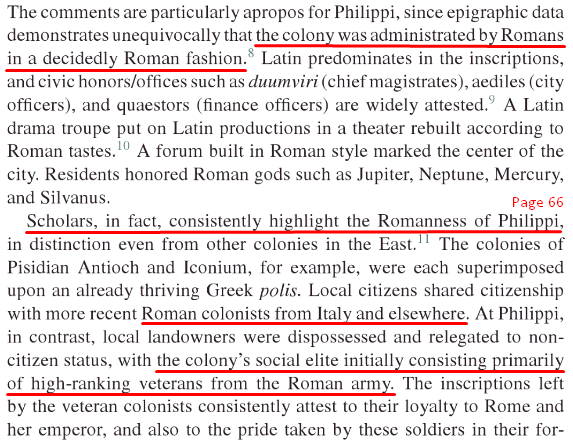
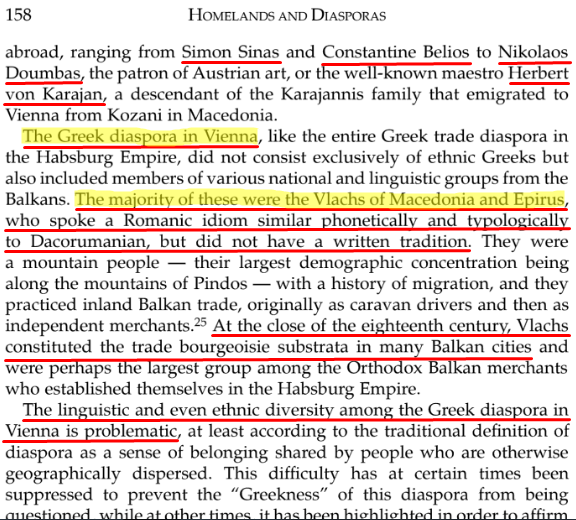
3) "In short, the only drawback to my amusement, was my inability to hold converse with our warlike companions, except through the medium of two bad interpreters, Stefa and the hanji – a Zinzar [Vlach], whose native tongue, the Roumaniski, somewhat resembled the Latin."
 
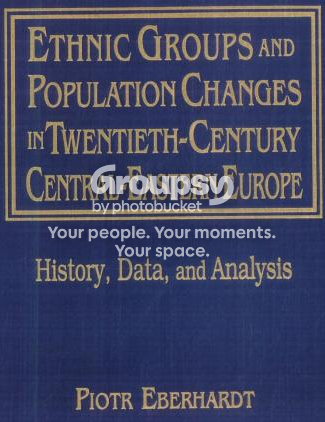
piotr.png

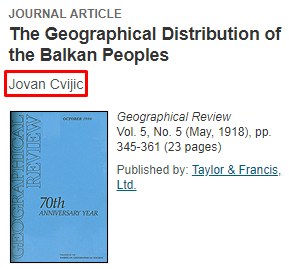
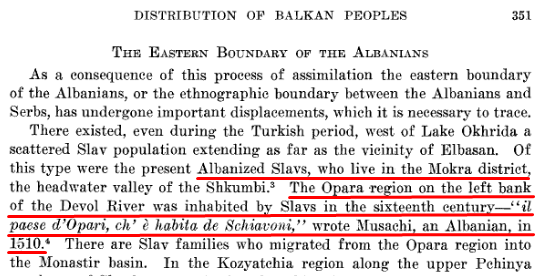
page 352
piotr352.png

piotr353.png

Interesting.
 
- John Chrysostom reported in a sermon held in 399 AD that the Thracians had translated the scriptures into their own language. This message agrees with other accounts of the existence of the Thracian language in the 4th century, which shows that big part of the Thracians, probably the village masses, understood very little to no Greek and Latin (languages in which the Christian teachings were usually preached).

- According to Procopius the term Ῥωμαῖοι (Romaioi) means not only those who spoke Latin, but also those who were Eastern Roman, that is, "Byzantine" subjects. One illustrative example in this respect is the following example: μετὰ δὲ τῶν τινα Ῥωμαίων, Βέσον γένος Βουρκέντιον ὄνομα, ὑπὸ Ναροῇ τεταγμένον τῷ Ἀρμενίῳ. That is, the Thracian Burkentiu was a Roman citizen, a Bessian by tribal (ethnic) origin, and a serviceman of the Armenian Narses.

- In Chap. VII of the third book of his work "On Buildings", Procopius reports that Thracians (still) lived in Anchialus/Pomorie. [Pomorie is a town in southeastern Bulgaria, located on a narrow rocky peninsula in Burgas Bay on the southern Bulgarian Black Sea Coast.]

- According to Theophanes, in 505 AD, Emperor Anastasius sent troops against the Persians, composed of Goths, Bessi, and other Thracian tribes: στρατιὰ Γότθων τε καὶ Βέσσων καὶ ἑτέρων Θρᾳκίων ἐθνῶν. One commander of the same emperor bears the Thracian name Ζήμαρχος (Zímarchos).

- According to Priscus, the "Byzantine" commander Dionysius, who was willing to go as a messenger to the Huns (in 433 AD), was a Thracian: Διονύσιος δὲ τοῦ Θρακίου γένους.

- Around 492 AD, Emperor Anastasius sent an army composed of Bessi, Goths, and Scythians (μετὰ πλήθους Σκυθῶν καὶ Γοτθικῆς καὶ Βεσσικῆς χειρός) against the rebellious Isaurians.

- The Thracian miners were subjected to very heavy taxes and were forced to leave their places of residence and seek asylum in neighboring areas. To stop this escape, in 370 AD Emperor Valentinian I issued an order commanding all Thracians who had fled to Illyria and Macedonia to be returned to their native places.

- At the Ecumenical Council in Serdica in 343 AD the bishop of Heracleia Theodore was deposed, who according to Sozomen was a Thracian: καθεῖλον δὲ τῆς ἐπισκοπῆς Θεόδωρον τὸν Θρᾴκα.
 
Last edited:
'Liturgier Armanesc' was written in the early 18th century. It was discovered in 1939 at the National Library of Tirana by Ilo Mitke-Qafezezi, who transcribed the Vlach text in the Albanian alphabet. This manuscript was lost during World War II. The text was written in Greek characters and covers 24 pages.
 
https://el.wikipedia.org/wiki/Φιέρι
https://en.wikipedia.org/wiki/Fier

1) Koukoudis, Asterios (2003). The Vlachs: Metropolis and Diaspora. Thessaloniki: Zitros Publications. page 359:
"Until the beginning of the twentieth century, Fier was inhabited almost exclusively by Vlach-speaking -with a few Albanian-speaking- Christians."

2) Fier Municipality. "History of the city" (in Albanian). Fier Municipality. Retrieved 2010-08-06:
"The first inhabitants of the city were the servants of Kahreman Pasha Vrioni and members of Vlach families that had lived in the area since the early 19th century period."
 
On the ethnographic map of the Serbian scholar S. Davidovic (1848), published in Belgrade, and at the expense of the Serbian government, the cities of Nish, Vranje and Skopje are designated as non-Serbian.
 
Does he expand on what the demography of these cities looked like?

I don't know, it is literally one sentence. The specific quote comes from the book "La Situation Juridique des Macédoniens en Yougoslavie", by Karl Strupp. I have not found or searched yet for the original work by S. Davidovic.
 
Theodor Capidan (1879–1953) was a Romanian linguist. He was born into a Vlach family in Prilep, Macedonia. He studied at Leipzig before teaching school at Salonica.

Capidan was interested in toponymy, particularly south of the Danube. During his Leipzig days, he delivered a report on the Slavic place names of Thessaly and Epirus. Over the years, he offered etymological explanations for a large number of place names. He used several of these to argue for the idea that certain Vlachs were native to Greece, basing the theory on their phonetic transformations found only in the Latin elements of Romanian.

In his book Farserotii (Studiu Lingvistic Asurpa Romanilor Din Albania), published in 1930 he had the following to say about the ethnic composition of Lerin. Prior to the Balkan Wars he wrote there were very few Romanians in Lerin. There were Turks and Muslim Albanians but they were expelled to Asia Minor. After the wars, a large number of Vlachs and (Christian) Albanians moved to the city:

"The Vlachs come from Bitola and the Romanian municipalities around this city, such as Magarevo, Trnovo, Nizhepole, Krushevo, etc. Unhappy with the Serbian regime, which closed their schools and churches, they moved to Greek cities... They are engaged in trade, especially the restaurants kept by them... Albanians come from the area of ​​Korcha. Some of them traded in Lerin before the Balkan War; others arrived from there during the riots in Albania in 1914-1915. Without being Greek, they are all Greek and do not want to know about what is happening in Albania, which they unfairly call Second Turkey..."
 
From Constantine Papanache's "Macedonia" newspaper, year 1955. Issue number 9, page 6:
zPrBDv0.png


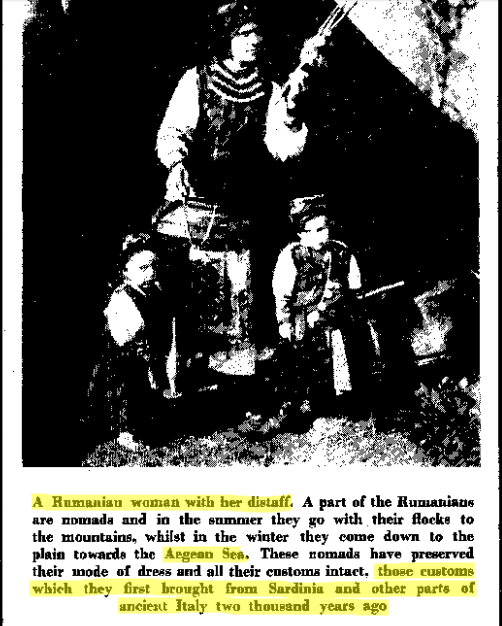
It's a very small sample size but it is curious that in the Sardinian language the word for 'language' is limba, while the word for 'water' is abba.

These could be natural variations caused by phonetic laws; it doesn't mean that the Vlachs are related to the Sardinians. But, it is very surprising and unexpected.

URLs:
https://books.google.ca/books?id=Re...VAhUo94MKHejiCYAQ6AEIMTAC#v=onepage&q&f=false
https://en.wikipedia.org/wiki/Sardinian_language
 
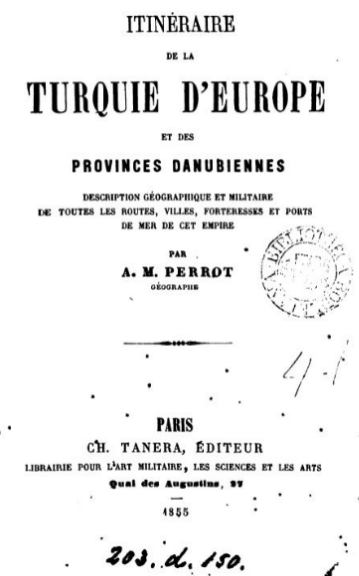
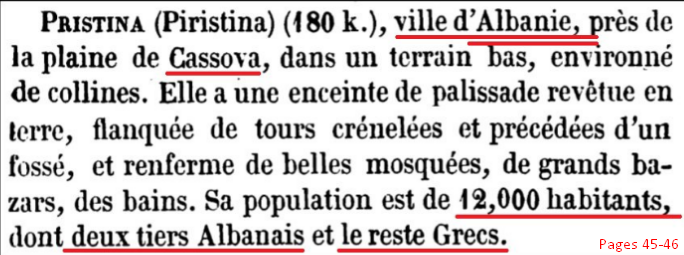
The testimony comes from a French source (Perrot), from 1855. Let's see what was the "ethnic composition" of Prishtina, Kosovo according to Perrot.

lJG9DPF.png

6NZbpn0.png


As we can plainly see, the population of Prishtina was: "12,000, of which two-thirds are Albanians and the rest are Greeks."

Let's break it down and analyze this in more detail. Branislav Nushich, in 1902, talks about the diverse ethnic composition of Prishtina:

"Prishtina is a compact town; houses do not have spacious courtyards and gardens... When Prishtina was declared the headquarters of the Vilayet, it barely counted 1800 houses and now it stands at 3760 houses. Of these, 3170 houses are Turks and Albanians; 420 houses of Serbs, and there are at least 100 houses of Gypsies, about 50 Jewish houses, 10 to 15 houses of Armani (Vlachs) and a little bit of Circassians. If we were count roughly five souls per household then the population proportions would be: 15850 Turks and Albanians; 2100 Serbs; 500 Gypsies; 250 Jews and several dozen Armani (Vlachs) and some Circassians, which would total 18,800 souls. Although the official Turkish statistics show this number, however, this is exaggerated. Prishtina does not have more than 12,000 inhabitants, because many people were forced out of the Vilayet and a lot of houses were left empty. A large number of people are moving out into livlier trade places, as well as emigrating to Serbia."

In another Serbian source/publication below we see that Jukich states that Prishtina has about 12,000 residents of which Serbs make up one-third of the population (including Vlachs in this number). According to the first official Yugoslav census in 1921, Prishtina had 14,338 inhabitants of which Serbs (4325), including 'other Slavs' (19) and Vlachs (17) formed roughly one-third (Serbian-speaking Orthodox Gypsies were apparently counted as 'Serbs' as well). Two-thirds were made up of people declaring themselves as Turks (7115) and Albanians (1421).

Links/Sources for the above:
https://www.facebook.com/notes/priština-u-/приштинабранислав-ђ-нушић-косово/1457808190952831/
https://books.google.ca/books?id=NR...oECAkQAQ#v=onepage&q=Приштина Цинцари&f=false

So, Perrot - in 1855 - got the number of Prishtina residents right (!) but his "ethnic Greeks" were Serbs (Slavs) who were Orthodox or Greek Christians. It is actually possible that Greek was used at this time in the Orthodox churches in Prishtina, while some merchants/traders utilized Greek as the language of commerce.

The point and question is this:

If educated westerners were incorrectly classifying population groups as 'Greek' as late as 1855, what hope do we have of knowing or accepting with certainty many other similar reports from Macedonia, Epirus, Thessaly, Peloponnese, Crete?
 
Last edited:
cglyL9x.png


Assertion of Zonaras: in the great migrations, the ancient Albanians were the same as the Alani who were driven from the Caucasus to Europe by the Tatars in the thirteenth century.
 
Last edited:
According to the testimonies divulged in the book "Bulgarians of Morava, Historical and ethnographic sketches" by the Bulgarian Gavriil Zanetov, regions of central, eastern and south-eastern Serbia were teeming with Romanians, Bulgarians, and settlers who arrived to some of these parts from Macedonia as well as from other nearby areas. There was apparently an "early migration" of Macedonians in northern Bulgaria, likely after the coming of the Ottoman Empire to the Balkans.

Here are some examples.

1) "At the beginning of the 19th century in Shumadija, Morava and the end of the Danube the population was very sparse. In previous centuries, there was talk of a compact population in these parts, which probably emigrated to the north, without preserving memories of it. As early as the beginning of the 18th century we found the area east of the Morava, along the Mlava, Peka, Porechka rivers and the Negotin region - inhabited by Vlachs from Banat and Wallachia. Along the Morava there are traces of immigrants from Vidin, Skopje, Herzegovina and elsewhere, from the same time. The people ... around Zajechar and several Serbian villages around Negotin have been resettled since the same time, if not earlier. The settlement of the Turks in the Peninsula forced the population to move from the south to the north. One of the earliest migrations was that of the Macedonians in northern Bulgaria, where they settled in the so-called "Arnaut" villages. In the 18th century, Vlachs from the town of Moscopole were scattered north through Bulgaria."

2) "A traveler through Serbia in 1829 said that there were a large number of Bulgarians and Vlachs among the Serbs. "The number of Bulgarians and Vlachs settled in Serbia is growing every day and is increasing with new immigrants." Prince Milosh then expressed that Serbia already had twice as many inhabitants as it had ten years earlier."

3) "The population along the Danube and the Sava is mixed, in every village there are migrants from different countries. In the south-eastern parts ... there is a population in the villages of Sremchitsi from Elashnitsa to Nis from the Bitola village of Buf ... In Pozharevac area near the Danube there are many migrants from Macedonia - Kichevo region, Tetovo region and from Bulgaria - from Vidin from Znepole."

4) "The Shumadijans call the immigrants from the east Bulgarians. They call the settlers from Macedonia - even when they are Slavs - Tsintsari or Shijatsi".
 
Last edited:
Turkish documents from the census in "Monastir" in the 15th and 16th centuries: Bitola was no bigger than a village

URL:
https://denesen.mk/turski-dokumenti...-od-selo-karakachanov-neka-gi-najde-bugarite/

As can be seen from the documents published in the book Bitola in 1468 had 470 households with 2,350 inhabitants, of which 1,475 were Muslims and 875 Christians. This is how the Ottoman Empire kept records, according to belonging to a particular religion.

That system, the so-called millet, lasted until the 19th and early 20th centuries. In 1520, half a century later, Bitola had only 300 additional inhabitants, or 2,645. So no more than one larger village.
 
Last edited:
The (recent) process of Albanization of villages in the Korca, Bilisht, Pogradec and Librazhd regions

URL:
https://en.wikipedia.org/wiki/Rrajcë

Rajca is a village and a former municipality in the Elbasan County, eastern Albania. It's located very close to Lake Ohrid and is roughly 25 km away from Struga.

In statistics gathered by Vasil Kanchov in 1900, the village of Rajca was inhabited by 840 Torbeshi, which were in the process of becoming Albanian:

"The Torbeshi from the village of Rajca, ... , speak mostly Albanian and are already counted as Arnauti."

The following appears to be the original quote from V. Kanchov: "Торбешитѣ отъ с. Рàица, най-южно отъ подримскитѣ потурчени села, говорятъ повечето арнаутски и се броятъ вече като арнаути."

During the 2000s linguists Klaus Steinke and Xhelal Ylli seeking to corroborate villages cited in past literature as being Slavic speaking carried out fieldwork. Rajca was noted as being fully Muslim and Albanian speaking while the linguists found no contemporary speakers of Slavic languages in the village, with local elderly people stating they spoke only Albanian:

"The search for other towns with a Slavic-speaking population was unsuccessful. Above all, the villages such as Miras (Božigrad), Bulgarec, Tren, Buzëliqen (Zagradec), Buçimas (Starova), Proptisht and Rajca, which are more frequently mentioned in the literature for the Korça, Bilisht, Pogradec and Librazhd regions, have, as the on-site inspection showed, no longer a Slavic-speaking population .... Everywhere, however, people only speak Albanian, and the older generation supposedly only used this language .... Buçimas and neighboring villages such as Zagorçan etc. (informant: Shaban Hoxha) and Rajca (informant: Spase Tanasov) have a purely Muslim population and only Albanian is spoken there."
 
Back
Top