• Welcome to the new Macedonian Truth Forum. All posts, members and private messages have been moved over from the old forum.

    Passwords from the old forum could not be carried over, so please use Forgot your password? to set a new one. The reset link is emailed to the address on your account.

  • Rules and Regulations at the forum of the Macedonian Truth Organisation (MTO)

    (1) The national-ethnic and cultural-linguistic identity of the Macedonian people is historically Macedonian, and derives its character from the native, indigenous and geographic homeland of the Macedonians, which is called Macedonia. To ensure that their human rights, integrity and heritage are appropriately respected, the only nouns and adjectives acceptable when reference is made to the above character and identity markers is Macedon, Macedonia, Macedonian and Macedonians.

    (2) The nation-state of the Macedonian people is the Republic of Macedonia, and is to be referred to by this official title so long as the 'republic' prefix is consistently applied to other states. Alternative references are the Macedonian Republic, or simply, Macedonia.

    (3) The 'ethnic' prefix is only acceptable for Macedonians in cases where differentiation is specifically required - so long as it is in context and consistent where it concerns its application to other ethnic groups.

    (4) Should any other differentiation be specifically required, the names of other ethnic groups that reside with Macedonians in either the Republic of Macedonia or the occupied Macedonian regions in Greece, Bulgaria, Serbia or Albania, are to be given a prefix.

    (5) Negating the identity, language and culture of the Macedonian people by deliberate avoidance of the terms Macedonia, Macedonian and Macedonians, or by any other means, is not permitted.

    (6) Systematic anti-Macedonian propaganda and rhetoric are not permitted.

    (7) Threads irrelevant to the Macedonian Cause, the community at the Macedonian Truth Organisation or the Macedonians in general may be considered as spam or not in the spirit of the forum. In such cases they are not permitted.

    (8) Continual posting of messages in threads with the sole purpose of deviating from the initial topics with the use of unrelated and unnecessary information is not permitted.

    (9) All posts, external articles, reports, etc that are cited in languages other than Macedonian or English, must be accompanied with a translation in one or both of the said languages.

    (10) Despite the possibility of some conversations and debates becoming heated, extreme abuse and/or racism, vulgar language and/or terminology, threats, revelation of personal information about others, harassment, and other such behavior will not be permitted. If deemed necessary all relevant information including member details will be reported to the appropriate authorities for investigation which may result in legal action.

    (11) Threads that are created must have a summary of a topic or excerpt of an article found in pertinent link(s) that have been included. One line threads will be considered unaccetable spam and are therefore not permitted.

    (12) Compulsive and deliberate lies, irrespective of the topic, are not permitted.

    (13) Any symbols or avatars found to be perceived as offensive to Macedonians are not permitted.

    (13) Any explicit or extreme material is not permitted.

    Failure to adhere to the above rules and regulations will result in a ban after 3 breaches. This may be reconsidered in some cases should the circumstances be of an unorthodox nature and/or require special consideration. To assure an effective deterrent against an individual or individuals with the sole purpose of causing dissent through spamming, racism or other improper means, the above rules will be strictly enforced.

    The MTO administration will monitor all discussions as reasonably practical and reserve the right to remove any post and/or member from the forum, and update the rules and regulations as required. Members are encouraged to immediately report any post and/or member to the MTO administration if they feel that these rules have not been abided by.

    The views expressed on this forum are those of the individuals. The only official representation of the MTO is made by the "Macedonian Truth Organisation (Site Owner)" username, and no other.

  • Macedonian Cause

    The Macedonian Truth Organisation calls on God in Heaven to protect, bless and guide the endeavour it is committing to undertake, and that is to work towards:

    Securing Macedonia as a free, independent and democratic republic in which sovereignty lies with the Macedonian citizens; as the nation-state of the Macedonian people in which they can preserve their culture, language and identity; as a state in which the Macedonian language and culture form the basis of public life and act as important unifying elements of Macedonian society; as the home of all its citizens to which it guarantees and obliges their inalienable natural rights and corresponding responsibilities;

    The acknowledgment as self-evident and irrefutable the existence of the:

    1) Indigenous, ethnonational name of Macedonia;
    2) Macedonian people, language and identity;
    3) Macedonian culture, symbols and folklore;
    4) Macedonian ancestry, heritage and history in its entirety; and
    5) Macedonian Orthodox Church;

    Securing recognition by the International Community of the tragedies endured by the Macedonian people, of the division of Macedonia with the signing of the Treaty of Bucharest on August 10, 1913, and the genocide committed against the Macedonian people at the hands of the Greek, Bulgarian and Serbian states and their respective churches during the 19th and 20th centuries;

    Ensuring that the Interim Accord is declared ‘null and void’ and that all constitutional provisions, acts, commitments, agreements, legislation, regulations, policies or programs emanating from, supporting or consequential to the Interim Accord are also declared ‘null and void’, including the use of any symbols and the completion of any acts imposed by, or originating from, the Interim Accord.

    Ensuring that the Framework Agreement is abolished and that all constitutional provisions, acts, commitments, agreements, legislation, regulations, policies and programs emanating from, supporting or consequential to the Framework Agreement are also abolished and replaced by a framework of constitutional and statutory law based on inalienable natural rights and corresponding responsibilities and universally codified human rights mechanisms.

    Securing the abolishment of any existing constitutional provisions, acts, agreements, legislation, regulations, policies and programs that discriminate against the Macedonian people, in any international organisation or any of the countries of the International Community where such constitutional provisions, acts, agreements, legislation, regulations, policies and programs exist, and thereby ensuring the freedom for Macedonians to exercise their inalienable natural rights and fulfil their corresponding responsibilities, and practice their culture, language and religious faiths in all the countries of the International Community without hindrance;

    The empowerment of Macedonians to undertake a moral revolution and to instil and/or reinvigorate within themselves a deep-rooted national, cultural, linguistic and historical dignity and a commitment to the exercise of freedom based on inalienable natural rights and corresponding responsibilities;

    The recognition of the Macedonian minorities in the neighbouring states of Macedonia as well as the respect for the inalienable rights and freedoms of the Macedonian minorities, as provided for by natural law and as codified by the United Nations Charter, the Universal Declaration of Human Rights and other universally codified human rights mechanisms;

    The full and unreserved respect of, and the support for, the rights of all people of non-Macedonian descent living in Macedonia and around the world, who share a reciprocal full and unreserved respect for the Macedonian people, their homeland and their state;

    The cultural unification and solidarity of the Macedonian people living in all parts of historical Macedonia and adjacent territories, as well as Macedonians throughout the world;

    The unity of all Macedonians on the principles, objectives and achievement of the Macedonian cause as defined by this declaration.

Possible Etymology of Alexander

The name Aleksandar also has the Macedonian word ЛЕК meaning 'cure' or 'heal'. Accompanied with the Macedonian word ДАР meaning 'gift', Aleksandar's name could mean 'the gift of healing' in the Macedonian language. Obviously I am no linguist, but this is easy enough to find by anyone familiar with the Macedonian language.
 
The name Aleksandar also has the Macedonian word ЛЕК meaning 'cure' or 'heal'. Accompanied with the Macedonian word ДАР meaning 'gift', Aleksandar's name could mean 'the gift of healing' in the Macedonian language. Obviously I am no linguist, but this is easy enough to find by anyone familiar with the Macedonian language.

I also viewed it that way as well, but I've struggled to see where the other parts of the name are derived from.
 
the greek is the suffix long version alexandrous.THE Macedonian is the shorter versionalexandar.THe gift (dar) by the gods.No ending suffixes like the greeks.
Dar or darron means gift in Macedonian very old word.History is tor I is a Macedonian word not greek.THe greeks borrowed Hellenised the Macedonian words.Look at the way the greeks copied the Macedonian gods using their Hellenising to make them greek.
 
The etymology of History is well known
http://en.wikipedia.org/wiki/History#Etymology


Which words? Which Gods?

Well for example,Poseidon, Aphrodite, Smyrna, Zagreus, Silenus, Semela

And Athens, which Herodotus clearly states was inhabited by Pelasgians before the Greeks came and copied their gods, is testament to the Pelasgian legacy. In Pelasgian, (meaning the whites in Macedonian) one can clearly see Proyo-Slavonic roots. It's important to know that Athens in ancient Greek was pronounced with an aspirated voiceless dental plosive (t̪ʰ) so it's pronunciation was much closer to modern-day Macedonian. In regards to it's etymology, Atina means "of the father, or belonging to the father", since it is well-documented that in archaic Macedonian "ata" meant "father", and to this day we still say "Tatina"

Not to mention there is no consensus on the etymology of these words, despite what the good people of Wikipedia claim.
 
Last edited:
you should know which gods & words plenty of examples abound.Pretending & acting dumb is not going to protect you.You know about the names how the ending is ous where you helenised the names.Names which you take for granted are not really greek.
 
Last edited:
Poseidon
http://en.wikipedia.org/wiki/Poseidon#Etymology

Aphrodite
http://en.wikipedia.org/wiki/Aphrodite#Etymology

Pelasgians
http://en.wikipedia.org/wiki/Pelasgians#Etymology

Athena
http://en.wikipedia.org/wiki/Athena#Name.2C_etymology.2C_and_origin

Smyrna
http://en.wikipedia.org/wiki/%C4%B0zmir#Names_and_etymology

Semele
http://en.wikipedia.org/wiki/Semele#Etymology

Silenus
Some believe it is related to the Thracian words zilai, zeila, zelas (= wine), or to a hypothetical (not real) early Thracian word Silfanos that would be related to the Latin Silvanus, Silva (=forest). Lastly, it has been related to the words silos, sillos, sillea (hair), anasillos (Satyre hairstyle) which would suggest that Silenus means hairy

Zagreus
Chantraine has suggested it comes from di-agreus (=perfect hunter)
 
Last edited:
or what about just Silen = Strong,Powerful. Direct Macedonian translation

If you have such a word you should trace it's history through your recent Bulgarian, Serbian or even Russian and Polish literature of the previous four or five centuries and gradually go back until the texts of Old Church Slavonic, Old (West and East) Slavic etc and find if it's still there and in which form. You just have to find its' earliest appearance in the middle Ages. I don’t know what next, but at least you may exclude some possibilities.

In short, you should study YOUR language; which I don’t see you doing (at least in this forum).
 
SS:

Here is a website also mentioning the God of Light Xandos, not Xanthus.

http://myweb.unomaha.edu/~mreames/Alexander/basics.html

And my point about the Thracian Pulpudeva is that the Thracian language, which was more related to ancient Macedonian than ancient Greek was, translated Phillippos as -Pulpu. This to me indicated that different people translated names in different ways. So Phillip's name, however it may have been spoken by Macedonians, may have been in an all-together different form than Phillippos. And it is well-known that the ancient Macedonians did not possess the letter f. This can be founds here: http://books.google.com/books?id=Ap...edonian was so far removed from greek&f=false
 
If you have such a word you should trace it's history through your recent Bulgarian, Serbian or even Russian and Polish literature of the previous four or five centuries and gradually go back until the texts of Old Church Slavonic, Old (West and East) Slavic etc and find if it's still there and in which form. You just have to find its' earliest appearance in the middle Ages. I don’t know what next, but at least you may exclude some possibilities.

In short, you should study YOUR language; which I don’t see you doing (at least in this forum).
power or virtue here:
http://www.utexas.edu/cola/centers/lrc/eieol/ocsol-BF.html

In short, people shouldn't throw stones if they live in glass houses.
Further, please don't forget where the Bulgars learned their current language. Many people seem to forget.

Any Macedonian should be able to understand the Old Macedonian. Try that with English of 1000 years ago. Or Greek prior to the great experiment of the 1800's.

Thanks.
 
Poseidon
http://en.wikipedia.org/wiki/Poseidon#Etymology

Aphrodite
http://en.wikipedia.org/wiki/Aphrodite#Etymology

Pelasgians
http://en.wikipedia.org/wiki/Pelasgians#Etymology

Athena
http://en.wikipedia.org/wiki/Athena#Name.2C_etymology.2C_and_origin

Smyrna
http://en.wikipedia.org/wiki/%C4%B0zmir#Names_and_etymology

Semele
http://en.wikipedia.org/wiki/Semele#Etymology

Silenus
Some believe it is related to the Thracian words zilai, zeila, zelas (= wine), or to a hypothetical (not real) early Thracian word Silfanos that would be related to the Latin Silvanus, Silva (=forest). Lastly, it has been related to the words silos, sillos, sillea (hair), anasillos (Satyre hairstyle) which would suggest that Silenus means hairy

Zagreus
Chantraine has suggested it comes from di-agreus (=perfect hunter)


Your reliance on Wikipedia as an actual source of information is troubling to say that least.

And if you read them, you´d see how many attest to the fact that the origins remains unclear.
 
how can you explainyour greek book written by your minister for northern Greece,4000 years of greek history when you have only been on the greek peninsula for 3k approximately.You had no language or alphabet.You adopted the phonecian alphabet 3 centuries after the liniar aA scripts,&liniar B scripts.So you started to Hellenise everything even to the point that your neighbour Macedonia was derived from greek stock.You believed in your greek lies Myths made up stories.None of it is true for Macedonians and greeks weren't a related race of people.
 
SS:

Here is a website also mentioning the God of Light Xandos, not Xanthus.

http://myweb.unomaha.edu/~mreames/Alexander/basics.html

Xandos (Ξάνδος or Ξανδός) is a rare form (alteration) of Xanthos (Ξανθος), so rare that at the first time Google would not produce relevant results. It is not a God, but an eponym of God Apollo. Both today and in antiquity it means blonde, yellow.

That brings as to a different (but again) Greek etymology for Alexander ranging from Ηλιόξανθος (Helioxanthos) to Αλιόξανδος (Alioxandos), meaning Yellow Sun.

And my point about the Thracian Pulpudeva is that the Thracian language, which was more related to ancient Macedonian than ancient Greek was, translated Phillippos as -Pulpu. This to me indicated that different people translated names in different ways. So Phillip's name, however it may have been spoken by Macedonians, may have been in an all-together different form than Phillippos. And it is well-known that the ancient Macedonians did not possess the letter f. This can be founds here: http://books.google.com/books?id=Ap...edonian was so far removed from greek&f=false

So you meant that ancient Macedonians did not possess the sound F, not the letter Φ. Actually, that’s not very clear. We only know that certain names of South (e.g. Pherenike, Phryges) appear in Macedonia as Berenike, Bryges. Yet, the letter Φ appears in many names (e.g. Philip, Philotas etc). Similarly Θ often changes to Δ in Macedonia (Xandos/Xanthos, αδραία/αιθρία), K becomes Γ, Ω becomes ΑΥ (σωτήρια/σαυτώρια) and so on.

These are considered Aeolic influences and bring Macedonian dialect closer to Homer’s language. On the contrary, Attic dialect is closer to Ionian.

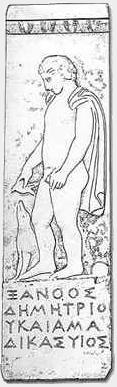
These effects are not the rule. E.g. Xanthos (with a Θ) appears in famous Macedonian headstone from Pella (around 420-400 BC). "Xanthos son of Demetrios and Amadika"

d009-1.jpg


A superficial search shows:
Russian/Bulgarian/Serbian: силен, Slovenian: Silen (=strong, forceful)
Czech/ Slovakian/ Polish: silny (=strong)

In short, people shouldn't throw stones if they live in glass houses.
What’s that supposed to mean?

Further, please don't forget where the Bulgars learned their current language. Many people seem to forget.
I don't buy that.

Any Macedonian should be able to understand the Old Macedonian. Try that with English of 1000 years ago. Or Greek prior to the great experiment of the 1800's.

Are you sarcastic by any chance? I thought, based on previous discussions, that Old Church Slavonic is not easily intelligible by you. I also sensed limited interest in investigating your recent linguistic history. But, if I'm wrong, I take it back.

Greek language hasn’t changed much in the last 1000 years. Changes in antiquity were faster and broader.


Your reliance on Wikipedia as an actual source of information is troubling to say that least.

And if you read them, you´d see how many attest to the fact that the origins remains unclear.

I didn’t find any “proto-slavic” interpretations, and I don’t know what this would mean. Wikipedia is an encyclopedia, an aggregator of sources (references can be found at the bottom of the page, discussion and compromises can be found in the discussion page).
I can’t say the same about the link you provided. After searching and searching I couldn’t find the author/compiler of these university notes or any references. I have to admit it was more entertaining than scientific and I mean this the good way. I hope these notes will be attractive for American students.

Some of the pages (e.g. the one on the controversies of Vergina tombs) may interest the members of the forum. So here it is:

http://myweb.unomaha.edu/~mreames/Alexander/tomb_discussion.html

---
 
Last edited:
A superficial search shows:
Russian/Bulgarian/Serbian: силен, Slovenian: Silen (=strong, forceful)
Czech/ Slovakian/ Polish: silny (=strong)
Why would you do a superficial search when I gave you a link to where the language was actually derived from? (Macedonia I might add)

It defies logic.

Ease up on the superficiality mate.

What’s that supposed to mean?
It means Greeks should not attempt to suggest they are the yardstick by which we should measure the authenticity of a language. There are numerous reasons why modern Greek exists as it does today and you would be a fool to ignore the revisions and codifications of the last 150 years.

I don't buy that.
You don't buy the fact that that the Bulgars spoke a different language prior to settling in the region? Don't worry, I am not selling it to you. Do you think the Greeks taught them their current language? Where did they learn the language? Please answer, although I must admit I expect to be amused more than I will learn anything.

It always amuses me when Old Macedonian is described as Old Bulgarian. How ridiculous. If they want to call it New Bulgarian I am happy to chat. Because that is pretty much what it became for the Bulgars. Give it your best shot champ.

Are you sarcastic by any chance? I thought, based on previous discussions, that Old Church Slavonic is not easily intelligible by you. I also sensed limited interest in investigating your recent linguistic history. But, if I'm wrong, I take it back.
Me? Sarcastic? Me?
sarcasm.jpg


Are your spider senses tingling on a number of issues? I gave you a link in my preceding post. I read a number of the texts on that link. It was quite easy to understand well over 70% of it. I think it is remarkable that this is the case with a language documented over 1000 years ago. Don't you?

Greek language hasn’t changed much in the last 1000 years. Changes in antiquity were faster and broader.
You should go back 200 years and tell everyone that. We know why you think it hasn't changed, but it did change and the change was to try to introduce archaic words into your modern language. They are accepted as normal now, but were not the case back when Grandparents could not understand their Grandchildren in the newly established modern Greece. Oh, and my Greek speaking relatives can't understand the archaic Hellenic languages. But they have the books which show the texts side by side (solely to impress other Greeks).
 
too me it sounds half macedonian half serbian, there is alot of words with serbian prefix "u" at the end of the words but alot of those words serbians dont even use or understand.
 
thats just logical, but im saying from a todays viewpoint, if you had no recollection of the past, you would see how the Macedonian language has morphed maybe 5% in 1300 years and how outsiders would could perceive the language as Serbian as many times our history has been muffled by western historians that came to balkans in 1800s and thought they saw Bulgarians or Serbians because of this reason, but as for the bible written for the slavic speakers of the Balkans and Eastern Europe, do you think it was intellectual by the other speakers.
 
I never quite realised how similar modern Macedonian and medieval Macedonian actually were. After looking through this I'm quite impressed.
In fact, it just took more time to come to terms with the biblical names, than it did for the rest of the Old Macedonian words.

It is remarkable, no doubt!

And if it was so well documented then, why would it be so difficult to believe the language thrived for hundreds of years in the region prior to that time.
 
Back
Top