• Welcome to the new Macedonian Truth Forum. All posts, members and private messages have been moved over from the old forum.

    Passwords from the old forum could not be carried over, so please use Forgot your password? to set a new one. The reset link is emailed to the address on your account.

  • Rules and Regulations at the forum of the Macedonian Truth Organisation (MTO)

    (1) The national-ethnic and cultural-linguistic identity of the Macedonian people is historically Macedonian, and derives its character from the native, indigenous and geographic homeland of the Macedonians, which is called Macedonia. To ensure that their human rights, integrity and heritage are appropriately respected, the only nouns and adjectives acceptable when reference is made to the above character and identity markers is Macedon, Macedonia, Macedonian and Macedonians.

    (2) The nation-state of the Macedonian people is the Republic of Macedonia, and is to be referred to by this official title so long as the 'republic' prefix is consistently applied to other states. Alternative references are the Macedonian Republic, or simply, Macedonia.

    (3) The 'ethnic' prefix is only acceptable for Macedonians in cases where differentiation is specifically required - so long as it is in context and consistent where it concerns its application to other ethnic groups.

    (4) Should any other differentiation be specifically required, the names of other ethnic groups that reside with Macedonians in either the Republic of Macedonia or the occupied Macedonian regions in Greece, Bulgaria, Serbia or Albania, are to be given a prefix.

    (5) Negating the identity, language and culture of the Macedonian people by deliberate avoidance of the terms Macedonia, Macedonian and Macedonians, or by any other means, is not permitted.

    (6) Systematic anti-Macedonian propaganda and rhetoric are not permitted.

    (7) Threads irrelevant to the Macedonian Cause, the community at the Macedonian Truth Organisation or the Macedonians in general may be considered as spam or not in the spirit of the forum. In such cases they are not permitted.

    (8) Continual posting of messages in threads with the sole purpose of deviating from the initial topics with the use of unrelated and unnecessary information is not permitted.

    (9) All posts, external articles, reports, etc that are cited in languages other than Macedonian or English, must be accompanied with a translation in one or both of the said languages.

    (10) Despite the possibility of some conversations and debates becoming heated, extreme abuse and/or racism, vulgar language and/or terminology, threats, revelation of personal information about others, harassment, and other such behavior will not be permitted. If deemed necessary all relevant information including member details will be reported to the appropriate authorities for investigation which may result in legal action.

    (11) Threads that are created must have a summary of a topic or excerpt of an article found in pertinent link(s) that have been included. One line threads will be considered unaccetable spam and are therefore not permitted.

    (12) Compulsive and deliberate lies, irrespective of the topic, are not permitted.

    (13) Any symbols or avatars found to be perceived as offensive to Macedonians are not permitted.

    (13) Any explicit or extreme material is not permitted.

    Failure to adhere to the above rules and regulations will result in a ban after 3 breaches. This may be reconsidered in some cases should the circumstances be of an unorthodox nature and/or require special consideration. To assure an effective deterrent against an individual or individuals with the sole purpose of causing dissent through spamming, racism or other improper means, the above rules will be strictly enforced.

    The MTO administration will monitor all discussions as reasonably practical and reserve the right to remove any post and/or member from the forum, and update the rules and regulations as required. Members are encouraged to immediately report any post and/or member to the MTO administration if they feel that these rules have not been abided by.

    The views expressed on this forum are those of the individuals. The only official representation of the MTO is made by the "Macedonian Truth Organisation (Site Owner)" username, and no other.

  • Macedonian Cause

    The Macedonian Truth Organisation calls on God in Heaven to protect, bless and guide the endeavour it is committing to undertake, and that is to work towards:

    Securing Macedonia as a free, independent and democratic republic in which sovereignty lies with the Macedonian citizens; as the nation-state of the Macedonian people in which they can preserve their culture, language and identity; as a state in which the Macedonian language and culture form the basis of public life and act as important unifying elements of Macedonian society; as the home of all its citizens to which it guarantees and obliges their inalienable natural rights and corresponding responsibilities;

    The acknowledgment as self-evident and irrefutable the existence of the:

    1) Indigenous, ethnonational name of Macedonia;
    2) Macedonian people, language and identity;
    3) Macedonian culture, symbols and folklore;
    4) Macedonian ancestry, heritage and history in its entirety; and
    5) Macedonian Orthodox Church;

    Securing recognition by the International Community of the tragedies endured by the Macedonian people, of the division of Macedonia with the signing of the Treaty of Bucharest on August 10, 1913, and the genocide committed against the Macedonian people at the hands of the Greek, Bulgarian and Serbian states and their respective churches during the 19th and 20th centuries;

    Ensuring that the Interim Accord is declared ‘null and void’ and that all constitutional provisions, acts, commitments, agreements, legislation, regulations, policies or programs emanating from, supporting or consequential to the Interim Accord are also declared ‘null and void’, including the use of any symbols and the completion of any acts imposed by, or originating from, the Interim Accord.

    Ensuring that the Framework Agreement is abolished and that all constitutional provisions, acts, commitments, agreements, legislation, regulations, policies and programs emanating from, supporting or consequential to the Framework Agreement are also abolished and replaced by a framework of constitutional and statutory law based on inalienable natural rights and corresponding responsibilities and universally codified human rights mechanisms.

    Securing the abolishment of any existing constitutional provisions, acts, agreements, legislation, regulations, policies and programs that discriminate against the Macedonian people, in any international organisation or any of the countries of the International Community where such constitutional provisions, acts, agreements, legislation, regulations, policies and programs exist, and thereby ensuring the freedom for Macedonians to exercise their inalienable natural rights and fulfil their corresponding responsibilities, and practice their culture, language and religious faiths in all the countries of the International Community without hindrance;

    The empowerment of Macedonians to undertake a moral revolution and to instil and/or reinvigorate within themselves a deep-rooted national, cultural, linguistic and historical dignity and a commitment to the exercise of freedom based on inalienable natural rights and corresponding responsibilities;

    The recognition of the Macedonian minorities in the neighbouring states of Macedonia as well as the respect for the inalienable rights and freedoms of the Macedonian minorities, as provided for by natural law and as codified by the United Nations Charter, the Universal Declaration of Human Rights and other universally codified human rights mechanisms;

    The full and unreserved respect of, and the support for, the rights of all people of non-Macedonian descent living in Macedonia and around the world, who share a reciprocal full and unreserved respect for the Macedonian people, their homeland and their state;

    The cultural unification and solidarity of the Macedonian people living in all parts of historical Macedonia and adjacent territories, as well as Macedonians throughout the world;

    The unity of all Macedonians on the principles, objectives and achievement of the Macedonian cause as defined by this declaration.

Possible Etymology of Alexander

First of all I thought you regard yourself as a macedonian of today, meaning that you are a macedonian not living in the past, but living in the present. The same goes for the term modern macedonia. It is meant as something that is macedonia today. Making a distinction of macedonia in antiquity, but not meaning a different one other than the chronological.
But if you don't want it it's OK. I never had a problem with calling macedonia macedonia, even old or new. I don't care really, I have enough evidence from the begining of the last century that makes me not having any problem at all with that. I cannot use some other terms of the events of the time. It's a thing with greek law, you (and I) will understand in due time.

However, I would like to see the correlation of macedonian language in the past with that of today (is that OK as terminology?). Now this would open a greater window for me.

I understand you mean it as no insult, I just think it's redundant and stupid to not keep the principle consistent when you say the Greek language, if you are Greeks of today.
There is a Macedonian Lexicon, i'm sure you'll have no trouble finding it with a search query on our forum.
If this opens new doors for you then be it, even if it were not there, we're basing our discussion on the Macedonian language.

Fine. Why don't you bring other languages into play. That could show even more correlations.
I never said it wasn't a possibility, I only said that this is how you can come to conclude its validity; The sole reason wasn't to prove it wrong, but to prove it's correct.
I am sorry, I only speak Macedonian and English. This is why it isn't a simple task any honest person would agree to that. Like I said, it is something I will get into.
I am not going to rush this subject just for our discussion, it has nothing to do with you, only my personal interest in linguistics.
 
I understand you mean it as no insult, I just think it's redundant and stupid to not keep the principle consistent when you say the Greek language, if you are Greeks of today.
There is a Macedonian Lexicon, i'm sure you'll have no trouble finding it with a search query on our forum.
If this opens new doors for you then be it, even if it were not there, we're basing our discussion on the Macedonian language.

Since I understand what happened at the time and place it would be stupid of me to think otherwise. There is an automatic relation to the past. Let's skip that.

Hopefully this Lexicon has many words. I'll give it a look.


I never said it wasn't a possibility, I only said that this is how you can come to conclude its validity; The sole reason wasn't to prove it wrong, but to prove it's correct.
I am sorry, I only speak Macedonian and English. This is why it isn't a simple task any honest person would agree to that. Like I said, it is something I will get into.
I am not going to rush this subject just for our discussion, it has nothing to do with you, only my personal interest in linguistics.

Yes I see. Well Philosopher is here, I'm here, I think we can put our knowledge to the test. And yes greek is very difficult even for the greeks.
 
Since I understand what happened at the time and place it would be stupid of me to think otherwise. There is an automatic relation to the past. Let's skip that.

Hopefully this Lexicon has many words. I'll give it a look.

Yes I see. Well Philosopher is here, I'm here, I think we can put our knowledge to the test. And yes greek is very difficult even for the greeks.

This does not differentiate you being able to call it Greek and then refer to a 'new Macedonian language'. Your language developed as much as French and Latin did, Macedonian has developed the least as it has held constant which shows its integrity.
If anything it should be called new-Greek and then Macedonian when we compare ratios of what has been held constant, but we aren't assholes to do such.

As is every language for everyone, which is essentially why each country has units for its own tongue. Yours is no different.
 
Tell me Nikolaj, this lexicon, is it this?

https://archive.org/stream/Macedoni...ue-Macedonien-du-XVie-siecle#page/n0/mode/2up

Because if it is, its from the 16th century and it has about 300 definitions. I don't see correlations. It uses greek alphabet instead of Cyrilic alphabet. Why is that? I don't know. I would understand if there was a correlation in greek but there isn't one.
Is there something to show me of the language used in ancient time for instanse B.C. or close to that?

I was refering to a language from antiquity to the present. A language that consists of a few thousand words at least.

Actually New-Greek is the term for greek spoken today. No Kidding that's how it is in school. I remember literature called like that. That doesn't mean it's different, it means that it's today's greek, very similar to those thousands of years ago.

You haven't understood what I said about the facts of which time. I thought we skipped the part where I said I understood what was happening in macedonia at the first half (at least) of the previous century. Hellooooooo!!
 
Last edited:
Tell me Nikolaj, this lexicon, is it this?

https://archive.org/stream/Macedoni...ue-Macedonien-du-XVie-siecle#page/n0/mode/2up

Because if it is, its from the 16th century and it has about 300 definitions. I don't see correlations. It uses greek alphabet instead of Cyrilic alphabet. Why is that? I don't know. I would understand if there was a correlation in greek but there isn't one.
Is there something to show me of the language used in ancient time for instanse B.C. or close to that?

I was refering to a language from antiquity to the present. A language that consists of a few thousand words at least.

Actually New-Greek is the term for greek spoken today. No Kidding that's how it is in school. I remember literature called like that. That doesn't mean it's different, it means that it's today's greek, very similar to those thousands of years ago.

You haven't understood what I said about the facts of which time. I thought we skipped the part where I said I understood what was happening in macedonia at the first half (at least) of the previous century. Hellooooooo!!

You do realize, the fact that it is so similar, probability is that it would most likely still be consistent if there were more words added, especially thousands.
If you are are denying its viability because of the amount of words in the lexicon you're then implying the language only had 300 words.
You should ask what is the consistency of those words being accurate to what we have today. Not disregard it because of its lack of words and doesn't suit your agenda.

The reason why it is written using Greek is clearly denoted on the second page. Nor does it matter to me, because we're speaking strictly on the pronunciation of the words and the words used.
The fact that it is written in another language means nothing, as for example you can convert Latin to Greek and Greek to Latin. The fact it didn't use Cyrillic means nothing and is quite an amateur argument.

3E3EJLm.png


Pronunciation is key and the words they used, not script, e.g. two general sentences.

CpjXOmD.png
 
Tell me Nikolaj, what are your thoughts on this?

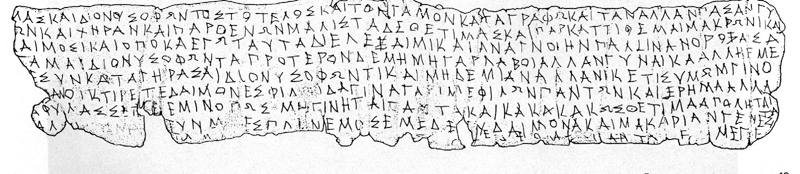
Pellatab.jpg


In your words surely you can't deny it because there is no other yet. The fact that it exists tells us that it such language existed.
 
Last edited:
Tell me Nikolaj, what are your thoughts on this?

Pellatab.jpg


In your words surely you can't deny it because there is no other yet. The fact that it exists tells us that it such language existed.

The Pella Curse tablet. Your point?

But lets disregard everything I've said in the past paragraph shall we? :yawn:

1. Of [Theti]ma and Dionysophon the ritual wedding and the marriage I bind by a written spell, and of all other
2. wo[men], both widows and maidens, but of Thetima in particular, and I entrust to Makron* and
3. [the] daimones, and (only) when I should dig up again and unroll and read this,
4. [?] that she might wed Dionysophon, but not before, for I wish him to take no other woman than me,
5. and that grow old with Dionysophon, and no one else. I [am] your supplicant:
6. Have pity on [Phil?]a*, dear daimones, for I am (a) dagina? of all my dear ones and I am abandoned.
7. But guard [this] for my sake so that these things do not happen, and wretched Thetima perishes miserably.
8. ... but that I become happy and blessed.
 
The Pella Curse tablet. Your point?

But lets disregard everything I've said in the past paragraph shall we? :yawn:

My point is about consistency. What do you think?

What was it you said in the last paragraph? That 16th century macedonian is pretty much the same as today's macedonian? Yes, so? Have you seen other languages from that era? Greek for instance?
The last speech of the last Emperor of Byzantium for instance in 1453. It's pretty much how it would be today.

So, what does this lexicon prove about consistency? More or less nothng. On the other hand the curse tablet might make you think that languages evolve and this is apparent in a larger scale of time, than that of 500 years.
 
Last edited:
spitfire said:
In a possible scenario, it could be difficult for the -ndre to be pronounced in Asia, hence it became -ar or -er and latin followed suit afterwards.
And another possible scenario is that people in Asia became accustomed to the name through Macedonian and Thracian soldiers in their own native language(s).
Whatever the case, language on its own is not sufficient for a common descent of something.
I agree, especially when a certain language is used by others for convenience, like you and I right now (yet neither of us are claiming descent from Henry VIII).
.......greek alphabet that derived from phoenician alphabet (probably).
And what is the other probability?
I was refering to a language from antiquity to the present. A language that consists of a few thousand words at least.
Macedonian (like most of today's languages) doesn't have a specific literature that began in antiquity. Latin does have such a history, just like Greek. Why do you think the former broke into several different languages whereas the latter didn't?
In your words surely you can't deny it because there is no other yet. The fact that it exists tells us that it such language existed.
The Pella Katadesmos was written in Greek, not Macedonian. It doesn't even exhibit Macedonian sound changes.
Amphipolis said:
we don't know the original names of the Macedonian Kings only through the works of historians, but also from the coins they printed (themselves) and I guess also from various other inscriptions.
I am not suggesting that certain Macedonians didn't have Greek names, but your examples don't indicate how all of their names were pronounced in the native language.
 
And another possible scenario is that people in Asia became accustomed to the name through Macedonian and Thracian soldiers in their own native language(s).

Yes, but the most probable one is that -ander is how the word transliterates in latin.

I agree, especially when a certain language is used by others for convenience, like you and I right now (yet neither of us are claiming descent from Henry VIII).

Antiquity belongs to antiquity. And in the words of a greek nationalistic page I came accross yesterday, The macedonians in the republic of macedonia are in all probability macedonians, so why bother in the first place? As much as we (meaning the greeks) can claim something so old in terms of blood, so can they (meaning macedonians).
That's a difference from the near past wouldn't you agree SoM?

And what is the other probability?
The other probabilities are linear A', linear B', Indo-european etc.

Macedonian (like most of today's languages) doesn't have a specific literature that began in antiquity. Latin does have such a history, just like Greek. Why do you think the former broke into several different languages whereas the latter didn't?

Because it was spoken by the people, whereas the Greek influence on these languages exists in a non so colloqual way. However it exists in english even colloqually big time.
Remember what happened also when the Roman Empire was broken in half with the east and the west.

The Pella Katadesmos was written in Greek, not Macedonian. It doesn't even exhibit Macedonian sound changes.

It is a Dorian dialect different than dorian dialects. This shows that it was spoken at the time.
I am aware of the different approach of the linguists for that time. I put it there becase Nikolaj suggested that a small number of findings suggests the existence of something.

I am not suggesting that certain Macedonians didn't have Greek names, but your examples don't indicate how all of their names were pronounced in the native language.

Have you got examples of macedonian names of that period other than greek?
 
Spitfire said:
Antiquity belongs to antiquity. And in the words of a greek nationalistic page I came accross yesterday, The macedonians in the republic of macedonia are in all probability macedonians, so why bother in the first place? As much as we (meaning the greeks) can claim something so old in terms of blood, so can they (meaning macedonians).

I find this statement rather extraordinary. Are you suggesting that a Greek nationalist page on the World Wide Web actually stated that "in all probability" that the Macedonians in the Republic of Macedonians are Macedonians, as in we are indigenous to the Balkans and the ancient Macedonians are our forefathers?

Am I reading this right?

What was the reaction to this statement?

Spitfire, there are a few things I would like you to clarify for me. And please, by all means, be honest and sincere in your statements.

What do you think was the native language of the ancient Macedonians?

Do you think Slavic was brought to the Balkans from the north?

What do you think accounts for the fact that, seemingly, all ancient Macedonian names referenced in history, and even in the New Testament, appear to be Greek?

You are right, it was not nationalist. I apologise, it was between other nationalist pages. I came across many pages last night because we were discussing a lot.

It does reflect though my opinion on the matter. It's in greek

http://www.kozanilife.gr/index.php/...noi-ston-olimpo-zisis-kontogounis-kozani.html

It says "very possibly are really", that's for sure: που πολύ πιθανόν είναι πραγματικά.

As for the rest, I think that there was a difference in language but at sometime the macedonians adopted greek eventually.
Now how much was that difference, when was it adopted and when and how and how much, it is still in question.

Is it really important if there was adoption of the Cyrillic alphabet at some time in history? Is it really important that languages evolve or imposed or chosen?
To me since there was a connection in the beginning of the 20th century somehow, then everything else is not important. There were people moving or exchanged so why ommit that? Neglected (in purpose?) in the books. A paragraph or so about the mater and move on? Yeah right. Relics of a national and pompus history learned at school. I understand all these, don't worry.

Things will change eventually Philosopher.
 
Spitfire said:
As for the rest, I think that there was a difference in language but at sometime the macedonians adopted greek eventually. Now how much was that difference, when was it adopted and when and how and how much, it is still in question.

I would say, from a scholarly position, there are two prevaling theories. The first being is that the native language of the ancient Macedonians was Greek and that they were a Greek tribe. The second theory, and one gaining much larger traction today, is that the ancient Macedonian language was a separate indo European language. There are only a few surviving Macedonian words, and for this reason no definitive pronouncement can be made. A third theory, not widely entertained, is that they spoke a language similar to Slavic, and that this language is indigenous to the Balkans.

I do not disagree that the ancient Macedonians, and in particular the government and aristocracy, used Greek as the language of the empire for administrative purposes. Whether the common Macedonian did or not is difficult to say.

Is it really important if there was adoption of the Cyrillic alphabet at some time in history? Is it really important that languages evolve or imposed or chosen?

Well, yes. The problem is that the most widely used argument against modern Macedonians is that they cannot be Macedonians because they came many centuries after the ancient Macedonians. Part and parcel of this is that the language spoken by today's Macedonians is Slavic and Slavic, we know, did not come to the Balkans until the 6th century or so. Consequently, today's Macedonians are not ethnic Macedonians.

I cannot begin to recount how many times I have heard or seen Greek pamphlets that state “Alexander the Great was not a Slav”, as if such an expression has any serious meaning.

There are many mysteries about this issue that I cannot explain, though I have a few theories.

To me since there was a connection in the beginning of the 20th century somehow, then everything else is not important. There were people moving or exchanged so why ommit that? Neglected (in purpose?) in the books. A paragraph or so about the mater and move on? Yeah right. Relics of a national and pompus history learned at school. I understand all these, don't worry.

I'm not sure what you mean by “a connection in the beginning of the 20th century”, but today's Macedonians did not develop a connection to Macedonia in the 20th century. Macedonians have identified as Macedonian for many centuries earlier; we have documents from the 1500s, 1600s, 1700s, et al. This does not mean the modern Macedonian identity began in the 1500s; all it means is that, from the historical record, we can go back as far as the 1500s. New documents may be discovered that expand on our knowledge.
 
I would add that the reason no serious scholar accepts the Macedonian word "Vasil" to be the source of the Greek "Vasileus", even though etymologically speaking, the former makes sense, whereas the latter does not, is because Vasileus is an ancient word, that predates the coming of Slavic in the Balkans. So if Slavic came after the fact, how could a Slavic word exist in the Balkans prior to the coming of the Slavs, and how could the Greek be based on this word?
 
Last edited:
Back to Alexander. Spitfire, have you seen this quote and if so, what are your thoughts on it?

Finally, it is interesting to take a look at the spelling of Alexander's name in the cuneiform texts. The correct rendering of Alexandros would have been A-lek-sa-an-dar-ru-su, but until now, no tablet has been discovered that uses this Greek name. Instead, after some first attempts to render the conqueror's name, the Babylonian scribes settled upon A-lek-sa-an-dar. Probably, this only shows that the scribes found it difficult to render a foreign name. On the other hand, it can not be excluded that Alexandar is the Macedonian name by which the conqueror of Asia was known to his courtiers.

http://bmcr.brynmawr.edu/2004/2004-02-13.html

The spelling the Babylonian scribes had of Alexander's name was "Aleksaandar", which is almost identical to the Macedonian "Aleksandar". As the writer wrote, the correct transliteration of the Greek Alexandros should have been "Aleksaandarrusu".
 
I would say, from a scholarly position, there are two prevaling theories. The first being is that the native language of the ancient Macedonians was Greek and that they were a Greek tribe. The second theory, and one gaining much larger traction today, is that the ancient Macedonian language was a separate indo European language. There are only a few surviving Macedonian words, and for this reason no definitive pronouncement can be made. A third theory, not widely entertained, is that they spoke a language similar to Slavic, and that this language is indigenous to the Balkans.

I do not disagree that the ancient Macedonians, and in particular the government and aristocracy, used Greek as the language of the empire for administrative purposes. Whether the common Macedonian did or not is difficult to say.

Sounds fair. However, This aristocracy includes Alexander the Great.

Well, yes. The problem is that the most widely used argument against modern Macedonians is that they cannot be Macedonians because they came many centuries after the ancient Macedonians. Part and parcel of this is that the language spoken by today's Macedonians is Slavic and Slavic, we know, did not come to the Balkans until the 6th century or so. Consequently, today's Macedonians are not ethnic Macedonians.

Which is a silly argument based on what we already said about identifying ethnicity based on language alone.

I cannot begin to recount how many times I have heard or seen Greek pamphlets that state “Alexander the Great was not a Slav”, as if such an expression has any serious meaning.

There are many mysteries about this issue that I cannot explain, though I have a few theories.

Prevailing nationalism in the balkans.


I'm not sure what you mean by “a connection in the beginning of the 20th century”, but today's Macedonians did not develop a connection to Macedonia in the 20th century. Macedonians have identified as Macedonian for many centuries earlier; we have documents from the 1500s, 1600s, 1700s, et al. This does not mean the modern Macedonian identity began in the 1500s; all it means is that, from the historical record, we can go back as far as the 1500s. New documents may be discovered that expand on our knowledge.

This means that connection of macedonians has been established when those events happened (the balkan wars). In other words there were people considered macedonians that their descendants today are not in the same ground anymore (well not all of them at least). There was population moving even in the late '40s, during the civil war in greece. That was a side effect of political reasons other than ethnic identity but still it was an effect.

I would add that the reason no serious scholar accepts the Macedonian word "Vasil" to be the source of the Greek "Vasileus", even though etymologically speaking, the former makes sense, whereas the latter does not, is because Vasileus is an ancient word, that predates the coming of Slavic in the Balkans. So if Slavic came after the fact, how could a Slavic word exist in the Balkans prior to the coming of the Slavs, and how could the Greek be based on this word?

Etymologically speaking it doesn't make sense, but again it's language alone that means nothing on its own when it comes to national identity. A clue yes, a proof no.
 
Back to Alexander. Spitfire, have you seen this quote and if so, what are your thoughts on it?


http://bmcr.brynmawr.edu/2004/2004-02-13.html

The spelling the Babylonian scribes had of Alexander's name was "Aleksaandar", which is almost identical to the Macedonian "Aleksandar". As the writer wrote, the correct transliteration of the Greek Alexandros should have been "Aleksaandarrusu".

And if Alexander had reached Oceania then his name there would be Alecdownunder. This ofcourse taken back in greek would make no sense since the transliteration serves the purpose of the language the word is transliterated into.

The same applies for Aleksandar.

An example. We have a square in athens called Canningos square. Named after a british prime minister. Normally this should be named as Canning square but paradoxically it was given the possesive case ending of the name, as it would if it had been a greek name.
 
Last edited:
And if Alexander had reached Oceania then his name there would be Alecdownunder. This ofcourse taken back in greek would make no sense since the transliteration serves the purpose of the language the word is transliterated into.

The same applies for Aleksandar.

I do not disagree. However, a distinction must be made. The cuneiform tablet appears to retain the name of Aleksandar, rather than use the Greek name. The author of the article states that the writers, for whatever reason, did not retain his Hellenic name "Alexandros". There are few possible reasons for this.

It could be because they wanted to "Babylonize" it in their language, which there is no evidence is the case; or it could be that the Babylonians knew Alexander under his Macedonian name, Aleksandar. We do not know the exact reason.

But considering the proximity of the cuneiform "Aleksaandar", the modern Macedonian "Aleksandar", and the Asiatic Iskandar or Sikandar. The ending "andar" and the use of "k" instead of "x" is somewhat conspicuous, and it seems to indicate that Alexander's Macedonian name was spelled with a "k" and "andar" and not as the the Greek spelling would have it.

An example. We have a square in athens called Canningos square. Named after a british prime minister. Normally this should be named as Canning square but paradoxically it was given the possesive case ending of the name, as it would if it had been a greek name.

This is common practice with the Greeks, though I'm not sure this would explain the adoption of "Aleksaandar" in the cuneiform.
 
I do not disagree. However, a distinction must be made. The cuneiform tablet appears to retain the name of Aleksandar, rather than use the Greek name. The author of the article states that the writers, for whatever reason, did not retain his Hellenic name "Alexandros". There are few possible reasons for this.

It could be because they wanted to "Babylonize" it in their language, which there is no evidence is the case; or it could be that the Babylonians knew Alexander under his Macedonian name, Aleksandar. We do not know the exact reason.

But considering the proximity of the cuneiform "Aleksaandar", the modern Macedonian "Aleksandar", and the Asiatic Iskandar or Sikandar. The ending "andar" and the use of "k" instead of "x" is somewhat conspicuous, and it seems to indicate that Alexander's Macedonian name was spelled with a "k" and "andar" and not as the the Greek spelling would have it.


This is common practice with the Greeks, though I'm not sure this would explain the adoption of "Aleksaandar" in the cuneiform.

Ξ is pronounced as KS in greek. No similar letter to Ξ? Then KS is used for transliteration.

Same principle when you can't pronounce correctly something. I almost imagine a babylonian trying to say Alexanthros. No way. Alekasandar should have suit him better.

The father of the mini car was known as Alec instead of his full name. Even in Greek the name Alekos is short for Alexander.
 
Last edited:
Back
Top