• Welcome to the new Macedonian Truth Forum. All posts, members and private messages have been moved over from the old forum.

    Passwords from the old forum could not be carried over, so please use Forgot your password? to set a new one. The reset link is emailed to the address on your account.

  • Rules and Regulations at the forum of the Macedonian Truth Organisation (MTO)

    (1) The national-ethnic and cultural-linguistic identity of the Macedonian people is historically Macedonian, and derives its character from the native, indigenous and geographic homeland of the Macedonians, which is called Macedonia. To ensure that their human rights, integrity and heritage are appropriately respected, the only nouns and adjectives acceptable when reference is made to the above character and identity markers is Macedon, Macedonia, Macedonian and Macedonians.

    (2) The nation-state of the Macedonian people is the Republic of Macedonia, and is to be referred to by this official title so long as the 'republic' prefix is consistently applied to other states. Alternative references are the Macedonian Republic, or simply, Macedonia.

    (3) The 'ethnic' prefix is only acceptable for Macedonians in cases where differentiation is specifically required - so long as it is in context and consistent where it concerns its application to other ethnic groups.

    (4) Should any other differentiation be specifically required, the names of other ethnic groups that reside with Macedonians in either the Republic of Macedonia or the occupied Macedonian regions in Greece, Bulgaria, Serbia or Albania, are to be given a prefix.

    (5) Negating the identity, language and culture of the Macedonian people by deliberate avoidance of the terms Macedonia, Macedonian and Macedonians, or by any other means, is not permitted.

    (6) Systematic anti-Macedonian propaganda and rhetoric are not permitted.

    (7) Threads irrelevant to the Macedonian Cause, the community at the Macedonian Truth Organisation or the Macedonians in general may be considered as spam or not in the spirit of the forum. In such cases they are not permitted.

    (8) Continual posting of messages in threads with the sole purpose of deviating from the initial topics with the use of unrelated and unnecessary information is not permitted.

    (9) All posts, external articles, reports, etc that are cited in languages other than Macedonian or English, must be accompanied with a translation in one or both of the said languages.

    (10) Despite the possibility of some conversations and debates becoming heated, extreme abuse and/or racism, vulgar language and/or terminology, threats, revelation of personal information about others, harassment, and other such behavior will not be permitted. If deemed necessary all relevant information including member details will be reported to the appropriate authorities for investigation which may result in legal action.

    (11) Threads that are created must have a summary of a topic or excerpt of an article found in pertinent link(s) that have been included. One line threads will be considered unaccetable spam and are therefore not permitted.

    (12) Compulsive and deliberate lies, irrespective of the topic, are not permitted.

    (13) Any symbols or avatars found to be perceived as offensive to Macedonians are not permitted.

    (13) Any explicit or extreme material is not permitted.

    Failure to adhere to the above rules and regulations will result in a ban after 3 breaches. This may be reconsidered in some cases should the circumstances be of an unorthodox nature and/or require special consideration. To assure an effective deterrent against an individual or individuals with the sole purpose of causing dissent through spamming, racism or other improper means, the above rules will be strictly enforced.

    The MTO administration will monitor all discussions as reasonably practical and reserve the right to remove any post and/or member from the forum, and update the rules and regulations as required. Members are encouraged to immediately report any post and/or member to the MTO administration if they feel that these rules have not been abided by.

    The views expressed on this forum are those of the individuals. The only official representation of the MTO is made by the "Macedonian Truth Organisation (Site Owner)" username, and no other.

  • Macedonian Cause

    The Macedonian Truth Organisation calls on God in Heaven to protect, bless and guide the endeavour it is committing to undertake, and that is to work towards:

    Securing Macedonia as a free, independent and democratic republic in which sovereignty lies with the Macedonian citizens; as the nation-state of the Macedonian people in which they can preserve their culture, language and identity; as a state in which the Macedonian language and culture form the basis of public life and act as important unifying elements of Macedonian society; as the home of all its citizens to which it guarantees and obliges their inalienable natural rights and corresponding responsibilities;

    The acknowledgment as self-evident and irrefutable the existence of the:

    1) Indigenous, ethnonational name of Macedonia;
    2) Macedonian people, language and identity;
    3) Macedonian culture, symbols and folklore;
    4) Macedonian ancestry, heritage and history in its entirety; and
    5) Macedonian Orthodox Church;

    Securing recognition by the International Community of the tragedies endured by the Macedonian people, of the division of Macedonia with the signing of the Treaty of Bucharest on August 10, 1913, and the genocide committed against the Macedonian people at the hands of the Greek, Bulgarian and Serbian states and their respective churches during the 19th and 20th centuries;

    Ensuring that the Interim Accord is declared ‘null and void’ and that all constitutional provisions, acts, commitments, agreements, legislation, regulations, policies or programs emanating from, supporting or consequential to the Interim Accord are also declared ‘null and void’, including the use of any symbols and the completion of any acts imposed by, or originating from, the Interim Accord.

    Ensuring that the Framework Agreement is abolished and that all constitutional provisions, acts, commitments, agreements, legislation, regulations, policies and programs emanating from, supporting or consequential to the Framework Agreement are also abolished and replaced by a framework of constitutional and statutory law based on inalienable natural rights and corresponding responsibilities and universally codified human rights mechanisms.

    Securing the abolishment of any existing constitutional provisions, acts, agreements, legislation, regulations, policies and programs that discriminate against the Macedonian people, in any international organisation or any of the countries of the International Community where such constitutional provisions, acts, agreements, legislation, regulations, policies and programs exist, and thereby ensuring the freedom for Macedonians to exercise their inalienable natural rights and fulfil their corresponding responsibilities, and practice their culture, language and religious faiths in all the countries of the International Community without hindrance;

    The empowerment of Macedonians to undertake a moral revolution and to instil and/or reinvigorate within themselves a deep-rooted national, cultural, linguistic and historical dignity and a commitment to the exercise of freedom based on inalienable natural rights and corresponding responsibilities;

    The recognition of the Macedonian minorities in the neighbouring states of Macedonia as well as the respect for the inalienable rights and freedoms of the Macedonian minorities, as provided for by natural law and as codified by the United Nations Charter, the Universal Declaration of Human Rights and other universally codified human rights mechanisms;

    The full and unreserved respect of, and the support for, the rights of all people of non-Macedonian descent living in Macedonia and around the world, who share a reciprocal full and unreserved respect for the Macedonian people, their homeland and their state;

    The cultural unification and solidarity of the Macedonian people living in all parts of historical Macedonia and adjacent territories, as well as Macedonians throughout the world;

    The unity of all Macedonians on the principles, objectives and achievement of the Macedonian cause as defined by this declaration.

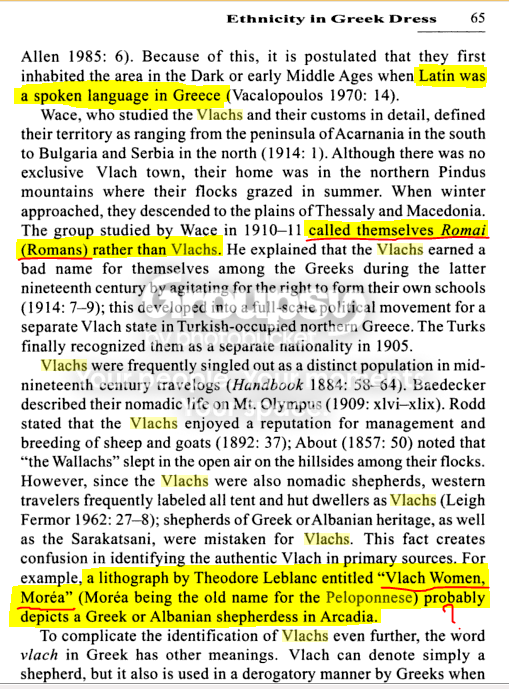
"Prior to 1865, Vlachs everywhere in the Peloponnese"

momce said:
My view of the vlachs is they are not related to the Romans at all........
Perhaps not so much genetically, but linguistically, they're without a doubt related to the Romans.
they might be part of a pre-Latin substrate that was in the area like the Italo-Illyrian bridge...........
They speak a Romance language derived from Latin, which is in turn derived from Italic. As far as I know, there is very little to connect the Vlach language with Illyrian.
the Albanians may be a similar output of the Illyro-Thracian bridge
I doubt it. If their language is anything to go by, the Albanians are the most heterogeneous group in the Balkans.
......both seem to be somwhat related to Romanians which are part of the same phenomenon..
Vlach and Romanian are both eastern Romance languages, whereas a significant portion of Latin loanwords in Albanian come from eastern Romance.
 
leblanc_zpsc244592b.png
 
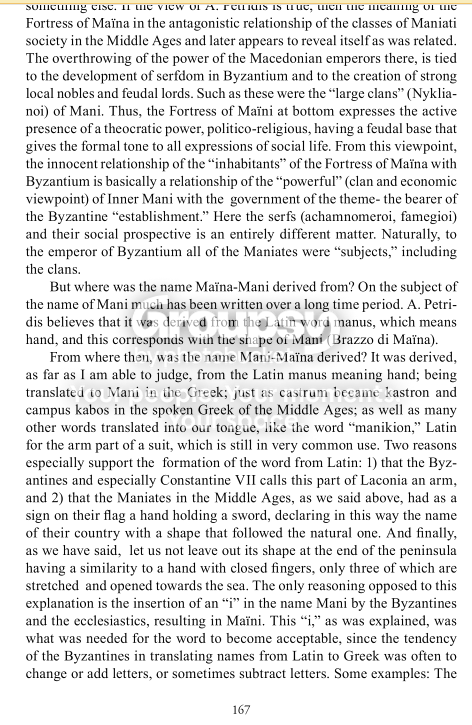
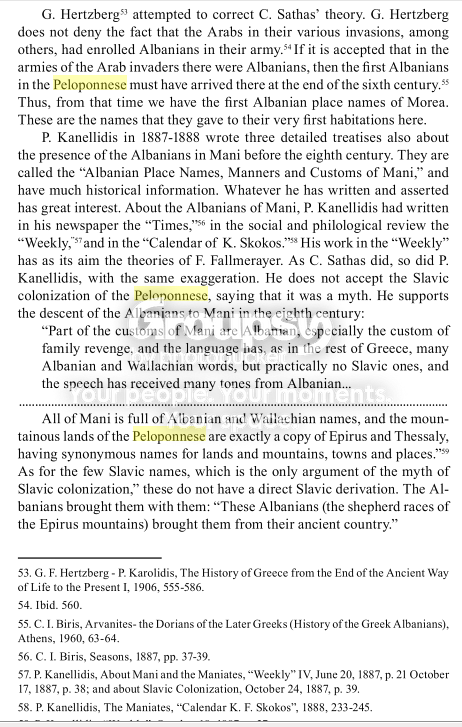
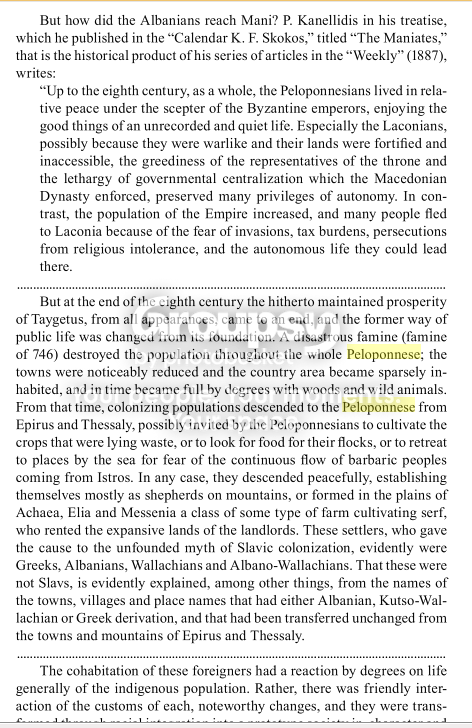
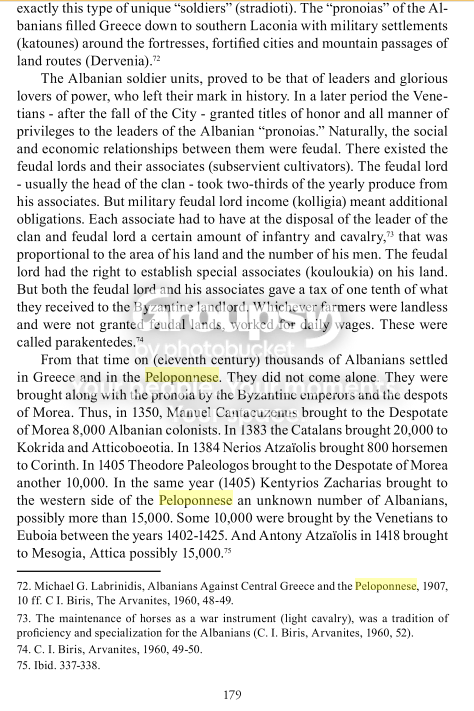
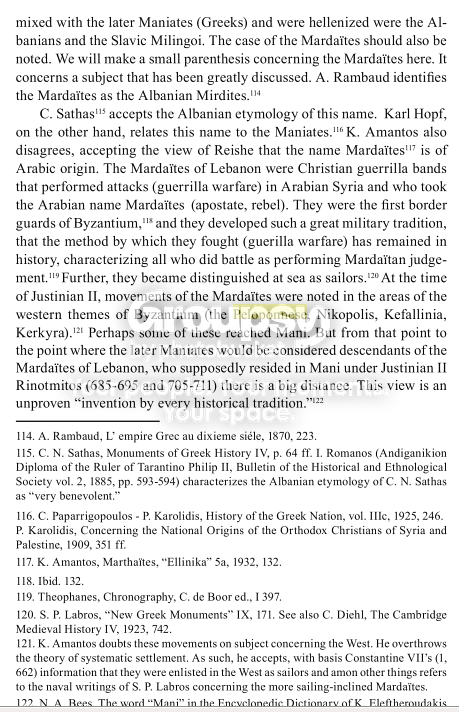
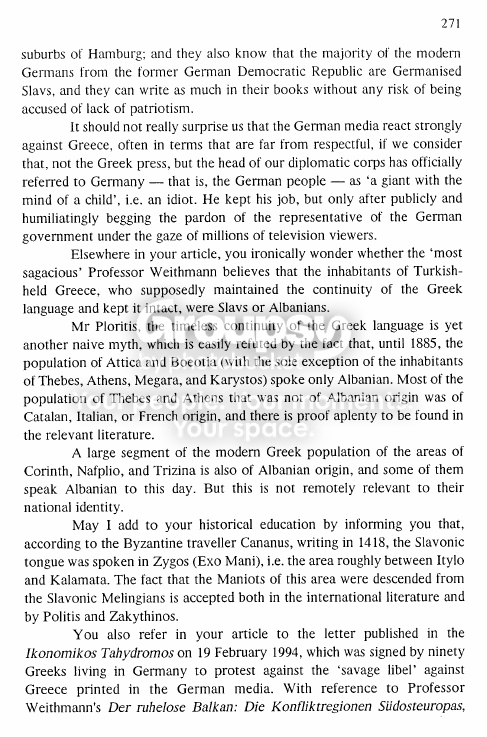
More on the Vlachs and Albanians in Morea (Peloponnese), specifically Mani.

The writers do provide interesting facts, such as:

- The term Mani and/or Maniates is most likely of Latin origin and derivation. It comes from the word 'manus', meaning hand (by the way, the word for hand is more or less the same in modern Vlach dialects and Romanian).
- Many Vlachs and Albanians settled in the Peloponnese, in repeated waves. Most came from the northern regions: Epirus and Thessaly.
- All of Mani is full of Albanian and Wallachian (Vlach) names.
- Part of the customs in Mani are Albanian.
- A disastrous famine of 746 AD destroyed the population throughout the Peloponnese.

(Please let me know if you want me to post additional pages from this book. It can be accessed in Google Books.)

Mani0_zps996a2574.png

Mani10_zps867a26d1.png

Mani12_zpse3393933.png

Mani13_zps19b799ae.png

Mani15_zps39fa8835.png

Mani17_zps89f2eb9e.png


PS:

This is a copy & paste from a newsgroup that is no longer available. I was able to save the info a while back (I did not make any editing to the text below). Some of the comments are from Constantine Buhayer (University of Westminster, London).


2 points:
If one assumes that many of the Greeks of Crimea were Ellinovlachi,
then the following historical item hints at their mercantile power and
national aspirations (even though this apparently covers mostly
Ioannina Greeks):

The author was Athanasios Petros Psalidas (1767-1829). Born in
Ioannina where he studies at the famous school of Balaton.

In 1792 he wrote a pamphlet in Vienna.

He describes the visit Catherine paid to her new acquisitions from
the Ottoman Empire, in Nizni and Tauria. Psalidas argues that the
hidden purpose of her visit was to liberate the Greeks. These are his
arguments: When she arrived at the palace gate of Niznan she was
stopped/welcomed by Archmandrite Dorotheos (an islander Greek)
who addressed her, praised her and compared her to Pallas Athena.
Her route had been lined by the local Greek merchants with oranges,
lemons (trees?), bread and salt, all produce of Greece to remind her
of who was behind the gesture. Dorotheos finally offered the cross to
her lips and thus made her bend forward and kiss it. They then
proceeded into the palace where the local Greek merchants,
dressed in their finest attire were waiting for her. Again, she was
praised and called upon to free and earn the eternal gratitude of
those Greeks enslaved by the Turks.

Psalidas tells us that most of the Greeks were from the region of
Ioannina, and that after the liberation of the city in 1784, it had
attracted various nations, including Greeks from the Peloponnese.
Furthermore, one of the liberating battalions consisted of Greeks
under Major Kostis of Ioannina (it was he who prepared the route
with oranges, etc). Psalidas says that many of those men were
promoted up the ranks, thereby, he argues preparing them to lead
an army and liberate the Greeks.
-----------------------------

Also, and uniquely (and that is the point) in the Greek world, why is it
that the term 'Vlachos' as well as describing a constituent groups of
the Hellenic people, also describes a pastoral Greek life style,
irrespective of regional affiliations. No other term of constituent
groups - Sarakatsanos, Makedonas, Kerkiraios, a.s.o - became such
a generic term. More so, I am not aware of a similar transference in
the (Western) English or (Western) French languages.
Of course, Vlachos is also used as a critical term by city dwellers.
But in this case, the word Athinaios can be a term of insult in Patra
and Thessaloniki, and the term Peloponnisios harbours no good will
when used in Macedonia.
As for 'Vlachopoula', I have only come across it as a term of
endearment from male to female. Likewise for 'Karagounitsa' but not
'nisiotisa' or 'protevousiana', aso.

Best
Constantine Buhayer
University of Westminster
London

http://maillists.uci.edu/mailman/public/mgsa-l/2004-May/003688.html

http://maillists.uci.edu/mailman/public/mgsa-l/2004-May/003691.html

C.Buhayer at westminster.ac.uk wrote:

> [snip]
>
> Also, and uniquely (and that is the point) in the Greek world, why is it
> that the term 'Vlachos' as well as describing a constituent groups of
> the Hellenic people, also describes a pastoral Greek life style,
> irrespective of regional affiliations. No other term of constituent
> groups - Sarakatsanos, Makedonas, Kerkiraios, a.s.o - became such
> a generic term. More so, I am not aware of a similar transference in
> the (Western) English or (Western) French languages.
> Of course, Vlachos is also used as a critical term by city dwellers.
> But in this case, the word Athinaios can be a term of insult in Patra
> and Thessaloniki, and the term Peloponnisios harbours no good will
> when used in Macedonia.
> As for 'Vlachopoula', I have only come across it as a term of
> endearment from male to female. Likewise for 'Karagounitsa' but not
> 'nisiotisa' or 'protevousiana', aso.
>
>

Some further reflections on the ubiquitous nature of Vlachs and
Arvanitovlachs (Karagouni) south of Thessaly and the Helladic Mainland and
across the Corinth canal.

In passing, I would like to add a footnote on the underinvestigated question
of Vlachs/Arvanitovlachs of Moreas (Peloponnese),

The French 19th century traveler Cousinery makes mention of Vlach-speakers
in the market of the city of Argos (Argolis, Peloponnese) during his travel
in Morea shortly after the War of Independence (1821). He specifically
makes mention of the fact that these men and women spoke a Latinate
language, similar to the Vlachs he met in Macedonia. These Vlachs told him
that they were pastoral nomads with settlements in the surrounding mountains
(I believe that the evidence points in the direction of Arcadia) [Cousinery
H.E.M., _Voyage dans de la Macédoine_, Book I. Paris, 1831, p.18; cited in
Koukoudis, A, _The Vlachs: Metropolis and Diaspora_, Zitros Publications,
Thessaloniki, 2000 (in Greek)]

There is also the unresolved issue of the widespread Sklabhnika, Armanika,
Arbanitika kai Latinokeltika (Slavonic-like, Vlach/Armiîn, Albanian, and
Latin-derived) toponyms particularly in Arcadia, a subject of tempting
speculation...

Aside from the obvious Vlachokerassia and Arvanitokerassia, toponyms like
Asanoi, Arachouva, Atsicholo, Baltetsi, Baltesiniko, Belimaki
[Mpelimatsioi], Berbaina [akin to Varbeani], Blongo, Garzeniko, Granitsa,
Dimitsana, Drestena, Nemnitsa (Nimnitsa), Palumba, Roinou, Saltozi, Sopôto,
Stemnitsa and so forth, raise legitimate questions as to Vlach and/or
Arvanitovlach presence particularly in the central and southeastern areas of
Peloponnese (including the region referred to as Tsakonia -- point of
reference: Leonidion)

[Swkrath N. Liakou: Ermhneia Ebdomhnta Sklabhnikwn Topwnumiwn ths Arkadias
(me tis Latinikh Keltikh Arbanitikh Armanikh), Mikroeurwpaikes (Balkanikes)
Meletes 13, Qessalonikh, Iounios, 1981]

Besides, the ingrained notion of a slavonic derivation attached to a
plethora of toponyms in Lacônia is also subjudice calling for a critical
reappraisal to assess the extent to which these might have a latin-based (as
opposed to slav-based) derivation, suggesting a putative Vlach/Arvanitovlach
link.

In the first place, the unresolved saga of Millingi in Mani comes to mind.
It is noteworthy that Millingi inhabited the inaccessible regions of Mt
Taygetus and Mt Parnôn, particularly the latter. But, as a rule, the
mountainous route of migration (or escape) would be more typical for the
fleeing indigenous populations, as compared to the settlements of invaders
who would tend to be more agrarian.

Incidentally, the purported Slavonic origin of the word Millingi is
questionable and so is the attendant implication that the Millingioi, i.e.,
the inhabitants, represented in fact, bona fide Slav tribes. In this
regard, one does not have to concur with Georgaka's interpretation [D.
Georgaka. _The Medieval Names Millingi and Ezeritae of Slavic Groups in the
Peloponnesus_. Byzantinische Zeitschrift, 1950, Munchen, pp. 43 49], in the
same way that one does not have to accept a priori Fallmerayer's assertions
[Ph. Fallmerayer, _Geschichte der Halbinsel Morea wahrend des
Mittelalteres_, Stuttgart, Tubingen, 1830-1836]], which have been
perpetuated by the old German school of Anthropology [Max Vasmer, _Die
Slawen in Griechenland_, Berlin, 1941: 87].

To the extent that the word Millingi may have a Latinate derivation [see J.
G. Th. Graesse _Orbis Latinus_ (2nd edition), Richard Carl Schmidt & Co.;
Berlin 1909], a possible medieval Vlach/Arvanitovlach origin of the term
should also be entertained.

The once rebellious Millingi, fought alongside with fellow 'Byzantine'
Greeks (i.e., Cynurians and other Arcadians and Lacônians) in the abortive
assault headed by Michael I Komnenos Doukas (despot of Epirus), against the
Franks (Venetians) in Messênia.

There are many signposts of Millingi in the Mt. Parnôn area, including
'Zygos tou Meligou', 'Dromos tou Miligou', 'Meligitika Kalubia' and, near
Agios Iôannis, the 'Meligou' or 'Meligoun' as is referred to by
(S)Phrantzês.

C.D.K.

PS. Last but not least, let us not forget the Moraitiko traditional song
"Mia Vlacha Vlachopoula, Arvanitopoula..."
 
Last edited:
these people the vlachs behaved themselves unlike the albanians who wanted the whole of macedonia for themselves.I don't think there was any resentment of the vlachs & macedonians ,has there ever been any?

There is something of tension in "modern greece". I think its cause vlachs have almost no traditions of their own they are more interested in becoming greeks whereas Macedonians are sceptical about most things and love their own things.
 
It reminds me how hollow, superficial and impoverished greek nationalism(any form of nationalism?) really is. No wonder it has such mass appeal.
 
Last edited:
I think the socio-economic linguistic analysis here is critical also which usually gets lost in modern mass homogenisation processes, i.e"nationalism", largely a construct of a small power group. Interesting from the above readings seems the "greek revolution" was something of an "outward" sham. Question: why was there a need to create the modern greek myth?
 
Last edited:
Perhaps not so much genetically, but linguistically, they're without a doubt related to the Romans.

They speak a Romance language derived from Latin, which is in turn derived from Italic. As far as I know, there is very little to connect the Vlach language with Illyrian.

I doubt it. If their language is anything to go by, the Albanians are the most heterogeneous group in the Balkans.

Vlach and Romanian are both eastern Romance languages, whereas a significant portion of Latin loanwords in Albanian come from eastern Romance.

What about quasi-unclassified dead languages like Messapic, Mysian etc?
 
Kostis Palamas in 1901. stated the following:

«Έλληνες για να ρίχνουμε στάχτη στα μάτια του κόσμου, πραγματικά Ρωμιοί».

"Hellenes in order to pull the wool over world's eyes, in reality ROMANS."

Many modern Greeks, like Palamas above, were very much aware what their true national name was: and this name is Romans (and Romans = Romaioi = Armani/"Vlachs").
 
Last edited:
Carlin, were the vlachs of Greece the descendants of romanized greek population? Or they were the results of migrations?
 
I would say that most Greek Vlachs subscribe to the "theory" that they are Latinized native (Greek) populations. This may be true to a certain degree, however, I disagree with it (this theory is a relatively modern creation of Greek scholars/historians). I believe the Vlachs of Greece and Balkans in general are a by-product of Roman empire, numerous migrations, settlements, population transplantations, and intermingling among various ethnic elements.
 
Last edited:
18th Century Aromanian Writers: the Enlightement and the Awakening of National and Balkan Consciousness, Nistor Bardu --

Or: how the bilingual, wealthy and educated Vlachs of Moskopole and Janina created Balkan literacy, created and formed modern Greek literacy, culture, and identity.

https://docs.google.com/viewer?a=v&...k7mzy_&sig=AHIEtbREGKUBr9JW3T4GeOKs8D7vjNZMtQ

In PDF format:
http://www.philologica-jassyensia.ro/upload/III_1_Bardu.pdf

Some notable names (among many others):

Ioannis Chalkeus (Vlach from Moskopole)
http://en.wikipedia.org/wiki/Ioannis_Chalkeus

Theodore Kavallioti (Vlach from Moskopole)
http://en.wikipedia.org/wiki/Theodore_Kavalliotis

Eugenios Voulgaris (Bulgarian from Corfu)
http://en.wikipedia.org/wiki/Eugenios_Voulgaris


http://www.youtube.com/watch?v=Ka2OmWCIico

http://www.youtube.com/watch?v=duBjWexRsUA
 
Last edited:
Lots of similarities between Albanians and Vlachs ,its like they are the same people culturally but divided at one point linguistically.
 
Given that Vlachs were basicaly NOWHERE in Peloponnese, either prior or after 1865, I just have to ask. What is the video-text of post#1?


Here are just two sources which logically invalidate your claim.

1) Cousinery states clearly that he encountered many Vlachs in Argos, Peloponnese:

The French 19th century traveler Cousinery makes mention of Vlach-speakers in the market of the city of Argos (Argolis, Peloponnese) during his travel in Morea (Peloponnese) shortly after the War of Independence, 1821. He specifically makes mention of the fact that these men and women spoke a Latinate language, similar to the Vlachs he met in Macedonia. These Vlachs told him that they were pastoral nomads with settlements in the surrounding mountains.

Cousinery H.E.M., Voyage dans de la Macédoine, Book I. Paris, 1831.

2) The London Quarterly Review, published in April 1895 and July 1895:
"The Wallachians ... are numerous in the Peloponnesus."

Note that these are only two sources.


:)

Ούτως εν Λακωνία οι Μανιάται διακρίνονται πάντοτε ευκρινώς από των μη Μανιατών, ους καλούση γενικώς Βλάχους και σφόδρα καταφρονουσιν' εν Κυνουρία οι Τζακώνες του Λεωνιδίου και των πέριξ χωριών ου μόνον κατά την γλώσσαν, αλλά και κατά συνείδησιν φιλετικιν διακρίνονται από των λοιπών της επαρχίας ταύτης κατοίκων, οίτινες εαυτούς καλούση Βλάχους εν κ υπό των μακράν οικούντων καλούνται ενίοτε εξ άγνοιας Τζακώνες.
 
Last edited:
Lots of similarities between Albanians and Vlachs ,its like they are the same people culturally but divided at one point linguistically.

Antiquarian Researches in Illyricum: Part I-IV, By Sir Arthur Evans.

Pages 156-157:

"Above this spot were some curious niches with remains of frescoes, but these of medieval Byzantine or Slavonic date, cut in the face of the cliff. The present population is Albanian, belonging to three "Fises" - "Plahach," "Sopa," and "Kilment" ("Clementi," as pronounced by my guide). From what I learned from him as to the local dialect, Roman or Rouman influence on the language must be here very marked, and I was much struck with his remark: "Albanian, Italian, and Vlach are all the same." On the opposite side of the Golema is a village with the purely Rouman name, Pratosielce=Willow-mead, and Konchul on the other side of the Morava has an equally Rouman sound."

PS: Sir Arthur Evans' guide was an Albanian by the name Mustafa.

Here is more information about Mustafa, from Evans in the pg. 156 footnotes:

"Mustafa had picked up a little Italian from some workmen engaged on the new Serbian line. Amongst words in the local dialect which struck him as like Italian he instanced Szavle=Sand, [Cf. Ital. Sabbia, Rouman, Sablu], Plop or Plep=poplar [Ital. pioppo, Macedo-Rouman plop], Sielce=willow [Italian Salice, Macedo-Rouman Salice or Salce], Supra=above [It. Sopra, Rouman Supra, ordinary Albanian Siper], Ca'olli also Cavolli, horse [It. Cavallo, Rouman Callu, ordinary Albanian Colli or Calli], etc."
 
Last edited:
PS: Can you please translate the following? :)

Ούτως εν Λακωνία οι Μανιάται διακρίνονται πάντοτε ευκρινώς από των μη Μανιατών, ους καλούση γενικώς Βλάχους και σφόδρα καταφρονουσιν' εν Κυνουρία οι Τζακώνες του Λεωνιδίου και των πέριξ χωριών ου μόνον κατά την γλώσσαν, αλλά και κατά συνείδησιν φιλετικιν διακρίνονται από των λοιπών της επαρχίας ταύτης κατοίκων, οίτινες εαυτούς καλούση Βλάχους εν κ υπό των μακράν οικούντων καλούνται ενίοτε εξ άγνοιας Τζακώνες.

This passage is from the video-text of post#1. Here's the translation. (Now you owe to tell me the source, or simply say there's no source).

So in Laconia, Maniots are always clearly distinguished from non-Maniots, whom they generally call Vlachs and vehemently disdain.

In Cynuria, the Tsakonians of Leonidio and the surrounding villages, not only in language but also in tribal conscience, are distinguished from the other inhabitants of the province, who call themselves Vlachs, even though people from outside sometimes call them Tsakonians out of ignorance.
 
Last edited:
This passage is from the video-text of post#1. Here's the translation. (Now you owe to tell me the source, or simply say there's no source).

So in Laconia, Maniots are always clearly distinguished from non-Maniots, whom they generally call Vlachs and vehemently disdain.

In Cynuria, the Tsakonians of Leonidio and the surrounding villages, not only in language but also in tribal conscience, are distinguished from the other inhabitants of the province, who call themselves Vlachs, even though people from outside sometimes call them Tsakonians out of ignorance.

Thank you.

I did not upload the video, so I can't comment on the source. I would like to find out the source myself, if there is one in this case. It seems to be a rather detailed document from 1915, so if it is fraudulent it's an elaborate hoax.


"The Albanians from Arcadia are three times more numerous than the Turks." -- The present state of the Morea called Peloponnesus, Bernard Randolph, an English traveler, London, 1686.
 
Last edited:


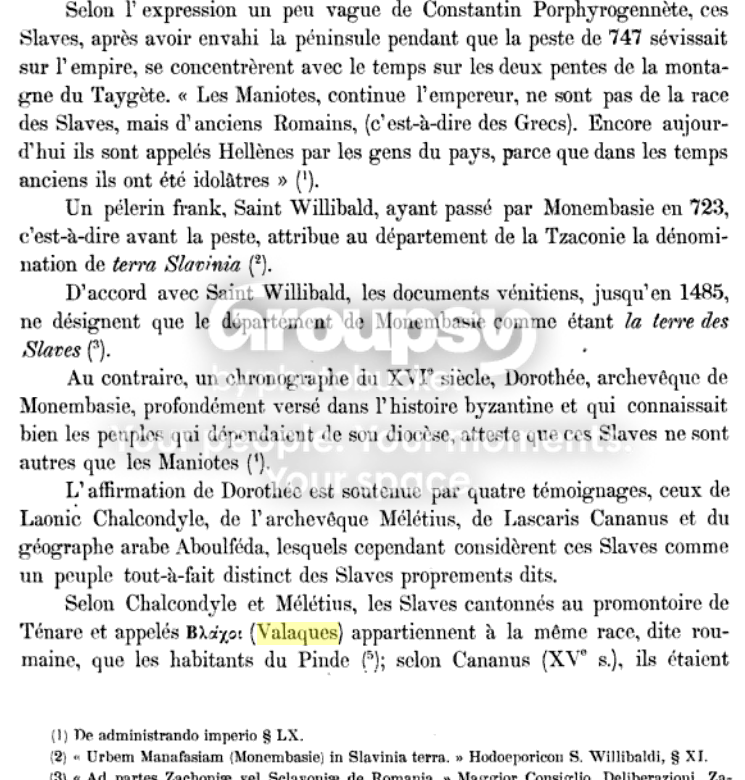
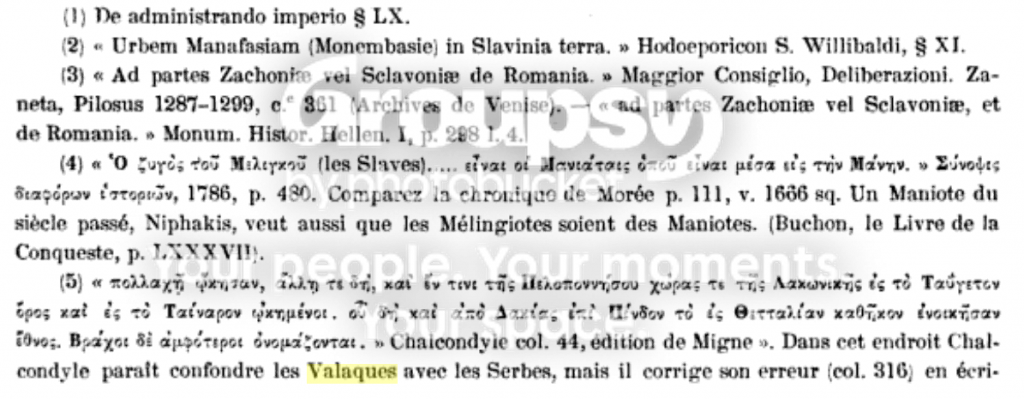
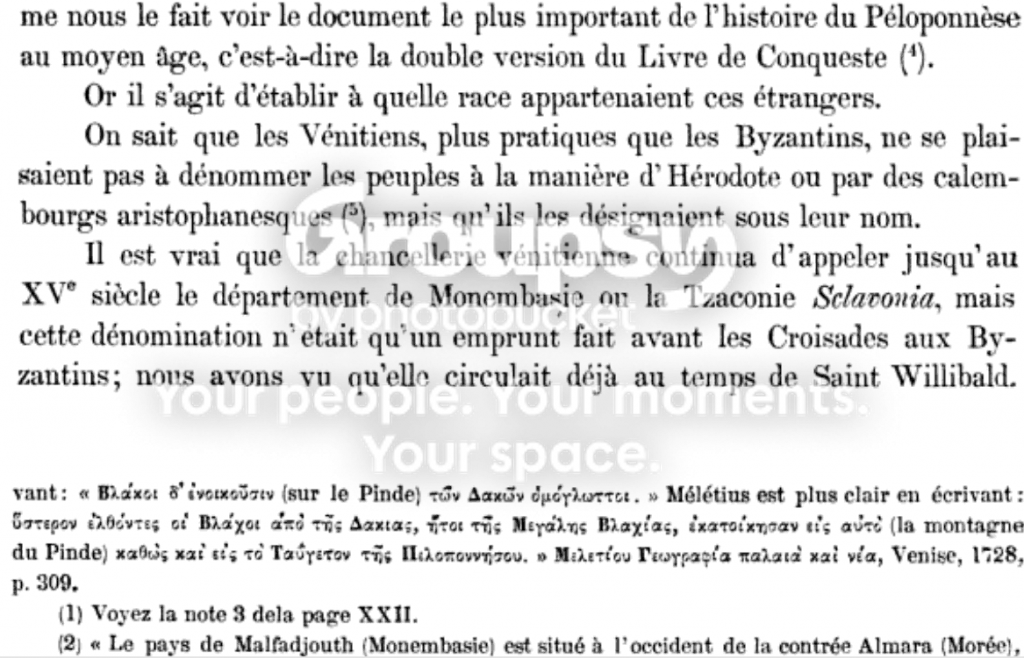
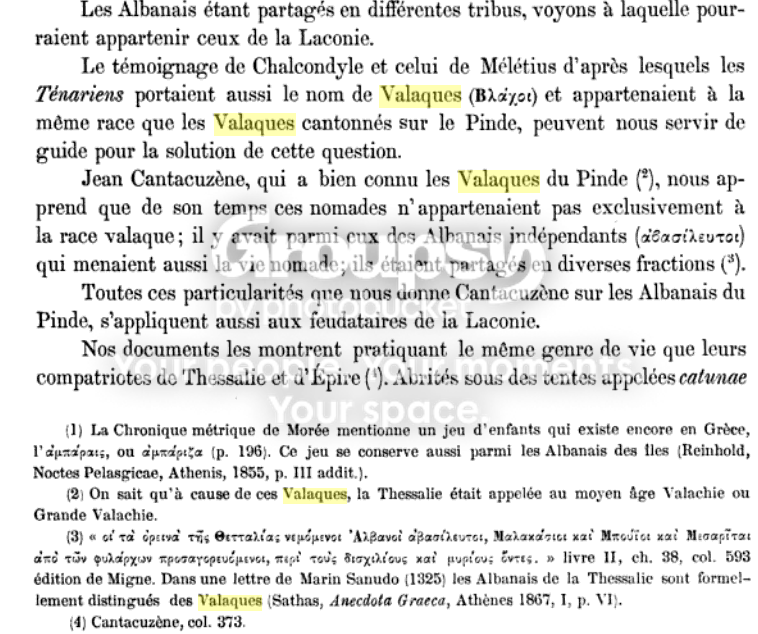
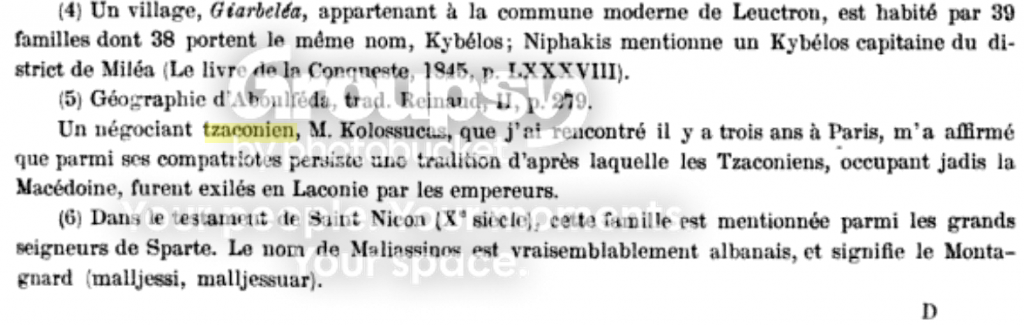
1) Here are some additional quotes and findings which indicate that Maniotes, Tzakonians (but also Melingi) were all Vlachs.

Although what follows is mostly in French I will summarize the most relevant points. (Note that mountain Taygetos and Cape Tainaron are considered as traditional lands of Maniotes - or Mani.)

- According to testimonies from both Chalcondyle and Meletius the Slavs of mountain Taygetos and Cape Tainaron in Peloponnese, were called Vlachs and belonged to the same race (referred to as Roman), as the people living in Dacia, Pindus area and Great Wallachia-Thessaly. (They originally migrated from Dacia.) Primary original quotes are provided below.
- Melingi are a branch/part of Maniotes. A Maniote from the 18th century, Niphakis, "wants" Melingi to be Maniotes.
- According to a Tzakonian merchant (trader), M. Kolossucas, there still existed a tradition among his people that Tzakonians once occupied Macedonia, and were exiled from there to Laconia by the emperors.
- There existed "ethnological" chaos among various writers during the Middle Ages. Slavs were called Vlachs, among other things. Many made such mistakes (out of sheer ignorance), including the Venetians.


LibraryWisconsin_zps1a1ac623.png

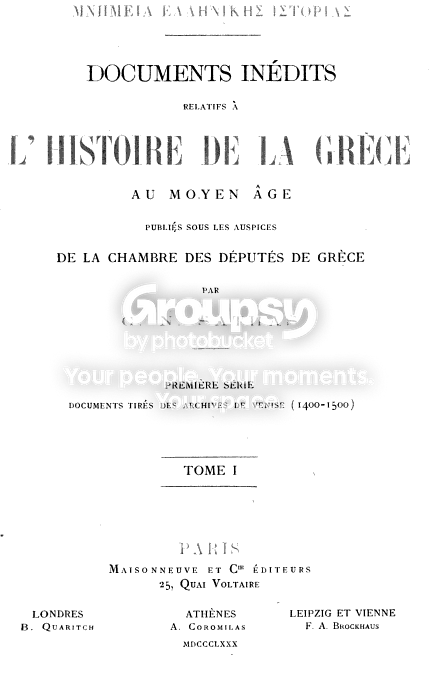
TitleSathas_zpsc2c893a2.png


ValaquesTaygetosTainaron_zps21baaa44.png


ChalcondylequoteValaques_zps3ef5acb8.png

MeletiusquoteValaques_zpsb46332d4.png


SathasValaques_zps850ca140.png


TzakoniansMacedonia_zps029c4906.png


2) Peloponnesiaca: A Supplement to Travels in the Moréa, By William Martin Leake.

Page 336. Laconians = Tzakonians = Maniates (= Vlachs.)

".. for it is evident from the anonymous Metrical Chronicle of the Wars of the Franks in the Morea in the 13th century, that Tzakonia had then a much wider signification. Even as late as the beginning of the 18th century we find the Venetians applying the name Zaccunia to all the ancient Laconia, including Mani. There remains, therefore, the strongest reason to believe that the Lakones or Tzakones mentioned by Pachymer and Gregoras consisted chiefly of Maniates."

3) "Waren die peloponnesischen Melinger Vlachen?", By Johann Benos.

Were the Peloponnesian Melingi Vlachs?

Many authors believe that the Peloponnesian Melingi were either of Slav or of unknown origin. However, there is evidence in the sources that they probably were Vlachs from Thessaly.

http://www.rutzen-verlag.de/publikationen/thetis2.html

 
Last edited:
I have posted the following in another thread, but here it is one more time - as found in this book:

Source: Mnemeia Hellenikes historias: Statuta et capitula --> Page "PREFACE LXXI".

French: "Dans la petition des Monembasiotes (1527), ces habitants des environs de Monembasie portent le nom Vulachi (Βλάχοι). Voir p. 231.

English: "In the petition of Monembasiotes (1527), the nearby residents of Monemvasia are named Vlachs (Βλάχοι). See p. 231."
 
Last edited:
Back
Top