• Welcome to the new Macedonian Truth Forum. All posts, members and private messages have been moved over from the old forum.

    Passwords from the old forum could not be carried over, so please use Forgot your password? to set a new one. The reset link is emailed to the address on your account.

  • Rules and Regulations at the forum of the Macedonian Truth Organisation (MTO)

    (1) The national-ethnic and cultural-linguistic identity of the Macedonian people is historically Macedonian, and derives its character from the native, indigenous and geographic homeland of the Macedonians, which is called Macedonia. To ensure that their human rights, integrity and heritage are appropriately respected, the only nouns and adjectives acceptable when reference is made to the above character and identity markers is Macedon, Macedonia, Macedonian and Macedonians.

    (2) The nation-state of the Macedonian people is the Republic of Macedonia, and is to be referred to by this official title so long as the 'republic' prefix is consistently applied to other states. Alternative references are the Macedonian Republic, or simply, Macedonia.

    (3) The 'ethnic' prefix is only acceptable for Macedonians in cases where differentiation is specifically required - so long as it is in context and consistent where it concerns its application to other ethnic groups.

    (4) Should any other differentiation be specifically required, the names of other ethnic groups that reside with Macedonians in either the Republic of Macedonia or the occupied Macedonian regions in Greece, Bulgaria, Serbia or Albania, are to be given a prefix.

    (5) Negating the identity, language and culture of the Macedonian people by deliberate avoidance of the terms Macedonia, Macedonian and Macedonians, or by any other means, is not permitted.

    (6) Systematic anti-Macedonian propaganda and rhetoric are not permitted.

    (7) Threads irrelevant to the Macedonian Cause, the community at the Macedonian Truth Organisation or the Macedonians in general may be considered as spam or not in the spirit of the forum. In such cases they are not permitted.

    (8) Continual posting of messages in threads with the sole purpose of deviating from the initial topics with the use of unrelated and unnecessary information is not permitted.

    (9) All posts, external articles, reports, etc that are cited in languages other than Macedonian or English, must be accompanied with a translation in one or both of the said languages.

    (10) Despite the possibility of some conversations and debates becoming heated, extreme abuse and/or racism, vulgar language and/or terminology, threats, revelation of personal information about others, harassment, and other such behavior will not be permitted. If deemed necessary all relevant information including member details will be reported to the appropriate authorities for investigation which may result in legal action.

    (11) Threads that are created must have a summary of a topic or excerpt of an article found in pertinent link(s) that have been included. One line threads will be considered unaccetable spam and are therefore not permitted.

    (12) Compulsive and deliberate lies, irrespective of the topic, are not permitted.

    (13) Any symbols or avatars found to be perceived as offensive to Macedonians are not permitted.

    (13) Any explicit or extreme material is not permitted.

    Failure to adhere to the above rules and regulations will result in a ban after 3 breaches. This may be reconsidered in some cases should the circumstances be of an unorthodox nature and/or require special consideration. To assure an effective deterrent against an individual or individuals with the sole purpose of causing dissent through spamming, racism or other improper means, the above rules will be strictly enforced.

    The MTO administration will monitor all discussions as reasonably practical and reserve the right to remove any post and/or member from the forum, and update the rules and regulations as required. Members are encouraged to immediately report any post and/or member to the MTO administration if they feel that these rules have not been abided by.

    The views expressed on this forum are those of the individuals. The only official representation of the MTO is made by the "Macedonian Truth Organisation (Site Owner)" username, and no other.

  • Macedonian Cause

    The Macedonian Truth Organisation calls on God in Heaven to protect, bless and guide the endeavour it is committing to undertake, and that is to work towards:

    Securing Macedonia as a free, independent and democratic republic in which sovereignty lies with the Macedonian citizens; as the nation-state of the Macedonian people in which they can preserve their culture, language and identity; as a state in which the Macedonian language and culture form the basis of public life and act as important unifying elements of Macedonian society; as the home of all its citizens to which it guarantees and obliges their inalienable natural rights and corresponding responsibilities;

    The acknowledgment as self-evident and irrefutable the existence of the:

    1) Indigenous, ethnonational name of Macedonia;
    2) Macedonian people, language and identity;
    3) Macedonian culture, symbols and folklore;
    4) Macedonian ancestry, heritage and history in its entirety; and
    5) Macedonian Orthodox Church;

    Securing recognition by the International Community of the tragedies endured by the Macedonian people, of the division of Macedonia with the signing of the Treaty of Bucharest on August 10, 1913, and the genocide committed against the Macedonian people at the hands of the Greek, Bulgarian and Serbian states and their respective churches during the 19th and 20th centuries;

    Ensuring that the Interim Accord is declared ‘null and void’ and that all constitutional provisions, acts, commitments, agreements, legislation, regulations, policies or programs emanating from, supporting or consequential to the Interim Accord are also declared ‘null and void’, including the use of any symbols and the completion of any acts imposed by, or originating from, the Interim Accord.

    Ensuring that the Framework Agreement is abolished and that all constitutional provisions, acts, commitments, agreements, legislation, regulations, policies and programs emanating from, supporting or consequential to the Framework Agreement are also abolished and replaced by a framework of constitutional and statutory law based on inalienable natural rights and corresponding responsibilities and universally codified human rights mechanisms.

    Securing the abolishment of any existing constitutional provisions, acts, agreements, legislation, regulations, policies and programs that discriminate against the Macedonian people, in any international organisation or any of the countries of the International Community where such constitutional provisions, acts, agreements, legislation, regulations, policies and programs exist, and thereby ensuring the freedom for Macedonians to exercise their inalienable natural rights and fulfil their corresponding responsibilities, and practice their culture, language and religious faiths in all the countries of the International Community without hindrance;

    The empowerment of Macedonians to undertake a moral revolution and to instil and/or reinvigorate within themselves a deep-rooted national, cultural, linguistic and historical dignity and a commitment to the exercise of freedom based on inalienable natural rights and corresponding responsibilities;

    The recognition of the Macedonian minorities in the neighbouring states of Macedonia as well as the respect for the inalienable rights and freedoms of the Macedonian minorities, as provided for by natural law and as codified by the United Nations Charter, the Universal Declaration of Human Rights and other universally codified human rights mechanisms;

    The full and unreserved respect of, and the support for, the rights of all people of non-Macedonian descent living in Macedonia and around the world, who share a reciprocal full and unreserved respect for the Macedonian people, their homeland and their state;

    The cultural unification and solidarity of the Macedonian people living in all parts of historical Macedonia and adjacent territories, as well as Macedonians throughout the world;

    The unity of all Macedonians on the principles, objectives and achievement of the Macedonian cause as defined by this declaration.

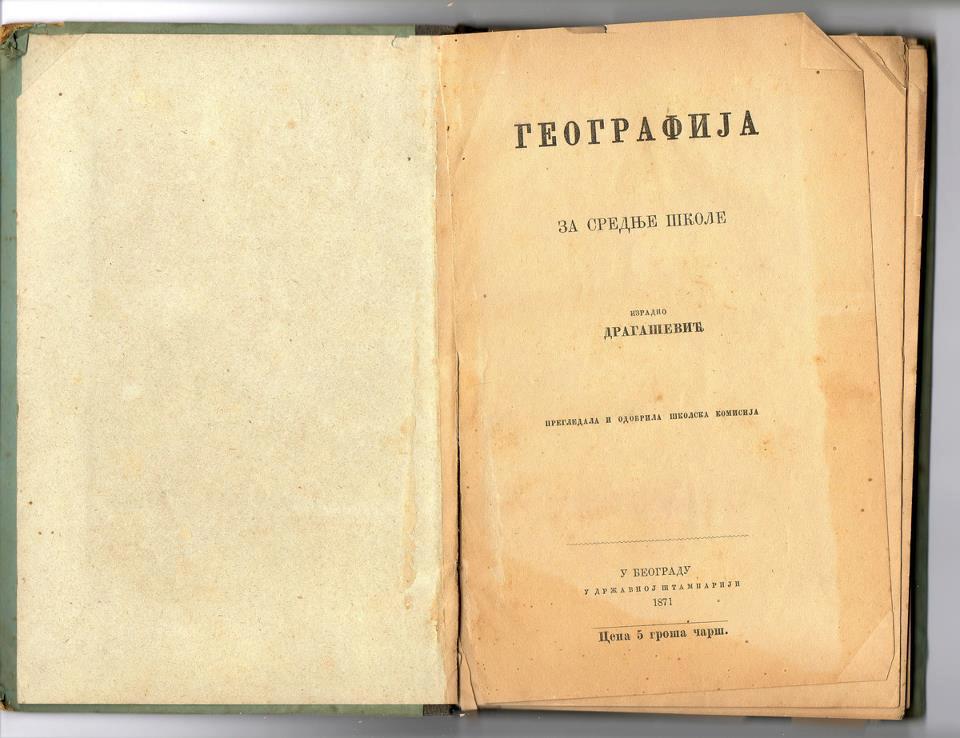
Serbian Geography Textbook - 1871: "Macedonians are indigenous"

Carlin

New member
Serbian Textbook:
- Macedonians are the oldest Slavs in the region, and perhaps even in Europe.
- Bulgarians and Serbs are newcomers in the Balkans, compared to the indigenous Macedonians.

serbian_geography_1871_p000.jpg

Translation of the title page: Geography for High Schools, prepared by Dragasevic. Reviewed and approved by the school commission -- Belgrade, 1871

serbian_geography_1871_p114-p115.jpg

Page 114 relevant translation: Natives in these lands, were in ancient times some Slavs, whose names we do not know ... these are modern Macedonians.

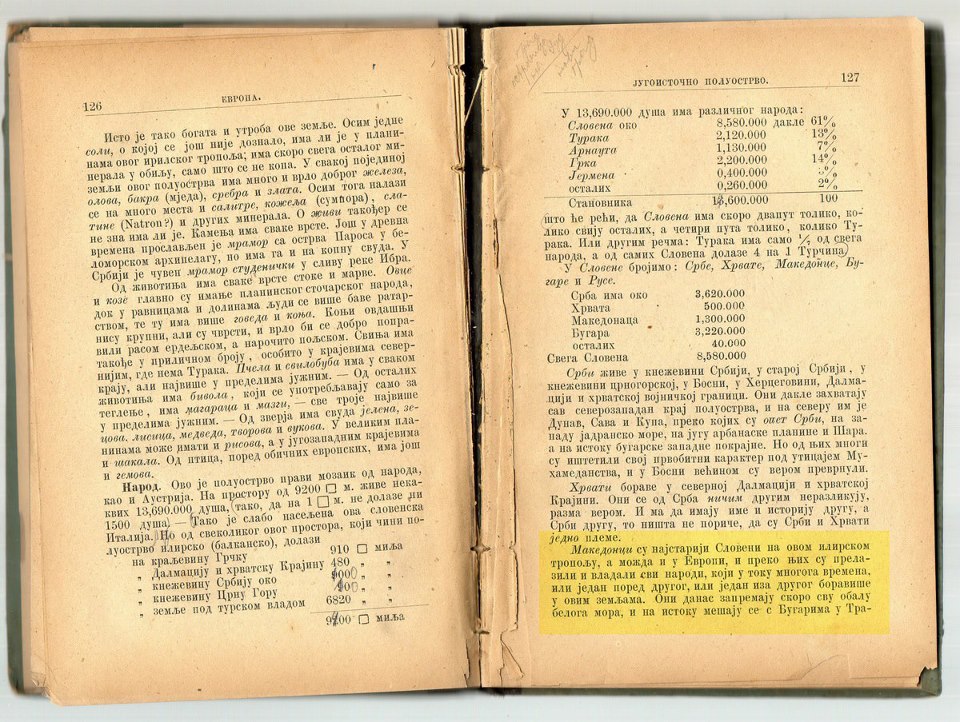
serbian_geography_1871_p126-p127.jpg

Page 127:
Slavs encompass: Serbs, Croatians, Macedonians, Bulgarians and Russians.
There are 3620000 Serbs, 500000 Croatians, 1300000 Macedonians, etc...


Further down on page 127, the beginning of the highlighted part: Macedonians are the oldest Slavs in these Illyrian lands, perhaps even in Europe...

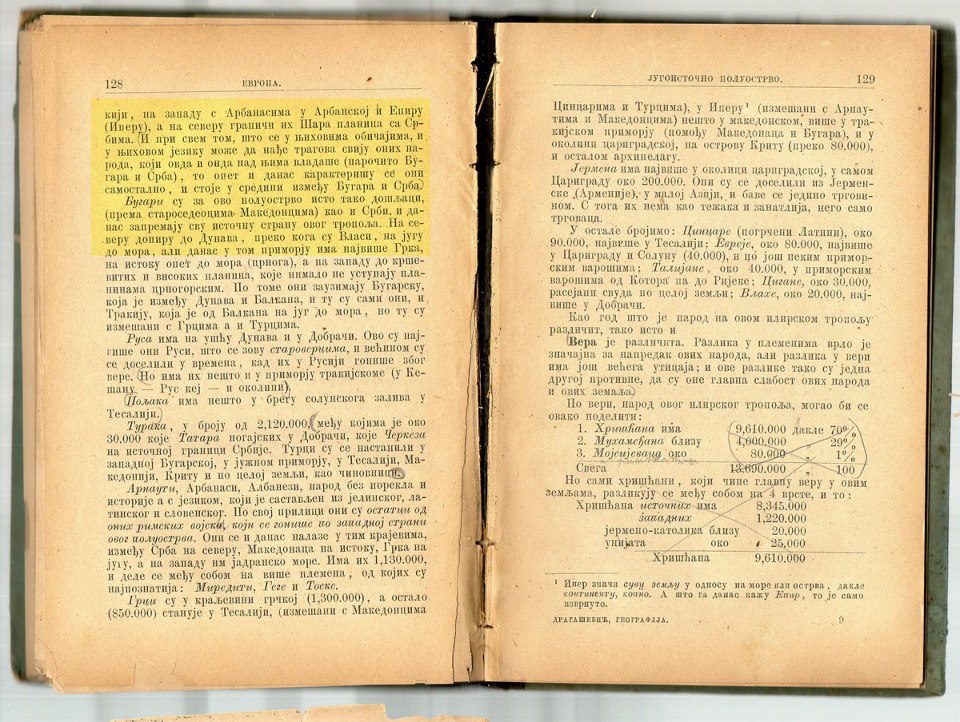
serbian_geography_1871_p128-p129.jpg

Page 128: Bulgarians are newcomers to this peninsula (when compared to the native/indigenous Macedonians) as are the Serbs...
 
Last edited:
Thank you Carlin this is very interesting. We need to translate the pages into English.
Bravo!

Daskalot you can publish that for the world to see and they still won't believe us...You can put 10,000 Macedonians in front of the United Nations building and one Greek and they will still deny the very existence of our people...and on top of that the Grujo and his croonies will still say no we're not Macedonians we're FYR Macedonians because we don't want to upset the Greek that's denying us...

Seriously when are the people of Macedonia going to stop taking shit???
 
But isnt this portraying us to be just Slavs when that is not the case?

Or do we just look past that and focus on the other concept behind this evidence which is the fact that the author says the Macedonians are indigenous to the Balkans?
 
But isnt this portraying us to be just Slavs when that is not the case?

Or do we just look past that and focus on the other concept behind this evidence which is the fact that the author says the Macedonians are indigenous to the Balkans?

During this period in time, it was popular for Serbian nationalists, as well as, a bit irrational, I might add, to regard themselves as having descended from the Sarmatians to the North in Sorabia (Sorbs) due to the Sarmatian military campaigns in that region during the declining years of the Eastern Roman Empire, despite the fact that Serbians were referred to continuously as Triballians thoughout the Roman occupation of Southeastern Europe. Triballians were a Thracian people. It seems probable that a number of Sarmatians may have overstayed the invasions and that there were cultural exchanges between Sarmatia and Triballia as greater economic activity resumed across the Danube, but not the biological displacement of an entire nation of people or even a significant portion of their population. Its more likely, given genetic and linguistic evidence, that the Triballians colonized what would become known as Sorabia, rather than the other way around.

'Sloveni' is a relational term that equates itself to an imagined or real kinship by way of linguistic similarity between at least two different populations, designating people as speakers of "the common tongue". Its not an authentic ethno-linguistic term in the languages that its forms are used in. Slav is a proper noun based on Sklabenoi, a Roman Period ethnic slur for populations who regarded themselves as 'sloveni', such as the Getae (Goths), Vindelicians (Vandals) and Sarmatians, who appear to have been comprised of both Getian (Dacian) and Vindelician (Vandalic, Wendish) populations. Mistranslations of historical texts based on this logical and grammatical disconnect have been very common since the advent of Pan-Germanism and Pan-Slavism and, unfortunately, human convention keeps perpetuating this false notion in contemporary works of scholarship.

"Macedonians are the oldest of the kindred peoples in the region and, perhaps, even in Europe."

This translation is based on inter-linguistic reciprocity and carries a meaning that remains aligned with the fact that it was common knowledge during the Renaissance Period that the Macedonians were regarded as a kindred people to the Sarmatians and the Triballians, a notion that some during the not so distant past appeared to have remembered, as well, as this passage seems to indicate.
 
In this case the term 'Slavs' can only have linguistic connotations, because it refers to indigenous Macedonians on the one hand and newcomer Serbs and Bulgars on the other.

By the way, Sovius, nice to see you're still around mate.
 
a lot of the slav component bought up is to smear us & tarnish us with the same brush.[If they say we are Slavic then we are really Macedonian but by whose decision by those who don't respect us & don't like us & prefer we don't exist.But we do exist as Macedonians,we allways have.There is a lot of written evidence of our Macedonian heritage.Look at threads by TM who has shown that we are ...Macedonian,We are not slav Macedonian.WE are smeared & our name is besmirched by those who don't regard us as alive.Yes Virginia Macedonians do exist despite the stupid propaganda to the otherwise.
 
In this case the term 'Slavs' can only have linguistic connotations, because it refers to indigenous Macedonians on the one hand and newcomer Serbs and Bulgars on the other.

By the way, Sovius, nice to see you're still around mate.

Hey SoM,
Its good to get away from the grindstone for a bit. Some excellent new material to ponder! As always, much appreciated. Hopefully, more and more folks in Macedonia are getting access to these documents.


George, a classic line!
 
MM much appreciated,Thanks to SOM for bringing thingslike these up.The material should be archived for reference purposes.I just reminded people of the propaganda & modus operandi of the serbs.Not much different to our other neighbour assimilation attempts of the Macedonian population.
 
So based on Sovius' theory (which I tend to agree with) can we argue that Sloveni as a relational term exited before the 6th century?
 
So based on Sovius' theory (which I tend to agree with) can we argue that Sloveni as a relational term exited before the 6th century?
I think the conditions for such a relational term to develop were around perhaps a century or so earlier than it is first mentioned in written records, not much earlier than that.
 
I think the conditions for such a relational term to develop were around perhaps a century or so earlier than it is first mentioned in written records, not much earlier than that.

I agree that it did exist before the 6th century, but I am not sure as to how far back. I'm trying to figure out how the Veneti fall into all this, since most of the sources I have read indicate they had a Slavic roots. I've also read that Veneti derives from "Sloveneti" or "Sloventi" (the Greeks and Romans could not start words with -Slo). However, these are proposed roots, and I don't know how much credibility to give them. There is a seemingly logical connection between the words the two words, but that would push back the use of "Sloveni" or some variant of it much further back in history and I haven't found much evidence to indicate Paleo-Balkans referred to each other by the closeness of their languages as "Sloveni". The only "evidence" I have is an inscription from a Slovenian website that promotes the Veneti theory. Here is the inscription in question:

http://s100.photobucket.com/user/MarioMacedon/media/slovonici_zps98446311.jpg.html

I suppose even if Veneti does not derive Sloven(e)ti, where does it come from? Is it just an term to denote a Slavic-speaking group, while Sloveni developed independently from it to describe ALL Slavic-speaking groups?
 
Last edited:
chak there is a sanscrit possibility.THere are a lot of words that are indoeuropean.Slov means word it would be interesting to see where it was all derived from.I also read that venets & there's enets all I know is they existed a long time ago.dont forget the brygians,eutruscans.etc
 
I agree that it did exist before the 6th century, but I am not sure as to how far back. I'm trying to figure out how the Veneti fall into all this, since most of the sources I have read indicate they had a Slavic roots. I've also read that Veneti derives from "Sloveneti" or "Sloventi" (the Greeks and Romans could not start words with -Slo). However, these are proposed roots, and I don't know how much credibility to give them. There is a seemingly logical connection between the words the two words, but that would push back the use of "Sloveni" or some variant of it much further back in history and I haven't found much evidence to indicate Paleo-Balkans referred to each other by the closeness of their languages as "Sloveni". The only "evidence" I have is an inscription from a Slovenian website that promotes the Veneti theory. Here is the inscription in question:

http://s100.photobucket.com/user/MarioMacedon/media/slovonici_zps98446311.jpg.html

I suppose even if Veneti does not derive Sloven(e)ti, where does it come from? Is it just an term to denote a Slavic-speaking group, while Sloveni developed independently from it to describe ALL Slavic-speaking groups?

Venetia (Venice/Veneto) was a region populated by Slovenian speaking people north of Rome and was recorded as Venetia by Latin speaking populations. To the south of Rome there lived the Venetulani. The whole peninsula was more or less culturally homogenous during the Bronze Age. Over 10 years ago, geneticists demonstrated that Central and Southeastern European populations were and are largely indigenous to the regions they continue to inhabit and have been living more or less where they have collectively since before the Neolithic Period. The Latin language evolved out of the admixture of Illyrian (Slovenian/Slavic) language speaking populations with Afro-Asiatic and other non-indigenous language speakers in what is now called central Italy as a center of Mediterranean and Continental European trade, similar to the Achaean language and its speakers' exposure to dissimilar cultures. So, Veneti is simply an exonym and Venetologists have proposed a hypothetical evolution of the term in that manner. There's obviously no way to know for certain how the term Veneti (Wend, Enetoi) came into being, but what is certain is that the Veneti to the north of Venetia weren't called Sklavus until after the Vindelicians and the Getae began their campaigns to end Rome's oppressive rule over large tracts of Europe.

The Primary Chronicle of the Rus is the earliest example of the use of slovenskii as a relational term that I have been able to identify. Anytime before that has to be based on plausible assumption. Did the people of Illyrian origin who reported their history to Nester begin using the term on the day he started writing his book? Two weeks before he got a publishing contract from New York? Two centuries? While an answer to the question has to exist, the means to answer it might never materialize.

It is definitely hard to sort out and define terms like Slavs, Sklabenoi,Veneti, etc, since they are for the most part exonyms. For now, we do not know how the Slovenic people (I use this term intentionally to refer to their linguistic relationship) referred to themselves in antiquity and before the invasion of the Getae and other tribes. Out of curiosity, do you believe the Vindelcians were also of Venetic descent? Furthermore, are Vindelcians from the region NE present-day Italy? That's what most maps I dig up seem to show. If the Vindelcians ARE of Venetic, that could be a logical starting point as to where Slovenii possibly came from.

The website below makes the claim that the Veneti (Eastern and Western Slovenic groups) had had their original name of "Sloveneti" pushed into oblivion because of constant foreign exonyms. They then say that a new name, Sloveni, emerged out of "desperation" for an identity. If the Vindelcians were part of this Venetic group, as their name suggests, and also part of the 6th century raids, then it's possible, in my opinion, that "Sloveni" emerged with them and later became deformed into "Sklabenoi" when Greeks first heard it. Of course this is all highly speculative, but it is seemingly logical. Here is the website: http://sloveneti.tripod.com/veg/e/Init/union_e.html
 
Last edited:
The total extent of Venetia remains preserved in Western archeology textbooks as Europe's Urnfield Cultures of the Bronze Age. The whole region is still a living museum of Slovenian toponyms and substratum language influences among non-Slovenian speaking people, and the prehistoric genetic dispersal matches the language dispersal. So, Vindelician civilization evolved out of Venetian civilization, but also followed a different path of development over time. Sarmatia was populated by both Vindelicians and Dacians in addition to Galicians (Golitsa: a place characterized by barren land), among other peoples. The Polish language features a divergent pronunciation scheme not found in Southeastern or South Central Europe. The Oder river in Poland was once known as Suevus. The Suevians were Galicians and they founded the short lived kingdom of Galaecia in the northwest region of Hispania during the dismantling of the Roman Empire. They were regarded as Celtic, as were the Vindelicians. They gave spiritual reverence to Oak trees rather than the Orthodox Venetian Linden tree and must have been thought of as heretics. This cultural admixture is still preserved in rural Poland, with some villages favoring idolatry and some sticking with the one true tree. Suevi can be thought of as an inter-linguistic adoption of Swove-yawn-ee, 'sloveni' in Polish, given the indigenous existence of Sarmatian populations. Galicia still remains a part of Polish territory and, while they may now identify as Polish, their ancestors were referred to as Galicians (Galatians).

Why is this important? Because Simocatta referred to the Getae as Sklavenes, not Sueves or swovenes. Its all about the 'L' in my opinion. It seems to me that Sklabenoi had to have meant "proto-Romanian" in the Eastern Roman language or "a people who know how to pronounce 'slovo' correctly". The use of the "L" would indicate transference through the Dacian language. The Dacians were also described as Sporoi, which meant refugees in the Eastern Roman language, or more specifically, a scattered people. This suggests displacement through conquest, which, again, favors the Getae.

Winnica (venn-ee-tsa) means 'a land bearing grape vines' in Polish and is still the commonly used term for vineyards. The regions to the south of Vindelicia have been known to produce a high quality barrel or two. Why is this important? Because the Poljani lived in the fields and the Drevjani lived amongst the trees. The Golitsi lived along barren hills and the Veneti must have lived where, according to how groups of people came to be referred to as in the languages of our ancestors?

I believe the inscription says 'slovonici', similar to 'slovinci' . The mechanical aspects of the 'sloveneti' explanation possesses exceptional merit, especially because they make complete sense in terms of Slovenian grammar, not simply lexicon. But what exactly did it mean to early Slovenians (Venetians)? Was it used as a formal ethnic or political designation or as a simple expression of intelligibility between neighboring peoples or between neighbors? Did it mean ' kindred' during that period in time, a term possessing a connotative meaning in addition to its original denotation? If it was an ethno-nationalistic term, why wasn't Venetia referred to as sklavenetia right off the bat in the records of the Romans? Slovonica, a place where words are kept? A library, perhaps? Us, rather than them? Slo-veni, one who speaks in the Venetian language, a colloquial agglutination, or to speak in Venetian?

Some additional observations: The northern region of Hispania was a part of Venetia before it fell to Rome. Old school nationalist scholars like to go on about the "savage" directionless barbarians and "civilized" Romans ad nauseum, but there is another depth of understanding waiting for them, once they are able to lift the veil of centuries of ethnocentricism and brutal cultural negation. We are, after all, discussing things that were well known during the Renaissance Period. Its not like someone misplaced Galicia for a thousand years or something like that. The Finnish word for our peoples to the East is Venaja. Again, there are no adaptive forms like 'Solvenaja' for the proposed intranym, but there is the historically attested to form, preserved on two different sides of the continent, existing basically unchanged in two completely different languages. And then, there is the term, itself, still in use, alive and well.
 
Sovius, you theories are truly amazing and I commend you for your research into this area; I believe you have taken major steps in the right direction. However, I don't believe I am quite up to speed with you yet. For one, I still picture Vindelcia as a part of modern-day Switzerland and Italy, so I am struggling to see how Vindelcians also lived among the Getae, Dacians, Galicians in Sarmatia. Are we referring to the same region and people?

Furthermore your theory of the use of Sklabenoi is particularly fascinating. Are you suggesting the Getae referred to themselves as something along the lines of "Sloveni", or that they were referring to another group of people? I remember reading your earlier posts about it being somewhat of a slur used by the Byzantines, so is this still in line with that?


Once again, great work!
 
Last edited:
Back
Top