
• Welcome to the new Macedonian Truth Forum. All posts, members and private messages have been moved over from the old forum.

    Passwords from the old forum could not be carried over, so please use Forgot your password? to set a new one. The reset link is emailed to the address on your account.

  • Rules and Regulations at the forum of the Macedonian Truth Organisation (MTO)

    (1) The national-ethnic and cultural-linguistic identity of the Macedonian people is historically Macedonian, and derives its character from the native, indigenous and geographic homeland of the Macedonians, which is called Macedonia. To ensure that their human rights, integrity and heritage are appropriately respected, the only nouns and adjectives acceptable when reference is made to the above character and identity markers is Macedon, Macedonia, Macedonian and Macedonians.

    (2) The nation-state of the Macedonian people is the Republic of Macedonia, and is to be referred to by this official title so long as the 'republic' prefix is consistently applied to other states. Alternative references are the Macedonian Republic, or simply, Macedonia.

    (3) The 'ethnic' prefix is only acceptable for Macedonians in cases where differentiation is specifically required - so long as it is in context and consistent where it concerns its application to other ethnic groups.

    (4) Should any other differentiation be specifically required, the names of other ethnic groups that reside with Macedonians in either the Republic of Macedonia or the occupied Macedonian regions in Greece, Bulgaria, Serbia or Albania, are to be given a prefix.

    (5) Negating the identity, language and culture of the Macedonian people by deliberate avoidance of the terms Macedonia, Macedonian and Macedonians, or by any other means, is not permitted.

    (6) Systematic anti-Macedonian propaganda and rhetoric are not permitted.

    (7) Threads irrelevant to the Macedonian Cause, the community at the Macedonian Truth Organisation or the Macedonians in general may be considered as spam or not in the spirit of the forum. In such cases they are not permitted.

    (8) Continual posting of messages in threads with the sole purpose of deviating from the initial topics with the use of unrelated and unnecessary information is not permitted.

    (9) All posts, external articles, reports, etc that are cited in languages other than Macedonian or English, must be accompanied with a translation in one or both of the said languages.

    (10) Despite the possibility of some conversations and debates becoming heated, extreme abuse and/or racism, vulgar language and/or terminology, threats, revelation of personal information about others, harassment, and other such behavior will not be permitted. If deemed necessary all relevant information including member details will be reported to the appropriate authorities for investigation which may result in legal action.

    (11) Threads that are created must have a summary of a topic or excerpt of an article found in pertinent link(s) that have been included. One line threads will be considered unaccetable spam and are therefore not permitted.

    (12) Compulsive and deliberate lies, irrespective of the topic, are not permitted.

    (13) Any symbols or avatars found to be perceived as offensive to Macedonians are not permitted.

    (13) Any explicit or extreme material is not permitted.

    Failure to adhere to the above rules and regulations will result in a ban after 3 breaches. This may be reconsidered in some cases should the circumstances be of an unorthodox nature and/or require special consideration. To assure an effective deterrent against an individual or individuals with the sole purpose of causing dissent through spamming, racism or other improper means, the above rules will be strictly enforced.

    The MTO administration will monitor all discussions as reasonably practical and reserve the right to remove any post and/or member from the forum, and update the rules and regulations as required. Members are encouraged to immediately report any post and/or member to the MTO administration if they feel that these rules have not been abided by.

    The views expressed on this forum are those of the individuals. The only official representation of the MTO is made by the "Macedonian Truth Organisation (Site Owner)" username, and no other.

  • Macedonian Cause

    The Macedonian Truth Organisation calls on God in Heaven to protect, bless and guide the endeavour it is committing to undertake, and that is to work towards:

    Securing Macedonia as a free, independent and democratic republic in which sovereignty lies with the Macedonian citizens; as the nation-state of the Macedonian people in which they can preserve their culture, language and identity; as a state in which the Macedonian language and culture form the basis of public life and act as important unifying elements of Macedonian society; as the home of all its citizens to which it guarantees and obliges their inalienable natural rights and corresponding responsibilities;

    The acknowledgment as self-evident and irrefutable the existence of the:

    1) Indigenous, ethnonational name of Macedonia;
    2) Macedonian people, language and identity;
    3) Macedonian culture, symbols and folklore;
    4) Macedonian ancestry, heritage and history in its entirety; and
    5) Macedonian Orthodox Church;

    Securing recognition by the International Community of the tragedies endured by the Macedonian people, of the division of Macedonia with the signing of the Treaty of Bucharest on August 10, 1913, and the genocide committed against the Macedonian people at the hands of the Greek, Bulgarian and Serbian states and their respective churches during the 19th and 20th centuries;

    Ensuring that the Interim Accord is declared ‘null and void’ and that all constitutional provisions, acts, commitments, agreements, legislation, regulations, policies or programs emanating from, supporting or consequential to the Interim Accord are also declared ‘null and void’, including the use of any symbols and the completion of any acts imposed by, or originating from, the Interim Accord.

    Ensuring that the Framework Agreement is abolished and that all constitutional provisions, acts, commitments, agreements, legislation, regulations, policies and programs emanating from, supporting or consequential to the Framework Agreement are also abolished and replaced by a framework of constitutional and statutory law based on inalienable natural rights and corresponding responsibilities and universally codified human rights mechanisms.

    Securing the abolishment of any existing constitutional provisions, acts, agreements, legislation, regulations, policies and programs that discriminate against the Macedonian people, in any international organisation or any of the countries of the International Community where such constitutional provisions, acts, agreements, legislation, regulations, policies and programs exist, and thereby ensuring the freedom for Macedonians to exercise their inalienable natural rights and fulfil their corresponding responsibilities, and practice their culture, language and religious faiths in all the countries of the International Community without hindrance;

    The empowerment of Macedonians to undertake a moral revolution and to instil and/or reinvigorate within themselves a deep-rooted national, cultural, linguistic and historical dignity and a commitment to the exercise of freedom based on inalienable natural rights and corresponding responsibilities;

    The recognition of the Macedonian minorities in the neighbouring states of Macedonia as well as the respect for the inalienable rights and freedoms of the Macedonian minorities, as provided for by natural law and as codified by the United Nations Charter, the Universal Declaration of Human Rights and other universally codified human rights mechanisms;

    The full and unreserved respect of, and the support for, the rights of all people of non-Macedonian descent living in Macedonia and around the world, who share a reciprocal full and unreserved respect for the Macedonian people, their homeland and their state;

    The cultural unification and solidarity of the Macedonian people living in all parts of historical Macedonia and adjacent territories, as well as Macedonians throughout the world;

    The unity of all Macedonians on the principles, objectives and achievement of the Macedonian cause as defined by this declaration.

Slavization of the Balkans

The slavization of the Balkans should be viewed the same as the Latinization of western Europe.
Genetics and physical appearence prove that there are no real slavs in the balkans. The northern european (slavic) appearence is absent in the balkans.
The slavic speaking people of the balkans are slavicized balkaners, just like the french are latinized gauls, romanians are latinized dacians, the irish are anglified celts etc. etc.

A majority of people accepting the language of a minority is not a rare thing. It has happened many times in history. It depends on the socio-political situation and other circumstances. And it is impossible and funny to assume that the slavs had numbers great enough to colonise such a vast area of europe in the early middle ages. The same could be said about the Franks, Visigoths, Vandals etc. Owning a territory does not mean colonisation.

This is what I'm talking about:
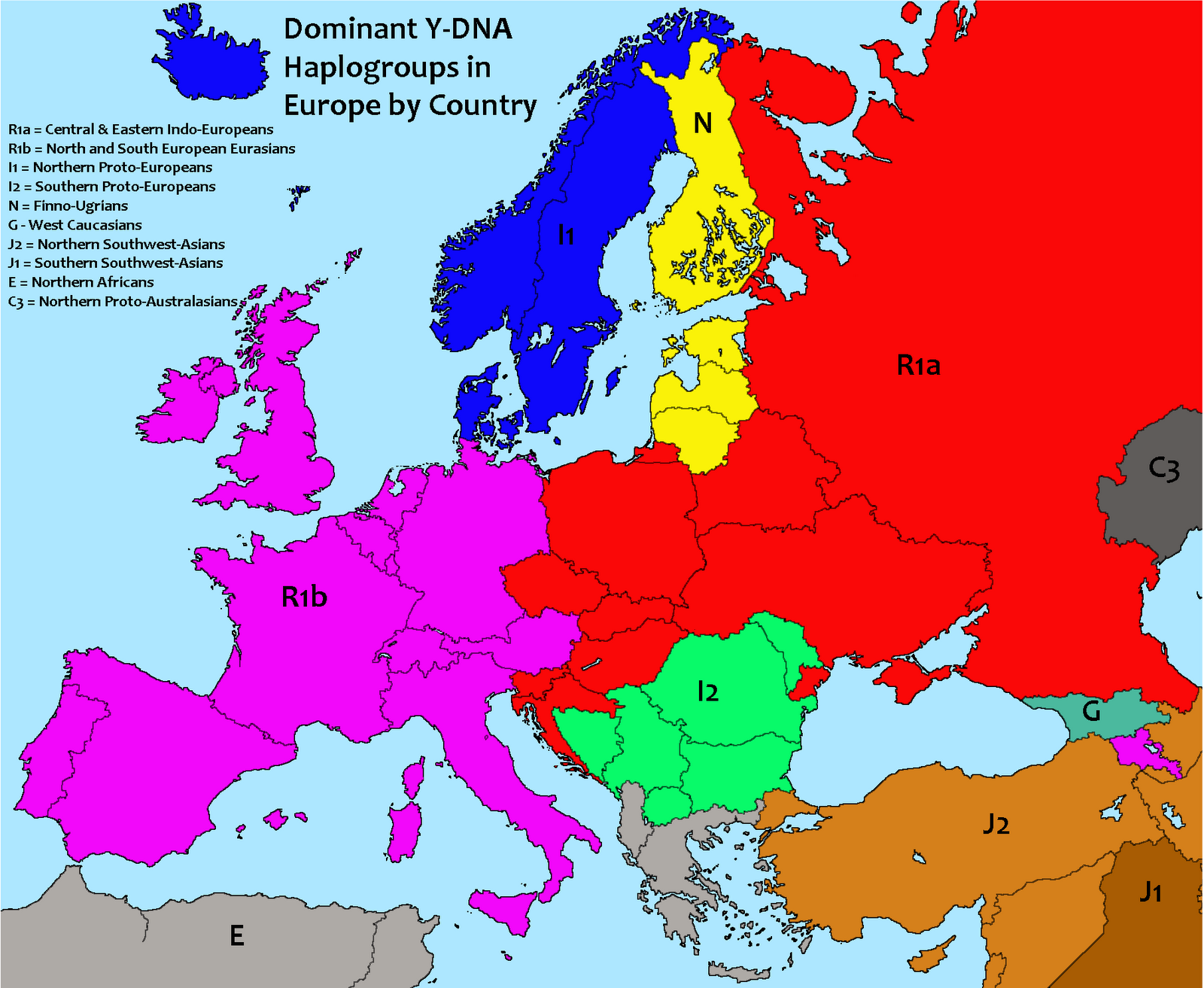
y-dna_haplogroups_europe_genetic_map.png


7fff0eb41f54b6e2b7599e62e6a983cb.jpg


I have seen some Macedonians and other balkaners supporting the idea that the ancient peoples of the balkans spoke slavic. This can be easily disproven.
The slavic languages are too close to eachother to have been separated for thousands of years. In fact the slavic branch has the closest languages, which means that the separation happened later than other branches.


Now, when the slavization happened, almost the entire balkan peninsula spoke slavic (with native balkan accents) except Hellas and Dacia (although influenced).
Albanians weren't here at that point in time. We can say this because:

1- If the albanians were always here then they would have been latinized, slavicized or grekified. No paleo-balkan language survived after the slavization.

2- If the albanians were always here then we would have seen albanian placenames all over.. instead we see albanized versions of slavic names all over kosovo and albania. Which means they came after the slavization

3. - If the albanian language was always here, we would have seen much influences from Greek - the ancient lingua franca of the east mediteranean.
And the comment above.

4- From the remains of the illyrian language we can conclude that it was on the same indo-european branch with Celtic and Italic.. And that it has no connection to the albanian language.

5- Every person from present-day albania mentioned in historical texts from the early middle ages has a slavic name. The same can be said about villages and cities.

Leave the albanians now.. back to the natives.

We can see that, like other places in the world, language has nothing to do with ethnicity and ancestry.
So what language did our ancestors speak? What are we? Ofcorse there is no pure nation in the world, but what matters is the core of a population / nation.

The ancient Macedonians were in the ''Brygian group'' together with the Paeonians, Dasseratians, Enchelaneans, Pelagonians, Epirotes, Mygdonians, Crestonians, Paphlagonians and Phrygians. That's why many of these tribes were so easily assimilated into the Macedonians.
Most of what we know about this language branch is known to us through the Phrygians in Asia Minor. But we also know that the ancient Macedonians had their own names for the gods. ''Aret'' for Zeus, ''Zeirena'' for Aphrodite etc. This language group was different from it's neighbours and people needed translators to understand eachother with Illyrians, Greeks or Thracians.

Here is a map of the language groups (families) of the ancient balkans:

cUXD5RUnQVe9gCA-gJo3jA.png


When the word ''Slavic'' stops having a racial meaning, and starts having a linguistic and cultural meaning (like Latin), then many problems in the Balkans will be solved.
 
Last edited:
What do you guys think about this image?

R1_AGR.jpg


Do you think that the Greeks which resettled in Aegean Macedonia in the 1920's have close ties to the Slavs which were deported from the Balkans to Anatolia by the Byzantine Empire in the middle ages?
 
All I know is that R1a is the “Polish-Russian” haplogroup.

The overall percentage in Greece is correct (around 9%) but the coloring of local areas is problematic. It is statistically impossible to have 23% in Rethymno, 20% in Lasithi and 0% in Heraclion, especially since Heraclion (like Athens) attracts population from everywhere. Scientists should take a deeper look at this. I see the potential for a huge discovery. Maybe there’s a germ over there that’s killing the R1a gene.
 
I agree, the 'ethno' part should be dropped when describing slavs as an 'ethno-linguistic' group. My theory to as of why the slavic migration theory is widely accepted is because the western and eastern world powers came to a common ground on it, but each having separate motives behind it. The west's promotion of it being an attempt to tarnish the majority of followers of the orthodox church as being descendants of 'invaders', and Russia's was for Moscow to claim the title of 'Third Rome', since they can be viewed as the motherland for most followers of the orthodox faith.
 
I think it really depends on what they sampled. When people say countries are heterogeneous in their genetic makeup, I personally don't see it as a regional thing, but more based on settlements. I mean two neighboring villages could a different genetic makeup. So I don't think results like this shouldn't come at too much of a surprise.
 
Check out this interesting book - from page 22 and onwards, "Migration and Invasion" google books.

"The invasion hypothesis is dead and buried. No longer would we even want to litter the prehistoric and first-millenium Europe with a succession of ancient 'peoples' carving out their chosen niches via a lethal cocktail of large-scale movement and ethnic cleansing."


https://books.google.ca/books?id=gb...AA#v=onepage&q=Empires and Barbarians&f=false

https://www.amazon.ca/Empires-Barbarians-Fall-Birth-Europe/dp/0199892261

Some good reviews/comments from Amazon readers.

Similar tribes (i.e. Angles and Saxons) invaded Britain in large enough groups that they displaced the local elites and destroyed their economic systems; eventually, they instilled their language into the local populace, as women could teach the children their original languages, they replaced local languages, including Latin and Celtic. This was a pattern that was often repeated in Europe until 1000 CE, when the principal language patterns that survive with few exceptions (Turkish in Anatolia being a rather big one) to this day.

As western Roman economic structures declined, new power centers arose in northern Europe for the first time, in 7 C CE. Though the level of socio-economic and political sophistication were far below those of the Romans, the new entities were proto-modern states nonetheless. They learned to create military organizational structures, monopolizing the means of force in order to maintain the elites that eventually became entrenched in land ownership and hence became the grand royal and aristocratic families that ruled for the next 1500 years. Heather also covers the Vikings and Slavs; the origins of the latter remain murky and unknowable from the archaeological record. The Slavs, interestingly, conquered much of central Europe because elite Germans seem to have migrated West, leaving poorly armed and disorganized Germanic peasants, who were then absorbed into the newly dominant Slavic elites and tended to adopt their languages. Due to their lack of ability to tax and build viable cities, these semi-nomadic groups faced inherent limits: once they expanded to large size based on pillage and forced tribute, they could no longer pay their forces enough to keep them together and so these mini-empires disintegrated; so the Carolingians, Merovingians, Ottonians, and scores of others succeeded each other a few generations after the charismatic founder disappeared.


In "The Fall of the Roman Empire," Heather presented what was to me a new and original explanation for the dissolution of the empire, one of history's great questions. Heather believes that technological developments and wealth leached out from the Roman borders to allow the Germanic tribes living in northern and eastern Europe to develop a greater level of material and political sophistication and more efficient agricultural methods. This increase in sophistication led to a population rise among the Germanic tribes, and in turn an increase in political and military heft, which allowed the tribes to encroach on an overextended Roman empire, teetering from civil war and war on its Persian front. In a fascinating passage in "Empires & Barbarians," Heather speculates that the Hunnic invasion form the steppes led by Attila was a crucial precipitating cause in the collapse of the empire, as the increasingly powerful Germanic tribes would probably have done no more than annex certain Roman provinces, letting the Empire continue on. Heather supports his theory principally through a review of recent archaeological research from Germany and eastern Europe with less emphasis placed on Roman historical writings.


PS:

Did a similar process take place in the Balkans?

Did the Slavic Elite conquer much of Balkans because Elite Romans fled and migrated elsewhere, leaving poorly armed and disorganized Romance-speaking and other native Balkan peasants and shepherds, who were then absorbed into the newly dominant Slavic elites and adopted the Slavic language?
 
Last edited:
Did the Slavic Elite conquer much of Balkans because Elite Romans fled and migrated elsewhere, leaving poorly armed and disorganized Romance-speaking and other native Balkan peasants and shepherds, who were then absorbed into the newly dominant Slavic elites and adopted the Slavic language?

I think that is a plausible explanation. The rich/elite could afford to migrate away, while the wealth of the poor was generally their land, which some couldn't afford to leave behind.
 
Put a Russian or a Pole next to a Macedonian. You don't have to be an expert to see that we have nothing in common.
Macedonians are a mediterranean people of Brygian stock.
 
Put a Russian or a Pole next to a Macedonian. You don't have to be an expert to see that we have nothing in common.
Macedonians are a mediterranean people of Brygian stock.

Also I've heard now and then that the Macedonian language is the most unintelligible out of all the slavic languages of the Balkans when spoken to Poles/Russians or any non-Balkan slavic speakers.

Can anyone confirm if this is true? Or does it narrow down to regional dialects?
 
Also I've heard now and then that the Macedonian language is the most unintelligible out of all the slavic languages of the Balkans when spoken to Poles/Russians or any non-Balkan slavic speakers.

Can anyone confirm if this is true? Or does it narrow down to regional dialects?

The most distant languages in the Slavic branch are Polish and Macedonian.
 
Put a Russian or a Pole next to a Macedonian. You don't have to be an expert to see that we have nothing in common.
Macedonians are a mediterranean people of Brygian stock.

Macedonians are indeed a Mediterranean people, and all evidence supports this thesis.

The problem is convincing the rest of the world about the veracity of this thesis. Even Borza, who supports the distinctness of the ancient Macedonians, believes that modern day Macedonians first arrived in the Balkans in the 5th and 6th centuries AD.

Greeks use this argument as fodder in denying our ethnic identity and our connection to the ancient Macedonians. Western academics and the media unfortunately also use this argument against us.
 
'Cretans' and 'Montenegrins'


Crnogorci = Slavicized Keraunioi Illyriovlachs
 
Last edited:
Is there anything out there that explains what types of geographical regions Slavic tribes preferred to settle in? If they were as dominate and numerous as the slavic migration theory makes them out to be, you'd think they would prefer to settle in lush valleys and fertile plains rather than remote mountains.

I know the turkic tribes generally settled in plains because of their horse breeding culture.

They were not numerous at all. They were small clans that established many little states across the balkan in which they were the ruling elite, with slavic becoming the language of administration, thus being spread to the locals, which were the absolute majority.

Balkan historians are gradually accepting this.
Some of them, not wanting to lose the claim on Macedonian land, started arguing that the ancient Macedonians were Thracians / Illyrians. Luckily archaeology and onomastics prove them wrong. The only thing they rely on being the words of a few ancient greek historians who didn't know much about, and were not interested in, ''barbarian'' nations in the first place.
 
Atlas of world history, volume one.
Hermann Kinder and Werner Hilgemann

The Slavs (Slovene from slovo = the word), a major branch of the Indo-European family of peoples, originally lived in the Pripet Marches. The area settled by Slavs later included parts of Poland, White Russia and the Ukraine. During the early centuries the history of the Slavs was connected with that of the Germans (Goths), Huns, Alani and Turkomans, with whom the Slavs often entered into mutually fruitful relationships (=symbiosis). Pliny the elder, Tacitus and the geographer Ptolemy called them Venedi or Veneti; the Germans called them Wenden; from the 6th century Byzantine writers (Procopius and Jordanes) spoke of the Sklavenoi, placing them along the Lower Danube, but also in the eastern Alps. From 600, Slavic peoples (Abodrites, Sorbs, Veneti and Pomerani) settled east of the Elbe in the areas vacated by Germanic tribes. As with the Czechs, their historical record becomes verifiable only in the Carolingian period (805, construction by Charlemagne of the limes sorbicus = line of the easternmost Frankish trade settlements).

Grouping of Slavic tribes: t
he east Slavs (Russians later subdivided into Ukrainians, White and Great Russians), west Slavs (Pols, Pomerani, Abodrites, Sorbs, Czechs and Slovaks), and south Slavs (Slovenes, Serbs, Croats and Bulgars). The unity of the Slavic world was disrupted by Germanic colonization in the Danubian area and the Eastern Alps after the destruction the Avar kingdom, and by the migration of the Magyars to the Hungarian plain c. 900 (owing to pressure from the east by the Patzinaks): separation of the west Slavs in the north from the south Slavs.

Society: originally the Slavs lived in clans (reverence of ancestors), consisting of large familial communities. Several of these familial communities made up larger social units led by elders. These again made up the tribe with its military organization (the century as the basic unit of the levy, then the millennium) and its common religious culture. The leaders of the familial communities gradually developed into an aristocratic upper class. The particularism of the tribes prevented the establishment of any great power status for the Slavs. Titles of rulers used in later times were borrowed from other languages: kunedzi (prince) was Germanic (king); Korlji (Czech Kral) was derived from the name Charlemagne; the title of Tsar from the Roman Caesar.

Economic Life: the Slavs occupied themselves with farming, hunting, fishing, the raising of domestic animals and bee-culture in the extended areas of their settlement. There were also – predominantly living in the towns – artisans (specialist): carpenters, weavers, potters, tanners and furriers. Active trading developed along the rivers. Raw materials (honey, wax, furs) were exchanged for textiles, weapons, utensils, jewellery, gold and silver. The Jews, Germans and Greeks at first monopolized trade; the Slavs themselves did so later. The trading centres of the east Slavs became towns.

Religion: historical sources speak of names and images of gods, of the temples of the west Slavs (the temple of Arkona on the island of Rugen, the shrine of the god Triglaw at Stettin and that of Svaricic at Rethra), of tree cultures and oracles. The use of amulets and symbols indicates contacts with the Iranians and Turkomans. The east Slavs knew the God of Thunder and Lightning, Perun. The supreme deity of the ancient Slavs was Svarog, an early God of the Heavens and Thunder. The Slavs of the Havel area worshipped Dazbag (God of the Sun) and Jarovit (God of Spring). Within the familial communities the fertility gods Rod and Rozanicy were worshipped. All tribes worshiped nature.

The christianization of the Slavs began with the advance of Roman and Byzantine civilization into Eastern and Central Europe: during the 6th century missionary activity from Aquileia among the Croats; during the 8th century from Salzburg among the Slovenes. Missionary activity among the Wends, the Czechs (from Regensburg), the Abodrites and Elbe Slavs (from Verden at the Aller) was initiated during the reign of Charlemagne. The Slavs joined the Eastern Church c. 850. The Apostles of the Slavs, Cyril and Methodius, conducted missionary activity within the Greater Moravian Kingdom from 863; they later joined Rome.
864-5 Conversion of the Bulgars (1st autocephalous Eastern Church).
866 Christianization of groups of the Rus.
948 Establishment of the bishoprics of Havelberg, Brandenburg and Oldenburg.
966 Baptism of duke Miezko of Poland.
968 Establishment of the archbishopric of Magdeburg with the suffragan bishoprics of Meissen, Merseburg and Zeitz (moved to Naumburg in 1032) by Otto I (intended to bring about the conversion of the Elbe Slavs).
973 Establishment of the bishopric of Prague.
983 Suppression of Christian missionary activity during the rebellion of the Slavs (Havelberg, Brandenburg).
988 Baptism of the Varangian Prince Vladimir.
1000 Establishment of the archbishopric of Gnesen.
1001 Establishment of the archbishopric of Gran (Esztergom). With the establishment of this archbishopric the Polish and Hungarian churches freed of Germanic influence.

All Slavic states attempted to establish auto-nomous churches (autocephalous bishoporic or patriarchate). The Slavic language, based on a Macedonian Dialect, became the language of the Slavic churches and the written language of the Balkan and East Slavs With their acceptance into the community of Christian peoples, the Slavs reached a higher cultural level; the new common faith of the developing Slavic states also contributed to the fusion of the heterogeneous ethnic and cultural elements. Despite their split into Raman Catholic (west Slavs) and Greek Orthodox (East Slavs) states, both groups were part of the European civilization by virtue of their Christianity.
 
Last edited:
Back
Top