• Welcome to the new Macedonian Truth Forum. All posts, members and private messages have been moved over from the old forum.

    Passwords from the old forum could not be carried over, so please use Forgot your password? to set a new one. The reset link is emailed to the address on your account.

  • Rules and Regulations at the forum of the Macedonian Truth Organisation (MTO)

    (1) The national-ethnic and cultural-linguistic identity of the Macedonian people is historically Macedonian, and derives its character from the native, indigenous and geographic homeland of the Macedonians, which is called Macedonia. To ensure that their human rights, integrity and heritage are appropriately respected, the only nouns and adjectives acceptable when reference is made to the above character and identity markers is Macedon, Macedonia, Macedonian and Macedonians.

    (2) The nation-state of the Macedonian people is the Republic of Macedonia, and is to be referred to by this official title so long as the 'republic' prefix is consistently applied to other states. Alternative references are the Macedonian Republic, or simply, Macedonia.

    (3) The 'ethnic' prefix is only acceptable for Macedonians in cases where differentiation is specifically required - so long as it is in context and consistent where it concerns its application to other ethnic groups.

    (4) Should any other differentiation be specifically required, the names of other ethnic groups that reside with Macedonians in either the Republic of Macedonia or the occupied Macedonian regions in Greece, Bulgaria, Serbia or Albania, are to be given a prefix.

    (5) Negating the identity, language and culture of the Macedonian people by deliberate avoidance of the terms Macedonia, Macedonian and Macedonians, or by any other means, is not permitted.

    (6) Systematic anti-Macedonian propaganda and rhetoric are not permitted.

    (7) Threads irrelevant to the Macedonian Cause, the community at the Macedonian Truth Organisation or the Macedonians in general may be considered as spam or not in the spirit of the forum. In such cases they are not permitted.

    (8) Continual posting of messages in threads with the sole purpose of deviating from the initial topics with the use of unrelated and unnecessary information is not permitted.

    (9) All posts, external articles, reports, etc that are cited in languages other than Macedonian or English, must be accompanied with a translation in one or both of the said languages.

    (10) Despite the possibility of some conversations and debates becoming heated, extreme abuse and/or racism, vulgar language and/or terminology, threats, revelation of personal information about others, harassment, and other such behavior will not be permitted. If deemed necessary all relevant information including member details will be reported to the appropriate authorities for investigation which may result in legal action.

    (11) Threads that are created must have a summary of a topic or excerpt of an article found in pertinent link(s) that have been included. One line threads will be considered unaccetable spam and are therefore not permitted.

    (12) Compulsive and deliberate lies, irrespective of the topic, are not permitted.

    (13) Any symbols or avatars found to be perceived as offensive to Macedonians are not permitted.

    (13) Any explicit or extreme material is not permitted.

    Failure to adhere to the above rules and regulations will result in a ban after 3 breaches. This may be reconsidered in some cases should the circumstances be of an unorthodox nature and/or require special consideration. To assure an effective deterrent against an individual or individuals with the sole purpose of causing dissent through spamming, racism or other improper means, the above rules will be strictly enforced.

    The MTO administration will monitor all discussions as reasonably practical and reserve the right to remove any post and/or member from the forum, and update the rules and regulations as required. Members are encouraged to immediately report any post and/or member to the MTO administration if they feel that these rules have not been abided by.

    The views expressed on this forum are those of the individuals. The only official representation of the MTO is made by the "Macedonian Truth Organisation (Site Owner)" username, and no other.

  • Macedonian Cause

    The Macedonian Truth Organisation calls on God in Heaven to protect, bless and guide the endeavour it is committing to undertake, and that is to work towards:

    Securing Macedonia as a free, independent and democratic republic in which sovereignty lies with the Macedonian citizens; as the nation-state of the Macedonian people in which they can preserve their culture, language and identity; as a state in which the Macedonian language and culture form the basis of public life and act as important unifying elements of Macedonian society; as the home of all its citizens to which it guarantees and obliges their inalienable natural rights and corresponding responsibilities;

    The acknowledgment as self-evident and irrefutable the existence of the:

    1) Indigenous, ethnonational name of Macedonia;
    2) Macedonian people, language and identity;
    3) Macedonian culture, symbols and folklore;
    4) Macedonian ancestry, heritage and history in its entirety; and
    5) Macedonian Orthodox Church;

    Securing recognition by the International Community of the tragedies endured by the Macedonian people, of the division of Macedonia with the signing of the Treaty of Bucharest on August 10, 1913, and the genocide committed against the Macedonian people at the hands of the Greek, Bulgarian and Serbian states and their respective churches during the 19th and 20th centuries;

    Ensuring that the Interim Accord is declared ‘null and void’ and that all constitutional provisions, acts, commitments, agreements, legislation, regulations, policies or programs emanating from, supporting or consequential to the Interim Accord are also declared ‘null and void’, including the use of any symbols and the completion of any acts imposed by, or originating from, the Interim Accord.

    Ensuring that the Framework Agreement is abolished and that all constitutional provisions, acts, commitments, agreements, legislation, regulations, policies and programs emanating from, supporting or consequential to the Framework Agreement are also abolished and replaced by a framework of constitutional and statutory law based on inalienable natural rights and corresponding responsibilities and universally codified human rights mechanisms.

    Securing the abolishment of any existing constitutional provisions, acts, agreements, legislation, regulations, policies and programs that discriminate against the Macedonian people, in any international organisation or any of the countries of the International Community where such constitutional provisions, acts, agreements, legislation, regulations, policies and programs exist, and thereby ensuring the freedom for Macedonians to exercise their inalienable natural rights and fulfil their corresponding responsibilities, and practice their culture, language and religious faiths in all the countries of the International Community without hindrance;

    The empowerment of Macedonians to undertake a moral revolution and to instil and/or reinvigorate within themselves a deep-rooted national, cultural, linguistic and historical dignity and a commitment to the exercise of freedom based on inalienable natural rights and corresponding responsibilities;

    The recognition of the Macedonian minorities in the neighbouring states of Macedonia as well as the respect for the inalienable rights and freedoms of the Macedonian minorities, as provided for by natural law and as codified by the United Nations Charter, the Universal Declaration of Human Rights and other universally codified human rights mechanisms;

    The full and unreserved respect of, and the support for, the rights of all people of non-Macedonian descent living in Macedonia and around the world, who share a reciprocal full and unreserved respect for the Macedonian people, their homeland and their state;

    The cultural unification and solidarity of the Macedonian people living in all parts of historical Macedonia and adjacent territories, as well as Macedonians throughout the world;

    The unity of all Macedonians on the principles, objectives and achievement of the Macedonian cause as defined by this declaration.

The Illyrians

Soldier of Macedon

Senior Member
John Wilkes produced a very informative book about the Illyrians, and his work is considered authorative for Illyrian studies. It is considered to be one of the most in depth descriptions of this ancient people. I will post excerpts gradually, here are some to begin with:

The southern-limit starts on the coast of central Albania and passes inland to Yugoslavia (**Note: book was written during Yugoslav state existence) to include the Lakeland, the Skopje basin and the Kosovo-Metohija region. Then it turns north to follow a line west of the river Morava to the vicinity of Belgrade on the Danube. On the north the Sava and Drava valleys are included along with an area north of the latter extending in the direction of Lake Balaton in western Hungary. From there the limit passes southwestwards, skirting the southeast Alps, to meet the Adriatic in Istria. Finally, the ancient districts of Calabria and Apulia in southeast Italy are included.

Along the eastern margins of the Illyrians there is a broad area of intermingling or 'contact zone' between names of Illyrian and Thracian origin, running from the Danube below Belgrade down the west of the Morava valley to the Vardar and the northern border of Macedonia. The number of recorded native names in this area is not large. Those of Illyrian and Thracian origins occur together in the mining area of Mount Kosmaj south of Belgrade and there is another group of names from the Metohija area of Dardania. Native names of Roman soldiers recruited in the second century ad from Scupi (Skopje) in the south and Ratiaria (Archar) on the Danube include a few names of Pannonian Illyrian origin, for example, Dassius and Andio, but familiar Thracian names, Bitus, Sinna, Dolens, Drigissa, Mucco, Auluzon, Mucatral and Daizo, are in the majority.
 
Literally dozens of Illyrian names resemble Slavic names and words today, here are some of the few that are more obvious:

Grabus (Grabai, Grb)
Glavus (Glava)
Billena (Biljana)
Mallika (Molika, Malenka)
Boria (Bori)
Pravaius (Prava)
Zorata (Zora)


And just for fun, and I am not kidding here either, it seems that the Greeks were right, the Sloveno-Croat of Yugoslavia did have a time machine, as the name Tito is also attested as an Illyrian name, lol :eek:
 
It seems as though the presence of Tattoos on the Thraco-Illyrian peoples was commonplace, when making reference to the Japodes, who lived in the bordering areas of what are now Croatia and Slovenia, John Wilkes cites the following passage by Strabo:

Their armour is of the Celtic style. Their bodies are tattooed like those of the other Illyrian and Thracian people. Book 7.


John Wilkes appears to go along with the theory of a Slavic migration, however, he is also open (to a degree) to other suggestions regarding the relation between the ancient peoples and the Slavic-speaking people of today. Here is some more of what he wrote:

The new setllers did not strive to eradicate the existing Illyrian and Roman cultures, and several of their major settlements grew up on the sites of Roman cities................

Archaeological evidence has so far been unable to fill the gap between the end of Roman Illyricum and the tenth century. Few early Slav villages, with their hand-made pottery and cremation burials, have been identified in the Illyrian lands. Some Slavic material has been found on the sites of Roman cities and there are traces of an early settlement near Chapljina in the Neretva valley. It seems reasonable to assume that some of the local characteristics exhibited later by Slavs in the Illyrian lands were a consequence of assimilating existing local culture. The Illyrian heritage of the Adriatic Slavs is even today regularly invoked by Slovenes and Croats, while the Albanian claims to an Illyrian ancestry have encouraged Slavs to search for traces of their own Illyrian heritage. These include similarities in burial rites, stone-lined graves and the smashing of pottery; periodic redivision of land on the island of Pag, similar to that reported for the pre-Roman Delmatae; use of bread-making mould known in the Illyrian Iron Age; the tasselled Like cap of the Japodes and taste for tattooing which still survive in that area; and the possible descent of 'Mother Jana', forest goddess of the Balkan Slavs, from the Illyrian version Silvanus. Medieval documents indicate the survival of Illyrian personal names, Licca from Licca/Licco, Batoia from Bato, Pletto from Plator, etc. In the mountainous areas the two medieval sources, the twelfth-century priest of Duklja (Dioclea) and Thomas the Archdeacon of Split, refer to the Svachichs (Snachichs), who were evidently of pre-Slav origin. The Illyrian contribution to Slav popular culture included several less easily documented examples: the circle (kolo) dances of the southern Slavs and which seem to resemble those on funeral monuments of the Roman era; the sheperd's panpipes, five pipes of unequal lenth clamped together, which appear on situlae and on some Roman reliefs of Silvanus; and some polyphonic musical patterns, confined to the Slavs of Illyrian lands, which may be of ancient origin. Taken together, and there are probably several more examples which could be cited, they indicate a significant cultural inheritance but not necessarily an ethnic descent from Illyrians. In contrast a direct continuity from ancient Illyrians has been claimed, and contested, by the modern Albanians.
 
Here is something.

http://www.associatedcontent.com/article/1382150/tattoos_in_ancient_europe_an_historical_pg3.html

An Archaeological Perspective
It is known from written Greek sources that many of the Eastern European and Central Asian tribes of the Scythian-Siberian culture such as the Dacians, Thracians, Illyrians and Pazyryk tattooed themselves. Archaeological evidence suggests that these tattoos marked high status and were only given to certain individuals. These cultures developed around the art of horse riding which allowed them unprecedented military advantages and allowed them to overrun neighboring tribes and rule large swaths of land stretching from Central Asia to the Eastern Balkans. It is also believed that it allowed them to have much wider contacts throughout Asia. "Archaeological discoveries confirm that the Pazyryk had contact with the Chinese and the Persians" (van Dinter 2005:28). In 1993, mummified bodies dating from about 2500 years ago were discovered in burial mounds in the Pazyryk valley in the High Altai Mountains of western and southern Siberia. Among them were two warriors, a male and a female, who were intricately and beautifully tattooed. Their well preserved skins show a variety of fantastical and stylized animal motifs that resemble the motifs incorporated into their jewelry, utensils, felt-work and those found in their tombs. The tattoos cover their arms, legs and shoulders and are so refined and sophisticated that "only recently could their quality be equaled in Europe" (van Dinter 2005:28). There are representations of tigers, deer, snakes, mountain goats, sheep and fish as well as mythical creatures. Analysis of the depth of the tattoos suggests that the technique used to create them was the skin pricking technique as opposed to the sewing-in technique used by Siberian tribes and the Inuit. This might indicate that this particular tattoo culture was more influenced by indigenous Southeast Asian tattooing such as that done in Burma. The quality of the tattoos rivals that found in Burma at the time and the representation of real and mythical animals is also a common feature of traditional Burmese tattoo. If these tattoo cultures are related, then we can also guess at the possible purpose of these warrior tattoos. In Southeast Asia, tattoos were considered magical and were applied for protection and good fortune while hunting and fishing, the same might be true of these Pazyryk tattoos (van Dinter 2005:25-29). "No instruments specifically designed for tattooing were found, but the Pazyryks had extremely fine needles with which they did miniature embroidery, and these were undoubtedly used for tattooing" (2006 Tattoo History). The fact that tattoos were only found on two of the warriors in the burial mound suggests that they were indicators of a special status in that society and were probably given only to important individuals. The fact that both the male and the female mummy were tattooed and buried as warriors suggests that tattooing was more strongly tied to status and role than gender.

According to Herodotus, the Scythians also tattooed themselves and it is most likely that the wide ranging contacts they were able to have across the continent is what spread the practice and art of tattooing from Asia into Eastern Europe as they encountered different tribes who were eager to copy the highly stylized and beautiful tattoos of the Scythian warriors. Tribes more firmly rooted in Europe, like the Thracians of Eastern Europe, the Agathyrsi of what is now Transylvania or the Dacians and Illyrians of the Balkan region, were also known to tattoo themselves. Depictions on Thracian vases from around 500 BC show tattooed women. The Greek historian Athenaeus provides one possibility for the origins of tattooing among the Thracians. He writes that the Scythians invaded Thrace and humiliated local women by marking their bodies with blue dots. After the Scythians left, these women covered their shameful markings with decorative designs. This would suggest therefore, that the Scythians were responsible for introducing tattooing and for spurring the development of a local tattoo culture in Thrace. The shared deer motif also points to some definite relationship between Thracian tattoo and Pazyryk tattoo. A Thracian vase exhibited in the Louvre in Paris from the 5th century BC depicts a woman with deer tattoos that resemble those of the Pazyryk warrior mummies showing definite links between the tattoo styles of these two groups of people (van Dinter 2005:30).
 
http://www.bnr.bg/RadioBulgaria/Emi..._The_Map_Of_Bulgaria/Material/Kazanluketc.htm

Check the girl's face at the bottom of the picture row, and ignore the Bulgarians dressed and behaving like the looney tune Hellenic Pagans in the 'Hellenic Religion' thread. The nerve of the Greeks and Bulgars, walking around in white rags and pretending to speak to the 12 gods, while they try and deny the right of the Macedonians to claim their own history.


“It turns out the Thracian used the tattoo on various occasions,” Dora Petkova from the local community says. “We don’t know yet whether they used the tattoo as a means to brandish a guilty person, or as some kind of embellishment device. There are very many who consider that it was a form of stigmatization, as tattoos were most often laid on the arms and hands. On the other hand, adulterers and adulteresses were tattooed on the lips, face and neck, and the women on the breasts. We invited Bulgarian artists, who first studied the murals in the tombs in the Valley of Thracian Kings and then recreated the tattoos on the bodies of local girls.”
 
Here are some scanned pages from the book of John Wilkes.

Some ancient sites and map.


Greek writing on an Illyrian helment, even though the Illyrians, like the Macedonians, are not Greeks.


Interesting designs and ornaments, looks similar to the national dress of Macedonian women.


This is an example of Illyrian culture used by the Christian Slavs.
 
RTG Wrote:

Any examples of Thracian tattoos?

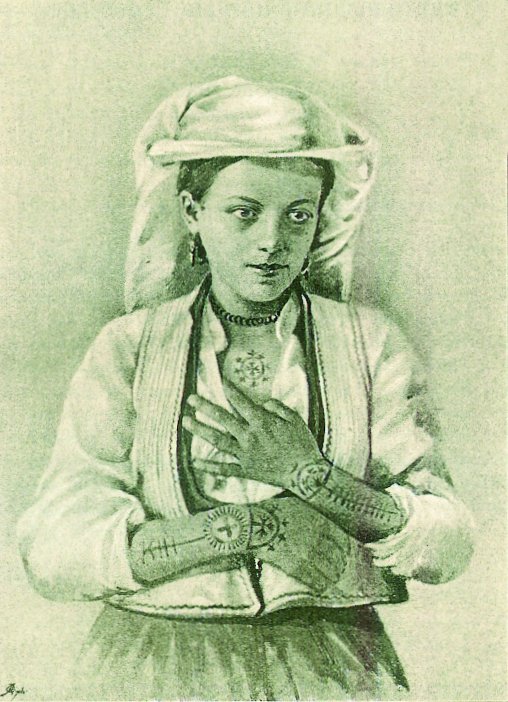
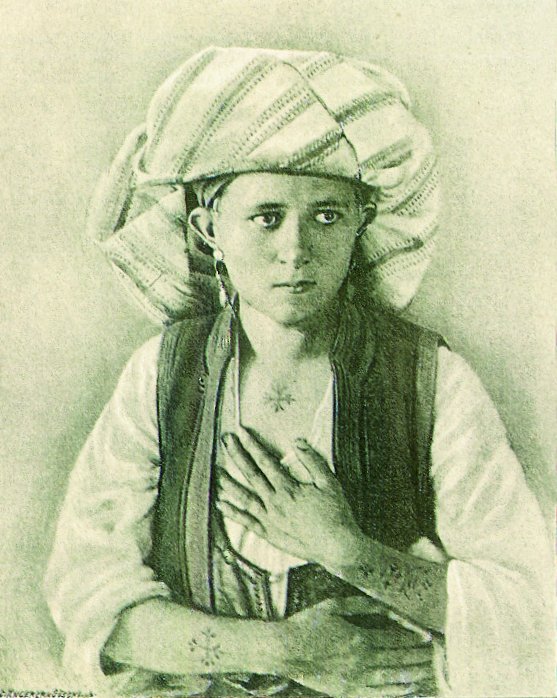
I couldn't find any Thracian examples, but here are some Illyrian (Croatian) ones. Seems the practice of tattooing amongst the Croatian population of Bosnia and Dalmatia was common until very recently. They probably give us a hint at what the Thracian ones might have looked like.

tattoo1.jpg

tattoo2.jpg
 
RTG Wrote:


I couldn't find any Thracian examples, but here are some Illyrian (Croatian) ones. Seems the practice of tattooing amongst the Croatian population of Bosnia and Dalmatia was common until very recently. They probably give us a hint at what the Thracian ones might have looked like.

tattoo1.jpg

tattoo2.jpg
Hey Napoleon, been a while, excellent pictures!
 
Hi SOM,

Here's a sample of what the Croatians considered their language to be in some old dictionaries. Can anybody produce any evidence that the Albanians considered their language to be 'Illyrian' prior the late 1800's when the Austrians discovered their Illyrian 'origins' for them.

1604 - Bartol Kašić, Institutiones linguæ Illyricæ
Cassius_168_169_m.jpg


1740 - Ivan Belosteneć, Gazophylacium Illyrico-Latinum
Bellosztenecz_01_m.jpg


1785 - Ardelio Della Bella, Dizionario italiano-latino-illirico, a cui si premettono alcune brevi instruzioni gramaticali, nesessarie per apprendere la lingua e l’ortografia illirica
DizionarioItalianoLatinoIllirico_title_m.jpg


1801 - Joakim Stulli, Lexicon latino-italico-illyricum ditissimum, ac locupletissimum, in quo adferuntur usitatiores, elegantiores, difficiliores earundem linguarum phrases, loquendi formula, ac proverbia
Stulli_title_m.jpg


1854 - Vjekoslav Babukić, Ilirska slovnica
Ilirska_cover_m.jpg
 
So far I asked Albanians if they have any books where they refer to their language as Illyrian, no one had anything to post or reply.... So the answear to the question would be no.....

By the way, those are good copy's, I have one or two my self, but you made a good point.......


Here is a German Illyrian dictionary

Here is the Introduction:

2i1cmbn.jpg
 
Last edited:
My mother's friend's mother in law from Bosnia still has the tattoos on her arms. And most old women I saw in the village there also had them. As far as I know only Catholic women still uphold this tradition and I think it is again becoming popular with the youth, although I doubt they'll be old fashioned tattoos.
 
More from John Wilkes:

While some scholars appear entirely engaged with placing Illyrian in this or that group, there are indications that some of the divergences once regarded as definitive in the two Indo-European groups (my note: satem and centum) in fact arose at a much later stage of the development of the language. In the end the strongest evidence for the connection between Illyrian and Albanian must be the few direct correspondences of vocabulary often cited. page 73.
I would say that the correspondence in vocabulary between Illyrian and Slavic is stronger.

At the beginning of the book John Wilkes cites what seems to be the very first time that the idea of Illyrian origins for the modern Albanian is conjured. Fittingly, it is a Germanic, just like for Greece.
The first detailed account of the ancient Illyrians appeared in the Albanesische Studien of J.G von Hahn, published at Jena in 1854, in which the author advanced the proposition that modern Albanians were descended from ancient Illyrians. Page 5.
 
Hi SOM

The first detailed account of the ancient Illyrians appeared in the Albanesische Studien of J.G von Hahn, published at Jena in 1854, in which the author advanced the proposition that modern Albanians were descended from ancient Illyrians.

Its ironic that J.G von Hahn (Johann Georg von Hahn) was an Austrian diplomat at the time of making his proposition that the Albanians were descended from the ancient Illyrians. This is significant because at that time the Croatians and Slovenians were going through a period of national awakening which entailed demanding autonomy within the Austro-Hungarian empire. The movement was known as the Illyrian Movement.

The Austrian response was simple, while Austrian scholars were busy proposing that the Albanians were descended from the ancient Illyrians (which became official Austrian state policy) they also began propagating the theory that the Croatians and Slovenians were just merely nomadic 'Slavs', the product of a 6th century migration and therefore they didn't really 'own' the lands they came to settle anyway. The Austrian officials backed up this policy by making all reference to the word 'Illyria' or 'Illyrians' a death penalty offence in Slovenia and Croatia.
 
Hi SOM


Its ironic that J.G von Hahn (Johann Georg von Hahn) was an Austrian diplomat at the time of making his proposition that the Albanians were descended from the ancient Illyrians. This is significant because at that time the Croatians and Slovenians were going through a period of national awakening which entailed demanding autonomy within the Austro-Hungarian empire. The movement was known as the Illyrian Movement.

The Austrian response was simple, while Austrian scholars were busy proposing that the Albanians were descended from the ancient Illyrians (which became official Austrian state policy) they also began propagating the theory that the Croatians and Slovenians were just merely nomadic 'Slavs', the product of a 6th century migration and therefore they didn't really 'own' the lands they came to settle anyway. The Austrian officials backed up this policy by making all reference to the word 'Illyria' or 'Illyrians' a death penalty offence in Slovenia and Croatia.
Hey Napoleon, that is a very important point that you have just highlighted. Had it not been for this Austrian writer, the modern Albanians would not be claiming an Illyrian origin, and the right to claim these people would have correctly remained with the Slavic-speakers of the west Balkans.
 
More from Wilkes:

Page 219:
In the matter of physical character skeletal evidence from prehistoric cemeteries suggests no more than average height (male 1.65 m, female 1.53 m). Not much reliance should perhaps be placed on attempts to identify an Illyrian ahtropological type as short and dark-skinned similar to modern Albanians.

Here is something from pages 221-222:
As an alternative to wine the Greeks learned of an excellent recipe for mead made from honey and water from the Taulantii near Dyrrachium, still consumed by the Pannonian Illyrians in the age of Attila the Hun.
That seems to be in relation to Mario Alinei's explanation of the Slavic word 'medu', meaning honey, used among the natives in the area north of the Danube, at a time when Attila had reigned over them.

http://www.continuitas.com/interdisciplinary.pdf
 
What do you think about this one:

Another ancient Illyrian element is the plain local “opinga”, (kind of mocassina).
http://worldmusiccentral.org/article.php/20041228040955584

As far as I know, this opinga >mocassina's shoes are not restricted to the Albanians.

The Serbs have them and call them opinak and we have them and call them opinec. Of course there are slight differences in the model and design, but all in all, it is the same thing we are talking about.

How much does that make the Albos a descendants of the Illyrians.

I would like to hear the Albanian ethimology of the word.

As for the "Slavic" it is most likely related to опне > to draw tight, to stretch, to tighten up, as related to napne > to make an effort.

So the opinga separates to opin <> opni and ga> go > it. Something you tighten up or draw tight to your foot.

Only Logical to me.
 
What do you think about this one:


As far as I know, this opinga >mocassina's shoes are not restricted to the Albanians.

The Serbs have them and call them opinak and we have them and call them opinec. Of course there are slight differences in the model and design, but all in all, it is the same thing we are talking about.

How much does that make the Albos a descendants of the Illyrians.

I would like to hear the Albanian ethimology of the word.

As for the "Slavic" it is most likely related to опне > to draw tight, to stretch, to tighten up, as related to napne > to make an effort.

So the opinga separates to opin <> opni and ga> go > it. Something you tighten up or draw tight to your foot.

Only Logical to me.

Opinga - Opinca (Opinci, pl.)

I remember hearing my father say 'ne se opinai nogu' - meaning "don't advance (approach in an uncontrolled manner) too much", it makes more sense in Macedonian.

What is the Illyrian word for it?
 
Opinga - Opinca (Opinci, pl.)

I remember hearing my father say 'ne se opinai nogu' - meaning "don't advance (approach in an uncontrolled manner) too much", it makes more sense in Macedonian.

What is the Illyrian word for it?

опне is the Macedonian word. It has many meanings. One of it is your example of usage.

As for the Illyrian word, I still could not trace it. If I do, than I will post it here.

But opinga is in no case Albanian word, that is for sure. Just like Besa ;)

The "Illyrians" though.
 
Back
Top