• Welcome to the new Macedonian Truth Forum. All posts, members and private messages have been moved over from the old forum.

    Passwords from the old forum could not be carried over, so please use Forgot your password? to set a new one. The reset link is emailed to the address on your account.

  • Rules and Regulations at the forum of the Macedonian Truth Organisation (MTO)

    (1) The national-ethnic and cultural-linguistic identity of the Macedonian people is historically Macedonian, and derives its character from the native, indigenous and geographic homeland of the Macedonians, which is called Macedonia. To ensure that their human rights, integrity and heritage are appropriately respected, the only nouns and adjectives acceptable when reference is made to the above character and identity markers is Macedon, Macedonia, Macedonian and Macedonians.

    (2) The nation-state of the Macedonian people is the Republic of Macedonia, and is to be referred to by this official title so long as the 'republic' prefix is consistently applied to other states. Alternative references are the Macedonian Republic, or simply, Macedonia.

    (3) The 'ethnic' prefix is only acceptable for Macedonians in cases where differentiation is specifically required - so long as it is in context and consistent where it concerns its application to other ethnic groups.

    (4) Should any other differentiation be specifically required, the names of other ethnic groups that reside with Macedonians in either the Republic of Macedonia or the occupied Macedonian regions in Greece, Bulgaria, Serbia or Albania, are to be given a prefix.

    (5) Negating the identity, language and culture of the Macedonian people by deliberate avoidance of the terms Macedonia, Macedonian and Macedonians, or by any other means, is not permitted.

    (6) Systematic anti-Macedonian propaganda and rhetoric are not permitted.

    (7) Threads irrelevant to the Macedonian Cause, the community at the Macedonian Truth Organisation or the Macedonians in general may be considered as spam or not in the spirit of the forum. In such cases they are not permitted.

    (8) Continual posting of messages in threads with the sole purpose of deviating from the initial topics with the use of unrelated and unnecessary information is not permitted.

    (9) All posts, external articles, reports, etc that are cited in languages other than Macedonian or English, must be accompanied with a translation in one or both of the said languages.

    (10) Despite the possibility of some conversations and debates becoming heated, extreme abuse and/or racism, vulgar language and/or terminology, threats, revelation of personal information about others, harassment, and other such behavior will not be permitted. If deemed necessary all relevant information including member details will be reported to the appropriate authorities for investigation which may result in legal action.

    (11) Threads that are created must have a summary of a topic or excerpt of an article found in pertinent link(s) that have been included. One line threads will be considered unaccetable spam and are therefore not permitted.

    (12) Compulsive and deliberate lies, irrespective of the topic, are not permitted.

    (13) Any symbols or avatars found to be perceived as offensive to Macedonians are not permitted.

    (13) Any explicit or extreme material is not permitted.

    Failure to adhere to the above rules and regulations will result in a ban after 3 breaches. This may be reconsidered in some cases should the circumstances be of an unorthodox nature and/or require special consideration. To assure an effective deterrent against an individual or individuals with the sole purpose of causing dissent through spamming, racism or other improper means, the above rules will be strictly enforced.

    The MTO administration will monitor all discussions as reasonably practical and reserve the right to remove any post and/or member from the forum, and update the rules and regulations as required. Members are encouraged to immediately report any post and/or member to the MTO administration if they feel that these rules have not been abided by.

    The views expressed on this forum are those of the individuals. The only official representation of the MTO is made by the "Macedonian Truth Organisation (Site Owner)" username, and no other.

  • Macedonian Cause

    The Macedonian Truth Organisation calls on God in Heaven to protect, bless and guide the endeavour it is committing to undertake, and that is to work towards:

    Securing Macedonia as a free, independent and democratic republic in which sovereignty lies with the Macedonian citizens; as the nation-state of the Macedonian people in which they can preserve their culture, language and identity; as a state in which the Macedonian language and culture form the basis of public life and act as important unifying elements of Macedonian society; as the home of all its citizens to which it guarantees and obliges their inalienable natural rights and corresponding responsibilities;

    The acknowledgment as self-evident and irrefutable the existence of the:

    1) Indigenous, ethnonational name of Macedonia;
    2) Macedonian people, language and identity;
    3) Macedonian culture, symbols and folklore;
    4) Macedonian ancestry, heritage and history in its entirety; and
    5) Macedonian Orthodox Church;

    Securing recognition by the International Community of the tragedies endured by the Macedonian people, of the division of Macedonia with the signing of the Treaty of Bucharest on August 10, 1913, and the genocide committed against the Macedonian people at the hands of the Greek, Bulgarian and Serbian states and their respective churches during the 19th and 20th centuries;

    Ensuring that the Interim Accord is declared ‘null and void’ and that all constitutional provisions, acts, commitments, agreements, legislation, regulations, policies or programs emanating from, supporting or consequential to the Interim Accord are also declared ‘null and void’, including the use of any symbols and the completion of any acts imposed by, or originating from, the Interim Accord.

    Ensuring that the Framework Agreement is abolished and that all constitutional provisions, acts, commitments, agreements, legislation, regulations, policies and programs emanating from, supporting or consequential to the Framework Agreement are also abolished and replaced by a framework of constitutional and statutory law based on inalienable natural rights and corresponding responsibilities and universally codified human rights mechanisms.

    Securing the abolishment of any existing constitutional provisions, acts, agreements, legislation, regulations, policies and programs that discriminate against the Macedonian people, in any international organisation or any of the countries of the International Community where such constitutional provisions, acts, agreements, legislation, regulations, policies and programs exist, and thereby ensuring the freedom for Macedonians to exercise their inalienable natural rights and fulfil their corresponding responsibilities, and practice their culture, language and religious faiths in all the countries of the International Community without hindrance;

    The empowerment of Macedonians to undertake a moral revolution and to instil and/or reinvigorate within themselves a deep-rooted national, cultural, linguistic and historical dignity and a commitment to the exercise of freedom based on inalienable natural rights and corresponding responsibilities;

    The recognition of the Macedonian minorities in the neighbouring states of Macedonia as well as the respect for the inalienable rights and freedoms of the Macedonian minorities, as provided for by natural law and as codified by the United Nations Charter, the Universal Declaration of Human Rights and other universally codified human rights mechanisms;

    The full and unreserved respect of, and the support for, the rights of all people of non-Macedonian descent living in Macedonia and around the world, who share a reciprocal full and unreserved respect for the Macedonian people, their homeland and their state;

    The cultural unification and solidarity of the Macedonian people living in all parts of historical Macedonia and adjacent territories, as well as Macedonians throughout the world;

    The unity of all Macedonians on the principles, objectives and achievement of the Macedonian cause as defined by this declaration.

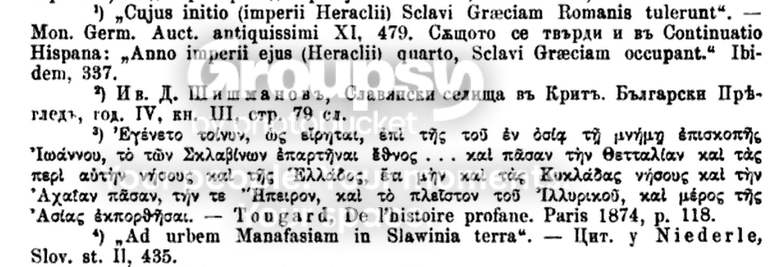
The Real Ethnic Composition of Modern Greece

I am not aware of coming across this before - so I'm adding it here. It is found in a Bulgarian book, written by Yordan Ivanov.

Footnote 3 (the text in Greek) basically states that the Sklavini devastated all Thessaly, nearby islands and those of Helada, also the Cyclades along with entire Achaia, Epirus, the bigger part of Illyricum and part of Asia.


Good find. So Vlachs settled there later.
 
SLAVS IN MIDDLE AGES


a) Mazaris wrote:

«Εν Πελοποννήσω, ως και αυτός οίδας, ξείνε, οικεί αναμίξ γένη πολιτευόμενα πάμπολλα, ων τον χωρισμόν ευρείν νυν ούτε ράδιον, ούτε κατεπείγον. α δε ταις ακοαίς περιηχείται, ως πάσι δήλα και κορυφαία, τυχγάνει ταύτα. Λακεδαίμονες, Ιταλοί, Πελοποννήσιοι, Σθλαβίνοι, Ιλλυριοί, Αιγύπτιοι και Ιουδαίοι (ουκ ολίγοι δε μέσον τούτων και υποβολιμαίοι), ομού τα τοιαύτα επαριθμούμενα επτά» [Μάζαρις 1831, 174 και Μάζαρις 1860, 239].

"In Peloponnese, as you can see stranger, dwell various mixed ethne mixed among themselves, who's separation is neither easy nor necessary ... "Laconians" (Tzakones), "Italians" ( various western neolatin speakers as Italian, French, Spaniards etc),"Peloponnesians" (non Tsakonian Greek speakers), "Slavenes" (Slavs) "Illyrians" (Albanians), "Egyptians" (gypsies) and "Judaeans" (Jews).


Μάζαρις (Mazaris) :

«Δέδοικα ουν ίνα μη γένωμαι και αυτός διατρίβων εν Σπάρτη ώσπερ εν τη Κωνσταντίνου γέγονεν ο Πελοποννήσιος εκείνος, Συναδινός ο Κορμέας, ή ίνα μη βαρβαρωθώ και αυτός ώσπερ άρα βεβαρβάρωνταί γε οι Λάκωνες, και νυν κέκληνται Τζάκωνες, και πιάσον τα και σφίξον τα, και δώσον τα, και ήμενον, και ηρχόντησαν, και καθεζούτησαν, και έλαδε, πα, και αιτιτοίωσέν (ετετοίωσέν) τον, και άλλ’ άττα βάρβαρα λέγουσιν» [Μάζαρις 1831, 164 και Μάζαρις 1860, 230].


Google Translate:
"I do not know what I am, and he is in Sparta while Constantine is the Peloponnesian who is, the Syrian of Kormeas, or is not barbarous, and hence the barbarians of the Laconians, and now Jacokes are called, and as long as they tighten them, They gave birth to them, and they lived, and they departed, and received, and cried out, and another barbarous word. "[Mavaris 1831, 164 and Mavaris 1860, 230].
 
Last edited:
Mazaris described the characteristic features of each one of the ethnic groups in the Peloponnese.

The Laconians, he says, were known for their "vanity and perfidy... their tendency toward slander and blackmail, their bragging and drunkenness, their utter miserliness and low cunning". The Slavs were cruel, savage, brutal, bloodthirsty, known for their "robbery and barbarity, their hatred of the powers that be, their hatred of God". The Albanians (the text has Illyrians) influenced others by "their deceit and spying, their brutal methods of levying taxes, their soberness in the matter of clothing and luxuries... their thievishness, their fickleness, and their sly, crooked ways".

The "Laconians", or "Tsacones", were a people whose origin was associated with the invasion of the peninsula by the "Slavs".

The existence of Jewish communities at the time of Mazaris is well known, and the evidence for the significant presence of Gypsies is very good. The information about the Gypsies in the region of Nauplion and in Modon is particularly detailed (=> George C. Soulis, "The Gypsies in the Byzantine Empire and the Balkans in the Late Middle Ages", Dumbarton Oaks Papers 15 (1961), 152-154).

Returning to the Slavs - the historian Menander in one fragment wrote: "While Hellas was pillaged by the Slavs and successive perils gathered against her from every side, Tiberius, who did not have capable forces to fight, not even against one detachment of his enemies... sent an embassy to the prince of the Avars".

Another source of evidence consists of two entries in the Latin chronicle of John of Biclar. One of these entries reads: "... the Avars were driven from the borders of Thrace and occupied parts of Greece (Graecia) and Pannonia."

And the other: "The people of the Slavs devastated Illyricum and Thrace".

On the demography of medieval Greece : a problem solved
Peter Charanis

Link:
https://ojs.lib.uom.gr/index.php/BalkanStudies/article/view/5113
 
Last edited:
Isidore of Kiev referred to Laconians as barbaric according to Oxford Dictionary of Byzantium.
 
Last edited:
The "Laconians", or "Tsacones", were a people whose origin was ultimately associated with the invasion of the peninsula by the "Slavs". (Charanis though considers "Tsacones" as descendants of ancient Hellenes.)

How so? Can you explain in details?
 
How so? Can you explain in details?

Here are the quotes from Charanis (which I do not endorse):

- "The Laconians were the particular group of Greek speakers, the inhabitants of the mountain regions of eastern Peloponnese, often referred to by late Byzantine writers also as Tsacones and whose origin was associated with the invasion of the peninsula by the Slavs. The Peloponnesians must be identified with the general Greek speaking populations found throughout the empire, numerically the strongest element of its population as a whole, the Romaioi of the Byzantine texts."

- "To what extent the Greek speakers of the Peloponnese represented the old native stock is a question which is, of course, most difficult, if not impossible to answer, but there can be no doubt that they included the remnants of that stock."

https://ojs.lib.uom.gr/index.php/BalkanStudies/article/view/5113

Would you be able to provide the citation from Isidore of Kiev regarding the barbaric Laconians?
 
Last edited:
What was the scale and impact of Roman colonization and immigration into Peloponnese & Greece? I am usually told, and hear, that the impact was minimal and that the number of colonists was not large (and that those who arrived were almost immediately hellenized).

Processes of Cultural Change and Integration in the Roman World
https://books.google.ca/books?id=VD...=Roman soldiers settle Patras Corinth&f=false

Page 154: This paper presents the results of such context-specific case study. It focuses on the city of Patras, which was colonized by Augustus in 14 B.C. Colonization entailed a massive influx of foreigners into the city, among them a large number of Roman army veterans.

Page 156: The colonization of Patras took place in the context of the reorganization of Greece that was started by Caesar and continued by Augustus.

Page 158: The settlement of veterans from Antony's legions after the battle of Actium must have posed a serious problem for Augustus, since, according to some estimations, there were about 35,000 veterans who had to be accommodated; Patras was just one destination for the veterans. ...... A third wave of immigration has been suggested by Keppie and Rizakis ........ The process of large-scale immigration entailed major disruptions to local society. In the case of Patras the act of colonization and the immigration of thousands of colonists led to a radical overthrow of the established order of things.


Who were then the medieval Romaioi and Tsacones of Peloponnese?
 
The History of Leo the Deacon: Byzantine Military Expansion in the Tenth Century, by Leo (the Deacon)
https://books.google.ca/books?id=RC...q=Armenians Romans other rabble Crete&f=false

Page 46 -

At II:8 Leo says that Phokas settled Crete after its conquest with "bands of Armenians, Romans, and other rabble," reflecting the policy of providing plots of land to soldiers in return for the obligation of military service.

The quote can also be found here Leonis diaconi Caloënsis Historia libri decem: et liber de Velitatione ...
https://books.google.ca/books?id=GC...ir_esc=y#v=onepage&q="leonis diaconi"&f=false

Interesting how in the Latin translation it states: ...contuberniis Armeniorum, Romanorum, convenarum hominum eo in coloniam deductis...
 
Μάζαρις (Mazaris) :

«Δέδοικα ουν ίνα μη γένωμαι και αυτός διατρίβων εν Σπάρτη ώσπερ εν τη Κωνσταντίνου γέγονεν ο Πελοποννήσιος εκείνος, Συναδινός ο Κορμέας, ή ίνα μη βαρβαρωθώ και αυτός ώσπερ άρα βεβαρβάρωνταί γε οι Λάκωνες, και νυν κέκληνται Τζάκωνες, και πιάσον τα και σφίξον τα, και δώσον τα, και ήμενον, και ηρχόντησαν, και καθεζούτησαν, και έλαδε, πα, και αιτιτοίωσέν (ετετοίωσέν) τον, και άλλ’ άττα βάρβαρα λέγουσιν» [Μάζαρις 1831, 164 και Μάζαρις 1860, 230].

Actually the "vulgarisms" Mazaris presents (piason ta, doson ta, erhontissan, kathezoutisan, elade, aetitiosen etc) are totally Greek and quite... archaic. Not as archaic as the language he uses, but certainly more archaic than the demotic Greek language of that time, or present-day. That makes it clearer that Laconians/Tzaconians are not related to any foreign entity (Slavs, Vlachs, Italians or Albanians).

By the way this was written in 1410s not in the 1800s.
 
No, unfortunately I cannot find any reference of him.

https://www.docdroid.net/FzrTqxX/oxford-dictionary-of-byzantium-3-volumes-1991.pdf.html#page=2181

So what are your thoughts on Tsakones?

Barbaric could mean many things.

Tchaiku, thanks for your question. I will reply soon.

In the meantime, I wanted to post this (unrelated to your question above, the author is Arsi Pipa) -


[ Note that the Italians called the Byzantine Arberesh Greci? So, WHO are then the Greci / Greeks? Isn't this a contradiction? :) ]
 
Last edited:
Actually the "vulgarisms" Mazaris presents (piason ta, doson ta, erhontissan, kathezoutisan, elade, aetitiosen etc) are totally Greek and quite... archaic. Not as archaic as the language he uses, but certainly more archaic than the demotic Greek language of that time, or present-day. That makes it clearer that Laconians/Tzaconians are not related to any foreign entity (Slavs, Vlachs, Italians or Albanians).

By the way this was written in 1410s not in the 1800s.

ZACHONIE VEL SLAVONIE


In the above-mentioned text, derived from the book "Les Tsakones" by Stamatis Caratzas, an extract from a text that was first published in the 1st volume of K. Sathas' paper has been highlighted "Documents inédits relatifs à l'histoire de la Grèce au moyen âge", that is, in exactly the same volume in which he first formulated his theory of Slavic movements. In the highlighted text it appears that the Venetians who wrote it reported in 1485 the area of ​​Tsakonia as Slavonia (Tsakonia = Slavonia).

What is behind this? In 1464 the Venetians took control of Monemvasia and the surrounding area, which they held until 1540, although around 1500 they lost the rural area around the castle. This particular text, issued in 1485, is an order referring to the area around the castle of Monemvasia, which is again referred to Tsakonia as Slavonia. This order forbids the introduction of salt in this area from the area of ​​Glarenza, which in 1485, when it was written, was held by the Turks.

So it is certain that K. Sathas knew the existence of such Venetian texts. And that means that it is really a mystery because he finally proceeded to formulate his theory. Even if he thought the Byzantines were not (unintentionally unwittingly) accurate in this matter, he could never assume that the Venetians were equally inaccurate in their own references.

Thoughts? Why was Tsakonia referred to as Slavonia by the Venetians in 1485?

If, like you state, the Tsakonians are not related to any foreign entity (i.e. the Slavs, in this specific case) - why is Tsakonia referred to as Slavonia?
 
Actually the "vulgarisms" Mazaris presents (piason ta, doson ta, erhontissan, kathezoutisan, elade, aetitiosen etc) are totally Greek and quite... archaic. Not as archaic as the language he uses, but certainly more archaic than the demotic Greek language of that time, or present-day. That makes it clearer that Laconians/Tzaconians are not related to any foreign entity (Slavs, Vlachs, Italians or Albanians).

Can you be more clear?
 
ZACHONIE VEL SLAVONIE


In the above-mentioned text, derived from the book "Les Tsakones" by Stamatis Caratzas, an extract from a text that was first published in the 1st volume of K. Sathas' paper has been highlighted "Documents inédits relatifs à l'histoire de la Grèce au moyen âge", that is, in exactly the same volume in which he first formulated his theory of Slavic movements. In the highlighted text it appears that the Venetians who wrote it reported in 1485 the area of ​​Tsakonia as Slavonia (Tsakonia = Slavonia).

What is behind this? In 1464 the Venetians took control of Monemvasia and the surrounding area, which they held until 1540, although around 1500 they lost the rural area around the castle. This particular text, issued in 1485, is an order referring to the area around the castle of Monemvasia, which is again referred to Tsakonia as Slavonia. This order forbids the introduction of salt in this area from the area of ​​Glarenza, which in 1485, when it was written, was held by the Turks.

So it is certain that K. Sathas knew the existence of such Venetian texts. And that means that it is really a mystery because he finally proceeded to formulate his theory. Even if he thought the Byzantines were not (unintentionally unwittingly) accurate in this matter, he could never assume that the Venetians were equally inaccurate in their own references.

Thoughts? Why was Tsakonia referred to as Slavonia by the Venetians in 1485?

If, like you state, the Tsakonians are not related to any foreign entity (i.e. the Slavs, in this specific case) - why is Tsakonia referred to as Slavonia?

Can you quote the citation in english and elaborate? The text does not directly indicate that Tsakones are Slavs, for example just as '' Slavs in Germany'' does not mean that Germans are Slavs.
 
Last edited:
I'm sorry what is the Sathas theory?

If Tzaconia once covered all SE Peloponnese, it's clear that Tzacones were gradually limited to a small part of middle-East Peloponnese (as we can see in the famous map of 1800s). As for the area below (where Monemvasia is) it seems it was populated by other Greeks and Albanians.

As for Slavs, I'm not sure I remember where the last Slavs were located (by 1400s) or when they are last mentioned (I think Celebi didn't find any in the 1600s).

The nine phrases/verbs Mazaris mentions are in a Greek dialect, a distortion of ancient Greek, yet very close to Medieval and present-day vernacular Greek.
 
(Answering some of my questions myself)

(Not sure how but) William Miller believes the Slavs were two distincts groups located as follows:

-Ezerites at Elos (this is at the Laconian Gulf between the middle and right finger of Peloponnese)

-Melingi at Taygetos Mountain (this mountain covers the middle finger of Peloponnese).
 
Can you quote the citation in english and elaborate? The text does not directly indicate that Tsakones are Slavs, for example just as '' Slavs in Germany'' does not mean that Germans are Slavs.

I agree, but it says Tsakonia or Slavonia. As an example, if the Venetians happened to arrive and colonize Bavaria - and mention in an official document Bavaria or Slavonia (Sclavonia), what would you think? Wouldn't you think this is a reason to at least explore this a bit further, or to ask why does Bavaria=Slavonia in the eyes of the Venetians? (It doesn't mean that Germans are Slavs though.)

The full translation of the highlighted text is:

It is forbidden to the Venetians and subjects of the Republic to transport salt ... from Glarenza/Clarence and elsewhere to Tzaconia or Sclavonia.
 
More ramblings on the Tzakonians/Tzakonia

I have already written/added material regarding Tzakonia and Tzakonians that can be found in these threads:

1) http://www.macedoniantruth.org/forum/showthread.php?t=405
2) http://www.macedoniantruth.org/forum/showthread.php?t=6633&page=6

To summarize from various books and sources (I will not explicitly list the names of all the authors - all can be found in the above two threads including citations and screenshots):

- The Venetian documents mention Albanians in Tzaconia.
- The Mardaites inhabited the territory of Monemvasia, or modern Tzaconia.
- Like 'Mardaite', the word 'Tzacon' did not mean a people, but a category of soldiers.
- According to historian Sathas: the ancient Tzaconians belong to Albanian sailors of Kranidi, Hydra.
- Philippson admits that Slavic colonies existed in Vatika also, that is to say south of the fortress of Tzaconia and close to Monemvasia. Some Slavic place names reinforce this supposition.
- As per Chalkokondyles and geographer Meletios, the regions of Taygetos, land of Laconia, and promontory of Tenaron were long inhabited by Romani (that is, Vlachs / Armanoi).
- The Vlachs / Armanoi have been variously called by different writers and in different places by a variety of names: Maniati, Laconi, Bui, Megalovlahiti, Dasareti, Meteori, etc.
- Stam. C. Caratzas states that "Two indications argue for the existence of a relationship between Tzacones and Vlachs in popular poetry."
- Per author F. Curta, the "Tzakonians" appear to have been settled in the Peloponnesus in the course of the ninth and tenth century. The viewpoint that the Tzakonians were settled in the Peloponnesus, from elsewhere, is also supported and shared by the author Stamatis C. Caratzas. There exists a legend which states that Tzakonians originate from Macedonia, namely from the area of Chalkidiki peninsula - and specifically, from the vicinity of Mount Athos district (Holy Mountain).
- Evliya Tchelebi compares the physical features of the inhabitants of Tzaconia between Molai and Monemvasia, to those of Tatar-Kalmyks.
- Investigator Katsanis: "The Tsakonian was influenced without doubt by the Aromanian tongue."
- In village Geraki of Laconia the words ‘κρούσκος/krouskos=relation by marriage’ and ‘τάτας/tatas=father’ correspond to Aromanian ‘cúscru’ and ‘táta’. ‘Γκάλμπινος/galmpinos/ in Greek idioms of the Peloponnese and Epirus means 'blond’, ‘pale yellow’, ‘sallow’, ‘gook’, while ‘galbinu’ is the ‘yellow’ in Aromanian."
- In the petition of Monembasiotes (1527), the nearby residents of Monemvasia are named Vlachs (Βλάχοι).

As a result, in a small area such as Tzakonia we have explicit testimonies and references to a few different ethno-linguistic groups: Vlachs, Slavs, Albanians, Mardaites, etc.

Furthermore -
http://www.persee.fr/doc/rebyz_0766-5598_1963_num_21_1_1311?q=ahrweiler tzakon

- The ζακα-σακα terms are identical: both are forms of the same word, surely a foreign term, as shown by the vacillation that marked its transcription in Greek, gender (ό σάκας, ή ζάκα, τό σάκα) and declination (ή ζαζ -κός, ο σάκας -α, το σάκα -α), and the expression τό λεγόμενον or καλούμενον σάκα constant in texts that mention the term, which usually introduces a foreign word. A. Dain, who dedicated a note to σάκα (29), attached to the word Arabic saqat.

- The Arabic term (saqat) is the procession mounted prince.

- To sum up: it seems that the term ζάκα-σάκα (Arabic term and not Greek, as Sathas previously thought), designating the guard, the procession mounted prince comes through the non-certified form ζάκων- σάκων the τζάκων τσάκων-term, designating one who stands guard. The transformation of σ-ζ in τζ-τσ early in a foreign word is in common purpose in the transcription of the word in Greek (include for example: ζεμπίλι-τσεμπίλί, Ζανής-Τζανής, Ζαμαν- δός-Τζαμανδός , Σαούσης-Τζαούσης, Ζαμπουρνίζω-τσαμπουρνίζω, etc.).


I have a few more points to make, but leave it at that for now.
 
The following figure illustrates page 80 of a short dictionary published in Venice in 1827 and known under the title Nuovo Dizionario Geografico Portatile (New Geographical Dictionary, Portable).


The above dictionary is a summary of a much larger work of the Danish geographer of the 19th century, Malte Brun, which was written around 1812. In the above picture, with a yellow mark, the dictionary for a region of the Peloponnese appears. From the name one can easily understand which area it is.

In addition, the entry refers to both the number of inhabitants of the area (40,000) at the time of the original work (1812) and its "ethnological recommendation" (in the view of the dictionary writer).

Specifically, it is reported that there was a mixture in that area (mescuglio = mixture in the Venetian language) of Spartani and Slavs (Schiavoni = Slavs in the Venetian language) at that time.

("Albanians", "Vlachs", "Greeks", "Mardaites" are all absent. And who were these Spartani?)
 
Back
Top