• Welcome to the new Macedonian Truth Forum. All posts, members and private messages have been moved over from the old forum.

    Passwords from the old forum could not be carried over, so please use Forgot your password? to set a new one. The reset link is emailed to the address on your account.

  • Rules and Regulations at the forum of the Macedonian Truth Organisation (MTO)

    (1) The national-ethnic and cultural-linguistic identity of the Macedonian people is historically Macedonian, and derives its character from the native, indigenous and geographic homeland of the Macedonians, which is called Macedonia. To ensure that their human rights, integrity and heritage are appropriately respected, the only nouns and adjectives acceptable when reference is made to the above character and identity markers is Macedon, Macedonia, Macedonian and Macedonians.

    (2) The nation-state of the Macedonian people is the Republic of Macedonia, and is to be referred to by this official title so long as the 'republic' prefix is consistently applied to other states. Alternative references are the Macedonian Republic, or simply, Macedonia.

    (3) The 'ethnic' prefix is only acceptable for Macedonians in cases where differentiation is specifically required - so long as it is in context and consistent where it concerns its application to other ethnic groups.

    (4) Should any other differentiation be specifically required, the names of other ethnic groups that reside with Macedonians in either the Republic of Macedonia or the occupied Macedonian regions in Greece, Bulgaria, Serbia or Albania, are to be given a prefix.

    (5) Negating the identity, language and culture of the Macedonian people by deliberate avoidance of the terms Macedonia, Macedonian and Macedonians, or by any other means, is not permitted.

    (6) Systematic anti-Macedonian propaganda and rhetoric are not permitted.

    (7) Threads irrelevant to the Macedonian Cause, the community at the Macedonian Truth Organisation or the Macedonians in general may be considered as spam or not in the spirit of the forum. In such cases they are not permitted.

    (8) Continual posting of messages in threads with the sole purpose of deviating from the initial topics with the use of unrelated and unnecessary information is not permitted.

    (9) All posts, external articles, reports, etc that are cited in languages other than Macedonian or English, must be accompanied with a translation in one or both of the said languages.

    (10) Despite the possibility of some conversations and debates becoming heated, extreme abuse and/or racism, vulgar language and/or terminology, threats, revelation of personal information about others, harassment, and other such behavior will not be permitted. If deemed necessary all relevant information including member details will be reported to the appropriate authorities for investigation which may result in legal action.

    (11) Threads that are created must have a summary of a topic or excerpt of an article found in pertinent link(s) that have been included. One line threads will be considered unaccetable spam and are therefore not permitted.

    (12) Compulsive and deliberate lies, irrespective of the topic, are not permitted.

    (13) Any symbols or avatars found to be perceived as offensive to Macedonians are not permitted.

    (13) Any explicit or extreme material is not permitted.

    Failure to adhere to the above rules and regulations will result in a ban after 3 breaches. This may be reconsidered in some cases should the circumstances be of an unorthodox nature and/or require special consideration. To assure an effective deterrent against an individual or individuals with the sole purpose of causing dissent through spamming, racism or other improper means, the above rules will be strictly enforced.

    The MTO administration will monitor all discussions as reasonably practical and reserve the right to remove any post and/or member from the forum, and update the rules and regulations as required. Members are encouraged to immediately report any post and/or member to the MTO administration if they feel that these rules have not been abided by.

    The views expressed on this forum are those of the individuals. The only official representation of the MTO is made by the "Macedonian Truth Organisation (Site Owner)" username, and no other.

  • Macedonian Cause

    The Macedonian Truth Organisation calls on God in Heaven to protect, bless and guide the endeavour it is committing to undertake, and that is to work towards:

    Securing Macedonia as a free, independent and democratic republic in which sovereignty lies with the Macedonian citizens; as the nation-state of the Macedonian people in which they can preserve their culture, language and identity; as a state in which the Macedonian language and culture form the basis of public life and act as important unifying elements of Macedonian society; as the home of all its citizens to which it guarantees and obliges their inalienable natural rights and corresponding responsibilities;

    The acknowledgment as self-evident and irrefutable the existence of the:

    1) Indigenous, ethnonational name of Macedonia;
    2) Macedonian people, language and identity;
    3) Macedonian culture, symbols and folklore;
    4) Macedonian ancestry, heritage and history in its entirety; and
    5) Macedonian Orthodox Church;

    Securing recognition by the International Community of the tragedies endured by the Macedonian people, of the division of Macedonia with the signing of the Treaty of Bucharest on August 10, 1913, and the genocide committed against the Macedonian people at the hands of the Greek, Bulgarian and Serbian states and their respective churches during the 19th and 20th centuries;

    Ensuring that the Interim Accord is declared ‘null and void’ and that all constitutional provisions, acts, commitments, agreements, legislation, regulations, policies or programs emanating from, supporting or consequential to the Interim Accord are also declared ‘null and void’, including the use of any symbols and the completion of any acts imposed by, or originating from, the Interim Accord.

    Ensuring that the Framework Agreement is abolished and that all constitutional provisions, acts, commitments, agreements, legislation, regulations, policies and programs emanating from, supporting or consequential to the Framework Agreement are also abolished and replaced by a framework of constitutional and statutory law based on inalienable natural rights and corresponding responsibilities and universally codified human rights mechanisms.

    Securing the abolishment of any existing constitutional provisions, acts, agreements, legislation, regulations, policies and programs that discriminate against the Macedonian people, in any international organisation or any of the countries of the International Community where such constitutional provisions, acts, agreements, legislation, regulations, policies and programs exist, and thereby ensuring the freedom for Macedonians to exercise their inalienable natural rights and fulfil their corresponding responsibilities, and practice their culture, language and religious faiths in all the countries of the International Community without hindrance;

    The empowerment of Macedonians to undertake a moral revolution and to instil and/or reinvigorate within themselves a deep-rooted national, cultural, linguistic and historical dignity and a commitment to the exercise of freedom based on inalienable natural rights and corresponding responsibilities;

    The recognition of the Macedonian minorities in the neighbouring states of Macedonia as well as the respect for the inalienable rights and freedoms of the Macedonian minorities, as provided for by natural law and as codified by the United Nations Charter, the Universal Declaration of Human Rights and other universally codified human rights mechanisms;

    The full and unreserved respect of, and the support for, the rights of all people of non-Macedonian descent living in Macedonia and around the world, who share a reciprocal full and unreserved respect for the Macedonian people, their homeland and their state;

    The cultural unification and solidarity of the Macedonian people living in all parts of historical Macedonia and adjacent territories, as well as Macedonians throughout the world;

    The unity of all Macedonians on the principles, objectives and achievement of the Macedonian cause as defined by this declaration.

The Real Ethnic Composition of Modern Greece

I don't understand anything about the pronunciation symbols either in Metsovo or Kozani.
Kozani is toned in A and Koz- sounds as the English word cause and -ani as Annie.
Metsovo is toned in E, ts sounds like tch in catch.
Are you referring to stressed syllables? In Macedonian, the stress is placed on the first syllable of both Kožani and Mečovo. In Greek, stress is placed on the second syllable of Kozani. Are you suggesting that the stress is placed on the first syllable when you pronounce Metsovo?
 
Here is the relevant text:

Carlin, correct me if I am wrong, but it appears that he dismissed a Slavic etymology because the place name in Aromanian/Vlach (Mintšu) means the reconstructed original word for Mečovo must be *Męčovo and include a nasal vowel. When he makes a comparison with Serbo-Croatian (mečka, meče) and Bulgarian (mečъk, mečka), there is no nasal vowel, thus he concludes that the root word cannot be from a Slavic language. Let's assume that is the case, I wonder if he went to the extent of including the south-western dialects of the Macedonian language (Kostur and Nestram-Kostenar) in his comparison, given that they are geographically closest to Mečovo. One of the main features that sets the Kostur area apart from other Macedonian dialects is precisely the nasal vowel, which means the standard Macedonian word for tooth (zab) is rendered as zamb, the word for hand (raka) is rendered as ranka, the word for child (čedo) is rendered as čendo, etc.

I think it might help if anyone knew German and provide an accurate translation of that entire paragraph. He did reference a nasal vowel, but I'm not an expert in linguistics so the only thing I would say, to quote Noel Malcolm, is that Historical linguistics is a complex science and not, in some of its activities, a very exact one.

Presumably, Metsovo was established long time ago - at a time when nasal vowels were still in use (?). This wikipedia entry states that:

"Nasal vowels were initially retained in most Slavic dialects, but soon underwent further changes. Nasality is preserved in modern Polish, as well as in some peripheral dialects of Slovene (e.g. the Carinthian dialect group) and Bulgarian/Macedonian (e.g. around Thessaloniki and Kastoria)."

Considering that nasal vowels are preserved in the areas of Salonica and Kostur I'd say it wouldn't be out of the question to consider that similar regional dialects were being used in the distant past in nearby areas, that is, in Metsovo/Epirus.

URL:
https://en.wikipedia.org/wiki/History_of_the_Slavic_languages#The_nasal_vowels_ę_and_ǫ

I can't say more really other than Metsovo seems to be of Slavonic origin. Although, there might be a possibility that we have here a "non-Slavic prefix" being followed by the -ovo (Slavic) ending.
 
He lived in the exact opposite (Eastern) side of Macedonia, in Eleutheroupolis/Pravi. What's weird about this guy is that half of his children (including my grandmother) adopted his original surname while the other half adopted the nickname. My own father didn't really know or care much and the story was clarified for me only 3-4 years ago when I met a cousin that bears the Kozanitis name.

It's not uncommon. For instance, the popular author Freddy Germanos has this surname because his grandfather studied in Germany, not because he was German.

Thanks, that's interesting.

Would you be able to provide a quick summary as to the ethnic makeup of Eleutheroupolis/Pravi/Pravishta within the last 200 years (or longer)?
 
Is this Kostiani in Epirus mentioned in any contemporary record while it existed?

Is the destruction of the village or the migration of the 'trilingual populations' mentioned in any contemporary record around the time it happened?

That contradicts the other sources you've referenced.

Are you suggesting the name changed from Kosdiani to Kozani in 100 years? Were there any Ottoman surveys or census' in the area prior to 1498?

This weird local newspaper has an excellent analysis in p.3. (https://www.tzourlakos.com/files/kastaniani-105.pdf). According to this:

-Lioufis says Kostiani is mentioned in a byzantine lexicon but he is wrong

-Aravantinos (geographer of Epirus in 1800s) mentions a Kostiani (Tepeleni district) and a Kotziani (Premeti district), both having Albanian speakers (so the author believes they're not the ones we're looking for).

-He goes very far mentioning other villages with same or similar names and long stories on how various authors got them wrong.

-By the way this is a newspaper of Kostaniani/Kastaniani near Konitsa, i.e. another village that was created by the same people.

-He also provides an analysis on the surnames of the first Kozani settlers comparing them to the settlers of his village.


==
 
Last edited:
The episode concerning the destruction of Kostiani, is about a woman called Argyro that believed people of Kostiani murdered her son and hired an army of murderers to destroy the village.

The migrating populations were trilingual, Greek, Albanian and Vlach. According to Patrinelis, this isn't about Muslim oppression as there were hardly Muslims (around 3%) at that area.

Telltale signs of a multilingual Vlach-speaking population.
 
One of the main features that sets the Kostur area apart from other Macedonian dialects is precisely the nasal vowel, which means the standard Macedonian word for tooth (zab) is rendered as zamb, the word for hand (raka) is rendered as ranka, the word for child (čedo) is rendered as čendo, etc.

My family speak Kosturski but say zab. We do say ranka instead of raka however; I do not know about čedo/čendo.
 
Thanks, that's interesting.

Would you be able to provide a quick summary as to the ethnic makeup of Eleutheroupolis/Pravi/Pravishta within the last 200 years (or longer)?

I believe Greeks, a few Vlachs and Gypsies (Muslims)

Are you referring to stressed syllables? In Macedonian, the stress is placed on the first syllable of both Kožani and Mečovo. In Greek, stress is placed on the second syllable of Kozani. Are you suggesting that the stress is placed on the first syllable when you pronounce Metsovo?

Yes, Metsovo is stressed in E.
 
My family speak Kosturski but say zab. We do say ranka instead of raka however; I do not know about čedo/čendo.
As I indicated earlier, I am not sure if this feature has been consistent among all Macedonian-speakers from Kostur nor about the depth of its use. It is, however, noteworthy that your family doesn't apply the nasal vowel in all cases. Perhaps it's a case of dialect levelling, which essentially means that some dialects (or aspects within) have converged with others, leading to a reduction of heterogeneity in a language. That could also be a reason for the possible shift from *Męčovo > Mečovo, provided that it was indeed pronounced with a nasal vowel in the beginning.
Yes, Metsovo is stressed in E.
I haven't done any thorough research on this, so maybe you can save me the trouble. I notice that trisyllabic place names that end with an H or I often have the stress on the second syllable when pronounced in Greek, such as Κοζάνη, Μαρούσι and Γαλάτσι, but for those that end with an O or an A the stress is often on the first syllable, hence Μέτσοβο, Τέτοβο, Κρούσοβο, Κόσοβο, Φλώρινα, Βέροια, Πρέβεζα, and Λάρισα. Do you know why the stress isn't placed on the first syllable for Τραγάνα and Καβάλα, given that they too end in A?
 
I believe Greeks, a few Vlachs and Gypsies (Muslims)

Thanks. Will need to dig into this further. I see some obvious discrepancies in terms of ethnic makeup - which is not uncommon or uncharacteristic.

I read that Eleftheroupoli/Pravi/Pravishta is being mentioned as having a Turkish majority until the population exchange of 1920s. Were the Roma (Gypsies) all Muslims, and therefore "Turks"? What were the true Vlachs as "percentage" of the Greek Christian population?

Here are the 'known ethnic reports', at least what I was able to find here:
https://bg.wikipedia.org/wiki/Правища

1) Towards the end of the 19th century: "Pravishta has about 600 houses of Turks, Greeks and a few Vlachs."

2) By 1900, according to Kanchov's statistics, there were 1,250 Turks, 1,100 Greek Christians and 1,200 Gypsies living in Pravishta.

3) According to the Secretary of the Bulgarian Exarchate Dimitar Mishev in 1905 there were 1,100 Greeks and 1,200 Gypsies in Pravishta.

4) In the 1920s, its Turkish population emigrated under the agreement on population exchange between Greece and Turkey, and in its place were settled Greek refugees (roughly 745 people). In 1929 the town was renamed to Eleutheropolis.

[Accoring to information found here http://hellenisteukontos.blogspot.com/2010/05/old-accounts-of-kzderbent.html "Other Anatolian Bulgarians can be found in the village of Nea Iraklica, of Pravishta".]
 
I haven't done any thorough research on this, so maybe you can save me the trouble. I notice that trisyllabic place names that end with an H or I often have the stress on the second syllable when pronounced in Greek, such as Κοζάνη, Μαρούσι and Γαλάτσι, but for those that end with an O or an A the stress is often on the first syllable, hence Μέτσοβο, Τέτοβο, Κρούσοβο, Κόσοβο, Φλώρινα, Βέροια, Πρέβεζα, and Λάρισα. Do you know why the stress isn't placed on the first syllable for Τραγάνα and Καβάλα, given that they too end in A?

No, anything goes actually. There are no rules of this sort.
 
I believe Greeks, a few Vlachs and Gypsies (Muslims)

The ethnic makeup of Eleutheroupolis/Pravi/Pravishta within the last 100-150 years has been described as having a few Vlachs.

This is no different than, for example (and this is just one example), how some described the ethnic makeup of Klissura.

Alexandre Synvet ("Les Grecs de l’Empire Ottoman. Etude Statistique et Ethnographique") wrote in 1878 that Klissura is inhabited by 7,000 Greeks. Similarly, Greek statistics from 1905 paint a similar picture to "Pravishta" --> Klissura is a town with 3,700 Greeks and 100 Vlachs.

Klissura however, according to tradition, was founded in the 15th century by the merger of five Vlach settlements - Kotori di Yazia, Agru al Kyaku, Chereshi, Kardzha and Gyura. In Ottoman tax registers from 1481, Klissura is listed as a settlement with 76 families - about 500 inhabitants.

Other travelers/sources depict Klissura as a Vlach-speaking town in its entirety (of course, some/many also spoke Greek, belonged to the Patriarchate and had a Greek school in the town). The town is described as a "Wallach town" as late as 1904.

When was Pravishta established and what are the traditions around its founding?
 
LOL, what's wrong with you? The establishment is obscure as it is located on what was (until recently) the main route from West to East and the district was always inhabited. I've read that the exact location and town was formed during Ottoman Empire, but I'll have to search more.

This was a flourishing industrial town until the Balkan Wars devastated the tobacco market before the two Bulgarian occupations make things even worse. I don't know when my grandmother left the town or if any of her five siblings remained there. It's certain that Kavala has been becoming more and more important while Eleutheroupolis is going down.
 
My family speak Kosturski but say zab. We do say ranka instead of raka however; I do not know about čedo/čendo.

In Statitsa, (which is located in the northern reaches of the Kostur region) the words chendo, and zamb / zambi are common, however, we utilize the word raka for hand, which could be due to the village's proximity to Lerin.
 
Last edited:
ITALIAN PROVINCES IN GREEK REGIONS

The Kingdom of Italy (1861-1947) expanded Italian influence and control on some islands of Greece. In the first half of the XX century there were also a few tentatives to create these "italian provinces" in those islands: "Provincia di Corfu", "Provincia di Rodi", "Provincia delle Cicladi" and "Provincia delle Sporadi".

Initially these tentatives were due to some ideals linked to the "Italian Irredentism", like as happened with Corfu and the Ionian islands. Those islands (mainly Corfu, actual Kerkyra) in the beginning of the XIX century had a huge community of venetian speaking inhabitants (the island of Cefalonia -actual Kephalonia- was nearly totally venetian speaking in the XVIII century, according to: Kendrick, Tertius T. C. (1822). "The Ionian islands: Manners and customs"; p. 106 ), as a consequence of the Republic of Venice "dominions" in this region since the Middle Ages. For example one of the Italian "Risorgimento" fathers was Ugo Foscolo, born in Zante (actual Zakynthos).

Full article here:
http://researchomnia.blogspot.com/2020/09/italian-provinces-in-greek-regions.html
 
Let us not forget San Torino.
(Santorini)

Interestingly, according to "wikipedia":

Santorini was named by the Latin Empire in the thirteenth century, and is a reference to Saint Irene, from the name of the old cathedral in the village of Perissa – the name Santorini is a contraction of the name Santa Irini.

URL:
https://en.wikipedia.org/wiki/Santorini

Also, the Arvanite island of Spetses bears a Venetian/Italian name:

In the 15th century, the Venetians who ruled the island since 1220, named it Spezia ("Spice") for its position on a major traderoute that dealt in spices. Over time the name was Hellenised to Spetsai (Spetse/Spetses).

URL:
https://en.wikipedia.org/wiki/Spetses

2mgZMEx.png

DOnikr9.png


hnYOoRk.png
 
Last edited:
ITALIAN PROVINCES IN GREEK REGIONS

The Kingdom of Italy (1861-1947) expanded Italian influence and control on some islands of Greece. In the first half of the XX century there were also a few tentatives to create these "italian provinces" in those islands: "Provincia di Corfu", "Provincia di Rodi", "Provincia delle Cicladi" and "Provincia delle Sporadi".

Initially these tentatives were due to some ideals linked to the "Italian Irredentism", like as happened with Corfu and the Ionian islands. Those islands (mainly Corfu, actual Kerkyra) in the beginning of the XIX century had a huge community of venetian speaking inhabitants (the island of Cefalonia -actual Kephalonia- was nearly totally venetian speaking in the XVIII century, according to: Kendrick, Tertius T. C. (1822). "The Ionian islands: Manners and customs"; p. 106 ), as a consequence of the Republic of Venice "dominions" in this region since the Middle Ages. For example one of the Italian "Risorgimento" fathers was Ugo Foscolo, born in Zante (actual Zakynthos).

Full article here:
http://researchomnia.blogspot.com/2020/09/italian-provinces-in-greek-regions.html

ITALIAN CYCLADES

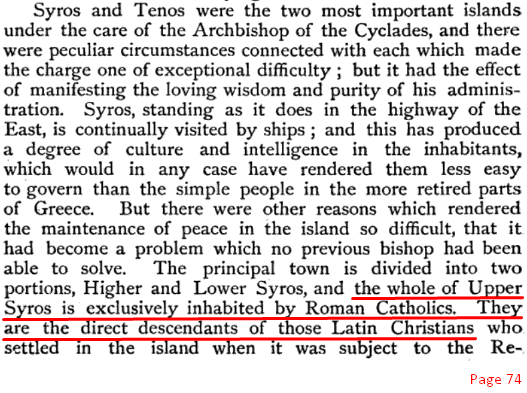
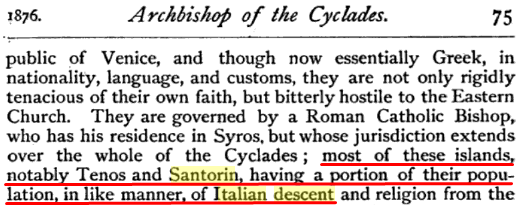
"Among the civilian population there was a substantial approval of the Italian presence only in the area of ​​the capital of Siro and in the island of Tino, where many boasted distant Venetian roots and were numerous Catholics for centuries - especially in the town "Ano Syros", founded in 1200 by the Venetians."
 
I have seen it as Santorino for years.
Oh well. Still Italian.

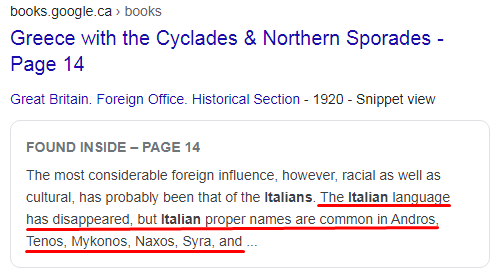
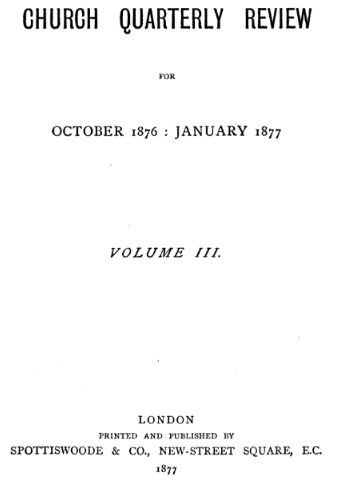
1) "There is a strong Italian admixture in the population of Santorin, although the Italian language has disappeared ; about 600 of the richest and most intelligent part of the population retain the Roman Catholic religion, and lead in the educational and intellectual development of the island."
-- Peace Handbooks: The Balkan States - Page 14 [Great Britain. Foreign Office. Historical Section, ‎George Walter Prothero - 1973]

2) "French and Italian families still form a distinct element of the population of Naxos, Santorin, and Syra."
-- Greece, Turkey in Europe, Rumania, Servia, Montenegro, Italy, Spain, and Portugal - Page 45 [New York: D. Appleton And Company, Elisée Reclus - 1881]

3)
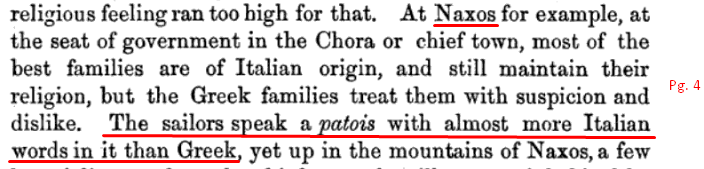
uYh9Rd9.png

d6RLcaI.png

Zx5e1rm.png

BMN2jps.png
 
Last edited:
Back
Top