• Welcome to the new Macedonian Truth Forum. All posts, members and private messages have been moved over from the old forum.

    Passwords from the old forum could not be carried over, so please use Forgot your password? to set a new one. The reset link is emailed to the address on your account.

  • Rules and Regulations at the forum of the Macedonian Truth Organisation (MTO)

    (1) The national-ethnic and cultural-linguistic identity of the Macedonian people is historically Macedonian, and derives its character from the native, indigenous and geographic homeland of the Macedonians, which is called Macedonia. To ensure that their human rights, integrity and heritage are appropriately respected, the only nouns and adjectives acceptable when reference is made to the above character and identity markers is Macedon, Macedonia, Macedonian and Macedonians.

    (2) The nation-state of the Macedonian people is the Republic of Macedonia, and is to be referred to by this official title so long as the 'republic' prefix is consistently applied to other states. Alternative references are the Macedonian Republic, or simply, Macedonia.

    (3) The 'ethnic' prefix is only acceptable for Macedonians in cases where differentiation is specifically required - so long as it is in context and consistent where it concerns its application to other ethnic groups.

    (4) Should any other differentiation be specifically required, the names of other ethnic groups that reside with Macedonians in either the Republic of Macedonia or the occupied Macedonian regions in Greece, Bulgaria, Serbia or Albania, are to be given a prefix.

    (5) Negating the identity, language and culture of the Macedonian people by deliberate avoidance of the terms Macedonia, Macedonian and Macedonians, or by any other means, is not permitted.

    (6) Systematic anti-Macedonian propaganda and rhetoric are not permitted.

    (7) Threads irrelevant to the Macedonian Cause, the community at the Macedonian Truth Organisation or the Macedonians in general may be considered as spam or not in the spirit of the forum. In such cases they are not permitted.

    (8) Continual posting of messages in threads with the sole purpose of deviating from the initial topics with the use of unrelated and unnecessary information is not permitted.

    (9) All posts, external articles, reports, etc that are cited in languages other than Macedonian or English, must be accompanied with a translation in one or both of the said languages.

    (10) Despite the possibility of some conversations and debates becoming heated, extreme abuse and/or racism, vulgar language and/or terminology, threats, revelation of personal information about others, harassment, and other such behavior will not be permitted. If deemed necessary all relevant information including member details will be reported to the appropriate authorities for investigation which may result in legal action.

    (11) Threads that are created must have a summary of a topic or excerpt of an article found in pertinent link(s) that have been included. One line threads will be considered unaccetable spam and are therefore not permitted.

    (12) Compulsive and deliberate lies, irrespective of the topic, are not permitted.

    (13) Any symbols or avatars found to be perceived as offensive to Macedonians are not permitted.

    (13) Any explicit or extreme material is not permitted.

    Failure to adhere to the above rules and regulations will result in a ban after 3 breaches. This may be reconsidered in some cases should the circumstances be of an unorthodox nature and/or require special consideration. To assure an effective deterrent against an individual or individuals with the sole purpose of causing dissent through spamming, racism or other improper means, the above rules will be strictly enforced.

    The MTO administration will monitor all discussions as reasonably practical and reserve the right to remove any post and/or member from the forum, and update the rules and regulations as required. Members are encouraged to immediately report any post and/or member to the MTO administration if they feel that these rules have not been abided by.

    The views expressed on this forum are those of the individuals. The only official representation of the MTO is made by the "Macedonian Truth Organisation (Site Owner)" username, and no other.

  • Macedonian Cause

    The Macedonian Truth Organisation calls on God in Heaven to protect, bless and guide the endeavour it is committing to undertake, and that is to work towards:

    Securing Macedonia as a free, independent and democratic republic in which sovereignty lies with the Macedonian citizens; as the nation-state of the Macedonian people in which they can preserve their culture, language and identity; as a state in which the Macedonian language and culture form the basis of public life and act as important unifying elements of Macedonian society; as the home of all its citizens to which it guarantees and obliges their inalienable natural rights and corresponding responsibilities;

    The acknowledgment as self-evident and irrefutable the existence of the:

    1) Indigenous, ethnonational name of Macedonia;
    2) Macedonian people, language and identity;
    3) Macedonian culture, symbols and folklore;
    4) Macedonian ancestry, heritage and history in its entirety; and
    5) Macedonian Orthodox Church;

    Securing recognition by the International Community of the tragedies endured by the Macedonian people, of the division of Macedonia with the signing of the Treaty of Bucharest on August 10, 1913, and the genocide committed against the Macedonian people at the hands of the Greek, Bulgarian and Serbian states and their respective churches during the 19th and 20th centuries;

    Ensuring that the Interim Accord is declared ‘null and void’ and that all constitutional provisions, acts, commitments, agreements, legislation, regulations, policies or programs emanating from, supporting or consequential to the Interim Accord are also declared ‘null and void’, including the use of any symbols and the completion of any acts imposed by, or originating from, the Interim Accord.

    Ensuring that the Framework Agreement is abolished and that all constitutional provisions, acts, commitments, agreements, legislation, regulations, policies and programs emanating from, supporting or consequential to the Framework Agreement are also abolished and replaced by a framework of constitutional and statutory law based on inalienable natural rights and corresponding responsibilities and universally codified human rights mechanisms.

    Securing the abolishment of any existing constitutional provisions, acts, agreements, legislation, regulations, policies and programs that discriminate against the Macedonian people, in any international organisation or any of the countries of the International Community where such constitutional provisions, acts, agreements, legislation, regulations, policies and programs exist, and thereby ensuring the freedom for Macedonians to exercise their inalienable natural rights and fulfil their corresponding responsibilities, and practice their culture, language and religious faiths in all the countries of the International Community without hindrance;

    The empowerment of Macedonians to undertake a moral revolution and to instil and/or reinvigorate within themselves a deep-rooted national, cultural, linguistic and historical dignity and a commitment to the exercise of freedom based on inalienable natural rights and corresponding responsibilities;

    The recognition of the Macedonian minorities in the neighbouring states of Macedonia as well as the respect for the inalienable rights and freedoms of the Macedonian minorities, as provided for by natural law and as codified by the United Nations Charter, the Universal Declaration of Human Rights and other universally codified human rights mechanisms;

    The full and unreserved respect of, and the support for, the rights of all people of non-Macedonian descent living in Macedonia and around the world, who share a reciprocal full and unreserved respect for the Macedonian people, their homeland and their state;

    The cultural unification and solidarity of the Macedonian people living in all parts of historical Macedonia and adjacent territories, as well as Macedonians throughout the world;

    The unity of all Macedonians on the principles, objectives and achievement of the Macedonian cause as defined by this declaration.

The Real Ethnic Composition of Modern Greece

What a great map depicting Macedonia as fyrom. I didn't know fyrom existed in 1769. Regardless, you shouldn't post such crap on this forum.
 
The map ignores many things, not just the Vlach-Greeks in Albania. Many settlements/areas and villages seem to have been omitted. Some towns or cities which had a significant Vlach-speaking presence even before 1769 are excluded. The 'dots'/'shaded areas' on the map seem somewhat comical and the author asks us to believe and accept this was the state of Vlach ancestral group in specifically 1769.

What a great map depicting Macedonia as fyrom. I didn't know fyrom existed in 1769. Regardless, you shouldn't post such crap on this forum.

The map is from 1997 (as seen in the legend) and refers to 1769.
Actually this is far from crap, this is a very serious effort. You can enter the book here, and see many similar maps (about 10 detailed maps per district or era). LOL, sorry it seems there's no chapter on Peloponnese.

http://www.vlachs.gr/el/news/vlachs-1900


===
 
Last edited:
The map is from 1997 (as seen in the legend) and refers to 1769.
Actually this is far from crap, this is a very serious effort. You can enter the book here, and see many similar maps (about 10 detailed maps per district or era). LOL, sorry it seems there's no chapter on Peloponnese.

http://www.vlachs.gr/el/news/vlachs-1900


===
In future, don't post maps that refer to Macedonia by the idiotic acronym imposed by idiots from Morea. If you can't find an alternative because you're referencing a Greek website then post the statistics only. As for the Vlachs, they were more numerous than that map indicates.
 
The map is from 1997 (as seen in the legend) and refers to 1769.
Actually this is far from crap, this is a very serious effort. You can enter the book here, and see many similar maps (about 10 detailed maps per district or era). LOL, sorry it seems there's no chapter on Peloponnese.

http://www.vlachs.gr/el/news/vlachs-1900


===

Obviously it doesn't just refer to 1769, as there was no fyrom terminology in that year. Any map that shows Macedonia as fyrom is crap.
 
In future, don't post maps that refer to Macedonia by the idiotic acronym imposed by idiots from Morea. If you can't find an alternative because you're referencing a Greek website then post the statistics only. As for the Vlachs, they were more numerous than that map indicates.

Obviously it doesn't just refer to 1769, as there was no fyrom terminology in that year. Any map that shows Macedonia as fyrom is crap.

Didn't get who the idiot from Morea is. Well, you'll have to get over it about FYROM and keep from the maps what is useful for you, just as you do with Bulgarian statistics. You and me, we don't care about the Vlachs, but I posted this for Carlin who may have made more than 100 posts about Vlachs.

I would insist that these maps are very interesting. Unfortunately they are all in Greek, in this link you can see English grey scale versions of only half of these maps. Here, you can read the legends but not see the colors.

http://www.vlachs.gr/el/various-articles/chartografontas-ti-vlachiki-diaspora-sta-valkania

The maps refer to several periods and districts. They don't have numbers of people, but, for instance, main and full Vlach villages are indicated. In the book there are more (color) maps, including Thessaly and Eastern Macedonia. The book display has fullscreen, zoom and download options.

1769 is the key year of the destruction of Moschopolis which seems to have affected significantly the movements of Vlachs in the recent centuries.


==
 
Last edited:
Didn't get who the idiot from Morea is.
Your politicians from the early 90's.
Well, you'll have to get over it about FYROM.....
No, we don't have to get over it, and we won't validate that stupid acronym here.
.....keep from the maps what is useful for you, just as you do with Bulgarian statistics.
That's not the same thing. Sometimes it's impossible to avoid older sources due to the value of their content, but in this case you have a modern map which uses the acronym even though the period in question is during Ottoman times. Look harder and find another map or exclude the section which refers to the acronym. Next time you post such a map or links to such maps, they will be deleted. The acronym is an insult to us. Understand that and keep it in my mind when you post anything here.
 
The map is from 1997 (as seen in the legend) and refers to 1769.
Actually this is far from crap, this is a very serious effort. You can enter the book here, and see many similar maps (about 10 detailed maps per district or era). LOL, sorry it seems there's no chapter on Peloponnese.

http://www.vlachs.gr/el/news/vlachs-1900


===

I don't doubt this is a serious effort, the issue here seems to be is that this is a serious effort of present (remaining) Vlach villages and culture.

The current ethnographic situation is then taken and projected back into the past, to specifically 1769 (the destruction of Moschopolis), and we are asked to believe and accept the map as is.

There are many questions that arise, but I will only ask two very specific questions:

1) Why was the "Probable Mijak" group included in the first map of the Vlach ancestral group in 1769? If the "Mijaks" were included (who are at best a mix of Slavophones and Vlachophones), why not include other similar groups? More importantly, and I ask this seriously, what is the evidence / facts that the "Mijaks" spoke (exclusively) Vlach in 1769?

2) Why were the Vlachs of Acarnania excluded? There are no tiny/small 'dots' of Vlachs in Acarnania. This is interesting because, number 1) does the author know the Vlachs emigrated here after 1769, and number 2) what is the evidence of this emigration to Acarnania after 1769?

If there was even one or two such villages at/prior to 1769, why do we not see small 'dots' in Acarnania?

... And we do know there are Vlachs in Acarnania for the following simple reason:

The language of Acarnania's Vlachs (Karagounidhes): recording of language under disappearance
https://www.didaktorika.gr/eadd/handle/10442/34870?locale=en

The subject of this thesis is the study of the idiom of Vlach (Karagouniki) language group of Acarnania. Its purpose is the cross-sectional study of the important elements of the Vlach idiom (phonetics-phonology, morphology, syntax, etc.). Additionally, its aim is to record and annotate the vocabulary of this idiom especially in areas where it is of particular interest, namely in the field of onomasiology (anthroponymy and toponymy). The work is based primarily on primary (on the spot) research but also secondary research (reviews) is employed.
 
1) Anonymi Descriptio Europae orientalis. Imperium Constantinopolitanum, Albania, Serbia, Bulgaria, Ruthenia, Ungaria, Polonia, Bohemia. Anno MCCCVIII exarata. Cracoviae, 1916: As per the anonymous traveler of Eastern Europe from the XIV century, it is stated that Vlachs (whom the author calls "Blasi"), are a numerous people living between Macedonia, Achaia and Salonika.

2) Johann Thunmann, Untersuchungen uber die Geschichte der ostlichen europaischen Volker, I. Leipzig, 1774: The author states that Vlachs represent half the population of Thrace, and three quarters of inhabitants of Thessaly and Macedonia combined.

3) Inhabitants of Greece through the eyes of various foreign visitors and travelers. Various regions/areas:

"The once glorious Athens is so desolate that it seems incredible that it was once glorious. I, for one, did not see anywhere a more terrible place. Wilderness, swamps...." »DAramon, French ambassador.

"The population of Samos is Turkish." Ruy Gonzales de Clavijo, envoy of the king of Castile, Henry III, the court of Tamerlane.

"Eleusis is now a poor village with 1,200 inhabitants, mostly Albanians." - John Fulleylove MClymont JA, 1902.

"The Albanians from Arcadia are three times more numerous than the Turks." » (The present state of the Morea called Peloponesus, Bernard Randolph, an English traveler, London, 1686).

"Kos is inhabited by Turks." (Pierre Belon, a French physician and botanist, 1546.)

"Mykonos.. It was almost uninhabited." Thevenot (1655).
 
Last edited:
For Akarnania you'll have to look at the map of page 12. There are different colors depending on the era of arrival. For some towns and villages there are exact dates on the map.

For details you'll have to find his articles. His books are attractive and awarded but as far as I can see this guy (Koukoudis) as a scientist is so-so.

By the way, are you writing a PhD on Vlachs?
 
How much is the proportion of modern Greek population of Wallachian origin?

In the 1928 and 1951 censuses they are numbered as 0,3% and 0,5% respectively based on mother language. In 1928 they are more frequent in Epirus (1,7%) and Macedonia (1,0%).
 
A Greco-Albanian Epirot has revealed to me his Aromanian origin. Many Northern Epirots (those in Albania) are aware of Arvanites and neo-hellenism unlike the Greeks in Greece.
I did speak to an Arvanite some months ago in Albanian and I was told that 1/5 of Greeks are in reality Arvanites.
 
Last edited:
The first census that records language (home language) is in 1870. Total population is 1,458,000 people. Based on language: Greek 95%, Albanian 2,6%, Vlach 0,8%. At the time Greece is what now is South Greece (Thessaly & Crete are not yet included).


==
 
Last edited:
However I disagree, I do not believe that 1/5 of Greeks are Arvanites more like 10%.


Johann Georg von Hahn (father of “albanology”) concludes the total number of 173.000 Arbanites in Greece in 1854 (Albaneische Studien,1854).
(total population of Greece 1.096.810)
After Hahn’s own corrections he finally comes to the number of 158.000.(he has done some mistakes about Fokis and Spercheios areas)

Alfred Philipsson, after touring Peloponese in 1889 ,counted 90.253 Arbanites in this area (730.000 total) .(9.5%)
As for the total number he considers it was 224.000 in a total of 2.187.208 (that’s 10%) (zur ethnographic des Peloponnes,pettersmans mittelingen,1890)

Greekhistory.GIF
 
Last edited:
That's interesting. I haven't heard of any of these before, but I suspect they did it in the same way as Lithoxoou. They used the detailed census data, and for the villages or small towns they considered as Arvanite they counted everybody in.

Maps and details here:
http://www.lithoksou.net/p/plithysmos-kai-xoria-ton-arbaniton-1879-%E2%80%93-1907-2005

With this method, Lithoxoou estimates them as 10,6% in 1879 and 9% in 1907 (the area of Greece had changed in between).


====
 
Last edited:
The map is from 1997 (as seen in the legend) and refers to 1769.
Actually this is far from crap, this is a very serious effort. You can enter the book here, and see many similar maps (about 10 detailed maps per district or era). LOL, sorry it seems there's no chapter on Peloponnese.

http://www.vlachs.gr/el/news/vlachs-1900


===

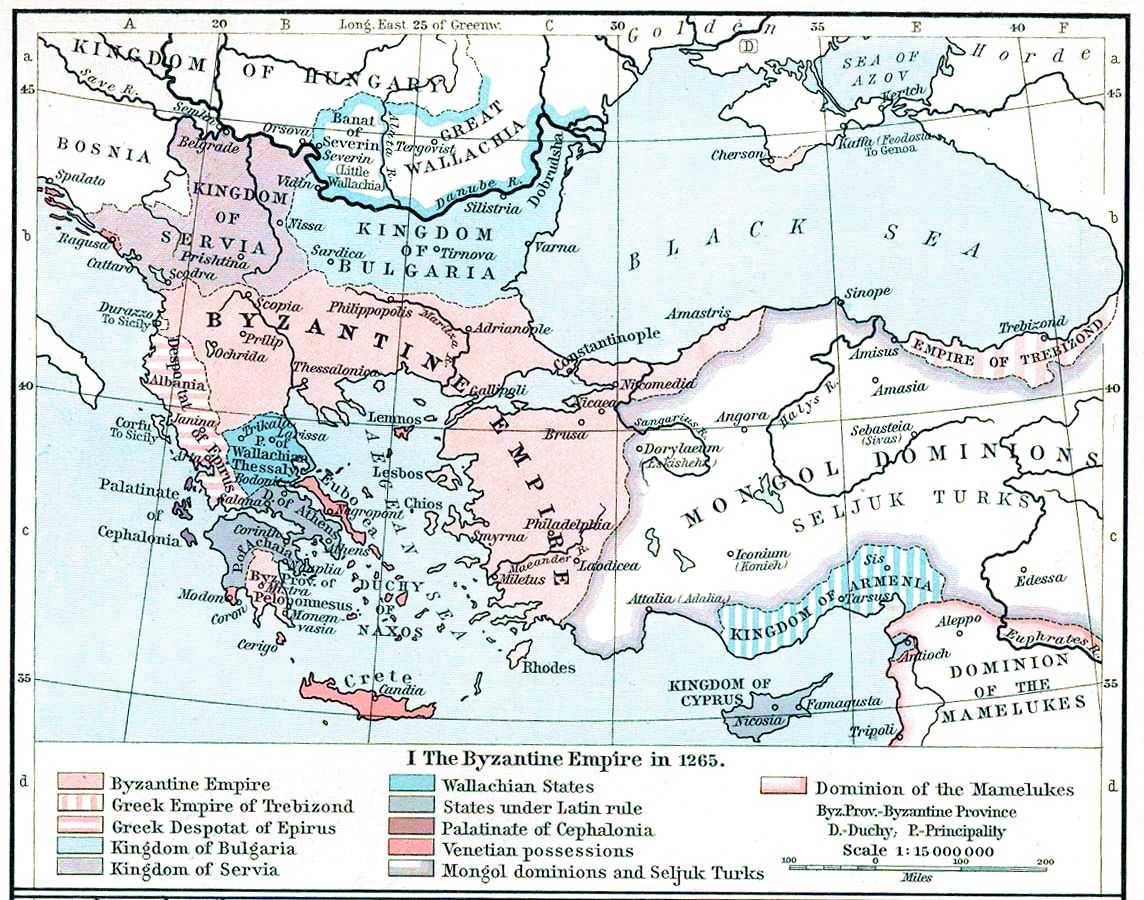
I was searching in Wikipedia and I found out this map.

ShepherdByzempire1265.jpg


Thessaly was a Wallachian state as early as 13th century.
 
Aromanians another category ( Vlachs) are those who are known today as "Greek minority" in Albania. It is historical fact that the ancestors of the "minorities" of today were farmers coming from the Pindos mountains, to work on southern areas. Zones of them have come to the Middle Ages and during the time that the new name was different "Wallachia" (For more you can read the "History of the Balkans" by Georges Castellan) So arrivals as farmers in areas Vurgu, Delvina, Dropullit etc. were Greek-Vlach. Given the influence of the church and especially in the Greek policies, we can understand very well why the so-called "Greek minority" is called such way. So "Greek minority" is not a Greek minority.
 
Last edited:
the new name was different "Wallachia" (For more you can read the "History of the Balkans" by Georges Castellan)

Thessalian Vlachia was apparently also known as "Vlachia in Hellas" (ἐν Ἑλλάδι Βλαχία), as well as "Great Vlachia" (Μεγάλη Βλαχία), to distinguish it from other Vlach-inhabited areas, "Upper Vlachia" in Epirus, and a "Little Vlachia" in Aetolia-Acarnania
Perhaps that is what they are talking about?

More on Great Vlachia:

https://en.wikipedia.org/wiki/Great_Vlachia


The contemporary Byzantine historian Niketas Choniates however distinguishes "Great Vlachia" as a district near Meteora.[3] "Vlachia", "Great Vlachia", and the other variants began to fall out of use for Thessaly at the turn of the 14th century, and with the emergence of Wallachia north of the Danube, from the 15th century the name was reserved for it.

After the conquest of large parts of the Byzantine Empire in the mid-1340s, the Serbian ruler Stefan Dushan was crowned emperor in 1346, founding the Serbian Empire.[12] In 1347–1348 he and his general Preljub extended Serbian control over Epirus and Thessaly.[13] Afterwards, Stefan Dushan claimed the titles, in Latin, of imperator Raxie et Romanie, dispotus Lartae et Blachie comes ("Emperor of Rascia and Romania [Byzantine Empire], Despot of Arta and Count of Vlachia").
 
Aromanians another category ( Vlachs) are those who are known today as "Greek minority" in Albania. It is historical fact that the ancestors of the "minorities" of today were farmers coming from the Pindos mountains, to work on southern areas. Zones of them have come to the Middle Ages and during the time that the new name was different "Wallachia" (For more you can read the "History of the Balkans" by Georges Castellan) So arrivals as farmers in areas Vurgu, Delvina, Dropullit etc. were Greek-Vlach. Given the influence of the church and especially in the Greek policies, we can understand very well why the so-called "Greek minority" is called such way. So "Greek minority" is not a Greek minority.

e__internet_intranet_sfs_CLIO_PHOTOLISTEcastellan_500_.jpg


The grammar errors are from Google Translate I did not bother reconstructioning the paragraph entirely.

What is the title of this article and would you be able to provide source/link? Thanks.
 
Back
Top