• Welcome to the new Macedonian Truth Forum. All posts, members and private messages have been moved over from the old forum.

    Passwords from the old forum could not be carried over, so please use Forgot your password? to set a new one. The reset link is emailed to the address on your account.

  • Rules and Regulations at the forum of the Macedonian Truth Organisation (MTO)

    (1) The national-ethnic and cultural-linguistic identity of the Macedonian people is historically Macedonian, and derives its character from the native, indigenous and geographic homeland of the Macedonians, which is called Macedonia. To ensure that their human rights, integrity and heritage are appropriately respected, the only nouns and adjectives acceptable when reference is made to the above character and identity markers is Macedon, Macedonia, Macedonian and Macedonians.

    (2) The nation-state of the Macedonian people is the Republic of Macedonia, and is to be referred to by this official title so long as the 'republic' prefix is consistently applied to other states. Alternative references are the Macedonian Republic, or simply, Macedonia.

    (3) The 'ethnic' prefix is only acceptable for Macedonians in cases where differentiation is specifically required - so long as it is in context and consistent where it concerns its application to other ethnic groups.

    (4) Should any other differentiation be specifically required, the names of other ethnic groups that reside with Macedonians in either the Republic of Macedonia or the occupied Macedonian regions in Greece, Bulgaria, Serbia or Albania, are to be given a prefix.

    (5) Negating the identity, language and culture of the Macedonian people by deliberate avoidance of the terms Macedonia, Macedonian and Macedonians, or by any other means, is not permitted.

    (6) Systematic anti-Macedonian propaganda and rhetoric are not permitted.

    (7) Threads irrelevant to the Macedonian Cause, the community at the Macedonian Truth Organisation or the Macedonians in general may be considered as spam or not in the spirit of the forum. In such cases they are not permitted.

    (8) Continual posting of messages in threads with the sole purpose of deviating from the initial topics with the use of unrelated and unnecessary information is not permitted.

    (9) All posts, external articles, reports, etc that are cited in languages other than Macedonian or English, must be accompanied with a translation in one or both of the said languages.

    (10) Despite the possibility of some conversations and debates becoming heated, extreme abuse and/or racism, vulgar language and/or terminology, threats, revelation of personal information about others, harassment, and other such behavior will not be permitted. If deemed necessary all relevant information including member details will be reported to the appropriate authorities for investigation which may result in legal action.

    (11) Threads that are created must have a summary of a topic or excerpt of an article found in pertinent link(s) that have been included. One line threads will be considered unaccetable spam and are therefore not permitted.

    (12) Compulsive and deliberate lies, irrespective of the topic, are not permitted.

    (13) Any symbols or avatars found to be perceived as offensive to Macedonians are not permitted.

    (13) Any explicit or extreme material is not permitted.

    Failure to adhere to the above rules and regulations will result in a ban after 3 breaches. This may be reconsidered in some cases should the circumstances be of an unorthodox nature and/or require special consideration. To assure an effective deterrent against an individual or individuals with the sole purpose of causing dissent through spamming, racism or other improper means, the above rules will be strictly enforced.

    The MTO administration will monitor all discussions as reasonably practical and reserve the right to remove any post and/or member from the forum, and update the rules and regulations as required. Members are encouraged to immediately report any post and/or member to the MTO administration if they feel that these rules have not been abided by.

    The views expressed on this forum are those of the individuals. The only official representation of the MTO is made by the "Macedonian Truth Organisation (Site Owner)" username, and no other.

  • Macedonian Cause

    The Macedonian Truth Organisation calls on God in Heaven to protect, bless and guide the endeavour it is committing to undertake, and that is to work towards:

    Securing Macedonia as a free, independent and democratic republic in which sovereignty lies with the Macedonian citizens; as the nation-state of the Macedonian people in which they can preserve their culture, language and identity; as a state in which the Macedonian language and culture form the basis of public life and act as important unifying elements of Macedonian society; as the home of all its citizens to which it guarantees and obliges their inalienable natural rights and corresponding responsibilities;

    The acknowledgment as self-evident and irrefutable the existence of the:

    1) Indigenous, ethnonational name of Macedonia;
    2) Macedonian people, language and identity;
    3) Macedonian culture, symbols and folklore;
    4) Macedonian ancestry, heritage and history in its entirety; and
    5) Macedonian Orthodox Church;

    Securing recognition by the International Community of the tragedies endured by the Macedonian people, of the division of Macedonia with the signing of the Treaty of Bucharest on August 10, 1913, and the genocide committed against the Macedonian people at the hands of the Greek, Bulgarian and Serbian states and their respective churches during the 19th and 20th centuries;

    Ensuring that the Interim Accord is declared ‘null and void’ and that all constitutional provisions, acts, commitments, agreements, legislation, regulations, policies or programs emanating from, supporting or consequential to the Interim Accord are also declared ‘null and void’, including the use of any symbols and the completion of any acts imposed by, or originating from, the Interim Accord.

    Ensuring that the Framework Agreement is abolished and that all constitutional provisions, acts, commitments, agreements, legislation, regulations, policies and programs emanating from, supporting or consequential to the Framework Agreement are also abolished and replaced by a framework of constitutional and statutory law based on inalienable natural rights and corresponding responsibilities and universally codified human rights mechanisms.

    Securing the abolishment of any existing constitutional provisions, acts, agreements, legislation, regulations, policies and programs that discriminate against the Macedonian people, in any international organisation or any of the countries of the International Community where such constitutional provisions, acts, agreements, legislation, regulations, policies and programs exist, and thereby ensuring the freedom for Macedonians to exercise their inalienable natural rights and fulfil their corresponding responsibilities, and practice their culture, language and religious faiths in all the countries of the International Community without hindrance;

    The empowerment of Macedonians to undertake a moral revolution and to instil and/or reinvigorate within themselves a deep-rooted national, cultural, linguistic and historical dignity and a commitment to the exercise of freedom based on inalienable natural rights and corresponding responsibilities;

    The recognition of the Macedonian minorities in the neighbouring states of Macedonia as well as the respect for the inalienable rights and freedoms of the Macedonian minorities, as provided for by natural law and as codified by the United Nations Charter, the Universal Declaration of Human Rights and other universally codified human rights mechanisms;

    The full and unreserved respect of, and the support for, the rights of all people of non-Macedonian descent living in Macedonia and around the world, who share a reciprocal full and unreserved respect for the Macedonian people, their homeland and their state;

    The cultural unification and solidarity of the Macedonian people living in all parts of historical Macedonia and adjacent territories, as well as Macedonians throughout the world;

    The unity of all Macedonians on the principles, objectives and achievement of the Macedonian cause as defined by this declaration.

Todor Aleksandrov

I have heard about this probability also. I don't think it's a far stretch, while Todor Alexandrov broke the shackles of his earlier Exarchist upbringing and worked for Macedonia and the Macedonians, Mihailov turned into an opportunistic bulgarophile.
 
With all of these artices surfacing about Vanco Mihailov and his apparent stance for an independent Macedonia and against the neighbouring wolves, I am wondering wether or not this individual was a decent Macedonian at some stage, or if he was infected with bulgarophilism from the beginning to the end.

What do you think, Prolet?
 
1924 Times articles on Todor Alexandrov

1924 Times articles on Todor Alexandrov

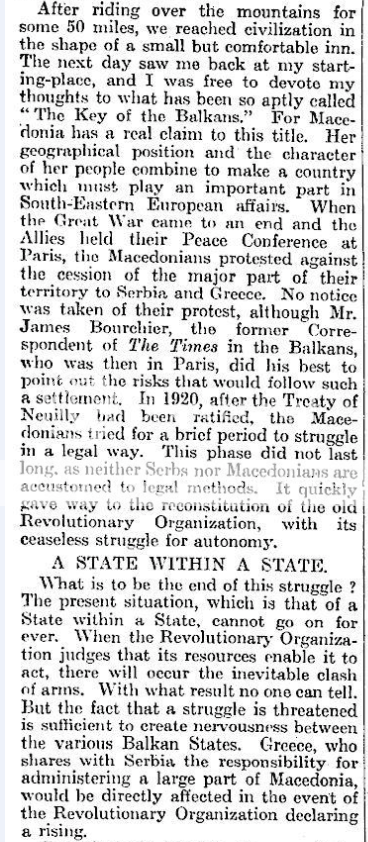
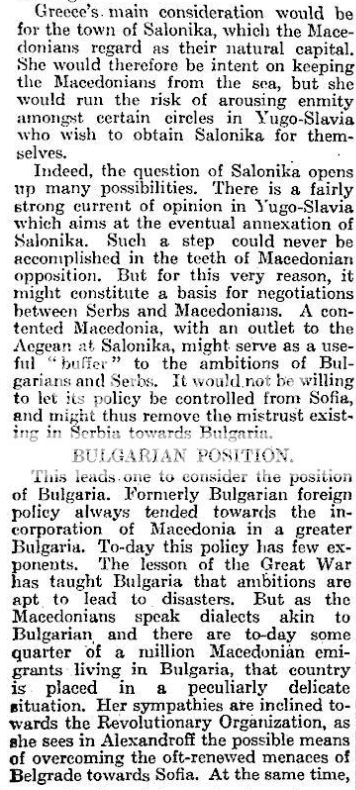
The Times 1924 January 4 Page 11
1924Alexandrov1.png

1924Alexandrov2.png

1924Alexandrov3.png

1924Alexandrov4.png

1924Alexandrov5.png

1924Alexandrov6.png

1924Alexandrov7.png

1924Alexandrov8.png

1924Alexandrov9.png
 
Todor Aleksandrov: “lifelong believer in the creed of “Macedonia for the Macedonians"

Todor Aleksandrov: “lifelong believer in the creed of “Macedonia for the Macedonians"

TODOR ALEKSANDROV

“... A lifelong believer in the creed of “Macedonia for the Macedonians”....

“...He declares that the population will not tolerate being ruled by Serbians, Greeks, Bulgarians...”

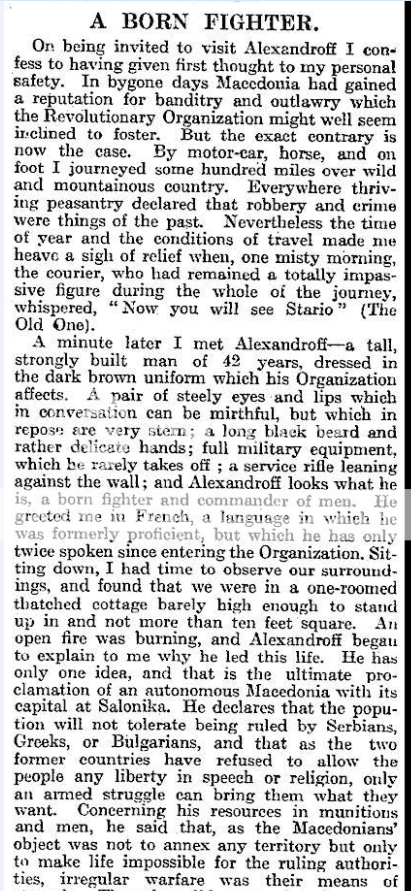
... He has only one idea, and that is the ultimate proclamation of an autonomous Macedonia with its capital at Salonika. He declares that the population will not tolerate being ruled by Serbians, Greeks, Bulgarians, and that as the two former countries have refused to allow the people any liberty in speech or religion, only an armed struggle can bring them what they want.....”
[The London Times Jan 4 1924]

..................................

Alexandroff of Macedonia

Code of An Outlaw


(by our Special Correspondent)
This article was published originally in The Times of London on Jan. 4, 1924, several months before the assassination of Alexandroff on Aug. 31, 1924.


On The Serbo-Bulgarian Frontier.
Raiko Daskaloff, who with Stambolisky pursued a bitter campaign against the Macedonian Revolutionary Organisation, was assassinated last summer at Prague, where he had formerly been Bulgarian Minister. His assailant, Nicoloff, was afterwards tried, acquitted, and re-arrested. He was re-arrested on the grounds that he was an agent of Todor Alexandroff, the chief of the Revolutionaries. This series of events has revived interest in the activities of the Macedonians.

The present leader of the Revolutionaries is Todor Alexandroff, whom I have just visited. Whatever opinions may be held concerning the rights and wrongs of the cause he defends and the methods he employs, he and his organisation constitute an interesting study. A lifelong believer in the creed of “Macedonia for the Macedonians” and a Komita, Alexandroff took up in 1919 the leadership of the revolutionary movement. He had previously been living at Sofia, but Stambolisky had him arrested and imprisoned. His friends arranged his escape and he crossed into Macedonia, where ever since he has led a life which needs to be seen to be believed. Having decided to organise a revolutionary movement against the Serbians and Greeks who by the Peace Treaty obtained the greater part of Macedonia, Alexandroff reorganised the old Macedonian Committee, which had existed under the Turks in 1893. In the accomplishment of this task he has perforce become an outlaw, and a price of over $2,000 has been put on his head by the Serbian authorities. He leads a wandering life, dedicated to the creation of an autonomous Macedonia. Always on foot and always by night Alexandroff travels throughout Macedonia, without, however, venturing into the large towns like Salonika or Monastir. In winter he lives in some humble peasant cottage; in summer he sleeps in the open air. During the daytime he lies low. Never stopping more than two or three days in the same place, he is accompanied by a small band of devoted friends. The chief preoccupation of this band is not to enter into conflict with the Serbian or Greek authorities, but to visit and control the different committees which during the last three years have sprung up in almost every town and village.


A Born Fighter.
On being invited to visit Alexandroff I confess to having given first thought to my personal safety. In bygone days Macedonia had gained a reputation for banditry and outlawry which the Revolutionary Organization might well seem inclined to foster. But the exact contrary is now the case. By motor-car, horse, and on foot I journeyed some hundred miles over wild and mountainous country. Everywhere thriving peasantry declared that robbery and crime were things of the past. Nevertheless the time of year and the conditions of travel made me heave a sigh of relief when, one misty morning, the courier, who had remained a totally impassive figure during the whole of the journey, whispered, “Now you will see Stario” (The Old One). A minute later I met Alexandroff-a tall, strongly built man of 42 years, dressed in the dark brown uniform which has Organisation affects. A part of steely eyes and lips which in conversation can be mirthful, but which in repose are very stern; full military equipment, which he rarely takes off; a service rifle leaning against the wall; and Alexandroff began to explain to me why he led his life. He has only one idea, and that is the ultimate proclamation of an autonomous Macedonia with its capital at Salonika. He declares that the population will not tolerate being ruled by Serbians, Greeks, Bulgarians, and that as the two former countries have refused to allow the people any liberty in speech or religion, only an armed struggle can bring them what they want. Concerning his resources in munitions and men, he said that as the Macedonians object was not to annex any territory but only to make life impossible for the ruling authorities, irregular warfare was their means of struggle. Thus they did not need to have any artillery. It was on foot that they would wage their battle although mountain ponies could be used if required. They had a large supply of rifles, bombs, and ammunition, as the last few wars had led to the arming of almost every peasant.

Arms and Men.
Concerning the strength of his forces, Alexandroff claims that in Macedonia alone he can mobilise approximately 150,000 men. He pointed out, however, that the great proportion of these men were at present civilians, and that only a few thousand Komitadjis (bands of armed men) were now on a war footing. He did not refer to Macedonians outside the frontier, but it is thought that in the event of a rising many thousands now in Bulgaria would flock to his colours. When questioned as to the possible date of a revolution, he replied that circumstances were not yet altogether favourable. I took this to mean that the Organisation had not yet made all their preparations. Besides this I gathered that bigger reserves of arms and munitions were going to be accumulated. Alexandroff went on to say that he hoped that the Croats, Slovenes, and Montenegrins would in the long run discard legal for illegal methods against Serbia; a combined rising might then take place.

Asked if a compromise was not possible between the Organisation and the ruling authorities, he replied that many Serbians now resident in Macedonia realised that the present situation was extremely unsatisfactory, but that the party of Pashitch, the principal statesman in Serbia, seemed inflexible in their desire to destroy Macedonia. But, he explained, “Turkey tried to destroy us during countless years; she failed, and it is important to remember that then the considerable Turkish population was against the Revolutionary Organisation; now the Turks are with us, and I emphatically state that we are stronger than we have ever been before.” Alexandroff admitted to being in relations with Turkey, but it is easy to see that he does not place much faith on outside assistance. His is a Macedonian movement, which he hopes to bring off in conjunction with other races now forming part of the Triune Kingdom. At the same time he professed the willingness of the Organisation to submit to any impartial inquiry about the situation in Macedonia by the Great Powers, the League of Nations, or a group, of independent journalists. In addition, he stated that failing the granting of autonomy, the Organisation would welcome the placing of Macedonia under the protection of a Great Power, preferably England. As for the relations of the Organisation with Bulgaria, he rejoiced at the fall of Stambolisky and his followers, who in trying to create a Federalist Macedonian movement were the first Bulgarian Government who had ever shown themselves openly hostile to the aspirations of the Macedonian people. He characterised the Macedonian Federalists as a group of two or three hundred persons in the pay of Serbia who had no influence or importance. He emphasised that the Macedonian movement was in no way directed from Sofia and denied most categorically having been in Bulgaria or having taken part in the June coup d’Etat.

Speaking of the death of Stambolisky, he rejected the idea that his Organisation was responsible for it, but added that it was highly possible that his death had been compassed by one or more Macedonians who had grievances against him. On the other hand, he admitted that, the killing of Daskaloff, whom he described as a demagogue amongst demagogues, was the work of the Organisation. In this connection he showed me a protest which the Organisation had addressed to the Czecho-Slovak Government about the rearrest of Nicoloff, the assassin. Alexandroff considers that after Nicoloff had been once acquitted by the Czech Court of Justice there was no case against him, and that it was because the Serbian Press took up such a hostile and menacing attitude that the Czechs found a pretext for his rearrest.


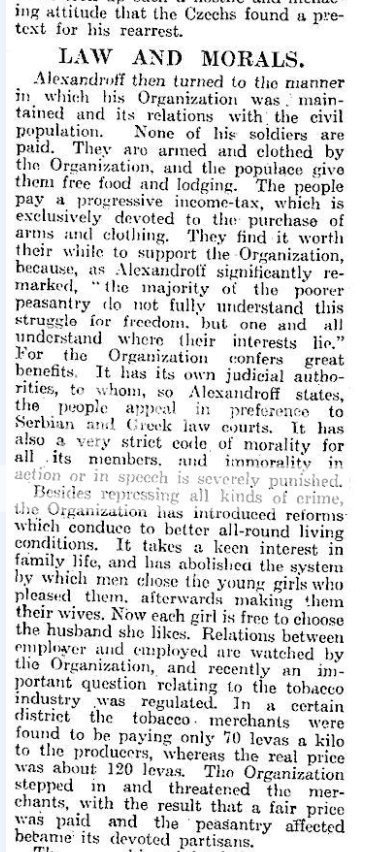
Law And Morals.
Alexandroff then turned to the manner in which his Organisation was maintained and its relations with the civil population. None of his soldiers are paid. They are armed and clothed by the Organisation, and the populace give them free food and lodging. The people pay a progressive income-tax, which is exclusively devoted to the purchase of arms and clothing. They find it worth their while to support the Organisation, because, as Alexandroff significantly remarked, “the majority of the poorer peasantry do not fully understand this struggle for freedom, but one and all understand where their interests lie.” For the Organisation confers great benefits. It has its own judicial authorities, to whom, so Alexandroff states, the people appeal in preference to Serbian and Greek law courts. It has also a very strict code of morality for all its members, and immorality in action or in speech is severely punished.

Besides repressing all kinds of crime, the Organisation has introduced reforms which conduce to better all-round living conditions. It takes a keen interest in family life, and has abolished the system by which men chose the young girls who please them, afterwards making them their wives. Now each girl is free to choose the husband she likes. Relations between employer and employed are watched by the Organisation, and recently an important question relating to the tobacco industry was regulated. In a certain district the tobacco merchants were found to be paying only 70 levas a kilo to the producers, whereas the real price was about 120 levas. The Organisation stepped in and threatened the merchants, with the result that a fair price was paid and the peasantry affected became its devoted partisans.

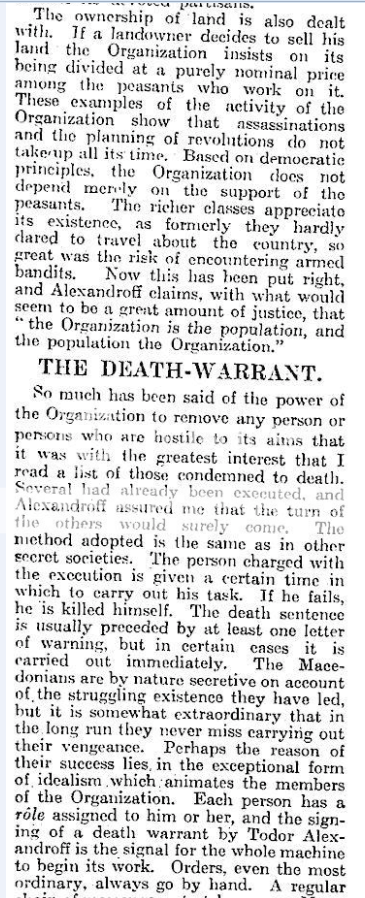
The ownership of land is also dealt with. If a landowner decides to sell is land, the organisation insists on its being divided at a purely nominal price among the peasants who work on it. These examples of the activity of the Organisation show that assassinations and the planning of revolutions do not take up all its time. Based on democratic principles, the Organisation does not depend merely on the support of the peasants. The richer classes appreciate its existence, as formerly they hardly dared to travel about the country, so great was the risk of encountering armed bandits. Now this has been put right, and Alexandroff claims, with what would seem to be a great amount of justice, that “the Organisation is the population, and the population the Organisation.”

The Death-Warrant
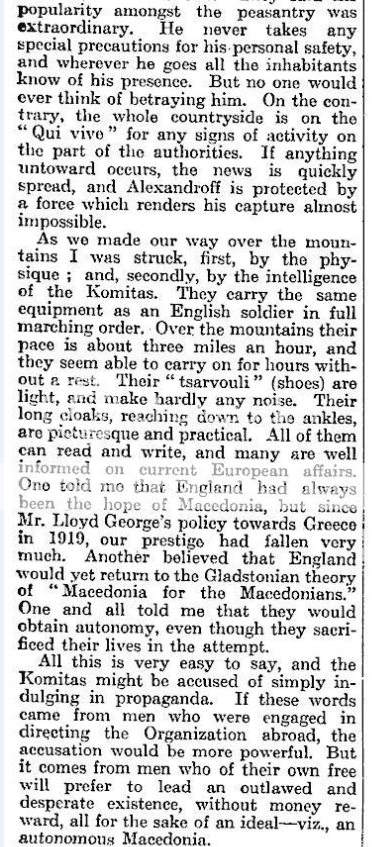
So much has been said of the power of the Organisation to remove any person or persons who are hostile to its aims that it was with the greatest interest that I read a list of those condemned to death. Several had already been executed, and Alexandroff assured me that the turn of the others, would surely come. The method adopted is the same as in other secret societies. The person charged with the execution is given a certain time in which to carry out his task. If he fails, he is killed himself. The death sentence is usually preceded by at least one letter of warning, but in certain cases it is carried out immediately. The Macedonians are by nature secretive on account of the struggling existence they have led, but it is somewhat extraordinary that in the long run they never miss carrying out their vengeance. Perhaps the reason of their success lies in the exceptional form of idealism which animates the members of the Organisation. Each person has a role assigned to him or her, and the signing of a death warrant by Todor Alexandroff is the signal for the whole machine to begin its work. Orders, even the most ordinary, always go by hand. A regular chain of messengers stretches across Macedonia today. I was the witness if the working of one chain, and found it marvellously efficient. Each courier has his beat, and as he is usually a native of the region in which he travels, every nook and cranny of the ground is known to him. Sometimes the death sentence, as in the case of Daskaloff, has to be carried out abroad. If so, the unofficial representatives whom the Organisation maintains in Sofia, Constantinople, Budapest, and other European capitals are called in to play their part. The Organisation is, in fact, a vast octopus which has its tentacles stretched out over most of South-eastern Europe. Alexandroff’s ambition is that one day it will have its official representatives accredited to every European country. Still, even today there exists in the Revolutionary Organisation a factor which neither great nor small European Powers can afford to disregard.

The wintry day was drawing to a close, and it was time to take leave of Alexandroff. Some dinner, consisting of chicken and rice, washed down by linden tea, was put before us. Alexandroff ate sparingly, and soon assumed his favourite posture sitting crossed-legged, with head well back, eyes half-closed, and hands stretched forward towards the fire. An expression of grim austerity comes over his face, and to see him thus is to carry away an unforgettable impression of a very remarkable man. The whole visit seemed like a dream. Was it possible that such a Organization could exist in the twentieth century? I was quickly brought back to reality on stepping outside the house. Snow was falling, and a Komitaji band was drawn up on parade. Its leader had distinguished himself in a recent skirmish with the ruling authorities, and Alexandroff, in a short speech, presented him with the Order of Merit. The Komitas, who were all young men six feet and more high, cheered their leader and then filed silently away. A few minutes later I took my departure with my not inconsiderable bodyguard. Alexandroff saw me off, and immediately set off on a 20-kilometer march to another hamlet to continue his preaching of “Macedonian for the Macedonians.”

------------

Dats, great work in bringing the original scans to MTO!

I post the text version that has been around for over a decade on the Internet so that it can be verified and utilised when needed.

So pochit,
I.
 
Last edited:
MACEDONIAN REPRISALS. Precise Information has not yet been received of the exact circumstances in which Todor Alexandroff met his death (says Reuter in the London 'Daliy Telegraph,' under date Sofia, September 16). According to the best, authenticated account, however, . Alexandroff was killed while 'on his way to attend a revolutionary congress at some secret meeting place in the mountains. He was accompanied by two guides whom he believed to be devotedly attached to his person. Unfortunately for Alexandroff, however, his trust was misplaced. The guides had been suborned and killed their master while he was resting on the journey. His body waa subsequently found by others of his followers and buried In the Macedonian mountains, where he had made his home for so many years and where he had played so formidable a role behind the scenes in Balkan politics. While public opinion has naturally been greatly excited over the dramatc death of this Balkan Robin Hood, as he had been aptly called, there have been no disorders. The newspaper 'Slovo,' which is in close touch with Macedonian circles, says that the murder of Todor Alexandroff was the outcome of a political plot organised from the Bolshevik centre in Vienna, which has for long wished to weaken the revolutionary movement in Macedonia. The newspaper claims that Vasilleff and, Athanosoff, rival Macedonian leaders, intended to proclaim a Soviet Republic In the Petrich district on September 15th and that they had obtained financial support from foreign sources by the Intermediation of Bulgarian Communists. The Sofia correspondent of the London 'Times' under date September 16 said: According to a communication signed by General Protogueroff, one of the leaders of the Macedonian Revolutionary Organisation, Todor Alexandroff was killed by two Macedonians in the service of certain chiefs who have been recently engaged In Bolshevist propaganda. The death of Alexandroff, who was killed on August 31st, was kept secret in order to enable the Macedonian Nationalists to take in hand the direction of the revolutionary movement, and to forestall the manoeuvres of those in the service of the Bolshevists, several of whom it was decided to put to death. In accordance with this decision, Aleko Pasha and Colonel Athanasoff, who were chiefs of bands, as well as other Macedonian Communists, were killed on September 13 on the Serbian frontier by order of the Revolutionary Organisation. In Sofia Hadijimoff, a Macedonian Bolshevist, and Judge Kovatcheff, both Communist Deputies — have been assassinated by two young Macedonians, whom the police have arrested. The Government is taking measures to prevent further murders by the opposing factions of the Macedonian revolutionaries in Bulgarian territory.


(The Townsville Daily Bulletin, Saturday November 22nd 1924, page 13)
 
Haven't gone through this book in detail so not sure what it says about Macedonians in other sections, but it briefly touches on the subject of Aleksandrov's murder:

http://books.google.com/books?id=y3...&resnum=5&ved=0CDoQ6AEwBA#v=onepage&q&f=false
Eastern Europe Between the Wars, 1918-1941, By Hugh Seton-Watson. p. 314.

The alliance of the IMRO chief with the Left undoubtedly alarmed the Sofia army chiefs and nationalist politicians, besides annoying their Italian patrons. In August Aleksandrov was murdered, some believe on the instructions of Mihailov and his protector War Minister Volkov. In October of the same year Vlahov founded a seperate Macedonian movement known thenceforth as Obedineta movement, which preached federation on Communist lines. This group had the support of Macedonian communists, and was closely connected to the Bulgarian communist movement. Protogerov, who had been with Aleksandrov when he was murdered, and whom Mihailov's men had accused of complicity in the crime, inclined towards the Obedineta group. Although he never accepted a communist programme, he favoured increasingly a federalist solution of the Macedonian question. In 1928, he was murdered by Mihailov's agents.
 
Still,what should our attitude towards Alexandrov be?He's a very controversial person,at some stages of life fighting for Macedonia and Macedonians,he pushed the 'United Macedonia' idea within a Balkan federation,but also no one can deny his role in the murders of Jane Sandanski and Gorce Petrov,arguably the most prominent Macedonian heroes of the era.A very controversial figure of our history indeed.
 
Last edited:
Factional divisions and fratricide were unfortunate by-products of the Macedonian revolution, not uncommon for other peoples either. What evidence is there for his direct involvement in Sandanski's murder?
 
Factional divisions and fratricide were unfortunate by-products of the Macedonian revolution, not uncommon for other peoples either. What evidence is there for his direct involvement in Sandanski's murder?

Actually, there is pretty accurate info about Alexandrov. DPMNE helped (Gruevski personally) publish a quite thick book with documents about and from him. It is quite clear from the docs that he was a Bulgarian nationalist, more Bulgarian then the Bulgarians themselves, very similar to Ivan Mihajlov. He used to write letters to Bulgarian PM's telling them what to do. In one letter he's practically ordering the PM to withdraw the ambassador in Prague because his wife spoke openly that Macedonians are a separate nation. Why did Macedonians flock to him? He evidently spoke only of free and united Macedonia and kept his Bulgarian nationalism hidden - something like Ljubco Georgievski today.
 
Mango, we both know that there are even Macedonians from the 'left' faction who shared such a sentiment at one point or another. I put most of this down to Exarchate propaganda, that is the garbage they were brought up with, that is how they were schooled. I would never place Aleksandrov in the same basket as an opportunist dog like Georgievski, but that is just my opinion. I understand others feel differently, and that's fair enough. I would be really interested to see these documents you've made reference to. What is the book called, and how do we obtain a copy?
 
Factional divisions and fratricide were unfortunate by-products of the Macedonian revolution, not uncommon for other peoples either. What evidence is there for his direct involvement in Sandanski's murder?
Well,both Bulgarian and Macedonian Wikipedia page about Sandanski claim the involvement of the Nevrokop detachment of VMRO (at the time VMRO was led by Todor Aleksandrov),specifically the cheta of the local vojvoda Stojan Filipov with the executor being a certain Andon Kacharkov.The Macedonian one quotes the reference of the book "For freedom and perfection. The Life of Yané Sandansky" by Mercia MacDermott,and the Bulgarian one quotes Николов, Борис Й. "Вътрешна македоно-одринска революционна организация. Войводи и ръководители (1893-1934)".So,even if Aleksandrov didn't order his death directly (the above sources claim Ferdinand Koburshki of Bulgaria did,he only used VMRO of Aleksandrov as the instrument),it couldn't be done without his knowledge and approval.But all sources agree that it was Ferdinand who ordered Sandanski's death because Jane was plotting to assassinate him,he cunningly used the hatred between Sandanski (as a "lefty") and Aleksandrov (as the "authonomist") to get him killed.
 
Last edited:
Mango, we both know that there are even Macedonians from the 'left' faction who shared such a sentiment at one point or another. I put most of this down to Exarchate propaganda, that is the garbage they were brought up with, that is how they were schooled. I would never place Aleksandrov in the same basket as an opportunist dog like Georgievski, but that is just my opinion. I understand others feel differently, and that's fair enough. I would be really interested to see these documents you've made reference to. What is the book called, and how do we obtain a copy?

If I'm not mistaken the book is called "Se za Makedonija" and you might try the local branch of DPMNE to see if they can find it for you. Another very interesting discovery in the book is Alexandrov's description of Gjorce Petrov, Dimo HadziDimov, Gerdjikov and Sandanski- he describes them as hostile to Bulgarian interests to the point of taking arms against Bulgaria in case Macedonia was forced to unite with Bulgaria.
 
Whatever complexes the man may have had, towards the end of his life he realised that he was being used as a tool by the Bulgarian government and consequently consolidated his ideology with a pro-Macedonian perspective. This is made obvious by his endorsement of the so-called 'May Manifesto' of 1924. And despite the fact that he was later intimidated into denouncing it, he paid for his expression of Macedonian nationalism with his life when Mihailov (in conjunction with Volkov) ordered his murder.

The London Times, January 4, 1924:
He has only one idea, and that is the ultimate proclamation of an autonomous Macedonia with its capital at Salonika. He declares that the population will not tolerate being ruled by Serbians, Greeks, Bulgarians...........
May Manifesto, May 15, 1924:
For the liberation and unification of the torn parts of Macedonia in a completely independent and autonomous political unit, in its natural, geographic and ethnographic boundaries...........
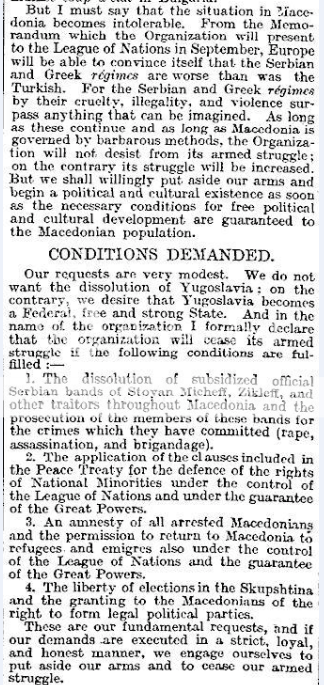
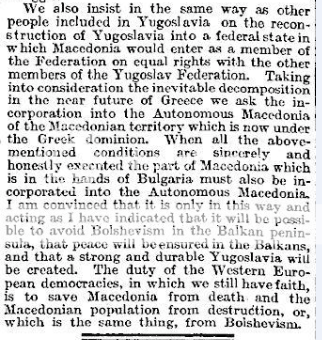
Even after denouncing this May Manifesto and 'Bolshevism', shortly before his death he was reported as saying the following, which was published after his death in The London Times, September 16, 1924:
We also insist in the same way as other people included in Yugoslavia on the reconstruction of Yugoslavia into a federal state in which Macedonia would enter as a member of the Federation on equal rights with the other members of the Yugoslav Federation. Taking into consideration the inevitable decomposition in the near future of Greece we ask the incorporation into the Autonomous Macedonia of the Macedonian territory which is now under the Greek dominion. When all the above-mentioned conditions are sincerely and honestly executed the part of Macedonia which is in the hands of Bulgaria must also be incorporated into the Autonomous Macedonia.
He was murdered on August 31, 1924.

I understand that he isn't free from criticism, but the above shouldn't be dismissed.


Below is the May Manifesto, quite an interesting document.

http://mk.wikisource.org/wiki/Мајски_манифест
До македонскиот народ, до организираното револуционерно население во Македонија и до македонските револуционери

Браќа Македонци!

Македонија, во своите природни географски граници меѓу реката Места, планините Родопи, Рила и Шар, реката Дрим, Охридското Езеро, планината Грамос, реката Бистрица и Егејското Море, со едно пространство од 65.000 кв. километра, пресечена од реките Места, Струма, Вардар, Дрим, Бистрица и надарена со најразнообразни природни богатства и благопријатни климатски услови; со своето 2.302.000 население, рознооброзно по својот етнографски состав, со својата централна економска и стратегиска положба на Балканите, меѓу басените на реката Дунав, Егејското и Јадранското Море - ги има сите услови и права за самостојно палитичко постоење, како независна држава што се управува самостојно, која ќе послужи како обединувачка, политкчка и економска алка меѓу народите и државите на Балканското Полуострово.

Вековните борби на македонското население против господството над неговата територија од страна на едно племе и тиранијата спроведувана спрема другите племиња што ја населуваат Македанија; отпорот што го покажа тоа спрема денационализаторската политика на државите што ја владееле Македонија или граничиле со неа; учеството на македонското население во сите востанија и револуционерни движења; содејството што беспрекидно, во сите војни на Балканите, им го даваше на земјите што се јавуваа да се борат во имета на ослобадувањето и самоопределувањето на балканските народи, - е најочигледниот доказ за правата и свеста на македонскиот народ да биде една самостојна политичка единица на Балканите.

Тргнувајќи и опирајќи се на таа свест, Внатрешната македонска револуционерна организација, ВМРО, во текот на цели десет летија, води најрешителна револуционерна борба за ослободувањето на Македонија. Таа борба, во зовисност од соодносот на факторите во меѓународната и балканската политика и етнографскиот состав во организацијата што преовладува, поставуваше различни тактички задачи и се ползуваше со различни средства.

Долго време македонскиот народ, верувајќи во ослободителните стремежи на великите европски сили и малнте балкански држави спрема Македонија, ги беше насочил своите погледи кон нив и го очекуваше своето ослободување преку нивна интервенција. Сообразно со тоа, ВМРО ја беше насочила целата своја дејност да го издигне гласот на страдалниот македонски роб до ушите на идните свои ослободители, да го привлече нивното внимание, да го предизвика нивното мешање, да го исползува натпреварувањето на нивната палитика и по тој начин да ја истргне слободата на Македонија. Примерот со создавањето на слободна Србија, Грција, Црна Гора и Бугарија беше привлечен и охрабрувачки. Сообразно со таа тактичка задача на македонската револуционерна борба беа и нејзините средства, во прв ред единичните и делумните удари, било против владетелската власт, било против туѓите интереси врзани со Македонија. Дури ни Илинденското востание, најголемото и најмасовното движење, не можеше да смета дека само ќе извојува слобода на Македонија, туку илаше цел да му го наложи на општоевропското јавно миелење и на меѓународната дипломација резрешувањето на македонското прашање.

За една вистинска револуционерна акција во голем масовен македонски или балкански размер, којашто би сметала само на себе за извојувањето на македонската слобода ни збор не можеше да стане.

Резултатите од европската интервенција по Илинденското востание, изразени во лицемерните реформи, насочени повеќе да го заздрават и закрепнат турското владеење над Македонија, отколку да ја родат нејзината слобода го разочараа македонскиот народ. Тоа разочарување ја засили струјата во редовите на ВМРО којашто, сметајќи на ослободителната мисија на младите балкански држави, ги насочуваше своите усилби да предизвика нивна воена интервенција. Балканската војна, која заврши со поделба на Македонија во Букурешт 1913 г., а по неа и општоевропската војна, со нејзините Париски договори кои го раскинаа живото тело на Македонија и го поделија меѓу балканските држави што ја окружуваа, дефинитивно ја убија верата на македонскиот народ во ослободителната мисија на интервенционистичката политика на големите европски и малите балкански држави. Берлинскиот (1878 г.), Букурешкиот (1913 г.) и Париските мировни договори од 1919 г. го убедија и најпоследниот неверен Тома, дека како големите, така и малите европски држави спроведуваат своја егоистичка политика, поради што слободата и постоењето на Македонија може да биде само монета за поткусуравање.

Од тоа произлегува дека од тие држави, додека се раководени од влади кои ја подржуваат завојувачката и империјалистичката политика на тие догавори, или, со други зборови, додека кај нив не се установат влади што ќе ја базираат својата надворешна и внатрешна политика врз вистинското самоопределување на народите, македонскиот народ не може да очекува никаква поткрепа за својата слобода.

Проценувајќи го основно тој историски опит, ВМРО доаѓа до цврстиот и конечен заклучок дека во својата револуционерна борба за слободата на Македонија, таа може да смета само на крајно прогресивно-револуцнонерните движења во Европа, кои се борат против империјалистичката политика на своите влади, против постојните мировни договори и за вистинско самоопределување на своите и туѓи народи.

Ете зошти ВМРО изјавува дека во интерес на македонската слобода ќе ја даде сета своја поткрепа само на оние што на балканска почва се борат против завојувачката политика на европскиот империјализам, спроведувана било директно било преку владите на балканските држави.

Но, владите на балканските држави не се јавуваат само како орудија на европскиот империјализам; тие спроведуваат и своја сопствена националистичка, завојуаачка политика. Благодарејќи на таа општоевропска империјалистичка и општобалканска националистичка завојувачка политика, Македанија, истоштена од петвековното ропство, разурната од три војни, денес одново е поробена и разделена помеѓу трите балкакски држави: Србнја, Грција и Бугарија.

Ниедна од владите на балканските држави не мисли за ослободувањето и обединувањето па раскинатите делови на Македонија; ниедна од нив не мисли и не дејствува за самоопределувањето на македонскиот народ во самостојна политичка единица; ниедна од нив не сака на поробените Македонци да им ги даде правата предвидени во договорите кои им го осигуруваат културниот развиток како национални малцинства. Поради тоа, ВМРО е принудена да изјави дека политиката на сите сегашни балкански влади е непријателска за слободното и самостојно палитичко постоење на Македонија и дека таа најрешително и со сите средстаа на револуционерната борба ќе се бори против нивната завојувачка политика спрема Македонија и македонскиот народ.

За да се избегне секакво недоразбирање и нејасност, ВМРО изјавува исто така дека таа не може да се дезинтересира за внатрешната и надворешната политика на балканските држави и особено на Србија, Грција и Бугарија кои владеат цели делови од територијата и населението на Македонија.

По однос на Грција ВМРО ќе се бори против секој обид за враќање на монархијата - најјаркиот израз на ултраимперијалистичката грчка политика - и против секоја грчка влада која ја подржува денешната делба на Македонија, го денационализира населението во грчка Македонија и насилно го изменува неговиот етнографски состав, протерувајќи го домородечкото население и заменувајќи го со грчки преселеници од Мала Азија и Тракија.

По однос на Југославија ВМРО најрешително ќе се бори против сите, без разлика на партија, белградски влади, кои ја крепат денешната српска политика на насилнички централизам, денационализација и угнетување не само на македонскиот народ, туку и на народите на Хрватска, Босна и Херцеговина, Црна Гора, Косово, Војводина, Словенија и Далмација; уште повеќе затоа што таа политика, поткрепена од некои европски држави, е насочена кон нови заграбувања на туѓи територии за сметка на Албанија, бугарска и грчка Македонија. ВМРО изјавува дека во внатрешните национални борби во Југославија таа решително застанува на страната на сите угнетени народности, што ќе се борат против белградските влади - за демократска децентрализација и федеративна реорганизација на Југославија.

По однос на Бугарија ВМРО изјавува дека и покрај сите жртви, што бугарскиот народ ги давал и е готов да ги даде за слободата и независноста на Македонија, денешната бугарска влада на Цанков, во расчекор со чувствата и интересите на својот народ, води една политика јавно антимакедонска и антибугарска, една политика јавно србофилска, која не само шта ја овековечува делбата на Македонија туку подготвува нови територијални прекројувања на Балканите за сметка на Македонија. ВМРО ги предупредува народите на Македонија, Југославија, Грција и Тракија, дека белградската влада, опрена на своите договори со некои европски држави за делбата на Хрватска, Албанија и Грција, се гатви да ја рашири својота завојувачка политика накај Солун, терајќи ја софиската влада кон Кавала, заплашувајќи ја, дека во противен случај ќе ги окупира бугарските градови Перник и Ќустендил.

И владата на Цанков, е изгледа, соблазнета од тие империјалистички перспективи, потшепнувани од белградските сирени. Таа се зафатила да ја уништи Внатрешната Македонска Револуционерна Организација и македонското револуционерно движење, кои се јавуваат како најсериозна пречка за остварувањето на тие престапни намери. Додека белградската влада ја подготвува и раздувува граѓанската војна во Албанија, софиската влада на Цанков се зафатила со уништувањето на ВМРО.

Затворањето на неколку статини Македонци во Бугарија, осомничени за учество или соучество во македонското ослободително движење; забранувањето на сите легални печатни органи на македонската емиграција во Бугарија, кои го заштитуваат ослабодителното дело на Македонија; готовноста на софиската влада да посегне и по највидните дејци на македонското ослободително движење за да ги затвори и предаде на Србија, очевидно како искупителна жртва на новиот курс на српската и бугарската завојувачка политика, се најпоследните и јарки дакази за престапната политика на софиската влада.

ВМРО го знае изворот на таа српска и бугарска политика. Слабоста на белградската влада внатре во земјата ја тера да ги жртвува интересите на хрватскиот народ во полза на Италија - Ријека и Јадранското приморје - и да бара компензација за сметка на Албанија, бугарска и грчка Македонија. А внатрешната слабост на софиската влада ја прави неспособна да им се противстави на белградските заплашувања и пред опасноста од окупирањето на Перник и Ќустендил од Србите таа е готова да оди на доброволно саработување со српската експанзионистичка политика накај Солун, надевајќи се дека самата ќе биде компензирана накај Кавала. На таков начин се жртвуваат не само интересите на Македонија и Тракија, туку во исто време се засегаат и интересите на Бугарија, Југославија и сите балкански народи.

Основната причина за слабоста на софиската влада е нејзината изолираност, откинатост од народните маси и непријателството од овие последниве кон неа. Борејќи се по секоја цена за запазување на власта во свои раце и не наоѓајќи никаква подршка во народот за да се противстави на српската завојувачка политика, таа се мачи, во соработка са неа, да ги отклони опасностите што висат над Бугарија, подбуцнувајќи ја последната кон нова авантура, само и само да спечали некој привремен успех со кој би ја зајакнала својата разнишана положба внатре во земјата. За таа цел таа ги жртвува како интересите на македонскиот така и интересите на бугарскиот народ. Таа е принудена да управува во внатрешната политика со терор, суспендирање на сите уставни гаранции; таа е принудена да ја суспендира слободата на говорот, печатот, соборите и здруженијата, да растура цели задружни организации и политички партии; таа е принудена дури да откажува прибежиште за палитичките бегалци на Македонија.

При таквата положба ВМРО изјавува дека политиката на владата на Цанков е непријателска спрема македонскиот и бугарскиот народ и апелира кон сите Македонци и Бугари да поведат најрешителна борба против неа.

Тие треба да и дадат своја поткрепа само на една таква влада во Бугарија која, опирајќи се врз широките трудбенички маси од градот и селото, не ќе има нужда од терор и исклучителни закони за своето управување, не ќе прибегнува кон суспендирање на суштествените гаранции за една вистински народна и демократска власт и која, опирајќи се врз довербата на масите на слободољубивиот, демократски и нешовинистички бугарски народ, ќе може да му ги даде неопходните средства за борба против завојувачката политика на соседните држави, без да се плаши дека тие средства ќе бидат свртени против неа.

Само во установувањето на една таква влада во Бугарија, ВМРО гледа гаранцнја и за понатамошниот успешен развој на својата револуционерна борба за слободата и независноста на Македонија и за политичката независност на сите балкански народи.

Зацртувајќи го во општи линии својот однос кон државните фактори на општоевропската и балканската политика, ВМРО изјавува дека таа се бори и ќе се бори со сите средства на револуционерната борба:

1. За ослободувањето и обединувањето на раскинатите делови на Македонија во една наполно независна и самостојна политичка единица, во нејзините природни, географски и етнографски граници;

2. За демократизирањето на соседните на Македонија балкански држави и нивното сојузување во една балканска федерација, која единствено може да го гарантира политичкото постоење на независна Македонија и независноста на другите балкански народи; да ги задоволи економските и културните интереси на сите балкански народи, сврзани со излегувањето на трите балкански мориња; да ги парализира анексионистичките стремежи на балканските и империјалистичките стремежи на големите европски држави; а исто така да го гарантира правилното разрешување на сите национални спорови, осигурувајќи го културниот развиток на сите етнички малцинства.

ВМРО изјавува дека во својата борба за независна Македонија и Балканската федерација смета, пред сe, на обединетите револуционерни сили на целото македонско население, без разлика на вера и народност, кои ќе ја поведат својата борба во тесна соработка со револуционерните сили на трудбеничките маси во другите балкански држави. Доколку пак успехот на нејзината ослободителна револуционерна борба зависи од меѓународната положба, ВМРО смета пред сe, на моралната и материјалната поткрепа од прогресивно-револуционерните движења во европските држави, кои се борат против империјалистичката политика на нивните влади, против создадените империјалистички мировни договори и за полното и вистинско самоопределување на народите.

На таков начин ВМРО прекинува конечно со илузиите да ја очекува слободата на Македонија и создавањето на Балканската федерација преку интервенцијата на балканските шовинистички и европски империјалистички влади.

Таа изјавува дека само оние држави и влади можат да претендираат да бидат искрени пријатели на македонската слобода и на балканските народи, кои со својата сопствена политика даваат даволно докази дека го следат и на дело го реализираат принципот за слободно самоопределување на народите. Сите други се непријатели на македонската слобода и против нивната политика на Балканот, ВМРО ќе води најрешителна борба.

ВМРО е свесна за релативната слабост на своите сили, но таа исто така добро знае дека цела Европа е минирана од противречја многу подлабоки и понепомирливи отколку оние што ја предизвикаа општоевропската војна во 1914 година. Една нова балканска и општоевропска војна или меѓународна граѓанска револуционерна борба за ослободување и самоопределување на народите е неминовна. Нешто повеќе, таа тропа веќе на портите на сите држави.

ВМРО ја сфаќа многу добро големата и решителна улога која Балканот ја одигра во избувнувањето на општоевропската војна од 1914-1918 г. Таа им обрнува внимание на сите Македонци и балкански револуционери дека и во идните борби кои бргу се приближуваат, Балканот може да изигра уште поголема и порешителна улога, доволно е само револуционерните усилби на сите угнетени балкански народи да бидат сплотени и обединети под знамето на македонската слобода и независност, под знамето на својата сопствена слобода и независност и најпосле под знамето на Балканската федерација.

И затоа ВМРО апелира кон сите свесни борци за слободата и независноста на балканските народи да ги сплотат своите сили за брзото формирање на еден единствен македонски револуционерен фронт, кој ќе послужи за образувањето на единетвен балкански револуционерен фронт против сите шовинисти, против сите анексионисти и империјалисти, против сите угнетувачи на своите и туѓи народи.

За да ги даде сите докази дека ја управува својата дејност по тој пат, ВМРО изјавува најсвечано дека ги прекратува сите потери и ги укинува снте екзекутивни мерки и наредби протнв одделните македонски дејци, групи, организации и струи, штом тие искрено ќе застанат врз базата на вистинската револуционерна борба, во духот на овој манифест и ќе подадат рака за општа борба под знамето на слободна и независна Македонија, под знамето на Балканската федерација.

Со тоа ВМРО го прави првиот и најрешителен чекор за создавањето на неопходната поволна атмосфера за свикување во скоро време на еден обединителен конгрес на целото македонско револуционерно движење, на кој преку усилбите на сите искрени македонски револуционери, ќе се создаде единствениот македонски револуционерен фронт кој, опирајќи се врз единствениот балкански револуционерен фронт, во тесна соработка со сите прогресивнореволуционерни движења на Балканите и во Европа, ќе ја извојува слободата и независноста на Македонија, ќе го наложи создавањето на Балканската федерација, ќе го осигури мирот на Балканот - за да го потпомогне востановувањето на мирот во цела Европа.

Сите напред во редовите на револуционерната македонска борба!

Да живее единствениот македонски револуционерен фронт!

Да живее единствениот балкански револуционерен фронт!.

Да живее обединета и независна Македонија!

Да живее Балканска федерација!

Виена, 15 мај 1924 г.
За ВМРО Централен комитет
А. Протогеров
П. Чаулев
За Т. Александров и по негово полномоштие потпишале:
П. Чаулев
А. Протогеров

 
It has been established that Todor Aleksandrov was at times a controversial figure in Macedonian history, so in this thread I would like to focus on some of the more positive statements he made. Below is a letter he sent to the newspaper known as 'Sloboda' in Skopje during Serbian occupation, 30th May 1924.
Во вашиот бесно-шовинистички весник се среќаваат, иако многу ретко, трезвени мисли, а понекогаш и драгоцени самопризнанија за ужасниот спрски режим во Македонија.......се изјаснувате против средствата за борба против четите на ВМРО предлагани од Вашиот белградски колега, и тоа: авиони, отровни гасови и др. слични.

Јасно им е на сите кои имаат барем малку ум во својата глава и кои можат да извлекуваат поука од животот и до историјата дека идејните ослободителни движења не можат да се уништуваат со жестокости, особено кога целото население – во дадени области е обземено од таква идеја, како што е случајот со Македонија, со Хрватска, со Црна Гора, со Косово и др. Некогашната голема турска империја неможеше да го убие борбениот дух на македонското население, ниту да ја уништи ВМРО, иако, на времето, ги употреби сите можни спредства за таа цел. И Велика Британија не можеше да ја задуши желбата на Ирците да живеат автономно туку ги задоволи.

Она што се покажа невозможно за великани, смешно е да се напнуваат да го прават џуџиња!

Недопустливо е Шумадинците, најнеморални на Балканот и со ниска култура, да држат под ропство, да ги наметнуваат со сила својата култура, својот јазик и да зборуваат за кревање на моралот во соседните несрпски народности.

Вие, Шумадинци-империјалисти, наместо да толчите вода во аван, органичете се да ја уредувате под свој вкус Шумадија, а оставете ги Македонците, Хрватите, Словенците, Црногорците, Албанците, Бошњаците и др. да си ги уредуваат своите области како што сакаат. Само на тој начин нема уште еднаш да потпалите нов светски пожар од кој тешко ќе се најдат безумни големи народи да ве спасуваат.


1)


"Писмо до Јован Јовичевиќ од септември 1923 г.", "Сè за Македонија"

"Почитуван господине,

Вашиот план за една југословенска федеративна република не само што не е необичаен туку и е многу разумен. Што има подобро од тоа - Црна Гора, Босна, Хрватска, Словенија, Банат, Србија, Македонија, Бугарија - да формираат една федеративна република. Така би се создала една голема држава од албанските планини до Црно Море и од Трст до Солун. Кон таа федерација доброволно и по потреба, би се присоединиле и Грција, и Албанија, па и Романија, иако несловенски земји, па таа би се проширила до општобалканска федерација. Ние особено сметаме на тоа бидејќи во Македонија, нашата татковина, освен Бугари, живеат и Грци, и Турци, и Албанци, и Власи, па кога таа ќе биде самоуправна политичка единица во федерацијата, ќе може да се уреди така за сите споменати народности да имаат исти и еднакви права.

Ние, македонските Бугари, многу страдавме и страдаме, та не сакаме ниту еден друг народ, колку и да е мал, да страда.

Меѓутоа, наивност е да се мисли дека кралот Александар и кликата околу него од офицери, политичари и професори ќе го прифатат доброволно Вашиот план. Тие, кои посегнаа подмолно врз независноста на јуначка Црна Гора која, единствена од христијанските земји на полуостровот, не ѝ се потчини на големата Отоманска Империја - тие империјалисти братоубијци никогаш доброволно нема да се откажат од своето владеење и од својот престапен пансрбизам..."


2)
Тодор Александров - "Мемоар од ЦК на ВМРО до Друштвото на народите од октомври 1922 г.", "Се за Македонија: Документи : 1919-1924", 2005 година

"Господине претседателе на Советот,

Македонија ги има следниве природни граници: на исток реката Места и планината Родопи; на север масивите на Рила планините Осогово, Скопска Црна Гора и Шар; на запад албанските планини и реката Црн Дрим, на југ река Бистрица и Егејско Море. Таа има население од 2.301.767 души, распределени вака: Бугари - 1.096.376 или 48% од целото население; Турци - 541.615 - 23%; Албанци - 184.315 - 8%; Власи - 77.365 -3.4%; Цигани - 43.370 -1,6%; Евреи и други етнички групи 106.360 - 5%.

Македонија е разделена меѓу Грција, Србија и Бугарија. Но таа поделба е сосема случајна и вештачка. Долните теченија на реките Места, Струма и Вардар, кои ги следат главните патишта што водат од континентот до морето, се наоѓаат во границите на Грција; нивните горни и средни теченија се во Бугарија и Србија. Оттука доаѓа и економското назадување на градовите во крајбрежните и во внатрешните области, кога ќе се додаде и немањето сигурност кое се должи на омразата што ги дели управувачите и управуваните, може да се разбере зошто мизеријата на населението се зголемува. Деведесет проценти од населението на Македонија, кое ги вклучува Бугарите, Турците, Албанците, Власите и Евреите, е против таа поделба од причини што ги изложивме погоре. Тоа се придружува енергично кон својот стар идеал, да се формира една независна Македонија, ставена под заштита на Друштвото на народите или на некоја сила ополномоштена од него. Во случај некој да се сомнева во желбата на македонското население, може да се пристапи кон плебисцит."


3)


Last edited:
Back
Top