• Welcome to the new Macedonian Truth Forum. All posts, members and private messages have been moved over from the old forum.

    Passwords from the old forum could not be carried over, so please use Forgot your password? to set a new one. The reset link is emailed to the address on your account.

  • Rules and Regulations at the forum of the Macedonian Truth Organisation (MTO)

    (1) The national-ethnic and cultural-linguistic identity of the Macedonian people is historically Macedonian, and derives its character from the native, indigenous and geographic homeland of the Macedonians, which is called Macedonia. To ensure that their human rights, integrity and heritage are appropriately respected, the only nouns and adjectives acceptable when reference is made to the above character and identity markers is Macedon, Macedonia, Macedonian and Macedonians.

    (2) The nation-state of the Macedonian people is the Republic of Macedonia, and is to be referred to by this official title so long as the 'republic' prefix is consistently applied to other states. Alternative references are the Macedonian Republic, or simply, Macedonia.

    (3) The 'ethnic' prefix is only acceptable for Macedonians in cases where differentiation is specifically required - so long as it is in context and consistent where it concerns its application to other ethnic groups.

    (4) Should any other differentiation be specifically required, the names of other ethnic groups that reside with Macedonians in either the Republic of Macedonia or the occupied Macedonian regions in Greece, Bulgaria, Serbia or Albania, are to be given a prefix.

    (5) Negating the identity, language and culture of the Macedonian people by deliberate avoidance of the terms Macedonia, Macedonian and Macedonians, or by any other means, is not permitted.

    (6) Systematic anti-Macedonian propaganda and rhetoric are not permitted.

    (7) Threads irrelevant to the Macedonian Cause, the community at the Macedonian Truth Organisation or the Macedonians in general may be considered as spam or not in the spirit of the forum. In such cases they are not permitted.

    (8) Continual posting of messages in threads with the sole purpose of deviating from the initial topics with the use of unrelated and unnecessary information is not permitted.

    (9) All posts, external articles, reports, etc that are cited in languages other than Macedonian or English, must be accompanied with a translation in one or both of the said languages.

    (10) Despite the possibility of some conversations and debates becoming heated, extreme abuse and/or racism, vulgar language and/or terminology, threats, revelation of personal information about others, harassment, and other such behavior will not be permitted. If deemed necessary all relevant information including member details will be reported to the appropriate authorities for investigation which may result in legal action.

    (11) Threads that are created must have a summary of a topic or excerpt of an article found in pertinent link(s) that have been included. One line threads will be considered unaccetable spam and are therefore not permitted.

    (12) Compulsive and deliberate lies, irrespective of the topic, are not permitted.

    (13) Any symbols or avatars found to be perceived as offensive to Macedonians are not permitted.

    (13) Any explicit or extreme material is not permitted.

    Failure to adhere to the above rules and regulations will result in a ban after 3 breaches. This may be reconsidered in some cases should the circumstances be of an unorthodox nature and/or require special consideration. To assure an effective deterrent against an individual or individuals with the sole purpose of causing dissent through spamming, racism or other improper means, the above rules will be strictly enforced.

    The MTO administration will monitor all discussions as reasonably practical and reserve the right to remove any post and/or member from the forum, and update the rules and regulations as required. Members are encouraged to immediately report any post and/or member to the MTO administration if they feel that these rules have not been abided by.

    The views expressed on this forum are those of the individuals. The only official representation of the MTO is made by the "Macedonian Truth Organisation (Site Owner)" username, and no other.

  • Macedonian Cause

    The Macedonian Truth Organisation calls on God in Heaven to protect, bless and guide the endeavour it is committing to undertake, and that is to work towards:

    Securing Macedonia as a free, independent and democratic republic in which sovereignty lies with the Macedonian citizens; as the nation-state of the Macedonian people in which they can preserve their culture, language and identity; as a state in which the Macedonian language and culture form the basis of public life and act as important unifying elements of Macedonian society; as the home of all its citizens to which it guarantees and obliges their inalienable natural rights and corresponding responsibilities;

    The acknowledgment as self-evident and irrefutable the existence of the:

    1) Indigenous, ethnonational name of Macedonia;
    2) Macedonian people, language and identity;
    3) Macedonian culture, symbols and folklore;
    4) Macedonian ancestry, heritage and history in its entirety; and
    5) Macedonian Orthodox Church;

    Securing recognition by the International Community of the tragedies endured by the Macedonian people, of the division of Macedonia with the signing of the Treaty of Bucharest on August 10, 1913, and the genocide committed against the Macedonian people at the hands of the Greek, Bulgarian and Serbian states and their respective churches during the 19th and 20th centuries;

    Ensuring that the Interim Accord is declared ‘null and void’ and that all constitutional provisions, acts, commitments, agreements, legislation, regulations, policies or programs emanating from, supporting or consequential to the Interim Accord are also declared ‘null and void’, including the use of any symbols and the completion of any acts imposed by, or originating from, the Interim Accord.

    Ensuring that the Framework Agreement is abolished and that all constitutional provisions, acts, commitments, agreements, legislation, regulations, policies and programs emanating from, supporting or consequential to the Framework Agreement are also abolished and replaced by a framework of constitutional and statutory law based on inalienable natural rights and corresponding responsibilities and universally codified human rights mechanisms.

    Securing the abolishment of any existing constitutional provisions, acts, agreements, legislation, regulations, policies and programs that discriminate against the Macedonian people, in any international organisation or any of the countries of the International Community where such constitutional provisions, acts, agreements, legislation, regulations, policies and programs exist, and thereby ensuring the freedom for Macedonians to exercise their inalienable natural rights and fulfil their corresponding responsibilities, and practice their culture, language and religious faiths in all the countries of the International Community without hindrance;

    The empowerment of Macedonians to undertake a moral revolution and to instil and/or reinvigorate within themselves a deep-rooted national, cultural, linguistic and historical dignity and a commitment to the exercise of freedom based on inalienable natural rights and corresponding responsibilities;

    The recognition of the Macedonian minorities in the neighbouring states of Macedonia as well as the respect for the inalienable rights and freedoms of the Macedonian minorities, as provided for by natural law and as codified by the United Nations Charter, the Universal Declaration of Human Rights and other universally codified human rights mechanisms;

    The full and unreserved respect of, and the support for, the rights of all people of non-Macedonian descent living in Macedonia and around the world, who share a reciprocal full and unreserved respect for the Macedonian people, their homeland and their state;

    The cultural unification and solidarity of the Macedonian people living in all parts of historical Macedonia and adjacent territories, as well as Macedonians throughout the world;

    The unity of all Macedonians on the principles, objectives and achievement of the Macedonian cause as defined by this declaration.

Who are the Slavs? - Citations and Sources

By Slavonic do you mean Gothic (Getic, Geats), Hunnic, Dacian, Sarmatian, Vandalic (Vindelician) or Scythian? Oddly enough, I just presented evidence left behind by a Macedonian writer who was alive and kicking during this "back then" Period of which you speak, an author who regarded himself as a Macedonian and who was regarded by others during his time as a Macedonian. Clearly, it will take one of the greatest feats in the history of engineering to get your head out of that place that it never should've gotten stuck in to begin with.

Quite fascinating, really, but in a deranged, uber-psychotic sort of way.
 
Do you know what the etymology of this Macedonian writer means ?

Correction, all the names you mentioned arent Slavs. Draguvites, Berzites, Ezerites, Mellingoi are Slav tribes.
 
Last edited:
Do you know what the etymology of this Macedonian writer means ?
Do you know what his real name was? Look up Voltaire or Mark Twain. I think you'll start to get the picture. Was Spartacus a Thracian name?

Half the tribes you mentioned are not considered Slavs.
This is because "Slavs" have never existed as anything but a figment of revisionist historians' imaginations and in the minds those who were forced to read their textbooks in school. Can you say Dacian? Do you refer to Modern Germans as "Krauts"? Do you lack such a complete disrespect for other people that you cannot even call them by the names they were truly known by?
 
Surely, Macedonians would have their real names etched in somewhere. Thracians did.

You're in denial, Its only your figment of imagination that they did not exist. I provided you a few Slavic tribes above as an example.
 
Onur,I didn't mention any Germanic tribes,Goths or Celts,I had only the Slavs in mind.I have watched the Terry Jones' Barbarians documentaries but I was interested in specifically how the hell could "tribes living in forest settlements and were far undeveloped than their other contemporaries" simply overtake half the territories of the contemporary mighty empires if they were indeed THAT primitive.That's all.Any thoughts?
 
Hm? The Macedonians were comprised of Thracians. Thank you Voltron, truly enlightening. Maybe there's hope for you yet.

And its already been demonstrated long ago that these people were Dacians. Go do a search on this site for Simocatta and Getae or Getai. It's a miracle you are still able to type given your, ah, contortionistically challenged condition.

Got to go
 
Sovius, do you have an issue of stating simple obvious terminology such as Byzantine Empire, Greek language ? Whats with all this Eastern Roman crap, Hell you even had SOM confused on what you were trying to say.
Voltron, you cannot force anyone to use the term invented by French Montesquieu in 18th century. As Sovious said, there was no such a thing as "Byzantines" when eastern Roman empire was intact and as i proved here in this forum by linking documents, even when the kingdom of Greece has been founded in 1829, the Rums of Istanbul including the patriarch was still calling themselves as Rums aka Romans.

Onur,I didn't mention any Germanic tribes,Goths or Celts,I had only the Slavs in mind.I have watched the Terry Jones' Barbarians documentaries but I was interested in specifically how the hell could "tribes living in forest settlements and were far undeveloped than their other contemporaries" simply overtake half the territories of the contemporary mighty empires if they were indeed THAT primitive.That's all.Any thoughts?
Thats an easy question to answer.

The key element is; these slavic tribes never confronted against Romans (east&west) all by themselves. They were always subjects [or allies] of other ruling elites. First of all, these slavic tribes has migrated to the Balkans, central Europe from today`s northern Ukraine during Avar empire`s reign, 500-800 AD. According to the eastern Roman chronicles, Turkic Avars thought warfare skills to them and they attacked Roman cities together.

If we take account Bulgarian empires, it was same. In the first Bulgarian empire, the ruling elite and the core of the army was the fugitive Bulgar Turks from Volga. In the second Bulgarian empire, ruling elite and the army was Turkic Cumans. Cumans was fugitives again because of ever increasing pressure from Mongols and their Tatar subjects. This is provable by the names of the ruling monarchies like Asens, Shismans.

For Romanians, it was Cumans again in 13-14th century, the monarchy of Basarabs (basaroba)

Magyar/Hungarian tribes also allied with local slavs when they settled in Pannonia.

Probably all these tribes, Slavs, Magyars and Turkic people had not much problem while creating their alliances because already their homelands was close to each other. Magyars in north of Blacksea, Slavs in further north and Turks in the east of them. Already these people was mobile, migrating around for finding fresh grass for their animals. They must have known each other even before all the migrations begun. They probably needed each other too, to be able to confront and defeat ~100.000 men strong Roman armies.

But we are not sure what happened after that stage. Maybe slavs was more populated than other tribes or maybe Romans baptized slavs first and supported them against the ruling pagan turkic elites or simply all the other tribes except slavs assimilated and disappeared among them.


Edit: I forgot to say;
We can guess how powerful was the slavic and turkic coalition in Avar empire from their siege of Constantinople. They failed to capture but they were the very first army who were able to reach to the walls of the city and it was the first ever siege of Constantinople anyway, in 626 AD. They formed an alliance with Persians from east and attacked together.

http://en.wikipedia.org/wiki/Siege_of_Constantinople_(626)
 
Last edited:
Still,I can't see how a people of "pagan beliefs",and "far behind other peoples" could simply come out of nowhere,invade vast territories of Europe and Asia and defeat such mighty empires like Byzantine,Hunnic,and even Chinese,and now populate some good 40% of Europe?Just by fighting with stones and wooden sticks?!If they were so retarded how could this happen?Is there something fishy about this or is it just me?:)
A critical misconception is that most changes took place due to the spread of a 'new' population rather than the more logical spread of a new socio-political order.
Sovius said:
The southern language group is regarded by researchers as being far more heterogenous, possessing way more dialectical variation than either the western or eastern branches. Just like genes, homogeneity (lack of broad variation across a given area) indicates that they are both younger than the southern languages.
The common linguistic process where the centre of origin continues to evolve while the periphery remains conservative. Certainly a convincing argument if the southern branch of Slavic languages has more dialectal diversity than both the western and eastern branches. Has it been determined which sub-group has the most dialects?
........it was largely your ancestors to the South who migrated North of the Danube to become my ancestors, as well.
When do you think this took place?
I believe that these two different terms developed in cultural isolation from one another in two very different ways, terms which then came to be erroneously treated as representing the same meanings much later in history.
I don't disagree that other meanings developed (those you suggested make sense), but I think terms such as Sklavenes, Sclavenes, etc are ultimately derived from the self-designation of Slovenski.
If a word does not carry the same meaning between languages then, by definition, they are not the same words, their apparent associations, then, being artificial in nature and grafted into interpretations that do not accurately reflect the past and, therefore, the present.
Depending on the period in question, sometimes 'Slav' can mean a speaker of a Slavic language, other times a resident of a rebel enclave. The confusion is unfortunate, and makes it necessary to provide a logical summary for the purpose of revealing the truth. I guess the only way this can be avoided is to use the original terms (Sloveni, Sklavenes, etc), but sometimes even they overlap, so this can also pose a problem. Each situation needs to be analysed, for example, the Slavs in the Peloponnese may simply have come from the Sklavinia in Macedonia rather than the Sclavenes beyond the Danube.
They wrote in the lingua franca of the Eastern Roman Empire (Greek), but would have used their native language around the house so to speak.
This was also the case in most commercial centres prior to Roman expansion. So I suppose the question would be, why didn't Slavic placenames appear earlier?
I'd be interested in learning a little more about the evidence you're using to base your views on a proposed linguistic transformation in the Balkans that would necessitate a re-classification of the languages spoken in the area if you have the time.
I don't think it requires a new classification overall, only in terms of sub-group classification. My perception on linguistic transition is largely based on comparison of placenames and personal names, before and after the 6th century. Changes probably had more to do with grammar than anything else. To give a specific example, Slavic suffixes such as 'ski' and 'ovo' appear lacking pre-6th century, whereas traditional case endings in Paleo-Balkan languages that conclude with '-s' are no longer present post-6th century (some of them are of course a result of Greek or Latin rendition, yet the same type of case endings are retained in the more conservative Baltic languages). By no means would I claim to have 'figured it all out', and I am open to other suggestions so long as they are supported by a measure of solid information and logic.
 
Has it been determined which sub-group has the most dialects?

I believe Macedonian leads the way among the southern group and Slovenian, which is the southernmost language spoken throughout the western group, which may be why its mistaken for a southern language, also possesses an incredible number of dialects. Mountains and the isolation they provide seem to foster the opposite effect of urbanization, where languages have the opportunity to become more homogenous due to population proximity and interaction.


When do you think this took place?

It looks like this migration followed the availability of livable land and climate change. Populations carrying the R1a mutation and other haplogroups look like they spent a good amount of time in the Middle East, Anatolia and Southern Europe during the last ice age and then simply moved North in different ways. Those among our ancestors who would eventually become classified as Indo-Iranians expanded East following the areas where their animals could graze and set up communities and established trade routes, eventually winding up in Iran and India. Those who stayed behind and those who remained in between continued to expand northward and westward. The evolution of what would nowadays be classified as an early form of the Baltic languages into what could be thought of as an early form of the Slovenian languages must have occurred as a result of the Neolithic Revolution in my opinion, as this follows the toponyms, not just the events that occurred in the Eastern Roman Empire during the early part of the Middle Ages, and allows for an admixture of the Baltic and Slovenian languages at the far point of Northwest Europe during the Iron Age. So, roads and routes, a quickening in the pace of life and a larger dispersal area brought about by roads and larger communities facilitated a less conservative version of what is now called Baltic and early systems of travel also allowed for a greater reach in terms of change in relation to where these changes originally first took place, along with new words, technologies and ideas. Folks living in more remote locations would have preserved more conservative suffixes and what not longer due to isolation. I don't think we're looking at a uniform spread into any area.

To truly answer this question, forensic climatologists are going to have to refine their understanding of the events that gave people the opportunity to move in the first place.


I don't disagree that other meanings developed (those you suggested make sense), but I think terms such as Sklavenes, Sclavenes, etc are ultimately derived from the self-designation of Slovenski.

It seems likely that Sklavene developed out of Sklabenoi and that Sklabenoi developed out of slovenski. The Sklabenoi were targeted for Slavery during the Roman occupation and, therefore, the association between slave and slovenski remains logical. What people shouldn't loose sight of is the fact that we're still around and that Rome is now largely populated by the descendents of the people they enslaved, not by descendents of the Romans themselves, which tends to occur over the generations when you're outnumbered 5 to 1. They paid a huge price for their ill gotten gains in terms of the Darwinistic struggle.


Depending on the period in question, sometimes 'Slav' can mean a speaker of a Slavic language, other times a resident of a rebel enclave. The confusion is unfortunate, and makes it necessary to provide a logical summary for the purpose of revealing the truth. I guess the only way this can be avoided is to use the original terms (Sloveni, Sklavenes, etc), but sometimes even they overlap, so this can also pose a problem. Each situation needs to be analysed, for example, the Slavs in the Peloponnese may simply have come from the Sklavinia in Macedonia rather than the Sclavenes beyond the Danube.


Defining things before trying to refine our understanding of the past would go a long way and is now more important than ever when attempting to communicate complex ideas or even to refine our understanding of simple events.

This was also the case in most commercial centres prior to Roman expansion. So I suppose the question would be, why didn't Slavic placenames appear earlier?


Or, conversely, why did people in the area favor using intranyms instead of exonyms when recording place names during this period?

Why did Bylazora (belo zora, a place where the dawn is white), a Slovenian place name and an indigenous place name in use during the Afro-Asiatic colonization of the southern Balkan region, appear alongside Astraion, meaning starry in the Greek language, an exonym, during a later period? They were both Paeonian place names. Why would settlers who were supposedly of Dacian descent call Strymon Strumica and not Slav Land? The familiarity of writers with what they were writing about must have been greater than Western Roman chroniclers' knowledge about who they were conquering and the actually names of places that were already in use further off the radar than a place of greater renown like Bylazora.

I don't think it requires a new classification overall

I don't see this is a re-classification, because, by definition, in my view, we're discussing a misclassification. The written record would specifically state, in my opinion, that Illyrians no longer spoke an Illyrian language, but a Dacian, Sarmation or Gothic language. They don't, so all these books and PhD papers and every single piece of filth that comes out of the mouth of the Greek government regarding Macedonia's early history is based on a false postulation, an illusion that's still lodged in people's brains for the betterment of Germanic and Russian expansion. Alexander the Great spoke in the tongue of the common people, but he was not a Slav. I don't see any evidence of ethno-genesis that historians like Curta are promoting. It's still retrofitting the past to conform to present day views.


During the Renaissance Period, people didn't seem to think these economizations towards what could be viewed as more informal forms and any other changes warranted a reclassification away from Illyrian to Slavic. I believe the branch is dependent on the trunk. It’s the root and not the leaf that truly defines what something is or isn't. Suffix use changes much more rapidly or, should I say, rapidiously, than the roots of words. Slavic and Baltic are by no means the same language. I don't think the same could be said of Macedonian and Dacian, not to the point that researchers would have been warranted to put that divider in place.
 
I don't see this is a re-classification, because, by definition, in my view, we're discussing a misclassification. The written record would specifically state, in my opinion, that Illyrians no longer spoke an Illyrian language, but a Dacian, Sarmation or Gothic language. They don't, so all these books and PhD papers and every single piece of filth that comes out of the mouth of the Greek government regarding Macedonia's early history is based on a false postulation, an illusion that's still lodged in people's brains for the betterment of Germanic and Russian expansion. Alexander the Great spoke in the tongue of the common people, but he was not a Slav. I don't see any evidence of ethno-genesis that historians like Curta are promoting. It's still retrofitting the past to conform to present day views.

Sovius, what exactly do you have that all these "postulates" dont ?
On the flip side I can say that all your illusions are based on the Bulgarian and subsequent Russian expanionist desires to have access to the Aegean Sea. Stick with the Slav topic and leave the rest to the experts.
 
Sovius, what exactly do you have that all these "postulates" dont ?
Honesty and common sense backed by historical information (evidence), which is indisputable if one was honest to admit, and not be a lying delusional character.

On the flip side I can say that all your illusions are based on the Bulgarian and subsequent Russian expanionist desires to have access to the Aegean Sea.
Speaking of delusional characters, Can you also hallucinate evidence to this claim? Or was it just a useless claim that has no meaning and only said because there was nothing else to reply (you know...playing with your self).
 
Sovius, what exactly do you have that all these "postulates" dont ?
On the flip side I can say that all your illusions are based on the Bulgarian and subsequent Russian expanionist desires to have access to the Aegean Sea. Stick with the Slav topic and leave the rest to the experts.

Thanks Bill


Look chipmunk brain. Most people's DNA in the Balkans is upstream from people who continue to live North of the Danube river. Most history books and anthropological textbooks based on interpretative models developed during the 19th Century concerning Central, Southeastern, and Eastern Europe are based on the outdated ideas of migration and population replacement. Population genetics has nothing to do with taking land away from what can be anthropologically defined as Greater Albania. Whoever conquers Greece next takes on Greece's debt. I think you'll be safe for a few millennia. The postulated 6th Century migration of a people known as the Slavs couldn't have happened. So, we have all these theories, ideas, research and speculation based on something that didn't happen and I ask you, what would Aristotle do? What would a scientist, student or scholar faced with such overwhelming evidence conclude? You speak of me, instead of we.
 
Sovius said:
It seems likely that Sklavene developed out of Sklabenoi and that Sklabenoi developed out of slovenski.

Don't you have the word order wrong, and the spelling of these terms all wrong? I think that SoM and Slovak should go back to the original sources in their original Greek, and so should you.

What is 'a Slav'? Its not an ethnic group, its not a nationality, and before the Western Europeans coined the phrase to mean 'language', it wasn't even a language. So what is it? Ask the ancient Thracians and they won't have a clue, because it wasn't coined yet. It means whatever you want it to mean! Thats the magic of it. Slovak and SoM toss the term 'Slav' around like its a salad.

Honestly the semantic drivel has to stop - a bunch of vague semantic resemblances of people, places and events as varied and as unconnected, as distant and as far apart as two things could possibly be, that have no historical or natural association or connection, except within a highly hyperthetical scenario. What this means is that people like SoM, Slovak are making it up as they go! People, places, events, objects all being 'reconfigured' into one overarching 'slav' metanarrative - renamed in effect! What a gross distortion of the actual evidence, and the historical sources! How can anyone associate a ter 'Sklavoi' used to describe a 6th century invader (invader we know nothing about), and know what the author meant by it, and expect an 18th or 19th century historian to 'know' who the original historian was describing, what they spoke, that 'know' that when he used the term 'Sklavoi' he actually meant 'Slav' which has an entirely different meaning? All we have is a semantic resemblance. Its like saying 'Mars' the Roman God, has a historical connection to a chocolate bar of the same name in the 20th century, because the two words are the same and that somehow the chocolate bar must be connected to the ancient Roman God of antiquity. I mean come on. Is this history 101, or has someone forgotten basic scientific rules of inquiry and evidence? I wouldn't buy into the crap being floated around at the moment, because it is highly hyperthetical.
 
Last edited:
Don't you have the word order wrong, and the spelling of these terms all wrong? I think that SoM and Slovak should go back to the original sources in their original Greek.
The terms are correct and the same as those in the original sources.
It means whatever you want it to mean! Thats the magic of it.
Yep, it is 'magic', you've hit the nail on the head!
a bunch of vague semantic resemblances of people, places and events as varied and as unconnected, as distant and as far apart as two things could possibly be, that have no historical or natural association or connection......
I can see why it may look this way to someone like yourself who smokes 'magic' for a living, but to those who have actually taken the time to open a book and read it, things are much clearer.
Is this history 101, or has someone forgotten basic scientific rules of inquiry and evidence?
Pelister, you don't understand my arguments, your own arguments make no sense, and you wouldn't know the first thing about scientific approach. Go back to that knucklehead who disappeared from this forum and now disrespects me from elsewhere, and ask him to provide you something of substance - and when I say substance, I don't mean the 'magic' you've been smoking.
 
Honesty and common sense backed by historical information (evidence), which is indisputable if one was honest to admit, and not be a lying delusional character.

Well said, that is exactly how I see things myself.

Speaking of delusional characters, Can you also hallucinate evidence to this claim? Or was it just a useless claim that has no meaning and only said because there was nothing else to reply (you know).

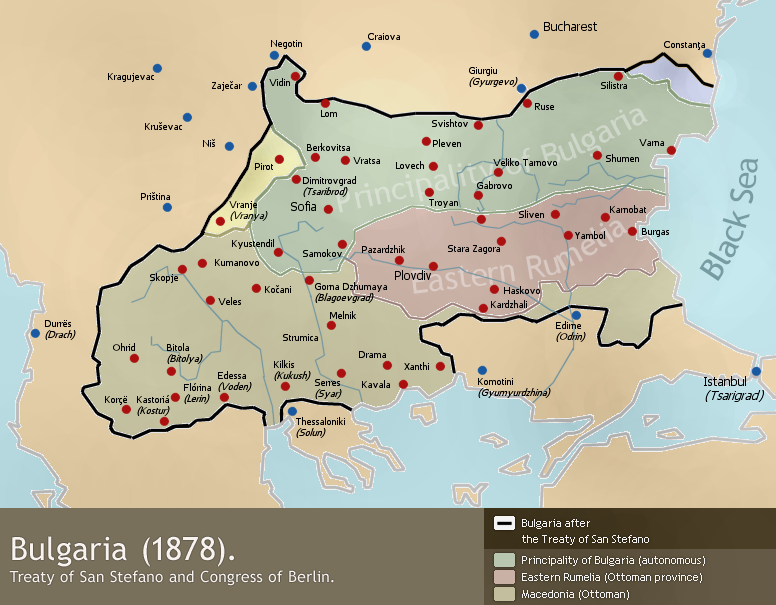
Bill, Sovius made an comment regarding the betterment of Russian and Germanic expansion. Which in turn resulted in my reply, I was referring to the Treaty of San Stefano.
Is this map a hallucination ?

Bulgaria-SanStefano_-%281878%29-byTodorBozhinov.png
 
Last edited:
Thanks Bill


Look chipmunk brain. Most people's DNA in the Balkans is upstream from people who continue to live North of the Danube river. Most history books and anthropological textbooks based on interpretative models developed during the 19th Century concerning Central, Southeastern, and Eastern Europe are based on the outdated ideas of migration and population replacement. Population genetics has nothing to do with taking land away from what can be anthropologically defined as Greater Albania. Whoever conquers Greece next takes on Greece's debt. I think you'll be safe for a few millennia. The postulated 6th Century migration of a people known as the Slavs couldn't have happened. So, we have all these theories, ideas, research and speculation based on something that didn't happen and I ask you, what would Aristotle do? What would a scientist, student or scholar faced with such overwhelming evidence conclude? You speak of me, instead of we.

There is absoultly no evidence whatsover that say a migration never happened. People move all the time, how the hell do you think the Turks ended up in Anatolia ? Just as the Turks move westward they absorbed the local inhabitants while the Turkish language and culture (somewhat) remained. We can use the same example with the Slavs, the futher north we go the stronger the Slav element. Further East we go the stronger Turkic element. Or is this to complicated for you ?
 
Voltron said:
There is absoultly no evidence whatsover that say a migration never happened. People move all the time, how the hell do you think the Turks ended up in Anatolia ?
Comparing the appearance of 'Slavs' to the arrival of Turks only highlights your deluded perception. You are not able to produce a shred of proof in support of a mass migration.
Sovius said:
I believe Macedonian leads the way among the southern group and Slovenian, which is the southernmost language spoken throughout the western group.........
I have read the same. Interesting how you classify Slovenian in the western group, I have also read about this too. Perhaps Zrinski can let us know if Croatian or Polish is easier for him to understand.
Or, conversely, why did people in the area favor using intranyms instead of exonyms when recording place names during this period?
I believe this may have been the case in some instances, but not in all of them. However, I would be happy to see some more examples if you're able to provide them.
Why did Bylazora (belo zora, a place where the dawn is white), a Slovenian place name and an indigenous place name in use during the Afro-Asiatic colonization of the southern Balkan region, appear alongside Astraion, meaning starry in the Greek language, an exonym, during a later period? They were both Paeonian place names.
Astraion was an exonym used in Greek for the main city of the Paeonian tribe of Astrai, which was later known as Strumica. From where did you obtain the 'starry' etymology of Astraion? In the case of Bylazora, it may have also been an exonym itself which differed little from the original endonym. The reason I say this is because even with a Greek transliteration, I am not sure how much that particular placename would change in appearance.
Why would settlers who were supposedly of Dacian descent call Strymon Strumica and not Slav Land?
I have always found it interesting how a supposed 'migrating' tribe came to be named after an indigenous hydronym. The Strumjani may very well have been one of those local rebel groups that sided with their distant kinsmen from the Danube against the (east) Roman Empire.
I don't see this is a re-classification, because, by definition, in my view, we're discussing a misclassification.
Multiple classifications are required if we are to account for all of the stages of development. The broadest and most important one needs to include all of the Paleo-Balkan and Balto-Slavic languages. This is in line with your comment below:
I believe the branch is dependent on the trunk. It’s the root and not the leaf that truly defines what something is or isn't.
The only problem is what to call this group. The term Illyrian doesn't quite cover all of the areas where these languages were spoken, nor does Thracian, Macedonian or Scythian. Once an appropriate name can be determined, for the sake of clarity each sub-group will also need an appropriate name. That is where terms like Slavic and Baltic (as the last living descendants of the broader group) come into the picture.
Suffix use changes much more rapidly or, should I say, rapidiously, than the roots of words. Slavic and Baltic are by no means the same language. I don't think the same could be said of Macedonian and Dacian, not to the point that researchers would have been warranted to put that divider in place.
I would think that some of the Paleo-Balkan suffixes were closer to Baltic than Slavic equivalents. In other cases, I would allow for the possibility of Greek and Latin renditions of Paleo-Balkan words that had no such suffixes. In any case, I would like to thank you for conveying your point of view in a sensible and logical manner. You've added another dimension to this discussion and it has been very insightful. I hope you can continue to contribute.
Pelister said:
I think that SoM and Slovak should go back to the original sources in their original Greek.
Just to follow up on this again, below is a text from Constantine Porphyrogenitus, who wrote during the middle of the 10th century. It relates to Dalmatia and how that region was lost by the Romans. On one page is the original Greek, on the other is the English translation. As you can clearly see, the term 'Sklav' is equated with 'Slav', and there is no doubt that the people being referred to as 'Slavs' in this instance were the ancestors of Dalmatian Croats.

 
To be honest I think polish is hard to understand for any slavic speaker except themselves;) I am probably not the right person to ask since I didn´t grow up speaking Slovenian. I have only learn some myself in the last years. Croatian is familiar to me since I have listened a lot to their music, so for me of course croatian is easier than polish. And I do understand more slovakian and czech than I do polish.
 
Back
Top