• Welcome to the new Macedonian Truth Forum. All posts, members and private messages have been moved over from the old forum.

    Passwords from the old forum could not be carried over, so please use Forgot your password? to set a new one. The reset link is emailed to the address on your account.

  • Rules and Regulations at the forum of the Macedonian Truth Organisation (MTO)

    (1) The national-ethnic and cultural-linguistic identity of the Macedonian people is historically Macedonian, and derives its character from the native, indigenous and geographic homeland of the Macedonians, which is called Macedonia. To ensure that their human rights, integrity and heritage are appropriately respected, the only nouns and adjectives acceptable when reference is made to the above character and identity markers is Macedon, Macedonia, Macedonian and Macedonians.

    (2) The nation-state of the Macedonian people is the Republic of Macedonia, and is to be referred to by this official title so long as the 'republic' prefix is consistently applied to other states. Alternative references are the Macedonian Republic, or simply, Macedonia.

    (3) The 'ethnic' prefix is only acceptable for Macedonians in cases where differentiation is specifically required - so long as it is in context and consistent where it concerns its application to other ethnic groups.

    (4) Should any other differentiation be specifically required, the names of other ethnic groups that reside with Macedonians in either the Republic of Macedonia or the occupied Macedonian regions in Greece, Bulgaria, Serbia or Albania, are to be given a prefix.

    (5) Negating the identity, language and culture of the Macedonian people by deliberate avoidance of the terms Macedonia, Macedonian and Macedonians, or by any other means, is not permitted.

    (6) Systematic anti-Macedonian propaganda and rhetoric are not permitted.

    (7) Threads irrelevant to the Macedonian Cause, the community at the Macedonian Truth Organisation or the Macedonians in general may be considered as spam or not in the spirit of the forum. In such cases they are not permitted.

    (8) Continual posting of messages in threads with the sole purpose of deviating from the initial topics with the use of unrelated and unnecessary information is not permitted.

    (9) All posts, external articles, reports, etc that are cited in languages other than Macedonian or English, must be accompanied with a translation in one or both of the said languages.

    (10) Despite the possibility of some conversations and debates becoming heated, extreme abuse and/or racism, vulgar language and/or terminology, threats, revelation of personal information about others, harassment, and other such behavior will not be permitted. If deemed necessary all relevant information including member details will be reported to the appropriate authorities for investigation which may result in legal action.

    (11) Threads that are created must have a summary of a topic or excerpt of an article found in pertinent link(s) that have been included. One line threads will be considered unaccetable spam and are therefore not permitted.

    (12) Compulsive and deliberate lies, irrespective of the topic, are not permitted.

    (13) Any symbols or avatars found to be perceived as offensive to Macedonians are not permitted.

    (13) Any explicit or extreme material is not permitted.

    Failure to adhere to the above rules and regulations will result in a ban after 3 breaches. This may be reconsidered in some cases should the circumstances be of an unorthodox nature and/or require special consideration. To assure an effective deterrent against an individual or individuals with the sole purpose of causing dissent through spamming, racism or other improper means, the above rules will be strictly enforced.

    The MTO administration will monitor all discussions as reasonably practical and reserve the right to remove any post and/or member from the forum, and update the rules and regulations as required. Members are encouraged to immediately report any post and/or member to the MTO administration if they feel that these rules have not been abided by.

    The views expressed on this forum are those of the individuals. The only official representation of the MTO is made by the "Macedonian Truth Organisation (Site Owner)" username, and no other.

  • Macedonian Cause

    The Macedonian Truth Organisation calls on God in Heaven to protect, bless and guide the endeavour it is committing to undertake, and that is to work towards:

    Securing Macedonia as a free, independent and democratic republic in which sovereignty lies with the Macedonian citizens; as the nation-state of the Macedonian people in which they can preserve their culture, language and identity; as a state in which the Macedonian language and culture form the basis of public life and act as important unifying elements of Macedonian society; as the home of all its citizens to which it guarantees and obliges their inalienable natural rights and corresponding responsibilities;

    The acknowledgment as self-evident and irrefutable the existence of the:

    1) Indigenous, ethnonational name of Macedonia;
    2) Macedonian people, language and identity;
    3) Macedonian culture, symbols and folklore;
    4) Macedonian ancestry, heritage and history in its entirety; and
    5) Macedonian Orthodox Church;

    Securing recognition by the International Community of the tragedies endured by the Macedonian people, of the division of Macedonia with the signing of the Treaty of Bucharest on August 10, 1913, and the genocide committed against the Macedonian people at the hands of the Greek, Bulgarian and Serbian states and their respective churches during the 19th and 20th centuries;

    Ensuring that the Interim Accord is declared ‘null and void’ and that all constitutional provisions, acts, commitments, agreements, legislation, regulations, policies or programs emanating from, supporting or consequential to the Interim Accord are also declared ‘null and void’, including the use of any symbols and the completion of any acts imposed by, or originating from, the Interim Accord.

    Ensuring that the Framework Agreement is abolished and that all constitutional provisions, acts, commitments, agreements, legislation, regulations, policies and programs emanating from, supporting or consequential to the Framework Agreement are also abolished and replaced by a framework of constitutional and statutory law based on inalienable natural rights and corresponding responsibilities and universally codified human rights mechanisms.

    Securing the abolishment of any existing constitutional provisions, acts, agreements, legislation, regulations, policies and programs that discriminate against the Macedonian people, in any international organisation or any of the countries of the International Community where such constitutional provisions, acts, agreements, legislation, regulations, policies and programs exist, and thereby ensuring the freedom for Macedonians to exercise their inalienable natural rights and fulfil their corresponding responsibilities, and practice their culture, language and religious faiths in all the countries of the International Community without hindrance;

    The empowerment of Macedonians to undertake a moral revolution and to instil and/or reinvigorate within themselves a deep-rooted national, cultural, linguistic and historical dignity and a commitment to the exercise of freedom based on inalienable natural rights and corresponding responsibilities;

    The recognition of the Macedonian minorities in the neighbouring states of Macedonia as well as the respect for the inalienable rights and freedoms of the Macedonian minorities, as provided for by natural law and as codified by the United Nations Charter, the Universal Declaration of Human Rights and other universally codified human rights mechanisms;

    The full and unreserved respect of, and the support for, the rights of all people of non-Macedonian descent living in Macedonia and around the world, who share a reciprocal full and unreserved respect for the Macedonian people, their homeland and their state;

    The cultural unification and solidarity of the Macedonian people living in all parts of historical Macedonia and adjacent territories, as well as Macedonians throughout the world;

    The unity of all Macedonians on the principles, objectives and achievement of the Macedonian cause as defined by this declaration.

Who are the Slavs? - Citations and Sources

If it is Risto then its for the wrong reasons. I see it as a knee jerk reaction to us Greeks that use the Slav subject in the context of the name dispute. It cant be just a coincidence that this anti-Slav thesis started shortly after the name dispute started.
 
It cant be just a coincidence that this anti-Slav thesis started shortly after the name dispute started.
It is completely a product of the Greek insistence on using Slav as a way of negating Macedonian's historical claim to Macedonia. You know that. It has been a silly approach because it has turned the spotlight back on Greece and the question marks about Greek continuity have never been so prominent as they have in the last 20 years.
 
If we accept the Macedonian language is in a grouping of languages, surely one of the outcomes of this dialogue can be to choose a name for this grouping. What do you think better describes this grouping?

Chronologically, 'sloveni' is the original term and all other terms are corruptions of this word form with the potential to distort perceived meaning. Using the English language 'Slovenian' word form allows us to create statements that provide for the separation of Macedonian separatists and Roman loyalists of Macedonian ethnicity, where the Sklavenes spoke a Slovenian language, as did loyalists, when they weren't busy formally communicating in Latin or Greek. The Macedonian Saints carried scriptures written in the tongue of the common people to Moravia. The modern Macedonian language is a Slovenian language that is classified as a Slavic language by Western European Anthropologists and historians, a term which often leads to confusing misinterpretations of early European history when used out of context. The Roman province of Achaea was invaded and occupied by a large number of Eastern Roman separatists and allied armies who are thought to have originated from North of the Danube river, who were referred to as Sklavenes by Eastern Roman loyalists. As you can see, I'm not really arguing for a drastic change in classification so much as an evolutionary step forward in the way we informally and formally communicate about the past and the present.

Now, you don't have to have to take one step forward, but I do, as the 'Slavic' word form can no longer be adequately used to explain events in European prehistory. If our ancestors weren't hanging out in the Swamps of Central Asia during the formation of European civilization, then using a term that originated during the 6th Century AD only leads to confusion when stepping back further in time. Anthropology is a science that seeks out a greater understanding of the past, not just the present moment. Because the 'Slav' term exists as a modern period generalization with derogatory connotations, it can't be used for truly meaningful communication in objective scholarship conducted in a language that originated in Western Europe. It, unfortunately, has to be de-Slavicized in order to account for the prehistoric co-existence of our ancestors among other populations in Europe and the formation of those other populations for the purposes of progressive research.
 
Associating Slavs with "Slaves" is just ridiculous. As if the Romans did not have other people in slavery. And isnt it amazing how a "Slave" group of people managed to spread their language through half of continental Europe, that must be a sign of their weakness.

To try and outright deny and accuse a western conspiracy of certain historical facts is a sign of insecurity on your part. I have noticed that it is always a small group of Macedonians that feel this way about the Slav ethnicity and language grouping. You wont find any other South Slav country denying the obvious.

If you dont like the term Slavic as a linguistic identifier then you might as well start learning Greek Sovius, you dont really have other options on the table.

Voltron make big words.
Slavius no understand.
 
I proposed the theory of preservation and spreading of the Proto-Slavic language by maintaining cultural and trade relations with specific groups of tribes inhabiting the banks of certain great European rivers like Danube, Sava, Morava, Prut, Dnieper, Dniester, Oder, Visla, Laba, Vardar and the coasts of the Aegean, Black, Adriatic, Ionic and Baltic seas with the centre being in the Danubian, Trypillian and Lusatian cultures.


Very interesting. Have you done any further work or research on this or published anything? etc
 
I think I finally understand Greeks, based on dwelling upon some of the points above.
Because various Slavic groups shared words, the Greeks want to round us up in one grouping and call us Slavs.

In a similar way, if some Arab (or possibly a Turk) strings together a couple of Hellenic remnants of words ... then they are Greek too. Notwithstanding that every other aspect of their ethnic character tells a different story.

If we "filthy slavs" (according to Greeks) used this approach, then it would have to be said unequivocally that the "filthy slavs" left far more of an impact on Europe and civilisation than the Greeks could ever dream of. Would any Greek care to disagree?

yes its very warped....actually when greeks insult their neighbours they are actually insulting themselves since they are a mixed lot with a greek formal culture....a hideous mask modern greece...the beast made gains in places but in other places its project was a failure(Anatolia, Cyprus etc)
 
the greeks themselves weren't immune to slavicism.The greeks weren't so pure they were as much eexpoused and influenced as the rest of the people in other countries.
 
i would say more of a direct fear of macedonian irrendist claims.Greece thinking along the same lines but wanting a bigger slice of macedonia do people know they have irrendist claims on paeonia.So their claim is equally met by their claims they have been doing it since 1913.
It seems to be ill founded as how can a small dfenceless country be a fear to them,it seems to be the fear of the truth rather than power play.They want the world to know that macedonia is greek & anything else is not worthy of being called macedonian.Sounds familiar.
 
Excerpt from "The Myth of Nations", Patrick J. Geary.

Pages 142–150:

If the Saxons had taken the place of the Franks and the Alamanni to the West, the Avars assumed the roles of the Goths and Huns to the east. This steppe confederation, fleeing the Turkic expansion in Central Asia, appeared in the Carpathian basin in 567 and in 558-559 sent an emissary to the Emperor Justinian, offering to fight against the Empire’s enemies in return for annual payments. In many fundamental ways they resembled other steppe peoples who appeared in Europe in the first millennium. These nomads developed a highly specialized form of survival, based on pastoralism, that allowed them to live in regions otherwise unsuitable for human settlement. Traveling hundreds of miles in seasonal migrations necessitated the development of complex forms of organization and communication. These ecological imperatives developed into characteristic forms of political and social organization. Mobility, flexibility, and mounted warfare were essential for survival. So, too, was the need to combine with other, similar groups and thus develop enormous steppe empires over a rapid period of time. We have already seen this in the short-lived Empire of Attila’s Huns. Where the Avars differed from their predecessors, however, was in their ability to transform themselves from just another steppe people into a fairly centralized and institutionalized, polyethnic kingdom between Byzantium and the western kingdoms that survived, in victory and defeat for 2.5 centuries.

The Avars achieved this feat because they managed to establish hegemony over the disparate peoples along the Balkan frontier of the Empire and to monopolize the name Avar to an extraordinary degree. For some twenty years, Baian, the ruler or khagan of the Avars, fought Utigurs, Antes, Gepids, and Slavs until he had created a large, polyethnic confederation. Following the departure of the Lombards, Baian firmly established his rule in Pannonia. In 582 he captured the old Illyrian capital of Sirmium. His sons felt strong enough to challenge Constantinople itself: In 626, a vast army, composed of Avar horsemen and Slavic ships, began an attack on the city coordinated with Persian allies. The siege lasted little more than a week and ended in an Avar defeat. Such a catastrophe might easily have meant the end of Avar hegemony. Indeed, some of the subject groups attempted to go their own way following the disaster, but the core held, although, although it was greatly diminished. A century later, Avar horsemen raided west into Bavaria and Italy until they finally met their superior in the person of Charlemagne. Charlemagne penetrated into the center of the Avar kingdom in modern Hungary, and destroyed the Avars’ ability to maintain their polyethnic confederation. Within a generation and without a major battle, the Avars vanished from history.

If the Avar confederation disappeared without leaving more than rich graves across eastern Austria and Hungary, it nevertheless played a fundamental role in the creation of the most important and enduring phenomenon of Eastern Europe: the rapid and thorough Slavicization of Central and Eastern Europe.

Between the fifth and seventh centuries, eastern portions of the area long considered Germania, as well as the Balkan and Black Sea provinces of the Empire from the Baltic to the Mediterranean came to be controlled by Slavs. This transformation took place without great fanfare, without tales of powerful kings like Attila, Theodoric, or Clovis; without heroic migrations or desperate battles. It was a process that left no written evidence from the Slavs themselves, and its internal dynamic was even less noted and understood by Byzantine and Latin observers than were the Germanic ethnogenesis processes of Western Europe. And yet the effects of Slavicization were far more profound.

In the west, barbarian federated troops absorbed Roman systems of government, religion, and settlement. They ultimately became thoroughly Roman, even while changing utterly what this term meant. The Slavic migrations did not adopt or build on Roman systems of taxation, agriculture, social organization, or politics. Their organization was not based on Roman models, and their leaders were not normally dependent on Roman gold for their success. Thus, their effect was far more thorough than anything that the Goths, the Franks, or the Saxons ever achieved. Almost everything about the early Slavs – their origins, their social and political structures, and their tremendous success – has been an enduring puzzle.

Scholars have long debated the “original home” of the Slavs. The question of origin is probably as meaningless to ask for the Slavs as for other barbarian peoples, formed as they were through amalgams of what Roman sources termed Scythian or Sarmatian and Germanic populations in the regions east of the Elbe, left behind the military elites who formed the Germanic armies moving toward the Empire. Recent scholarship has argued convincingly that the “birth” of the Slavs took place along the Byzantine frontier under the influence of Byzantine military and economic pressure, much as that of the Franks and the Alamanni along the Rhine had centuries before in the west. However, Slavic culture was much closer to the soil and more deeply attached to agriculture than the fast-moving Frankish and Alamannic armies that became Roman federates and, eventually, conquerors. With their light plows, small-scale agriculture, and small, individually organized social units, Slavs did not simply arrive as tax-collecting armies but as farmers who worked the lands they conquered.

For conquer they did. Their spread was slow but violent, followed by the absorption of indigenous populations into their linguistic and social structures. But this expansion was uncoordinated and radically decentralized. Into the high Middle Ages, Slavic language and material culture presented a remarkable unity across Eastern Europe, but this was in radical juxtaposition to an equally radical lack of indigenous political centralization. The sixth-century Byzantine historian Procopius described how they were “not ruled by one man, but they have lived from old under a democracy, and consequently everything which involves their welfare, whether for good or for ill, is referred to the people.” This decentralization was perhaps the key to their success: Without kings or large-scale chieftains to bribe into cooperation or to defeat and force into service, the Byzantine Empire had little hope of either destroying or co-opting them into the imperial system.

Gradually, across the seventh century, Slavic warrior-settlers moved across the Danube and into the Balkans. The chronology is unclear and necessarily so: The process was so decentralized and fluid that it could hardly be dated or documented. Individual reversals at the hands of Byzantine counteroffensives could not stop such a widespread process. Nor did conquest simply mean transfer of tax revenues, as it had for the victims of Germanic conquest two centuries before: Slavs either killed the soldiers they captured or sold them for ransom. Those who remained faced flight or absorption into the Slavic peasantry. In this society of soldier-farmers, there were no other options.

When large-scale, hierarchical organization of Slavic groups did take place, it was almost inevitably done according to leadership structures introduced from outside. These might be Germanic or Central Asian leaders, whose model of ethnogenesis provided the possibility of greater concentration of power and greater subordination of individuals and groups. Fundamental to this process were the Avars.

The Slavicization of a wide band from the Elbe to the lower Danube was already well underway before the arrival of the Avars. The Avars settlement may have increased the Slavic pressure against the Byzantine frontier, as Slavic bands fled this new steppe Empire. This may explain the early Slavic invasions of the Greek peninsula in the latter half of the sixth century, soon to be followed by Slavic armies under Avar command. Others were absorbed into it and became a permanent fixture within the Avar kingdom. The Avars demanded winter quarters from their Slavs, requisitioning horses, supplies, and women from them, as needed. In times of war, they used tributary Slavs as infantry and, during the siege of Constantinople, as a navy. However, they seem to have also been prepared to treat some of their Slavic communities with more restraint, offering gifts to their headmen in return for troops and support. Byzantine chroniclers described the Slavs as the oppressed subjects of the Avars; Western observers described the Avars and Slavs as allies rather than as rulers and ruled. Both were probably correct.

Avar political and military structures provided the context for the ethnogenesis of specific Slavic groups. In the early seventh century, probably in the aftermath of the debacle before the walls of Constantinople in 626, considerable portions of the Avar periphery revolted, carving out autonomous polities between the Avar kaganate – to the west, the Franks; to the east, Byzantium.

In the region that is now probably the Czech Republic, a Frank, Samo, organized a band of mixed-parentage Slavs who had rebelled against the Avars into a formidable union. According to a Western source, the Slavs elected Samo king, and he ruled a Slavic kingdom for over thirty-five years. The hiving off of Samo’s Slavs from the Avar confederation following the Avar failure to capture Constantinople in 626 was probably only one of several such revolts against the defeated Avar Kagan.

The various groups known in the tenth century as Croats and Serbs probably had their origins in this same period of internal crisis in the kaganate. The early history of the Croats is impossible to disentangle entirely and is based almost entirely on the account of the Byzantine emperor Constantine Porphyrogenitus (905-959). Constantine wrote a treatise for his successors on how to administer the Empire that paid particular attention to the Empire’s Slavic neighbors. He drew both on contemporary experience and on now-lost materials in imperial archives going back centuries, but it is impossible to know exactly how dated, or indeed how accurate anything that he says really is. Constantine speaks of two groups of Croatians, those he calls the “White” Croats living near the Franks and the Croats in Dalmatia. He provides a mythical genealogy according to which once upon a time the Croats lived “beyond Bavaria” but a family of five brothers and two sisters split off from them, led their people to Dalmatia, where they defeated the Avars and then further divided into different groups. Actually, the Croatian name appears in various areas of the periphery of the former Avar kaganate, in what is modern Germany, the Czech Republic, Austria, Moravia, Slovenia, and Greece, as well as in modern Croatia. Attempts to establish proof of some ethnic unity for all these groups, perhaps predating the arrival of the Avars, has proven impossible.

Certainly, the term Croat does not appear in any source from before the middle of the ninth century as the designation of a people or tribe. The term Croat probably originally designated either a social stratum or was the title of a regional office within the kaganate. Such an explanation would explain why this term, which is not a Slavic word, might eventually designate a Slavic “people” without having to imagine that there had once upon a time been a non-Slavic Croatian people. It also accounts for the appearance of “Croats” on opposite ends of the kaganate without having to imagine great migrations or a family of brothers, each of whom establishes a different part of a Croatian people. Probably, in the course of the eighth and ninth centuries, these breakaway groups, identified as “Croat” by their leadership or organization in the Avar kingdom, gradually coalesced into separate polities with invented ethnic identity and a fanciful genealogy.

Just as Constantine posits a people known as the “White” Croats related to the Croats of Dalmatia, he tells of Serbian origins in a people known as “White” Serbs living beyond the land of the Huns, bordering the Frankish kingdom and White Croatia. Again he reports a genealogical legend: Two brothers take half the people and request protection from Emperor Heraclius. The emperor then settles these Serbs in the province of Thessaloniki. Later, they decide to return to their homeland, and when they ask permission of Heraclius’s commander at Beograd, they are given land in what is now Serbia. This legend, like that of the Croats, places the origins of the Serbs in the period of the Avar debacle before Constantinople, explains the presence of Serbs on distant ends of the Avar kingdom, and accounts for the emergence of a new “people” who carry another non-Slavic name in the Balkans. Rather than mining the legend for historical evidence on the origins of the Serbs, it should probably be seen as part of the rapid centrifugal forces tearing at the Avar kaganate following its defeat.

A similar origin can be seen for the Bulgars. Romans had encountered peoples of this name since the fifth century around the Black Sea. They, along with other –gur– named groups, such as the Kutrigurs, the Onogurs, and the Ogurs belonged, in Roman eyes, to the Huns, that is, to Central Asian steppe warriors. In the aftermath of 626, however, rebels against the Kagan are regularly called Bulgars. Again, as in the case of Croats, the diversity of the Bulgars is explained later in the legend of five brothers, the sons of the Onogur Kuvrat who revolted in the 630s, threw off Avar control, and united the Bulgars around the Black Sea. At the same time, Bulgar refugees from an unsuccessful revolt in the western regions of the kingdom fled to Bavaria, where they were first welcomed by the Frankish King Dagobert and then, after being dispersed for the winter, set upon, and killed by royal orders. In the following generation, a Bulgar leader, Kuver, revolted against the Avars and led a mixed population of descendants of Roman prisoners who had been settled in the Avar kingdom fifty years previously south to Thessaloniki. Possibly in the seventh century the names Kuvrat, Kuver, and Croat may all have originated in a title and only came in time to designate individuals or peoples. In any case, none of these groups – be it Samo’s kingdom, the Croats, or the Bulgars of Kuver – were pre-existing peoples revolting against Avar lordship. Rather, they were peoples in the making, forming in opposition to the Avars, but organized in some way according to institutions of principles taken from their lords.

Over the course of the following centuries these groups, whose non-Slavic names may be derived from Avar titles, developed from political units, created in opposition to their Avar masters, into “peoples,” complete with genealogically informed origin myths that explained their origins in ethnic terms rather than in terms of political organization.

By the early eighth century, then, political rather than ethnic identities characterized populations in what had once been the Roman Empire.
 
Last edited:
"The Entry of the Slavs Into Christendom: An Introduction to the Medieval.." - By A. P. Vlasto.

http://books.google.ca/books?id=fpV...4Q6AEwAA#v=onepage&q=Slavs in Aetolia&f=false

Page 8:

"The density of Slav settlements in Greece was also far from even; study of Slav place names suggests that the western parts both of peninsular Greece and of the Peloponnese received or retained a denser Slav population than the eastern. Over 500 Slav place names are still identifiable in the area Epirus-Acarnania-Aetolia, only some 300 in the larger area Thessaly-Attica. Similarly in the Peloponnese there are about three times as many Slav place names in the western as in the eastern half (Argolis, Laconia). As is to be expected, the absolute figure for Macedonia is very high indeed."
 
The greeks are slavs too just as anyone in the balkan area.Just because the greeks speak greek it doesn't make them greek.The labelling of macedonians as just slavs is a fallsehood.
Those that hate us call us slavs & all sorts of names to smear us to tell us we are not macedonians .Hence the greeks claim to be the macedonians.
 
Here is a book called "Byzantine sources for the history of the peoples of Yugoslavia" - http://archive.org/stream/Byzantine...lavia/bulgaria_slavs-SAN1955#page/n0/mode/2up

I'm not endorsing it. I am using SoM's first posting on this topic as to find and gather all the info here.
Hi TrueMacedonian,

I don't know who uploaded those pages on the archive.org site, but they certainly messed up.
They are not part of the book "Byzantine sources for the history of the peoples of Yugoslavia"

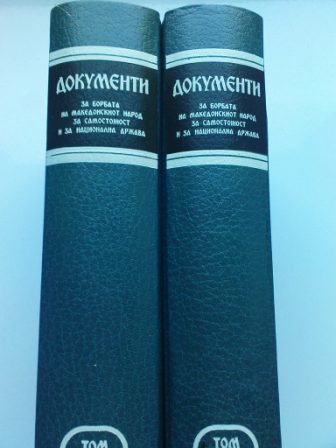
All of these pages actually comprise a chapter in the english translation of the Macedonian book titled:
"Документи за борбата на македонскиот народ за самостојност и за национална држава", Том први, Од населувањето на Словените во Македонија до крајот на првата светска војна, Скопје, 1981 г.

9034600_orig.jpg


This book was a joined publication of the:
Филозофски факултет, група за историја
and
Институт за национална историја

The chapter is the first chapter of the book, and its original title is:
Населувањето на Словените во Македонија и создавањето на Склавиниите (VI - средината на IX век)

Here's the first page from the original, that matches the first page in the link you provided

9zyg.jpg

Fala Sarlo.
 
Back
Top