• Welcome to the new Macedonian Truth Forum. All posts, members and private messages have been moved over from the old forum.

    Passwords from the old forum could not be carried over, so please use Forgot your password? to set a new one. The reset link is emailed to the address on your account.

  • Rules and Regulations at the forum of the Macedonian Truth Organisation (MTO)

    (1) The national-ethnic and cultural-linguistic identity of the Macedonian people is historically Macedonian, and derives its character from the native, indigenous and geographic homeland of the Macedonians, which is called Macedonia. To ensure that their human rights, integrity and heritage are appropriately respected, the only nouns and adjectives acceptable when reference is made to the above character and identity markers is Macedon, Macedonia, Macedonian and Macedonians.

    (2) The nation-state of the Macedonian people is the Republic of Macedonia, and is to be referred to by this official title so long as the 'republic' prefix is consistently applied to other states. Alternative references are the Macedonian Republic, or simply, Macedonia.

    (3) The 'ethnic' prefix is only acceptable for Macedonians in cases where differentiation is specifically required - so long as it is in context and consistent where it concerns its application to other ethnic groups.

    (4) Should any other differentiation be specifically required, the names of other ethnic groups that reside with Macedonians in either the Republic of Macedonia or the occupied Macedonian regions in Greece, Bulgaria, Serbia or Albania, are to be given a prefix.

    (5) Negating the identity, language and culture of the Macedonian people by deliberate avoidance of the terms Macedonia, Macedonian and Macedonians, or by any other means, is not permitted.

    (6) Systematic anti-Macedonian propaganda and rhetoric are not permitted.

    (7) Threads irrelevant to the Macedonian Cause, the community at the Macedonian Truth Organisation or the Macedonians in general may be considered as spam or not in the spirit of the forum. In such cases they are not permitted.

    (8) Continual posting of messages in threads with the sole purpose of deviating from the initial topics with the use of unrelated and unnecessary information is not permitted.

    (9) All posts, external articles, reports, etc that are cited in languages other than Macedonian or English, must be accompanied with a translation in one or both of the said languages.

    (10) Despite the possibility of some conversations and debates becoming heated, extreme abuse and/or racism, vulgar language and/or terminology, threats, revelation of personal information about others, harassment, and other such behavior will not be permitted. If deemed necessary all relevant information including member details will be reported to the appropriate authorities for investigation which may result in legal action.

    (11) Threads that are created must have a summary of a topic or excerpt of an article found in pertinent link(s) that have been included. One line threads will be considered unaccetable spam and are therefore not permitted.

    (12) Compulsive and deliberate lies, irrespective of the topic, are not permitted.

    (13) Any symbols or avatars found to be perceived as offensive to Macedonians are not permitted.

    (13) Any explicit or extreme material is not permitted.

    Failure to adhere to the above rules and regulations will result in a ban after 3 breaches. This may be reconsidered in some cases should the circumstances be of an unorthodox nature and/or require special consideration. To assure an effective deterrent against an individual or individuals with the sole purpose of causing dissent through spamming, racism or other improper means, the above rules will be strictly enforced.

    The MTO administration will monitor all discussions as reasonably practical and reserve the right to remove any post and/or member from the forum, and update the rules and regulations as required. Members are encouraged to immediately report any post and/or member to the MTO administration if they feel that these rules have not been abided by.

    The views expressed on this forum are those of the individuals. The only official representation of the MTO is made by the "Macedonian Truth Organisation (Site Owner)" username, and no other.

  • Macedonian Cause

    The Macedonian Truth Organisation calls on God in Heaven to protect, bless and guide the endeavour it is committing to undertake, and that is to work towards:

    Securing Macedonia as a free, independent and democratic republic in which sovereignty lies with the Macedonian citizens; as the nation-state of the Macedonian people in which they can preserve their culture, language and identity; as a state in which the Macedonian language and culture form the basis of public life and act as important unifying elements of Macedonian society; as the home of all its citizens to which it guarantees and obliges their inalienable natural rights and corresponding responsibilities;

    The acknowledgment as self-evident and irrefutable the existence of the:

    1) Indigenous, ethnonational name of Macedonia;
    2) Macedonian people, language and identity;
    3) Macedonian culture, symbols and folklore;
    4) Macedonian ancestry, heritage and history in its entirety; and
    5) Macedonian Orthodox Church;

    Securing recognition by the International Community of the tragedies endured by the Macedonian people, of the division of Macedonia with the signing of the Treaty of Bucharest on August 10, 1913, and the genocide committed against the Macedonian people at the hands of the Greek, Bulgarian and Serbian states and their respective churches during the 19th and 20th centuries;

    Ensuring that the Interim Accord is declared ‘null and void’ and that all constitutional provisions, acts, commitments, agreements, legislation, regulations, policies or programs emanating from, supporting or consequential to the Interim Accord are also declared ‘null and void’, including the use of any symbols and the completion of any acts imposed by, or originating from, the Interim Accord.

    Ensuring that the Framework Agreement is abolished and that all constitutional provisions, acts, commitments, agreements, legislation, regulations, policies and programs emanating from, supporting or consequential to the Framework Agreement are also abolished and replaced by a framework of constitutional and statutory law based on inalienable natural rights and corresponding responsibilities and universally codified human rights mechanisms.

    Securing the abolishment of any existing constitutional provisions, acts, agreements, legislation, regulations, policies and programs that discriminate against the Macedonian people, in any international organisation or any of the countries of the International Community where such constitutional provisions, acts, agreements, legislation, regulations, policies and programs exist, and thereby ensuring the freedom for Macedonians to exercise their inalienable natural rights and fulfil their corresponding responsibilities, and practice their culture, language and religious faiths in all the countries of the International Community without hindrance;

    The empowerment of Macedonians to undertake a moral revolution and to instil and/or reinvigorate within themselves a deep-rooted national, cultural, linguistic and historical dignity and a commitment to the exercise of freedom based on inalienable natural rights and corresponding responsibilities;

    The recognition of the Macedonian minorities in the neighbouring states of Macedonia as well as the respect for the inalienable rights and freedoms of the Macedonian minorities, as provided for by natural law and as codified by the United Nations Charter, the Universal Declaration of Human Rights and other universally codified human rights mechanisms;

    The full and unreserved respect of, and the support for, the rights of all people of non-Macedonian descent living in Macedonia and around the world, who share a reciprocal full and unreserved respect for the Macedonian people, their homeland and their state;

    The cultural unification and solidarity of the Macedonian people living in all parts of historical Macedonia and adjacent territories, as well as Macedonians throughout the world;

    The unity of all Macedonians on the principles, objectives and achievement of the Macedonian cause as defined by this declaration.

Do Ancient Greeks have African Origins?

So there is no clear recipe for the archetypal Hellene against which the non-Hellene can be measured and weighed. Both descriptors must have changed over time and space, in reaction to different stimuli. As a category, "Hellene" (like "Phoenician") is unstable, variously applying some combination of cultural behaviors, kinship ties and general genealogical ties, quasi-national identity, intra-Hellenic identity, and so on, depending on context. Inclusion or exclusion as a Hellene is not necessarily located in clear-cut difference or absolute otherness. Rather, difference was probably located within categories of what was apparently the same. Likewise, cultural conjunctions "serve to underscore, not to undermine" cultural distinctiveness.
 
Excerpts from Hellenicity by Jonathan Hall (2005)

http://books.google.ca/books?id=F4A...a=X&ei=GcnYUOSPKq6G0QHO-4GQDA&ved=0CDwQ6AEwAQ

Ethnic Identity in Greek Antiquity

http://books.google.ca/books?id=jJB...a=X&ei=GcnYUOSPKq6G0QHO-4GQDA&ved=0CDYQ6AEwAA


"Although the Greeks themselves believed in polygenetic origins within
the Balkan peninsula in Greece, the discovery of the Indo-European
language group prompted scholars to view Greek speakers as immigrants
from an original Indo-European homeland. Furthermore, the fact that
Greek civilization is known predominantly—and, prior to the emergence
of the discipline of archaeology, exclusively—through its literary
remains has tented to promote the Greek language as the quintessential
expression of Greekness. The result is that a horizon has been drawn
between a pre-Greek chronological phase and a properly Greek era,
signaled by the arrival of the first Greek speakers. Chapter 2 charts
the various attempts that have been made to date this arrival by means
of perceived disjuncture in the archaeological record and argues,
firstly, that these supposed cultural breaks are becoming ever more
illusory as our archaeological knowledge increases and, secondly that
the very assumptions that apparent material innovations should signal
the arrival of a new language and that a linguistic group necessarily
equates with a self-conscious ethnic group are, on the basis of
comparative anthropological evidence questionable (Hall 2005, p. 5)."

"More importantly, the biblical account of unilineal or monogenetic
origins in the Near East dictated that the ancestors of the Greeks
must have arrived from OUTSIDE Greece (Hall 2005, p. 37, emphasis in
the original)."

"Although claims for a northern European origin have not been entirely
abated today, they are largely outnumbered by proposals for an
Indo-European Urheimat in either the steppes of Southern Russia or,
more recently, Anatolia. The debate is still far from being resolved
to universal satisfaction, but with regard to specifically Greek
origins the question most frequently posed has not been "from where?"
but rather "When?" (Hall 2005, p. 28)."

"Schmidt (proponent of the wave model) himself did not question the
existence of an original PIE languages, but the Russian linguist
Nikolai Trubetskoy (1939) raised the possibility that originally
dissimilar "Indo-European" languages could have gradually come to
resemble one another through repeated contact and borrowing. Parallel
examples of this phenomenon are offered by the languages of the
Balkans; the Chinese, Thai and Vietnamese languages in southeast Asia;
the Indo-European, Dravidian and Munda languages of the Indian
subcontinent; and the Indo-European and Caucasian leagues of the Black
Sea and Caspian areas. The question is whether the undeniably closer
and more numerous correspondences among Indo-European languages can
similarly be explained by an exceptionally long period of contact an
development, but either way it is clear that linguistic innovation
need to require the sort of mass immigration that archeologist have
sought in the material record (Hall 2005, p. 44, parenthesis added)."

"The whole debate on the "coming of the Greeks" has been characterized
by the repeated tendency to confuse emic (internal/subjective) and
etic (external/objective) categories. Even if we are prepared to
accept that a number—be it large or small—of Indo-European speakers
arrived in the Greek mainland at a certain point in time and imposed
their language on the substrate language of their predecessors, that
does not in itself indicate the commencement of Hellenic identity as
the Greeks themselves conceived it. The history of a language or of
cultural practices is not necessarily the same as the history of the
people who are later identified—and identify themselves—with these
markers (Hall 2005, p. 45)."


Hall, J. M. (2005). Hellenicity: between ethnicity and culture.
Chicago, IL: The University of Chicago Press. ISBN 978-0-226-31330-6

In lieu of an abstract, here is a brief excerpt of the content:

Journal of Interdisciplinary History 34.1 (2003) 65-66

Hellenicity: Between Ethnicity and Culture. By Jonathan M. Hall (Chicago, University of Chicago Press, 2002) 312pp. $50.00

In a famous passage (Histories, 8.144), Herodotus has the Athenians chastise the Spartans for fearing that Athens might capitulate to the Persians. Several deterrents, according to the Athenians, keep them from betraying Greece—the places of worship that the Persians had destroyed andthe elements constituting a "common Greekness" (to Hellenikon)—common blood and language, common shrines to the gods, common sacrifices, and common customs. This seems to be straightforward testimony to the ancient Greek conception of Hellenic ethnicity, but Hall demonstrates that communally shared Panhellenic identity was unstable and, at most times, less salient than other collective identities, especially in pre-classical Greece apart from Athens.

This study traces the formation of a collective Hellenic identity in Greek antiquity, referring throughout by neologism to ancient Greek ethnic consciousness as "Hellenicity." Hall begins by setting out his methodological and theoretical positions on the study of ethnic identity. For him, ethnicity represents a constructivist "imagined community," not any primordial Stammbaum, and ethnicity "denotes both the self-consciousness of belonging to an ethnic group ('ethnic identity') and the dynamic process that structures, and is structured by, ethnic groups in social interaction with one another." The most important aspects of ethnic self-ascription are mythic common descent and kinship, an association with a geographical locality or region, and a sense of common historical experience. Above all, ethnicity is attitudinal and selective, and it is strategically employed in particular historical configurations in the interests of its constituency.

Hall takes up the question of ancient Greek origins, offering a good historical synthesis of modern archaeological and linguistic work on the problem of when Greek-speaking peoples first arrived in Greece. But this question is of peripheral importance to Hall's study. He argues that Greek-speakers' penetration into the Greek peninsula came gradually over an extended period of time, and that the idea of a massive population influx of Greek speakers is untenable. The main ethnic sub-categories of the ancient Greeks—Achaeans, Ionians, Aiolians, and Dorians—only emerged in local conditions during the eighth and seventh centuries B.C.E. Panhellenism was a sporadic and ephemeral force in ancient Greece. It peaked under extraordinary circumstances—prospects for united aggression, the threatened security of Hellas, or international crisis for the collective Greek city-states. Hall suggests that we look to the great athletic festivals for origins; in this context, Hellenism may have been an aggregrative ethnicity that operated across geographically contiguous regions to weld together a transregional aristocracy against lesser status groups. "Hellenicity" clearly emerges only in the fifth century B.C.E., and then it was largely the production of imperial Athens, which acted as "the new self-appointed arbiter of cultural authenticity." Hellenic identity thus came to be measured increasingly in terms of culture and education rather than of putative descent groups through a process that reached its completion during the Hellenistic age.


Craige B. Champion
Syracuse University

 
Last edited:
the problem is to get that greek jack in the box out of Macedonia to get that hunchback of notre dame out of Macedonia..holy shit greece are like the guy riding the bicycle with popcorn and candy thinking everywhere he goes is greece and trying to trap people in his cage hahaha
 
Last edited:
1) Carian inscriptions from Karabournaki (Salonika)

http://www.academia.edu/2263452/Two...lAsie_Mineure._Hommages_a_Raymond_Descat_2012

2) Greek-Carian Bilingual inscriptions from Athens

http://books.google.ca/books?id=WJb...epage&q=Carian inscriptions in Athens&f=false

3) Carians/Leleges in Greece (Map)

http://www.palaeolexicon.com/Assets/Carian/map_of_caria.jpg

4) The Land of Ionia: Society and Economy in the Archaic Period, By Alan M. Greaves.

"The predominance of inscriptions from a religious context may be a product of Ionian Greek epigraphic habits at the time (i.e. the use of inscriptions may have been limited to cult practices), or indicate that Greek was not widespread in the wider community.."

5) The First Greek speakers

http://www.palaeolexicon.com/default.aspx?static=14&Language_ID=1

- A hard task in history is to define who the first Greek speakers were and how they emerged. First of all, the term Greek/Hellenic is something that cannot be used as an ethnonym in the prehistory of the early speakers of this language. Neither can early written forms of Greek set a date to the formation of the ethnogenesis, the language and the culture of these people. In the last centuries many scholars have tried to bound language and archaeology into a date that would signify the so called 'coming of the Greeks'. There are still questions that remain unanswered and others that have more than one explanation.

- From those two theories it is evident that we cannot identify the first Greek speakers nor date their first presence easily. It is like asking where were the English when Julius Caesar invaded Britain? There's no answer to that. To talk about the 'coming of the Greeks' means that we suppose the pre-existence of the Greek language outside Greece, a hypothesis for which there is no evidence. The motherland of the Greek language has always been, the area of the present state of Greece. Just like modern English was formed in England out of Anglo-Saxon heavily contaminated with Norman French and other foreign bodies. The traditional view of waves of Greek-speaking warriors marching down the Balkans to subjugate Greece is an old one.

- The Greeks also knew that some of their countrymen spoke other languages (e.g Eteo-Cretans - meaning true Cretans) or that people they lived with side by side were not originally Greek (e.g the Carians, Leleges).

- In 1963, Chadwick was the first to propose that the Greek language did not exist as we know it before the 20th century BC, but was formed by the mixture of an indigenous populations with invaders who spoke another PIE language. When these newcomers (mello-Greeks) reached Greece, they mixed with the previous inhabitants, whom they succeeded in subjugating, and borrowed from them many words for unfamiliar objects. The mispronunciation of the PIE words by those aboriginals led to permanent changes in the phonetics. Both the indigenous inhabitants and the newcomers started to form a group that in the future would become the Greeks. Future discoveries might throw some light into the Greek language prehistory. What is certain right now, is that the first Greek speakers had a multi-ethnic/lingual prehistory. In other words the fusion of cultures and languages of the Greek mainland and the Aegean starting from the neolithic period until the Trojan war has been the mother of the Hellenic tongue.


What is certain right now, is that the first Greek speakers had a multi-ethnic/lingual prehistory. In other words the fusion of cultures and languages of the Greek mainland and the Aegean starting from the neolithic period until the Trojan war has been the mother of the Hellenic tongue.
 
What are you talking about??? Show me a black Greek....and please don't post that picture of the black Greek basketball player who immigrated from Nigeria :lol: The average height in Greece is 5 foot 10 for men, and the average with women is five foot four.

http://en.wikipedia.org/wiki/Human_height

You can find similar numbers throughout Europe.

And no, tallness and hairless-ness is a strong association with African people...when's the last time you saw an African with arm hair, back hair, leg hair, etc.?

Some modern greeks look black actually :). I think the mistake here is to confuse black with egyptian, libyan and semitic which is more likely as opposed to pure black which is more nubian.
 
there was a thread whether the greeks were black at one point.Evidence shows that the greeks were black like the sudan of afrika.The greeks had the black athena vases depicting blackness.Some writers described macedonians as tall & fair whils't greeks were short & black.I had such a long discussion with a greek agamythae that he refused to beleive that greeks were black but when shown the evidence gis response was" so what if i'm a goddam nigger".Frankly who the fuck cares of what greeks were.A bit of an admissionm to some home truths now & again helps.
Also i read somewhere or another that the word athens is not really a greek word probably stolen from somebody sounds familiar.
 
Last edited:
The word Athen is pre/non-Greek. My view is there was no such thing as ancient greeks as a homogeneous concept which is alien to how ancient societies actually worked and operated. Usually we are taught the greco-roman view of history filtered through the Roman state form and church dogmatics which is really a false view. What we see in ancient socieities are huge discontinuities at all levels and any attempt to apply modern political or social concepts(based on mostly deterministic methodologies) to their study has to be thrown out the window. The real micro-research shows something very different. So we get a situation where real paleo-identities are denied whereas fabricated ones are considered real and mainstream. I am not sure what they call this phenomenon in the natural sciences, perhaps warping, perhaps illusion. So ancient "greeks" were probably all kinds of different people, which may have included African origins(Egypt, Libya) and also semitic and black sea/anatolian origins. There is evidence of discontinuity, i,e the Dorian invasions, the relation between pre-Greek, Myceanean and the later dialects("ancient greek" as a standard language only really begins with the Alexandrian koine which was a construction and of course the later "modern greek" is an even more removed from the original Hellenic language group) etc, the greek dark age which scholars explain away with straightline extrapolations etc. These could very well be non-greek phenomenon or non-hellenic phenomenon which would just add to the polyglot nature of ancient civilisation formation. One thing is clear to me they were not indigenous to the Balkans or what later became known as "Greece" which were all paleo-Balkan civilisations much older then the later, mostly insular developed "greek" civilisation which was actually a very small plastic cultural world.
 
Last edited:
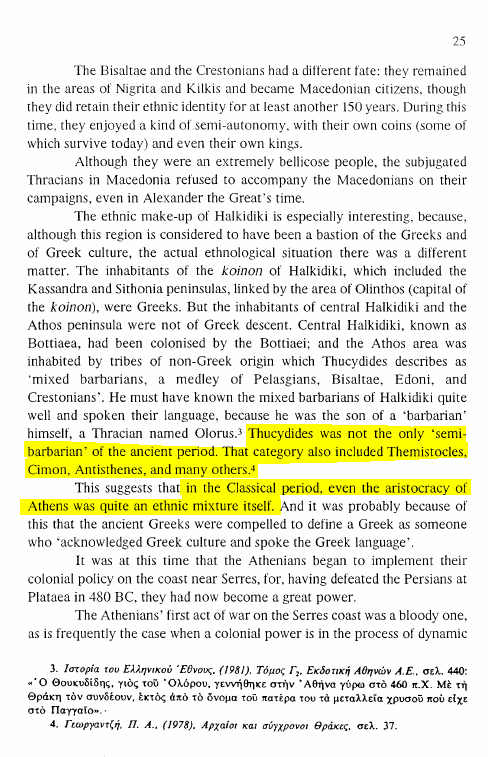
Nakra22_zpseb18fe58.png


Majority of inhabitants in Athens were bilingual (if not multilingual).
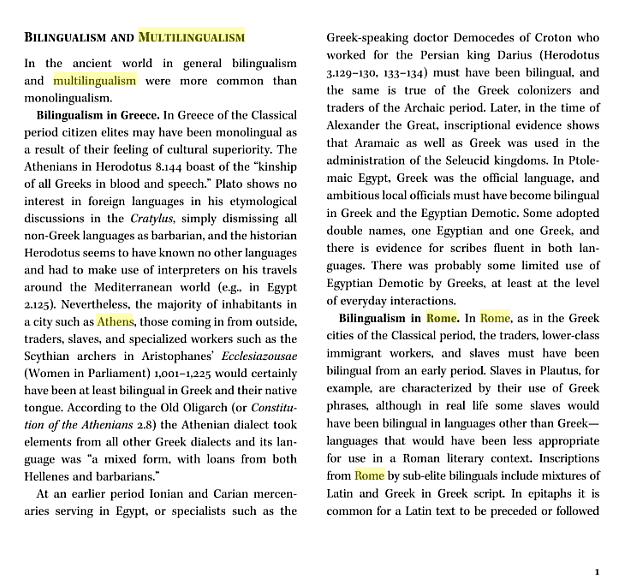
Oxford1_zps01782b06.png


There was no official policy of enforcing Latin in the (Roman) empire.
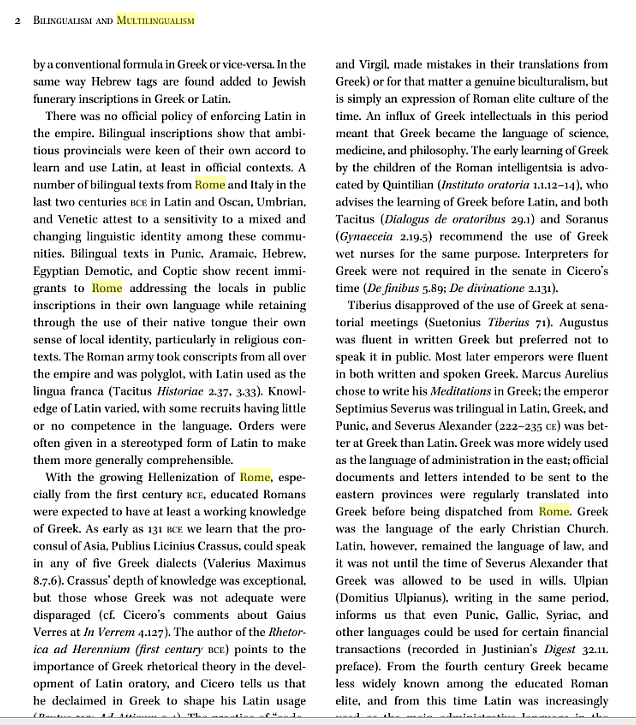
Oxford2_zpsbc8aaee2.png
 
From Jonathan Hall.

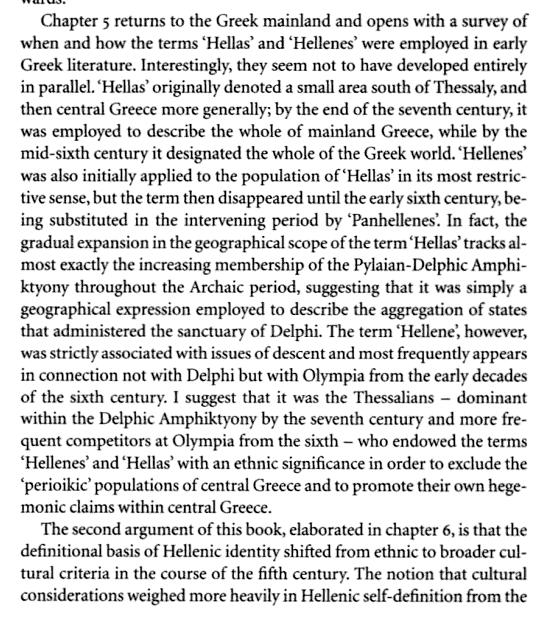
The terms 'Hellas' & 'Hellenes':

- 'Hellas' originally denoted a small area south of Thessaly.
- By the end of the seventh century (600's BC), it was employed to describe the whole of mainland Greece.
- By the mid-sixth century (550's BC), it designated the whole of the Greek world.
- The gradual expansion in the geographical scope of the term 'Hellas' tracks almost exactly the increasing membership of the (Religious) Pylaian-Delphic Amphiktyony throughout the Archaic period, suggesting that it was simply a geographical expression employed to describe the aggregation of states that administered the sanctuary of Delphi.

Helasd15_zpsa69fe8f4.png

Helasd10_zpsfefe36e0.png


More from J. Hall.

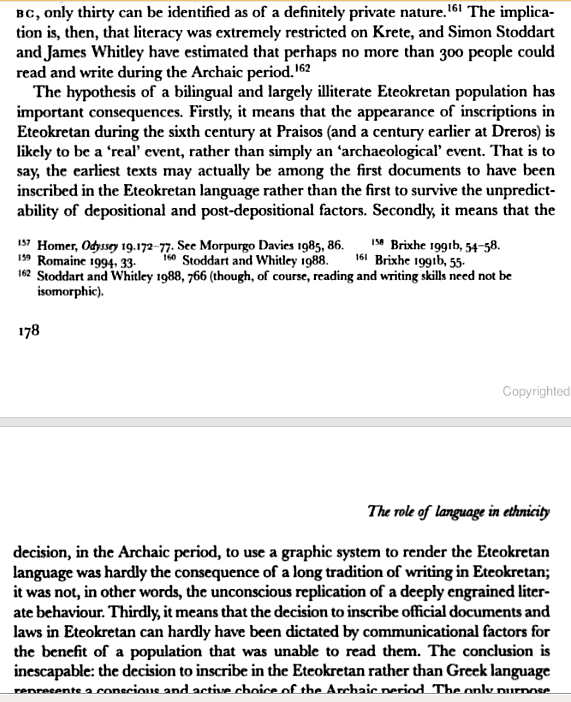
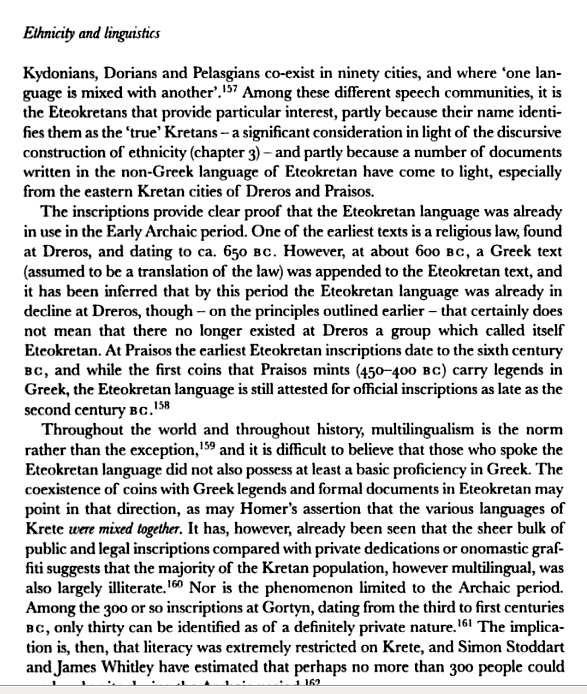
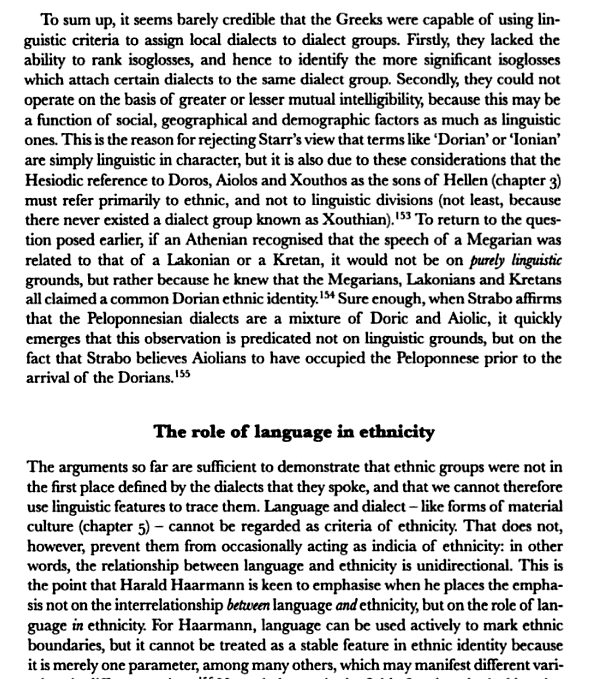
- A number of documents written in the non-Greek language of Eteokretan have come to light.
- Another interesting observation from J. Hall is the following: "Throughout the world and throughout history, multilingualism is the norm rather than the exception." This specifically applies to the ancient Hellenes (..who were a multiethnic multilingual community).

Helasd29_zps3eee9194.png

Helasd28_zps945c3293.png

Helasd26_zps16f4eeb5.png


Helasd33_zps09b8fa5f.png

Helasd34_zps1c1934cc.png


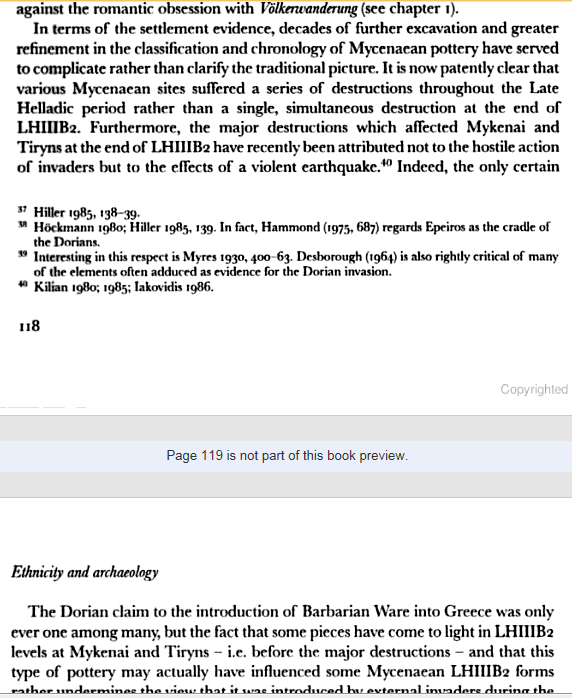
The Dorian invasion:

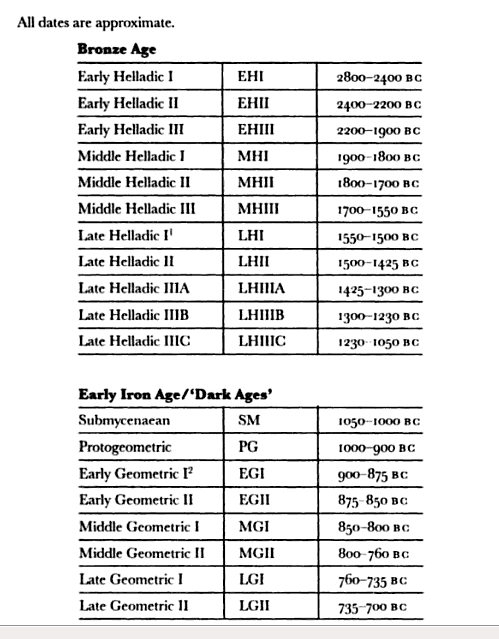
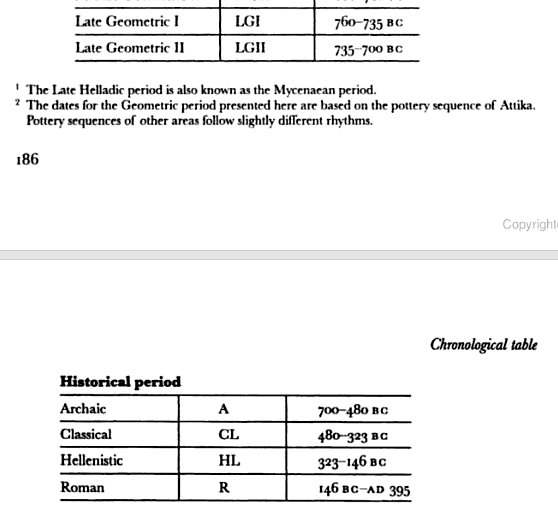
"It is now patently clear that the various Mycenaean sites suffered a series of destructions throughout the Late Helladic period rather than a single, simultaneous destruction at the end of LHIIIB2. Furthermore, the major destructions which affected Mykenai and Tiryns at the end of LHIIIB2 have recently been attributed not to the hostile action of invaders but to the effects of a violent earthquake."


Helasd25_zps4bebde69.png
 
Last edited:
This is a great thread. Shows how diverse the ancient world really was and how impoversihed it became with the rise of monotheism and modern state terror.
 
the greeks lived in myths & legends.They lived the make bleive.

I dont even think thats totally true. Ur-phenomenon have a tendancy of reappearing all the time. I doubt we actually know exactly how the ancient greeks or anyone exactly lived or thought.
 
the greeks lived in myths & legends.They lived the make bleive.

I dont even think thats totally true. Ur-phenomenon have a tendancy of reappearing all the time. Im sure most people in the ancient world were bilingual or multilingual or of mixed natures. Can we say for example what exactly or distinctly was ancient greek as opposed to the homogeneous constructs we are usually taught?(and that distinctly ancient greek has nothing to do with ancient Macedonia or even modern greece that world is dead and buried). Was it linguistic changes that took place in what was known as greece proper-i.e attica and peloponnese, was it geometrical art etc)I doubt we actually know exactly how the ancient greeks or anyone exactly lived or thought. Most of the way we are taught to think is the result of centralisation.
 
Last edited:
This is a response to a certain Kaka (I bet he's Greek) that was having a discussion with me yesterday via personal messages about how Greeks weren't black and all that.Well,since he has blocked me from sending any more personal messages,I'll enlighten him through this very thread so he can read it and have a think.
OK,let's make it simple for our friend here.This is a graphic description of all Y-DNA haplogroups in human DNA by nation:

http://en.wikipedia.org/wiki/Haplogroups_by_nations

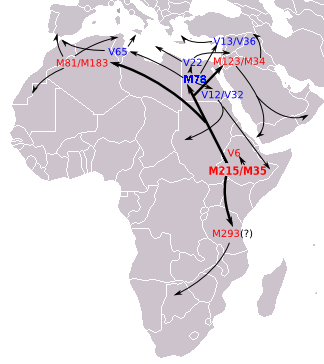
Now then,see the graph about Greek people (continental,north,south etc.).See which haplogroup is most frequent in Greek DNA.As shown,it's E1b1b,a.k.a.E-M215,it varies from 20% till up to 50%.After you've done that,Google this haplogroup and you'll find the following : place of origin - EAST AFRICA,time of origin - approx 22 400 years ago.
Meaning,your black ancestors migrated to the southern balkan peninsula,mixed with the locals and in time lost their black features.But as I said earlier in our messages - PEOPLE LIE,DNA DOESN'T.Simple as that.Oh,and just in case you question the haplogroup chart,in the top right corner of every number there is another number featured in blue.Just place your mouse cursor on top and it shows you who made the research,when,etc etc.WE didn't make these researches,it was made by smart people with degrees in biology,chemistry,genetics etc,people that are masters of their craft,people that unlike you actually KNOW what they're talking about.And finally,here's the route of distribution of your ancestors blood,you can clearly see WHERE E1bib (E-M215) originates for yourself.TOUCHE!

E1b1bRoute.png
 
Last edited:
Interesting. I assume this DNA cluster would be stronger around the original greek settlement areas around the insular coast lines of the area? Explains alot. Isnt there evidence that Macedonians have more ancient Hellenic(Doric, not to say they were total Dorians) DNA then modern greeks?(note difference Hellenic from greek)
 
Last edited:
More on the bilingualism & multilingualism of the ancient Mediterranean world.

Excerpt from "Hellenicity: Between Ethnicity and Culture", By Jonathan M. Hall.

Pages 113-116:

Communication would certainly have been facilitated by bilingualism, a natural consequence of intermarriage between alloglots: thus, Herodotus (6.138.2) recounts how the Athenian women kidnapped by the Pelasgians of Lemnos taught their children the Attic tongue (glossa Attike). But the earliest attested instance of bilingualism in Greek literature is found in the Homeric Hymn to Aphrodite (113-16), where Aphrodite disguises herself as a Phrygian woman who addresses the Trojan Ankhises in his own language. Indeed it is more commonly non-Greeks who are credited with a multilingual proficiency: for example, the mid-seventh-century Egyptian Pharaoh Psammetikhos is said to have entrusted Egyptian children to his Greek mercenaries in order to learn the Greek language; at a vast banquet held in 479 B.C. to which the Thebans invited Persian dignitaries, Thersandros of Orkhomenos was addressed in Greek by his Persian dining partner; and the Karians and the populations of the Khalkidike were apparently competent in the Greek language. There are, however, also instances of Greeks who possess varying levels of bilingual competence. The characterization of a Lydian woman by the late sixth-century poet Hipponax betrays some knoweledge of Lydian and even Phrygian vocabulary; Histiaios, the tyrant of Miletos, is said to have been able to speak Persian and a similar competence in Persian is attributed to Themistokles and to Alkibiades, while Pythagoras is supposed to have learnt Egyptian.

Iamblikhos' notice (Life of Pythagoras 34.241) that Pythagoras ordered all Greek Pythagoreans to speak Greek is interesting in that it suggests that many of the Greeks of South Italy may have employed indigenous idioms. Bilingualism would also have facilitated (though it is not necessarily required by) the transmission of the Greek alphabet, adopted by Phrygians, Etruscans and Lydians in the 8th century, the Karians in the 7th century and the Lykians, Sikeloi and Elymoi in the 6th century.

PS: An early conception of a singular Hellenic language is illusory in documentation. In fact, it is not until the 5th century that we find a concrete expression on this concept in the phrase he Hellas glossa ('the Greek tongue'). This is also the period when the verb hellenizein first appears.

The fact is that what we term the Greek language was in reality a collection of myriad regional dialects. It is often assumed that these were mutually intelligible and that therefore the greater ease with which Greeks could have understood one another as opposed to speakers of other languages would have engendered a growing consciousness of a shared Greek language. Yet quite apart from the already noted lack of terminology to express such a consciousness prior to the 5th century, there are many documented instances within ethnolinguistic research which demonstrate clearly that dialect speakers are often able to comprehend dialects of another language group better than some dialects within their own language group.
 
http://en.wikipedia.org/wiki/Haplogroups_by_nations

Now then,see the graph about Greek people (continental,north,south etc.).See which haplogroup is most frequent in Greek DNA.As shown,it's E1b1b,a.k.a.E-M215,it varies from 20% till up to 50%.[/IMG]

Yes, the numbers posted around 20% that average around the Balkans are from tests sampling modern Greeks. The numbers below going up to 47% are from this test:

http://www.cell.com/AJHG/fulltext/S0002-9297(08)00547-8

Where they used sampling from ancient Greek colonial sites and graves. It doesn't make much sense that they would test modern Greeks if they wanted their paper to focus strictly on ancient Greeks. After all they found no Turkish blood which I find remarkably hard to believe. Needless to say the same group did blood samples from participants when they published a paper on Jews and Palestinians which they talk about in their paper about the ancient Greeks.
 
i) Hekataios of Miletos (1 FGrH 119) mainatained that most of Greece had formerly been occupied by 'barbarians' such as the Phrygians, the Egyptians, the Dryopes, the Kaukones, the Pelasgians, the Leleges, the Thrakians and the Phoenicians.

Some of these non-Hellenic peoples were evidently still occupying parts of the Aegean during the fifth century: Pelasgian-speaking populations are attested for the Khalkidike peninsula (Macedonia), the regions west of the river Strymon (Macedonia and Thrace) and the island of Lemnos, while the cities of Hermione in the Argolid, Asine in Messenia and Styra on Euboia together with the island of Kythenos were populated by Dryopes. The Leleges are said to have once occupied the Megarid, Lakonia and above all the islands.

(Above taken from Hall's book "Hellenicity".)

ii) Sir John Linton Myres, Wykeham Professor of Greek History at the University of Oxford.

Wikipedia link -
http://en.wikipedia.org/wiki/John_Myres

Myres examined all the physical anthropological, linguistic, religious and archaeological evidence that was available to him before proceeding to test it against what he termed the 'folk memory' of the (ancient) Greeks themselves. For example, analysis of skeletal remains and particularly skull types - a favourite preoccupation of scholars in these decades - revealed the coexistence of 'Alpine-Armenoid', 'Mediterranean' and 'Northern' types, leading him to believe that the Greek people emerged 'from mongrel ancestry' (1930: 532). Myres also saw this original 'hybridity' reflected in the development and distribution of the historical (ancient) Greek dialects, in the Greek pantheon and in the material culture of the Bronze Age, which he attributed to both indigenous development and external influence from areas as distant as North Africa, Asia Minor and the Lower Danube. Furthermore, these findings appeared to accord with the myths that told of the arrival of 'foreign' heroes such as Pelops, Kadmos or Danaos. In short:

The Greeks of classical times were of mixed descent, spoke different dialects of a hybrid language, combined Olympian with chthonic cults and rituals ... and their traditions intermixed indigenous stocks, which were not Greek, with immigrant culture-heroes, pervasive Hellenes, migratory Dorians and Aeolians transposed and superposed on other kinds of Greeks. (1930: 531)

(Quoted in "Hellenicity".)

iii) Jonathan Hall's quote, page 227 of his book "Hellenicity" - Epilogue.

The geography and history of the Greek peninsula long conspired to militate against the emergence of an overarching, transregional Hellenic consciousness. There is not the slightest evidence that Greeks of the Late Bronze Age recognized themselves as a singular ethnic entity nor - despite claims to the contrary - is there any compelling support for the notion that confrontation with indigenous 'others' on the periphery of the Greek world triggered a sense of Hellenic 'sameness' in the 8th century BC.

The testimony suggests instead that Hellenic identity arose in the elite environment of the Olympic Games during the course of the 6th century and that it served both to cement alliances between ruling families of various regions and to promote the hegemonic claims of the Thessalians over their neighbous in central Greece. Hellenicity in the Late Archaic period was predicated on ethnic criteria to the extent that affiliation was legitimated aggregatively through genealogical discourse rather than by means of a conscious reification of language, religion or culture, but it was noninclusive in the sense that Hellenic membership was denied to certain populations that we would today consider Greek.

Just at the point, in the immediate aftermath of the Persian War, where an oppositional construction of Hellenicity could have permitted a more inclusive basis of enrolment, its ethnic foundations imploded and retreated rapidly before more cultural criteria.
 
Last edited:
Foundation Tales as Cultural Thievery.

Celebrated characters from legend could serve as founders of foreign nations. Or, more inventively, fictive tales ascribed names derived from extant peoples to fabricated figures who became those peoples' progenitors. The Hellenic penchant for peering through parochial spectacles is well known. Alien nations became transformed and familiar when fitted into Greek traditions.

That held true even for the supposed archenemy, Persia. According to Herodotus, the Hellenic hero Perseus wed his rescued damsel Andromeda whose son by him was named Perses. And from him the Persians took their own name. So Herodotus (or rather his sources). The story is a noteworthy one. The most inveterate foe of Hellas thus came within the Hellenic embrace. Greeks slipped one of their most celebrated legendary figures into a fictitious narrative of Persian history, thus to account for the very name of the people.

That fable, in its many manifestations, may be the most dramatic instance of identity theft. But far from the only one. Another tradition took this maneuver a step further. The ruling house of Persia carried the designation of Achaemenids. That played nicely into the hands of Greek fashioners of legend. They concocted an Achaemenes as founder of the dynasty, made him a son of Perseus, and explained his name as derived from his grandfather, who came from Achaea in the Peloponnese. So even prime villains of the Greek master narrative, the Achaemenid clan and the Persian empire, turn out to be Greek in origin. That is appropriation indeed.

If Persians could be hellenized, anyone was fair game.


Page 224 -- Rethinking the Other in Antiquity, Erich S. Gruen.
 
Continued.

The Greeks had no monopoly on this sort of "identity theft." Egyptians employed the same form of imaginary lineage that attached foreign cultures to themselves. Egyptian mythology that made its way to Diodorus of Sicily included a tale of the wanderings of Osiris, most venerable and sacred of the nation's deities. The story has Osiris venture across the Hellespont to Thrace and beyond. In the course of his travels he left behind a son named Macedon as ruler of a land that was henceforth to be known as Macedonia. And, for good measure, he behind another son, now aged, who would oversee the cultivation of plants in Thrace and found a city there, duly to be designed as Maroneia.

Macedonians may have installed an alien dynasty on the Egyptians' land -- But, on this concoction, Macedonia itself owed its origin to an Egyptian dynasty.

:)
 
Back
Top