Excerpts from Hellenicity by Jonathan Hall (2005)
http://books.google.ca/books?id=F4A...a=X&ei=GcnYUOSPKq6G0QHO-4GQDA&ved=0CDwQ6AEwAQ
Ethnic Identity in Greek Antiquity
http://books.google.ca/books?id=jJB...a=X&ei=GcnYUOSPKq6G0QHO-4GQDA&ved=0CDYQ6AEwAA
"Although the Greeks themselves believed in polygenetic origins within
the Balkan peninsula in Greece, the discovery of the Indo-European
language group prompted scholars to view Greek speakers as immigrants
from an original Indo-European homeland. Furthermore, the fact that
Greek civilization is known predominantly—and, prior to the emergence
of the discipline of archaeology, exclusively—through its literary
remains has tented to promote the Greek language as the quintessential
expression of Greekness. The result is that a horizon has been drawn
between a pre-Greek chronological phase and a properly Greek era,
signaled by the arrival of the first Greek speakers. Chapter 2 charts
the various attempts that have been made to date this arrival by means
of perceived disjuncture in the archaeological record and argues,
firstly, that these supposed cultural breaks are becoming ever more
illusory as our archaeological knowledge increases and, secondly that
the very assumptions that apparent material innovations should signal
the arrival of a new language and that a linguistic group necessarily
equates with a self-conscious ethnic group are, on the basis of
comparative anthropological evidence questionable (Hall 2005, p. 5)."
"More importantly, the biblical account of unilineal or monogenetic
origins in the Near East dictated that the ancestors of the Greeks
must have arrived from OUTSIDE Greece (Hall 2005, p. 37, emphasis in
the original)."
"Although claims for a northern European origin have not been entirely
abated today, they are largely outnumbered by proposals for an
Indo-European Urheimat in either the steppes of Southern Russia or,
more recently, Anatolia. The debate is still far from being resolved
to universal satisfaction, but with regard to specifically Greek
origins the question most frequently posed has not been "from where?"
but rather "When?" (Hall 2005, p. 28)."
"Schmidt (proponent of the wave model) himself did not question the
existence of an original PIE languages, but the Russian linguist
Nikolai Trubetskoy (1939) raised the possibility that originally
dissimilar "Indo-European" languages could have gradually come to
resemble one another through repeated contact and borrowing. Parallel
examples of this phenomenon are offered by the languages of the
Balkans; the Chinese, Thai and Vietnamese languages in southeast Asia;
the Indo-European, Dravidian and Munda languages of the Indian
subcontinent; and the Indo-European and Caucasian leagues of the Black
Sea and Caspian areas. The question is whether the undeniably closer
and more numerous correspondences among Indo-European languages can
similarly be explained by an exceptionally long period of contact an
development, but either way it is clear that linguistic innovation
need to require the sort of mass immigration that archeologist have
sought in the material record (Hall 2005, p. 44, parenthesis added)."
"The whole debate on the "coming of the Greeks" has been characterized
by the repeated tendency to confuse emic (internal/subjective) and
etic (external/objective) categories. Even if we are prepared to
accept that a number—be it large or small—of Indo-European speakers
arrived in the Greek mainland at a certain point in time and imposed
their language on the substrate language of their predecessors, that
does not in itself indicate the commencement of Hellenic identity as
the Greeks themselves conceived it. The history of a language or of
cultural practices is not necessarily the same as the history of the
people who are later identified—and identify themselves—with these
markers (Hall 2005, p. 45)."
Hall, J. M. (2005). Hellenicity: between ethnicity and culture.
Chicago, IL: The University of Chicago Press. ISBN 978-0-226-31330-6
In lieu of an abstract, here is a brief excerpt of the content:
Journal of Interdisciplinary History 34.1 (2003) 65-66
Hellenicity: Between Ethnicity and Culture. By Jonathan M. Hall (Chicago, University of Chicago Press, 2002) 312pp. $50.00
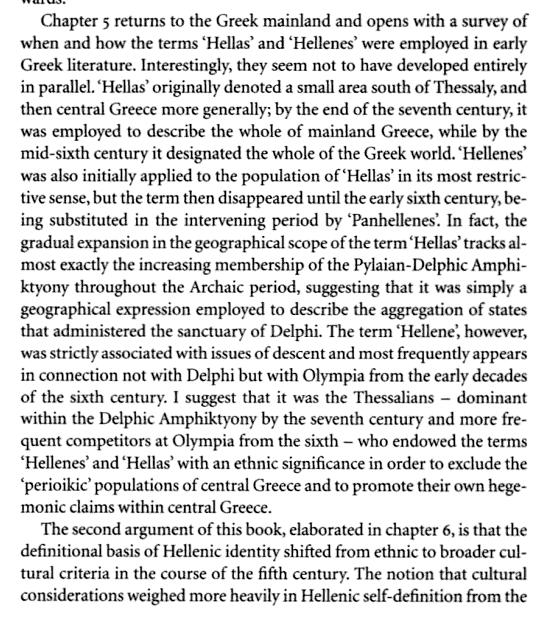
In a famous passage (Histories, 8.144), Herodotus has the Athenians chastise the Spartans for fearing that Athens might capitulate to the Persians. Several deterrents, according to the Athenians, keep them from betraying Greece—the places of worship that the Persians had destroyed andthe elements constituting a "common Greekness" (to Hellenikon)—common blood and language, common shrines to the gods, common sacrifices, and common customs. This seems to be straightforward testimony to the ancient Greek conception of Hellenic ethnicity, but Hall demonstrates that communally shared Panhellenic identity was unstable and, at most times, less salient than other collective identities, especially in pre-classical Greece apart from Athens.
This study traces the formation of a collective Hellenic identity in Greek antiquity, referring throughout by neologism to ancient Greek ethnic consciousness as "Hellenicity." Hall begins by setting out his methodological and theoretical positions on the study of ethnic identity. For him, ethnicity represents a constructivist "imagined community," not any primordial Stammbaum, and ethnicity "denotes both the self-consciousness of belonging to an ethnic group ('ethnic identity') and the dynamic process that structures, and is structured by, ethnic groups in social interaction with one another." The most important aspects of ethnic self-ascription are mythic common descent and kinship, an association with a geographical locality or region, and a sense of common historical experience. Above all, ethnicity is attitudinal and selective, and it is strategically employed in particular historical configurations in the interests of its constituency.
Hall takes up the question of ancient Greek origins, offering a good historical synthesis of modern archaeological and linguistic work on the problem of when Greek-speaking peoples first arrived in Greece. But this question is of peripheral importance to Hall's study. He argues that Greek-speakers' penetration into the Greek peninsula came gradually over an extended period of time, and that the idea of a massive population influx of Greek speakers is untenable.
The main ethnic sub-categories of the ancient Greeks—Achaeans, Ionians, Aiolians, and Dorians—only emerged in local conditions during the eighth and seventh centuries B.C.E. Panhellenism was a sporadic and ephemeral force in ancient Greece. It peaked under extraordinary circumstances—prospects for united aggression, the threatened security of Hellas, or international crisis for the collective Greek city-states. Hall suggests that we look to the great athletic festivals for origins; in this context, Hellenism may have been an aggregrative ethnicity that operated across geographically contiguous regions to weld together a transregional aristocracy against lesser status groups.
"Hellenicity" clearly emerges only in the fifth century B.C.E., and then it was largely the production of imperial Athens, which acted as "the new self-appointed arbiter of cultural authenticity." Hellenic identity thus came to be measured increasingly in terms of culture and education rather than of putative descent groups through a process that reached its completion during the Hellenistic age.
Craige B. Champion
Syracuse University


 The average height in Greece is 5 foot 10 for men, and the average with women is five foot four.
 . I think the mistake here is to confuse black with egyptian, libyan and semitic which is more likely as opposed to pure black which is more nubian.