• Welcome to the new Macedonian Truth Forum. All posts, members and private messages have been moved over from the old forum.

    Passwords from the old forum could not be carried over, so please use Forgot your password? to set a new one. The reset link is emailed to the address on your account.

  • Rules and Regulations at the forum of the Macedonian Truth Organisation (MTO)

    (1) The national-ethnic and cultural-linguistic identity of the Macedonian people is historically Macedonian, and derives its character from the native, indigenous and geographic homeland of the Macedonians, which is called Macedonia. To ensure that their human rights, integrity and heritage are appropriately respected, the only nouns and adjectives acceptable when reference is made to the above character and identity markers is Macedon, Macedonia, Macedonian and Macedonians.

    (2) The nation-state of the Macedonian people is the Republic of Macedonia, and is to be referred to by this official title so long as the 'republic' prefix is consistently applied to other states. Alternative references are the Macedonian Republic, or simply, Macedonia.

    (3) The 'ethnic' prefix is only acceptable for Macedonians in cases where differentiation is specifically required - so long as it is in context and consistent where it concerns its application to other ethnic groups.

    (4) Should any other differentiation be specifically required, the names of other ethnic groups that reside with Macedonians in either the Republic of Macedonia or the occupied Macedonian regions in Greece, Bulgaria, Serbia or Albania, are to be given a prefix.

    (5) Negating the identity, language and culture of the Macedonian people by deliberate avoidance of the terms Macedonia, Macedonian and Macedonians, or by any other means, is not permitted.

    (6) Systematic anti-Macedonian propaganda and rhetoric are not permitted.

    (7) Threads irrelevant to the Macedonian Cause, the community at the Macedonian Truth Organisation or the Macedonians in general may be considered as spam or not in the spirit of the forum. In such cases they are not permitted.

    (8) Continual posting of messages in threads with the sole purpose of deviating from the initial topics with the use of unrelated and unnecessary information is not permitted.

    (9) All posts, external articles, reports, etc that are cited in languages other than Macedonian or English, must be accompanied with a translation in one or both of the said languages.

    (10) Despite the possibility of some conversations and debates becoming heated, extreme abuse and/or racism, vulgar language and/or terminology, threats, revelation of personal information about others, harassment, and other such behavior will not be permitted. If deemed necessary all relevant information including member details will be reported to the appropriate authorities for investigation which may result in legal action.

    (11) Threads that are created must have a summary of a topic or excerpt of an article found in pertinent link(s) that have been included. One line threads will be considered unaccetable spam and are therefore not permitted.

    (12) Compulsive and deliberate lies, irrespective of the topic, are not permitted.

    (13) Any symbols or avatars found to be perceived as offensive to Macedonians are not permitted.

    (13) Any explicit or extreme material is not permitted.

    Failure to adhere to the above rules and regulations will result in a ban after 3 breaches. This may be reconsidered in some cases should the circumstances be of an unorthodox nature and/or require special consideration. To assure an effective deterrent against an individual or individuals with the sole purpose of causing dissent through spamming, racism or other improper means, the above rules will be strictly enforced.

    The MTO administration will monitor all discussions as reasonably practical and reserve the right to remove any post and/or member from the forum, and update the rules and regulations as required. Members are encouraged to immediately report any post and/or member to the MTO administration if they feel that these rules have not been abided by.

    The views expressed on this forum are those of the individuals. The only official representation of the MTO is made by the "Macedonian Truth Organisation (Site Owner)" username, and no other.

  • Macedonian Cause

    The Macedonian Truth Organisation calls on God in Heaven to protect, bless and guide the endeavour it is committing to undertake, and that is to work towards:

    Securing Macedonia as a free, independent and democratic republic in which sovereignty lies with the Macedonian citizens; as the nation-state of the Macedonian people in which they can preserve their culture, language and identity; as a state in which the Macedonian language and culture form the basis of public life and act as important unifying elements of Macedonian society; as the home of all its citizens to which it guarantees and obliges their inalienable natural rights and corresponding responsibilities;

    The acknowledgment as self-evident and irrefutable the existence of the:

    1) Indigenous, ethnonational name of Macedonia;
    2) Macedonian people, language and identity;
    3) Macedonian culture, symbols and folklore;
    4) Macedonian ancestry, heritage and history in its entirety; and
    5) Macedonian Orthodox Church;

    Securing recognition by the International Community of the tragedies endured by the Macedonian people, of the division of Macedonia with the signing of the Treaty of Bucharest on August 10, 1913, and the genocide committed against the Macedonian people at the hands of the Greek, Bulgarian and Serbian states and their respective churches during the 19th and 20th centuries;

    Ensuring that the Interim Accord is declared ‘null and void’ and that all constitutional provisions, acts, commitments, agreements, legislation, regulations, policies or programs emanating from, supporting or consequential to the Interim Accord are also declared ‘null and void’, including the use of any symbols and the completion of any acts imposed by, or originating from, the Interim Accord.

    Ensuring that the Framework Agreement is abolished and that all constitutional provisions, acts, commitments, agreements, legislation, regulations, policies and programs emanating from, supporting or consequential to the Framework Agreement are also abolished and replaced by a framework of constitutional and statutory law based on inalienable natural rights and corresponding responsibilities and universally codified human rights mechanisms.

    Securing the abolishment of any existing constitutional provisions, acts, agreements, legislation, regulations, policies and programs that discriminate against the Macedonian people, in any international organisation or any of the countries of the International Community where such constitutional provisions, acts, agreements, legislation, regulations, policies and programs exist, and thereby ensuring the freedom for Macedonians to exercise their inalienable natural rights and fulfil their corresponding responsibilities, and practice their culture, language and religious faiths in all the countries of the International Community without hindrance;

    The empowerment of Macedonians to undertake a moral revolution and to instil and/or reinvigorate within themselves a deep-rooted national, cultural, linguistic and historical dignity and a commitment to the exercise of freedom based on inalienable natural rights and corresponding responsibilities;

    The recognition of the Macedonian minorities in the neighbouring states of Macedonia as well as the respect for the inalienable rights and freedoms of the Macedonian minorities, as provided for by natural law and as codified by the United Nations Charter, the Universal Declaration of Human Rights and other universally codified human rights mechanisms;

    The full and unreserved respect of, and the support for, the rights of all people of non-Macedonian descent living in Macedonia and around the world, who share a reciprocal full and unreserved respect for the Macedonian people, their homeland and their state;

    The cultural unification and solidarity of the Macedonian people living in all parts of historical Macedonia and adjacent territories, as well as Macedonians throughout the world;

    The unity of all Macedonians on the principles, objectives and achievement of the Macedonian cause as defined by this declaration.

Ghost on the throne by James Romm

Thank you too for answering our questions. I see you're not like the others greeks, you have a very logical view about modern greece. I agree with the most things you wrote.
The greek language is, indeed, a connection between Ancient and Modern Greece, but it is the only one. I disagree also with "the unbroken continuity of the Greek language as a common mother tongue". The greek language existed, but it was the mother tongue of no one for centuries. Like you said it was used for the purpose of religion, administration, business etc ... But the ones who used this tongue did feel everything but certainly no greekness. It's a fact.

Also about this part you wrote :

"The ancient Macedonians participated in aspects of Greek society which were closed to anyone but Greeks. Their language, religion and culture were exclusively Greek. In the expansion of their empire they persistently built cities on the Greek model, in infrastructure, culture and institutions, even in their farthest reaches of Asia. More, the ancient Macedonians said they were Greek. One has a choice: he can believe what the Macedonians said about themselves in their own words and expressed in their own desires and behaviour, or he can believe Eugene Borza. "

First the religion didn't define your ethnicity (I speak about the ancient times, not today :D), and maybe you don't know, the gods that the greeks praised where in fact of non-greek origin. Here the greeks gods and their egyptians counterparts in the book of Françoise Dunand, Gods and Men in Egypt (2004), that you can see on the page 242 :

"Dionysos = Osiris, Demeter = Isis, Apollo = Horus
Artemis = Bastet, Zeus = Amon, Athena = Neith
Aphrodite = Hathor, Hermès = Thoth, Hephaistos = Ptah
Leto = Wadjit, Pan = Dieu de Mendes, Typhon = Seth".

Does that make the greeks egyptians ? Absolutely not. The same for the macedonians, the fact that they have possibly whorshipped "greeks" gods, did not make them greeks.

About the culture, i think that Philip II, the royal house, were certainly philhellenic, that's why he chooses Aristotle to be the teacher of Alexander. Aristotle originated from a greek colony in Macedonia. I will not say that all macedonians and all Macedonia was of greek culture. I don't ignore also that the greek culture was very powerful, and dominant. Only the elite at the time could access education, don't forget.

It's sure that the greek language was used at the Macedonian royal house, the same for the Illyrian and Thracian royalty. But this was not the mother tongue of the macedonians. I will try, in a future post, to provide you quotes of ancient authors that cleary make the distinction between greek and macedonian language :wink:. You can also visit the rest of the Forum, the issue about the ancient macedonian language is already tackled.

Here's one quote of Plutarch about the egyptian queen, Cleopatra, who was of macedonian origin :

"She spake unto few barbarous people by interpreter, but made them answer her self, or at the least the most part of them: as the Ethiopians, the Arabians, the Troglodytes, the Hebrews, the Syrians, the Medes, and the Parthians, and to many others also, whose languages she had learned. Whereas divers of her progenitors, the kings of Egypt, could scarce learn the Egyptian tongue only, and many of them forgot to speak the Macedonian. ("Life of Anthony", 27) ".

You say that the language of the macedonians was greek, but why he mentioned "macedonian" language instead of "greek" ?

I will post other examples later.
 
Last edited:
If the people of of the ROM also had Greek as a mother tongue, what "dispute" would exist between them and the Republic to the south?
 
@ Nexus:

Conversely, we might ask how credible would a modern Greek claim be to a connection to the ancient world if the modern Greeks spoke Turkish, or Albanian as a mother tongue.

Contrary to your statement, your religion did indeed denote your "ethnicity," and your example proves it.

As you quote from Dunand, there were many equivalencies among alien gods in the pagan world: Dionysos to Osiris, Apollo to Horus, Zeus to Amon, Zeus to the Norwegian Thor, etc, etc. However, the name of the god signified the speaker's tongue, his "ethnicity." Only the Greeks said "Zeus" while the Egyptians said "Amon". If someone said he worshiped "Osiris", he would not be thought to be Greek and if someone said he worshiped "Dionysos" he would not be thought Egyptian. More clearly, the Roman and Greek gods were identical, yet a Roman would say that he worshiped Minerva and a Greek Athena, a Roman Jupiter and a Greek Zeus. By simply saying "Minerva" or "Athena" one could tell if the speaker were Roman or Greek even though they were the exact same goddesses. The Macedonians worshiped the same Greek gods in the same Greek names, in the same Greek language.

The evolutionist Richard Dawkins responded to those who still doubt the theory of evolution that all that one needs to disprove it is to find a fossil that is chronologically at a more complex state of development than its progeny. No such fossil has or can be found. Similarly, all that one needs to prove the existence of an ancient Macedonian language that is not Greek is to find a decipherable text or an inscription in that language, the language of an entire people. Surely, if an entire people spoke a language at the same place as written Greek, someone must have written a letter, or a poem , or an instruction, or a recipe, or a love note or something, anything, in that language.

Just like today in Greece, "Macedonian" is a synonym for "Greek," so Plutarch was using the word "Macedonian" to signify the language spoken was Greek. To prove otherwise, you would have to find a passage where Plutarch says that someone was speaking "Macedonian" and not "Greek". Since so many ancient authors said that someone spoke "Macedonian," and not meaning "Greek" by it, there must certainly exist some example of it or the very same authors could not have known what it was.

As for the Greek that "was no one's mother tongue," when exactly did it disappear and when and how did it start up again? Did the Germans teach the Greeks how to speak it in 1821 using the highly successful "Rosetta Stone" method? Greek is well established as a spoken language throughout the ages. Poems, folk songs, popular works of literature, formal and informal communications between authorities, and between common people exist from every period without interruption. When exactly was the period when Greek was not spoken by any population? When and why was it suddenly taken up by an entire people?

Great fun, Cheers.
 
One is being asked to believe that the ancient Macedonians who established an empire stretching from Egypt to India and created within it colonies that ruled for hundreds of years, never once communicated in writing between themselves or anyone else, never left an inscription, in their own true language which for some reason they kept a secret preferring to use someone else's over centuries, even though ancient writers must have heard it or read it because when they referred to "Macedonian" they did not mean "Greek."

Such a leap of logic is not easy for everyone to make. It does, given the approaching season, make belief in the virgin birth a short step by comparison.
 
Mistercona the goal posts seem to change distance where it concerns modern Greek identity. First religion determined ones greekness. A convenient application considering most everyone in newly independent Greece spoke a language other than romaika. Once the language issue was fixed then language determined ones greekness. Then came Macedonia. Now religion and self-determination as well as education determined ones greekness. It seems fitting when you look at the speed of conclusions you can come to when determining an Albanian is related to Pericles and a Christian Turk is related to Alexander the Great under the guise of 19th century Droysenian Hellenism.
 
One is being asked to believe that the ancient Macedonians who established an empire stretching from Egypt to India and created within it colonies that ruled for hundreds of years, never once communicated in writing between themselves or anyone else, never left an inscription, in their own true language which for some reason they kept a secret preferring to use someone else's over centuries, even though ancient writers must have heard it or read it because when they referred to "Macedonian" they did not mean "Greek."

Such a leap of logic is not easy for everyone to make. It does, given the approaching season, make belief in the virgin birth a short step by comparison.
Refer to Eugene Borza on the first page of this topic. He basically knocks out all your questions with mind blowing answers your type choose to ignore.
 
Perhaps your reading of Borza is different from mine. I found Borza a clear and logical writer, and that was his problem. At the beginning of each chapter he proposed that the ancient Macedonians were a different people than the Greeks. By the end of every chapter he resorted to qualifiers and conditionals that completely refuted his argument, which he would take up in a spirited and clear manner in the next chapter only to end with speculations, suppositions, backpeddling, and many "Perhaps" and "maybe". Borza starts and ends his book with the statement that the ancient Macedonians were different from Greeks, and he packs several hundred pointless and circuitous pages in between. He is expressing his opinions. He seems like a nice man all-in-all. I would gladly have had tea with him.

If anywhere in Borza or any other writer there is a deciphered text of Macedonian language that is NOT GReek, I, and many other people, am anxious to see it.

Describe any Macedonian-dominated city in the divided empire. What are its cities like? How are they positioned, what are the public buildings called, what are the temples like and what are the names of the gods? What is the language used? How does this differ from a Greek city of the period? How is it "Macedonian" and not "Greek?" What makes it "Macedonian"?
 
@ TrueMacedonian:

On your suggestion I went back to Eugene Borza and on page 255 of Macedonia Redux, I found the following passage. It was very useful. It explains a lot. Thanks for the tip.

"If the claim is based on ethnicity, it is an issue of a different order. Modern Slavs, both Bulgarians and Macedonians, cannot establish a link with antiquity as the Slavs entered the Balkans centuries after the demise of the ancient Macedonian kingdom. Only the most radical Slavic factions - mostly emigres from the United States, Canada and Australia - even attempt to establish a link to antiquity."
 
@ Nexus:

Hi Nexus. Thanks for your note. I tried to respond but couldn't manage the technology (I'm a bit of a Ludite).

Ages ago, I started with the established "classical" writers of Greek history. I believe I started with Arnold Toynbee who was an excellent, world-renouned scholar and teacher and a very clear and interesting writer. History is very important because it teaches us so much about ourselves. It is timeless. if you want to know about American politics, the financial crisis, or whats happening in the Middle East, the explanations lie in the histories of Greece and Rome. It's a pity that history is so badly taught and so easily discarded. We have thrown away the key to humanity and have ended up banging our heads against the shuttered door.

Nice to hear from you.
 
@ TrueMacedonian:

On your suggestion I went back to Eugene Borza and on page 255 of Macedonia Redux, I found the following passage. It was very useful. It explains a lot. Thanks for the tip.

"If the claim is based on ethnicity, it is an issue of a different order. Modern Slavs, both Bulgarians and Macedonians, cannot establish a link with antiquity as the Slavs entered the Balkans centuries after the demise of the ancient Macedonian kingdom. Only the most radical Slavic factions - mostly emigres from the United States, Canada and Australia - even attempt to establish a link to antiquity."

Interesting quote. I spotted it here - http://www.amazon.com/Theft-King-Wh...sr_1_1_cm_cr_acr_txt?ie=UTF8&showViewpoints=1

So Militiades E. Bolaris may I ask you about the letter with 350 scholars on it (half of them conveniently "greeks") like you wrote in your review on Amazon. Or may I ask you again what do you think you have in common with the dead ancient race of hellenes?

By the way Mili,,, what Borza said applies to you Slavs over in modern greece as well. Think about that before you post something. Really think.
 
@ Nexus:

Hi Nexus. Thanks for your note. I tried to respond but couldn't manage the technology (I'm a bit of a Ludite).

Ages ago, I started with the established "classical" writers of Greek history. I believe I started with Arnold Toynbee who was an excellent, world-renouned scholar and teacher and a very clear and interesting writer. History is very important because it teaches us so much about ourselves. It is timeless. if you want to know about American politics, the financial crisis, or whats happening in the Middle East, the explanations lie in the histories of Greece and Rome. It's a pity that history is so badly taught and so easily discarded. We have thrown away the key to humanity and have ended up banging our heads against the shuttered door.

Nice to hear from you.

I agree with you Milipede E. Bolari.
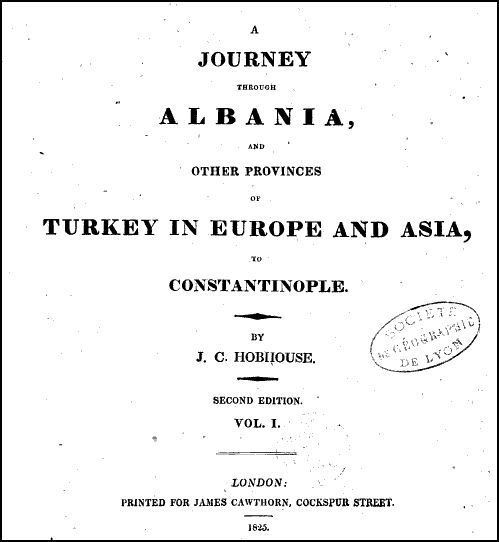
History is very important. This is how I learned about modern greece;

Hobhouse.jpg

Hobhouse596.jpg
 
@ TrueMacedinian

As I have repeated many, many times (endlessly) modern Greece is, like all nation states, a social and cultural construct. "Ethnically" the modern Greek people have been formed out of different linguistic groups: Albanians, Slavs, Vlachs, Italians etc. This is true of the people of Spain, France, Britain, Germany, Russia, and of course, the US, Canada, Australia and so on.

Out of these disparate people, a modern Greek nation was formed with a predominant language and a strong national identity. National identity is based on a collective myth, an emotional and cultural union of different peoples.

The question is, how and why did all these different people, one bright and sunny day, decide to abandon their native tongue and culture and suddenly decide to speak Greek and think of themselves in that way?

Hobhouse's observations are astute and for the most pat accurate. I and others agree with him and what I have written above agrees with what you have underlined.

You are arguing against a "straw man" of your own creation who says that the modern Greeks are direct blood descendants of the ancient Greek people (who themselves were a mixed bag of other "races"). No one but a simpleton or a thug from the Golden Dawn Nazi Party (the same thing, really) would say such a thing.
 
The southernmost ("Greek") peninsula of the Balkans was left outside effective control for many centuries, this, and its open exposure to the sea and proximity to other continents made it accessible and vulnerable to the migrations and invasions of a large variety of different peoples. Yet, from these extremely diverse migrations and settlements of a wide variety of different linguistic and tribal groups, a unitary modern Greek state predominantly speaking the Greek language and with a single national identity (for the most part) was formed. Surely, this is no small accomplishment.
 
The question is, how and why did all these different people, one bright and sunny day, decide to abandon their native tongue and culture and suddenly decide to speak Greek and think of themselves in that way?
So its the math that's got you puzzled, or are you playing games.

It did not happen in "one bright sunny day"
But it took time and effort by western powers and fantasising Bavarian kings together with the kings architects, then add a spice of evil priests and a number of dictators during the journey and you have a creation (over time) of hallucinating nut cases that still exist till this day.
 
@ TrueMacedinian

As I have repeated many, many times (endlessly) modern Greece is, like all nation states, a social and cultural construct. "Ethnically" the modern Greek people have been formed out of different linguistic groups: Albanians, Slavs, Vlachs, Italians etc. This is true of the people of Spain, France, Britain, Germany, Russia, and of course, the US, Canada, Australia and so on.

Out of these disparate people, a modern Greek nation was formed with a predominant language and a strong national identity. National identity is based on a collective myth, an emotional and cultural union of different peoples.

The question is, how and why did all these different people, one bright and sunny day, decide to abandon their native tongue and culture and suddenly decide to speak Greek and think of themselves in that way?

Hobhouse's observations are astute and for the most pat accurate. I and others agree with him and what I have written above agrees with what you have underlined.

You are arguing against a "straw man" of your own creation who says that the modern Greeks are direct blood descendants of the ancient Greek people (who themselves were a mixed bag of other "races"). No one but a simpleton or a thug from the Golden Dawn Nazi Party (the same thing, really) would say such a thing.

I'm not just pointing out the obvious ethnic dilmma with modern Greece. There is certainly a cultural issue. Hellenism was a 19the century invention. I know you know this. So back to square one. What are you even posting in a topic that unrelated to you and your kind? What exactly does forcing a population to speak a foreign language, romaika, have to do with your connection to antiquity? Do you see the issue here? Maybe you can also elaborate on your book reviews on Amazon.
 
If the people of of the ROM also had Greek as a mother tongue, what "dispute" would exist between them and the Republic to the south?

Certainly it will be no dispute, if we share the same or similar language. But it is very hard to imagine a situation like that :D .

As for the Greek that "was no one's mother tongue," when exactly did it disappear and when and how did it start up again? Did the Germans teach the Greeks how to speak it in 1821 using the highly successful "Rosetta Stone" method? Greek is well established as a spoken language throughout the ages. Poems, folk songs, popular works of literature, formal and informal communications between authorities, and between common people exist from every period without interruption. When exactly was the period when Greek was not spoken by any population? When and why was it suddenly taken up by an entire people?

Maybe you didn't understand me correctly, or my words were not clear, sorry friend. I didn't want to mean that the greek language have disappeared. Greek survived throughout the ages, it is a undeniable fact. But when i said that the greek was the mother tongue for no one for centuries, i wanted to say that it was not the native tongue for anybody for centuries. The native tongue of the peoples in Greece, 300 years ago, was slavic, albanian or vlach ... Greek was a language that they learned, for religion, trade etc ... It was not the language with wich they were raised, not the language of their mothers.

Just like today in Greece, "Macedonian" is a synonym for "Greek," so Plutarch was using the word "Macedonian" to signify the language spoken was Greek. To prove otherwise, you would have to find a passage where Plutarch says that someone was speaking "Macedonian" and not "Greek". Since so many ancient authors said that someone spoke "Macedonian," and not meaning "Greek" by it, there must certainly exist some example of it or the very same authors could not have known what it was.

I think personally that the world "Macedonian" becoming synonym of "Greek", is a very recent phenomenom. You will be certainly interested to know that Pavlos Melas, a greek historical figure, refered in his letters in 1904, to a macedonian language :

[...]Pirzas translated emotionally, loudly, and with a lot of passion, as Kota spoke Macedonian[...]

I learned Macedonian words that I say to women and mothers, which pleases them[...]

Pavlo Melas ,who died for Macedonia becoming part of Greece, did recognize at his time a macedonian people, and a macedonian language.

Look also at this picture http://i198.photobucket.com/albums/aa260/Piperkata/Macedonian-GreekLexicon1907-malo.png. Now maybe you understand that the greek logic Macedonian=Greek is recent. There is a lot of examples like that, greeks referring to a slavic-like macedonian language in the XIX-XX centuries. And it is not only the greeks, the international community have referred to our language as macedonian. The "institut d'études slaves de l'université de paris" (My country and my city :D) have produced, in 1958, a lexicon about the macedonian dialect of Kostur (now Kastoria), wich is based of words and phrases from south-west Macedonia in the 16th century. You can take a look here : http://fr.scribd.com/doc/28858477/Macedonian-Lexicon-XVI-Century-Un-Lexique-Macedonien-du-XVie-siecle. Write "macedonian language" in the tool "Search Forums"-"Search titles only" and you will find numerous documents that concord with my words.

Now about the ancient world and Macedonia. We both know that a nation called "Macedonian" appeared around 700 to 800 B.C. If this nation was greek, a part of the greek-speaking world, why there are no inscriptions in any form of Greek from before about 400 B.C. found in material excavated in any part of Macedonia ? Because greek language and his adoption by the Macedonian elite was a recent phenomenom. In time their leaders aspired to be as culturally refined and politically powerful as the Greeks, and used Greek teachers for their children. We must not denying the fact that macedonians leaders wanted a rapprochement with Greece and his very powerful culture. But you must no hide the fact that the greeks never saw the macedonians as greeks. So did the macedonians themselves. The Greeks called them barbarians, along with the Persians, Illyrians, and Thracians, a label that they attributed to all non-Greeks who neither spoke nor understood the Greek language. Actually, and it's funny, the macedonians were worse than barbarians if we had to believe Demosthenes, who claimed that Philip II was "not only not a Greek, nor related to the Greeks, but not even a barbarian from any place that can be named with honors, but a pestilent knave from Macedonia, whence it was never yet possible to buy a decent slave" (Third Philippic, 31). You should know better than me the signification of this word, barbarous, it's a very powerful word and i think that the greeks today try to attenuate it. One should not see the absence of evidence as an evidence of absence. Many languages have not left traces, but ancient texts tell us that they existed, it is the case of the macedonian language.

As you quote from Dunand, there were many equivalencies among alien gods in the pagan world: Dionysos to Osiris, Apollo to Horus, Zeus to Amon, Zeus to the Norwegian Thor, etc, etc. However, the name of the god signified the speaker's tongue, his "ethnicity." Only the Greeks said "Zeus" while the Egyptians said "Amon". If someone said he worshiped "Osiris", he would not be thought to be Greek and if someone said he worshiped "Dionysos" he would not be thought Egyptian. More clearly, the Roman and Greek gods were identical, yet a Roman would say that he worshiped Minerva and a Greek Athena, a Roman Jupiter and a Greek Zeus. By simply saying "Minerva" or "Athena" one could tell if the speaker were Roman or Greek even though they were the exact same goddesses. The Macedonians worshiped the same Greek gods in the same Greek names, in the same Greek language.

I totally disagree with you. Believing in gods with greeks names (i will call them, hellenic gods) did not make you greek. Here's what happened when Paul and Barnabas visited Lystra, a city of Lycaonia, in Asia Minor :

14:8-10 Paul noticed this cripple who was listening very intently. We wonder what was meant by "seeing that he had faith to be healed." When Luke questioned Paul he might have said "As I saw his faith, I just knew God was touching him, and I remembered hearing about the cripple who was healed near the temple in the early days of the church. So, like Peter I just told him to stand up and he did" (2:1-6).

14:11-13 Everybody knew this cripple, who probably begged by the city gate, and when they saw him standing up and walking the Phrygian people shouted excitedly in the Lycaonian language that Barnabas must be Zeus and Paul must be Hermes (Zeus' messenger). Paul and Barnabas apparently did not know what was happening till the priest of the temple of Zeus' brought oxen (garlanded with marigold flowers) to offer sacrifice in the open space by the city gate.

14:14-15 Barnabas and Paul rushed into the crowd to prevent this. The tearing of one's clothes was a sign used to express great horror (Judges 11:35, 2 Samuel 1:11, 3:31, 1 Kings 21:27). They explained that they were ordinary mortals (not like the gods of polytheism), and they had been preaching good news about the living God, creator of the universe.

Our holy book tells the truth :D !

For finishing my post i will quote a part of a text from the book of John Shea, Macedonia and Greece: The Struggle to Define a New Balkan Nation:

It should be noted that several ancient writers acknowledged the close association of the Macedonians and the Greeks, once the Greeks had been conquered by the Macedonians. Often the Macedonian rulers wanted the Greeks to be working in concert with them, though the Greeks were less enthusiastic about this idea. As already noted, the Macedonian leaders, from about the fourth century B.C., moved increasingly to adopt the use of the Greek language for official affairs, and were attracted by facets of Greek culture. Greek culture was spread widely throughout the world by Macedonians rulers in their Macedonian Empire, and then by Romans in the Byzantine Empire. To be consistent one might just as well argue that since the Romans maintained and spread Greek culture they must have been Greek. Of course this is obviously wrong, but it points to the weakness of this argument when applied to the Macedonians.

There are several sources and texts about the conquest of Alexander the Great of Macedon. He did not care about spreading hellenism, his ambition was totally different. And the language wich with he adressed to his troops was not greek, but macedonian. In that time they even needed translators !

I will post later an history of a conlict of Alexander and one of his general/friend. I don't know correctly, i need to find the text. And sorry for taking me so long for respond. English is not my native language, and to write a complete and understanding answer is difficult. I need to train my english :D !

A last thing. Medeius of Larisa was one of the Greeks accompanying Alexander the Great in Asia. According to him the Thessalians are "the most northerly of the Greeks", thus excluding the Macedonians as non-Greeks since they live north of Thessaly.
 
Last edited:
@ Bill77:

I believe you are saying that for some unexplained reason the Germans and the British were able to entice or force a varied collection of unrelated tribes to speak another language and assume an entirely different culture totally alien from their own. It is an extraordinary supposition. If it is true, the results were amazingly successful and evident for all to see: a unified modern Greek State with a dominant language and culture and a cohesive and powerful (even overbearing) collective national identity which is recognised internationally. It was a bold and astonishingly successful experiment in human engineering on the part of the Germans and the British. I presume the Greeks are grateful.

I am not being facetious. We both agree that the modern Greeks exist. You say that they, their language and their culture were created out of full cloth by the Germans and the British. Fine. Whoever created them, they are nonetheless there with a collective national identity speaking as a mother tongue an evolved version of a language that has a long historical record, even if that language had been somehow "interrupted" and had to be resurrected (an hypothesis which contradicted by the evidence, but let's assume it's true).

Have I interpreted and understood your point correctly?
 
Hi Nexus. Thanks for your post. It's a long one and I will try to respond in sections.

You say "The native tongue of the peoples in Greece, 300 years ago, was slavic, albanian or vlach ... Greek was a language that they learned, for religion, trade etc ... It was not the language with wich they were raised, not the language of their mothers."

There was no "Greece" 300 years ago. The modern Greek State was created in the early 19th century from the various linguistic tribes that you mentioned (you left out the Greek-speaking ones) in what was a part of the Ottoman empire. That these people had a collective, Greek-speaking identity is evidence by the revolution against the Turks and the subsequent creation of a Greek-speaking state which (for better or worse) still exists today.

Your supposition that these tribes gave up their own language in order to speak Greek is a bit ahistorical and unprecedented but for the sake of argument I will agree with you: because of religion and business and whatever they gave up their own languages and now speak Greek. It does not change the fact that modern Greece is (for the greatest part) a unified, Greek-speaking State.

Alexander did indeed believe, we are told, in a form of "internationalism". This does remove him from his own culture. There have been, and there are, many people who advocate the cultural and national unity of different civilizations. The Englishman Bertrand Russell, the German Karl Marx come immediately to mind but there have been too many to list.

Regarding language. In Germany still today, there are so many and so strong German dialects that a person from one village might have difficulty understanding someone from a village not too far away. While this has been greatly reduced by modern communications, there are still stark differences in words and pronunciations in German and within other European languages. In the northern periphery of the Greek-speaking world, it would have been extraordinary if there weren't dialectic differences between people. I believe even in a small area like Macedonia, there are differences, to whatever extent, between the Macedonian of one region and another.

Your English is very good, indeed. I wish I could speak and write Macedonian as well as you do English.
 
A little more on language. English is my mother tongue (literally) but I find myself smiling and nodding incomprehensively whenever I "speak" to a Yorkshireman (someone from the "English"-speaking region of Yorkshire in northern England).

Of course, the linguistic definition of language is far more complex than my anecdotal example and lies well beyond my field of knowledge. My understanding is that the weight of linguistic evidence and opinion (though never a concensus, of course) is that that the ancient Macedonians spoke a dialect of Greek which, in time, contributed to and was assimilated into the Koinoi, or "Common" Greek version.
 
I wrote hastily: "That these people had a collective, Greek-speaking identity is evidence by the revolution against the Turks and the subsequent creation of a Greek-speaking state which (for better or worse) still exists today."

Of course, the linguistic assimilation of the non Greek-speaking people in the new State took place over a period of time. After its creation and for a time later, there were many pockets of non-Greek-speaking populations. The Vlachs and the "Grkomen" (is that right?) of today still have their original languages to a greater or lesser extent. They are, nonetheless, Greek in identity as are the descendants of those from the exchange of populations between Greece and Turkey that were settled in Greek Macedonia, some of whom knew no Greek at all and some of whom probably had a "Christian" rather than "Greek" identity. They feel Greek now so have some pity on them.
 
Back
Top