• Welcome to the new Macedonian Truth Forum. All posts, members and private messages have been moved over from the old forum.

    Passwords from the old forum could not be carried over, so please use Forgot your password? to set a new one. The reset link is emailed to the address on your account.

  • Rules and Regulations at the forum of the Macedonian Truth Organisation (MTO)

    (1) The national-ethnic and cultural-linguistic identity of the Macedonian people is historically Macedonian, and derives its character from the native, indigenous and geographic homeland of the Macedonians, which is called Macedonia. To ensure that their human rights, integrity and heritage are appropriately respected, the only nouns and adjectives acceptable when reference is made to the above character and identity markers is Macedon, Macedonia, Macedonian and Macedonians.

    (2) The nation-state of the Macedonian people is the Republic of Macedonia, and is to be referred to by this official title so long as the 'republic' prefix is consistently applied to other states. Alternative references are the Macedonian Republic, or simply, Macedonia.

    (3) The 'ethnic' prefix is only acceptable for Macedonians in cases where differentiation is specifically required - so long as it is in context and consistent where it concerns its application to other ethnic groups.

    (4) Should any other differentiation be specifically required, the names of other ethnic groups that reside with Macedonians in either the Republic of Macedonia or the occupied Macedonian regions in Greece, Bulgaria, Serbia or Albania, are to be given a prefix.

    (5) Negating the identity, language and culture of the Macedonian people by deliberate avoidance of the terms Macedonia, Macedonian and Macedonians, or by any other means, is not permitted.

    (6) Systematic anti-Macedonian propaganda and rhetoric are not permitted.

    (7) Threads irrelevant to the Macedonian Cause, the community at the Macedonian Truth Organisation or the Macedonians in general may be considered as spam or not in the spirit of the forum. In such cases they are not permitted.

    (8) Continual posting of messages in threads with the sole purpose of deviating from the initial topics with the use of unrelated and unnecessary information is not permitted.

    (9) All posts, external articles, reports, etc that are cited in languages other than Macedonian or English, must be accompanied with a translation in one or both of the said languages.

    (10) Despite the possibility of some conversations and debates becoming heated, extreme abuse and/or racism, vulgar language and/or terminology, threats, revelation of personal information about others, harassment, and other such behavior will not be permitted. If deemed necessary all relevant information including member details will be reported to the appropriate authorities for investigation which may result in legal action.

    (11) Threads that are created must have a summary of a topic or excerpt of an article found in pertinent link(s) that have been included. One line threads will be considered unaccetable spam and are therefore not permitted.

    (12) Compulsive and deliberate lies, irrespective of the topic, are not permitted.

    (13) Any symbols or avatars found to be perceived as offensive to Macedonians are not permitted.

    (13) Any explicit or extreme material is not permitted.

    Failure to adhere to the above rules and regulations will result in a ban after 3 breaches. This may be reconsidered in some cases should the circumstances be of an unorthodox nature and/or require special consideration. To assure an effective deterrent against an individual or individuals with the sole purpose of causing dissent through spamming, racism or other improper means, the above rules will be strictly enforced.

    The MTO administration will monitor all discussions as reasonably practical and reserve the right to remove any post and/or member from the forum, and update the rules and regulations as required. Members are encouraged to immediately report any post and/or member to the MTO administration if they feel that these rules have not been abided by.

    The views expressed on this forum are those of the individuals. The only official representation of the MTO is made by the "Macedonian Truth Organisation (Site Owner)" username, and no other.

  • Macedonian Cause

    The Macedonian Truth Organisation calls on God in Heaven to protect, bless and guide the endeavour it is committing to undertake, and that is to work towards:

    Securing Macedonia as a free, independent and democratic republic in which sovereignty lies with the Macedonian citizens; as the nation-state of the Macedonian people in which they can preserve their culture, language and identity; as a state in which the Macedonian language and culture form the basis of public life and act as important unifying elements of Macedonian society; as the home of all its citizens to which it guarantees and obliges their inalienable natural rights and corresponding responsibilities;

    The acknowledgment as self-evident and irrefutable the existence of the:

    1) Indigenous, ethnonational name of Macedonia;
    2) Macedonian people, language and identity;
    3) Macedonian culture, symbols and folklore;
    4) Macedonian ancestry, heritage and history in its entirety; and
    5) Macedonian Orthodox Church;

    Securing recognition by the International Community of the tragedies endured by the Macedonian people, of the division of Macedonia with the signing of the Treaty of Bucharest on August 10, 1913, and the genocide committed against the Macedonian people at the hands of the Greek, Bulgarian and Serbian states and their respective churches during the 19th and 20th centuries;

    Ensuring that the Interim Accord is declared ‘null and void’ and that all constitutional provisions, acts, commitments, agreements, legislation, regulations, policies or programs emanating from, supporting or consequential to the Interim Accord are also declared ‘null and void’, including the use of any symbols and the completion of any acts imposed by, or originating from, the Interim Accord.

    Ensuring that the Framework Agreement is abolished and that all constitutional provisions, acts, commitments, agreements, legislation, regulations, policies and programs emanating from, supporting or consequential to the Framework Agreement are also abolished and replaced by a framework of constitutional and statutory law based on inalienable natural rights and corresponding responsibilities and universally codified human rights mechanisms.

    Securing the abolishment of any existing constitutional provisions, acts, agreements, legislation, regulations, policies and programs that discriminate against the Macedonian people, in any international organisation or any of the countries of the International Community where such constitutional provisions, acts, agreements, legislation, regulations, policies and programs exist, and thereby ensuring the freedom for Macedonians to exercise their inalienable natural rights and fulfil their corresponding responsibilities, and practice their culture, language and religious faiths in all the countries of the International Community without hindrance;

    The empowerment of Macedonians to undertake a moral revolution and to instil and/or reinvigorate within themselves a deep-rooted national, cultural, linguistic and historical dignity and a commitment to the exercise of freedom based on inalienable natural rights and corresponding responsibilities;

    The recognition of the Macedonian minorities in the neighbouring states of Macedonia as well as the respect for the inalienable rights and freedoms of the Macedonian minorities, as provided for by natural law and as codified by the United Nations Charter, the Universal Declaration of Human Rights and other universally codified human rights mechanisms;

    The full and unreserved respect of, and the support for, the rights of all people of non-Macedonian descent living in Macedonia and around the world, who share a reciprocal full and unreserved respect for the Macedonian people, their homeland and their state;

    The cultural unification and solidarity of the Macedonian people living in all parts of historical Macedonia and adjacent territories, as well as Macedonians throughout the world;

    The unity of all Macedonians on the principles, objectives and achievement of the Macedonian cause as defined by this declaration.

Population of Macedonia and Adjacent Areas

Tm who was it that came in the 7/or 8th century ad??The albanoi came from asia.Prior to that it was illyrian but how much of them mixed with the albanians.Recent tests i saw in one article actually show that dna tests only show 10% of the people are illyrian,the same apply for illyrians in macedonia & even greece.As a matter of fact the research goes on to show that most people in albania they all show 10% of the population is illyrian. areThe albanians in albania apparently most of them are actually slavs.Who knows??
 
Last edited:
Genetics wise, most of the ancient Balkan population (Thracians, Illyrians, Macedonians, Greeks etc.) has been disappeared between 5-11th century AD because of the dark plague, famine, wars, eastern Roman settlement policies against invading tribes/groups and other causes. So, today`s genetic pool of the Balkans is largely the heritage of post 11th century. Ofc the ancient people surely left their genes too but it`s faint.

The remaining ancient people has been culturally transformed and lost/changed their former identities because of empirical policies of the Roman era. Only some elements of the ancient cultures are still alive today but these remnants are so shallow because most of these cultural elements also disappeared due to christianization.

I am not counting Ottoman era here because that transformation was already completed b4 14th century. The only major cultural transformation happened during Ottoman era was the islamization of Bosnians and some Albanians and this is not even 5% of all the Balkan population.
 
Last edited:
Tm who was it that came in the 7/or 8th century ad??The albanoi came from asia.Prior to that it was illyrian but how much of them mixed with the albanians.Recent tests i saw in one article actually show that dna tests only show 10% of the people are illyrian,the same apply for illyrians in macedonia & even greece.As a matter of fact the research goes on to show that most people in albania they all show 10% of the population is illyrian. areThe albanians in albania apparently most of them are actually slavs.Who knows??

George, I would need to see a few things about these 'tests'. I am assuming you mean the iGENEA genetic test (which no one on this forum by the way is interested on providing any peer reviewed material about iGENEA ,wonder why?)

I won't go by assumptions. I think that the migration evidence of Albanians into what is now grcija shows us what Macedonia's southern neighbors are definitely NOT. And is related to the ancient Hellenes ethnically and culturally. What are Albanians? Well they used to believe that they descended from an Arab named Jabali Alhama - http://www.macedoniantruth.org/forum/showthread.php?t=1966&highlight=albanian+myths&page=3
 
Last edited:
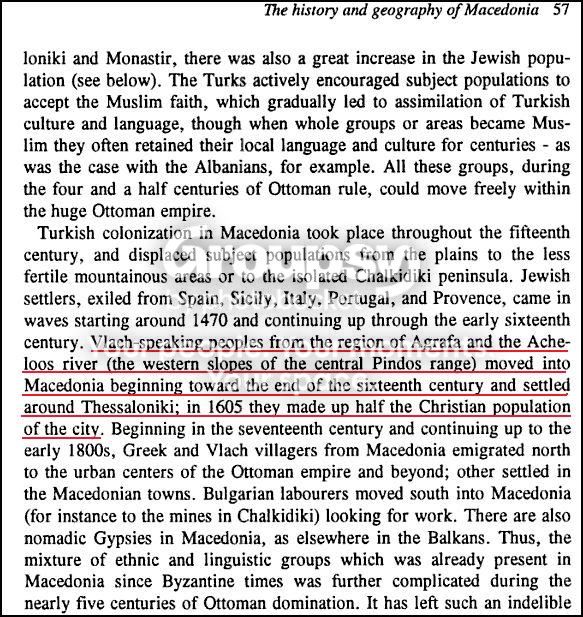
VlachsSalonica.jpg

VlachsSalonica57.jpg


Vlachs were half the christian population of Solun. Why am I not surprised. They were the merchants, artisans, well-to-do of the city. Hence they were the "greeks".
 
Last edited:
Genetics wise, most of the ancient Balkan population (Thracians, Illyrians, Macedonians, Greeks etc.) has been disappeared between 5-11th century AD because of the dark plague, famine, wars, eastern Roman settlement policies against invading tribes/groups and other causes. So, today`s genetic pool of the Balkans is largely the heritage of post 11th century. Ofc the ancient people surely left their genes too but it`s faint.

The remaining ancient people has been culturally transformed and lost/changed their former identities because of empirical policies of the Roman era. Only some elements of the ancient cultures are still alive today but these remnants are so shallow because most of these cultural elements also disappeared due to christianization.

I am not counting Ottoman era here because that transformation was already completed b4 14th century. The only major cultural transformation happened during Ottoman era was the islamization of Bosnians and some Albanians and this is not even 5% of all the Balkan population.

I agree, but not entirely. The ancient Balkan populations that did manage to survive were romanized and spoke Latin dialects (ancestors of 'Vlachs', especially those south of the Danube).

Most of the real Hellenes even disappeared long before the 5th century AD. Some did manage to survive but were wiped out by plagues, famines, wars, and other calamities (earthquakes, floods). The death blow came with the Gothic and Slavic-Avar invasions and settlement.

In general - people (Romans by this time..) who survived retreated to the mountains and inaccessible areas, and it is no surprise that only Vlach-speakers emerge from these regions after a few centuries.
 
The ancient Balkan populations that did manage to survive were romanized and spoke Latin dialects (ancestors of 'Vlachs', especially those south of the Danube).........people (Romans by this time..) who survived retreated to the mountains and inaccessible areas, and it is no surprise that only Vlach-speakers emerge from these regions after a few centuries.
That is such a simplistic take on things that it doesn't even begin to address a range of other factors. What evidence is there to support what you've written above, about the Balkan peoples retreating to mountains?
 
Genetics wise, most of the ancient Balkan population (Thracians, Illyrians, Macedonians, Greeks etc.) has been disappeared between 5-11th century AD because of the dark plague, famine, wars, eastern Roman settlement policies against invading tribes/groups and other causes. So, today`s genetic pool of the Balkans is largely the heritage of post 11th century. Ofc the ancient people surely left their genes too but it`s faint.
This sounds like a load of crap to me.

What evidence do you have of the near total disappearance of the ancient peoples?

What peoples do you claim were settled in the Balkans after the 11th century, seeing as you claim the "genetic pool" of the existing populations are post 1000's?
 
This sounds like a load of crap to me.
I disagree with that suggestion also.
What peoples do you claim were settled in the Balkans after the 11th century, seeing as you claim the "genetic pool" off the existing populations are post 1000's?
Good question. The most obvious peoples that spring to mind who had a serious impact on the East Roman Empire from that point onwards (aside from the Western Christians, Crusaders, etc) were the Turkic tribes from Asia. Is that where you were going with your suggestion, Onur?
 
That is such a simplistic take on things that it doesn't even begin to address a range of other factors. What evidence is there to support what you've written above, about the Balkan peoples retreating to mountains?

There is plenty of evidence from historical sources, although things are never black and white. What other factors did you have in mind?

Don't forget that Vlach-speakers also lived in the mountainous areas/inaccessible valleys, etc. of Bosnia, Montenegro, and Serbia - not just Albania, Macedonia, Greece.
 
Name some that refer to Balkan peoples retreating to the mountains. And while you're at it, name some that speak of their 'return' from the mountains centuries later.

Based on what credible sources do you deny this hypothesis? :)

What I stated is not my opinion but an accepted framework given by most scholars based on an analysis of medieval documents and texts.
 
Based on what credible sources do you deny this hypothesis? :)

What I stated is not my opinion but an accepted framework given by most scholars based on an analysis of medieval documents and texts.
If what you stated is the 'accepted framework' for most scholars, then you should be able to easily provide some sources, along with references to the medieval documents and texts.

Seeing as you are making the claim, the onus is on you to provide the evidence. The opposite is a perversion of the scholarly system of investigation and debate which you claim to be relying on.
Exactly. I know where he is heading with this anyway, it's the same story one hears of "Illyrians" disappearing into the mountains for half a millenia and then returning as 'Albanians'. Fanciful stuff. I know some western scholars even support such a thesis, but I don't recall seeing a contemporary source ever mentioning such a phenomena, not when they left, nor when they returned.
 
Exactly. I know where he is heading with this anyway, it's the same story one hears of "Illyrians" disappearing into the mountains for half a millenia and then returning as 'Albanians'. Fanciful stuff. I know some western scholars even support such a thesis, but I don't recall seeing a contemporary source ever mentioning such a phenomena, not when they left, nor when they returned.

The 'story' with the Illyrians doesn't rest on firm ground. The 'story' with the Vlachs is different as these Latin-speakers do have a clear connection with the pre-6th/7th c. Roman civilization and culture.

Most retreated to the mountains, but some stayed back (mostly in walled towns, protected by the Roman army), others were carried away as captives by the Slavs or Avars, others fled to the islands, etc. As I said, it's not a black and white issue where other scenarios didn't occur - but the main point is the majority of those who survived fled to higher ground and they emerge from these regions as Vlach/Latin-speakers a few centuries later.

The process of migration/returning was not a one time event, but occurred over a period of many decades, if not a couple of centuries. Modern historians find it difficult to explain relatively recent migrations, much less fix a specific time and date for something that happened almost 1500 years ago.

The best proof is Byzantine writers which make mention of various 'Wallachias' starting in the 11th century (i.e. Anna Komnene, first mention of Vlachs in Thessaly; Frantzis: Little Wallachia in Aetolia, Acarnania, Upper Wallachia in Epirus; Benjamin of Tudela: Great Wallachia/Wallachian Thessaly). By this time there were actually Slavs living in the plains of these regions (Epirus, Thessaly and further south; Macedonia was mostly 'Slavic'-speaking already), so Slavs and Vlachs likely intermingled eventually. The first mention of Vlachs is in roughly 976, when Kedrenos writes about the murder of Samuel’s brother by certain Vlach wayfarers (but that's about it..).

In 1221 AD the bishop of Nafpaktos John Apokafk notes the existence in Acarnania a rather significant number of "Roman colonists", now called Vlachs. This is a 'quote' (actually one of many) which the proponents of the Illyrian-Albanian hypothesis do not have at all.

Anyway, do you think terms such as 'Stari Vlah' in southwestern Serbia are a coincidence?

http://en.wikipedia.org/wiki/Stari_Vlah
 
The 'story' with the Vlachs is different as these Latin-speakers do have a clear connection with the pre-6th/7th c. Roman civilization and culture.
I don't doubt that, but their language is closely related to Romanian, and eastern Romance only became distinct from Vulgar Latin some time after the 6th century, and probably even as late as the 9th century. It seems unlikely that the Latin spoken near the Carpathians underwent practically the same sound changes as the Latin supposedly spoken in distant lands like Macedonia, Greece and Albania (the last of which fell within the sphere of western Romance, like Dalmatian) during the same period. It is more likely that Vlachs moved south of the Danube from what became Romania after eastern Romance came to be distinct from Vulgar Latin. That is not to say that Latin-speaking peoples weren't in other Balkan regions also, but the language of the Vlachs is too similar to Romanian to be coincidental.
........main point is the majority of those who survived fled to higher ground and they emerge from these regions as Vlach/Latin-speakers a few centuries later.
Carlin, you can keep repeating it all you want. Until you show us a contemporary source of this happening, it is little more than your own fantasy.
The best proof is Byzantine writers which make mention of various 'Wallachias' starting in the 11th century (i.e. Anna Komnene, first mention of Vlachs in Thessaly; Frantzis: Little Wallachia in Aetolia, Acarnania, Upper Wallachia in Epirus; Benjamin of Tudela: Great Wallachia/Wallachian Thessaly). By this time there were actually Slavs living in the plains of these regions (Epirus, Thessaly and further south; Macedonia was mostly 'Slavic'-speaking already), so Slavs and Vlachs likely intermingled eventually. The first mention of Vlachs is in roughly 976, when Kedrenos writes about the murder of Samuel’s brother by certain Vlach wayfarers (but that's about it..).
None of which speak about disappearing into mountains and returning centuries later.
In 1221 AD the bishop of Nafpaktos John Apokafk notes the existence in Acarnania a rather significant number of "Roman colonists", now called Vlachs.
Please provide the full quote and a link if possible.
Anyway, do you think terms such as 'Stari Vlah' in southwestern Serbia are a coincidence?
That doesn't prove anything. There are many placenames in the Balkans that start with the word 'stari'.
 
I don't doubt that, but their language is closely related to Romanian, and eastern Romance only became distinct from Vulgar Latin some time after the 6th century, and probably even as late as the 9th century. It seems unlikely that the Latin spoken near the Carpathians underwent practically the same sound changes as the Latin supposedly spoken in distant lands like Macedonia, Greece and Albania (the last of which fell within the sphere of western Romance, like Dalmatian) during the same period. It is more likely that Vlachs moved south of the Danube from what became Romania after eastern Romance came to be distinct from Vulgar Latin. That is not to say that Latin-speaking peoples weren't in other Balkan regions also, but the language of the Vlachs is too similar to Romanian to be coincidental.

Carlin, you can keep repeating it all you want. Until you show us a contemporary source of this happening, it is little more than your own fantasy.

None of which speak about disappearing into mountains and returning centuries later.

Please provide the full quote and a link if possible.

That doesn't prove anything. There are many placenames in the Balkans that start with the word 'stari'.


Chronicle of Monemvasia.

If this manuscript is somehow proven to be a forgery, it stands as valid evidence.

According to the manuscript, the Avars and Slavs conquered Thessaly, Epirus, Attica. Many natives retreated to other areas: the nearby islands or elsewhere. The city of Monemvasia, specifically, was built at the time on the coast in an inaccessible region of the Peloponnese by groups that would later be known collectively as Tzakones. As I have already stated, Tzakones were later on identified as Vlachs.

The following video specifically mentions that both Tzakones and Maniotes were Vlachs (it's in Greek though).
http://www.macedoniantruth.org/forum/showthread.php?t=6633
 
Carlin, what exactly is a real Hellene ? Greeks in antiquity were not immune to intermarriage (Carians for example). Civilised nations usually have contact with other peoples and their contact sometimes can result in a marriage and offspring. This notion of purity is practically nonexistant. Except maybe the eskimos or other isolated amazonian tribes.

According to the manuscript it was only for 200 odd years. Not to mention it was not an extermination spree like the ovens in Auschwitz, but more of an apartheid type of dominance. There is no archeological evidence of destruction during those years either, something Fallemeyer had a hard time explaining. I also disagree with the impact of Vlachs in Tsakonia, that also doesnt make a lot of sense.

Genetics wise, most of the ancient Balkan population (Thracians, Illyrians, Macedonians, Greeks etc.) has been disappeared between 5-11th century AD because of the dark plague, famine, wars, eastern Roman settlement policies against invading tribes/groups and other causes. So, today`s genetic pool of the Balkans is largely the heritage of post 11th century. Ofc the ancient people surely left their genes too but it`s faint.

Genetics wise the foreign invaders were absorbed by the locals. A genetic impact did happen but not to the point to erase their anthropoligical characteristics or origins.
 
Back
Top