• Welcome to the new Macedonian Truth Forum. All posts, members and private messages have been moved over from the old forum.

    Passwords from the old forum could not be carried over, so please use Forgot your password? to set a new one. The reset link is emailed to the address on your account.

  • Rules and Regulations at the forum of the Macedonian Truth Organisation (MTO)

    (1) The national-ethnic and cultural-linguistic identity of the Macedonian people is historically Macedonian, and derives its character from the native, indigenous and geographic homeland of the Macedonians, which is called Macedonia. To ensure that their human rights, integrity and heritage are appropriately respected, the only nouns and adjectives acceptable when reference is made to the above character and identity markers is Macedon, Macedonia, Macedonian and Macedonians.

    (2) The nation-state of the Macedonian people is the Republic of Macedonia, and is to be referred to by this official title so long as the 'republic' prefix is consistently applied to other states. Alternative references are the Macedonian Republic, or simply, Macedonia.

    (3) The 'ethnic' prefix is only acceptable for Macedonians in cases where differentiation is specifically required - so long as it is in context and consistent where it concerns its application to other ethnic groups.

    (4) Should any other differentiation be specifically required, the names of other ethnic groups that reside with Macedonians in either the Republic of Macedonia or the occupied Macedonian regions in Greece, Bulgaria, Serbia or Albania, are to be given a prefix.

    (5) Negating the identity, language and culture of the Macedonian people by deliberate avoidance of the terms Macedonia, Macedonian and Macedonians, or by any other means, is not permitted.

    (6) Systematic anti-Macedonian propaganda and rhetoric are not permitted.

    (7) Threads irrelevant to the Macedonian Cause, the community at the Macedonian Truth Organisation or the Macedonians in general may be considered as spam or not in the spirit of the forum. In such cases they are not permitted.

    (8) Continual posting of messages in threads with the sole purpose of deviating from the initial topics with the use of unrelated and unnecessary information is not permitted.

    (9) All posts, external articles, reports, etc that are cited in languages other than Macedonian or English, must be accompanied with a translation in one or both of the said languages.

    (10) Despite the possibility of some conversations and debates becoming heated, extreme abuse and/or racism, vulgar language and/or terminology, threats, revelation of personal information about others, harassment, and other such behavior will not be permitted. If deemed necessary all relevant information including member details will be reported to the appropriate authorities for investigation which may result in legal action.

    (11) Threads that are created must have a summary of a topic or excerpt of an article found in pertinent link(s) that have been included. One line threads will be considered unaccetable spam and are therefore not permitted.

    (12) Compulsive and deliberate lies, irrespective of the topic, are not permitted.

    (13) Any symbols or avatars found to be perceived as offensive to Macedonians are not permitted.

    (13) Any explicit or extreme material is not permitted.

    Failure to adhere to the above rules and regulations will result in a ban after 3 breaches. This may be reconsidered in some cases should the circumstances be of an unorthodox nature and/or require special consideration. To assure an effective deterrent against an individual or individuals with the sole purpose of causing dissent through spamming, racism or other improper means, the above rules will be strictly enforced.

    The MTO administration will monitor all discussions as reasonably practical and reserve the right to remove any post and/or member from the forum, and update the rules and regulations as required. Members are encouraged to immediately report any post and/or member to the MTO administration if they feel that these rules have not been abided by.

    The views expressed on this forum are those of the individuals. The only official representation of the MTO is made by the "Macedonian Truth Organisation (Site Owner)" username, and no other.

  • Macedonian Cause

    The Macedonian Truth Organisation calls on God in Heaven to protect, bless and guide the endeavour it is committing to undertake, and that is to work towards:

    Securing Macedonia as a free, independent and democratic republic in which sovereignty lies with the Macedonian citizens; as the nation-state of the Macedonian people in which they can preserve their culture, language and identity; as a state in which the Macedonian language and culture form the basis of public life and act as important unifying elements of Macedonian society; as the home of all its citizens to which it guarantees and obliges their inalienable natural rights and corresponding responsibilities;

    The acknowledgment as self-evident and irrefutable the existence of the:

    1) Indigenous, ethnonational name of Macedonia;
    2) Macedonian people, language and identity;
    3) Macedonian culture, symbols and folklore;
    4) Macedonian ancestry, heritage and history in its entirety; and
    5) Macedonian Orthodox Church;

    Securing recognition by the International Community of the tragedies endured by the Macedonian people, of the division of Macedonia with the signing of the Treaty of Bucharest on August 10, 1913, and the genocide committed against the Macedonian people at the hands of the Greek, Bulgarian and Serbian states and their respective churches during the 19th and 20th centuries;

    Ensuring that the Interim Accord is declared ‘null and void’ and that all constitutional provisions, acts, commitments, agreements, legislation, regulations, policies or programs emanating from, supporting or consequential to the Interim Accord are also declared ‘null and void’, including the use of any symbols and the completion of any acts imposed by, or originating from, the Interim Accord.

    Ensuring that the Framework Agreement is abolished and that all constitutional provisions, acts, commitments, agreements, legislation, regulations, policies and programs emanating from, supporting or consequential to the Framework Agreement are also abolished and replaced by a framework of constitutional and statutory law based on inalienable natural rights and corresponding responsibilities and universally codified human rights mechanisms.

    Securing the abolishment of any existing constitutional provisions, acts, agreements, legislation, regulations, policies and programs that discriminate against the Macedonian people, in any international organisation or any of the countries of the International Community where such constitutional provisions, acts, agreements, legislation, regulations, policies and programs exist, and thereby ensuring the freedom for Macedonians to exercise their inalienable natural rights and fulfil their corresponding responsibilities, and practice their culture, language and religious faiths in all the countries of the International Community without hindrance;

    The empowerment of Macedonians to undertake a moral revolution and to instil and/or reinvigorate within themselves a deep-rooted national, cultural, linguistic and historical dignity and a commitment to the exercise of freedom based on inalienable natural rights and corresponding responsibilities;

    The recognition of the Macedonian minorities in the neighbouring states of Macedonia as well as the respect for the inalienable rights and freedoms of the Macedonian minorities, as provided for by natural law and as codified by the United Nations Charter, the Universal Declaration of Human Rights and other universally codified human rights mechanisms;

    The full and unreserved respect of, and the support for, the rights of all people of non-Macedonian descent living in Macedonia and around the world, who share a reciprocal full and unreserved respect for the Macedonian people, their homeland and their state;

    The cultural unification and solidarity of the Macedonian people living in all parts of historical Macedonia and adjacent territories, as well as Macedonians throughout the world;

    The unity of all Macedonians on the principles, objectives and achievement of the Macedonian cause as defined by this declaration.

The Ancient Macedonian Language

Interesting. Thank you Aphimpolis. I've also seen two other translations ("slope" and "licking"). Could be one of those words that had several meanings.

 
HM,

The name Athanasios comes from the Hellenic word 'athanatos' (immortal), which ultimately derives from 'thanatos' (death). This name became widespread as a result of Christianity, which is probably where later Macedonian versions appear as Atanas, Tanase, Nase, etc.

Although palatalization can assist in explaining some likely cognates, I think there is another characteristic that features as the main factor in examples such as 'negotino'. Over time, Macedonian seems to have developed a feature of 'letter re-arrangement'. For example, from Greek to Macedonian, there is Antigonea -> Negotino, and Megalo -> Golemo, within Macedonian dialects there is Kade -> Deka. The definitive article suffix may also result from this feature, if examples such as the following are accepted: To dete -> Deteto.


I think we see a similar situation with other words. For example:

Greek Κεφάλι (head) to Macedonian Ќелав(и) (bald, hairless).
Ancient Macedonian Γάρκαν (branch) to modern Macedonian Гранка (branch).
Ancient Macedonian Γαβαλά(ν) (head) to Russian Голова (head).
 
Latin words of ancient Macedonian origin

Latin words of ancient Macedonian origin

The Macedonian language also appears to have influenced Latin. I've tracked down a few words that appear to be of Macedonian origin that were probably loaned into Latin. These are:

"Grabatus" deriving from Κράββατος
"Ilex" deriving from Ιλάξ
"Virgam" deriving from Γάρκαν​
**Page 475 for the book "Ethnography of Europe. 3d ed. 1841"

Additionally, there's the Macedonian word "Κάραξι (Karaxi)" attested in Hesychius' Glossary defined as "Σταυρώσω (Stauroso)" meaning "crucifixion, crucify, crossed." Perhaps the Latin "crucifixionis" derives from this Macedonian word? Or it could be that the Macedonian word derives from the Latin as it shows a "Macedonian-style pronunciation" similar to "Κάναδοι (Kanadoi)" instead of Greek "Γνάθοι (Gnathoi)" from the PIE *genu meaning 'jaw.' Have you guys seen any other Latin words of Macedonian origin?
 
Latin i is derived from utruskan.Look at words in latin they are similar to macedonian.
examples stari decisisis let the old decision stand.
Se stoi kaj trust ,everything stays in trust.There are other latin words. there are heaps of them,
 
Last edited:
I appreciate the input George, however I'm looking for citations based on authors that have a background in the topic. Citing lexicons is also helpful. I was aware that "grabatus" was loaned into Latin through "kravatos/krabbatos" from that Facebook page "Ancient Macedonian Language," then as I read through "Ethnography of Europe, 3rd ed. 1841" I uncovered that "ilex" and "virgam" were also Latin derivations from the Macedonian "ilax" and "garka(n)." My suspicion that the Latin "crucifixionis" derives from the Macedonian "karaxi" is based on just the similarities but that's just suspicion. Can anyone else track down some sources for more Latin words of Macedonian origin? Or also of Greek origin? That'd be greatly appreciated.
 
My suspicion that the Latin "crucifixionis" derives from the Macedonian "karaxi" is based on just the similarities but that's just suspicion. Can anyone else track down some sources for more Latin words of Macedonian origin? Or also of Greek origin? That'd be greatly appreciated.

This is a little difficult. The most bizzare is that χαράξι (haraxi) doesn't sound like a verb in the tense and face of σταυρώσω (stavroso= I will crucify) while there's a note saying it is related to καράρα (karara=head).

If we leave this behind, stavros (=cross) is a synonym of χάραξ (harax) and was the original Greek meaning of the word, which didn't necessarily have the shape of cross (as we know it) but it was anything like peg, stake, pole (harax also means ruler, pointer). So, karaxi is obviously somehow related to harax.
 
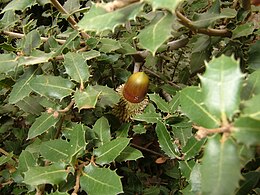
Regarding ίλαξ (ilax) Hesychius indeed says "same among Romeans and Macedonians". It is a plant that in English I find is called yew, ago, holly, holm oak. In Greek it is called prinos (ancient) or pournari (modern) but it is also called smilax.

260px-Q_cocciferab.jpg
 
This is a little difficult. The most bizzare is that χαράξι (haraxi) doesn't sound like a verb in the tense and face of σταυρώσω (stavroso= I will crucify) while there's a note saying it is related to καράρα (karara=head).

If we leave this behind, stavros (=cross) is a synonym of χάραξ (harax) and was the original Greek meaning of the word, which didn't necessarily have the shape of cross (as we know it) but it was anything like peg, stake, pole (harax also means ruler, pointer). So, karaxi is obviously somehow related to harax.

Alright, I see. Hard to say with this one then. I also don't see how it's related to καράρα (karara=head). The rest of them seem to check out from what I see. As for Κάραξι meaning "I will crucify," I see how it's related to Χάραξ(ι) (perhaps just the Macedonian pronunciation of "Haraxi"? It could've been Grk. originally but with a slightly different usage in Macedonian like Maced. "akontion" = spine vs. Grk. "akontion" = spear).

Edit -- If we take "Κάραξι" to mean "I will crucify," maybe we can connect it to the Slovenian(?) "Крижај" which I believe simply means "crucify"? I believe it is said that Slovenian has retain many archaic Slavic features and terms so perhaps this is one of them. I read about this on a forum I've forgotten about so I can't currently find the source. Can anyone verify this?
 
Last edited:
Heads Up!: Full Ancient Macedonian Dictionary

Heads Up!: Full Ancient Macedonian Dictionary

Just a quick heads up guys! The folks over at http://www.palaeolexicon.com/ are working on putting out a full dictionary of the Ancient Macedonian language. The dictionaries they have can be found by clicking on the Languages tab on their homepage then clicking on "Alphabetical Order". For now, I'd recommend checking out their Phrygian and Thracian dictionaries for those interested in those languages.

NOTICE! If the link I provided in this post leads you to a blocked page, just remove the the part "Blocked" from the address. Then hit enter and you should be able to go to the page.
 
Awesome thanks for the heads up Niko

Any time! I also found that if you search the word "name" in the search bar, there are 133 results in Ancient Macedonian. I have a feeling that this dictionary will probably be full of toponyms and anthroponyms! Just on the first page alone there are really interesting names like:

Ϝόλγανος (Wolganos): River and Deity name, related to the Proto-Indo-European "*welg / wolg" meaning "moisture"; Slavic: "volga/vlaga"
Καρβερένθης (Karberenthes): A Thracian name from Macedonia
Βῖθυς (Bithus): A Thracian name from eastern Macedonia
Βουκεφάλας (Boukefalas): The name of the horse of Alexander III
Βέργα (Berga): A Thasian (as in the island, Thasos) colony near Serres
Ἀέροπες (Aeropes): The name of a Macedonian tribe
Ἄθως (Athos): The holy mountain Athos (Sveta Gora)
βαλακρός (Balakros): Anthroponym and Oronym (Belasica Mountain)
Βερενίκη (Berenike): Veronica
Βίλιππος (Bilippos): Philip
Γάμψηλοι (Gampsiloi): A toponym (Γάμψ: curved ηλοι: rivets)
Δύστρος (Dystros): The month of March
Εορδός (Eordos): A Macedonian tribe (Hesychius' Glossary)
Ζειρηνίς (Zeirenis): The Macedonian goddess of love traced to the Proto-Indo-European root "*segh -" meaning "to hold/captivate"
Ἠμαθία (Emathia): An early name for Macedonia related to the Homeric word "ἠμαθόεις (emathoeis)" meaning "sandy"

I look forward to the full dictionary! It should be very interesting.
 
nikowhitewitch why don't you just put up any links to those dictionaries.I tell you many greeks believe that the ancient Macedonians never wrote in Macedonian it was only in greek.Also the supposed fact the Macedonians had no Macedonian language it was all greek.I have allways said there was a ancient Macedonian.Its a bitter pill to swallow.
 
nikowhitewitch why don't you just put up any links to those dictionaries.

Because of the way that the website is set up, I cannot provide the actual link to the dictionaries. To access them, simply go to the website, click on the "languages" tab on the top then click on "alphabetical order" and then you can see all of the dictionaries that they have in alphabetical order.
 
nikowhitewitch I tell you many greeks believe that the ancient Macedonians never wrote in Macedonian it was only in greek.Also the supposed fact the Macedonians had no Macedonian language it was all greek.I have allways said there was a ancient Macedonian.Its a bitter pill to swallow.

Yes, I'm well aware of the opinion that most Greeks have. They can believe whatever they want. That's none of my concern. I am not here to get into petty arguments over opinions to convince people to believe otherwise. It is a waste of time. I am here simply to gain more information on Macedonian history.
 
The Ancient Macedonian Language

I just want to highlight something about the era in which the Macedonians made their mark on world history. The concept of having an international or common language for people as an intermediary means of communication was very important to the ancient world. What is commonly referred to as a “lingua franca”, was a necessity to facilitate cooperation between the various ancient peoples.

It’s easy to imagine that the advent of diplomatic negotiations, trade and sharing ideas is a fairly recent phenomenon. However, this has been going on for thousands of years. The only difference between now and then is that we take it for granted that English has suddenly become the default international language. Before the turn of last century, French was the default international language. It was the language of the educated classes and the language that all the diplomats were using. Not that long ago, a new language, Esperanto, was being devised and prepared for international usage. I remember my mum’s uncle, God rest his soul, could speak in Esperanto. These days, English has taken over for obvious reasons. It’s not even the language of the educated classes. Non-English speaking people can almost certainly pick up a basic understanding of English by watching Hollywood movies and shows. It just so happens that most of the world wants to be able to communicate in this language.

In Alexander’s time, when the Macedonians were conquering the world, the ancient Greek language, was the lingua franca for most people of the eastern Mediterranean. In the middle to Far East, it was Aramaic, the language that Jesus spoke. However, and this needs to be stressed, just because a certain language was accepted as a common language of commerce and diplomacy, it didn’t mean that everyone could converse in that language. It was usually a small number of people such as merchants and diplomats who, through necessity, would have had to learn the common language.

The flourishing of Ancient Greek was facilitated by the fact that Greek colonies were spread across the Mediterranean from the southern coast of France all the way to the Black Sea coast and Asia Minor who were already trading in this language. The other thing that Ancient Greek had going for it, in contrast to most of the other ancient languages, was the fact that it could be written down. It had its own script. Fast forward 2,300 years and you could be excused for thinking everyone was Greek back then. The museums are filled with artefacts bearing Greek inscriptions, originating from all over the Mediterranean basin. That doesn’t necessarily mean that the inhabitants from these far flung regions, that produced these artefacts, were Greeks. It simply means that the ancient peoples were expressing themselves by utilising the available script of the time. By the same logic, artefacts written in Greek that have been uncovered in Macedonia do not prove the Ancient Macedonians were Greek. Likewise, digging up artefacts with Greek inscriptions in Bulgaria does not prove that the Thracians were Greek. Ditto the Illyrians.

Even before Alexander’s time, Greek was the language of commerce, education and literature and was readily accessible to the educated public. When Alexander adopted this language in his empire, he did so with the knowledge that, for a long time before him, various non-Greek speaking people were already communicating in this language. It just made things easier. In addition, it simply wasn’t worth the risk of revolts against Macedonian rule by imposing an unknown language on the local populace. A fascinating case is the example of the Romans. Unlike most of the ancient peoples, the Romans had their own Latin script, yet they chose to write exclusively in Greek right up until the first half of the 2nd Century BC. Contrary to Greek claims, Alexander did not spread Greek language and culture in the east. It was already there.

I do not accept that the Macedonians, in general, spoke Greek as their native tongue. There are enough examples, preserved by the ancient authors, that clearly speak of another, not often spoken it would seem, and almost forgotten language which, nonetheless, existed within Alexander’s camp. In the preserved anecdotes, they identified this language as Macedonian and it would seem that it was mainly spoken amongst the ordinary Macedonian foot soldiers of the Pezhetairoi units (pronounced Pesh-e-teri), who did not receive a formal education. These were the simple yet rough and tough peasant folk from the hills, who, as described by Alexander himself, tended flocks of sheep for a living and dressed in animal skins. The cream of the Macedonian army, they were conscripted from all parts of Macedonia, from the mostly rural, village communities that made up the majority of Macedonian society. The unifying bond that made them identify as Macedonians was their common Macedonian tongue, which, no doubt, had its own dialects.

The contrary is evident amongst the immediate entourage of Alexander. These were the privileged few, belonging to the Macedonian aristocracy, who had the opportunity to get an education and would have been educated in Greek. Many of these would have gone through the system of the well-known Macedonian institution of Royal Pages. The sons of prominent nobles, the Royal Pages received an education at court and developed a personal attachment to the king. Many of them made up part of Alexander’s Companion Cavalry and Royal Hypaspists units.

Judging from the ancient sources, the Macedonian language, although rendered almost obsolete for Alexander and his companions through neglect and the adoption of the common language, continued to be spoken by the ordinary Macedonian soldier. This is evident during the trial of Philotas where Alexander can be clearly seen trying to win points with the assembled Macedonian army when he asks Philotas whether he will speak in his native tongue before them.

Although their native tongue was quickly becoming a secondary language for the Macedonian elite, it was, nevertheless, the language that they often reverted to in times of crisis or heightened tensions. This is evident in the preserved incident with Alexander’s foster brother Cleitus, where the ancient authors made a point of stressing that, in the heat of the moment, Alexander shouted in Macedonian. The obvious allusion is hard to miss. The implication being that the drunk and enraged Alexander, feeling that his life was in danger, suddenly dropped his Greek façade and reverted to his primal and instinctive native tongue, Macedonian. Otherwise, why would Plutarch feel the need to specifically single out the usage of the Macedonian language? What was so unusual about this that it warranted making a point of it?

Clearly, judging from these two episodes, the adopted common language had precedence in Alexander’s court and the usage of Macedonian was relegated to the uneducated Macedonian rank and file only, who could not speak Greek.

We also have the example of Eumenes of Cardia, a rare case of an ethnic Greek being in a commanding position of Macedonians. Eumenes achieved his position after the death of Alexander as a result of his close personal friendship with him. Out of respect for Alexander, the Macedonians under Eumenes’ command allowed him to be their superior. Being in a commanding position, he was very conscious that if the Macedonians were going to follow his orders then he would need to learn Macedonian. The ancient authors speak of Eumenes being greeted in Macedonian by the troops, a sign of affection, and of him responding in kind. No doubt, as is only natural, through exposure with the Macedonians, he would have picked up some basic Macedonian. Yet, we are told by the ancient authors, that even he made sure that when an important message needed to be relayed to the Macedonian army, he had to make certain that it was delivered by a man fluent in Macedonian. In other words, Eumenes had need of a Macedonian interpreter to communicate with his own troops. These are just three examples. There are others but I won’t get into them. I think I have made my point.

If nothing more, then at the very least, the following passage by the Roman historian Quintus Curtius Rufus describing the trial of Philotas should give Greeks today some pause for thought. I particularly love this passage because it is like old Rufus is looking down the barrel of time itself and specifically addressing today’s loud-mouthed Greeks and their stubborn convictions.

“The Macedonians are going to judge your case, please state whether you will use your native language before them,” asked Alexander. “Besides the Macedonians,” replied Philotas, “there are many present who, I think, will find what I am going to say easier to understand if I use the language you yourself have been using, your purpose, I believe, being only to enable more people to understand you.”
 
In Alexander’s time, when the Macedonians were conquering the world, the ancient Greek language, was the lingua franca for most people of the eastern Mediterranean.

The flourishing of Ancient Greek was facilitated by the fact that Greek colonies were spread across the Mediterranean from the southern coast of France all the way to the Black Sea coast and Asia Minor who were already trading in this language. The other thing that Ancient Greek had going for it, in contrast to most of the other ancient languages, was the fact that it could be written down. It had its own script. Fast forward 2,300 years and you could be excused for thinking everyone was Greek back then. The museums are filled with artefacts bearing Greek inscriptions, originating from all over the Mediterranean basin.

Even before Alexander’s time, Greek was the language of commerce, education and literature and was readily accessible to the educated public. When Alexander adopted this language in his empire, he did so with the knowledge that,

I do not accept that the Macedonians, in general, spoke Greek as their native tongue. There are enough examples, preserved by the ancient authors, that clearly speak of another, not often spoken it would seem, and almost forgotten language which, nonetheless, existed within Alexander’s camp..”

Can you please provide some evidence of such bold statements? Here is a logical, balanced view:

http://www.livius.org/maa-mam/macedonia/macedonia.html

Language

At first sight, it appears that the inhabitants of the Macedonian alluvial plain spoke Greek. A fourth-century curse tablet from Pella, published in 1994, is written in Northwest Greek, and later inscriptions are in Attic Greek. Many personal names (like Philippos and Alexandros, Zeus and Herakles) are Greek as well. That the Macedonians spoke Greek, looks like an inevitable conclusion.
However, there is some room for doubt.

"None of this forces us to say that the Macedonians did not speak Greek, but it leaves the possibility that things were not what they seem. There is room for skepticism"

Words that have a counterpart in Greek. For example, the Macedonian title Nikat�r ("victor") is obviously the equivalent of Greek Nik�t�r. Usually, the Macedonian words are voiced and lack aspiration whereas Greek words are voiceless and aspirated: for example, Greek aith�r is the equivalent of Macedonian ad� ("sky").
Words that do not resemble a Greek word: sarissa ("lance"), abagna ("rose"), peliganes ("senate"). It is certain that these words are Indo-European.

At opposing case scenario, I agree with this statement "Macedonian and Greek were related but different, but it is not certain whether they were different languages (which means that they have a different grammar and syntaxis) or dialects"

In my opinion, ancient Macedonian and other ancient Greek dialects were probably similar in alphabetical format, but differing in dialect.

Please provide some reputable, scholarly analysis when making statements about ancient Macedonian language, history for discussion.

Regards,
 
You say in your opinion Macedonian and Greek were similar languages but differed in dialect. You base your opinion on the Pella curse tablet and other artefacts. That's fine, that's your opinion. My opinion is that they were two distinct and separate languages. And I base my opinion on the writings of Quintus Curtius and Plutarch.
 
Please explain to me the timeline of history who came after whom?macedonians can claim prehistoric existenceThe greeks came after.ITs a fact that greeks didnt understand macedonian language.
 
This might seem silly, but was ancient Macedonian written in Greek chars? If so why does Macedonia today write in Cyrillic?

I have always been confused and never knew where to look and looking for Macedonians to explain to me.

Do not confuse that with me saying anything about the Macedonian identity, Macedonians I think today and ancient ones have no connection to greeks.

Thanks for any reply!
 
Back
Top