
TrueMacedonian
Banned



The entry of the Slavs into Christendom, by A P Vlasto

Welcome to the new Macedonian Truth Forum. All posts, members and private messages have been moved over from the old forum.
Passwords from the old forum could not be carried over, so please use Forgot your password? to set a new one. The reset link is emailed to the address on your account.
(1) The national-ethnic and cultural-linguistic identity of the Macedonian people is historically Macedonian, and derives its character from the native, indigenous and geographic homeland of the Macedonians, which is called Macedonia. To ensure that their human rights, integrity and heritage are appropriately respected, the only nouns and adjectives acceptable when reference is made to the above character and identity markers is Macedon, Macedonia, Macedonian and Macedonians.
(2) The nation-state of the Macedonian people is the Republic of Macedonia, and is to be referred to by this official title so long as the 'republic' prefix is consistently applied to other states. Alternative references are the Macedonian Republic, or simply, Macedonia.
(3) The 'ethnic' prefix is only acceptable for Macedonians in cases where differentiation is specifically required - so long as it is in context and consistent where it concerns its application to other ethnic groups.
(4) Should any other differentiation be specifically required, the names of other ethnic groups that reside with Macedonians in either the Republic of Macedonia or the occupied Macedonian regions in Greece, Bulgaria, Serbia or Albania, are to be given a prefix.
(5) Negating the identity, language and culture of the Macedonian people by deliberate avoidance of the terms Macedonia, Macedonian and Macedonians, or by any other means, is not permitted.
(6) Systematic anti-Macedonian propaganda and rhetoric are not permitted.
(7) Threads irrelevant to the Macedonian Cause, the community at the Macedonian Truth Organisation or the Macedonians in general may be considered as spam or not in the spirit of the forum. In such cases they are not permitted.
(8) Continual posting of messages in threads with the sole purpose of deviating from the initial topics with the use of unrelated and unnecessary information is not permitted.
(9) All posts, external articles, reports, etc that are cited in languages other than Macedonian or English, must be accompanied with a translation in one or both of the said languages.
(10) Despite the possibility of some conversations and debates becoming heated, extreme abuse and/or racism, vulgar language and/or terminology, threats, revelation of personal information about others, harassment, and other such behavior will not be permitted. If deemed necessary all relevant information including member details will be reported to the appropriate authorities for investigation which may result in legal action.
(11) Threads that are created must have a summary of a topic or excerpt of an article found in pertinent link(s) that have been included. One line threads will be considered unaccetable spam and are therefore not permitted.
(12) Compulsive and deliberate lies, irrespective of the topic, are not permitted.
(13) Any symbols or avatars found to be perceived as offensive to Macedonians are not permitted.
(13) Any explicit or extreme material is not permitted.
Failure to adhere to the above rules and regulations will result in a ban after 3 breaches. This may be reconsidered in some cases should the circumstances be of an unorthodox nature and/or require special consideration. To assure an effective deterrent against an individual or individuals with the sole purpose of causing dissent through spamming, racism or other improper means, the above rules will be strictly enforced.
The MTO administration will monitor all discussions as reasonably practical and reserve the right to remove any post and/or member from the forum, and update the rules and regulations as required. Members are encouraged to immediately report any post and/or member to the MTO administration if they feel that these rules have not been abided by.
The views expressed on this forum are those of the individuals. The only official representation of the MTO is made by the "Macedonian Truth Organisation (Site Owner)" username, and no other.
The Macedonian Truth Organisation calls on God in Heaven to protect, bless and guide the endeavour it is committing to undertake, and that is to work towards:
Securing Macedonia as a free, independent and democratic republic in which sovereignty lies with the Macedonian citizens; as the nation-state of the Macedonian people in which they can preserve their culture, language and identity; as a state in which the Macedonian language and culture form the basis of public life and act as important unifying elements of Macedonian society; as the home of all its citizens to which it guarantees and obliges their inalienable natural rights and corresponding responsibilities;
The acknowledgment as self-evident and irrefutable the existence of the:
1) Indigenous, ethnonational name of Macedonia;
2) Macedonian people, language and identity;
3) Macedonian culture, symbols and folklore;
4) Macedonian ancestry, heritage and history in its entirety; and
5) Macedonian Orthodox Church;
Securing recognition by the International Community of the tragedies endured by the Macedonian people, of the division of Macedonia with the signing of the Treaty of Bucharest on August 10, 1913, and the genocide committed against the Macedonian people at the hands of the Greek, Bulgarian and Serbian states and their respective churches during the 19th and 20th centuries;
Ensuring that the Interim Accord is declared ‘null and void’ and that all constitutional provisions, acts, commitments, agreements, legislation, regulations, policies or programs emanating from, supporting or consequential to the Interim Accord are also declared ‘null and void’, including the use of any symbols and the completion of any acts imposed by, or originating from, the Interim Accord.
Ensuring that the Framework Agreement is abolished and that all constitutional provisions, acts, commitments, agreements, legislation, regulations, policies and programs emanating from, supporting or consequential to the Framework Agreement are also abolished and replaced by a framework of constitutional and statutory law based on inalienable natural rights and corresponding responsibilities and universally codified human rights mechanisms.
Securing the abolishment of any existing constitutional provisions, acts, agreements, legislation, regulations, policies and programs that discriminate against the Macedonian people, in any international organisation or any of the countries of the International Community where such constitutional provisions, acts, agreements, legislation, regulations, policies and programs exist, and thereby ensuring the freedom for Macedonians to exercise their inalienable natural rights and fulfil their corresponding responsibilities, and practice their culture, language and religious faiths in all the countries of the International Community without hindrance;
The empowerment of Macedonians to undertake a moral revolution and to instil and/or reinvigorate within themselves a deep-rooted national, cultural, linguistic and historical dignity and a commitment to the exercise of freedom based on inalienable natural rights and corresponding responsibilities;
The recognition of the Macedonian minorities in the neighbouring states of Macedonia as well as the respect for the inalienable rights and freedoms of the Macedonian minorities, as provided for by natural law and as codified by the United Nations Charter, the Universal Declaration of Human Rights and other universally codified human rights mechanisms;
The full and unreserved respect of, and the support for, the rights of all people of non-Macedonian descent living in Macedonia and around the world, who share a reciprocal full and unreserved respect for the Macedonian people, their homeland and their state;
The cultural unification and solidarity of the Macedonian people living in all parts of historical Macedonia and adjacent territories, as well as Macedonians throughout the world;
The unity of all Macedonians on the principles, objectives and achievement of the Macedonian cause as defined by this declaration.
I am impressed are our southern neighbors impressed?

Indeed a really simple question.As for the Bulgarians who still deny Macedonians their right to anything I just have one question to ask you,,, where did you learn your language and where did you adopt it?

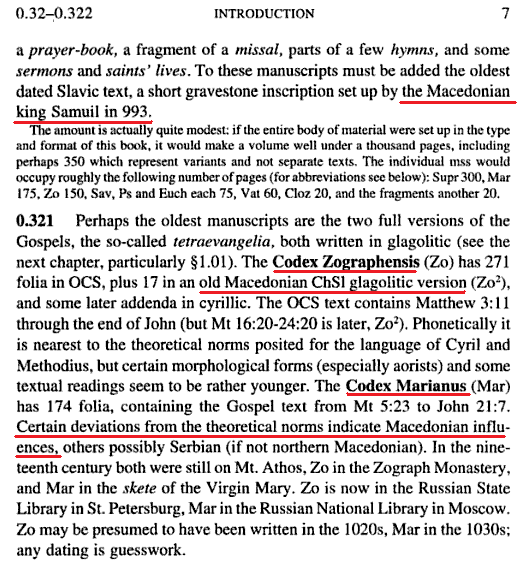
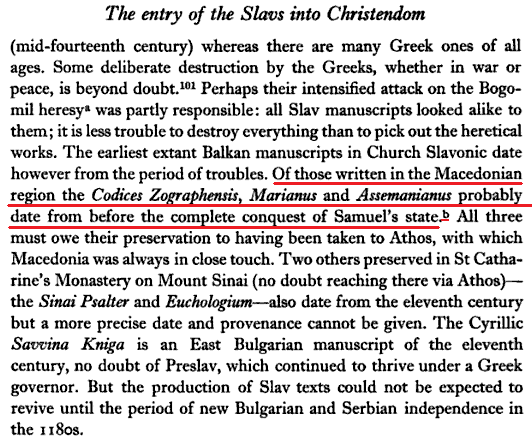
The manuscript contains 304 parchment folios, of which the foremost have not been preserved, and thus begins with Matthew 3:11. The first 288 folios are written in Glagolitic and contain the Gospel text. In addition, several additional folios from the middle of the manuscript are missing. At the end of the 11th or beginning of the 12th century some missing folios (from 41 to 57) were replaced with 17 new ones, written in square Glagolitic. They were themselves most likely a palimpsest. The rest of the 16 folios contain 13th-century synaxarium.
Codex's existence was made public by Izmail Sreznevsky in 1856. In 1860 Monks from the Zograf monastery gifted the Codex to Russian emperor Alexander II who donated it to Russian National Library, where the Codex is being kept today. Parts of Codex Zographensis were published by Russian linguist Izmail Sreznevsky in 1856.[2] The first to describe the codex was Viktor I. Grigorovič in 1877, and two years later the Glagolitic part of the codex was published in edition of Croatian Slavist Vatroslav Jagić in Berlin as Quattuor evangeliorum codex glagoliticus olim Zographensis nunc Petropolitanus, completely transcribed in Cyrillic, with introduction and extensive philological commentary in Latin. Jagić's edition has been republished in Graz in 1954. Other scholars who have extensively studied the language of Codex Zographensis include the Czech Josef Kurz and the Pole Leszek Moszyński.
Analysing the language of the codex it was established that the style and antiquity of the text is nonuniform, second part being more archaic than the first part. Some scholars explain this by gradual adaptation to the language of the source whence manuscript originated. Generally, phonology of the language of Codex Zographensis is very archaic - vocalizations of strong yers are rare, epenthetic l is preserved, though in the most parts of the manuscript yers are being assimilated. It is a bit less archaic with respect to morphology and syntax, though the forms of definite declension of adjectives and older forms of participles are well-preserved (e.g. prošь, nošь and rarely prosivъ, nosivъ).


I don't agree with your opinion.It kinda sparked the idea of re-adopting some of our old pre-Serb influenced characters to make our alphabet not only more flexible, but more accurate to represent our local Macedonian dialects, including those in Aegean and Pirin Macedonia.
Our current alphabet is not compatible with all Macedonian dialects and our post-WWII Macedonian orthographers made mistakes. Their apparent reasoning (distancing it from 'Bulgarian') was extremely stupid, as Risto pointed out.I think our alphabet is very flexible and applicable, and the situation from before ten centuries can't be compared with the situation from 19 or 20th century. In those times some of today characteristic voices didn't exist, and vice-versa.
If you read 19th century Macedonian literature you will see the use of нь, ль, гь and кьe (or even кѥ) used where they essentially represent the same sound as њ, љ, ѓ and ќ. The j was never necessary, we could have used an existing Cyrillic i or й or in other cases я and ѥ. I am in two minds about the letter џ, I suppose it could have been given a pass to avoid using two letters for the sake of forming a single sound, but it seems to be used only for foreign loanwords. The letter ъ was an absolute necessity in words like късмет, it never should have been excluded given that it is distinctly Cyrillic and could also have been used in words like църква, първа, търка, ъргьa. If we did this, it would not have marginalised any dialects, and would still make sense (phonetically) to speakers of the dialects in the republic because in most cases it is practically silent.Except "њ" and "љ" I don't think we have other serb influenced characters.
If you read 19th century Macedonian literature you will see the use of нь, ль, гь and кьe (or even кѥ) used where they essentially represent the same sound as њ, љ, ѓ and ќ. The j was never necessary, we could have used an existing Cyrillic i or й or in other cases я and ѥ. I am in two minds about the letter џ, I suppose it could have been given a pass to avoid using two letters for the sake of forming a single sound, but it seems to be used only for foreign loanwords. The letter ъ was an absolute necessity in words like късмет, it never should have been excluded given that it is distinctly Cyrillic and could also have been used in words like църква, първа, търка, ъргьa. If we did this, it would not have marginalised any dialects, and would still make sense (phonetically) to speakers of the dialects in the republic because in most cases it is practically silent.
In the end, our current version of the Cyrillic alphabet - despite the fact that original Cyrillic was based on one of our own dialects - is probably the most simplistic and bastardised of all along with Serbian. We should have stayed true to our literary tradition.
First of all our language is very different from the language from 10,11,12,13 century..I would say that the dark vowel is required for existing Macedonian dialects within the Republic of Macedonia. One side of my family uses the dark vowel all the time.
We have every legitimacy to use whatever original cyrillic characters we like I say, and why not write in an alphabet that not only belongs to us, but more logically and flexibly represents what all of our dialects sound like?
Po-drum, we can try and explain it however we like, at the end of the day, our alphabet has been bastardised.Po-drum said:I don't think it's bastardised but rather I would say it's very easy for learning and practical use (on the contrary you have english where you don't know how to write what you have heard).
If our people had no problem learning the alphabet as it was for a 1000 years, I don't see why certain elements should have been 'simplified' based on the invention of a Serb. Cyrillic alphabets were never meant to be "write as you speak", and I am pretty sure if some peasant in Bulgaria can handle this, then so could the descendants of the people who created Cyrillic. Aside from the Serbs (and now Macedonians), no other Slavic-speaking peoples use the Cyrillic alphabet in this manner.I don't see substantial difference between "нь, ль" and "њ, љ", the second forms are just ligatures and they are very useful invention of Vuk Karadzich.
If you want to compare, then there are much more Macedonian literary figures who used the original letters like Pejcinovik, Miladinovci, Shapkarev, Cepenkov, etc.The same principle was proposed about ѓ, ќ but the second commission have accepted with little modification the way Krste P. Misirkov have written them: г', к'. Same way is used by Selishchev in his book about macedonian dialects.
That has little to do with Macedonian. How many native Macedonian words are there which use that letter? I can't think of any. It seems that it is only used for foreign loanwords or suffixes. Even Misirkov doesn't use it.џ is used for first time in Romanian Cyrillic alphabet by 15-16 century, there is no need of two signs. It's easier.
That is a poor excuse and an insult towards Macedonians, like they are that stupid that they wouldn't be able to work out an alphabet their own ancestors created.About "j" the arguments were:
-it goes very often with "и" and use of "i" would make confusion in macedonian post WW2 citizens and students.
Whoever put forth that argument is an idiot.-there was already established practice for use of this sign in Vardar Macedonia under serbian occupation.
That may be so, but that doesn't mean the alphabet should contribute to the limitation. Koneski and co. did not do enough when codifying the literary language, they did not take enough consideration of the obvious fact that Macedonian is spoken in a much greater area than the confines of the Macedonian republic.Macedonian dialects have different characteristics and all versions can't be incorporated in the literary language.
I think it would be fair, if we would be more realistic (as you are allways trying to be).Po-drum, we can try and explain it however we like, at the end of the day, our alphabet has been bastardised.
If our people had no problem learning the alphabet as it was for a 1000 years, I don't see why certain elements should have been 'simplified' based on the invention of a Serb. Cyrillic alphabets were never meant to be "write as you speak", and I am pretty sure if some peasant in Bulgaria can handle this, then so could the descendants of the people who created Cyrillic. Aside from the Serbs (and now Macedonians), no other Slavic-speaking peoples use the Cyrillic alphabet in this manner.
The place of Krste Petkov Misirkov in macedonian linguistic and national history can't be same with the others. All those you have numbered were without clear national consciousness.If you want to compare, then there are much more Macedonian literary figures who used the original letters like Pejcinovik, Miladinovci, Shapkarev, Cepenkov, etc.
OK. But as in the case of "s" it was taken as an unofficial principle not to use digraphs for a single voice. The fact that it was not serbian I guess was the reason not even to discus about it.That has little to do with Macedonian. How many native Macedonian words are there which use that letter? I can't think of any. It seems that it is only used for foreign loanwords or suffixes. Even Misirkov doesn't use it.
I agree with you, but only from today point of view.That is a poor excuse and an insult towards Macedonians, like they are that stupid that they wouldn't be able to work out an alphabet their own ancestors created.
Whoever put forth that argument is an idiot.
Agree.That may be so, but that doesn't mean the alphabet should contribute to the limitation. Koneski and co. did not do enough when codifying the literary language, they did not take enough consideration of the obvious fact that Macedonian is spoken in a much greater area than the confines of the Macedonian republic.
I don't agree. Generally speaking, a Bulgarian peasant was no more literate or able in the 1870's than their Macedonian equivalent in the 1940's. I think the matter of Macedonians learning the proper alphabet was an entirely realistic expectation. There was no need to dumb it down.Po-drum said:In the first days of Macedonian Republic there was need of alphabet which would be easy for the people to use it.
You're creating excuses for the mistakes of Koneski and co. I couldn't care if Karadzic was a Bulgarian or a Russian, there is no good reason why we should have strayed from something perfectly useful - our own existing alphabet.We have to get rid of all national complexes which don't give us opportunity to make future progress for unification as a people (one of them is your problem with Vuk Karadzich. I am quite sure you hate his very useful inventions just because he is Serb )
That doesn't mean his example should have been given preference over the proper alphabet (not that the current alphabet is exactly the same as his anyway). We lost a long and traditional precedent unnnecessarily.The place of Krste Petkov Misirkov in macedonian linguistic and national history can't be same with the others. All those you have numbered were without clear national consciousness.
The case with 's' is different. It has a history in early Cyrillic and is a sound that is present in native Macedonian words like ѕвезда, ѕид, ѕвер, ѕвони and ноѕе.OK. But as in the case of "s" it was taken as an unofficial principle not to use digraphs for a single voice.
The fact that it was not an unnecessary foreign element. You don't seem to place much concern on preservation and appear to be indirectly showing some sort of apologetic disposition towards Serbian influence. I see that as more of a problem that my moderate preservationist tendencies.The fact that it was not serbian I guess was the reason not even to discus about it.

