• Welcome to the new Macedonian Truth Forum. All posts, members and private messages have been moved over from the old forum.

    Passwords from the old forum could not be carried over, so please use Forgot your password? to set a new one. The reset link is emailed to the address on your account.

  • Rules and Regulations at the forum of the Macedonian Truth Organisation (MTO)

    (1) The national-ethnic and cultural-linguistic identity of the Macedonian people is historically Macedonian, and derives its character from the native, indigenous and geographic homeland of the Macedonians, which is called Macedonia. To ensure that their human rights, integrity and heritage are appropriately respected, the only nouns and adjectives acceptable when reference is made to the above character and identity markers is Macedon, Macedonia, Macedonian and Macedonians.

    (2) The nation-state of the Macedonian people is the Republic of Macedonia, and is to be referred to by this official title so long as the 'republic' prefix is consistently applied to other states. Alternative references are the Macedonian Republic, or simply, Macedonia.

    (3) The 'ethnic' prefix is only acceptable for Macedonians in cases where differentiation is specifically required - so long as it is in context and consistent where it concerns its application to other ethnic groups.

    (4) Should any other differentiation be specifically required, the names of other ethnic groups that reside with Macedonians in either the Republic of Macedonia or the occupied Macedonian regions in Greece, Bulgaria, Serbia or Albania, are to be given a prefix.

    (5) Negating the identity, language and culture of the Macedonian people by deliberate avoidance of the terms Macedonia, Macedonian and Macedonians, or by any other means, is not permitted.

    (6) Systematic anti-Macedonian propaganda and rhetoric are not permitted.

    (7) Threads irrelevant to the Macedonian Cause, the community at the Macedonian Truth Organisation or the Macedonians in general may be considered as spam or not in the spirit of the forum. In such cases they are not permitted.

    (8) Continual posting of messages in threads with the sole purpose of deviating from the initial topics with the use of unrelated and unnecessary information is not permitted.

    (9) All posts, external articles, reports, etc that are cited in languages other than Macedonian or English, must be accompanied with a translation in one or both of the said languages.

    (10) Despite the possibility of some conversations and debates becoming heated, extreme abuse and/or racism, vulgar language and/or terminology, threats, revelation of personal information about others, harassment, and other such behavior will not be permitted. If deemed necessary all relevant information including member details will be reported to the appropriate authorities for investigation which may result in legal action.

    (11) Threads that are created must have a summary of a topic or excerpt of an article found in pertinent link(s) that have been included. One line threads will be considered unaccetable spam and are therefore not permitted.

    (12) Compulsive and deliberate lies, irrespective of the topic, are not permitted.

    (13) Any symbols or avatars found to be perceived as offensive to Macedonians are not permitted.

    (13) Any explicit or extreme material is not permitted.

    Failure to adhere to the above rules and regulations will result in a ban after 3 breaches. This may be reconsidered in some cases should the circumstances be of an unorthodox nature and/or require special consideration. To assure an effective deterrent against an individual or individuals with the sole purpose of causing dissent through spamming, racism or other improper means, the above rules will be strictly enforced.

    The MTO administration will monitor all discussions as reasonably practical and reserve the right to remove any post and/or member from the forum, and update the rules and regulations as required. Members are encouraged to immediately report any post and/or member to the MTO administration if they feel that these rules have not been abided by.

    The views expressed on this forum are those of the individuals. The only official representation of the MTO is made by the "Macedonian Truth Organisation (Site Owner)" username, and no other.

  • Macedonian Cause

    The Macedonian Truth Organisation calls on God in Heaven to protect, bless and guide the endeavour it is committing to undertake, and that is to work towards:

    Securing Macedonia as a free, independent and democratic republic in which sovereignty lies with the Macedonian citizens; as the nation-state of the Macedonian people in which they can preserve their culture, language and identity; as a state in which the Macedonian language and culture form the basis of public life and act as important unifying elements of Macedonian society; as the home of all its citizens to which it guarantees and obliges their inalienable natural rights and corresponding responsibilities;

    The acknowledgment as self-evident and irrefutable the existence of the:

    1) Indigenous, ethnonational name of Macedonia;
    2) Macedonian people, language and identity;
    3) Macedonian culture, symbols and folklore;
    4) Macedonian ancestry, heritage and history in its entirety; and
    5) Macedonian Orthodox Church;

    Securing recognition by the International Community of the tragedies endured by the Macedonian people, of the division of Macedonia with the signing of the Treaty of Bucharest on August 10, 1913, and the genocide committed against the Macedonian people at the hands of the Greek, Bulgarian and Serbian states and their respective churches during the 19th and 20th centuries;

    Ensuring that the Interim Accord is declared ‘null and void’ and that all constitutional provisions, acts, commitments, agreements, legislation, regulations, policies or programs emanating from, supporting or consequential to the Interim Accord are also declared ‘null and void’, including the use of any symbols and the completion of any acts imposed by, or originating from, the Interim Accord.

    Ensuring that the Framework Agreement is abolished and that all constitutional provisions, acts, commitments, agreements, legislation, regulations, policies and programs emanating from, supporting or consequential to the Framework Agreement are also abolished and replaced by a framework of constitutional and statutory law based on inalienable natural rights and corresponding responsibilities and universally codified human rights mechanisms.

    Securing the abolishment of any existing constitutional provisions, acts, agreements, legislation, regulations, policies and programs that discriminate against the Macedonian people, in any international organisation or any of the countries of the International Community where such constitutional provisions, acts, agreements, legislation, regulations, policies and programs exist, and thereby ensuring the freedom for Macedonians to exercise their inalienable natural rights and fulfil their corresponding responsibilities, and practice their culture, language and religious faiths in all the countries of the International Community without hindrance;

    The empowerment of Macedonians to undertake a moral revolution and to instil and/or reinvigorate within themselves a deep-rooted national, cultural, linguistic and historical dignity and a commitment to the exercise of freedom based on inalienable natural rights and corresponding responsibilities;

    The recognition of the Macedonian minorities in the neighbouring states of Macedonia as well as the respect for the inalienable rights and freedoms of the Macedonian minorities, as provided for by natural law and as codified by the United Nations Charter, the Universal Declaration of Human Rights and other universally codified human rights mechanisms;

    The full and unreserved respect of, and the support for, the rights of all people of non-Macedonian descent living in Macedonia and around the world, who share a reciprocal full and unreserved respect for the Macedonian people, their homeland and their state;

    The cultural unification and solidarity of the Macedonian people living in all parts of historical Macedonia and adjacent territories, as well as Macedonians throughout the world;

    The unity of all Macedonians on the principles, objectives and achievement of the Macedonian cause as defined by this declaration.

The Real Ethnic Composition of Modern Greece

This has been repeatedly debunked. Look back at posts #414 and #415 for a start.

It would be great if this woman had produced research related to her claims. No, she hasn't.


===
 
Last edited:
Maria Efthimiou is a respected modern Greek historian and not a malicious "foreigner", or somebody that does not have credentials. I've seen her appear on Greek TV programs and is usually attacked for her views by Greek nationalists such as yourself. Do you not think she might be familiar with all theories or claims that allegedly debunk her statements or numbers? Now, she might not be 100% correct but neither are claims that Albanians were less than 5-10% when we know that entire regions (south of Thessaly) were still compactly settled and inhabited by descendants of ethnic Albanians at the close of the 18th century.

I respect people's right to self-identity and nationality, but exchanging your mother tongue for modern Greek in the 19th century does not make those people ancient Hellenes.


Unrelated:

Nicholas Geoffrey Hammond places the foundation of Preveza at the end of the 14th century, possibly by Albanians. In the book "Octavian's Campsite Memorial for the Actian War" (by William Michael Murray, Photios Michael Petsas) it is stated on page 153 that Preveza was not attested until the beginning of the 15th century when Albanians were settled at the entrance of the Ambracian Gulf.
 
Last edited:
I'm not a Greek nationalist. Unfortunately, I checked her scientific profile and could hardly locate international publications or citations to her work. So yes, I guess in this case she pulled the number out of her ass.

She doesn't have a google scholar profile, her name is too common, she uses alternate names, most of her work is before the internet era etc. If there IS such an effort in her work, feel free to find it yourself, it won't be very easy. Send her an e-mail.
http://www.arch.uoa.gr/fileadmin/arch.uoa.gr/uploads/cvs/efthymiou_gr.pdf


Lithoxoou is an anti-Greek activist and an amateur "historian" who can... count and at least he made an effort, proving that however you overblow the numbers of Albanians they don't exceed 10%.


===
 
Last edited:
I'm not a Greek nationalist. Unfortunately, I checked her scientific profile and could hardly locate international publications or citations to her work. So yes, I guess in this case she pulled the number out of her ass.

She doesn't have a google scholar profile, her name is too common, she uses alternate names, most of her work is before the internet era etc. If there IS such an effort in her work, feel free to find it yourself, it won't be very easy. Send her an e-mail.
http://www.arch.uoa.gr/fileadmin/arch.uoa.gr/uploads/cvs/efthymiou_gr.pdf


Lithoxoou is an anti-Greek activist and an amateur "historian" who can... count and at least he made an effort, proving that however you overblow the numbers of Albanians they don't exceed 10%.


===

Albanians were 15% in 1850s, and probably 20% in Early Greeks state in 1832.
The reason why it decrease is that many Arvanites from Attica, for example moved to Athens as well as other rural zones, and there was a migration of other Greeks from outside the borders.

The figure of Arvanites that Lixouthou gave refers after many other regions of Greece were joined into the Greek state in 1907.
In 1890 Arvanites are counted as 12.5% of Peloponnese including the islands and 10% of mainland Peloponnese. With that being said many Arvanite villages, especially outside of Argolis, were omitted in those maps especially those in northwestern mountains of Peloponnese.

--
Carlin - The fact that Thessaly was once called Great Vlachia could suggest that it was overpopulated by Vlachs. Do you think so too?
 
LOL, I think you know my opinion on the matter.

I found the following to be noteworthy. It comes from a book by Abdolonyme Ubicini "Letters on Turkey" published in 1856.

Page 174: "... they take pride in the appellation of Roumouns or Roumains. The Greeks call them Vlaques, and the Sclavonians Zingaris. A document recently published at Athens computes the number of Zingaris dispersed through Greece and the Turkish provinces of Thessaly and Macedonia at 600,000."

600,000 "dispersed" through Greece (and the provinces of Thessaly and Macedonia) is still a staggering number -- in the year 1856. The author then states how this number is "probably an exaggeration", based on other figures/census. I would consider it understated. (In 1756, as opposed to say 1856, the number of Vlach-speakers would have been even greater and more "shocking".)

It's "problematic" because this number was given in A document recently published at Athens. What was the name of this document? Was it published in the years prior to 1856? What happened to this document? Ubicini obviously saw it or read about it -- and reported on it.

Why would official Athens provide this number? Today, there are only a couple of thousand Vlach-speakers in Greece but extrapolating "600,000" to today's numbers in Greece, and accounting for natural population growth, etc........does not produce a couple of thousand Vlach-speakers.
 
Last edited:
Based on the 1951 census, 5 biggest ethnic groups (based on mother language), bold when exceeding 1%

Continental Greece (& Euboea): Greek>Turkish>Armenian>Albanian>Vlach
Peloponnesus: Greek>Albanian>Turkish>Gypsy>Armenian
Ionian Islands: Greek>Turkish>Armenian>Albanian>Italian
Thessaly: Greek>Vlach>Turkish>Gypsy>Latino-Jewish
Macedonia: Greek(92,9%)>Turkish(3,3%)>Slavic(2,4%)>Vlach(0,7%)>Gypsy(0,2%)
Epirus: Greek>Vlach>Albanian>Turkish>Gypsy
Crete: Greek>Turkish>Armenian>French=English
Aegean Islands: Greek>Turkish>Slavic>Romanian>Armenian
Thrace: Greek>Turkish>Pomak>Albanian>Gypsy
==

More detailed on Vlachs by 1951 (this is about mother language, not home language), districts with a percentage above 1%

Continental Greece
Aetolia-Acarnania 1,4%

Thessaly
Larisa 3,6%
Trikala 4,3%

Macedonia
Hemathia 3,5%
Kilkis 1,9%
Pella 1,2%
Pieria 1,3%
Florina 1,3%

Epirus
Thesprotia 5,0%
Ioannina 4,9%
Preveza 2,4%
 
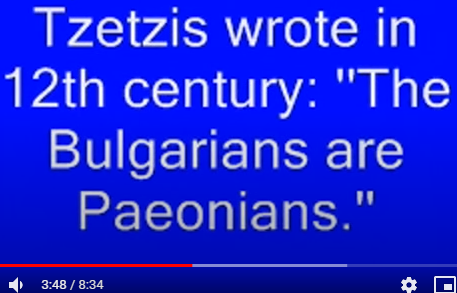
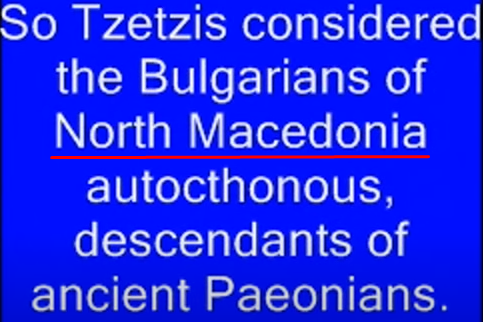
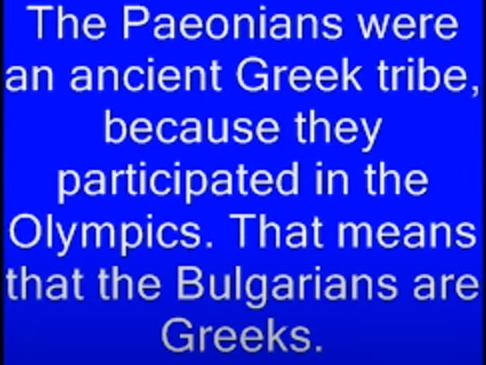
In addition to Arvanites, Armani (Vlachs), Lazes or Gagauzes being of GREEK ORIGIN, so are the Bulgarians, Thracians but also Paeonians:
https://www.youtube.com/watch?v=Ld472CLbhiQ

This video was made back in 2011. Pretty curious that the term "North Macedonia" appears at 3:55 minute. The ancient Paeonians were GREEKS too! Who knew!

d2tW2zG.png

ZKuozVn.png

3sRK7rG.png


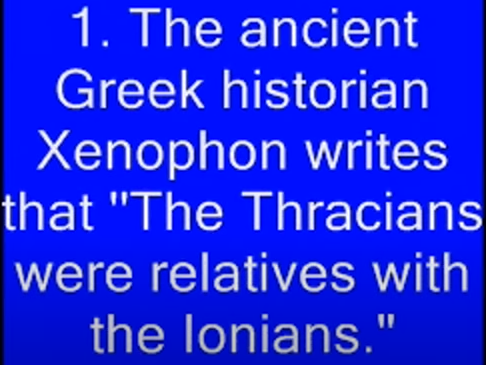
Thracians are also Greeks, specifically Proto-Ionians. One of the proofs for this was because Xenophon stated the following (?):
tFT1fE8.png


Wouldn't this indicate that the Ionians were a Hellenized population group?

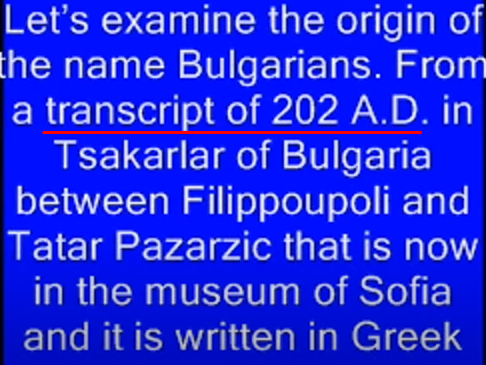
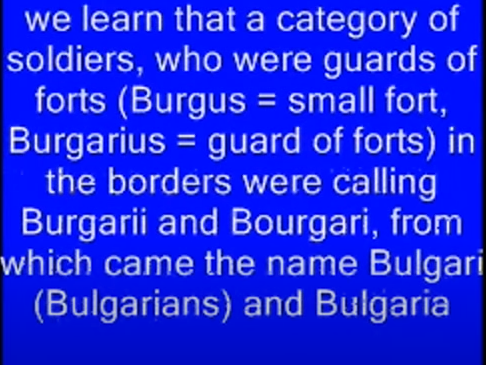
Something worth exploring, and this is something I read years ago, is that a category of soldiers, who were guards of forts, were called Burgarii and/or Bourgari. Is this how the name of Bulgarians arose?

(In the Arman-Vlach language --> Vurgari = "Bulgarians".)

IP1GSs9.png

BAznNV2.png
 
I'm not a Greek nationalist. Unfortunately, I checked her scientific profile and could hardly locate international publications or citations to her work. So yes, I guess in this case she pulled the number out of her ass.

She doesn't have a google scholar profile, her name is too common, she uses alternate names, most of her work is before the internet era etc. If there IS such an effort in her work, feel free to find it yourself, it won't be very easy. Send her an e-mail.
http://www.arch.uoa.gr/fileadmin/arch.uoa.gr/uploads/cvs/efthymiou_gr.pdf


Lithoxoou is an anti-Greek activist and an amateur "historian" who can... count and at least he made an effort, proving that however you overblow the numbers of Albanians they don't exceed 10%.


===

"Unfortunately", she is legit. A simple search of "μαρια ευθυμιου" in YouTube returned the following results:
https://www.youtube.com/results?search_query=μαρια+ευθυμιου

As a result, I'm sticking with her estimate that in Greece, in 1830, the percentage of Arvanite population was roughly 40%. One day, it is possible that she may "recant" what she said, however, that would likely be due to pressure -- and would not change anything, even if it happens.

I would also be interested in finding out more about the "document published at Athens", around 1856, which reported that 600,000 "Vlachs" were dispersed through Greece including the provinces of Thessaly and Macedonia. However, something tells me we will never be able to learn more about this document.

1. This statement of yours makes me more curious on what you think legit means, your age, location, studies and interests.

2. As I've said before, she doesn't look or sound capable of estimations. She does pulls numbers, but doesn't look like a person that can handle (e.g. add) numbers, as "non-legit" Lithoxoou did. Still, she does have an e-mail, maybe she has written a relevant article that she can send to you and prove me wrong.

3. The author probably refers to a rough estimation in a scientific journal of that time. It could be this one:

https://www.scribd.com/document/396401782/%CE%91%CE%A1%CE%91%CE%92%CE%91%CE%9D%CE%A4%CE%99%CE%9D%CE%9F%CE%A3-%CE%A0-%CE%A7%CE%A1%CE%9F%CE%9D%CE%9F%CE%93%CE%A1%CE%91%CE%A6%CE%99%CE%91-%CE%A4%CE%97%CE%A3-%CE%97%CE%A0%CE%95%CE%99%CE%A1%CE%9F%CE%A5-%CE%A4%CE%9F%CE%9C%CE%9F%CE%A3-%CE%92-%CE%91%CE%98%CE%97%CE%9D%CE%91-1856-1-180
 
1. LOL I am asking myself the same question about you. What do you think the term "legit" means?
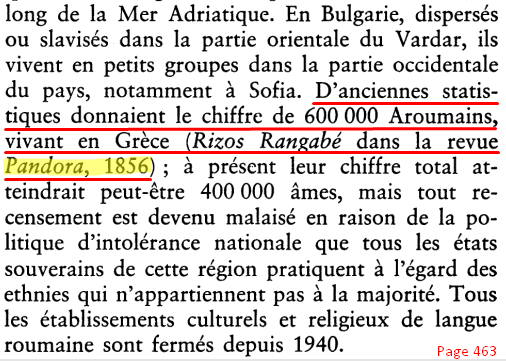
2. Why would you think she has any need to prove you wrong, or anybody else for that matter? The numbers you or Lithoxoou rely on can be questioned and may be unreliable. This is because any "official" census in the Balkan states became uneasy early on (quoting from page 463 below) due to the policy of national intolerance of all the sovereign states with regard to ethnic-linguistic groups (this is especially the case for the entire 19th century). Do you not leave some room for analysis?
3. Unfortunately, I am only able to view the first couple of pages of the link you shared. Does it say something along the following lines?

"Old statistics gave the figure of 600,000 Aromanians, living in Greece (Rizos Rangabe in the review Pandora, 1856)."

PmlOLhp.png

YDfRXeZ.png


PS:

Is Professor Thanos Veremis "legit"?

Professor Thanos Veremis, President of Greece's National Council of Education and founding member of the influential think-tank Hellenic Foundation for Defence and Foreign Policy (better known by its Greek acronym, ELIAMEP) made the following statement:

"Unfortunately, we (Greeks) are deeply conservative as a society. This (ethnic) homogeneity has been harmful (to us). The situation during the 19th century was different. It was rather fortunate that at that time Koraes and others had the inspiration to connect us with Ancient Hellas (an undertaking) which became the main (pre)occupation of the newly born State. In those days, there were Arvanites, Vlachs and Slavs. All of them had to become (part of) one (national body). And so they became. But this is not to say that in this day and age (we/they) should be under the illusion that (we/they) are descendants of Pericles. This (assimilating process of ethnic/national homogenization) might have been helpful before -even though we could not avoid a civil war- but it does not help us nowadays. Today we are not alone. We are surrounded by many neighbors. The (Greek) society must adapt (to new realities) instead of remaining insular and introvert."
 
Last edited:
Bulletin de l'Institut historique belge de Rome, Parts 39-40 (Bulletin of the Belgian Historical Institute in Rome)
Institut historique belge de Rome, 1968 - Archives

vJKLTtV.png

Page 170: "... in Crete the Vlachs are quite numerous in the fourteenth century."
Page 171: "... bought from a Catalan of Barcelona Maria, a Vlach, acquired at Thebes by the Catalans."
 
Last edited:
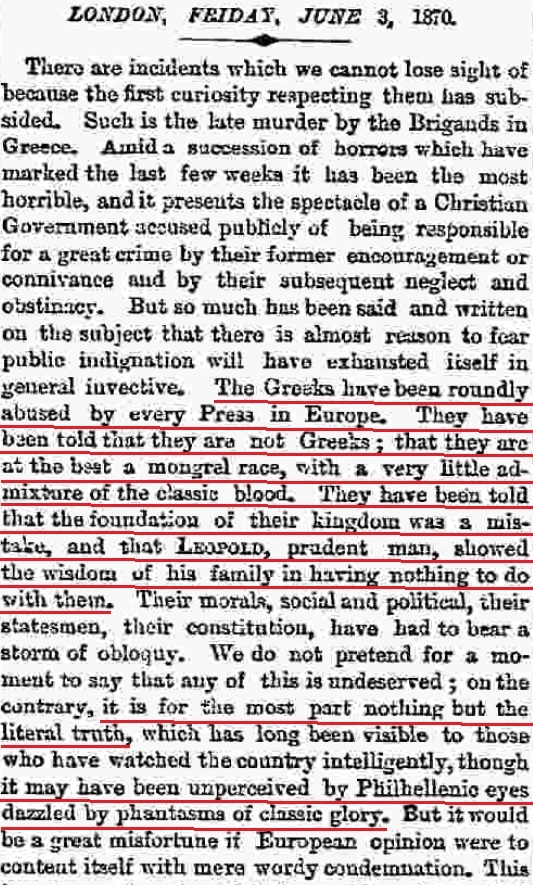
The below article was written during a time when some journalists from western Europe still had enough integrity to tell the truth. Their successors today seem to have forgotten about this contemporary sentiment and are now willing to afford the modern Greeks plenty of latitude when it comes to their myths and national narrative. The modern Greeks, for their part, have been projecting their own insecurities on others since independence. And these days we have the bizarre situation where the creator and the brainchild, both devoid of integrity, have joined forces to torment the Macedonians, a people who are indigenous to Macedonia and did not need different ethno-linguistic groups from the Balkans and elsewhere to come to the country in order to create, reaffirm or bolster their nation.

The Times, 3 June, 1870

 
From your link:
The MP from Milisi, who announced the history of the case in Parliament, claimed that all but two of the robbers were foreigners, ie "Albanians and Vlachs living in Turkey". It is believed that this statement was made because there was a European outcry against Greece for the event. The commentator of the announcement mentions that the Arvanitakis were Greeks from Agrafa, a family from which he had come and a leader of chariots. Takis Arvanitakis had excelled fighting against the Turks inrevolution of Agrafa in 1866. Also that the words "Vlachs", "Arvanites" and "Arvanitovlachoi" had an indefinite meaning and were used by the people in the sense of nomadic cattle breeders.
With a surname like Arvanitakis it is more than likely that the two brothers were Albanians. In some instances, the term Vlach may have been used in a generic manner for a shepherd or the like, but are there any sources from that period that suggest Arvanites and Arvanitovlachs have been used in the same manner?
 
From your link:

With a surname like Arvanitakis it is more than likely that the two brothers were Albanians. In some instances, the term Vlach may have been used in a generic manner for a shepherd or the like, but are there any sources from that period that suggest Arvanites and Arvanitovlachs have been used in the same manner?

Which manner is that? Arvanites, Vlachs and all other foreigners always had these two sides, a Greek one and a non-Greek one, so anyone would use the side that suited him at the occasion. I don't know if brigandry was predominately Albanian, it was actually a very complicated issue that was fully solved much later (in 1900s or 1910s)
 
Which manner is that? Arvanites, Vlachs and all other foreigners always had these two sides, a Greek one and a non-Greek one, so anyone would use the side that suited him at the occasion. I don't know if brigandry was predominately Albanian, it was actually a very complicated issue that was fully solved much later (in 1900s or 1910s)

Do tell us, if you know. I believe the specific question was:
Are there any sources from that period that suggest "Arvanites" and "Arvanitovlachs" have been used in the same or similar generic manner that the term "Vlach/Vlachs" may have been used?

Apparently, the term "Vlach" had multiple meanings (i.e. mountaineer, shepherd, villager, uncouth person), therefore, did the term "Arvanite" have similar meanings?
 
I was recently watching documentary videos on youtube about the breakup of Yugoslavia and read about the Glogova massacre which took place in Bosnia and Herzegovina, in May 1992.

Having come across the toponym "Glogova" it seemed like I came across this name before. I realized that there is a village "Drakovouni" in Arcadia, Peloponnese. The original/authentic name of "Drakovouni" was Glogova, until 1927 that is. Interestingly, I came across a few toponyms in Arcadia/Peloponnese that have their parallels in Bosnia and Herzegovina. We used to have a Kamenitsa in Arcadia but also Kamenica in Bosnia. We have Vytina in Arcadia but also Vitina in Bosnia, etc.

Questions for analysis:
- When were the Arcadian villages of Glogova, Kamenitsa and Vytina established?
- What is the likelihood that these villages were founded by medieval (monolingual) Greek-speakers?
- If they were not founded by Greek-speakers, which seems to be the case here, when did these villages fully self-Hellenize and what "foreign" language was spoken there earlier?
 
It also inspired the film Megalexandros (1980)

By the way, I realized Megalexandros is available on youtube, with English subtitles (you can activate them). This is the best Greek film on Alexander the Great, though you may find it has... little to do with him, and more with the folk view on him or the Dilesi incident mentioned above.

This is a masterpiece, for hardcore cinephiles only, and probably the best Greek film of the 1980s, largely unknown to Greeks today, including Macedonian landscapes and great Macedonian folk-like music written by Chalaris who is a great composer and also a musicologist expert in Byzantine music. Maybe, Carlin is interested because of the content.

https://www.youtube.com/watch?v=cCqV0cIRDF8
 
Back
Top