• Welcome to the new Macedonian Truth Forum. All posts, members and private messages have been moved over from the old forum.

    Passwords from the old forum could not be carried over, so please use Forgot your password? to set a new one. The reset link is emailed to the address on your account.

  • Rules and Regulations at the forum of the Macedonian Truth Organisation (MTO)

    (1) The national-ethnic and cultural-linguistic identity of the Macedonian people is historically Macedonian, and derives its character from the native, indigenous and geographic homeland of the Macedonians, which is called Macedonia. To ensure that their human rights, integrity and heritage are appropriately respected, the only nouns and adjectives acceptable when reference is made to the above character and identity markers is Macedon, Macedonia, Macedonian and Macedonians.

    (2) The nation-state of the Macedonian people is the Republic of Macedonia, and is to be referred to by this official title so long as the 'republic' prefix is consistently applied to other states. Alternative references are the Macedonian Republic, or simply, Macedonia.

    (3) The 'ethnic' prefix is only acceptable for Macedonians in cases where differentiation is specifically required - so long as it is in context and consistent where it concerns its application to other ethnic groups.

    (4) Should any other differentiation be specifically required, the names of other ethnic groups that reside with Macedonians in either the Republic of Macedonia or the occupied Macedonian regions in Greece, Bulgaria, Serbia or Albania, are to be given a prefix.

    (5) Negating the identity, language and culture of the Macedonian people by deliberate avoidance of the terms Macedonia, Macedonian and Macedonians, or by any other means, is not permitted.

    (6) Systematic anti-Macedonian propaganda and rhetoric are not permitted.

    (7) Threads irrelevant to the Macedonian Cause, the community at the Macedonian Truth Organisation or the Macedonians in general may be considered as spam or not in the spirit of the forum. In such cases they are not permitted.

    (8) Continual posting of messages in threads with the sole purpose of deviating from the initial topics with the use of unrelated and unnecessary information is not permitted.

    (9) All posts, external articles, reports, etc that are cited in languages other than Macedonian or English, must be accompanied with a translation in one or both of the said languages.

    (10) Despite the possibility of some conversations and debates becoming heated, extreme abuse and/or racism, vulgar language and/or terminology, threats, revelation of personal information about others, harassment, and other such behavior will not be permitted. If deemed necessary all relevant information including member details will be reported to the appropriate authorities for investigation which may result in legal action.

    (11) Threads that are created must have a summary of a topic or excerpt of an article found in pertinent link(s) that have been included. One line threads will be considered unaccetable spam and are therefore not permitted.

    (12) Compulsive and deliberate lies, irrespective of the topic, are not permitted.

    (13) Any symbols or avatars found to be perceived as offensive to Macedonians are not permitted.

    (13) Any explicit or extreme material is not permitted.

    Failure to adhere to the above rules and regulations will result in a ban after 3 breaches. This may be reconsidered in some cases should the circumstances be of an unorthodox nature and/or require special consideration. To assure an effective deterrent against an individual or individuals with the sole purpose of causing dissent through spamming, racism or other improper means, the above rules will be strictly enforced.

    The MTO administration will monitor all discussions as reasonably practical and reserve the right to remove any post and/or member from the forum, and update the rules and regulations as required. Members are encouraged to immediately report any post and/or member to the MTO administration if they feel that these rules have not been abided by.

    The views expressed on this forum are those of the individuals. The only official representation of the MTO is made by the "Macedonian Truth Organisation (Site Owner)" username, and no other.

  • Macedonian Cause

    The Macedonian Truth Organisation calls on God in Heaven to protect, bless and guide the endeavour it is committing to undertake, and that is to work towards:

    Securing Macedonia as a free, independent and democratic republic in which sovereignty lies with the Macedonian citizens; as the nation-state of the Macedonian people in which they can preserve their culture, language and identity; as a state in which the Macedonian language and culture form the basis of public life and act as important unifying elements of Macedonian society; as the home of all its citizens to which it guarantees and obliges their inalienable natural rights and corresponding responsibilities;

    The acknowledgment as self-evident and irrefutable the existence of the:

    1) Indigenous, ethnonational name of Macedonia;
    2) Macedonian people, language and identity;
    3) Macedonian culture, symbols and folklore;
    4) Macedonian ancestry, heritage and history in its entirety; and
    5) Macedonian Orthodox Church;

    Securing recognition by the International Community of the tragedies endured by the Macedonian people, of the division of Macedonia with the signing of the Treaty of Bucharest on August 10, 1913, and the genocide committed against the Macedonian people at the hands of the Greek, Bulgarian and Serbian states and their respective churches during the 19th and 20th centuries;

    Ensuring that the Interim Accord is declared ‘null and void’ and that all constitutional provisions, acts, commitments, agreements, legislation, regulations, policies or programs emanating from, supporting or consequential to the Interim Accord are also declared ‘null and void’, including the use of any symbols and the completion of any acts imposed by, or originating from, the Interim Accord.

    Ensuring that the Framework Agreement is abolished and that all constitutional provisions, acts, commitments, agreements, legislation, regulations, policies and programs emanating from, supporting or consequential to the Framework Agreement are also abolished and replaced by a framework of constitutional and statutory law based on inalienable natural rights and corresponding responsibilities and universally codified human rights mechanisms.

    Securing the abolishment of any existing constitutional provisions, acts, agreements, legislation, regulations, policies and programs that discriminate against the Macedonian people, in any international organisation or any of the countries of the International Community where such constitutional provisions, acts, agreements, legislation, regulations, policies and programs exist, and thereby ensuring the freedom for Macedonians to exercise their inalienable natural rights and fulfil their corresponding responsibilities, and practice their culture, language and religious faiths in all the countries of the International Community without hindrance;

    The empowerment of Macedonians to undertake a moral revolution and to instil and/or reinvigorate within themselves a deep-rooted national, cultural, linguistic and historical dignity and a commitment to the exercise of freedom based on inalienable natural rights and corresponding responsibilities;

    The recognition of the Macedonian minorities in the neighbouring states of Macedonia as well as the respect for the inalienable rights and freedoms of the Macedonian minorities, as provided for by natural law and as codified by the United Nations Charter, the Universal Declaration of Human Rights and other universally codified human rights mechanisms;

    The full and unreserved respect of, and the support for, the rights of all people of non-Macedonian descent living in Macedonia and around the world, who share a reciprocal full and unreserved respect for the Macedonian people, their homeland and their state;

    The cultural unification and solidarity of the Macedonian people living in all parts of historical Macedonia and adjacent territories, as well as Macedonians throughout the world;

    The unity of all Macedonians on the principles, objectives and achievement of the Macedonian cause as defined by this declaration.

The Real Ethnic Composition of Modern Greece

The contribution of Albanians

URL:
http://www.ekathimerini.com/246522/opinion/ekathimerini/comment/the-contribution-of-albanians

The big migration wave from Albania in the 1990s revitalized almost all professions and remains a decisive factor in the country’s economic development. Greece gained capable blue-collar workers and laborers who, with their dedication and hard work, continue to contribute to the country and create wealth.

The contribution of Albanians and ethnic Greeks from Albania to the Greek economy is indisputable. The big migration wave of the 1990s revitalized almost all professions and remains a decisive factor in the country’s economic development. Greece gained capable blue-collar workers and laborers who, with their dedication and hard work, continue to contribute to the country and create wealth.

Today, the children of those migrants not only speak excellent Greek, but are excelling in education, growing up in a country that they now consider their own, and contributing to the development of the arts, sciences and entrepreneurship (even if examples of unequal treatment and unacceptable difficulties in obtaining citizenship still persist).

The fears in the 1990s that the country’s cultural makeup would change were baseless. Let us remember that a great number of Albanian and Slavic people have migrated to Greek lands over the last few centuries and the descendants of many of them are now indistinguishable from the rest of the population. After all, what Greek or Englishman can say that he knows who his ancestors were 1,000 years ago? Even the United Kingdom’s Queen Elizabeth II is of German descent.

Greece, with its culture, geography, language, climate, history and religion, has created Greeks for millennia, whatever their place of birth.

Consequently, the new migrants who arrive in Greece also carry the promise of a significant contribution to Greece. This does not mean, however, that society has unlimited possibilities to develop social interactions with (the word “assimilate” is tasteless and racist) the “foreigner.”

People who come to our country should be treated well, but Greece cannot continue to take in so many arrivals. The increase in the number of refugees and migrants reaching Greece is driven by anti-Western forces that want to destabilize Europe.

Turkey allows the smuggling boats to sail from its shores, which it controls completely, as a means of pressure. This is aimed at making migration an issue of bilateral negotiation with Athens.

In other words, immigration certainly strengthens Greece in a variety of ways, as the Albanians and ethnic Greeks from Albania have clearly shown, but the large numbers of migrant arrivals, which is the result of secret plans to destabilize Europe, must be controlled by the mobilization of the European Union and NATO.
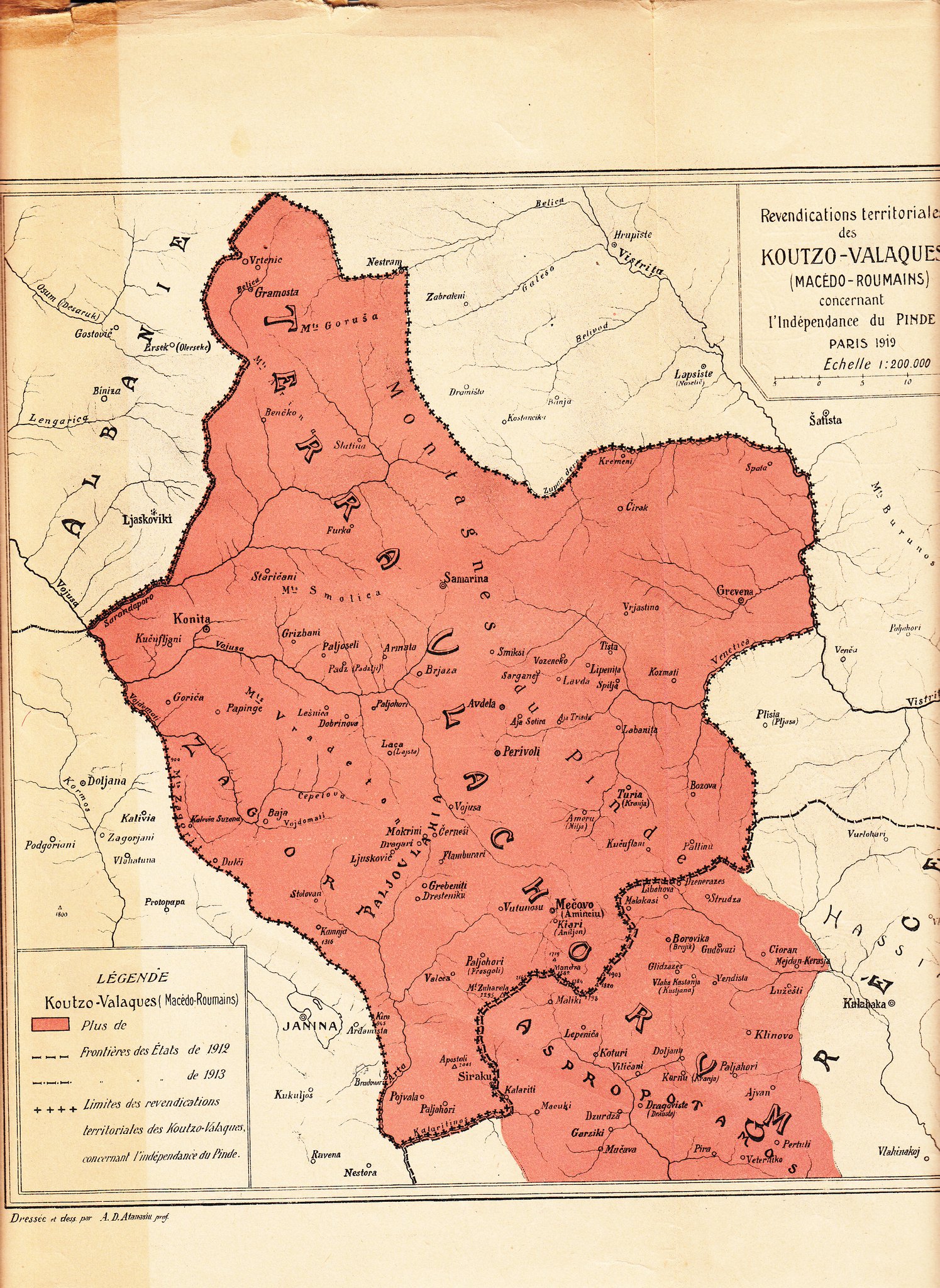
 
Map showing the territorial requests at the 1919 Peace Conference of Paris for the creation of an Arman-Vlach autonomous state in the Pindus region

Dt2EkOu.jpg
 
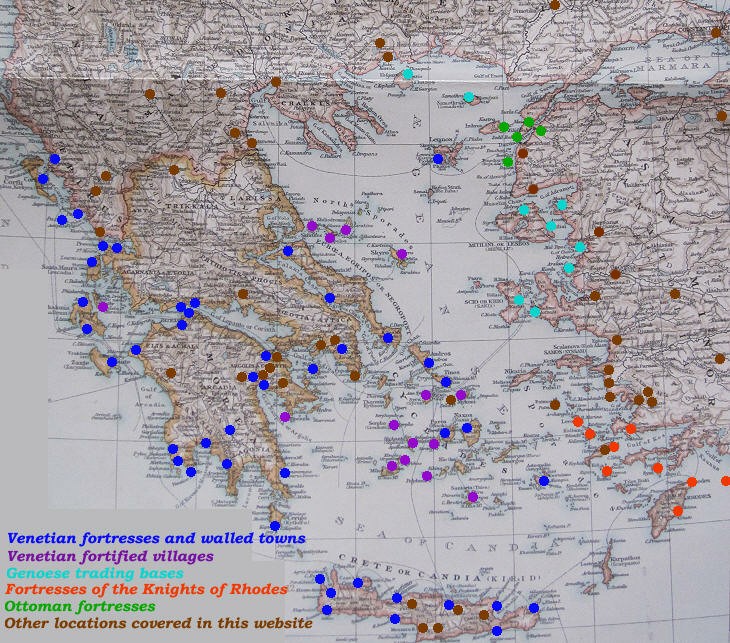
On this map we see which coastal areas Venetians held in Greece, marked in blue and purple. There was likely a 'significant influx' of Venetian and other colonists in these regions.

yq7GHVS.jpg
 
Also there are first names like Ivanis, Dobros, Traikos, Milos, Vlados, Stoianos, Nenadas, Vetikos, etc. Widow Mila, widow Petrana, widow Vlasina, widow Dobrina and many more.

Great post Carlin. It is interesting that it was (is?) customary when writing in Greek to add Greek word endings to names, even first names. The beauty of (some of) the names identified in the list is that they obviously belong to languages other than Greek.
 
Thanks Dove.


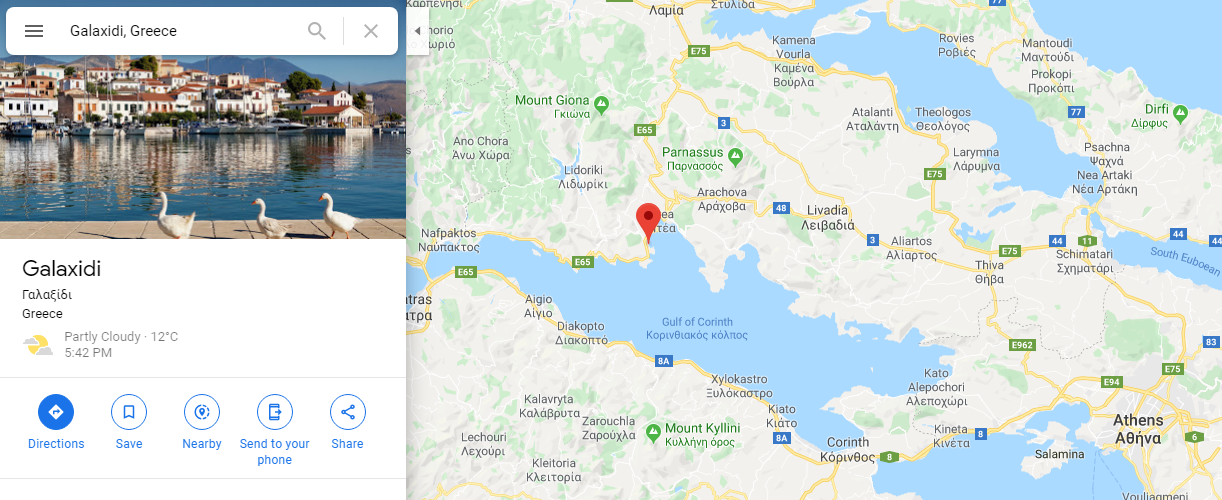
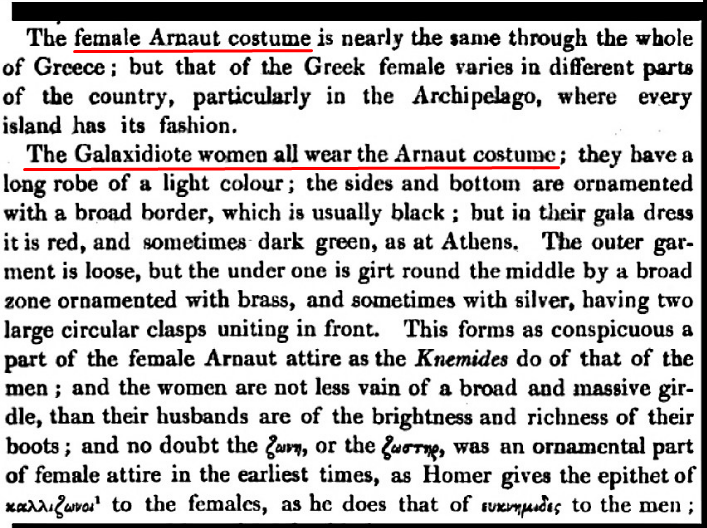
Galaxidi or Galaxeidi, is a town and a former municipality in the southern part of Phocis. According to Edward Dodwell, year 1819: The Galaxidiote women all wear the Arnaut costume.

Pe83NpY.png

AdcuWNB.png

ESARu24.png
 
A letter from Almira/Almyros (southern Thessaly), near the town of Ypati, addressed to the famous Alexandar Exarch in Constantinople, dated September 1850 by the peasant Kalina Stoiku.

The letter was written in Greek. In this letter, Kalina Stoiku pleads for her son, Konstantin Stoiku, to be released from the Constantinople prison where he was sent, slandered, that he was allegedly a robber. The letter, in addition to the signature of Kalina Stoiku, also carries signatures of several other leading figures from the same village, with the following names: Mito, Nechko, Licho, Lalo, Dimo and others.
 
Last edited:
"The Earth and Its Inhabitants", by Elisee Reclus, Ernst Georg Ravenstein, Augustus Henry Kane - year 1882

Pages 93-94:

- "The Arabs and Venetians, too, have been assimilated by the aboriginal Cretans; but there still exist a considerable number of Albanians, the descendants of soldiers, who have retained their language and customs."
- "All Cretans, with the exception of the Albanians, speak Greek..."
 
Burtzovlachs = Thessalian Vlachs

The earlier known references to the Vlach language date from the VI century (Wace & Thomson, 1989:2). In the Middle Ages, Vlachs established their own states in Great Vallachia (in Thessaly and Southern Macedonia) and Little Vallachia (in Etolia-Akarnania and Southern Epirus), in the XI and XII centuries (Dahmen, 1994:3; Berard, 1987:296); later on, they formed the basis of and provided the rulers to the ‘Second Bulgarian Kingdom’ or ‘Kingdom of Vlachs and Bulgarians’ (1185-1260), which at one point incorporated Great Vallachia. The latter survived the kingdom’s collapse as an autonomous area through the XIV century; then, and for some four centuries, little is known about the Vlachs who, as Orthodox Christians, belonged to the Greek-dominated Orthodox millet (= nationality) in the Ottoman Empire. Modern Vlachs are sometimes called Kutzovlachs (= Vlachs from Little Vallachia) or Burtzovlachs (= Vlachs from Great Vallachia), terms which have acquired demeaning connotations (Papathanasiou, 1991:25; Lazarou, 1986:62).

http://miris.eurac.edu/mugs2/do/blob.html?type=html&serial=1044526140151
 
corinth1.png

corinth2.png

corinth3.png

corinth4.png

Physical anthropology/taxonomy: Slavs/Avars of conquered Greece (Macedonia, Peloponesse, Hellas and Epirus) were mediterraean.
 
After conquering Constantinople, when Mehmed II finally entered the city through what is now known as the Topkapi Gate, he immediately rode his horse to the Hagia Sophia.

Mehmed's main concern with Constantinople was with rebuilding the city's defenses and repopulation. Building projects were commenced immediately after the conquest, which included the repair of the walls, construction of the citadel, and building a new palace.

Mehmed issued orders across his empire that Muslims, Christians, and Jews should resettle in the City demanding that five thousand households needed to be transferred to Constantinople by September. From all over the Islamic empire, prisoners of war and deported people were sent to the city; these people were called "Sürgün" in Turkish.

According to a survey carried out in 1478, there were then in Constantinople and neighboring Galata 16,324 households, 3,927 shops, and an estimated population of 80,000. The population was about 60% Muslim, 20% Christian, and 10% Jewish.

URL:
https://en.wikipedia.org/wiki/Mehmed_the_Conqueror

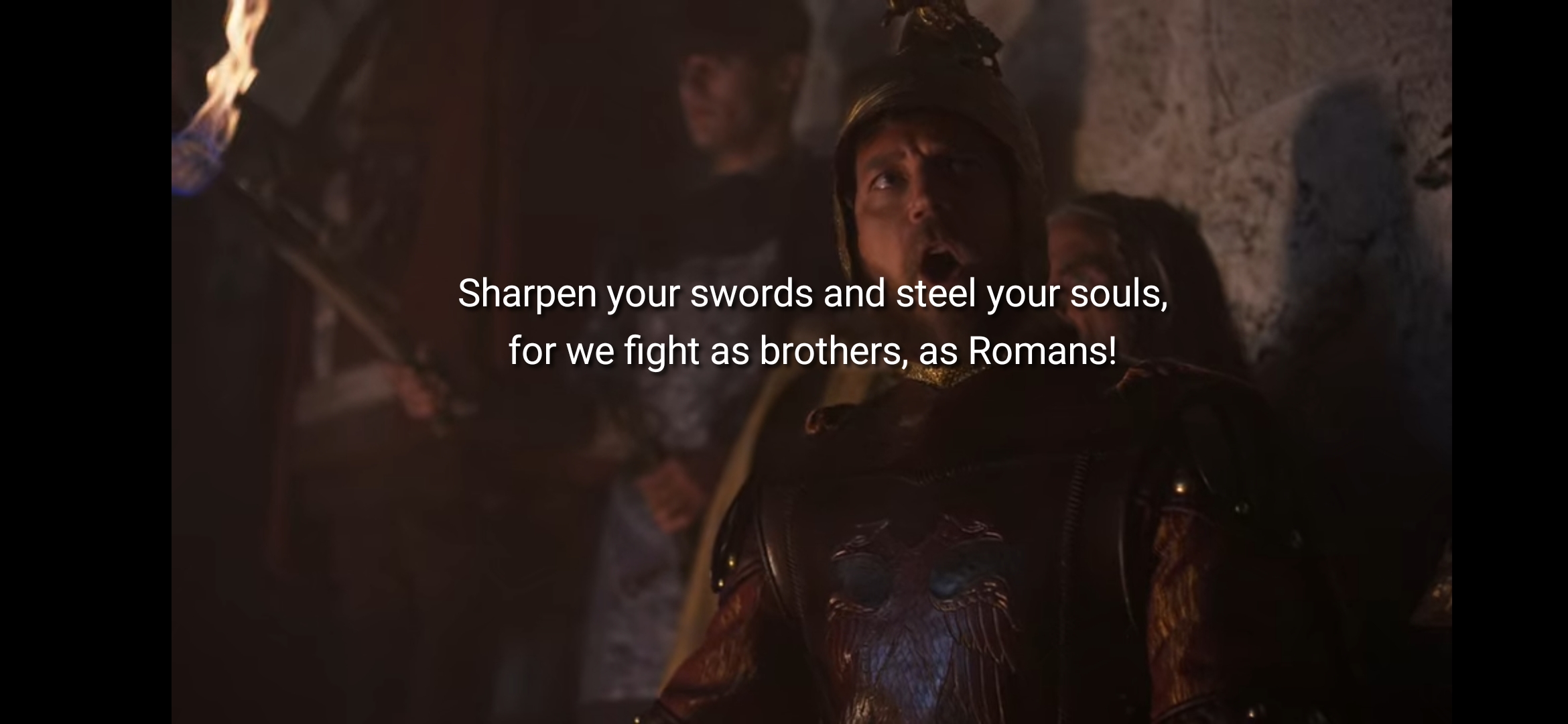
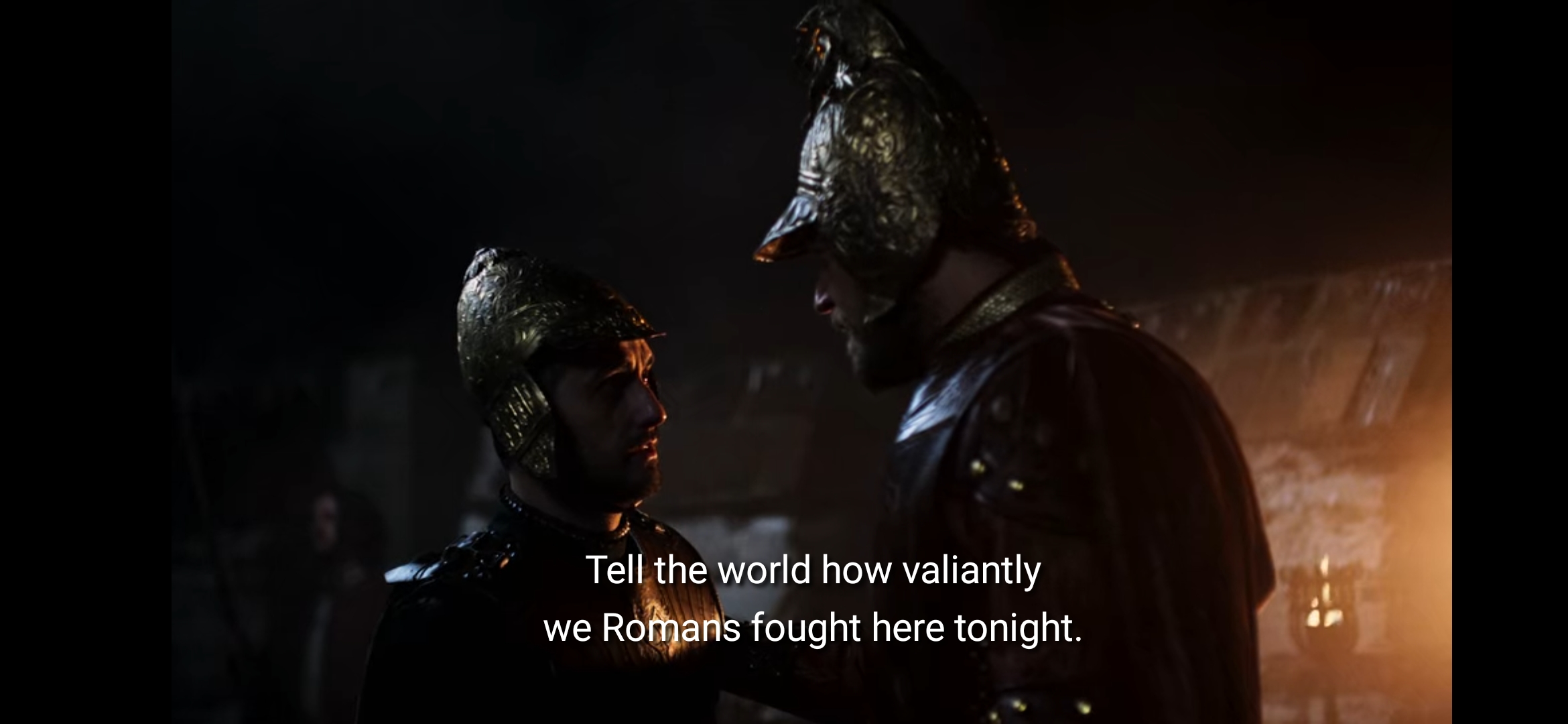
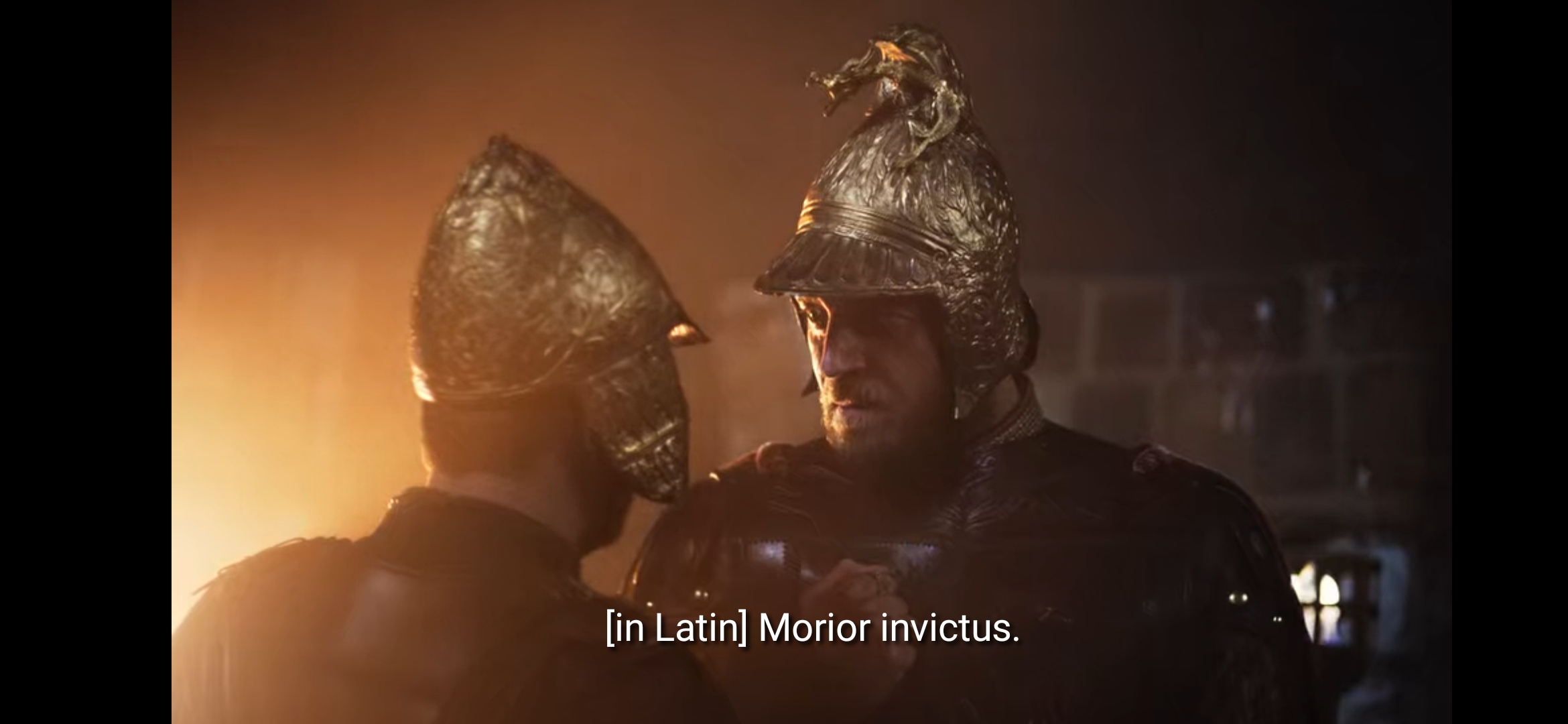
Images from the series Rise of Empires: Ottoman:
https://www.imdb.com/title/tt9244578/

"Ottoman Sultan Mehmed II wages an epic campaign to take the capital of Constantinople and shapes the course of history for centuries."

For the most part the series is true to history and portrays those fighting the Ottomans as Romans.

6NqgBke.jpg

XkTldBk.jpg

CbPUd8k.jpg
 
Last edited:
1) Case Sotiris Bletsas for Minority Languages - Video:
https://www.youtube.com/watch?time_continue=74&v=e7tP0XpX9ns&feature=emb_title

The case of Sotiris Bletsas that has been chased by the Greek Law for declaring that his mother language and his origin was Vlach

In 1995, at an Aromanian festival in Greece, he distributed some EBLUL material about minority languages in Greece. In 2001, on an initiative of the MP for Edessa Evgenios Haïtidis, he was charged with "dissemination of false information" (contrary to article 191 of the Greek Penal Code) who reportedly was supported by the leadership of the Panhellenic Federation of Cultural Associations of Vlachs. The case drew protest from the Greek Helsinki Monitor and from abroad. He was first found guilty and sentenced to fifteen months in jail, suspended for three years, and fined 500,000 drachmas, however, he successfully appealed the decision and was subsequently found not guilty on 18 October 2001.

2) Emperor Nicephorus (802-811) settled colonists from various parts of the empire - "Kapheroi, Thrakesians, Armenians, and others from different places and cities" - in the Peloponnese.

Possibly these "Kapheroi" may have been Syrian Christian ex-subjects of the Caliphate who had become refugees or evacuees.

URLs:
https://books.google.ca/books?id=-s...Q6AEIMTAB#v=onepage&q=Kapheroi Sparta&f=false
https://books.google.ca/books?id=Y2...=0ahUKEwiGzM31qdnnAhWMmuAKHfmoCPo4ChDoAQgnMAA

3) The Venetian Senate authorized the chatelain of Methoni to hire 300 mercenaries. Methoni is an interesting example of how Venetian colonists were settled, and their subsequent way of life. In 1293 the Senate ordered the walls of Methoni and Korone to be rebuilt and the towns populated by 24 families sent from Venice. Inside the burgus, or fortified town, of Methoni were commercial warehouses.

URL:
https://books.google.ca/books?id=kj...#v=onepage&q=venetian colonists cyprus&f=true
 
Last edited:
1) The term Koutsovlachs that is used by scholars since the past century and which very often has a humiliating character, is related to "Kioutsouk Vlachia" as the Turks called Aetolia-Akarnania (Little Vlachia). This entire region was an area with majority Vlach-speakers until the years of Cosmas of Aetolia (Epigram of Evgeniou Etolou).

2) Skourta is a village in Boeotia, Greece - probably associated by Arvanites. The Romanian version of the wikipedia page seems to mention Slavs and Vlachs:
https://ro.wikipedia.org/wiki/Skourta

What I find interesting is that there was a family with the last name Skourta or Skurta in the village of my ancestors. The Skourta family were Vlach-speakers.

3) Rigas, Georgakis Olympios, Yiannis Pharmakis, Hatzipetros, Vlahavei, all the benefactors except Sigron, Zappas, Averof, Sinas, Spiridon Lambrou, Papagos, Svolos, Kristallis and many others were of Vlach origin. Another aspect of the newly established Hellenic Republic that is not well known is that many modern artists are of Vlach origin like Koutsomitis, Prokovas, Papatakis, Tsitsanis, Virvos, Kaldaras, Mitropanos, Sgouros, etc.
 
Last edited:
Another aspect of the newly established Hellenic Republic that is not well known is that many modern artists are of Vlach origin like Koutsomitis, Prokovas, Papatakis, Tsitsanis, Virvos, Kaldaras, Mitropanos, Sgouros, etc.

And... who wrote this? And why is there an unknown name among well-known names? You shouldn't worry about your posts being scrutinized. Nobody here (except for me) knows any of these guys. Actually if you had written 20 random names they wouldn't have noticed it.

I'm a little confused on whether you're partly Greek or not, if you can read or speak Greek, I wonder if any of these names means something to you.


=
 
Last edited:
And... who wrote this? And why is there an unknown name among well-known names? You shouldn't worry about your posts being scrutinized. Nobody here (except for me) knows any of these guys. Actually if you had written 20 random names they wouldn't have noticed it.

I'm a little confused on whether you're partly Greek or not, if you can read or speak Greek, I wonder if any of these names means something to you.


=

Please follow up with user Antioxos from Hellas here:
http://archive.worldhistoria.com/history-of-the-romanians-and-vlachs-2711310_topic12810_page2.html

Also, check with these bloggers:
https://www.facebook.com/1779191761...emetery-of-the-city-of-athen/442643606335089/

"Here a lot of personalities with AROMANIAN / VLACH origins have the tombs.

Among the most famous personalities, we mention:

Odysseas Androutsos, hero of Greek War of Independence;
George Averoff, philanthropist, businessman;
Odysseas Elytis, poet;
Theodoros Kolokotronis, general, politician;
Giorgos Seferis, poet;
Michael Tositsas is one of the Great Benefactors of Greece;
Dimitris Mitropanos, singer"
 
1) The term Koutsovlachs that is used by scholars since the past century and which very often has a humiliating character, is related to "Kioutsouk Vlachia" as the Turks called Aetolia-Akarnania (Little Vlachia). This entire region was an area with majority Vlach-speakers until the years of Cosmas of Aetolia (Epigram of Evgeniou Etolou).

Is the term "Kioutsouk" therefore a Turkish word? If not, to which language does it belong?
 
"Here a lot of personalities with AROMANIAN / VLACH origins have the tombs.

Among the most famous personalities, we mention:

Odysseas Androutsos, hero of Greek War of Independence;
George Averoff, philanthropist, businessman;
Odysseas Elytis, poet;
Theodoros Kolokotronis, general, politician;
Giorgos Seferis, poet;
Michael Tositsas is one of the Great Benefactors of Greece;
Dimitris Mitropanos, singer"

Only Averof and Tositsas were Vlachs or of Vlach origin.
 
Is the term "Kioutsouk" therefore a Turkish word? If not, to which language does it belong?

The term is likely derived from Turkish: Kioutsouk or Ciuchuk = small. At times, Thessaly and south Macedonia were considered Great Vlachia, whereas ‘small’ Vlachia was Aetolia-Akarnania and adjacent regions. (Pindus was called Upper Vlachia.)


The following article was published in Greek in the journal Thessalonikeon Polis, May 2003. The English version reflects updated information. Helen Abadzi (habadzi@worldbank.org) was born in Thessaloniki, Greece in 1951. Her ancestors were from eastern Thrace and Sarakatsanoi of Serres (therefore Hellenized Vlach-speakers). She is an educational psychologist who works at the World Bank and has studied 16 languages. Her hobby is history, and she has published extensively on the interactions between Greece and India through the centuries as well as on Greek communities in British India.

Quote by Helen Abadzi:
"However, historically the members of this ‘minority’ have acted as the backbone of Hellenism: fighters against Ottoman occupation, like Rigas Feraios, Giorgakis Olympios, and possibly Theodoros Kolokotronis; leaders of leftist resistance against the Germans (EAM), such as Alexandros Svolos and Andreas Tzimas. Distinguished writers like Kostas Krystallis and Christos Zalokostas were Vlach, as were contemporary composers like Apostolos Kaldaras, Kostas Virvos, Babis Bakalis, and Mitropanos. Many became rich Balkan merchants during the 18th and 19th centuries and many Greek national benefactors were Vlachs, such as Nikolaos Stournaris, Georgios Arsakis, Michael and Georgios Tositsas, Georgios Sinas. Simon Sinas financed the construction of the Academy of Athens, while Georgios Averoff contributed to the first Olympic games."

URL:
http://www.farsarotul.org/nl26_1.htm


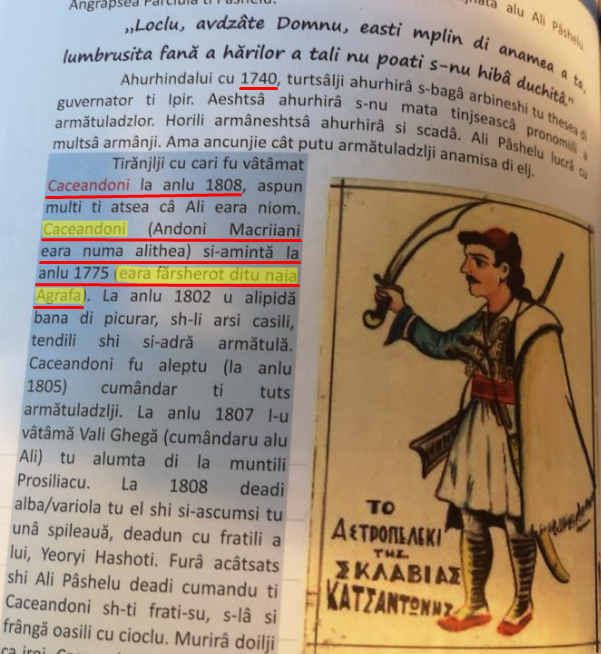
Antonis Katsantonis, Arvanitovlach (Farsherot) from Agrafa
19Zmp5P.png
 
Last edited:
wLxbnmO.png

ScxZf64.png

R4HVdHx.png


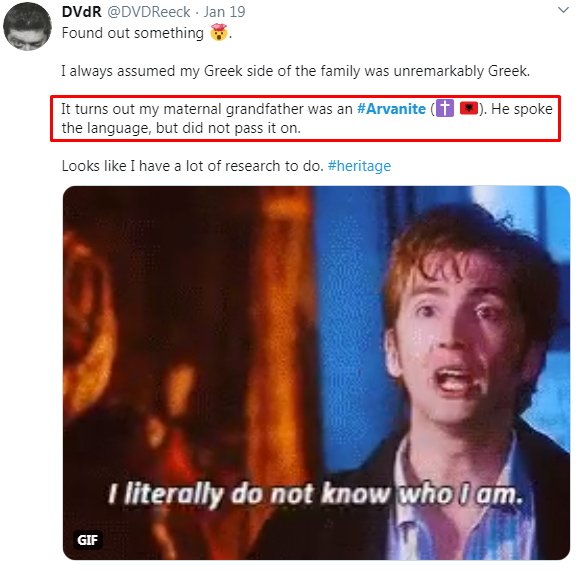
This person (who is half Greek) discovered that his maternal grandfather spoke Albanian. He should stop the research right there - he might be displeased what he finds.
kqioPMI.png


On that note, how many people actually do not know what languages their grandparents spoke?
 
Last edited:
Back
Top