• Welcome to the new Macedonian Truth Forum. All posts, members and private messages have been moved over from the old forum.

    Passwords from the old forum could not be carried over, so please use Forgot your password? to set a new one. The reset link is emailed to the address on your account.

  • Rules and Regulations at the forum of the Macedonian Truth Organisation (MTO)

    (1) The national-ethnic and cultural-linguistic identity of the Macedonian people is historically Macedonian, and derives its character from the native, indigenous and geographic homeland of the Macedonians, which is called Macedonia. To ensure that their human rights, integrity and heritage are appropriately respected, the only nouns and adjectives acceptable when reference is made to the above character and identity markers is Macedon, Macedonia, Macedonian and Macedonians.

    (2) The nation-state of the Macedonian people is the Republic of Macedonia, and is to be referred to by this official title so long as the 'republic' prefix is consistently applied to other states. Alternative references are the Macedonian Republic, or simply, Macedonia.

    (3) The 'ethnic' prefix is only acceptable for Macedonians in cases where differentiation is specifically required - so long as it is in context and consistent where it concerns its application to other ethnic groups.

    (4) Should any other differentiation be specifically required, the names of other ethnic groups that reside with Macedonians in either the Republic of Macedonia or the occupied Macedonian regions in Greece, Bulgaria, Serbia or Albania, are to be given a prefix.

    (5) Negating the identity, language and culture of the Macedonian people by deliberate avoidance of the terms Macedonia, Macedonian and Macedonians, or by any other means, is not permitted.

    (6) Systematic anti-Macedonian propaganda and rhetoric are not permitted.

    (7) Threads irrelevant to the Macedonian Cause, the community at the Macedonian Truth Organisation or the Macedonians in general may be considered as spam or not in the spirit of the forum. In such cases they are not permitted.

    (8) Continual posting of messages in threads with the sole purpose of deviating from the initial topics with the use of unrelated and unnecessary information is not permitted.

    (9) All posts, external articles, reports, etc that are cited in languages other than Macedonian or English, must be accompanied with a translation in one or both of the said languages.

    (10) Despite the possibility of some conversations and debates becoming heated, extreme abuse and/or racism, vulgar language and/or terminology, threats, revelation of personal information about others, harassment, and other such behavior will not be permitted. If deemed necessary all relevant information including member details will be reported to the appropriate authorities for investigation which may result in legal action.

    (11) Threads that are created must have a summary of a topic or excerpt of an article found in pertinent link(s) that have been included. One line threads will be considered unaccetable spam and are therefore not permitted.

    (12) Compulsive and deliberate lies, irrespective of the topic, are not permitted.

    (13) Any symbols or avatars found to be perceived as offensive to Macedonians are not permitted.

    (13) Any explicit or extreme material is not permitted.

    Failure to adhere to the above rules and regulations will result in a ban after 3 breaches. This may be reconsidered in some cases should the circumstances be of an unorthodox nature and/or require special consideration. To assure an effective deterrent against an individual or individuals with the sole purpose of causing dissent through spamming, racism or other improper means, the above rules will be strictly enforced.

    The MTO administration will monitor all discussions as reasonably practical and reserve the right to remove any post and/or member from the forum, and update the rules and regulations as required. Members are encouraged to immediately report any post and/or member to the MTO administration if they feel that these rules have not been abided by.

    The views expressed on this forum are those of the individuals. The only official representation of the MTO is made by the "Macedonian Truth Organisation (Site Owner)" username, and no other.

  • Macedonian Cause

    The Macedonian Truth Organisation calls on God in Heaven to protect, bless and guide the endeavour it is committing to undertake, and that is to work towards:

    Securing Macedonia as a free, independent and democratic republic in which sovereignty lies with the Macedonian citizens; as the nation-state of the Macedonian people in which they can preserve their culture, language and identity; as a state in which the Macedonian language and culture form the basis of public life and act as important unifying elements of Macedonian society; as the home of all its citizens to which it guarantees and obliges their inalienable natural rights and corresponding responsibilities;

    The acknowledgment as self-evident and irrefutable the existence of the:

    1) Indigenous, ethnonational name of Macedonia;
    2) Macedonian people, language and identity;
    3) Macedonian culture, symbols and folklore;
    4) Macedonian ancestry, heritage and history in its entirety; and
    5) Macedonian Orthodox Church;

    Securing recognition by the International Community of the tragedies endured by the Macedonian people, of the division of Macedonia with the signing of the Treaty of Bucharest on August 10, 1913, and the genocide committed against the Macedonian people at the hands of the Greek, Bulgarian and Serbian states and their respective churches during the 19th and 20th centuries;

    Ensuring that the Interim Accord is declared ‘null and void’ and that all constitutional provisions, acts, commitments, agreements, legislation, regulations, policies or programs emanating from, supporting or consequential to the Interim Accord are also declared ‘null and void’, including the use of any symbols and the completion of any acts imposed by, or originating from, the Interim Accord.

    Ensuring that the Framework Agreement is abolished and that all constitutional provisions, acts, commitments, agreements, legislation, regulations, policies and programs emanating from, supporting or consequential to the Framework Agreement are also abolished and replaced by a framework of constitutional and statutory law based on inalienable natural rights and corresponding responsibilities and universally codified human rights mechanisms.

    Securing the abolishment of any existing constitutional provisions, acts, agreements, legislation, regulations, policies and programs that discriminate against the Macedonian people, in any international organisation or any of the countries of the International Community where such constitutional provisions, acts, agreements, legislation, regulations, policies and programs exist, and thereby ensuring the freedom for Macedonians to exercise their inalienable natural rights and fulfil their corresponding responsibilities, and practice their culture, language and religious faiths in all the countries of the International Community without hindrance;

    The empowerment of Macedonians to undertake a moral revolution and to instil and/or reinvigorate within themselves a deep-rooted national, cultural, linguistic and historical dignity and a commitment to the exercise of freedom based on inalienable natural rights and corresponding responsibilities;

    The recognition of the Macedonian minorities in the neighbouring states of Macedonia as well as the respect for the inalienable rights and freedoms of the Macedonian minorities, as provided for by natural law and as codified by the United Nations Charter, the Universal Declaration of Human Rights and other universally codified human rights mechanisms;

    The full and unreserved respect of, and the support for, the rights of all people of non-Macedonian descent living in Macedonia and around the world, who share a reciprocal full and unreserved respect for the Macedonian people, their homeland and their state;

    The cultural unification and solidarity of the Macedonian people living in all parts of historical Macedonia and adjacent territories, as well as Macedonians throughout the world;

    The unity of all Macedonians on the principles, objectives and achievement of the Macedonian cause as defined by this declaration.

The Real Ethnic Composition of Modern Greece

This is an interesting topic in a wrong thread. Actually the problem was not having a cover version and these were not cases of plagiarism. It's just that in the 50s, 60s and even the 70s the crediting rules and mentality was not the same and I'm pretty sure you have to blame the record companies and not the composers like Kaldaras and Kazantzidis who are actually really major Greek composers.

These Indian songs are still officially credited to the Greek "composers" and I have personally tried to change this but it weirdly hasn't changed yet, when the real composer is obviously the Indian duo Shankar-Jaikishan. The three songs given in the link are the three most famous cases known in Greece as "Afti i Nyhta Menei", "Oso Axizeis Esy" and "Ligo Ligo Tha Me Synithiseis".

I guess, but I honestly didn't want to create a new thread - or Search for one that could have been perhaps more appropriate.

I also forgot to include the original link where I saw this - freeinquiry.gr of course:
https://freeinquiry.gr/single-post.php?id=921

By the way, could you please elaborate on your efforts to have the real Indian composers credited with the songs? Why do you think, in the year 2018, these Indian songs are still officially credited to the Greek "composers"?

There are also countless Arabic, Turkish and other songs that were copied and appropriated -- which still seem to be explained away as originally Greek or as legitimate heritage of the refugees. Do you know much about this?


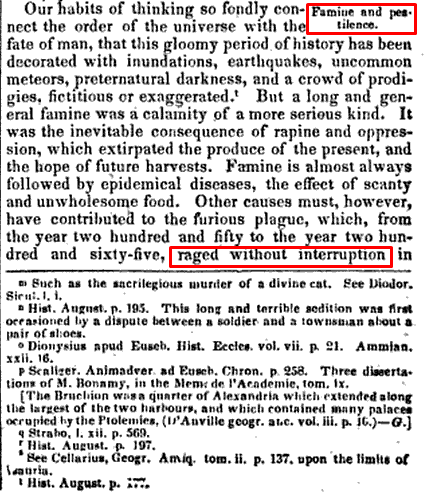
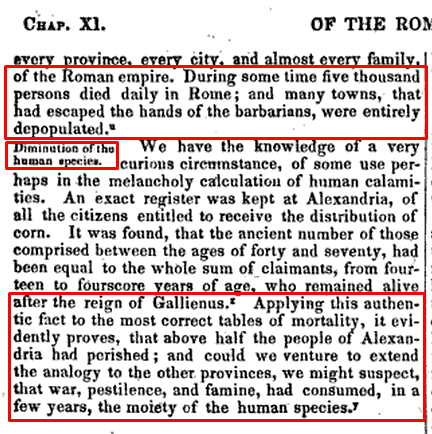
A law of Septimius Severus [a Roman emperor in 200 A.D.] speaks of a penuria hominum- a shortage of men. In Greece the depopulation had been going on for centuries. In Alexandria, which had boasted of its numbers, Bishop Dionysius calculated that the population had in his time (250 A.D.) been halved. He mourned to “see the human race diminishing and constantly wasting away.” Only the barbarians and the Orientals were increasing, outside of the Empire and within.

http://catholic-skyview-tremblay.blogspot.com/2012/02/caesar-depopulation-and-crisis-secular.html


"Fanis Michalopoulos has given the answer, who, referring to the visit of Cosmas of Aetolia to Aspropotamos and Agrafa regions, stresses that "the language here (was) Vlach in most villages"


Agrafa mountains - Agrafa is a mountainous region in Evrytania and Karditsa regional units in mainland Greece. It is the southernmost part of the Pindus range.

https://en.wikipedia.org/wiki/Agrafa
 
1) “Despite its ancient name and self presentation, Modern Greece is not an old nation. The Greek national state was born as the result of a separatist war..."

- Antonis Liakos, "Historical Time and National Space in Modern Greece"

URL:
http://src-h.slav.hokudai.ac.jp/coe21/publish/no15_ses/11_liakos.pdf

2) The difficulty of being a Greek, by Vasilis Rafailidis

* First Published in the Ethnos (1987)

URL:
http://eranistis.net/wordpress/2014/05/08/η-δυσκολία-να-είσαι-έλληνας/

Some interesting excerpts/translations.

a) The Greek Revolution of 1821 was indeed a revolution. But in a totally different sense from the textbooks and official stories that seem to ignore the meaning of the word. Revolution, therefore, means rebelling a part of the people of a particular ethnicity against part of the same people of the same ethnicity. The French Revolution, for example, was a revolution, because some Frenchmen were up against other Frenchmen. So was the October Revolution.

The war that takes place during a revolution which, of course, does not necessarily lead to a war, since disputes can be settled through negotiations, is necessarily civil (war between members of the same race). Why, then, was the Greek Revolution called a revolution? If the Greeks were fighting the Turks, we would have had to simply have a "liberating war" with the aim of expelling the conqueror from lands inhabited by a particular ethnicity, wishing to self-rule and to become autonomous (to establish the laws itself).

b) Gerasimos Kaklamanis, who, with his book "On the Structure of the Modern Greek State" (author's edition), provided us with the stimuli for today's text, says that not only Arvanites and Vlachs took part in the Greek Revolution (this is not disputed), but also about 430,000 Muslims in religion, many of whom were Turks in origin...

c) And if these are easily labeled by their names, the Arvanites, the Vlachs and the Slavs make it more difficult for them, mainly because they have been established for centuries in this place.

However, many names are irrefutable witnesses of the racial origin of at least half of the Neohellenic people. The names of Ghika, Gekas, Toskos and Kioses are typically Arvanite. Arvanite is also the common name of Sideris, which was given as a professional definition to the Arvanite blacksmiths, as well as all the names with the prefix "Arvanitis", such as Arvanitakis, Arvanitopoulos, etc. Similarly, there is a huge number of Greek names with the prefix Vlachos, such as Vlachopoulos, Vlachakis, Vlachogiannis, Vlachomitros, etc. Also easily distinguished are those with the Slavic ancestors: Stogiannis, Staikos, etc. Language was and still remains the most authoritative source for the science of Ethnology. We all know that half of the modern Greek words are Arvanite, Turkish, Vlach and Slavic. So, why do we talk about "racial purity" in a place where we all have in our genealogy tree of more than one ancestor of "other races"?

3) In the following article by the same writer Vasilis Rafailidis it is plainly stated that: today at least a quarter of Greeks are of Albanian descent - and anyone who challenges the contribution of the Arvanites to the Modern Greek history is either a baby, totally illiterate or malignant.

URL of the article (first published in 1987):
http://eranistis.net/wordpress/2014/10/21/αρβανίτες-οι-δωριείς-του-νέου-ελληνισ/
 
Last edited:
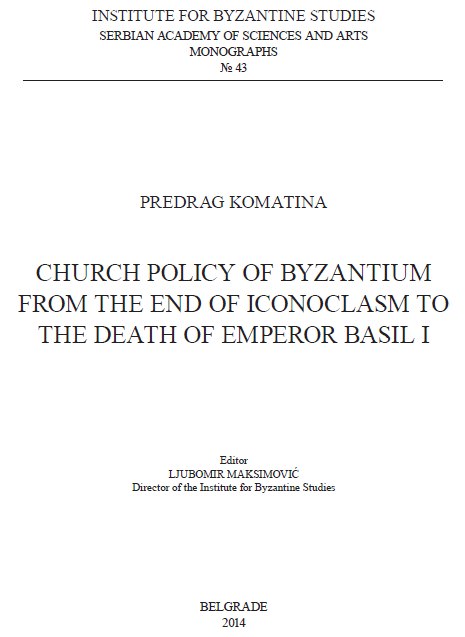
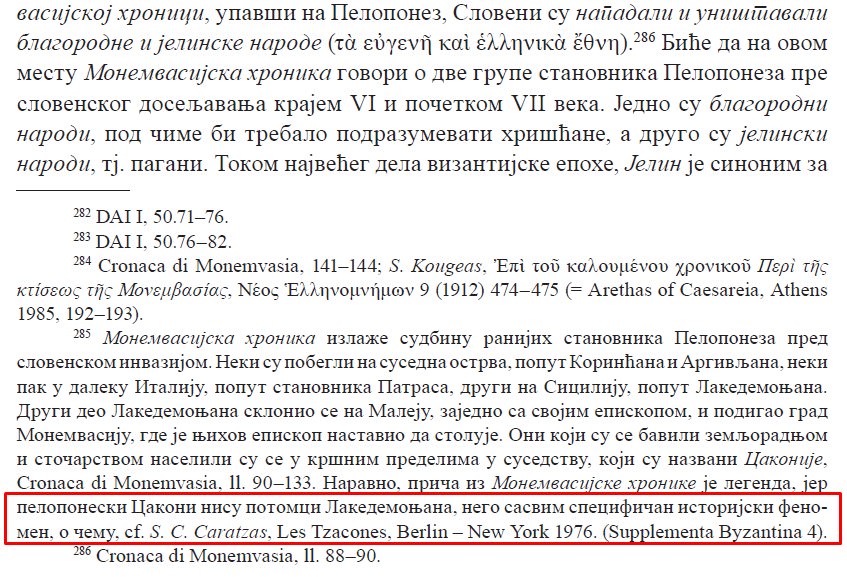
Serbian historian Predrag Komatina states openly that the Peloponnesian Tzakonians are not descendants of ancient Lacedaemonians - but rather a specific historical phenomenon (citing Caratzas).

fRnxwcq.jpg

ZJWCIhd.jpg


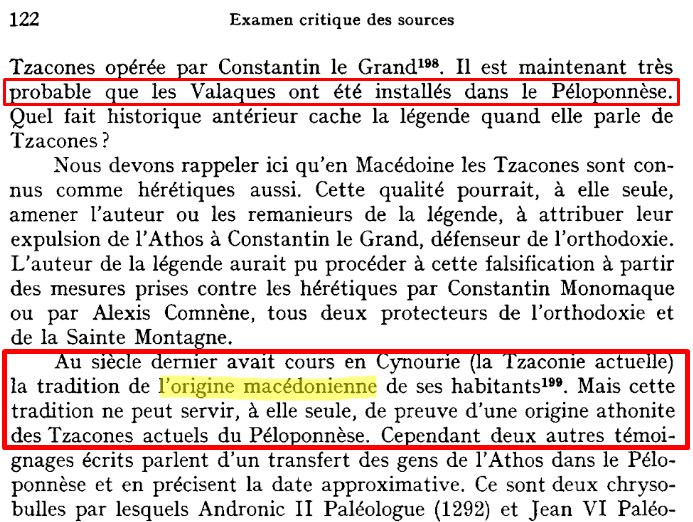
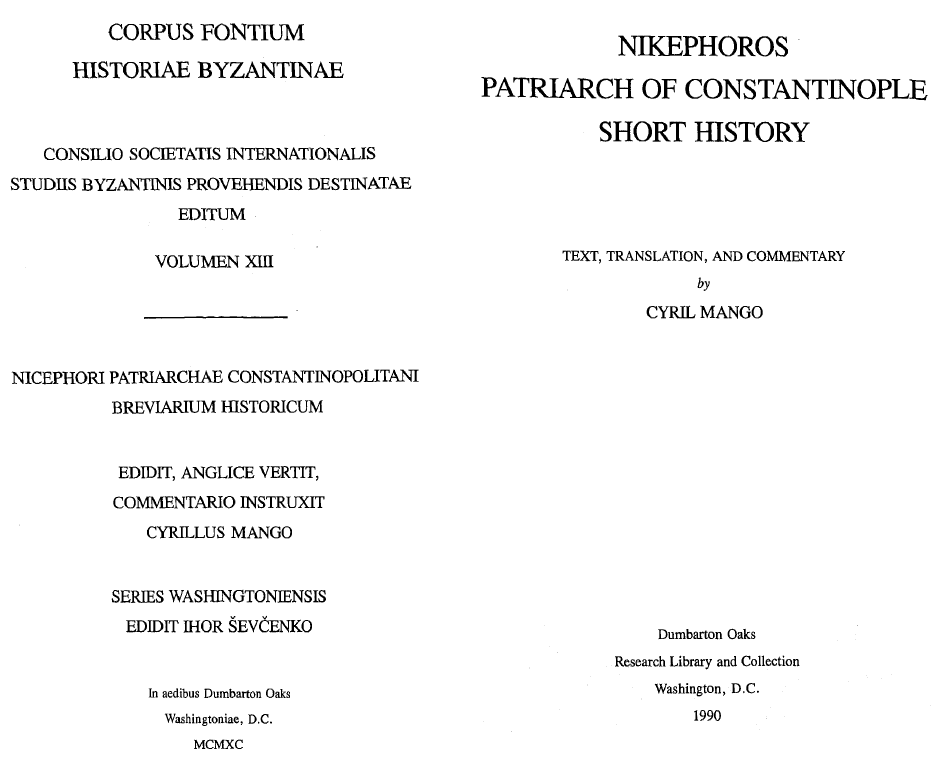
Now, let's remind ourselves of what Caratzas wrote and where the Tzakonians likely came from (previously shared on this forum). I have highlighted the interesting parts but can translate from French upon request.

bkikKJI.jpg

8ChDaeM.jpg

4qrNKtH.jpg


PS:

KO0orP4.jpg
 
Last edited:
Starting from top of page 122:

It is now very likely that the Vlachs were settled in the Peloponnese. What historical fact hides the legend which talks about Tzacones?

We must remember here that in Macedonia Tzacones were known as heretics too. This characteristic could, on its own, lead the author to recast the legend, to attribute their expulsion from Athos to Constantine the Great, defender of Orthodoxy. The author of the legend could have proceeded to this falsification starting from the measures taken against the heretics by Constantine Monomachus or Alexius Comnenus, both protectors of the Orthodoxy and the Holy Mountain.

In the 19th century, the tradition of the Macedonian origin of the inhabitants of Cynuria was present (Cynuria = today's Tzaconia). But this tradition alone can not serve as proof of an Athonite origin of the present Tzacones of the Peloponnese. However, two other written testimonies speak of a population transfer from Athos to the Peloponnese, and specify the date of their arrival. These are two chrysobulls by which Andronicus II Paleologus (1292) and John VI Paleologus (1344) confirm privileges conceded earlier and rule disputes of the Athonite monasteries Vatopedion and Esphigmenou.


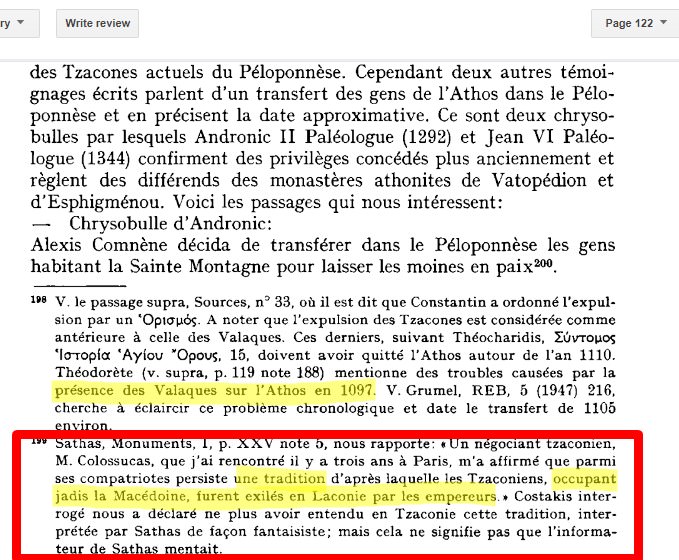
Highlighted footnotes, 198 and 199:

198) Theodorete mentions disorders caused by the presence of Vlachs in Athos in 1097.

199) Sathas tells us: "A Tzaconian merchant, M. Colossucas, whom I met three years ago in Paris, has told me that among his compatriots there persists a tradition according to which the Tzaconians, formerly occupying Macedonia, were exiled by the emperors."


And one more book, mentioning the well attested presence of Vlachs throughout the Chalcidice -

"The Vlachs are well attested in Chalcidice."

URL:
https://books.google.ca/books?id=gO...ved=0ahUKEwi23sTlp-jbAhUk74MKHb1dBPYQ6AEIMTAB

Byzantinische Forschungen, Volume 7, Publisher A.M. Hakkert, 1979


Also, THIS -

"The Tzaconians, those detestable Slavs and Turco-Macedonians of the ancient Byzantine tradition, suddenly became noble descendants of Lycurgus."

URL:
https://books.google.ca/books?id=Vn...nepage&q=tzaconiens Turco-Macédoniens&f=false

Annuaire de l'Association pour l'encouragement des études ..., Volumes 16-17, 1882

2xkDdMn.gif
 
Last edited:
We need a full entery to Byzantine writings to elaborate the origin of Tsakonians. Wikipedia is biased it wont help us.

Since you mentioned is Pontic Greek closer to Ancient Greek than Tsakonian is?
 
We need a full entery to Byzantine writings to elaborate the origin of Tsakonians. Wikipedia is biased it wont help us.

Since you mentioned is Pontic Greek closer to Ancient Greek than Tsakonian is?

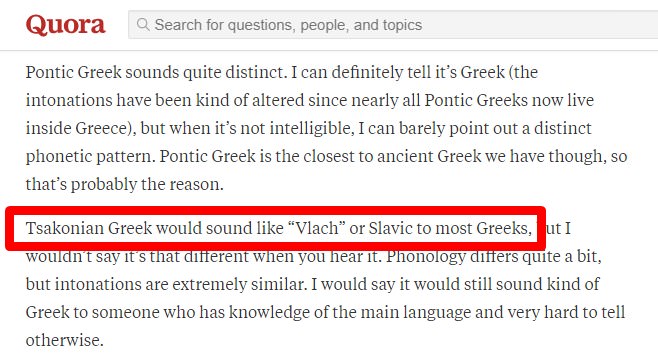
I didn't mention it - it comes from Quora (clearly an online post by a Greek), and I took a screenshot of it. The value of it simply is that to most Greeks Tsakonian seems to "sound" like Vlach or Slavic.

Anyway, all of these claims about which "Greek dialect" is more ancient are getting laughable. I mean I thought it was Tsakonian, which was most archaic and closest to Doric -- now it's Pontic Greek that's most ancient of them all... What's next?

PONTIC IS NOT GREEK / ΤΑ ΠΟΝΤΙΑΚΑ ΔΕΝ ΕΙΝΑΙ ΕΛΛΗΝΙΚΑ
https://freeinquiry.gr/single-post.php?id=4267

Yeah the fact that even Pontians, who are 70% hellenized Georgiano-Lazes, have their own Greek dialect is alarming about the language being the evidence of the Greek ''continuity''.
 
Repost

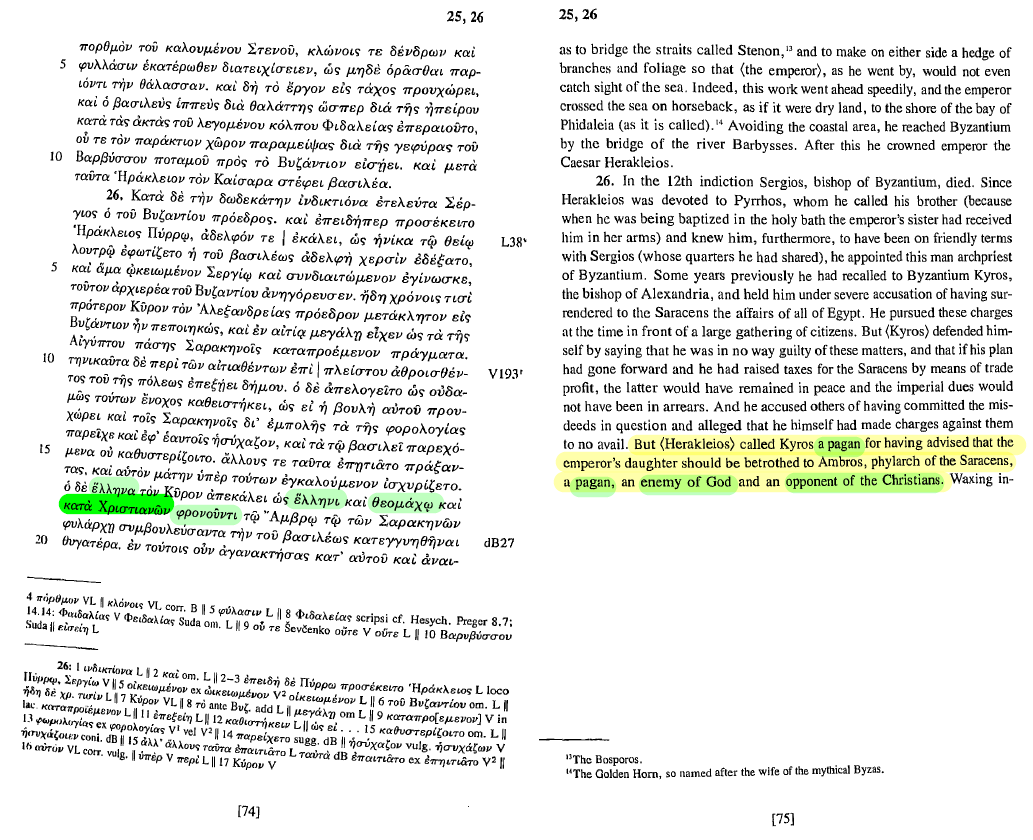
Herakleios called Kyros a HELLENE for having advised that the emperor's daughter should be betrothed to Ambros, phylarch of the Saracens, a HELLENE, an enemy of God and an opponent of the Christians.

The translation uses the term pagan, which is correct. The term "Hellene" did not have an ethnic/national meaning.
Please take a CLOSE look at the original and the translation.


Herakleios called Kyros a HELLENE for having advised that the emperor's daughter should be betrothed to Ambros, phylarch of the Saracens, a HELLENE, an enemy of God and an opponent of the Christians.

The translation uses the term pagan, which is correct. The term "Hellene" did not have an ethnic/national meaning.
 
Last edited:
If I may ask, what is it saying? In short words if you want.

Here are translations of (only) two sentences:

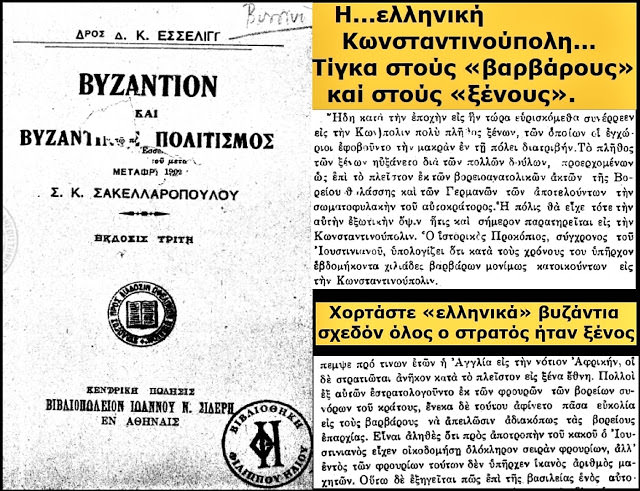
- The number of foreigners increased through many slaves, mostly from the northeastern coasts of the North Sea, and the Germans forming the emperor's bodyguard.

- Historian Procopius, contemporary of Justinian, estimates that during his time there were 70,000 barbarians legally residing in Constantinople.
 
Last edited:
Here are translations of (only) two sentences:

- The number of foreigners increased through many slaves, mostly from the northeastern coasts of the North Sea, and the Germans forming the emperor's bodyguard.

- Historian Procopius, contemporary of Justinian, estimates that during his time there were 70,000 barbarians legally residing in Constantinople.

Well Constantinople had a population of 500,000. But yeah I wonder how many ''illegal barbarians'' were there.
Btw the plague reduced Constantinople's population from 500,000 to 40,000 or 70,000 at most. So sad :( No doubt why Slavs were able to occupy Greece.
 
Last edited:
Yes we had Roman refugees when the Roman capitals changed, then we had the germanic Goths, then we had the Bulgars, then we had the Slavs, we had settlers from the Vangarian Guard, we had settlers from Spanish Aargon knights, we had settlers from French knights, we had Venetian & Genoan traders settle there and then Turks and lastly Spanish jews.

...and we are stil here.

:14::14::14: And 70 pages later :whistling: I wonder if he still feels like they are still here :6:

Reading older RtG posts made my sides split lol
 
wNM3664.jpg

SPnEvyj.jpg


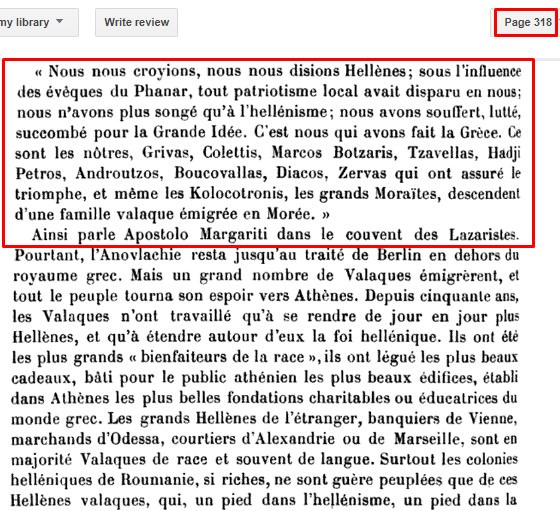
"We believed ourselves, we thought, as Hellenes; Under the influence of the bishops of the Phanar, all local patriotism had disappeared within us; We have only dreamed of Hellenism; We have suffered, struggled, succumbed to the Great Idea.

It was we who made Greece.

These are our own, Grivas, Colettis, Marcos Botzaris, Tzavellas, Hadji Petros, Androutzos, Boucovallas, Diacos and Zervas, who have assured the triumph, and even Kolocotronis, the great Moraite, descend from a Vlach family emigrated to Morea."

Thus speaks Apostol Margariti...


URL - Apostol Mărgărit (Apostolos Margaritis):
https://en.wikipedia.org/wiki/Apostol_Mărgărit
 
1) Anonymi Descriptio Europae orientalis. Imperium Constantinopolitanum, Albania, Serbia, Bulgaria, Ruthenia, Ungaria, Polonia, Bohemia. Anno MCCCVIII exarata. Cracoviae, 1916: As per the anonymous traveler of Eastern Europe from the XIV century, it is stated that Vlachs (whom the author calls "Blasi"), are a numerous people living between Macedonia, Achaia and Salonika.

2) Johann Thunmann, Untersuchungen uber die Geschichte der ostlichen europaischen Volker, I. Leipzig, 1774: The author states that Vlachs represent half the population of Thrace, and three quarters of inhabitants of Thessaly and Macedonia combined.

3) Inhabitants of Greece through the eyes of various foreign visitors and travelers. Various regions/areas:

"The once glorious Athens is so desolate that it seems incredible that it was once glorious. I, for one, did not see anywhere a more terrible place. Wilderness, swamps...." »DAramon, French ambassador.

"The population of Samos is Turkish." Ruy Gonzales de Clavijo, envoy of the king of Castile, Henry III, the court of Tamerlane.

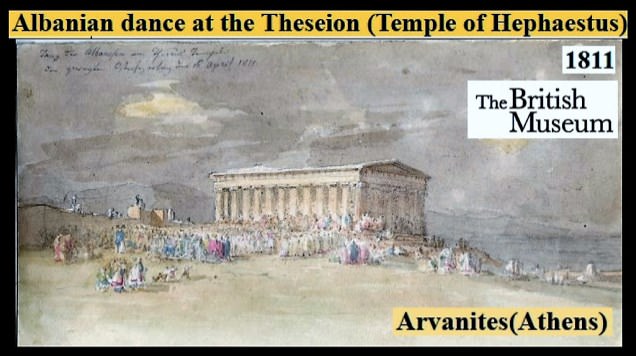
"Eleusis is now a poor village with 1,200 inhabitants, mostly Albanians." - John Fulleylove MClymont JA, 1902.

"The Albanians from Arcadia are three times more numerous than the Turks." » (The present state of the Morea called Peloponesus, Bernard Randolph, an English traveler, London, 1686).

"Kos is inhabited by Turks." (Pierre Belon, a French physician and botanist, 1546.)

"Mykonos.. It was almost uninhabited." Thevenot (1655).

BUMP ...

"The population of Samos is Turkish." Ruy Gonzales de Clavijo, envoy of the king of Castile, Henry III, the court of Tamerlane.


Just Turkish?
 
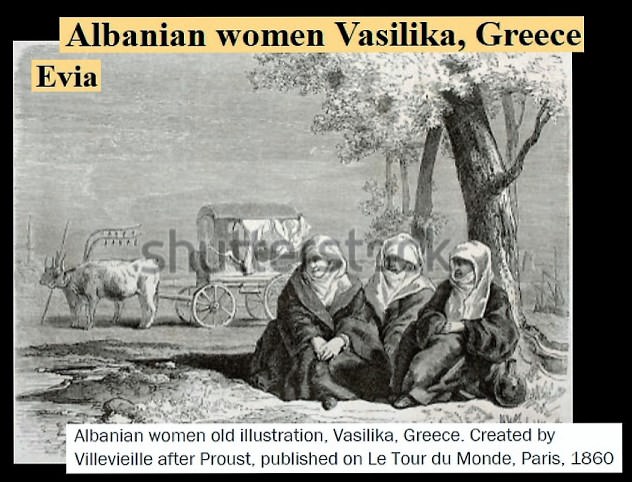
On Euboea 17th century -

IT Lyes to the North of Boeotia extending North West and South East about 120 miles; Its Breadth, at the broadest place not above 30. It was taken from the Venetians in the year 1471. The soil is very fertile, affording all sorts of Graine, Wine, and Oyle, as likewise Flesh and Fowl; the Sea abounding with Fish. Since the Turks have had possession of it, most of the Greeks are Fled from the Villages, and Townes; So as the inland places are mostly supplyed by Al∣baneses[, who are the Shepherds, and serve the Turks at their Farmes. Formerly here were two Citys, and 500. Townes and Villages; Now there is but one, which can be called a City, which is the ancient Chalcis and now hath the name of the Island; by the Turks it is called Egriboz. It stands on a point of Land, having the Sea two Thirds about it. Betwixt it and the Maine is a small Island, with a strong Castle. From the Maine to the small Island is a bridge built up∣on six good Arches, and thence to the Maine

https://quod.lib.umich.edu/e/eebo2/A70955.0001.001/1:5?rgn=div1;view=fulltext
 
Last edited:
Back
Top