• Welcome to the new Macedonian Truth Forum. All posts, members and private messages have been moved over from the old forum.

    Passwords from the old forum could not be carried over, so please use Forgot your password? to set a new one. The reset link is emailed to the address on your account.

  • Rules and Regulations at the forum of the Macedonian Truth Organisation (MTO)

    (1) The national-ethnic and cultural-linguistic identity of the Macedonian people is historically Macedonian, and derives its character from the native, indigenous and geographic homeland of the Macedonians, which is called Macedonia. To ensure that their human rights, integrity and heritage are appropriately respected, the only nouns and adjectives acceptable when reference is made to the above character and identity markers is Macedon, Macedonia, Macedonian and Macedonians.

    (2) The nation-state of the Macedonian people is the Republic of Macedonia, and is to be referred to by this official title so long as the 'republic' prefix is consistently applied to other states. Alternative references are the Macedonian Republic, or simply, Macedonia.

    (3) The 'ethnic' prefix is only acceptable for Macedonians in cases where differentiation is specifically required - so long as it is in context and consistent where it concerns its application to other ethnic groups.

    (4) Should any other differentiation be specifically required, the names of other ethnic groups that reside with Macedonians in either the Republic of Macedonia or the occupied Macedonian regions in Greece, Bulgaria, Serbia or Albania, are to be given a prefix.

    (5) Negating the identity, language and culture of the Macedonian people by deliberate avoidance of the terms Macedonia, Macedonian and Macedonians, or by any other means, is not permitted.

    (6) Systematic anti-Macedonian propaganda and rhetoric are not permitted.

    (7) Threads irrelevant to the Macedonian Cause, the community at the Macedonian Truth Organisation or the Macedonians in general may be considered as spam or not in the spirit of the forum. In such cases they are not permitted.

    (8) Continual posting of messages in threads with the sole purpose of deviating from the initial topics with the use of unrelated and unnecessary information is not permitted.

    (9) All posts, external articles, reports, etc that are cited in languages other than Macedonian or English, must be accompanied with a translation in one or both of the said languages.

    (10) Despite the possibility of some conversations and debates becoming heated, extreme abuse and/or racism, vulgar language and/or terminology, threats, revelation of personal information about others, harassment, and other such behavior will not be permitted. If deemed necessary all relevant information including member details will be reported to the appropriate authorities for investigation which may result in legal action.

    (11) Threads that are created must have a summary of a topic or excerpt of an article found in pertinent link(s) that have been included. One line threads will be considered unaccetable spam and are therefore not permitted.

    (12) Compulsive and deliberate lies, irrespective of the topic, are not permitted.

    (13) Any symbols or avatars found to be perceived as offensive to Macedonians are not permitted.

    (13) Any explicit or extreme material is not permitted.

    Failure to adhere to the above rules and regulations will result in a ban after 3 breaches. This may be reconsidered in some cases should the circumstances be of an unorthodox nature and/or require special consideration. To assure an effective deterrent against an individual or individuals with the sole purpose of causing dissent through spamming, racism or other improper means, the above rules will be strictly enforced.

    The MTO administration will monitor all discussions as reasonably practical and reserve the right to remove any post and/or member from the forum, and update the rules and regulations as required. Members are encouraged to immediately report any post and/or member to the MTO administration if they feel that these rules have not been abided by.

    The views expressed on this forum are those of the individuals. The only official representation of the MTO is made by the "Macedonian Truth Organisation (Site Owner)" username, and no other.

  • Macedonian Cause

    The Macedonian Truth Organisation calls on God in Heaven to protect, bless and guide the endeavour it is committing to undertake, and that is to work towards:

    Securing Macedonia as a free, independent and democratic republic in which sovereignty lies with the Macedonian citizens; as the nation-state of the Macedonian people in which they can preserve their culture, language and identity; as a state in which the Macedonian language and culture form the basis of public life and act as important unifying elements of Macedonian society; as the home of all its citizens to which it guarantees and obliges their inalienable natural rights and corresponding responsibilities;

    The acknowledgment as self-evident and irrefutable the existence of the:

    1) Indigenous, ethnonational name of Macedonia;
    2) Macedonian people, language and identity;
    3) Macedonian culture, symbols and folklore;
    4) Macedonian ancestry, heritage and history in its entirety; and
    5) Macedonian Orthodox Church;

    Securing recognition by the International Community of the tragedies endured by the Macedonian people, of the division of Macedonia with the signing of the Treaty of Bucharest on August 10, 1913, and the genocide committed against the Macedonian people at the hands of the Greek, Bulgarian and Serbian states and their respective churches during the 19th and 20th centuries;

    Ensuring that the Interim Accord is declared ‘null and void’ and that all constitutional provisions, acts, commitments, agreements, legislation, regulations, policies or programs emanating from, supporting or consequential to the Interim Accord are also declared ‘null and void’, including the use of any symbols and the completion of any acts imposed by, or originating from, the Interim Accord.

    Ensuring that the Framework Agreement is abolished and that all constitutional provisions, acts, commitments, agreements, legislation, regulations, policies and programs emanating from, supporting or consequential to the Framework Agreement are also abolished and replaced by a framework of constitutional and statutory law based on inalienable natural rights and corresponding responsibilities and universally codified human rights mechanisms.

    Securing the abolishment of any existing constitutional provisions, acts, agreements, legislation, regulations, policies and programs that discriminate against the Macedonian people, in any international organisation or any of the countries of the International Community where such constitutional provisions, acts, agreements, legislation, regulations, policies and programs exist, and thereby ensuring the freedom for Macedonians to exercise their inalienable natural rights and fulfil their corresponding responsibilities, and practice their culture, language and religious faiths in all the countries of the International Community without hindrance;

    The empowerment of Macedonians to undertake a moral revolution and to instil and/or reinvigorate within themselves a deep-rooted national, cultural, linguistic and historical dignity and a commitment to the exercise of freedom based on inalienable natural rights and corresponding responsibilities;

    The recognition of the Macedonian minorities in the neighbouring states of Macedonia as well as the respect for the inalienable rights and freedoms of the Macedonian minorities, as provided for by natural law and as codified by the United Nations Charter, the Universal Declaration of Human Rights and other universally codified human rights mechanisms;

    The full and unreserved respect of, and the support for, the rights of all people of non-Macedonian descent living in Macedonia and around the world, who share a reciprocal full and unreserved respect for the Macedonian people, their homeland and their state;

    The cultural unification and solidarity of the Macedonian people living in all parts of historical Macedonia and adjacent territories, as well as Macedonians throughout the world;

    The unity of all Macedonians on the principles, objectives and achievement of the Macedonian cause as defined by this declaration.

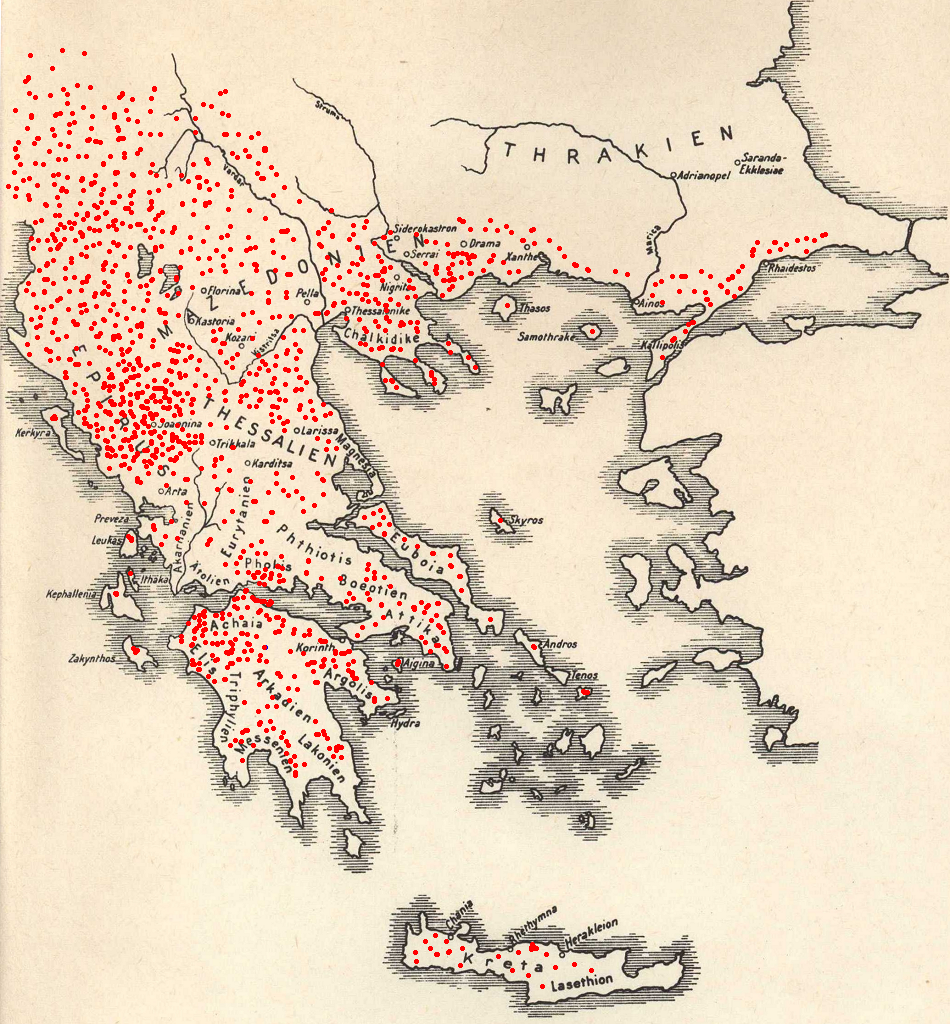
The Real Ethnic Composition of Modern Greece

What is the title of this article and would you be able to provide source/link? Thanks.

I found this on an Albanian forum the post were written as early as 2003, for more information you can find in the book of the author mentioned above.
 
Last edited:
Thanks.


Quote from Konstantinos Koumas (1777-1836), himself probably of Vlach extraction:

If the extraordinary hero of Macedonia succeeded in spreading the Greek language throughout the whole of the East, even as far as India, in a period of only ten years, it scarcely puts a strain on our credulity to imagine that the Romans might have accomplished the same thing! Indeed, it seems but perfectly natural that over eight centuries the Latin language should also have taken root in precisely those places where Latin colonies were planted - from England to the Euphrates and from the Elbe to the deserts of Africa. For almost six centuries before the fall of Rome, the whole of what is now European Turkey was filled with Roman armies, Roman prefects, Roman lords and magnates. The result of such continuous contact between the Romans and their subject peoples was that the whole peoples like the Macedonians, Thessalians, and Greeks not only learned the language of their masters but in many cases completely forgot their own mother tongue.

 
Some conclusion from earlier posts in here:
-The Vlachs-Greeks were speaking the Greek lanaguage of Byzantine Empire (Romania) bilingualy with their native language.

- They migrated later than Albanians.
https://en.m.wikipedia.org/wiki/Principality_of_Arbanon
From Pindos mountains.

-It is possible that they migrated in Epirus after the Slavs seeing the slavic toponyms.
 
Last edited:


.... Fanis Michalopoulos has given the answer, who, referring to the visit of Cosmas of Aetolia to Aspropotamos and Agrafa, stresses that "the language here (was) Vlach in most villages"
 
- Thessaly used to be called 'Great Vlachia' or 'Megali Vlachia', with the capital Larissa.
- The Chronicle of Epirus refers to 'Great Vlachia' as 'Greco-Vlachia'.
- Can provide detailed translation upon request.


Last edited:
1) The English Folk-Play, E. K. Chambers.

Page 229:

"In Epirus, where the inhabitants are mainly Hellenized Vlachs, there is a spring revival ceremony without a combat."

https://books.google.ca/books?id=rd...q=the english folk-play vlachs epirus&f=false

https://archive.org/stream/englishfolkplay027958mbp#page/n243/mode/2up

2) Euboea or Evia

"The ethnic Greek population is descended from Arvanites and Vlachs, who have lived in Euboea since the early Middle Ages."

http://www.landscapes.gr/evia.html
 
Христос (Кристе) Дагович = Хаджи Христо Българинът = Χατζηχρήστος Βούλγαρης

Date of birth: 1783.

Христос (Кристе) Дагович was a revolutionary, commander during the Greek War of Independence (1821 – 1832), who thanks to his achievements and contributions for the independence and freedom of Greece received a rank of General of Greek army, and later on actively participated in building Greece.

According to testimonies, he was leading a unit of 'Bulgarians' during the war. "This squad carried huge proven exploits, one of which is the notorious feat in Dervenaki (Дервенакија) on 26 and 27 July 1822" wrote a Greek historian. He was accepted warmly by the leaders of the uprising Theodoros Kolokotoronis and Alexander Ypsilanti.

https://bg.wikipedia.org/wiki/Хаджи_Христо_Българин
https://el.wikipedia.org/wiki/Χατζηχρήστος_Βούλγαρης

Битка кај Дервенакија
https://mk.wikipedia.org/wiki/Битка_кај_Дервенакија
 
Last edited:
This Greek article talks about the large waves of migrations of Vlachs to Asia Minor. There were mass migrations of Epirote Vlach settlements which began in the 17th, continued in the 18th century and peaked in the 19th century.

Actually, if one reads it he realizes that:

(a) This is not an article. It's a note by a theology student in a free forum.

(b) Unfortunately, the only large thing there, is the reference of Vlachs and Asia Minor in the title, not in the content of the text.
 
Actually, if one reads it he realizes that:

(a) This is not an article. It's a note by a theology student in a free forum.

(b) Unfortunately, the only large thing there, is the reference of Vlachs and Asia Minor in the title, not in the content of the text.

Google Translation -

Transportation Vlachs in Asia Minor

Manolis Kontosteliou

One of the largest population movements happened in Greece was the mass migration of Epirus Vlach settlements which began the 17th, continued in the 18th century and peaked in the 19th century. Migratory waves initially focused mainly on the Danube and then the Ottoman hinterland.

The main reasons that prompted the residents of Epirus in search of a better life were:

a) The revolutionary movements of 1600 and 1611 with the participation of Christians in Epirus and Thessaly in response to the call of Bishop Dionysios the Philosopher

b) The gradual limitation of the number of villages falling under privileged membership status

c) The overpopulation of mountain communities and

d) unknown factors like frequent epidemics and natural disasters.

... seek to examine the largely unknown relocation Vlachs in Asia Minor, ..... references and researchers on the topic.
 
Historical Documents: Albanians (and other peoples) in various Greek Islands.

Presence of Albanians located in the northeastern Aegean islands (Samos, Psara) and some islands of the Cyclades (Andros, Ios, Kea, Kythnos). Just a few random examples (Google Translation):

Andros:

"The inhabitants are estimated at 6000. There is an east coast town and 60 villages. Highlights are the sandpit and the Arna, inhabited by Arvanites, one thousand two hundred souls." From the diary of the French traveler Thevenot (1655). The Albanian settlement on Andros became Frankish in the first quarter of the 15th century. Second settlement was around the late 15th century."

The vicar general of Greece in 1828 wrote: "850 families in the northwestern part of Andros with Albanian dialect and customs." (AF 20, 21 March 1828, page 83).

Ios:

"Throughout the island there is only a small town on a hillside. The inhabitants are ethnic Albanians ...." (Francois Richard, 1650).

Samos:

Among the settlers of Samos included many Albanians. Albanians Samos reported including one French missionarios which an anonymous report in the early 18 th century, he notes, that lived mostly in the mountains of the island, engaged in farming. (LA Martin: «Lettres edifiantes et curieuses concernan lAsie, lAfrique et lAmerique avec quelques relations nouvelles des missions et des notes geographiques et historiques», Vol. 1, Paris, pp. 131, Paris, 1838. C Guerin, who came into the middle of the next century, the island, notes that residents Arvanites although they spoke good Greek, preserved but some of their own words).
 
Βλαχοχώρια της Εύβοιας, τόσο στην κεντρική και στη βόρεια Εύβοια, όσο και στην περιοχή Αλιβερίου-Κύμης, αποβλαχισμένα στις αρχές του 19ου αιώνα.

Vlach settlements in Euboea, both in the central and northern Euboea and in Kymi-Aliveri*, lost the (Vlach) language in the early 19th century.

* - Kymi-Aliveri
https://en.wikipedia.org/wiki/Kymi-Aliveri
 
In 1204 the Franks of the Fourth Crusade and the Venetians sacked Constantinople and began to divide up the provinces of the Byzantine Empire among themselves. A period of chaos ensued, during which several small principalities were established in the southwest Balkans. The only one which upheld the Greek tradition was that of the Angeli. the rulers of Epirus from 1206 to 1260, and they had to contend with the Albanian principality of Demetrios and Ghin, the Serbian principality of the Nemanja and Uros families, the kingdom of Thessalonica, and the rival Byzantine principality of Nicaea, quite apart from raids delivered from the west on the coast of Epirus. It was in this period that the flow of immigrants from the northwestern area began . It became a flood in the fourteenth century. They went as mercenaries, raiders and migrants. The great majority of them were speakers of Albanian, but others joined the movement. When they wanted to leave Thessaly and go elsewhere, many others appeared with their wives and children ("multicum uxoribus et filiis") and their combined forces proceeded to wreck other parts of Thessaly. John Cantacuzenus 1.495 described their raids on the west side of the peninsula in 1335: "The Albanoi who inhabit the area of Balagrita [Berat] and Kanina [inland of Valona], being adaptable to change and by nature revolutionary, ravaged and plundered … and oppressed the towns there with their brigandage and open raids".
The Byzantine rulers had recourse to two methods of treating these raiders The Emperor Andronicus III gave land to 12,000 Vlach-speaking raiders who submitted to him in Thessaly. ‘The Great Domestic', John Cantacuzenus, carried out a campaign against the Albanian-speaking tribes in 1335. "As the Albanians inhabited great mountain ranges which were difficult of access and had many retreats and hiding-places, they could not easily be injured by the cavalry." For this reason, light armed infantry and archers were recruited in Asia and took part in the campaign (Cantacuzenus 1.495). Even so the Albanians were not destroyed, for they withdrew into the mountains and beat off their attackers from above. However, the Emperor advanced from Thessaly to Dyrrachium and took spoil to the amount of 300,000 cattle, 5,000 horses and 1,200,000 sheep. But the Albanian raids continued and Acarnania was laid waste, in 1341 the Emperor attacked the offending Albanians "around Pogoniane and Libisda" (Lidizda), i.e. in the central part of northern Epirus; (20) and then in 1355 he campaigned from Thessaly as far south as Aetolia and Acarnania and was killed in action (Cantacuzenus 3.319). These campaigns did not stop the flood. Albanians were serving as mercenaries in the Peloponnese c. 1350, and they and their families were given land there to cultivate.
In 1358 the Albanians overran Epirus, Acarnania and Aetolia, and established two principalities under their leaders, John Spatas (shpate in Albanian meaning a sword) and Peter Leosas (lios in Albanian meaning a pockmark), Naupactus fell into their control in 1378. The cities which held out against them, especially loannina and Arta, were ravaged by a series of plagues, and Thomas, the Serbian Despot of loannina, saved himself at first by making marriage alliances with the two Albanian leaders. In the Greek account of the Albanian advance under Peter Leosas we learn that he was accompanied by "Mazarakii and Malakasei of his own race" (Epeirotica 2.220; cf. 222 f.), (21) While Mazaraki is in central Epirus by the river Kalamas, Malakasa is the coastal plain of central Albania farther north and the words ‘of his own race' were used to distinguish the Albanian-speaking Malakasaei from the Vlach-speaking Malakasii. It is clear that Thomas feared the Albanians above all. Whereas he mutilated the Bulgars and the Vlachs, he allowed most of his Albanian prisoners to be ransomed. Atrocities were committed no doubt by both sides, and Thomas came to be called Albanitoktonos (Albanian-killer; Epeirotica 2.225). In 1380 Thomas brought in the Turks as allies and passed to the offensive, but he did not advance farther than the basin of the upper Kalamas, where he took Vela (by Vrondismeni), Boursina (Vrousina), and Kretzounista (Dhespotikon) (21). The Albanians and in particular the Mazarakii of the Kalamas valley held firm against him. In 1385 he was assassinated by some of his own bodyguards (Epeirotica 2.230).
Other bands of Albanians and Vlachs invaded the Catalan principality of Boeotia and Attica, and a great many Albanians settled there as peasant-farmers in 1368 and later years. Around the end of that century a migrating group of 10,000 Albanians with their families and their animals came from pastures in central Greece to the Isthmus of Corinth and sought entry to the Peloponnese. This was granted by Theodore, who settled them within his own DOMAINS, where he used them as tough soldiers and "expert cultivators" (Manuel II, Funeral Speech, p. 40). Albanians and others were invited in 1402 to settle on uncultivated but cultivable lands in Euboea, if they were willing to serve as soldiers in defence of the island and work the soil. The proclamation of the Venetian rulers was extended to "quilibet Albanensis vel alia gens qui non sint no&tri subditi, qui cum equis volent venire et venient ad habitandum’ (23). By the middle of the fifteenth century the Albanians in the Peloponnese were so numerous that they tried to seize control, led first by one Peter the Lame, and then by a Greek, a member of the Cantacuzenus family, but their attempt failed.
The penetration of the Greek mainland which we have described occurred during the hundred or more years after 1325. The opportunity arose through the decline and disruption of the Byzantine Empire and the wars which followed between the various small principalities of Greeks, Serbs, Catalans, Venetians and others. One of the pressures which set the Albanians and others in motion came from the expanding power of the Serbs which reached its peak under the rule of Stephen Dusan (1331-1355), who subjugated Epirus and Acarnania. A contributory factor seems to have been overpopulation among the Albanians (24) - always a prolific people and underpopulation in mainland Greece as a result of internal collapse and foreign intervention. The strongest single group of invaders was that of the Vlachs which pressed down into Thessaly and opened the way there for the Albanians. But the most numerous by far were the Albanian-speakers, and their main line of invasion and penetration was down the western side of northern and central Greece.
Once in possession of most of north-western Greece, the Albanians opened the way for other immigrants. Offshoots of Albanians and Vlachs entered Boeotia, Attica and Euboea, having probably come from summer pastures on Mt Parnassus and from southern Aetolia; and other groups of Albanians forced an entry or gained an invitation of entry into the Peloponnese, sometimes crossing over the western part of the Gulf of Corinth and sometimes coming to the Isthmus of Corinth. When 10,000 Albanians came to the Isthmus of Corinth, they brought not only their families but also their flocks of animals. The Albanians in the Peloponnese took their herds in the winter to the coastal plain of Elis, “which was open to the sun, near the sea, had good grazing and was deserted by men (i.e. by the Greeks)"; and these herds consisted of "very many herds of horses, very many of cattle, most of sheep and most of pig"(29). Such Albanians as these—and they were evidently the majority - were described by Laonicus Chalcocondylas (406) as follows: "This race are all nomads, and do not make their stay for long in any one place" they were, then, transhumant pastoralists without fixed abodes or villages. But there were many others who wanted to cultivate the land and were given land by the Venetians and the Greeks, because they were such hard-working and expert cultivators. When Manuel Cantacuzenus, Despot of Mistra in the Peloponnese, took over "all Albania," he deported two groups of Albanians and settled them, one near Constantinople and the other in the Peloponnese, the latter "a great number" (30). The Albanians were acceptable to the Greek, Catalan or Venetian overlords, as the case might be, because they were capable of reviving agriculture in derelict areas.
In the eyes of the Greeks/ the Albanians and those associated with them were fine hunters, (31) excellent horsemen and redoubtable warriors. As has been said by Joseph Campbell, "by and large hunting people are warrior people; and not only that, but many are exhilarated by battle and turn warfare into exercises in bravura"(32). These were the ancestors of the Souliote warriors, whom Byron admired so much in the Greek War of Independence. In the fourteenth century they were feared and hated in northern Greece, but they were hired as mercenaries or attracted as settlers by the rulers of the principalities in the Peloponnese and central Greece and Thessaly. The most warlike of the Albanians were those described by the Greeks as living in great mountainous areas, that is those engaged in pastoralism with the transhumance of sheep. They were certainly illiterate, but they were tightly organised in tribal units with a patriarchal system of leadership. The leaders were evidently very capable men, possessing wide powers over their followers, and 'John the Sword', 'Peter the Pockmark' and 'Peter the Lame' led very large armies of Albanian warriors with success. When they were hired as mercenaries, they came not as individuals but as organised bands, sometimes accompanied by their families and animals. The hope of their employers was that the Albanians would "come with their horses" and fulfil their obligations "to maintain their horses, garrison the forts and obey orders (34)". It was these cavalrymen, with their entourage, who were the leaders. The rank and file fought on foot.
With the capture of Ioannina by the Turks in 1430. The role of the Albanians changed very little. The Albanians of Kruje, Mati and Dibra, i.e. of the areas north of the Shkumbi river, fought heroically against the Turks until the death of their leader, Skanderbeg, in 1467 and indeed after it, but unavailingly. The Albanians of the Peloponnese participated in a rising against the Turks in 1459. On the other hand the Turks were soon employing the Albanians as mercenaries and encouraging them to settle in the devastated areas not only of the Greek mainland but also in some of the Aegean islands. So the process of infiltration and expansion continued under Turkish rule. By 1687, for instance, almost all the population of Euboea was Albanian, (35) the Greeks having fled in 1471.
Piracy had led to impoverishment and depopulation in the islands during the late Byzantine period, and Albanians moved in as occasion arose. Thus they were brought to Andros (sic Salamis?) in the Saronic Gulf c. 1600 to cultivate the land; they went from Troezen to Hydra in 1580, and other settlers arrived from Parga, Souli, Valona, Euboea and Cythnos in the seventeenth century. Other groups went to Samos, Psara and Casos, many of the settlers being from western Epirus, Euboea and Thessaly. Yet other groups entered Andros, Ios, Cythnos and Ceos among the Cyclades and Scopelos in the Northern Sporades. They became excellent seamen, winning distinction in the Greek War of Independence and raising Hydra and Spetsae to a leading position in the carrying trade of the Aegean basin. Groups of soldiers were employed far afield: in Cyprus, for instance, in Byzantine times, and for some 250 years in Crete during the Turkish period.
 
Last edited:
(20) For descriptions of these places see Epirus, pp. 268 and 90.

(21) This work, sometimes called The Chronicle of Epirus, is published in the CSHB.

(22) For these places and their strategic importance see Epirus, p. 194 (Vela); p 186 (Vrousina); pp. 197 f. and 695 (Dhespotikon); with maps 7 and 18.

(23) C. N. Sathas, Documents inedits relatifs a l'histoire grecque au Moyen Age 2, p. 79 (no. 298) .

(24) Ducas 23, 8 (CSHB) called them "a race beyond number."

(25) E Kirsten (loc. cit , note 18) is of this opinion, n. 110, "die Geschichte der albanischen Landnahme in Aetolien, Akarnanien, dann bei Korinth . . . zeigt, dass die Bewegung auf der Westseite Griechenlands verlief und Mittel-griechenland von SW her erreichte."

(26) Another indication is provided by the distribution of Slavonic place-names. These were (before the rule of Metaxas) frequent in the canton of loannina, rare in that of Arta, and rarer still in that of Preveza, being displaced predominantly by Albanian place-names such as Toskesi and Ljapokhori. See Epirus. p. 27, n. 2.

(27) See Epirus, p 195.

(28) For these places see Epirus, p. 20, map 1, and p. 31, where I suggested that Zagorie included at one time the valley of the middle Aous from Permet to Konitsa and so linked up with Zagori. This may have been so in 1399.

(29) The document is cited in Sp. Lambros, Palaiologeia kai Peloponesiaka 3, p. 195.

(30) C. N. Sathas (op, cit., note 23) 9, p. 144.

(31) So described in a letter of Luc Notaras in Sp. Lambros, Onomatologia tes Attikes, p. 13.

(32) Joseph Campbell, Myths to Live by (New York, 1972) p. 176.

(33) Sathas (op, cit,, note 23) 9, p. 144; Ducas 45.12 (CSHB).

(34) Sathas (op. cit., note 23) 2, p. 79, qui cum equis volent venire; and Ljubic, Listine 10 no. 467, p 445, ut equitent et stent in castris apud te ad obedentiam tuam.

(35) So B. Randolph, an early traveller, cited by F W. Hasluck in "Albanian Settlements in the Aegean Islands,' BSA 15 (1908-9). I am indebted to this article in what follows.
 
"Thus in 826 invaders from Africa seized the island of Aegina, so close to Athens, and killed the husband of S. Athanasia, whose parents had forced her into marriage only sixteen days before. News of the proximity of the Moslems must have caused consternation in Athens, for their raid had been sufficient to leave Aegina "deserted and forgotten." In the year 826-7, when Crete and Sicily fell to the Moslems, they also invaded Aetolia and landed in force on the island of Lesbos, where their sinister memory long persisted."
 
- Thessaly used to be called 'Great Vlachia' or 'Megali Vlachia', with the capital Larissa.
- The Chronicle of Epirus refers to 'Great Vlachia' as 'Greco-Vlachia'.
- 'Great Vlachia' was a strong state during the decades of its ruler "Jovan I" (as written in Serbian), which was between 1258 and 1296.
- This Vlach state was under frequent attacks from Serbian rulers, as even the archbishop Danilo* noted - how king Milutin went with his army in order to conquer and plunder "drzhavu zemlye Vlahiotske".
https://en.wikipedia.org/wiki/Great_Vlachia
 
Last edited:
SLAVS IN MIDDLE AGES


Isidore of Seville.
640px-Isidor_von_Sevilla.jpeg

1) A little before 650 AD, Isidore of Seville wrote that during the first years of emperor Herakleios's reign (ca. 614 AD) "Sclavi Graeciam Romanis tulerunt" ("The Slavs have taken Greece from the Romans").

2) The writer of the "Miracles of Saint Demetrius" described 7th century Thessaloniki as "a Roman island in a slavic sea".

3) Willibald wrotein his biography that when he was going to Jerusalem from Sicily in 723 AD his ship stopped "ad urbem Manafasiam in Sclavenia terra" ("in the city of Monemvasia in the land of Sclavenia").

4) Byzantine anonymous epitomizer of Strabo wrote:

«Καὶ νῦν δὲ πᾶσαν Ἤπειρον καὶ Ἑλλάδα σχεδὸν καὶ Πελοπόννησον καὶ Μακεδονίαν Σκύθαι Σκλάβοι νέμονται»

"And now most of Epirus and Hellas and Peloponnesus and Macedonia are inhabited by 'Scythian' (=uncivilized) Slavs"


Vgl. Müller, Geographi Graeci Minores II S. 574.

And for Western Peloponnese in particular:

«Νῦν δὲ οὐδὲ ὄνομά ἐστι Πισατῶν καὶ Καυκώνων καὶ Πυλίων· ἅπαντα γὰρ ταῦτα Σκύθαι νέμονται»


s. Müller, Geogr. Graeci Minores II S. 583.

"And now not even the names of the Pisatans, the Caucones or the Pylians survive. All these regions are inhabited by 'Scythians'"


5) The Emperor Contantine VI Porphyrogennetos in the «Περί Θεμάτων» wrote about the Peloponnese that:

«Ἐσθλαβώθη δὲ πᾶσα ἡ χώρα καὶ γέγονε βάρβαρος, ὅτε ὁ λοιμικὸς θάνατος πᾶσαν ἐβόσκετο τὴν οἰκουμένην, ὁπηνίκα Κωνσταντῖνος ὁ τῆς κοπρίας ἐπώνυμος σκῆπτρα τῆς τῶν Ῥωμαίων διεῖπεν ἀρχῆς.

De thematibus II (ed. Bonn. 53, 18)

"The entire country [of Peloponnese] has been colonized by Slavs and became barbarian, when the deadly plague had stroke the empire, that is when Contantine V the "Copronymos" was emperor of the Romans".


Right after he had wrote that he remembered the Peloponnesian patrician Niketas Rendakios whom the people of Constantinople had described as a "cunning Slavic face" («γαρασδοειδής όψις εσθλαβωμένη»). The term «γαρασδοειδής» is an impromptu utilization of the slavic word gorazd = "valiant, clever", which here is used with the derogatory sense of "cunning, foxy". The Slavist Phaidon Malingoudis has explained the surname Rendakios also as a slavic nickname for "administrator" (he derives it from the proto-slavic verb ręditi (ę = a proto-slavic nasalised vowel pronounced as /en/ that survives in Polish) which means to "determine, administer, set".

6) In the late 11th century, the Patriarch Nicholas Grammatikos describes the Slavic colonization of the Peloponnese in a letter to emperor Alexios Komnenos with the words:

«Έπί διακοσίοις δεκαοκτώ χρόνοις όλοις κατεσχόντων την Πελοπόννησον, και της Ρωμαϊκής αρχής αποτεμομένων, ως μηδέ πόδα βαλείν όλως δύνασθαι εν αυτή Ρωμαίον άνδρα»

"For 218 years that the Slavs have held Peloponnesus cut off from the Roman empire so that no Roman could set his foot in the region"


7) When Emperor Michael Palaiologos decided to launch the reconquista of the Peloponnese from the Franks (late 13th century), when he arrived in Mistras, the first to welcome him were the Slavs of Taygetos and the Tsakones of Parnon. The Frankish rulers of Peloponnese in the french version of the "chronicle of Morea" describe these Slavs as "un gent de voulentè et n'obeissent a nul seignor" (Livre de la Conqueste de la Princèe de l'Amorèe) "a people with guts who don't obey in no master". Plus, they write that they had conquered all of Peloponnese except the Slavs of Taygetus. We are later told that the same Slavs of Taygetus had liberated the city of Kalamata from the Franks and restored it to the Byzantine control.

a) Mazaris wrote:

«Εν Πελοποννήσω, ως και αυτός οίδας, ξείνε, οικεί αναμίξ γένη πολιτευόμενα πάμπολλα, ων τον χωρισμόν ευρείν νυν ούτε ράδιον, ούτε κατεπείγον. α δε ταις ακοαίς περιηχείται, ως πάσι δήλα και κορυφαία, τυχγάνει ταύτα. Λακεδαίμονες, Ιταλοί, Πελοποννήσιοι, Σθλαβίνοι, Ιλλυριοί, Αιγύπτιοι και Ιουδαίοι (ουκ ολίγοι δε μέσον τούτων και υποβολιμαίοι), ομού τα τοιαύτα επαριθμούμενα επτά» [Μάζαρις 1831, 174 και Μάζαρις 1860, 239].

"In Peloponnese, as you can see stranger, dwell various mixed ethne mixed among themselves, who's separation is neither easy nor necessary ... "Laconians" (Tzakones), "Italians" ( various western neolatin speakers as Italian, French, Spaniards etc),"Peloponnesians" (non Tsakonian Greek speakers), "Slavenes" (Slavs) "Illyrians" (Albanians), "Egyptians" (gypsies) and "Judaeans" (Jews).


b) The Navigator Laskaris-Kananos made the circumnavigation of western Europe (Gibraltar, England, Northern Sea, Baltic Sea). When he reached the city of Lübeck/Ljubice which back then was the frontier between Germanic and Slavic speech he wrote:

Schließlich ist noch als Zeugnis aus dem 15. Jahrhundert für das Fortleben der Slaven am Taygetos eine Stelle aus der Schilderung einer Reise des Laskaris Kananos nach Deutschland und den nordischen Ländern zu erwähnen, deren Entstehung von Vasiljev (Buzeskul-Festschrift S. 397 ff) in die Jahre 1412—1418 gesetzt wird. Der Grieche schildert dort auch die Umgegend von Lübeck und nennt jenes Land Σθλαβουνία. Er fügt dann eine Bemerkung über die Verwandtschaft der lübeckischen Slaven mit den Zygioten im Peloponnes hinzu: Ἀπ᾽ αὐτῆς τῆς ἐπαρχίας ὑπάρχουν οἱ Ζυγιῶται οἱ ἐν Πελοποννήσῳ· ἐπεὶ ἐκεῖσε ὑπάρχουν πλεῖστα χωρία, ἅτινα διαλέγονται τὴν γλῶσσαν τῶν Ζυγιωτῶν. Vgl Vasiljev a. a. 399. Zu dem Namen Ζυγιῶται verweist der russische Historiker auf den Namen Sigo de la Chacoigne für den Taygetos in der französischen Fassung der Chronik vor Morea, welchen er mit griech. Ζυγός = Taygetos gleichseht. Vgl. auch

"From here starts 'Slavunia' (the land of the Slavs), the 'Zygiotes' (inhabitants of Zygòs = Taygetos) must have come from here, because there many villages here that speak the same language with the Zygiotes".

Leo VI the wise in his Tactica, how his father Basil I 'byzantinized' the Slavs of his empire:

[18.95] «Tαῦτα [τὰ Σκλαβικά ἔθνη] δὲ ὁ ἡμέτερος ἐν θείᾳ τῇ λήξει γενόμενος πατὴρ καὶ Ῥωμαίων αὐτοκράτωρ Βασίλειος τῶν ἀρχαίων ἐθῶν ἔπεισε μεταστῆναι καὶ, γρακῶσας, καὶ ἄρχουσι κατὰ τὸν Ῥωμαϊκό τύπον ὑποτάξας, καὶ βαπτίσματι τιμήσας, τῆς τε δουλείας ἡλευθέρωσε τῶν ἑαυτῶν ἀρχόντων, καὶ στρατεύεσθαι κατὰ τῶν Ῥωμαίοις πολεμούντων ἐθνῶν ἐξεπαίδευσεν, οὕτω πως ἑπιμελῶς περὶ τὰ τοιαύτα διακείμενος, διό καὶ ἀμερίμνους Ῥωμαίους ἐκ τῆς πολλάκις ἀπὸ Σκλάβων γενομένης ἀνταρσίας ἐποίησεν, πολλὰς ὑπ΄ἐκείνων ὀχλήσεις καὶ πολέμους τοῖς πάλαι χρόνοις ὑπομείναντας».

English Translation by George T. Dennis's "Tactica" (page 471):

"Our father, Emperor of the Romans, Basil, now in the divine dwelling, persuaded these peoples [the Slavic tribes] to abandon their ancient ways and, having tought them the greek language,, subjected them to rulers (archontes) according to the Roman model, and having graced them with baptism, he liberated them from slavery to their own rulers and trained them to take part in warfare against those nations warring against the Romans. By these means he very carefully arranged matters for those peoples. As a result, he enabled the Romans to feel relaxed after the frequent uprisings by the Slavs in the past and the many disturbances and wars they had suffered from them in ancient times".

MAX%20VAS%20GREEK.png
 
Last edited:
Back
Top