• Welcome to the new Macedonian Truth Forum. All posts, members and private messages have been moved over from the old forum.

    Passwords from the old forum could not be carried over, so please use Forgot your password? to set a new one. The reset link is emailed to the address on your account.

  • Rules and Regulations at the forum of the Macedonian Truth Organisation (MTO)

    (1) The national-ethnic and cultural-linguistic identity of the Macedonian people is historically Macedonian, and derives its character from the native, indigenous and geographic homeland of the Macedonians, which is called Macedonia. To ensure that their human rights, integrity and heritage are appropriately respected, the only nouns and adjectives acceptable when reference is made to the above character and identity markers is Macedon, Macedonia, Macedonian and Macedonians.

    (2) The nation-state of the Macedonian people is the Republic of Macedonia, and is to be referred to by this official title so long as the 'republic' prefix is consistently applied to other states. Alternative references are the Macedonian Republic, or simply, Macedonia.

    (3) The 'ethnic' prefix is only acceptable for Macedonians in cases where differentiation is specifically required - so long as it is in context and consistent where it concerns its application to other ethnic groups.

    (4) Should any other differentiation be specifically required, the names of other ethnic groups that reside with Macedonians in either the Republic of Macedonia or the occupied Macedonian regions in Greece, Bulgaria, Serbia or Albania, are to be given a prefix.

    (5) Negating the identity, language and culture of the Macedonian people by deliberate avoidance of the terms Macedonia, Macedonian and Macedonians, or by any other means, is not permitted.

    (6) Systematic anti-Macedonian propaganda and rhetoric are not permitted.

    (7) Threads irrelevant to the Macedonian Cause, the community at the Macedonian Truth Organisation or the Macedonians in general may be considered as spam or not in the spirit of the forum. In such cases they are not permitted.

    (8) Continual posting of messages in threads with the sole purpose of deviating from the initial topics with the use of unrelated and unnecessary information is not permitted.

    (9) All posts, external articles, reports, etc that are cited in languages other than Macedonian or English, must be accompanied with a translation in one or both of the said languages.

    (10) Despite the possibility of some conversations and debates becoming heated, extreme abuse and/or racism, vulgar language and/or terminology, threats, revelation of personal information about others, harassment, and other such behavior will not be permitted. If deemed necessary all relevant information including member details will be reported to the appropriate authorities for investigation which may result in legal action.

    (11) Threads that are created must have a summary of a topic or excerpt of an article found in pertinent link(s) that have been included. One line threads will be considered unaccetable spam and are therefore not permitted.

    (12) Compulsive and deliberate lies, irrespective of the topic, are not permitted.

    (13) Any symbols or avatars found to be perceived as offensive to Macedonians are not permitted.

    (13) Any explicit or extreme material is not permitted.

    Failure to adhere to the above rules and regulations will result in a ban after 3 breaches. This may be reconsidered in some cases should the circumstances be of an unorthodox nature and/or require special consideration. To assure an effective deterrent against an individual or individuals with the sole purpose of causing dissent through spamming, racism or other improper means, the above rules will be strictly enforced.

    The MTO administration will monitor all discussions as reasonably practical and reserve the right to remove any post and/or member from the forum, and update the rules and regulations as required. Members are encouraged to immediately report any post and/or member to the MTO administration if they feel that these rules have not been abided by.

    The views expressed on this forum are those of the individuals. The only official representation of the MTO is made by the "Macedonian Truth Organisation (Site Owner)" username, and no other.

  • Macedonian Cause

    The Macedonian Truth Organisation calls on God in Heaven to protect, bless and guide the endeavour it is committing to undertake, and that is to work towards:

    Securing Macedonia as a free, independent and democratic republic in which sovereignty lies with the Macedonian citizens; as the nation-state of the Macedonian people in which they can preserve their culture, language and identity; as a state in which the Macedonian language and culture form the basis of public life and act as important unifying elements of Macedonian society; as the home of all its citizens to which it guarantees and obliges their inalienable natural rights and corresponding responsibilities;

    The acknowledgment as self-evident and irrefutable the existence of the:

    1) Indigenous, ethnonational name of Macedonia;
    2) Macedonian people, language and identity;
    3) Macedonian culture, symbols and folklore;
    4) Macedonian ancestry, heritage and history in its entirety; and
    5) Macedonian Orthodox Church;

    Securing recognition by the International Community of the tragedies endured by the Macedonian people, of the division of Macedonia with the signing of the Treaty of Bucharest on August 10, 1913, and the genocide committed against the Macedonian people at the hands of the Greek, Bulgarian and Serbian states and their respective churches during the 19th and 20th centuries;

    Ensuring that the Interim Accord is declared ‘null and void’ and that all constitutional provisions, acts, commitments, agreements, legislation, regulations, policies or programs emanating from, supporting or consequential to the Interim Accord are also declared ‘null and void’, including the use of any symbols and the completion of any acts imposed by, or originating from, the Interim Accord.

    Ensuring that the Framework Agreement is abolished and that all constitutional provisions, acts, commitments, agreements, legislation, regulations, policies and programs emanating from, supporting or consequential to the Framework Agreement are also abolished and replaced by a framework of constitutional and statutory law based on inalienable natural rights and corresponding responsibilities and universally codified human rights mechanisms.

    Securing the abolishment of any existing constitutional provisions, acts, agreements, legislation, regulations, policies and programs that discriminate against the Macedonian people, in any international organisation or any of the countries of the International Community where such constitutional provisions, acts, agreements, legislation, regulations, policies and programs exist, and thereby ensuring the freedom for Macedonians to exercise their inalienable natural rights and fulfil their corresponding responsibilities, and practice their culture, language and religious faiths in all the countries of the International Community without hindrance;

    The empowerment of Macedonians to undertake a moral revolution and to instil and/or reinvigorate within themselves a deep-rooted national, cultural, linguistic and historical dignity and a commitment to the exercise of freedom based on inalienable natural rights and corresponding responsibilities;

    The recognition of the Macedonian minorities in the neighbouring states of Macedonia as well as the respect for the inalienable rights and freedoms of the Macedonian minorities, as provided for by natural law and as codified by the United Nations Charter, the Universal Declaration of Human Rights and other universally codified human rights mechanisms;

    The full and unreserved respect of, and the support for, the rights of all people of non-Macedonian descent living in Macedonia and around the world, who share a reciprocal full and unreserved respect for the Macedonian people, their homeland and their state;

    The cultural unification and solidarity of the Macedonian people living in all parts of historical Macedonia and adjacent territories, as well as Macedonians throughout the world;

    The unity of all Macedonians on the principles, objectives and achievement of the Macedonian cause as defined by this declaration.

The Real Ethnic Composition of Modern Greece

(Answering some of my questions myself)

(Not sure how but) William Miller believes the Slavs were two distincts groups located as follows:

-Ezerites at Elos (this is at the Laconian Gulf between the middle and right finger of Peloponnese)

-Melingi at Taygetos Mountain (this mountain covers the middle finger of Peloponnese).

 
- Akropolites' use of Rhomaioi (and.. 'Latins' for 'Lakonians'?)


- Slavs of Skorta (blue circled area in the map below)


Last edited:
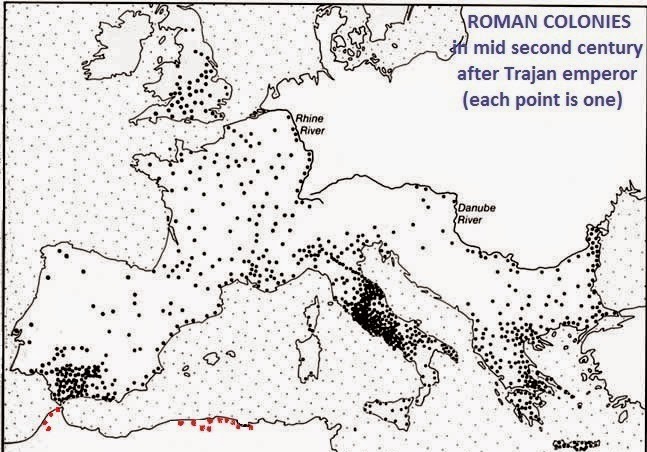
What was the scale and impact of Roman colonization and immigration into Peloponnese & Greece? I am usually told, and hear, that the impact was minimal and that the number of colonists was not large (and that those who arrived were almost immediately hellenized).

Processes of Cultural Change and Integration in the Roman World
https://books.google.ca/books?id=VD...=Roman soldiers settle Patras Corinth&f=false

Page 154: This paper presents the results of such context-specific case study. It focuses on the city of Patras, which was colonized by Augustus in 14 B.C. Colonization entailed a massive influx of foreigners into the city, among them a large number of Roman army veterans.

Page 156: The colonization of Patras took place in the context of the reorganization of Greece that was started by Caesar and continued by Augustus.

Page 158: The settlement of veterans from Antony's legions after the battle of Actium must have posed a serious problem for Augustus, since, according to some estimations, there were about 35,000 veterans who had to be accommodated; Patras was just one destination for the veterans. ...... A third wave of immigration has been suggested by Keppie and Rizakis ........ The process of large-scale immigration entailed major disruptions to local society. In the case of Patras the act of colonization and the immigration of thousands of colonists led to a radical overthrow of the established order of things.


Who were then the medieval Romaioi and Tsacones of Peloponnese?

Many of those Medival Romans in Byzantine Empire were indeed ancient Hellenes, but I wonder how much did Roman conquest affect Greece?
 
Romancoloniae.jpg
 
Many of those Medival Romans in Byzantine Empire were indeed ancient Hellenes, but I wonder how much did Roman conquest affect Greece?

Based on which sources do you base this belief on?

We have just read that up to 35,000 Roman veterans were settled in (southern) Greece, as well as having several waves of large-scale immigration into (only) Corinth and Patras.

Furthermore, Justinian established Castle of Maina/Mani and settled it with Roman colonists from elsewhere. (I do not have the source handy.)

Let's not forget that - for want of Hellenes - 'Kapheroi, Thrakesians, Armenians, and others from different places and cities' were settled in Peloponnesos in the early ninth century.

Moreover, did we not already read (several times) the following:

- "And now most of Epirus and Hellas and Peloponnesus and Macedonia are inhabited by 'Scythi-Slavs'."
- And for Western Peloponnese in particular: "And now not even the names of the Pisatans, the Caucones or the Pylians survive. All these regions are inhabited by 'Scythians'".

There were also minor settlements of Christian Orthodox Seljuk Turk "Romaioi" in the Peloponnesos as well (sometime during/after the 13th century).
 
I meant ... before slavic migration. The Roman conquest and assimilation of Ancient Hellenes into Christian Romans but what I meant is that when Christianization took over, how many of those Pagans were Latin colonies or native Hellenes. You get me ...
 
Last edited:
I meant ... before slavic migration. The Roman conquest and assimilation of Ancient Hellenes into Christian Romans but what I meant is that when Christianization took over, how many of those Pagans were Latin colonies or native Hellenes. You get me ...

Ok, got it.

Before the Slavic migrations, I am sure there were some native Hellenes. However, let's not forget also that there were numerous incursions into the Balkans and Greece even earlier - and after the Roman conquest of Greece. One of the most devastating attacks was carried out by the Goths, in 3rd century AD.

The following is the same as my post #235 in this same thread:
http://www.macedoniantruth.org/forum/showthread.php?t=17&page=24

Citations are from Edward Gibbon's "The History of The Decline and Fall of the Roman Empire". What was the extent of the Gothic invasion? Was it 'significant' or 'minor'? Interestingly, Gibbon himself states that troops of Greek deserters and fugitive slaves, which joined the Goths, were themselves of German or Sarmatian (likely Slavic) extraction. How many Germans and Sarmatians were living in Greece at the time of the Gothic attack is impossible to determine.

Quotes:

- At length the Gothic fleet anchored in the port of Piraeus, five miles distant from Athens, which had attempted to make some preparations for a vigorous defence. Cleodamus, one of the engineers employed by the emperor's orders to fortify the maritime cities against the Goths, had already begun to repair the ancient walls, fallen to decay since the time of Scylla. The efforts of his skill were ineffectual, and the barbarians became masters of the native seat of the muses and the arts. But while the conquerors abandoned themselves to the license of plunder and intemperance, their fleet, that lay with a slender guard in the harbor of Piraeus, was unexpectedly attacked by the brave Dexippus, who, flying with the engineer Cleodamus from the sack of Athens, collected a hasty band of volunteers, peasants as well as soldiers, and in some measure avenged the calamities of his country.

- But this exploit, whatever lustre it might shed on the declining age of Athens, served rather to irritate than to subdue the undaunted spirit of the northern invaders. A general conflagration blazed out at the same time in every district of Greece. Thebes and Argos, Corinth and Sparta, which had formerly waged such memorable wars against each other, were now unable to bring an army into the field, or even to defend their ruined fortifications. The rage of war, both by land and by sea, spread from the eastern point of Sunium to the western coast of Epirus. The Goths had already advanced within sight of Italy, when the approach of such imminent danger awakened the indolent Gallienus from his dream of pleasure.

- But as their numbers were gradually wasted by the sword, by shipwrecks, and by the influence of a warm climate, they were perpetually renewed by troops of banditti and deserters, who flocked to the standard of plunder, and by a crowd of fugitive slaves, often of German or Sarmatian extraction, who eagerly seized the glorious opportunity of freedom and revenge.
 
Last edited:
[ Note that the Italians called the Byzantine Arberesh Greci? So, WHO are then the Greci / Greeks? Isn't this a contradiction? :) ]

The only reason that the Italians called these people Greek (Arberesh were Christian Albanians who escaped Ottoman Empire and moved to Italy) is because they were Greek-Orthodox. They were also (linguistically) Hellenized, for instance the Bilbe hadn't been translated in Albanian at that time.
 
1. The Venetian documents mention Albanians in Tzaconia.
2. The Mardaites inhabited the territory of Monemvasia, or modern Tzaconia.
3. Like 'Mardaite', the word 'Tzacon' did not mean a people, but a category of soldiers.
4. According to historian Sathas: the ancient Tzaconians belong to Albanian sailors of Kranidi, Hydra.
5. Philippson admits that Slavic colonies existed in Vatika also, that is to say south of the fortress of Tzaconia and close to Monemvasia. Some Slavic place names reinforce this supposition.
6. As per Chalkokondyles and geographer Meletios, the regions of Taygetos, land of Laconia, and promontory of Tenaron were long inhabited by Romani (that is, Vlachs / Armanoi).
7. The Vlachs / Armanoi have been variously called by different writers and in different places by a variety of names: Maniati, Laconi, Bui, Megalovlahiti, Dasareti, Meteori, etc.
8. Stam. C. Caratzas states that "Two indications argue for the existence of a relationship between Tzacones and Vlachs in popular poetry."
9. Per author F. Curta, the "Tzakonians" appear to have been settled in the Peloponnesus in the course of the ninth and tenth century. The viewpoint that the Tzakonians were settled in the Peloponnesus, from elsewhere, is also supported and shared by the author Stamatis C. Caratzas. There exists a legend which states that Tzakonians originate from Macedonia, namely from the area of Chalkidiki peninsula - and specifically, from the vicinity of Mount Athos district (Holy Mountain).
10. Evliya Tchelebi compares the physical features of the inhabitants of Tzaconia between Molai and Monemvasia, to those of Tatar-Kalmyks.
11. Investigator Katsanis: "The Tsakonian was influenced without doubt by the Aromanian tongue."
12. In village Geraki of Laconia the words ‘κρούσκος/krouskos=relation by marriage’ and ‘τάτας/tatas=father’ correspond to Aromanian ‘cúscru’ and ‘táta’. ‘Γκάλμπινος/galmpinos/ in Greek idioms of the Peloponnese and Epirus means 'blond’, ‘pale yellow’, ‘sallow’, ‘gook’, while ‘galbinu’ is the ‘yellow’ in Aromanian."
13. In the petition of Monembasiotes (1527), the nearby residents of Monemvasia are named Vlachs (Βλάχοι).
Not sure where to start, I numbered the above points:

1. At some point, Albanians DO live at the area that is called Tzaconia. That doesn’t mean the two groups are one, they were never confused.

2. Really? When? Were these Mardaites Albanians?

3. Not after a while, as we can see. Everyone (for some reason) doesn’t avoid to single them out as a distinct linguistic group, not a social one.

4. LOL, I didn’t know Tzaconians or Albanians were ancient. What does this phrase mean? We want to know more.

5. Slavs existing at the south of Tzaconia, there’s no problem with that, I can’t see your point. As seen in Mazaris, Tzaconians can’t be confused with Slavs. Also, they still exist today (unlike Slavs) and we can study their language.

6. Yes, but that is not in Tzaconia. I understand you lost these Vlachs and you can’t find them anywhere. Also, it’s clear that these Vlachs had just arrived, they were not there during Mazaris work, were they already lost during Celebi’s travels?

7. No, no, no. That’s totally wrong and should be further discussed, investigated. Maniotes or Laconians/Tzaconians were not Vlachs.

8. This could be the fuzziest statement ever. Why do you keep repeating it since it means nothing? Which are these indications?

9. Mount Athos doesn’t have people, it is only restricted to monks.

10. There’s a bit of a problem, that these areas are not inhabited by Tzaconians at the moment (remember? You had busted our balls about that) but we certainly want to know more about this passage anyway. I’m very interested in Celebi.

11. LOL, Is it without doubt because of the …

12. … huge linguistic connection presented here?

13. Not sure what this means, but I’d like to see it again. So when are the Vlach traces finally lost?


===
 
Last edited:
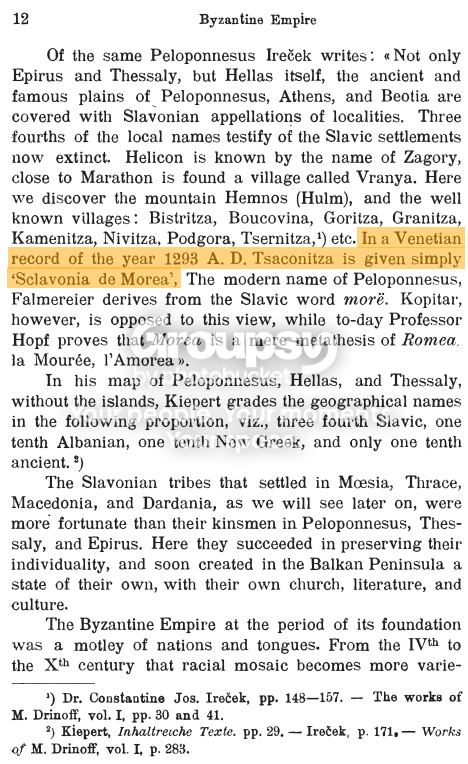
The full translation of the highlighted text is:

It is forbidden to the Venetians and subjects of the Republic to transport salt ... from Glarenza/Clarence and elsewhere to Tzaconia or Sclavonia.

So this refers to two places or one with two alternate names? Are there other sources mentioning this Venetian Sclavonia?
 
In addition, the entry refers to both the number of inhabitants of the area (40,000) at the time of the original work (1812) and its "ethnological recommendation" (in the view of the dictionary writer).

Specifically, it is reported that there was a mixture in that area (mescuglio = mixture in the Venetian language) of Spartani and Slavs (Schiavoni = Slavs in the Venetian language) at that time.

("Albanians", "Vlachs", "Greeks", "Mardaites" are all absent. And who were these Spartani?)

Spartani means... Spartans. You can't expect much. This is a generic dictionary so it draws basic information from other sources. Based on the various terms we've seen may times in this thread it could mean Peloponnesians, Maniotes (specifically as this is about Mani), I don't think this one refers to Tzaconians (who are also called Lacedaemonians, Laconians or Spartans).
 
So this refers to two places or one with two alternate names? Are there other sources mentioning this Venetian Sclavonia?

This seems to refer to one place: Tzaconia or Sclavonia.

Greek author Amantos refused to accept that this testimony refers to the same country or region.

There is another testimony, which I already shared on this forum, which states: Ad partes Zachoniae vel Sclavoniae de Romania -- Maggior Consiglio, Deliberazioni. Zaneta, Pilosus 1287-1299, c. 361 Archives de Venise.

The Venetian Chancery continued to call the department of Monemvasia or Tzaconia Sclavonia until the fifteenth century. This denomination could have been a loan though - but we have seen that it was already circulating in the time of Saint Willibald.

Saint Willibald (723 AD) assigned to the department of Tzaconia the denomination of terra Slavinia, and this was centuries before the terms Tzaconia and Tzaconians even begin to take shape.
 
Hi Amphipolis,

1. At some point, Albanians DO live at the area that is called Tzaconia. That doesn’t mean the two groups are one, they were never confused.

I don’t necessarily disagree with you but there are quite a few contradictions, confusions and unclear references. * - See below.


2. Really? When? Were these Mardaites Albanians?

9th century. Post #10 in the following thread -
http://www.macedoniantruth.org/forum/showthread.php?t=405

Hard to know if these Mardaites were Albanians. It is a distinct possibility.


3. Not after a while, as we can see. Everyone (for some reason) doesn’t avoid to single them out as a distinct linguistic group, not a social one.

Yes, and they are classified separately and distinguished even from the Greeks. As we saw, B. Randolph wrote that "THE Inhabitants of the Morea, are Turks, Greeks, Albaneses and T'Zackonians."

As a result, the Tzaconians can’t be confused with Greeks. This indicates they may have been hellenized at some point, or even bilingual.

Or do you think Randolph made an error, and a confusion?

http://www.macedoniantruth.org/forum/showthread.php?t=6633&page=12


4. LOL, I didn’t know Tzaconians or Albanians were ancient. What does this phrase mean? We want to know more.

Verbatim quote from Sathas, translated from French. Check out google books.


5. Slavs existing at the south of Tzaconia, there’s no problem with that, I can’t see your point. As seen in Mazaris, Tzaconians can’t be confused with Slavs. Also, they still exist today (unlike Slavs) and we can study their language.

Ok. Speaking of their language, Valentina Fedchenko stated the following on pages 77 and 78:
--> The dialect speakers maintained contacts with the mainland throughout the Middle Ages until the early part of the 19th c. As a result, the isolation argument can be questioned.
--> Contacts with other languages and Greek dialects are confirmed on the syncronic level by the Tsakonian lexical borrowings.
--> The description of Tsakonian as having traces of ancient Greek Dorian (Laconian) dialect seems to be a simplified one and neglects a few facts (one of them being the fact that different 'ancient' features ascribed to Tsakonian can be found is some other Greek dialects).

http://www.academia.edu/5743870/Subdialectal_diversity_in_the_Tsakonian-speaking_area_of_Arcadia


6. Yes, but that is not in Tzaconia. I understand you lost these Vlachs and you can’t find them anywhere. Also, it’s clear that these Vlachs had just arrived, they were not there during Mazaris work, were they already lost during Celebi’s travels?

I thought Tzaconia encompassed a much larger territory in the distant past?

Peloponnesiaca: A Supplement to Travels in the Moréa, By William Martin Leake.
Page 336, Laconians = Tzakonians = Maniates:

".. for it is evident from the anonymous Metrical Chronicle of the Wars of the Franks in the Morea in the 13th century, that Tzakonia had then a much wider signification. Even as late as the beginning of the 18th century we find the Venetians applying the name Zaccunia to all the ancient Laconia, including Mani. There remains, therefore, the strongest reason to believe that the Lakones or Tzakones mentioned by Pachymer and Gregoras consisted chiefly of Maniates."

I am lost for sure. : )


7. No, no, no. That’s totally wrong and should be further discussed, investigated. Maniotes or Laconians/Tzaconians were not Vlachs.

Verbatim quote from a Romanian author.


8. This could be the fuzziest statement ever. Why do you keep repeating it since it means nothing? Which are these indications?

Lifted from Caratzas. I can provide futher and more detailed translations. Parts of his book can be found on google books.


9. Mount Athos doesn’t have people, it is only restricted to monks.

To reduce temptations to a minimum, a ban on women and female livestock has been in effect for nearly 10 centuries. The official stories carefully fail to mention the real reason why they are not allowed in the monastic state: the Vlachs. For centuries, the monks and these nomad shepherds, who went there to find winter pasture for their sheep, lived side by side in relative peace.

Gradually, an increasing number of monks were “tempted” into sneaking ladies wearing men's clothes into the monasteries. “The things that occurred are shameful both to tell and to hear,” said a witness to these events.


https://www.vagabond.bg/travel/foreign-travel/item/622-for-mens-eyes-only.html

https://books.google.ca/books?id=tK...#v=onepage&q=women mount athos vlachs&f=false

https://books.google.ca/books?id=J6...EIIjAA#v=onepage&q=vlachs mount athos&f=false

https://books.google.ca/books?id=ql...onepage&q=vlachs expelled mount athos&f=false

The expelled laity / Vlachs from Mt. Athos were resettled in the Peloponnese, namely Tzaconia. Can elaborate on this.


10. There’s a bit of a problem, that these areas are not inhabited by Tzaconians at the moment (remember? You had busted our balls about that) but we certainly want to know more about this passage anyway. I’m very interested in Celebi.

Post #48 in the following thread (it includes the screenshot of page 204, in French) -
http://www.macedoniantruth.org/forum/showthread.php?t=6633&page=5


11. LOL, Is it without doubt because of the …
12. … huge linguistic connection presented here?


#11 was lifted from the article Waren die peloponnesischen Melinger Vlachen? by Johann Benos, where Katsanis was cited. Katsanis wrote [Κατσάνης, Ν.] 1989. Κουτσοβλάχικα και Τσακώνικα (Arumanian and Tsakonian). Ελληνική Διαλεκτολογία 1: 41-54 -- which Benos referenced, so we should check with him. Unfortunately, I am unable to find or order this book online.

#12 is a separate remark which was made by Antonis Bousboukis here:

http://vlahofonoi.blogspot.ca/2013/10/the-relationship-of-aromanians-with.html


13. Not sure what this means, but I’d like to see it again. So when are the Vlach traces finally lost?

Here - page 120 in the book Les Tzacones, footnote 190

https://books.google.ca/books?id=i_...AA#v=onepage&q=Apud Volchiam et alias&f=false


Also here - check the footnotes, where it says: Dans la petition des Monembasiotes (1527)...

https://books.google.ca/books?id=0b...jAA#v=onepage&q=Vulachi Monembasiotes&f=false


I guess (only small, perhaps last) traces is in Cousinery’s reference in 1831 to the presence of Vlach-speakers, probably Arvanitovlachs, in the area of Argos in the Peloponnese. He reports that, after the War of Independence of 1821, he met some Vlachs, men and women, in Argos market, who told him that they were pastoral nomads with settlements in the mountains around Argos. He also notes that these Vlachs spoke a Latinate language, like the Vlachs he had met in Macedonia.

http://www.vlachs.gr/en/home/englis...the-arvanitovlachs-in-roumeli-mainland-greece


* - From #1 (I wonder how accurate is Sathas in his interpretations..):

PAGE LXXII OF Documents inédits relatifs à l'histoire de la Grèce au Moyen âge publiés ... By Konstantinos N. Sathas

https://books.google.ca/books?id=0b...AEIKDAA#v=onepage&q=Tzaconiens Pindus&f=false

French: Chalcondyle et l'archeveque Meletius pretendent que les Tzaconiens sont originaires du mont Pindus. Au temps de lempereur Cantacuzene, cette montagne appartenait aux Albanais.

English:
Chalcocondyle and Archbishop Meletius claim that the Tzaconians are from Mount Pindus. In the time of the Emperor Cantacuzene, this mountain belonged to the Albanians.
 
Last edited:
Mardaites, Albanians and Vlachs were Christians unlike Tsakones who were Pagans.

If they were worshiping Slavic Gods, Constantine VII wouldn't call them ''older Romans''.
They were probably worshiping Zeus/Jupiter.
 
Last edited:
Did you know there's a village of black people in Greece? I first heard about it in the 1980s and thought of searching about them in the internet era. The village is called Avaton and is in Thrace. Back then (in less politically correct times) they were saying these blacks were so idiot that they didn't even know when/where they came from, even though they came quite recently.

The first theory was that they were African slaves of the Turks that were offered liberty during the population exchanges.

Another theory was that they were a black battalion of a European Army that stayed in Thrace after WWI.

Here's a link and pictures of them. As they say, now that they have started to mix with whites, they have become whiter/colorful. I may be wrong, but I think they are Muslims, and according to the link they come from Sudan or they were originally sold as slaves in Saudi Arabia.

http://www.enet.gr/?i=news.el.article&id=415642


===
 
Last edited:
Back
Top