• Welcome to the new Macedonian Truth Forum. All posts, members and private messages have been moved over from the old forum.

    Passwords from the old forum could not be carried over, so please use Forgot your password? to set a new one. The reset link is emailed to the address on your account.

  • Rules and Regulations at the forum of the Macedonian Truth Organisation (MTO)

    (1) The national-ethnic and cultural-linguistic identity of the Macedonian people is historically Macedonian, and derives its character from the native, indigenous and geographic homeland of the Macedonians, which is called Macedonia. To ensure that their human rights, integrity and heritage are appropriately respected, the only nouns and adjectives acceptable when reference is made to the above character and identity markers is Macedon, Macedonia, Macedonian and Macedonians.

    (2) The nation-state of the Macedonian people is the Republic of Macedonia, and is to be referred to by this official title so long as the 'republic' prefix is consistently applied to other states. Alternative references are the Macedonian Republic, or simply, Macedonia.

    (3) The 'ethnic' prefix is only acceptable for Macedonians in cases where differentiation is specifically required - so long as it is in context and consistent where it concerns its application to other ethnic groups.

    (4) Should any other differentiation be specifically required, the names of other ethnic groups that reside with Macedonians in either the Republic of Macedonia or the occupied Macedonian regions in Greece, Bulgaria, Serbia or Albania, are to be given a prefix.

    (5) Negating the identity, language and culture of the Macedonian people by deliberate avoidance of the terms Macedonia, Macedonian and Macedonians, or by any other means, is not permitted.

    (6) Systematic anti-Macedonian propaganda and rhetoric are not permitted.

    (7) Threads irrelevant to the Macedonian Cause, the community at the Macedonian Truth Organisation or the Macedonians in general may be considered as spam or not in the spirit of the forum. In such cases they are not permitted.

    (8) Continual posting of messages in threads with the sole purpose of deviating from the initial topics with the use of unrelated and unnecessary information is not permitted.

    (9) All posts, external articles, reports, etc that are cited in languages other than Macedonian or English, must be accompanied with a translation in one or both of the said languages.

    (10) Despite the possibility of some conversations and debates becoming heated, extreme abuse and/or racism, vulgar language and/or terminology, threats, revelation of personal information about others, harassment, and other such behavior will not be permitted. If deemed necessary all relevant information including member details will be reported to the appropriate authorities for investigation which may result in legal action.

    (11) Threads that are created must have a summary of a topic or excerpt of an article found in pertinent link(s) that have been included. One line threads will be considered unaccetable spam and are therefore not permitted.

    (12) Compulsive and deliberate lies, irrespective of the topic, are not permitted.

    (13) Any symbols or avatars found to be perceived as offensive to Macedonians are not permitted.

    (13) Any explicit or extreme material is not permitted.

    Failure to adhere to the above rules and regulations will result in a ban after 3 breaches. This may be reconsidered in some cases should the circumstances be of an unorthodox nature and/or require special consideration. To assure an effective deterrent against an individual or individuals with the sole purpose of causing dissent through spamming, racism or other improper means, the above rules will be strictly enforced.

    The MTO administration will monitor all discussions as reasonably practical and reserve the right to remove any post and/or member from the forum, and update the rules and regulations as required. Members are encouraged to immediately report any post and/or member to the MTO administration if they feel that these rules have not been abided by.

    The views expressed on this forum are those of the individuals. The only official representation of the MTO is made by the "Macedonian Truth Organisation (Site Owner)" username, and no other.

  • Macedonian Cause

    The Macedonian Truth Organisation calls on God in Heaven to protect, bless and guide the endeavour it is committing to undertake, and that is to work towards:

    Securing Macedonia as a free, independent and democratic republic in which sovereignty lies with the Macedonian citizens; as the nation-state of the Macedonian people in which they can preserve their culture, language and identity; as a state in which the Macedonian language and culture form the basis of public life and act as important unifying elements of Macedonian society; as the home of all its citizens to which it guarantees and obliges their inalienable natural rights and corresponding responsibilities;

    The acknowledgment as self-evident and irrefutable the existence of the:

    1) Indigenous, ethnonational name of Macedonia;
    2) Macedonian people, language and identity;
    3) Macedonian culture, symbols and folklore;
    4) Macedonian ancestry, heritage and history in its entirety; and
    5) Macedonian Orthodox Church;

    Securing recognition by the International Community of the tragedies endured by the Macedonian people, of the division of Macedonia with the signing of the Treaty of Bucharest on August 10, 1913, and the genocide committed against the Macedonian people at the hands of the Greek, Bulgarian and Serbian states and their respective churches during the 19th and 20th centuries;

    Ensuring that the Interim Accord is declared ‘null and void’ and that all constitutional provisions, acts, commitments, agreements, legislation, regulations, policies or programs emanating from, supporting or consequential to the Interim Accord are also declared ‘null and void’, including the use of any symbols and the completion of any acts imposed by, or originating from, the Interim Accord.

    Ensuring that the Framework Agreement is abolished and that all constitutional provisions, acts, commitments, agreements, legislation, regulations, policies and programs emanating from, supporting or consequential to the Framework Agreement are also abolished and replaced by a framework of constitutional and statutory law based on inalienable natural rights and corresponding responsibilities and universally codified human rights mechanisms.

    Securing the abolishment of any existing constitutional provisions, acts, agreements, legislation, regulations, policies and programs that discriminate against the Macedonian people, in any international organisation or any of the countries of the International Community where such constitutional provisions, acts, agreements, legislation, regulations, policies and programs exist, and thereby ensuring the freedom for Macedonians to exercise their inalienable natural rights and fulfil their corresponding responsibilities, and practice their culture, language and religious faiths in all the countries of the International Community without hindrance;

    The empowerment of Macedonians to undertake a moral revolution and to instil and/or reinvigorate within themselves a deep-rooted national, cultural, linguistic and historical dignity and a commitment to the exercise of freedom based on inalienable natural rights and corresponding responsibilities;

    The recognition of the Macedonian minorities in the neighbouring states of Macedonia as well as the respect for the inalienable rights and freedoms of the Macedonian minorities, as provided for by natural law and as codified by the United Nations Charter, the Universal Declaration of Human Rights and other universally codified human rights mechanisms;

    The full and unreserved respect of, and the support for, the rights of all people of non-Macedonian descent living in Macedonia and around the world, who share a reciprocal full and unreserved respect for the Macedonian people, their homeland and their state;

    The cultural unification and solidarity of the Macedonian people living in all parts of historical Macedonia and adjacent territories, as well as Macedonians throughout the world;

    The unity of all Macedonians on the principles, objectives and achievement of the Macedonian cause as defined by this declaration.

The Illyrians

The Position of Albanian
http://www.kroraina.com/balkan/ehamp.html

The genesis of the Balkan Peoples
http://www.kroraina.com/vg/vg.html

VIII. Albanians and Rumanians

Whether the Albanians are the successors of die Illyrians or the Thracians is a problem that has long been debated. Today the Albanians dwell in a region that was known in antiquity as Illyria. For that reason the Albanians have often been regarded as the heirs of the ancient Illyrians, although there are no other data supporting such a claim. In the same way, the Bulgarians might be considered as Thracians if the other Slavonic peoples and languages were not known.

But many linguists and historians, e.g. H. Hirt, V. Pârvan, Th. Capidan, A. Philippide, N. Jokl, G. Weigand, P. Skok, D. Detschew, H. Baric', I. Siadbei, etc. have put forward very important considerations indicating that the Albanians cannot be autochthonous in the Albania of today, that their original home was the eastern part of Mysia Superior or approximately Dardania and Dacia Mediterranea, i.e. the northern central zone of the Balkan Peninsula, and part of Dacia.

Now, however, when it is clear that Daco-Mysian and Thracian represent two different IE languages, the problem of the origin of the Albanian language and the Albanians themselves appears in quite a new light. The most important facts and considerations for determining the origin and original home of the Albanians are the following.

1. The Illyrian toponyms known from antiquity, e.g. Shköder from the ancient Scodra (Livius), Tomor from Tomarus (Strabo, Pliny, etc.), have not been directly inherited in Albanian: the contemporary forms of these names do not correspond to the phonetic laws of Albanian. The same also applies to the ancient toponyms of Latin origin in this region.

2. The most ancient loanwords from Latin in Albanian have the phonetic form of eastern Balkan Latin, i.e. of proto-Rumanian, and not of western Balkan Latin, i.e. of old Dalmatian Latin. Albanian, therefore, did not take its borrowings from Vulgar Latin as spoken in Illyria.

3. The Adriatic coast was not part of the primitive home of the Albanians, because the maritime terminology of Albanian is not their own, but is borrowed from different languages.

4. Another indication against local Albanian origin is the insignificant number of ancient Greek loanwords in Albanian. If the primitive home of the Albanians had been Albania itself, then the Albanian language would have to have many more ancient Greek loanwords.

5. The Albanians are not mentioned before the 9th century a.d., although place names and personal names from the whole region of Albania are attested in numerous documents from the 4th century onwards.

6. The old home of the Albanians must have been near to that of the proto-Rumanians. The oldest Latin elements in Albanian come from proto-Rumanian, i.e. eastern Balkan Latin, and not from Dalmatian, western Balkan Latin that was spoken in Illyria. Cf. the phonetic development of the following words:

Vulgar Latin caballum 'horse' Rum. cal, Alb. kal
Vulgar Latin cubitum 'elbow' Rum. cot. Alb. kut
Vulgar Latin lucta 'struggle, fight' Rum. luptǎ, Arum. luftǎ, Alb. luftë
Therefore Albanian did not take shape in Illyria. The agreement in the treatment of Latin words in Rumanian and in Albanian shows that Albanian developed from the 4th till the 6th century in a region where proto-Rumanian was formed.

7. Rumanian possesses about a hundred words which have their correspondences only in Albanian. The form of these Rumanian words is so peculiar (e.g. Rum. mazǎre = Alb. modhullë 'pea(s)') that they cannot be explained as borrowings from Albanian. This is the Dacian substratum in Rumanian, whereas the Albanian correspondences are inherited from Dacian.
 
Epirus said:
I ordered John Wilkes's book via amazon and now I can cite originally him.
Good decision, for somebody like yourself who has a keen interest in the Illyrians, the book is a must-have.
Wilkes position is that Albanian culture is an inheritance of several cultures, among whom were the Illyrians.
And I agree with that position. But you see how that differs markedly to your previous suggestion that the majority of Albanian culture is Illyrian.
Barthold Georg Niebuhr made a good analogy between Albanian "besa" and the Illyrian "oath of peace":
Many tribal cultures have traits such as 'oaths', it could easily have been imported by one of the other cultural-linguistic groups that Albanians have inherited. I don't see a definitive Illyrian connection there, unless you can refer to some sort of citation from antiquity which speaks of something along similar lines?
Of great importance in relating Illyrians with the Albanians is also the traditional customary law called 'Kanun':
Again, the opinion of the author in the quote you cited is based his own presumption that the Illyrians were the direct precursors of the Albanians. The first quote from Wilkes that you provided disputes that. Thus, the examples of the 'besa' and the 'kanun', while being unique to Albanian, aren't exactly confirmed as being of Illyrian origin.
 
And I agree with that position. But you see how that differs markedly to your previous suggestion that the majority of Albanian culture is Illyrian.
there are Tons of Facts that Albanians are iLLyrians, Starting from Clothes,Songs,Language...Etc.
Most of the illyrian kings have Names in Albanian language,for example Bardhylis, Bardh - White, Ylli - Star!
It means WhiteStar in Albanian, this is so clear!
Even the illyria in Albanian language means the peoples that are free!
Iliret!

Many tribal cultures have traits such as 'oaths', it could easily have been imported by one of the other cultural-linguistic groups that Albanians have inherited. I don't see a definitive Illyrian connection there, unless you can refer to some sort of citation from antiquity which speaks of something along similar lines?
Let me give you a iLLyrian song called "Moj e bukura", You can find it in Youtube and listen it!
The words of the song havent changes for hundred and hundred years!
 
there are Tons of Facts that Albanians are iLLyrians, Starting from Clothes,Songs,Language...Etc.
Tons? I doubt it. Most of what you consider 'facts' is trivial or incorrect, or shared with other Balkan peoples.
Most of the illyrian kings have Names in Albanian language........
Most? I don't think so. Probably more in the vicinity of few to none. I also question the suggested etymologies for 'bardyllis' and 'illyria'.
The words of the song havent changes for hundred and hundred years!
So?
 
I almost forgot I started making this site some time ago, but never finished it:
https://sites.google.com/site/neoillyrian/

It's my own little project to sort out the problem of the Serbian/Croatian/Bosnian/Montenegrin language. My solution is quite simple and it was proposed by many linguists and historians: call this language by the name it has been referred to for over a thousand years: Illyrian.

http://en.wikipedia.org/wiki/List_of_Croatian_dictionaries
http://en.wikipedia.org/wiki/Illyrian_movement
 
Tons? I doubt it. Most of what you consider 'facts' is trivial or incorrect, or shared with other Balkan peoples.
Our CCulture is Pure Illyrian,and yes we shared our Culture with other Balcan Nations, Like Greeks,Macedonians,Slavs....
One exmaple is Fustanella.

So it means that we are iLLyrians,its a song that have been singed by iLLyrians and now by us!
 
It's my own little project to sort out the problem of the Serbian/Croatian/Bosnian/Montenegrin language. My solution is quite simple and it was proposed by many linguists and historians: call this language by the name it has been referred to for over a thousand years: Illyrian.
That is the most logical and sensible name for it.
Valmir said:
Our CCulture is Pure Illyrian...........
Yeah, ok. How many more times do we need to go around the same circle before you start producing something of substance?
So it means that we are iLLyrians,its a song that have been singed by iLLyrians and now by us!
What evidence is there that the Illyrians were singing this song? Or is this something else that you've conjured in your colourful imagination?
 
That is the most logical and sensible name for it.
The most logical name for those languages is one,Slavic or Russian!
They speak almost the same language with Russians :)

What evidence is there that the Illyrians were singing this song? Or is this something else that you've conjured in your colourful imagination?
Illyrians were singing this song,we sing this song too!
And they singed that language in the same language as Albanians speak now!
I dont know how many more facts you want about Albanian iLLyrian origin :D
 
It's my own little project to sort out the problem of the Serbian/Croatian/Bosnian/Montenegrin language. My solution is quite simple and it was proposed by many linguists and historians: call this language by the name it has been referred to for over a thousand years: Illyrian.

Hehehe, So Slavs(Russians) now are Illyrians?
 
Hehehe, So Slavs (Russians) now are Illyrians?

http://en.wikipedia.org/wiki/List_of_Croatian_dictionaries

1670 – Pavao Ritter Vitezović, Lexicon Latino-Illyricum (a manuscript dictionary in which the author carried out in practice his views on the language and spelling).

1728 – Ardelio della Bella, Dizionario Italiano–Latino–Illirico (mainly based on Ragusan literary sources, but also includes Čakavian sources; supplemented by a short grammar of the Croatian language).
Adam Patačić, Dictionarium latino-illyricum et germanicum (manuscript dictionary).

1740 – Ivan Belostenec, Gazophylacium seu latino-illyricorum onomatum aerarium. (A Kajkavian based monumental dictionary of 50,000 entries)

1741 – Franjo Sušnik-Andrija Jambrešić, Lexicon latinum interpretatione illyrica, germanica et hungarica locu pies (the names "Croatian" and "Illyrian" are used synonymously).

1801 – Joakim Stulić, Lexicon latino-italico-illyricum, Budim.

1802—03 – Josip Voltiggi, Ričoslovnik iliričkoga, italijanskoga i nimačkoga jezika (A dictionary of the Illyrian, Italian and German languages) (based on Ikavian; Jekavian forms are cited along with Ikavian; Ekavian forms refer to Ikavian).

1806 – Joakim Stulić, Rječosložje ilirsko-talijansko-latinsko (Illyrian—Italian—Latin dictionary), Dubrovnik.

1810 – Joakim Stulić, Vocabolario italiano-illirico-latino, Dubrovnik (the bulk of the dictionary was excerpted from published works of Ragusan writers, along with Dalmatian, Herzegovinian, Bosnian, Slavonian and Istrian sources. More than 80,000 words on 4,600 pages, excerpted from 120 authors).

1842 – Ivan Mažuranić and Josip Užarević, Njemačko—ilirski slovar (A German–Illyrian dictionary. First "truly modern" Croatian dictionary).

---

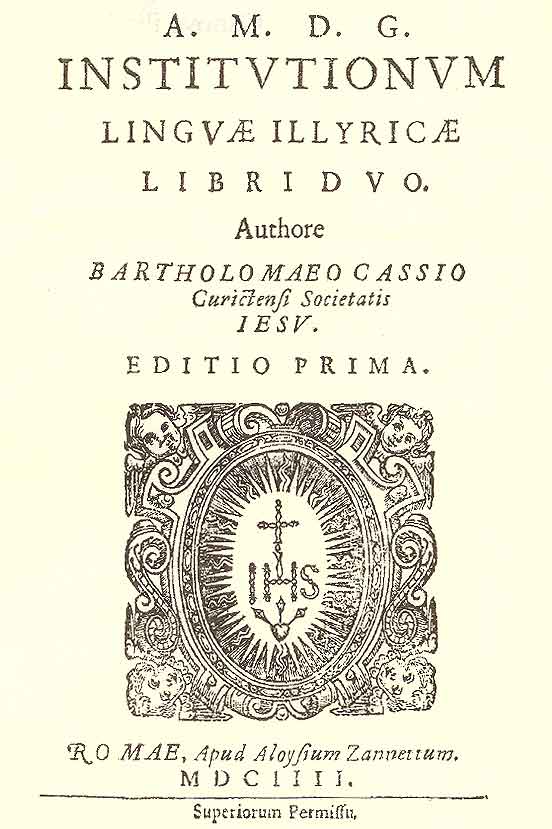
First Croatian/Illyrian grammar:
Bartol_Kasic_Institutiones_linguae_Illyricae.jpg

Institutionum linguae illyricae libri duo ("The Structure of the Illyrian Language in Two Books"), Rome, 1604.

---

The Illyrian Alphabet
http://user.icx.net/~richmond/rsr/illyrian/illiricum.html
illiricum1.jpg
 
Last edited:
The most logical name for those languages is one,Slavic or Russian!
They speak almost the same language with Russians :)
They didn't get their language from the Russians, so the suggestion is expectedly uninformed. As for the term 'Slavic', it is only suitable for a linguistic group and not a specific language, so it has parallels in Latin, Germanic, Celtic, etc. What linguistic group does Albanian belong to? None. Or perhaps all. That is because it is one of the most bastardised languages in Europe. And you're going to blabber on about "pure" Illyrians? Please....
Illyrians were singing this song,we sing this song too.....I dont know how many more facts you want about Albanian iLLyrian origin
You haven't even provided any facts, all you've done is claim that some song that Albanians sing is Illyrian. What proof is there that the Illyrians sang this song? How many times do I need to ask you the same question? Start proving these assertions of yours or at least provide some sort of logical response, or stop trolling on the forum.
 
Some of you may recall a show called Quantum Leap, the main actor was a guy called Scott Bakula. I found his surname interesting and after a brief search I found that he is of Croatian descent. I searched the origin of the name and found that it has a meaning in Sanskrit (not sure if it has one in Slavic), see below:

http://babynamesworld.parentsconnect.com/meaning_of_Bakula.html
Meaning: Resembles a crane; blossom

Bakula represents the blossom of the tree with the same name. According to a story the flowers of the Bakula blossom when they are kissed by a woman.
I wonder how this came to be. I find that there are many unique Croatian names.
 
They didn't get their language from the Russians
Yes they do,They speak the same language with Russians,just a little bit of Editing :D

As for the term 'Slavic', it is only suitable for a linguistic group and not a specific language
Slavic is a origin of some nations in Europe, which Serbs and Croats are one of them!

What linguistic group does Albanian belong to? None.
Im suprised that you dont know this,Its learned in all universities over Europe!
There are only 3 languages in the Europe that are directly connected to Indo-European Languages Tree!
Greek,Albanian,Armenian.
For more information click here:


Or perhaps all.
Nope, Albanian is INDO-EUROPiAN language!

That is because it is one of the most bastardised languages in Europe. And you're going to blabber on about "pure" Illyrians? Please....
Its not bastardised lol, WHo told you that?
Learn Albanian and you will se it, its true that we have some words similar with Italian,French,German language, thats because they have the same Origin (Indo European)

For more information about Indo European languages Click on Wikipedia :D
 
Your language is one of the most bastardised of all Indo-European languages. That is a fact. If you knew anything about your own language you would know this. But clearly you don't. In fact, judging by your posts, I can assure you that I know more about the history of your language than you do.
There are only 3 languages in the Europe that are directly connected to Indo-European Languages Tree!
Greek,Albanian,Armenian.
Lol, you seriously don't have a clue, do you? A significant portion of Greek vocabulary is of non Indo-European origin. Pick up a book and educate yourself.
 
SoM, he's screwing with you. No person could seriously be that much ignorant (well, I'll bite my tongue there). He's just messing with you.
 
Hi SoM,

Sorry again for the delayed response because I could not signed in for a while. The password of my account had already expired and there were some technical errs that did not allow me to sign with my current account. But now everything is OK.
Good decision, for somebody like yourself who has a keen interest in the Illyrians, the book is a must-have.

That's right! John Wilkes has written a good account on Illyrians and most importantly is updated with recent discoveries. Unfortunately there are a few books to be found in English about Illyrians.

Originally posted by SoM

And I agree with that position. But you see how that differs markedly to your previous suggestion that the majority of Albanian culture is Illyrian.

To be honest, Wilkes does not hold any elaborated position in regard with the Illyrian ancestry of the Albanians. He just gives a simple review on Albanian culture, emphasizing the Illyrian element in the formation of our culture.

I owe to the readers of MTO some further explanation about Illyro-Albanian connection. This has been a subject of several controversies among scholarship, but however, the Illyrian theory prevails among others, which is why is often taken seriously by modern historians. It would be of great importance to see some conclusions drew by Yugoslav scholars on that question. Indeed, the Serbian authors were the first who disputed Illyrian origin of us, but however they attribute to us an ancient origin, but this time relating to Daco-Moesians. They have argued that Albanians might have been Thracians, who were pushed into modern Albania during Slavic upheavals. Let us serve ourselves with some of their accounts:

In a study entitled Ilirska i Dardanska kraljevina (The Illyrian and Dardanelle Kingdom), the academic, Fanula Papazoglu writes in footnote 98 on page 169 "I have no intention of entering into the complicated question of the origin of the Albanians. I would wish only to recall that there are not a few experts (G. Weigand, N. Jockl, H. Baric, Vl. Georgiev) who locate the area of the forming of the Albanian people in the central part of Albania, citing various linguistic indicators (the kinship of Albanian with Illyrian, Thracian, that is, Dacomoesian). I would add that the ethnic word Arber, Arben, Arbanites, does not have to be strictly connected with Ptolemy's Albansi. Perhaps two different roots are in question so that the later correlation of the Albanians with the ancient Albanoi rests on a chance similarity of name."

On page 59 of the above-mentioned book by A. Stipcevic we read the following "Not disputing the old Balkan origins of the Albanians, many historians and linguists in the nineteenth and twentieth centuries have proposed a different solution to the question of Albanian origins. According to some, the Albanians derive from the Thracians (Carl Pauli, Gustav Weigand, Dimitar Decev) while others suggest the Dacomoesians (Vladimir Georgiev) etc."

In his contribution to the work Illyrians and Albanians published by the Serbian Academy of Arts and Sciences in Belgrade, 1988, entitled "The beginnings and origins of the Illyrians", the academic, Milutin Garasanin, writes under points 8 and 9 in his final conclusions:

9. This unification was reflected even more in the period of Roman domination with the introduction of the Roman military, administrative and political system into the Balkan provinces. It cannot be disputed that this process did not mean the complete destruction of the indigenous element nor of the Illyrians whose presence, especially in the more farflung areas and so less exposed to Romanisation, can be discerned in various cults, funeral rituals and customs and in artistic creation. Only the stormy and complicated events of late antiquity and the movement of peoples with the settlement of the Slavs led in the most part to the complete disappearance of the indigenous population although later evidence of their continued existence is surely apparent. In this regard, it is particularly necessary to point to the remnants of the old Romanised population - the Vlachs. Within this framework, it is natural to raise the question of the Albanians whose paleo-Balkan origin cannot be doubted although in the sense of a sub-strata with the location of their territory still a matter of discussion and divided opinion. In order to be able to approach this question in a completely satisfactory manner from the archaeological point of view, however, it would be necessary to be in possession of reliably gathered and published material, especially from Albania. Here, unfortunately, there is a great gap in scientific knowledge. Albanian historians basically deal with the problems of prehistory in a satisfactory manner, accepting, albeit often tacitly, the results of investigations on which our work is also based. Inconsistency arises in their case when they do not differentiate the ethnic concept of Illyrian from the administrative one of Illyrica and so they extend the territory of the Illyrians to the Sava, even as far as Pannonia, but in the east they simply ignore the archaeological arguments about the position in the central Balkans and attach the Illyrians to the Dardanians and the Peonians. Investigators who deal with the archaeology of Albania in the Roman period have, unfortunately, until now mostly published synthetic reviews in which, without argument, they propagate the thesis of continuity on the territory of Albania throughout the Roman period. This continuity could have existed on this territory but on only in some areas. Yet, without publishing the corresponding archaeological material and a thorough analysis of it, its scope and character, it is not possible to pass judgement. Among the problems which for now cannot be solved by archaeological means is the question of the IIlyrians and the Albanians the study of which has been given an undesirable political and tendentious tone which is far removed from a scientific approach to resolving problems and scientific credibility."

Since the theory of Pan-Illyrianism has remained unacceptable in world scientific circles, the correction of the extent of the Illyrian-settled area has reduced it to the northwestern part of the Balkan peninsula or, more exactly, as Dr. Milutin Garasanin has it ..."it has been concluded that the Illyrians can be placed in the western part of the Balkan peninsula. That means that, having started from Albania, the whole of that area is regarded as that where the Illyrians developed but it has still not been exactly determined where. That area is constantly being narrowed down with continuing systematic, particularly archaeological, investigations so that, today, we can limit the Illyrians to an area approximately from southern Albania to the upper reaches of the Drina and, in the west, somewhere to the Neretva or possibly to the Cetina. This is, naturally, the result of scientific investigations and these results are systematically published in different discussion papers, studies etc."

Serbian historiography claims that the Albanian population was formed from a mele of peoples including remnants of Illyrians but also a mixture of peoples who inhabited the western Balkans during the classical and medieval period.

http://www.nytimes.com/books/first/v/vickers-serb.html

There is a dispute about who are the direct descendants of the Illyrians among the Albanians and Serbians. The Albanians, on the one hand, claim to be direct descendants of the Illyrians while, on the other, Serbian scholars reject this claim and emphasize that the Albanians appeared on the scene in the early Middle Ages as a result of intermarriage between nomadic shepherds and the unromanised remnants of Illyrians and Dardanians from Thrace.

http://books.google.com/books?id=D9...&resnum=5&ved=0CEEQ6AEwBA#v=onepage&q&f=false

So even the most extremist Serbian scholars did not go as far as some members here who really believe that Albanians may have come from Persia or Arabia!!!
 
Epirot said:
To be honest, Wilkes does not hold any elaborated position in regard with the Illyrian ancestry of the Albanians. He just gives a simple review on Albanian culture, emphasizing the Illyrian element in the formation of our culture.
Hi Epirot, if you've read his book then you'd also be aware that he does the same for Slavic-speaking peoples in the Balkans.
Indeed, the Serbian authors were the first who disputed Illyrian origin of us, but however they attribute to us an ancient origin, but this time relating to Daco-Moesians. They have argued that Albanians might have been Thracians, who were pushed into modern Albania during Slavic upheavals.
In my opinion, I find the Daco-Moesian theory as dubious as the Illyrian theory with respect to the manner in which it has been presented. And the reason for this is quite simple - neither the Albanian people or the Albanian language are purely descended from the Paleo-Balkan peoples. The same applies for the Slavic-speaking peoples in the Balkans. Paleo-Balkan languages form a substratum in both Albanian and Slavic languages. But the difference is the dominant intrusive languages which contributed to their eventual formation. In the case of (Balkan) Slavic languages, there is only one, and that is the old or common Slavic that was developed along and above the Danube. The case with Albanian is quite different, as there is more than one intrusive language which contributed to its formation. Further to this, Paleo-Balkan languages generally share far more features with Balto-Slavic languages than they do with Albanian, hence the probability that they originally derived from the same ancestral tongue.
So even the most extremist Serbian scholars did not go as far as some members here who really believe that Albanians may have come from Persia or Arabia!!!
Personally, I wouldn't completely discount an Iranian and/or Arabic element, although the significance may be questionable. All sorts of 'Illyrian' theories were being experimented with during the 19th and 20th centuries. But if you look back earlier you will find Croatians claiming an Illyrian heritage as early as the 16th century, and that is only on recorded works. The folklore that led to these works undoubtedly stem from an even earlier period. When did Albanians first claim an Illyrian heritage themselves?
 
Back
Top