• Welcome to the new Macedonian Truth Forum. All posts, members and private messages have been moved over from the old forum.

    Passwords from the old forum could not be carried over, so please use Forgot your password? to set a new one. The reset link is emailed to the address on your account.

  • Rules and Regulations at the forum of the Macedonian Truth Organisation (MTO)

    (1) The national-ethnic and cultural-linguistic identity of the Macedonian people is historically Macedonian, and derives its character from the native, indigenous and geographic homeland of the Macedonians, which is called Macedonia. To ensure that their human rights, integrity and heritage are appropriately respected, the only nouns and adjectives acceptable when reference is made to the above character and identity markers is Macedon, Macedonia, Macedonian and Macedonians.

    (2) The nation-state of the Macedonian people is the Republic of Macedonia, and is to be referred to by this official title so long as the 'republic' prefix is consistently applied to other states. Alternative references are the Macedonian Republic, or simply, Macedonia.

    (3) The 'ethnic' prefix is only acceptable for Macedonians in cases where differentiation is specifically required - so long as it is in context and consistent where it concerns its application to other ethnic groups.

    (4) Should any other differentiation be specifically required, the names of other ethnic groups that reside with Macedonians in either the Republic of Macedonia or the occupied Macedonian regions in Greece, Bulgaria, Serbia or Albania, are to be given a prefix.

    (5) Negating the identity, language and culture of the Macedonian people by deliberate avoidance of the terms Macedonia, Macedonian and Macedonians, or by any other means, is not permitted.

    (6) Systematic anti-Macedonian propaganda and rhetoric are not permitted.

    (7) Threads irrelevant to the Macedonian Cause, the community at the Macedonian Truth Organisation or the Macedonians in general may be considered as spam or not in the spirit of the forum. In such cases they are not permitted.

    (8) Continual posting of messages in threads with the sole purpose of deviating from the initial topics with the use of unrelated and unnecessary information is not permitted.

    (9) All posts, external articles, reports, etc that are cited in languages other than Macedonian or English, must be accompanied with a translation in one or both of the said languages.

    (10) Despite the possibility of some conversations and debates becoming heated, extreme abuse and/or racism, vulgar language and/or terminology, threats, revelation of personal information about others, harassment, and other such behavior will not be permitted. If deemed necessary all relevant information including member details will be reported to the appropriate authorities for investigation which may result in legal action.

    (11) Threads that are created must have a summary of a topic or excerpt of an article found in pertinent link(s) that have been included. One line threads will be considered unaccetable spam and are therefore not permitted.

    (12) Compulsive and deliberate lies, irrespective of the topic, are not permitted.

    (13) Any symbols or avatars found to be perceived as offensive to Macedonians are not permitted.

    (13) Any explicit or extreme material is not permitted.

    Failure to adhere to the above rules and regulations will result in a ban after 3 breaches. This may be reconsidered in some cases should the circumstances be of an unorthodox nature and/or require special consideration. To assure an effective deterrent against an individual or individuals with the sole purpose of causing dissent through spamming, racism or other improper means, the above rules will be strictly enforced.

    The MTO administration will monitor all discussions as reasonably practical and reserve the right to remove any post and/or member from the forum, and update the rules and regulations as required. Members are encouraged to immediately report any post and/or member to the MTO administration if they feel that these rules have not been abided by.

    The views expressed on this forum are those of the individuals. The only official representation of the MTO is made by the "Macedonian Truth Organisation (Site Owner)" username, and no other.

  • Macedonian Cause

    The Macedonian Truth Organisation calls on God in Heaven to protect, bless and guide the endeavour it is committing to undertake, and that is to work towards:

    Securing Macedonia as a free, independent and democratic republic in which sovereignty lies with the Macedonian citizens; as the nation-state of the Macedonian people in which they can preserve their culture, language and identity; as a state in which the Macedonian language and culture form the basis of public life and act as important unifying elements of Macedonian society; as the home of all its citizens to which it guarantees and obliges their inalienable natural rights and corresponding responsibilities;

    The acknowledgment as self-evident and irrefutable the existence of the:

    1) Indigenous, ethnonational name of Macedonia;
    2) Macedonian people, language and identity;
    3) Macedonian culture, symbols and folklore;
    4) Macedonian ancestry, heritage and history in its entirety; and
    5) Macedonian Orthodox Church;

    Securing recognition by the International Community of the tragedies endured by the Macedonian people, of the division of Macedonia with the signing of the Treaty of Bucharest on August 10, 1913, and the genocide committed against the Macedonian people at the hands of the Greek, Bulgarian and Serbian states and their respective churches during the 19th and 20th centuries;

    Ensuring that the Interim Accord is declared ‘null and void’ and that all constitutional provisions, acts, commitments, agreements, legislation, regulations, policies or programs emanating from, supporting or consequential to the Interim Accord are also declared ‘null and void’, including the use of any symbols and the completion of any acts imposed by, or originating from, the Interim Accord.

    Ensuring that the Framework Agreement is abolished and that all constitutional provisions, acts, commitments, agreements, legislation, regulations, policies and programs emanating from, supporting or consequential to the Framework Agreement are also abolished and replaced by a framework of constitutional and statutory law based on inalienable natural rights and corresponding responsibilities and universally codified human rights mechanisms.

    Securing the abolishment of any existing constitutional provisions, acts, agreements, legislation, regulations, policies and programs that discriminate against the Macedonian people, in any international organisation or any of the countries of the International Community where such constitutional provisions, acts, agreements, legislation, regulations, policies and programs exist, and thereby ensuring the freedom for Macedonians to exercise their inalienable natural rights and fulfil their corresponding responsibilities, and practice their culture, language and religious faiths in all the countries of the International Community without hindrance;

    The empowerment of Macedonians to undertake a moral revolution and to instil and/or reinvigorate within themselves a deep-rooted national, cultural, linguistic and historical dignity and a commitment to the exercise of freedom based on inalienable natural rights and corresponding responsibilities;

    The recognition of the Macedonian minorities in the neighbouring states of Macedonia as well as the respect for the inalienable rights and freedoms of the Macedonian minorities, as provided for by natural law and as codified by the United Nations Charter, the Universal Declaration of Human Rights and other universally codified human rights mechanisms;

    The full and unreserved respect of, and the support for, the rights of all people of non-Macedonian descent living in Macedonia and around the world, who share a reciprocal full and unreserved respect for the Macedonian people, their homeland and their state;

    The cultural unification and solidarity of the Macedonian people living in all parts of historical Macedonia and adjacent territories, as well as Macedonians throughout the world;

    The unity of all Macedonians on the principles, objectives and achievement of the Macedonian cause as defined by this declaration.

The Real Ethnic Composition of Modern Greece

From the paper of post#654, how little things change in 700 years.

The author of the Chronicle of the Tocco, probably a Greek from Ioannina, also emphasizes this cultural gap:

They thought that in Ioannina there were Albanians
Pig-keepers of their kind, and that they would submit to them;
But there were Roman archons and courageous soldiers.

Actually the Chronicle of the Tocco multiplies the contemptuous comments about Albanian customs and Albanians generally, frequently recounting their ignorance (underlined by words like ἀμάθητοι, “the ones who did not learn”, ἀπαιδευσία, “lack of education”, ἀγνωσία, “lack of knowledge”, χονδρότητα, “roughness”, παχύτητα, “coarseness”) and their vulgar language and lack of morality (underlined by words as λείξευροι, λείξουροι, “greedy”, σκληροί, “cruel”, κακόγνωμοι, “bad-tempered”, ἐπίορκοι, “perjurers”, κλέπται, “thieves”), all of which characteristics were supposedly the consequence of their “Albanian nature”.

The same source offers more positive descriptions on some Albanians, or at least does not use such pejorative terms. This is the case of course when they are allied to Carlo Tocco, but also, for example, of Gjin Boua Spata, despot of Arta, who often made war against Ioannina and against Carlo Tocco. These descriptions however do not gainsay the fact that, for the most part, the Chronicle proclaims an inveterate hostility between the two populations.

The Chronicle of Ioannina although less aggressive, recounts the δυστροπία [peevishness] and the κακογνωμία [bad-temperedness] of the Albanians.

They are you. So that is quite a massive change from the descendants of pig keepers nowadays trying to pull something from Plato's ass.
 
Πλήθος Αλβανών κατέκλυσαν και τα Ιόνια. Σύμφωνα με τον Ουίλλιαμ Μίλλερ, έως το 1470, είχαν έλθει 15.000 στη Λευκάδα από την Ήπειρο και 10.000 στη Ζάκυνθο. («Ιστορία τής Φραγκοκρατίας εν Ελλάδι», τόμ. III, σελ. 47.) Το 1528 ο Αλβανικός πληθυσμός τής Ζακύνθου είχε αυξηθεί στα 17.255 άτομα.

Many Albanians flooded the Ionian Sea. According to William Miller, by 1470, there had been 15,000 in Lefkada from Epirus and 10,000 in Zakynthos. ("History of the Frankish Empire in Greece", vol. III, p. 47). In 1528 the Albanian population of Zakynthos had grown to 17,255 people.
 
Many Albanians flooded the Ionian Sea. According to William Miller, by 1470, there had been 15,000 in Lefkada from Epirus and 10,000 in Zakynthos. ("History of the Frankish Empire in Greece", vol. III, p. 47). In 1528 the Albanian population of Zakynthos had grown to 17,255 people

First of all, this comes from free inquiry website. Isn't that alarming enough for you?

Secondly, do you really process (and how exactly) this fragmentary (a la Calin) spate of data and quotes? It sounds like foreigners arrived and settled millions of times in Greece, all Greeks died millions of times by wars, earthquakes and plagues and in the end you have only Greeks and no foreigners. Does that initiate any thoughts or doubts in your mind?

For instance,

I'm pretty sure these 10,000 Albanians passed through the island and must have left their mark somewhere in Zakynthos as this detailed history of the island reveals.

https://en.wikipedia.org/wiki/Zakynthos

A mark? Wait... Is Albanian Wikipedia on Zakynthos more helpful?
From your link:

By 1460, and during the reign of Mehmed II, the Ottoman Turks eventually controlled most of the Peloponnese with the exception of the remaining Venetian-controlled towns of Argos, Napflion, Monemvassia, Methoni and Koroni. After the collapse of the Hexamilion, which was supposed to act as a defense across the Isthmus of Corinth; and hence, protect the Peloponnese, Leonardo III Tocco made an agreement with Venice to accept 10,000 refugees from this region. Leonardo III Tocco and his realm was increasingly vulnerable from Ottoman Turkish attacks. These refugees consisted of "Greeks", Arvanite-speaking "Greeks" and some Venetian officials. Some of them were Stradiotes (see below) which Leonardo III Tocco must have figured would act as a bulwark against the Ottoman Turks.

https://en.m.wikipedia.org/wiki/Stratioti

But yeah the number seems inflated.
 
Last edited:
In various medieval sources the recruits are mentioned either as "Greeks" or Albanians. The bulk of stradioti rank and file were of Albanian origin from regions of Greece, but by the middle of the 16th century there is evidence that many of them had been Hellenized and in some occasions even Italianized.
 
Leo VI the Armenian in his Tactica, how his father Basil I 'byzantinized' the Slavs of his empire:


«Tαῦτα [τὰ Σκλαβικά ἔθνη] δὲ ὁ ἡμέτερος ἐν θείᾳ τῇ λήξει γενόμενος πατὴρ καὶ Ῥωμαίων αὐτοκράτωρ Βασίλειος τῶν ἀρχαίων ἐθῶν ἔπεισε μεταστῆναι καὶ, γρακῶσας, καὶ ἄρχουσι κατὰ τὸν Ῥωμαϊκό τύπον ὑποτάξας, καὶ βαπτίσματι τιμήσας, τῆς τε δουλείας ἡλευθέρωσε τῶν ἑαυτῶν ἀρχόντων, καὶ στρατεύεσθαι κατὰ τῶν Ῥωμαίοις πολεμούντων ἐθνῶν ἐξεπαίδευσεν, οὕτω πως ἑπιμελῶς περὶ τὰ τοιαύτα διακείμενος, διό καὶ ἀμερίμνους Ῥωμαίους ἐκ τῆς πολλάκις ἀπὸ Σκλάβων γενομένης ἀνταρσίας ἐποίησεν, πολλὰς ὑπ΄ἐκείνων ὀχλήσεις καὶ πολέμους τοῖς πάλαι χρόνοις ὑπομείναντας».

English Translation by George T. Dennis's "Tactica" (page 471):

"Our father, Emperor of the Romans, Basil, now in the divine dwelling, persuaded these peoples [the Slavic tribes] to abandon their ancient ways and, having tought them the greek language,, subjected them to rulers (archontes) according to the Roman model, and having graced them with baptism, he liberated them from slavery to their own rulers and trained them to take part in warfare against those nations warring against the Romans. By these means he very carefully arranged matters for those peoples. As a result, he enabled the Romans to feel relaxed after the frequent uprisings by the Slavs in the past and the many disturbances and wars they had suffered from them in ancient times".
'
 
The surveys that were carried out under Boeotia Project covered parts of central Boeotia, the villages of Askri and Mavrommati to the west of Thebes, and the village of Pavlos on the northwestern fringes of Boeotia. Apart from a relatively large number of Byzantine potsherds, the surveys also yielded interesting findings of the so-called Slavic pottery. Those were handmade vases, manufactured without the use of a wheel and dated from the 7th to the 9th century.

On the basis of pottery chronologies, the decline of Roman population in the rural and urban settlements of southwestern Boeotia could be set in the middle or towards the end of the 7th century, as certain pottery types continue the Roman tradition down to the first half of the 7th century. As to the following period, Early Byzantine glazed pottery of the 7th-9th century has been found in three sites.

The first site, Palaiomavrommati, located approximately two kilometres to the southeast of the present-day village of Mavrommati, was probably a settlement of the Slavic raids period, as both surface pottery samples and a remarkable popular narrative about locals’ ancestry indicate. Palaiomavrommati is an isolated site, remote from arable fields and somewhat concealed from its surrounding areas. However, the other two sites that produced early glazed ware of the 7th-9th century are urban settlements, which date back to the Late Roman period: Thespies and Askri. Pottery demonstrates here a seamless transition from late antiquity to the Dark Ages and up to the Middle Byzantine years. Lying in low plains, the two settlements were unfortified, though a Middle Roman period fortification near the medieval village of Thespies (Erimokastro) might as well have sheltered people in case of threat or danger. The same pattern of uninterrupted habitation from the Late Roman to the Byzantine times can be noticed in Hyettus as well.

To what extent did these Late Roman settlements with the common Roman pottery types survive in the 7th century, remains an open question. On the other hand Slavs were a society that definitely used pottery. Ample evidence also derives from the toponyms, as well as the seal of “Dargdekavos, archon of Greece” [«Δαργδέκαβου, άρχοντος της Ελλάδος»] (Dunn, unpublished report), dated around AD 700 according to typological features; he could have been a Greek-Slav local governor (toparch), related to some extent with the Byzantine organization of themata.

It appears though that Thespies and Askri survived as small villages, because they yielded surface pottery of the medieval phases in places where habitation goes back to the Late Roman period.

As to present-day Askri, Peter Lock noted that, after abandoning its ancient name, it appears in the Middle Byzantine and Frankish sources as the see of the Thebes bishop’s debuty under the name of Zaratova. We could therefore assume a change of name under Slavic influence during the Middle Byzantine period, whereas later it was renamed Panagia, due to identification with a religious site dedicated to the Mother of God (church ruins). If Lock’s hypothesis is correct then Askri was the center of a Slavic settlement amidst Greek populations.
http://boeotia.ehw.gr/Forms/fLemmaBody.aspx?lemmaid=12826#chapter_2
 
Carlin when do you think that the Vlachs of Thessaly were (largely) hellenized?

Tchaiku,

If we assume that by largely hellenized we mean that the majority of residents of Thessaly became Greek-speaking monolinguals who completely abandoned the use of the Vlach language - I would say approx. early-to-mid-19th century (perhaps as late as 1880's, after the cession of the region of Thessaly and a part of southern Epirus to Greece). This is a guess. I could be wrong, and this "process" took place (much) earlier - but there are few facts which do not give me confidence to go back further than the early-to-mid 19th century timeline (early 19th c. being the lower boundary).

In a Bulgarian book I found and read not long ago (from what I recall), it is stated that in the 1820's-1830's, north of Mount Parnassus there were only Vlachs and Albanians (to paraphrase from the book, the entirety of the regions north of Mt. Parnassus was populated by the Albano-Vlach race).

Of course, this does not mean that Greek was not known prior to the 1820's/1830's. It was, and it was spoken widely - by the Vlachs and Albanians.

It is important to repeat that in general - it is well established that the modern Greek nation was built up in significant part through the assimilation, or "Hellenisation" (or "Self-Hellenisation), of originally non-Greek speaking elements, including Albanians, Vlachs, Slavs, and Turkish-speakers of the Orthodox Christian faith. In similar fashion, it has been suggested by competent scholars that at the time of the founding of the Bulgarian state in 1878, less than 50% of the new state's population may have been Bulgarian. Within a few decades this percentage rose to form an unchallengeable majority, partly, at least, through the assimilation of non-Bulgarian elements in the population. (Thessaly was no different.)

I would have to disagree with you, here. Due to the fact that the references of Vlachs after the 14th century became more minimal my guess is that maybe large numbers of them were hellenized by the late dark ages. (and the other half during the Ottoman period together with the Albanians) However I strongly believe that they were not that numerous during the 19th century (as the historical documents imply).
However it is hard to tell, this is why I asked your opinion.

Greek nationalist propaganda for the assimilation of Albanians Aromanians and other 'barbaric' speakers is well documented during the 18th century I don't know much about before.

Here you have:
https://books.google.com/advanced_book_search
Google Advanced Book Searcher you can add the date from 1100-1700 for more specific material that you are looking for.
This was the best I could do:
https://books.google.com/books?id=V...KHcdVCL8Q6AEIJjAA#v=onepage&q=Blaquia&f=false

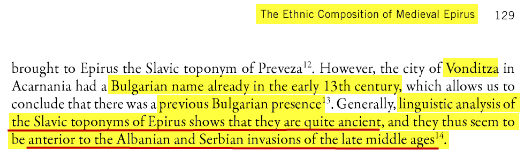
Also what do you think that happened to the previous Greek speakers that inhabited Thessaly and Epirus? In case of Slavs and Albanians massive wars, the Black Death and the plague of Justinian can largely explain, however Vlachs remain a mystery to me.
 
Last edited:


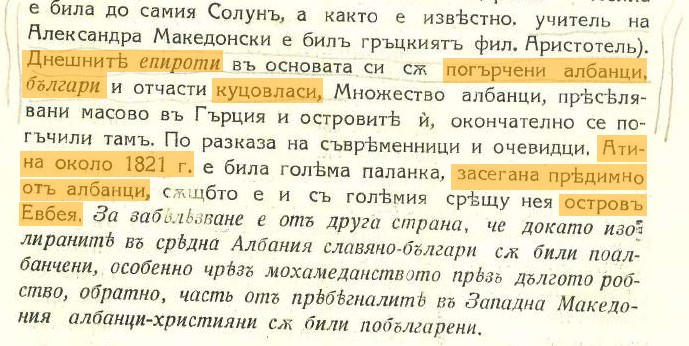
Today's Epirotes = Hellenized Albanians, Bulgarians and Vlachs.

Year 1821 = Athens and Euboea (Evia) mainly populated by Albanians.
 

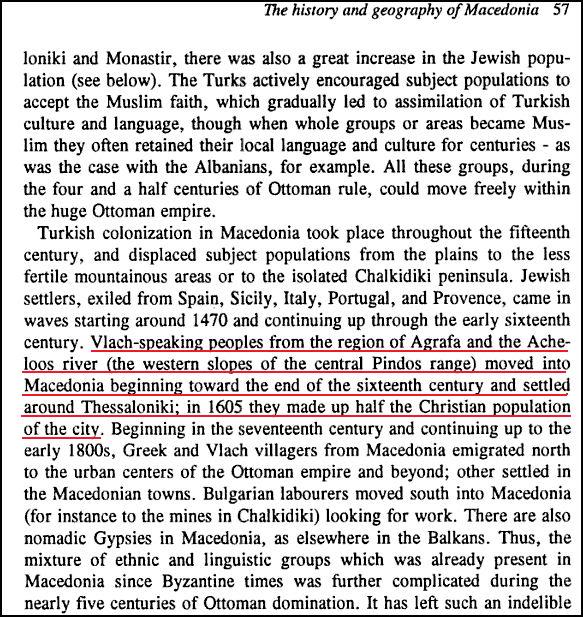
Exactly, so you can see my problem. This phrase "In 1605 AD, half of Thesaloniki's Christian population was of Vlach origin." is found in several books (including Greek ones) but it takes this extra amount of energy to find the original source and evaluate it.


Today's Epirotes = Hellenized Albanians, Bulgarians and Vlachs.

Year 1821 = Athens and Euboea (Evia) mainly populated by Albanians.

From the same book - in Bulgarian. (Some of this is not related to this thread so can be moved elsewhere.)


Summary:

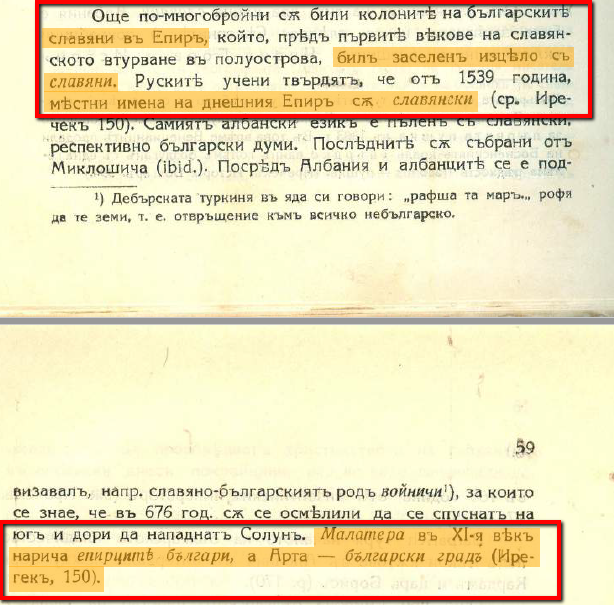
- In the 11th century Malaterra calls Epirotes Bulgarians, and Arta - Bulgarian town.
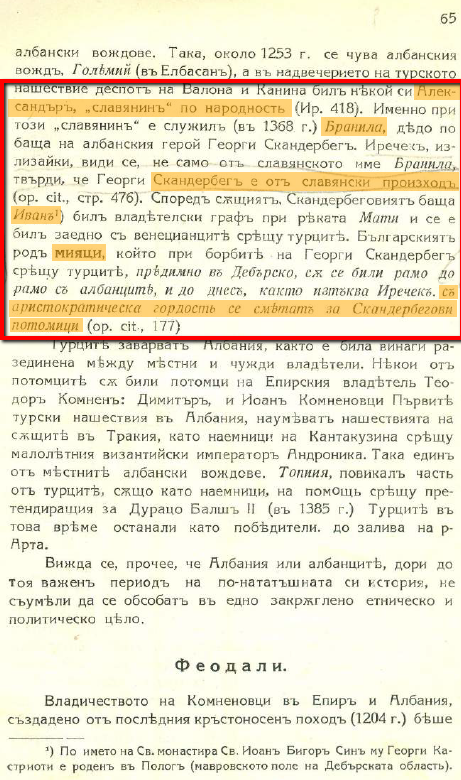
- Prior to the coming of the Turks the Despot of Avlona and Kanina was a certain Alexander, "Slav" by nationality (Aleksandar "slavianin" po narodnost). Branila served this Alexander, and Branila was grandfather (from father's line) of G. Skanderbeg. Jireček claims that G. Skanderbeg was of Slavic extraction.
- The Miyaks - Мијаци (here called a Bulgarian tribe), with aristocratic pride consider themselves as descendants of Skanderbeg.

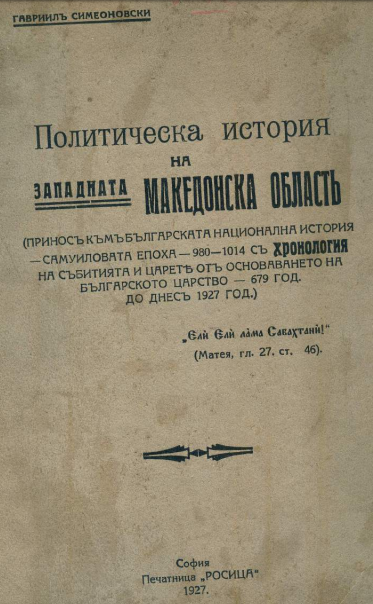
FYI - The author of this book was Gavriil Simeonovski, a native of Debar.
 
Last edited:
From the same book - in Bulgarian. (Some of this is not related to this thread so can be moved elsewhere.)


Summary:

- In the 11th century Malaterra calls Epirotes Bulgarians, and Arta - Bulgarian town.
- Prior to the coming of the Turks the Despot of Avlona and Kanina was a certain Alexander, "Slav" by nationality (Aleksandar "slavianin" po narodnost). Branila served this Alexander, and Branila was grandfather (from father's line) of G. Skanderbeg. Jireček claims that G. Skanderbeg was of Slavic extraction.
- The Miyaks - Мијаци (here called a Bulgarian tribe), with aristocratic pride consider themselves as descendants of Skanderbeg.

FYI - The author of this book was Gavriil Simeonovski, a native of Debar.


Can't find much on this Simeonovski, do you know any more?
 
The Dutch historian and geographer Olfert Dapper (1688) reports about the Arvanitic population of the islands of Salamis, Poros, and Aegina, "The inhabitants of these islands are very poor and live in poverty, as do almost all the Albanians that are scattered all over Greece" (1688: 145 f.).
 
Back
Top