• Welcome to the new Macedonian Truth Forum. All posts, members and private messages have been moved over from the old forum.

    Passwords from the old forum could not be carried over, so please use Forgot your password? to set a new one. The reset link is emailed to the address on your account.

  • Rules and Regulations at the forum of the Macedonian Truth Organisation (MTO)

    (1) The national-ethnic and cultural-linguistic identity of the Macedonian people is historically Macedonian, and derives its character from the native, indigenous and geographic homeland of the Macedonians, which is called Macedonia. To ensure that their human rights, integrity and heritage are appropriately respected, the only nouns and adjectives acceptable when reference is made to the above character and identity markers is Macedon, Macedonia, Macedonian and Macedonians.

    (2) The nation-state of the Macedonian people is the Republic of Macedonia, and is to be referred to by this official title so long as the 'republic' prefix is consistently applied to other states. Alternative references are the Macedonian Republic, or simply, Macedonia.

    (3) The 'ethnic' prefix is only acceptable for Macedonians in cases where differentiation is specifically required - so long as it is in context and consistent where it concerns its application to other ethnic groups.

    (4) Should any other differentiation be specifically required, the names of other ethnic groups that reside with Macedonians in either the Republic of Macedonia or the occupied Macedonian regions in Greece, Bulgaria, Serbia or Albania, are to be given a prefix.

    (5) Negating the identity, language and culture of the Macedonian people by deliberate avoidance of the terms Macedonia, Macedonian and Macedonians, or by any other means, is not permitted.

    (6) Systematic anti-Macedonian propaganda and rhetoric are not permitted.

    (7) Threads irrelevant to the Macedonian Cause, the community at the Macedonian Truth Organisation or the Macedonians in general may be considered as spam or not in the spirit of the forum. In such cases they are not permitted.

    (8) Continual posting of messages in threads with the sole purpose of deviating from the initial topics with the use of unrelated and unnecessary information is not permitted.

    (9) All posts, external articles, reports, etc that are cited in languages other than Macedonian or English, must be accompanied with a translation in one or both of the said languages.

    (10) Despite the possibility of some conversations and debates becoming heated, extreme abuse and/or racism, vulgar language and/or terminology, threats, revelation of personal information about others, harassment, and other such behavior will not be permitted. If deemed necessary all relevant information including member details will be reported to the appropriate authorities for investigation which may result in legal action.

    (11) Threads that are created must have a summary of a topic or excerpt of an article found in pertinent link(s) that have been included. One line threads will be considered unaccetable spam and are therefore not permitted.

    (12) Compulsive and deliberate lies, irrespective of the topic, are not permitted.

    (13) Any symbols or avatars found to be perceived as offensive to Macedonians are not permitted.

    (13) Any explicit or extreme material is not permitted.

    Failure to adhere to the above rules and regulations will result in a ban after 3 breaches. This may be reconsidered in some cases should the circumstances be of an unorthodox nature and/or require special consideration. To assure an effective deterrent against an individual or individuals with the sole purpose of causing dissent through spamming, racism or other improper means, the above rules will be strictly enforced.

    The MTO administration will monitor all discussions as reasonably practical and reserve the right to remove any post and/or member from the forum, and update the rules and regulations as required. Members are encouraged to immediately report any post and/or member to the MTO administration if they feel that these rules have not been abided by.

    The views expressed on this forum are those of the individuals. The only official representation of the MTO is made by the "Macedonian Truth Organisation (Site Owner)" username, and no other.

  • Macedonian Cause

    The Macedonian Truth Organisation calls on God in Heaven to protect, bless and guide the endeavour it is committing to undertake, and that is to work towards:

    Securing Macedonia as a free, independent and democratic republic in which sovereignty lies with the Macedonian citizens; as the nation-state of the Macedonian people in which they can preserve their culture, language and identity; as a state in which the Macedonian language and culture form the basis of public life and act as important unifying elements of Macedonian society; as the home of all its citizens to which it guarantees and obliges their inalienable natural rights and corresponding responsibilities;

    The acknowledgment as self-evident and irrefutable the existence of the:

    1) Indigenous, ethnonational name of Macedonia;
    2) Macedonian people, language and identity;
    3) Macedonian culture, symbols and folklore;
    4) Macedonian ancestry, heritage and history in its entirety; and
    5) Macedonian Orthodox Church;

    Securing recognition by the International Community of the tragedies endured by the Macedonian people, of the division of Macedonia with the signing of the Treaty of Bucharest on August 10, 1913, and the genocide committed against the Macedonian people at the hands of the Greek, Bulgarian and Serbian states and their respective churches during the 19th and 20th centuries;

    Ensuring that the Interim Accord is declared ‘null and void’ and that all constitutional provisions, acts, commitments, agreements, legislation, regulations, policies or programs emanating from, supporting or consequential to the Interim Accord are also declared ‘null and void’, including the use of any symbols and the completion of any acts imposed by, or originating from, the Interim Accord.

    Ensuring that the Framework Agreement is abolished and that all constitutional provisions, acts, commitments, agreements, legislation, regulations, policies and programs emanating from, supporting or consequential to the Framework Agreement are also abolished and replaced by a framework of constitutional and statutory law based on inalienable natural rights and corresponding responsibilities and universally codified human rights mechanisms.

    Securing the abolishment of any existing constitutional provisions, acts, agreements, legislation, regulations, policies and programs that discriminate against the Macedonian people, in any international organisation or any of the countries of the International Community where such constitutional provisions, acts, agreements, legislation, regulations, policies and programs exist, and thereby ensuring the freedom for Macedonians to exercise their inalienable natural rights and fulfil their corresponding responsibilities, and practice their culture, language and religious faiths in all the countries of the International Community without hindrance;

    The empowerment of Macedonians to undertake a moral revolution and to instil and/or reinvigorate within themselves a deep-rooted national, cultural, linguistic and historical dignity and a commitment to the exercise of freedom based on inalienable natural rights and corresponding responsibilities;

    The recognition of the Macedonian minorities in the neighbouring states of Macedonia as well as the respect for the inalienable rights and freedoms of the Macedonian minorities, as provided for by natural law and as codified by the United Nations Charter, the Universal Declaration of Human Rights and other universally codified human rights mechanisms;

    The full and unreserved respect of, and the support for, the rights of all people of non-Macedonian descent living in Macedonia and around the world, who share a reciprocal full and unreserved respect for the Macedonian people, their homeland and their state;

    The cultural unification and solidarity of the Macedonian people living in all parts of historical Macedonia and adjacent territories, as well as Macedonians throughout the world;

    The unity of all Macedonians on the principles, objectives and achievement of the Macedonian cause as defined by this declaration.

The Real Ethnic Composition of Modern Greece

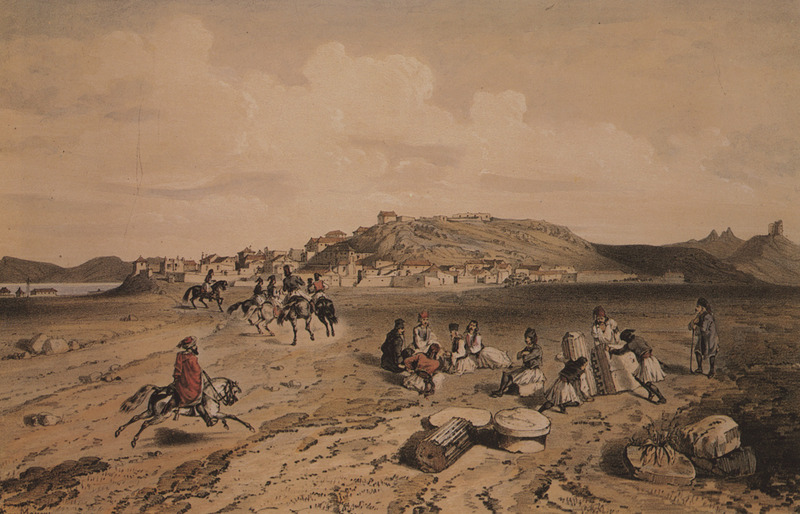
Eleusis_-_Du_Moncel_Th%C3%A9odore_-_1843.jpg

Albanians in Eleusis.
 
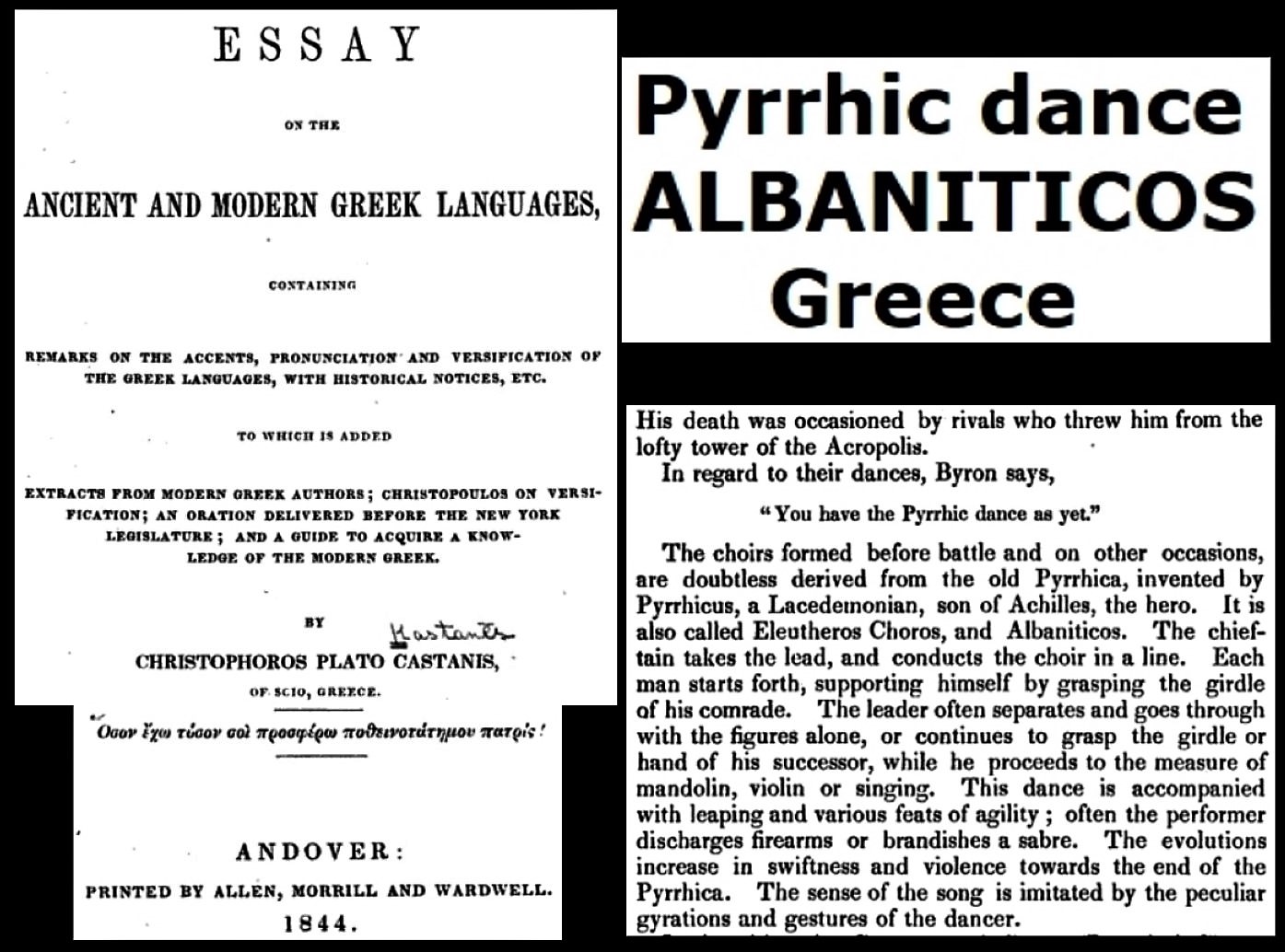
Basically what Howell is saying; is that old Greek is no longer spoken like it used to be ... well well neither is today. The Greek language that Romans used was not Doric, Ionic, Aeolic or any other native Hellenic dialect. They used Koine Greek. Which is what this is all about.

The author did not imply that there were no Greek speakers. He, however, leaves an important note that Slavonic is spoken in Epirus and Macedonia. Macedonia is an other story, but weren't Slavs in Epirus hellenized much earlier? Also did Albanians and Vlachs become the next dominant element in the religion?

Perhaps you are right, perhaps (likely) not.

How are the following two testimonies explained away?

I've already shared them before, and it applies directly to Thessaly and adjacent regions.

URL:
http://macedoniantruth.org/forum/showthread.php?p=167556

1) Anonymi Descriptio Europae orientalis. Imperium Constantinopolitanum, Albania, Serbia, Bulgaria, Ruthenia, Ungaria, Polonia, Bohemia. Anno MCCCVIII exarata. Cracoviae, 1916: As per the anonymous traveler of Eastern Europe from the XIV century, it is stated that Vlachs (whom the author calls "Blasi"), are a numerous people living between Macedonia, Achaia and Salonika.

2) Johann Thunmann, Untersuchungen uber die Geschichte der ostlichen europaischen Volker, I. Leipzig, 1774: The author states that Vlachs represent half the population of Thrace, and three quarters of inhabitants of Thessaly and Macedonia.
 
Last edited:
2) Johann Thunmann, Untersuchungen uber die Geschichte der ostlichen europaischen Volker, I. Leipzig, 1774: The author states that Vlachs represent half the population of Thrace, and three quarters of inhabitants of Thessaly and Macedonia.

3/4 of Macedonia was Vlach? Curious to know what Thunmann's definion of Macedonia was.
 
Perhaps you are right, perhaps (likely) not.

How are the following two testimonies explained away?

I've already shared them before, and it applies directly to Thessaly and adjacent regions.

URL:
http://macedoniantruth.org/forum/showthread.php?p=167556

1) Anonymi Descriptio Europae orientalis. Imperium Constantinopolitanum, Albania, Serbia, Bulgaria, Ruthenia, Ungaria, Polonia, Bohemia. Anno MCCCVIII exarata. Cracoviae, 1916: As per the anonymous traveler of Eastern Europe from the XIV century, it is stated that Vlachs (whom the author calls "Blasi"), are a numerous people living between Macedonia, Achaia and Salonika.

2) Johann Thunmann, Untersuchungen uber die Geschichte der ostlichen europaischen Volker, I. Leipzig, 1774: The author states that Vlachs represent half the population of Thrace, and three quarters of inhabitants of Thessaly and Macedonia.

I never claimed there were never (large number of) Vlachs in these regions.

https://en.wikipedia.org/wiki/Great_Vlachia

I have actually changed my mind, I now believe that Vlachs of Epirus were hellenized during 1700s mostly. I will elaborate on this later with more additional evidence which I have found.

The estimation of Johann Thunmann is interesting, I have seen this before and I wanted to ask you (before) based on what did the author made this estimation, on medieval Byzantine sources? Or did he actually visit Greece?


There's a thread on Great Wallachia/Great Vlachia/Vlach Thessaly if you care to move some info there :thumbup1:
 
I never claimed there were never (large number of) Vlachs in these regions.

https://en.wikipedia.org/wiki/Great_Vlachia

I have actually changed my mind, I now believe that Vlachs of Epirus were hellenized during 1700s mostly. I will elaborate on this later with more additional evidence which I have found.

The estimation of Johann Thunmann is interesting, I have seen this before and I wanted to ask you (before) based on what did the author made this estimation, on medieval Byzantine sources? Or did he actually visit Greece?

Ok no prob. Thanks in advance for the additional evidence you will share with us.
 
Ο σπόρος του Ρήγα βλάστησε την Εθνεγερσία του Εικοσιένα οπότε οι Βλάχοι σπεύδουν στην πρώτη γραμμή της φωτιάς από την πρώτη στιγμή. Είναι έτοιμοι από καιρό. Όταν το 1805, μετά πολιορκία 4,5 μηνών, τα στρατεύματα του Αλή Πασά καταλαμβάνουν τη Νάουσα, οι υπερασπιστές της πραγματοποιούν μια ηρωϊκή έξοδο βγαίνουν στα βουνά και καταλήγουν στον Όλυμπο. Είναι οι Βλάχοι Διαμαντής Νικολάου αρματολός της Καστανιάς, Ρομφέης από τη Σιάτιστα, Νιόπλιος από την Καστοριά και Γιάννης Φαρμάκης από το Μπλάτσι. Στον Όλυμπο συνάζονται και άλλοι Βλάχοι αρματολοί: ο θρυλικός Νικοτσάρας και οι φοβεροί Λαζέοι απ’ το Βλαχολίβαδο και την Μηλιά, ο παπα-Θύμιος Βλαχάβας από την Καλαμπάκα, ο Γεώργιος Σύρος από τα Σέρβια, ο Μπουκουβάλας από την Θεσσαλία, οι Μπιζιωταίοι από τα Χάσια και τα Σέρβια, ο Γιάννης Σταθάς από τον Βάλτο, γαμπρός του Μπουκουβάλα, οι Τζαχειλαίοι των Τεμπών. Σ’ αυτούς καταφεύγει και ο Θεόδωρος Κολοκοτρώνης μετά τον χαλασμό Κολοτρωναίων στον Μοριά. Σύντομα το 1807 ξεσπάει ένας ακόμη ρωσοτουρκικός πόλεμος και καταπλέει στο Αιγαίο η ρωσική αρμάδα υπό τον ναύαρχο Δημήτρη Σινιάβιν. Τότε οι Βλάχοι αρματολοί κατέρχονται από τον Όλυμπο και αρματώνουν επτά πειρατικά καράβια, που φέρουν τα ονόματα «Άσπρη Θάλασσα», «Κασσάνδρα», «Όλυμπος», «Βάλτος», «Μοριάς» και «Σκιάθος». Ο στόλος των κουρσάρων, με έδρα την Σκιάθο, κάνει συνεχείς καταδρομές στην Χαλκιδική μέχρι τα παράλια τείχη της Θεσσαλονίκης. Την δόξα τους τραγουδάει η λαϊκή μούσα στο Δημοτικό Τραγούδι.

Riga's seed germinated the Nation, so the Vlachs rush to the front line of fire from the first moment. They are ready for a long time. When in 1805, after a siege of 4.5 months, the troops of Ali Pasha occupy Naoussa, its defenders make a heroic exit to the mountains and end up in Mount Olympus. They are the Vlachs Diamantis Nicolaos, the Kastania armatole, the Rompheis from Siatista, Nioplios from Kastoria and Giannis Farmakis from Blatsi, etc etc. Other armatole Vlachs: the legendary Nikotsaras and the awesome Lazeoi from Vlacholivado and Milia, Papa-Thymios Vlahavas from Kalambaka, George Syros from Servia, Boukouvalas from Thessaly, the Biziataioi from Hassia and Servia, Yannis Stathas from Valtos, the Tzaheliaioi of Tempi.

URL - Λ. Σ. Μεγαλολιβαδιωτών Πάικου: “Οι Αρμάνοι στο Βασιλικόν Γένος μας και στον Ιερό Αγώνα του 1821”:
http://vlahofonoi.blogspot.ca/2017/04/1821.html#more
 
Last edited:
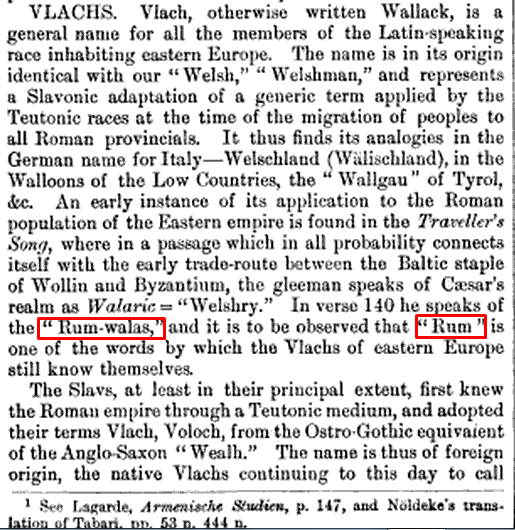
I'm far from certain and confident that we can interpret the terms ulah and rum in a manner illustrated above.

The Ottoman chancery used the term "Vlach" as an adminstrative fiscal term for pastoral clan groups performing certain services for the state, including those of military character, in exchange for tax exemptions or reductions. Since ethnic or religious identities of "Vlachs" were not a matter of the Ottoman's chancery concern, but the groups' services to the state, pastoral mode of production, and taxes they were required to pay, the term "Vlach" in the Ottoman documents might sometimes denote population that is not in a strict sense Vlach.

Similarly to the term "Vlach", the terms "Rum" or say "Yuruk" had an adminstrative meaning as well. For example, the term "Yuruk" lost its exclusive ethnic quality and became predominantly a "legal term" when it entered adminstrative use along the introduction of Yuruk kanuns in the time of Mehmed II. The terms "yurukluk" and "yurukculuk" in Ottoman adminstrative sources, denote primarily a distinctive social category, militarised status and special tax regulation.

In Ottoman documents from the 17th century, there are a group of fermans, berats and huccets, in which the term "Vlach" is COMBINED with the terms Surf/Serf ("Serb") and RUM. The second, rather ambiguous term RUM, obviously originates from the identification of the 'Byzantium' with the Eastern Roman Empire, which borrowed its name to the Ottoman possessions in the Balkans as well: Rum-ili ("Land of the Romans"), i.e. Rumelia. Vlach adoption of Orthodox Christianity, as well as Byzantine culture, tradition and heritage might led to their identification with the Byzantines as Rums, which seems to be acknowledged by the Ottomans as well. It shall be emphasised that the Rum identity was much wider than the (Assumed) Greek one, and it integrated all followers of the Orthodox Church, the institution that outlived the Byzantine Empire.

In Ottoman adminstrative use the following COMBINATIONS OF TERMS are documented (a few examples):

- Rum ve Sirf ve Eflak keferesinin ayinleri = "rites/customs of the Orthodox Christian, Serbian and Vlach unbelievers" in ferman from 1615;

- Serf ve Eflak milletinde olan rahibler = "priests in the Serbian and Vlach millet" in a berat from 1626;

- Rum ve Serf ve Eflak dinleri = "the creeds of the Orthodox Christians, Serbs and Vlachs" in huccet from 1662;

- Rum ve Sirf ve Eflak piskoposlari = "bishops of the Orthodox Christians, Serbs and Vlachs" in ferman from 1669;

- Rum ve Sirf ve Eflak keferesi patrikleri = "patriarchs of the Orthodox Christian, Serb and Vlach infidels" in huccet of 1688, etc.

The use of multiple names - RUM, SIRF/SERF and EFLAK - however, does not necessarily mean the existence of three distinct identities/ethnicities at the given date, but probably reflects other/earlier realities and/or socio-economic categories. Interestingly, all citations / examples provided above are largely from the regions of Bosnia/Herzegovina (but apply elsewhere throughout the Balkans) - so one would be rather foolish in this case here to assert and argue that the term RUM had ethnic and/or linguistic meaning and value (i.e. = Greek).

Another curious fact, unrelated perhaps, is that Bosnian Franciscan writers and chroniclers in the 17th and 18th centuries did not use the "ethnonym" Serbs to denote the Orthodox Christians in Bosnia but, apart from polemical "schismatics" or "Old believers", most widely employed the term "VLACHS" (VLASI). For example, the 18th century Franciscan chronicler Nikola Lashvanin depicted attempts of the Serbian Orthodox Christian patriarch to collect taxes from the Catholics and allegedly convert them to the Orthodox Christianity, as "VLACHIZATION". So, why did the Bosnian Franciscans, as indigenous people that were usually well aware of local particularities, not use the term "Serb" in the period when it was widely in use by the Orthodox clergy and even Ottoman chancery, but preferred terms "Vlach" in general or "GREEK" (Grk) and "schismatic Greek patriarch" (Scismaticus Patriarca Graecus) when referring to the patriarch or higher clergy? Note - the traditional use of the term "GREEK" in the meaning of "Orthodox Christian" in the Western Christendom corresponded to the use of the term "Rum" in the Ottoman case.

Despite the irrelevance of ethnic origin on the adminstrative definition of Vlach status, its general significance should not be overlooked. I will reiterate the point here one more time that the term "Rum" is perhaps the most ambiguous term in terms of usage, and largely denoted "Orthodox Christians" (perhaps "Romans" in a national-religious sense).

As a result, I would be rather cautious interpreting the terms as you have - or as your source did (since we don't have the full context), even if we are talking about Thessaly.

My source for all of the above is:

Being an Ottoman Vlach: On Vlach Identity (Ies), Role and Status in Western Parts of the Ottoman Balkans (15th - 18th centuries) by Vjeran Kursar.

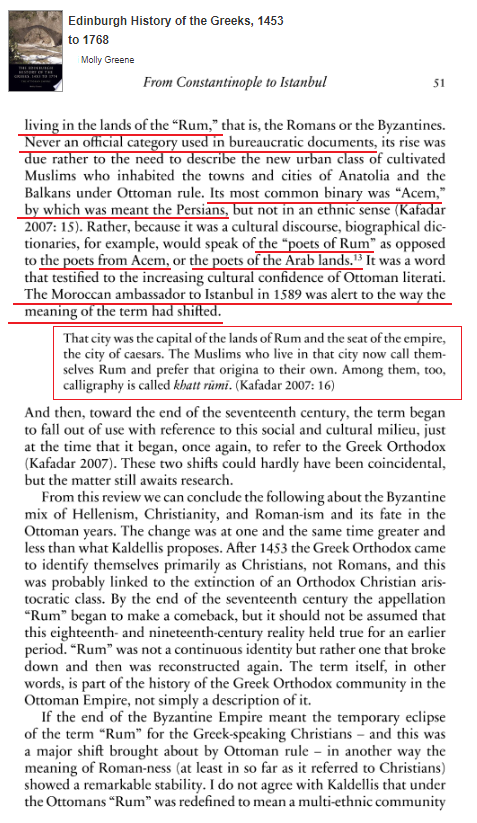
One more thing regarding the term "Rum" - note that the Morrocan ambassador to Istanbul in 1589 reported that the "Muslims who live in that city now call themselves Rum and prefer that origina to their own. Among them, too, calligraphy is called khatt rumi."

How then did these Muslims use and understand the term RUM? What did the term RUM mean in 1589 Instanbul? Why / how would we assume that the term RUM in this specific context meant Greeks (or association with the Greek language), i.e. that these Muslims actually called themselves Greeks? Could we make that leap of faith? Why would we - as it clearly states in the same quote that Istanbul was the city of caesars (Roman Caesars), capital of the Lands of Rum (Roman Lands)?

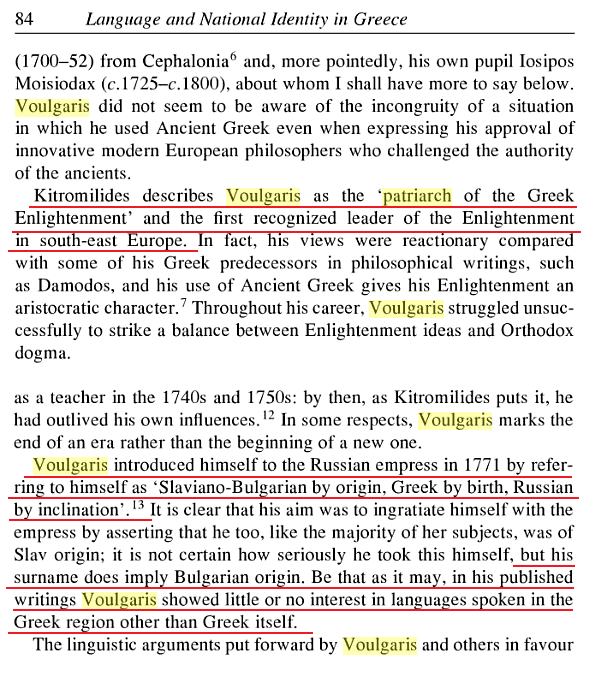
Here is a screenshot where the quote comes from - perhaps the entire page is worth a read (this does not mean / imply that I agree 100% with the views expressed below).


PS:
In the early Islamic sources, Bilad al-Rum (countries of Rum) meant "Byzantine" territory, and Muslim scholars such as Bukhari, Tabari, and Masudi referred to these lands as “Rum.” The natural frontier of Bilad al-Rum was defined by the Taurus Mountains and the Euphrates. The term began to be applied to the Seljuks in Anatolia, who were called Selçukiyan-ı Rum, setting them apart from the Seljuks in Baghdad. For the Ottomans, the term was used to refer to, among other meanings, the country that they inhabited, Memleket-i Rum (the country of Rum). <-- From Zeynep Aydoğan.


R U M = V L A C H S
 
1) URL:
https://www.freeinquiry.gr/single-post.php?id=4192

- Constantine IX Monomachos (11th century). Alexios Komninos (12th century). Theodore II Laskaris (13th century)... All of them wear non-Greek attire and are called kings of the Romans. This is where the name “Romios” (Roman) is derived from. It means a subject of the Eastern Roman Empire.

- The inhabitants of Modern Greece had called themselves “Romios” (“Romioi”-plural) for many centuries. In other words, they considered themselves Romans and not Greeks. The word “Greek” began to be used ─in parallel with the word "Romios"─ in the last two centuries when the notion of nationalism was born in the Balkan Peninsula. It served as a description of the Christian - contemporary inhabitants of Greece.

- The Byzantine Empire, that modern Greeks wish to consider as “Hellenic” (a continuation of the ancient Greek world), also referred to as the Eastern Roman Empire. It was the continuation of the Roman Empire in the East and that lasted up until Late Antiquity and the Middle Ages. In reality, Byzantium was a multi-ethnic hard core orthodox Christian territory ruled by the Church, the Emperor and his visible or invisible court members. None of the Byzantine emperors was Greek in origin. Sciences, philosophy and democratic ideals were not only forbidden but also condemned. In 529 C.E, emperor Justinian closed Platoʼs famous Academy of Athens. The Byzantine era can be characterized by stagnation, political intrigues, treachery, conspiracies, corruption and great luxury.

- The majority of modern Greeks today traces its origin from the mixture of Albanians, Wallachians, Northern Africans and Anatolians who had infested the land of Greece back then along with Slavs and some Francs and Venetians. Unfortunately even today, most modern Greeks are oblivious to their true historic and genetic origin. They think that they are the offsprings of ancient Greeks who suddenly saw the “light” and became Christians. Quite the opposite is true; they were Christians who were made to believe that their ancestors were the ancient Greeks. (Yiannis Lazaris: “The unknown 1821 - The apostasy of Romioi”, ed. “Dromon”, Athens, 2016). The same applies of course for almost every country. There is no racial purity anywhere.

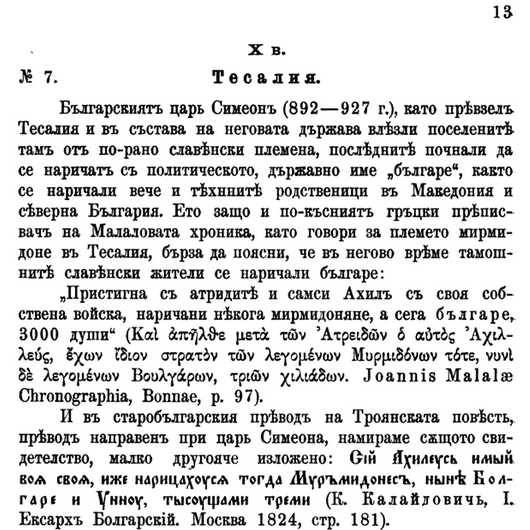
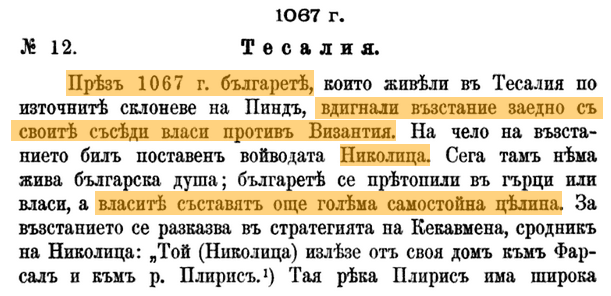
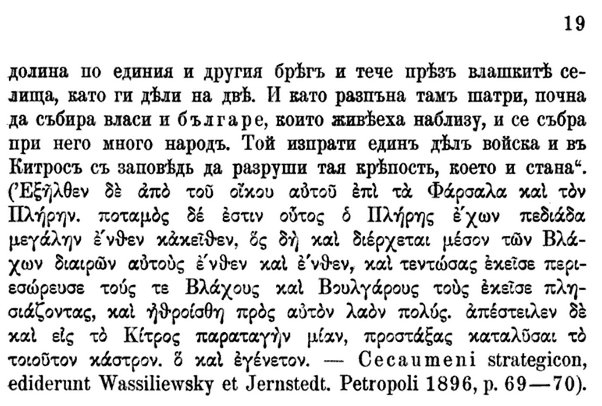
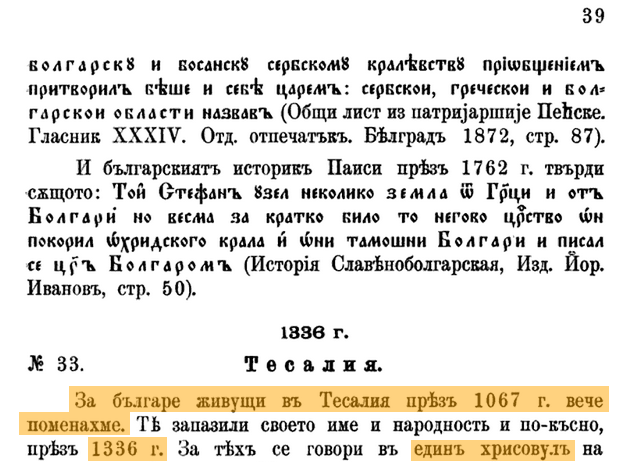
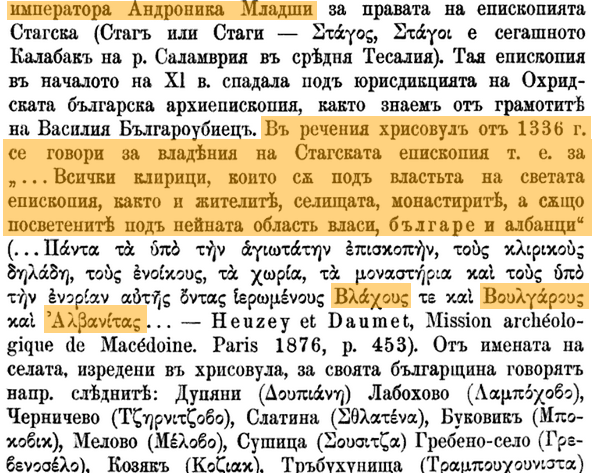
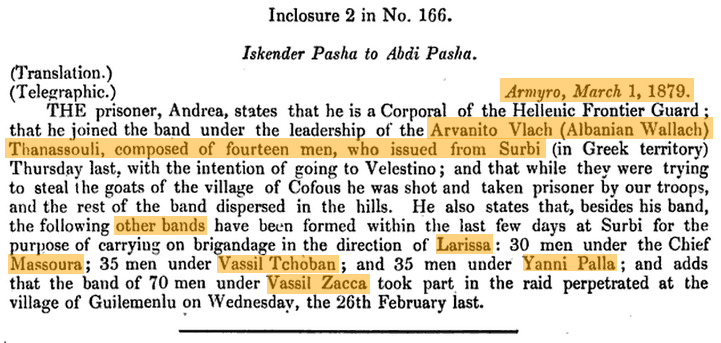
2) Slavs/Bulgarians, Vlachs and Albanians in Thessaly - from chrysobull dated 1336. (Some would have us believe that this was not the case elsewhere throughout Thessaly, but applied only to a tiny area -- and yes, these three different ethnicities packed themselves into and crammed one small area only.)

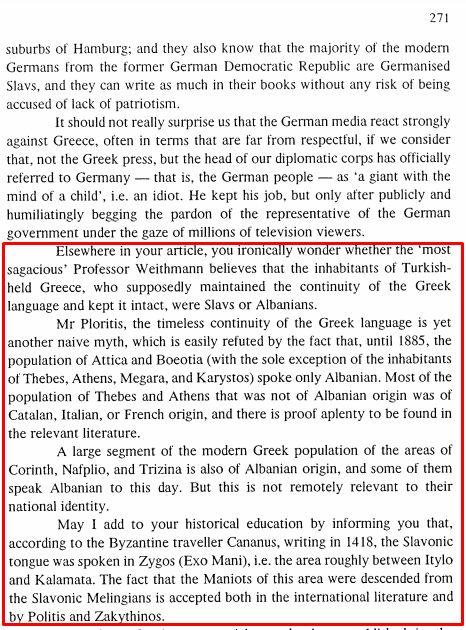
The following comes from a Bulgarian book and point of view. The relevant pages are below. It is in Bulgarian, I can translate but will need time of course. The title page is given below as well. I have highlighted the most interesting parts.


3)

 
Last edited:
1) The Edinburgh History of the Greeks, c. 500 to 1500, by Florin Curta

Page 288 and Page 289 quotes/summaries:
- 'Kapheroi, Thrakesians, Armenians, and others from different places and cities' settled in Peloponnesos in the early ninth century, while Armenians 'and other rabble' came to Crete in the aftermath of the island's conquest in 961.
- The Kapheroi may well have been converted Arabs from the eastern frontier of the Empire.

2) The Crusades from the Perspective of Byzantium and the Muslim World, edited by Angeliki E. Laiou, Roy P. Mottahedeh.

Page 204, footnote 42:
- Some 2,000 Armenians were settled in Crete in 1363.
 
Additional book by G. Nakratzas. Will it be translated into english?

ΗΠΕΙΡΟΣ - ΝΟΤΙΑ ΕΛΛΑΔΑ Η ΣΤΕΝΗ ΕΘΝΟΛΟΓΙΚΗ ΣΥΓΓΕΝΕΙΑ ΤΩΝ ΣΗΜΕΡΙΝΩΝ ΕΛΛΗΝΩΝ, ΒΟΥΛΓΑΡΩΝ ΚΑΙ ΤΟΥΡΚΩΝ

EPIRUS - SOUTH GREECE THE STRONG ETHNOLOGICAL AFFINITY OF THE CURRENT GREEKS, BULGARIANS AND TURKS

The book seems to contain separate chapters and material on:
- Attica
- Boeotia
- Thessaly
- Morea, and other regions

https://www.politeianet.gr/books/97...-georgios-mpatabia-ipeiros-notia-ellada-19017
 
Bavarian Establishment Of The Modern Greek Army 1832 - History Of Europe

The Bavarian Expedition To Greece – King Otto Of Greece
By: Spiro De Castro Leon
Date: Tuesday, January 17th, 2012
Creation Of Greek State & Military By The Bavarians 1833-1865
Political Perspective

Modern Greece is a country born out of a mixture of regional ethnicities, mostly huddled under the banner of the Greek Orthodox Christian Church (often a flag of convenience for Jews in Turkey) and therefore describing themselves as 'Greek'.

European powers including Russia, Britain, Germany, Austria-Hungary, France and Italy, desired the demise of the troublesome Ottoman Empire and supported its breakup into independent countries, along ethnic-cultural lines, a rare instance of western European agreement, one of these newly created countries was modern Greece.

The consensus figure to become King Of Greece, and create the structures of an independent Greek state, was Prince Otto, Bavarian (German) King Ludwig's second son.

With money borrowed from the British Government and the illustrious Jewish banking family of Rothschild, an expedition of Bavarian buraeucrats and palace officials plus a Bavarian military expedition force of 3500 men was created as the initial army of Greece, these were dispatched in 1835 to Greece together with prince Otto as the new king of Greece

Brief Historical Perspective

Following the revolt against the Ottoman Turkish rule by (the Vassal administrator) Ali Pasha of Janina (now in modern Greece), Morea, Rumelia, and Thessaly also revolted in 1821, this was met with extreme cruelty by the Turks, the Greeks received no help from Europe or Russia, however numerous associations sprung up in northern Europe with the aim of helping Greece. One of those formed in Munich, the capital of Bavaria, led by the philologist and pedagogue (teacher) Thiersch.

In vain the pragmatic Metternich tried to argue with them that modern Greeks were not the Greeks of antiquity but a mixture of Albanians, Slavs, and other elements, the liberal romanticists like King Ludwig of Bavaria saw in Greeks the descendants of ancient Greeks who brought human culture to its highest perfection.

View/read the entire article here:

http://www.valueforless.com/cohila/...ishment-modern-greek-army-1832-history-europe

Repost - I posted this long time ago.
 
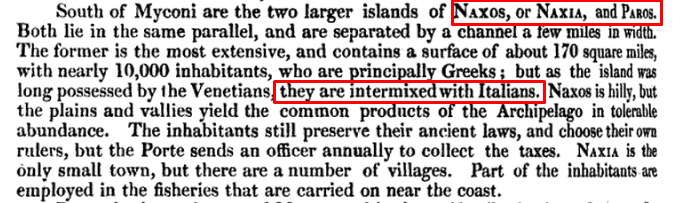
2) Euboea or Evia

"The ethnic Greek population is descended from Arvanites and Vlachs, who have lived in Euboea since the early Middle Ages."

http://www.landscapes.gr/evia.html

Any data on northern Euboea? According to Hammond, Euboea's Christian population was almost entirely Albanian in 17th century (citing Randolph writings during his trip on Greece). One-third of Euboea was Albanian in early 19th century.
 
Indian and Turkish ...Greek Music

Greek songs are pure copies of Indian, Turkish, and other songs. Refugee-born and devoid of musical education, Stellios Kazantizidis, pioneered such replicas and filled Greece with Madhubala, Ninaani, and many other eastern counterparts in both lyrics and music songs.

Madhubala, for example, was a real person, a Hindu actress and the homonymous song, which was later written by Stellios Kazantizidis, exists in an old Indian film. See below video.

The Indian ...Greek music - URL:
https://www.youtube.com/watch?time_continue=53&v=KWJeceJ0hXw

Article: When India Conquered Greece: Hindi Films of the 50s in Greece, By Dr. Helen Abadzi
http://www.soundofindia.com/showarticle.asp?in_article_id=1096044732

- As the above article implies, the transformed songs had a big problem: plagiarism. With few exceptions, the songs appeared as creations of at least 26 Greek musicians. The copying was systematic. Some musicians copied some songs on reel tape recorders directly from movie theaters, and in other cases, music companies ordered records from India and distributed them to willing people for copying. The names of Naushad Ali, Shankar-Jaikishan, and Chitalkar Ramachandra were never heard in Greece.

- During that same period, many Turkish and Arabic songs were also copied and expropriated through acquisition of records and radio programs. (The Turkish and Arabic movies never achieved the prominence of their Hindi counterparts.) Although this tendency was generally known, it was not considered very important; copies from neighboring countries could be explained away as originally Greek or as legitimate heritage of the refugees.

Greece fell in love with Nargis and Madhubala in the 1950s – and is still singing songs of love
https://scroll.in/article/811860/gr...-the-1950s-and-are-still-singing-not-in-hindi
 
Last edited:
This is an interesting topic in a wrong thread. Actually the problem was not having a cover version and these were not cases of plagiarism. It's just that in the 50s, 60s and even the 70s the crediting rules and mentality was not the same and I'm pretty sure you have to blame the record companies and not the composers like Kaldaras and Kazantzidis who are actually really major Greek composers.

These Indian songs are still officially credited to the Greek "composers" and I have personally tried to change this but it weirdly hasn't changed yet, when the real composer is obviously the Indian duo Shankar-Jaikishan. The three songs given in the link are the three most famous cases known in Greece as "Afti i Nyhta Menei", "Oso Axizeis Esy" and "Ligo Ligo Tha Me Synithiseis".
 
Back
Top