• Welcome to the new Macedonian Truth Forum. All posts, members and private messages have been moved over from the old forum.

    Passwords from the old forum could not be carried over, so please use Forgot your password? to set a new one. The reset link is emailed to the address on your account.

  • Rules and Regulations at the forum of the Macedonian Truth Organisation (MTO)

    (1) The national-ethnic and cultural-linguistic identity of the Macedonian people is historically Macedonian, and derives its character from the native, indigenous and geographic homeland of the Macedonians, which is called Macedonia. To ensure that their human rights, integrity and heritage are appropriately respected, the only nouns and adjectives acceptable when reference is made to the above character and identity markers is Macedon, Macedonia, Macedonian and Macedonians.

    (2) The nation-state of the Macedonian people is the Republic of Macedonia, and is to be referred to by this official title so long as the 'republic' prefix is consistently applied to other states. Alternative references are the Macedonian Republic, or simply, Macedonia.

    (3) The 'ethnic' prefix is only acceptable for Macedonians in cases where differentiation is specifically required - so long as it is in context and consistent where it concerns its application to other ethnic groups.

    (4) Should any other differentiation be specifically required, the names of other ethnic groups that reside with Macedonians in either the Republic of Macedonia or the occupied Macedonian regions in Greece, Bulgaria, Serbia or Albania, are to be given a prefix.

    (5) Negating the identity, language and culture of the Macedonian people by deliberate avoidance of the terms Macedonia, Macedonian and Macedonians, or by any other means, is not permitted.

    (6) Systematic anti-Macedonian propaganda and rhetoric are not permitted.

    (7) Threads irrelevant to the Macedonian Cause, the community at the Macedonian Truth Organisation or the Macedonians in general may be considered as spam or not in the spirit of the forum. In such cases they are not permitted.

    (8) Continual posting of messages in threads with the sole purpose of deviating from the initial topics with the use of unrelated and unnecessary information is not permitted.

    (9) All posts, external articles, reports, etc that are cited in languages other than Macedonian or English, must be accompanied with a translation in one or both of the said languages.

    (10) Despite the possibility of some conversations and debates becoming heated, extreme abuse and/or racism, vulgar language and/or terminology, threats, revelation of personal information about others, harassment, and other such behavior will not be permitted. If deemed necessary all relevant information including member details will be reported to the appropriate authorities for investigation which may result in legal action.

    (11) Threads that are created must have a summary of a topic or excerpt of an article found in pertinent link(s) that have been included. One line threads will be considered unaccetable spam and are therefore not permitted.

    (12) Compulsive and deliberate lies, irrespective of the topic, are not permitted.

    (13) Any symbols or avatars found to be perceived as offensive to Macedonians are not permitted.

    (13) Any explicit or extreme material is not permitted.

    Failure to adhere to the above rules and regulations will result in a ban after 3 breaches. This may be reconsidered in some cases should the circumstances be of an unorthodox nature and/or require special consideration. To assure an effective deterrent against an individual or individuals with the sole purpose of causing dissent through spamming, racism or other improper means, the above rules will be strictly enforced.

    The MTO administration will monitor all discussions as reasonably practical and reserve the right to remove any post and/or member from the forum, and update the rules and regulations as required. Members are encouraged to immediately report any post and/or member to the MTO administration if they feel that these rules have not been abided by.

    The views expressed on this forum are those of the individuals. The only official representation of the MTO is made by the "Macedonian Truth Organisation (Site Owner)" username, and no other.

  • Macedonian Cause

    The Macedonian Truth Organisation calls on God in Heaven to protect, bless and guide the endeavour it is committing to undertake, and that is to work towards:

    Securing Macedonia as a free, independent and democratic republic in which sovereignty lies with the Macedonian citizens; as the nation-state of the Macedonian people in which they can preserve their culture, language and identity; as a state in which the Macedonian language and culture form the basis of public life and act as important unifying elements of Macedonian society; as the home of all its citizens to which it guarantees and obliges their inalienable natural rights and corresponding responsibilities;

    The acknowledgment as self-evident and irrefutable the existence of the:

    1) Indigenous, ethnonational name of Macedonia;
    2) Macedonian people, language and identity;
    3) Macedonian culture, symbols and folklore;
    4) Macedonian ancestry, heritage and history in its entirety; and
    5) Macedonian Orthodox Church;

    Securing recognition by the International Community of the tragedies endured by the Macedonian people, of the division of Macedonia with the signing of the Treaty of Bucharest on August 10, 1913, and the genocide committed against the Macedonian people at the hands of the Greek, Bulgarian and Serbian states and their respective churches during the 19th and 20th centuries;

    Ensuring that the Interim Accord is declared ‘null and void’ and that all constitutional provisions, acts, commitments, agreements, legislation, regulations, policies or programs emanating from, supporting or consequential to the Interim Accord are also declared ‘null and void’, including the use of any symbols and the completion of any acts imposed by, or originating from, the Interim Accord.

    Ensuring that the Framework Agreement is abolished and that all constitutional provisions, acts, commitments, agreements, legislation, regulations, policies and programs emanating from, supporting or consequential to the Framework Agreement are also abolished and replaced by a framework of constitutional and statutory law based on inalienable natural rights and corresponding responsibilities and universally codified human rights mechanisms.

    Securing the abolishment of any existing constitutional provisions, acts, agreements, legislation, regulations, policies and programs that discriminate against the Macedonian people, in any international organisation or any of the countries of the International Community where such constitutional provisions, acts, agreements, legislation, regulations, policies and programs exist, and thereby ensuring the freedom for Macedonians to exercise their inalienable natural rights and fulfil their corresponding responsibilities, and practice their culture, language and religious faiths in all the countries of the International Community without hindrance;

    The empowerment of Macedonians to undertake a moral revolution and to instil and/or reinvigorate within themselves a deep-rooted national, cultural, linguistic and historical dignity and a commitment to the exercise of freedom based on inalienable natural rights and corresponding responsibilities;

    The recognition of the Macedonian minorities in the neighbouring states of Macedonia as well as the respect for the inalienable rights and freedoms of the Macedonian minorities, as provided for by natural law and as codified by the United Nations Charter, the Universal Declaration of Human Rights and other universally codified human rights mechanisms;

    The full and unreserved respect of, and the support for, the rights of all people of non-Macedonian descent living in Macedonia and around the world, who share a reciprocal full and unreserved respect for the Macedonian people, their homeland and their state;

    The cultural unification and solidarity of the Macedonian people living in all parts of historical Macedonia and adjacent territories, as well as Macedonians throughout the world;

    The unity of all Macedonians on the principles, objectives and achievement of the Macedonian cause as defined by this declaration.

The Real Ethnic Composition of Modern Greece

Err these are not simply "genes" but a collections of DNA markers which are grouped according to some criteria.

Myheritage's so called "Balkan" group does not sound really Balkan either, given it's really common for Slovenians, Romanians and Slovakians. Also going by your logic the "Balkan" group should probably be "Slovenian", as it is the most prevalent in Slovenians.

Also given that only 19.1% of Turks have an affiliation to this "Greek" group makes it sound like these markers are related to Paleo Balkan people mixed with other people whom settled in the Balkans (Slavs, Vlachs, ect). I'd assume many people in RoM and Albania will also belong to this "Greek" group.
 
I don’t really know if it would be fair to understand the Balkan marker as ancient Thracian or Thraco-Illyrian. It seems to be Paleo-Balkan and not Greek.

I also suspect “Eastern European” is for Slavic, though something seems to be wrong with Hungary.

19% Greek in Turkey seems correct, as Turkey is a very big country and extends very far to the East. The West-Asian marker seems to describe Anatolian-Persian people which is most of Turkey’s population.

I don’t really know how these markers or genes work but they seem to match with the situation. Example: One of my grandmothers comes from the Aegean coast of Asia Minor, i.e. the borderline of “Greek” and “West Asia” marker. Thus, before getting my results I would bet-expect one of these two or a combination. Let’s wait and see.
 
I promise to try everything especially if I don’t like the results.

This is another DNA results video from a different company (didn’t get the name). A beautiful black girl who knows she’s 100% Ethiopian, yet very light-color skinned finds out she’s 2/3 African and 1/3 Arab.

In 8:30-9:30 there’s something interesting. The company provides full (weighted) DNA makeup per country (in % percentages) which is what my-heritage-DNA doesn’t give though it’s mathematically simple.

https://www.youtube.com/watch?v=4a7Z8Q43cfw
 
I moved this here:

Balkan is a classification specifically made by MyHeritage to denote South Slavic ancestry, which is a combination of incoming Slavic tribes in the Early Middle Ages, and assimilated Thracians, Illyrians, Dacians etc. Since Albanians are a Paleo-Balkanic people without (major) Slavic ancestry.. they do not score this in great amounts. Matter of fact, I have seen Greeks score more of this, especially northern Greeks score around 30% Balkan, than Albanians.


My impression is that Balkan stands for Ancient Thracians (and Illyrians maybe), not for Slavs. A Northern Greek having 30% Balkan seems normal. I’m 50% Northern Greek (Macedonian & Thracian) let’s see how much Balkan I will score.

That's it. No other classification than 'Greek', a fellow Paleo-Balkanic ethnic group, that makes the slightest sense for Albanians to score in their results. It does not matter whether it is South or north, Tosk or Gheg Albanians we are speaking of, they score 'Greek' because that is the only ethnic group in MyHeritage's database genetically closest to them. It has nothing to do with Tosks having some Greek ancestors, Kosovars also score loads of 'Greek' and often even more than actual Greeks.


That’s an interesting DNA classification problem. My understanding is that Albanians, a separate people, with a separate language and NO brotherly populations SHOULD have some major differences in their DNA. One company cannot separate Greeks from Italians another company seems to achieve this successfully. I knew all Scandinavians are one people but I’m impressed no company can separate German and French people.

My father took a Myheritage DNA test, he is both Kosovar and Greek, and he turned out to be 67.1% 'Greek'. His Greek side is from the Peleponnese and northern Greece, where the people do have quite some foreign admixture thus if he were only Greek he would not score more than 60% Greek, and his Albanian side is obviously from Kosovo, a region with absolutely no historical Greek population. A Gheg (northern) Albanian I met on the internet showed his results and they said he is 94% Greek.


These are not the strangest results. Overall Albanian results do not exist yet, so I don’t know what Albanians would expect as normal.

'Greek' includes the descendants of other Paleo-Balkanic peoples with little Slavic ancestry, so does it include many west Anatolian ancient nations such as Carians, Lydians, Lycians, Mysians, Bithynians etc. It is a big mistake for companies to call the classification they make for the Greek people 'Greek' if they do not make seperate additional classifications to represent Albanians and ancient Anatolian ancestry, who otherwise just fall under the ‘Greek’ section. Thus one should take their results with a grain of salt.


I believe Slavs are clustered in the “Eastern Europe” category and most of the other people in “West Asia”

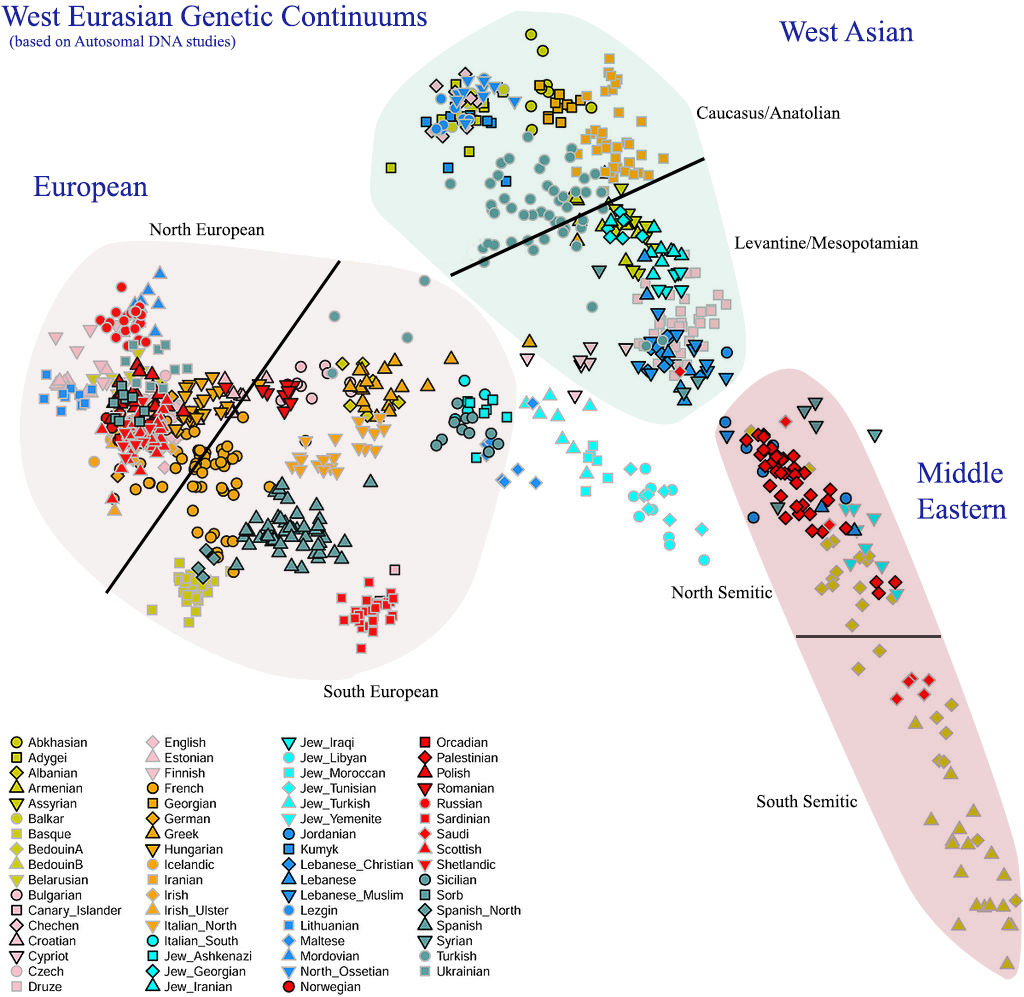
Look at Albanians and mainland Greeks:

pb7Osaw.png


They barely differ. Illyrians, Thracians, Italians and Hellenes did not have a major genetic distance. Similar to north Germans and Dutch.
There is no ''Greek'' gene or ''Thracian'' gene.
 
Everything seems normal in this diagram, but you have to understand that every dot is simply ONE person and the DNA cmpanies utilize much more info than two indices. Having said that, this diagram DOES separate Germans and French.
 
DNA companies utilize much more info than two indices

Pretty sure the above is Principle Component Analysis. There could be 100's of variables involved which they project into to a 2D plane (like the one above). So you're right that each dot represents one person, but I'm sure there is much more information involved than two variables.
 
Everything seems normal in this diagram, but you have to understand that every dot is simply ONE person and the DNA cmpanies utilize much more info than two indices. Having said that, this diagram DOES separate Germans and French.

Academic PCA works are MUCH more accurate. Other than the fact that it can be influenced by political agenda.

Besides when you said that it is normal for Albanians to score ''Greek'' (not that it bothers me) did you mean Greek literally?

Autosomal DNA cannot tell you are Greek or Italian in percentage. It can tell you that you are GENETICALLY close to Greeks or that you had some cousins in Greece in the past 200-300 years, but it ends there.

This Cypriot guys scores more than 50% Greek:
Gedmatch.com Eurogenes K13 Results:
# Population (source) Distance
1 Cyprian 5.9
2 Lebanese_Muslim 9.67
3 Sephardic_Jewish 10.2
4 Algerian_Jewish 10.35
5 South_Italian 10.71
6 Tunisian_Jewish 10.73
7 Italian_Jewish 11.3
8 Syrian 11.5
9 Ashkenazi 11.55
10 Libyan_Jewish 11.66
11 East_Sicilian 11.69
12 Central_Greek 12.18
13 Samaritan 13.19
14 Lebanese_Christian 13.75
15 Turkish 14.12
16 Lebanese_Druze 14.52
17 Jordanian 15.08
18 Assyrian 15.64
19 Palestinian 15.78
20 Italian_Abruzzo 16.04

He is closer to Lebanese than Italians.
 
Last edited:
Basically what Howell is saying; is that old Greek is no longer spoken like it used to be ... well well neither is today. The Greek language that Romans used was not Doric, Ionic, Aeolic or any other native Hellenic dialect. They used Koine Greek. Which is what this is all about.

The author did not imply that there were no Greek speakers. He, however, leaves an important note that Slavonic is spoken in Epirus and Macedonia. Macedonia is an other story, but weren't Slavs in Epirus hellenized much earlier? Also did Albanians and Vlachs become the next dominant element in the region?

*Region not religion. Grammar mistake.
 
- Vlach villages of Karpenissi, lingustically Hellenized (abandoned Vlach)
- Vlach villages of Agrafa, linguistically Hellenized (abandoned Vlach)
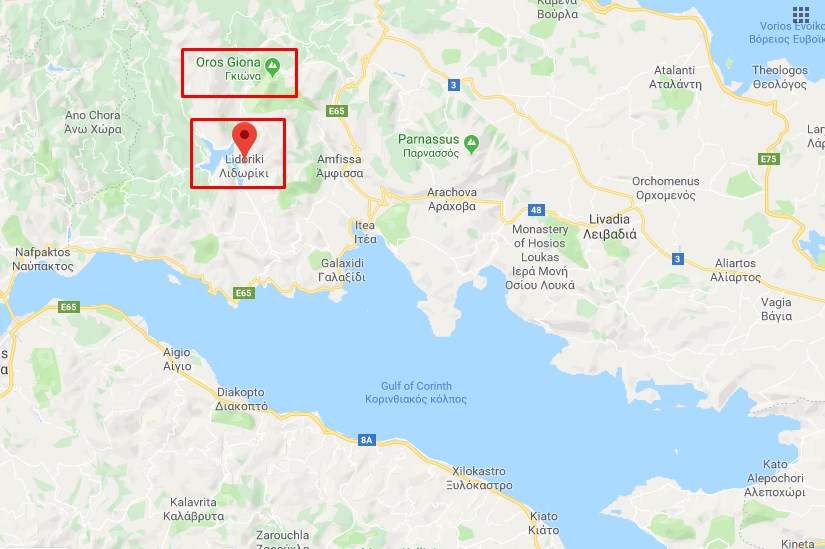
- Vlach villages of Gkiona, Lidoriki, Karoutes, Sykia, etc. linguistically Hellenized (abandoned Vlach) starting from the 18th century

DNxNB5i.jpg


- Vlach villages of Mount Oeta, Ypati areas linguistically Hellenized (abandoned Vlach) starting from the 18th century
- Vlach villages of Artotina, Mousounitsa, Kostarsa, Paliokatouna, etc. linguistically Hellenized (abandoned Vlach)

CMlgdIV.jpg


From the book oi ellinovlachoi (armanoi) by giorgis exarchos - pages 157 and 158.
 
Last edited:
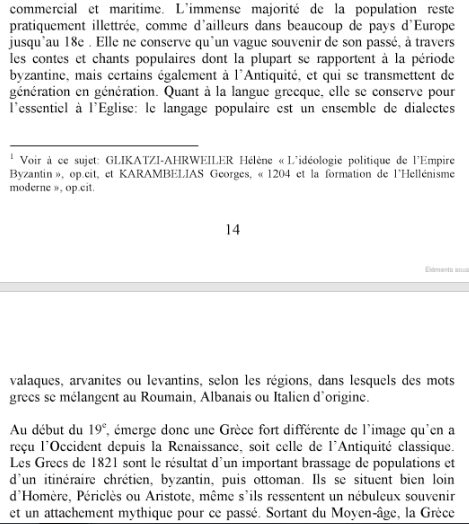
Histoire de la Grèce moderne, 1828-2012: mythes et réalités - Pages 14 and 15, by Nicolas Bloudanis.

URL:
https://books.google.ca/books?id=9Z...oderne, 1828-2012: mythes et réalités&f=false

AljVm6u.jpg

5taZvq7.jpg


Pg. 14 top:

The populations of the Greek space thus keep their own traditions, a mixture of Christianized Hellenism and cultures and languages specific to each ethnic group, mainly Albanian, Vlach and Latin (Italian). The whole Christian population, including the Balkan Slavs, is the "Rum millet", the "Roman Nation", in fact "Greek".

Pg. 14 bottom/Pg. 15 top:

The immense majority of the population remains practically illiterate, as indeed in many countries of Europe until the 18th century. The population retains only a vague memory of its past, through folk tales and songs, most of which relate to the Byzantine period, but some also to antiquity, and which are transmitted from generation to generation.

As for the Greek language, it is conserved essentially in the Church: the popular language is a set of dialects: Vlach, Arvanite or Levantine, according to the regions, in which Greek words are mixed with Romanian, Albanian or Italian.

At the beginning of the 19th century, there emerges a Greece very different from the image that the West has received since the Renaissance, that of classical Antiquity. The Greeks of 1821 are the result of an important brewing of populations and a path that is Christian, Byzantine, then Ottoman. They are a long way from Homer, Pericles or Aristotle, even if they feel a nebulous memory and a mythical attachment for this past.

This is really interesting. What is Levantine? Never heard of it.
 
This is really interesting. What is Levantine? Never heard of it.

I may be mistaken, but I think that Levantine is a term applied to the Catholic populations of various medieval states. These included the Crusader states, the Latin Empire, the possessions of Venice, the late Byzantium, and later the Ottoman Empire. Nowadays the term is sometimes used to refer to their descendants residing in Turkey and the Middle East.

"Levantines were mostly of Italian (especially Venetian and Genoese), French, or other Euro-Mediterranean origin."

URL:
https://en.wikipedia.org/wiki/Latin_Church_in_the_Middle_East

In the French version of the same wikipedia page, I found this:

Nowadays in Turkey, the term "Levantine" refers only to Turkish nationals of Western origin. Their surnames were adapted during the writing reforms (1928). In Istanbul there are still large Levantine families, generally French-speaking: Alyont (Alléon), Baltacı (Baltazzi), Bastiyon (Bastion), Boduyi (Baudouy), Dandriya (D'Andria), Döhoşpiye (De Hochepied), Glavani (Glavany), Jiro (Giraud), Kaporal (Caporal), Kasanova (Casanova), Kastelli (Castelli), Korpi (Corpi), Krepen (Crespin), Kuto (Coûteaux), Lombardi, Marmara, Tomaselli... ... etc.
 
Last edited:
I may be mistaken, but I think that Levantine is a term applied to the Catholic populations of various medieval states. These included the Crusader states, the Latin Empire, the possessions of Venice, the late Byzantium, and later the Ottoman Empire. Nowadays the term is sometimes used to refer to their descendants residing in Turkey and the Middle East.

"Levantines were mostly of Italian (especially Venetian and Genoese), French, or other Euro-Mediterranean origin."

URL:
https://en.wikipedia.org/wiki/Latin_Church_in_the_Middle_East

In the French version of the same wikipedia page, I found this:

Nowadays in Turkey, the term "Levantine" refers only to Turkish nationals of Western origin. Their surnames were adapted during the writing reforms (1928). In Istanbul there are still large Levantine families, generally French-speaking: Alyont (Alléon), Baltacı (Baltazzi), Bastiyon (Bastion), Boduyi (Baudouy), Dandriya (D'Andria), Döhoşpiye (De Hochepied), Glavani (Glavany), Jiro (Giraud), Kaporal (Caporal), Kasanova (Casanova), Kastelli (Castelli), Korpi (Corpi), Krepen (Crespin), Kuto (Coûteaux), Lombardi, Marmara, Tomaselli... ... etc.

Here it is referred to as a language though? It can't be Vlach as it is distinguished from that already
 
Google Translation -

Transportation Vlachs in Asia Minor

Manolis Kontosteliou

One of the largest population movements happened in Greece was the mass migration of Epirus Vlach settlements which began the 17th, continued in the 18th century and peaked in the 19th century. Migratory waves initially focused mainly on the Danube and then the Ottoman hinterland.

The main reasons that prompted the residents of Epirus in search of a better life were:

a) The revolutionary movements of 1600 and 1611 with the participation of Christians in Epirus and Thessaly in response to the call of Bishop Dionysios the Philosopher

b) The gradual limitation of the number of villages falling under privileged membership status

c) The overpopulation of mountain communities and

d) unknown factors like frequent epidemics and natural disasters.

... seek to examine the largely unknown relocation Vlachs in Asia Minor, ..... references and researchers on the topic.

I just read about the resettlement of Christians from Epirus in Bithynia in 17th century. Not sure if they were Vlachs ...
 
Last edited:
Where did you read it?

We know that there was movement of Greek populations within the Ottoman Empire; we know for example that Bithynia was resettled from Epirus in the 17th century, and we know that the Tsakonian colony near Erdek/Artaki cannot have been indigenous, and likely dates from the 18th century.
http://hellenisteukontos.opoudjis.n...ely-from-anatolia-after-the-ottoman-conquest/

It is legit, however it is hard to find any additional information in Google.

No prob, I was just looking for a link (or anything). There were always population movements.

Now that you mention Erdek - what I found interesting with my ancestrydna timeline is that I have 'dots' in this area and Marmara Ereglisi (they appear here for the first time in the 19th century):
K3VH8G1.jpg
 
Back
Top